Logistics & Drone Delivery

The Sky Is Not the Limit

Wing's drone delivery network is quietly building the logistics infrastructure that will make two-dollar deliveries inevitable.

Listen
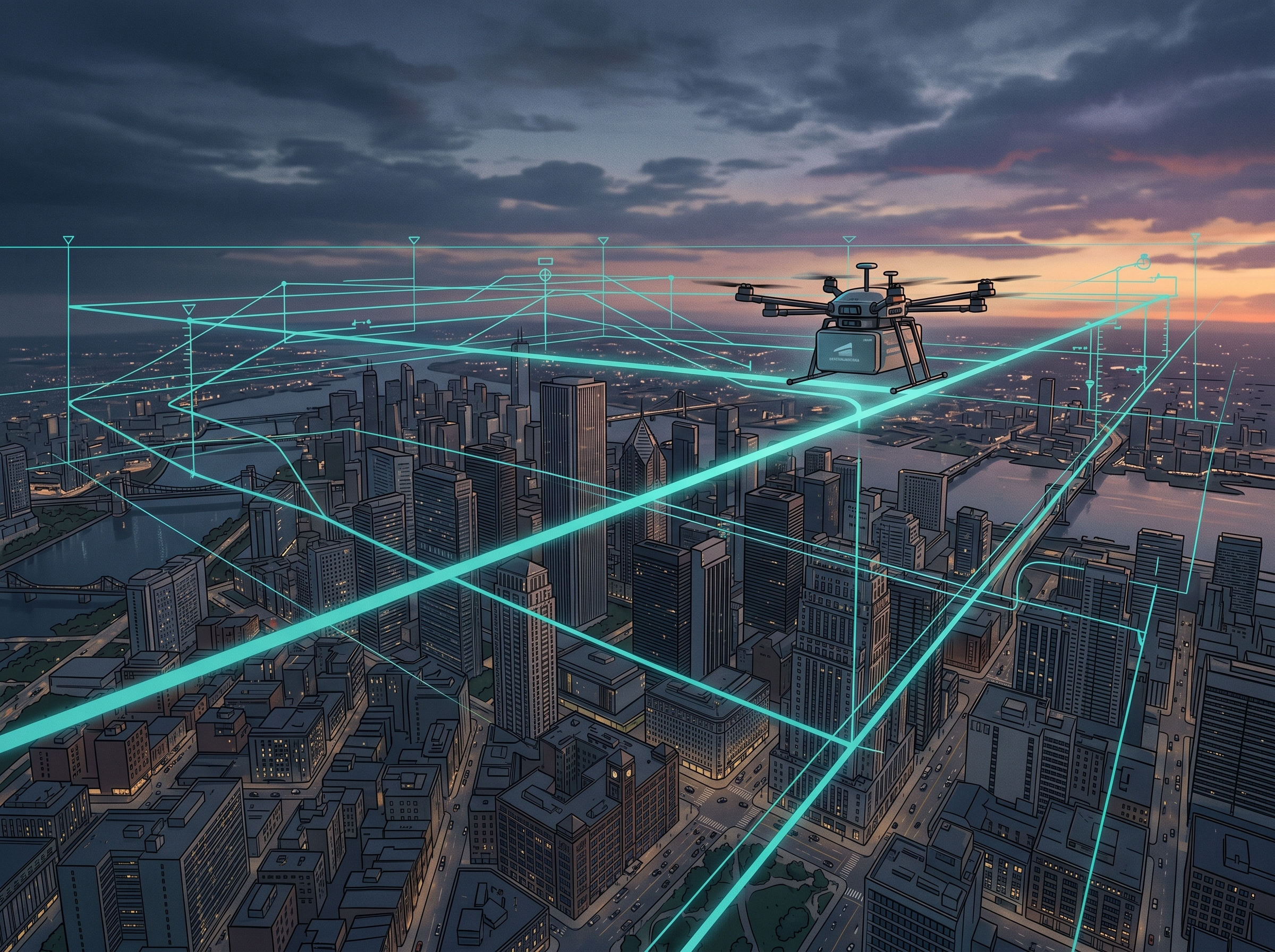
Autonomous delivery drone flying freely over a city skyline with geometric flight path lines
01

The FAA Just Handed Drones the Keys to American Airspace

Here's a number that should reframe how you think about drone delivery economics: every single flight that Wing has operated until now has required a human being standing on the ground, staring at the sky, making sure the drone doesn't hit anything. That's not a safety feature. That's a jobs program masquerading as a regulation.

The FAA Reauthorization Act of 2024 changes this. It mandates a final Part 108 rule for Beyond Visual Line of Sight (BVLOS) operations within 20 months, effectively telling the FAA to stop dragging its feet on letting drones fly without ground-based visual observers. Wing has already received "summary grants" in Dallas-Fort Worth, relying on its proprietary strategic deconfliction software instead of eyeballs.

This isn't incremental. Removing the observer requirement is the single biggest cost lever in drone delivery. Every drone that flies today carries the overhead of a person who exists solely to watch it fly. Eliminate that person, and the entire unit economics equation flips. Wing knows this. So does Zipline. The race now isn't about who can build a better drone — it's about who can prove to regulators that software-based deconfliction is safer than a human squinting at a speck in the sky.

The bottom line: Part 108 is to drone delivery what the 1996 Telecommunications Act was to the internet — the regulatory precondition for explosive scaling. If the FAA delivers on the 20-month timeline, expect 2026 to be the year drone delivery stops being "interesting" and starts being "inevitable."
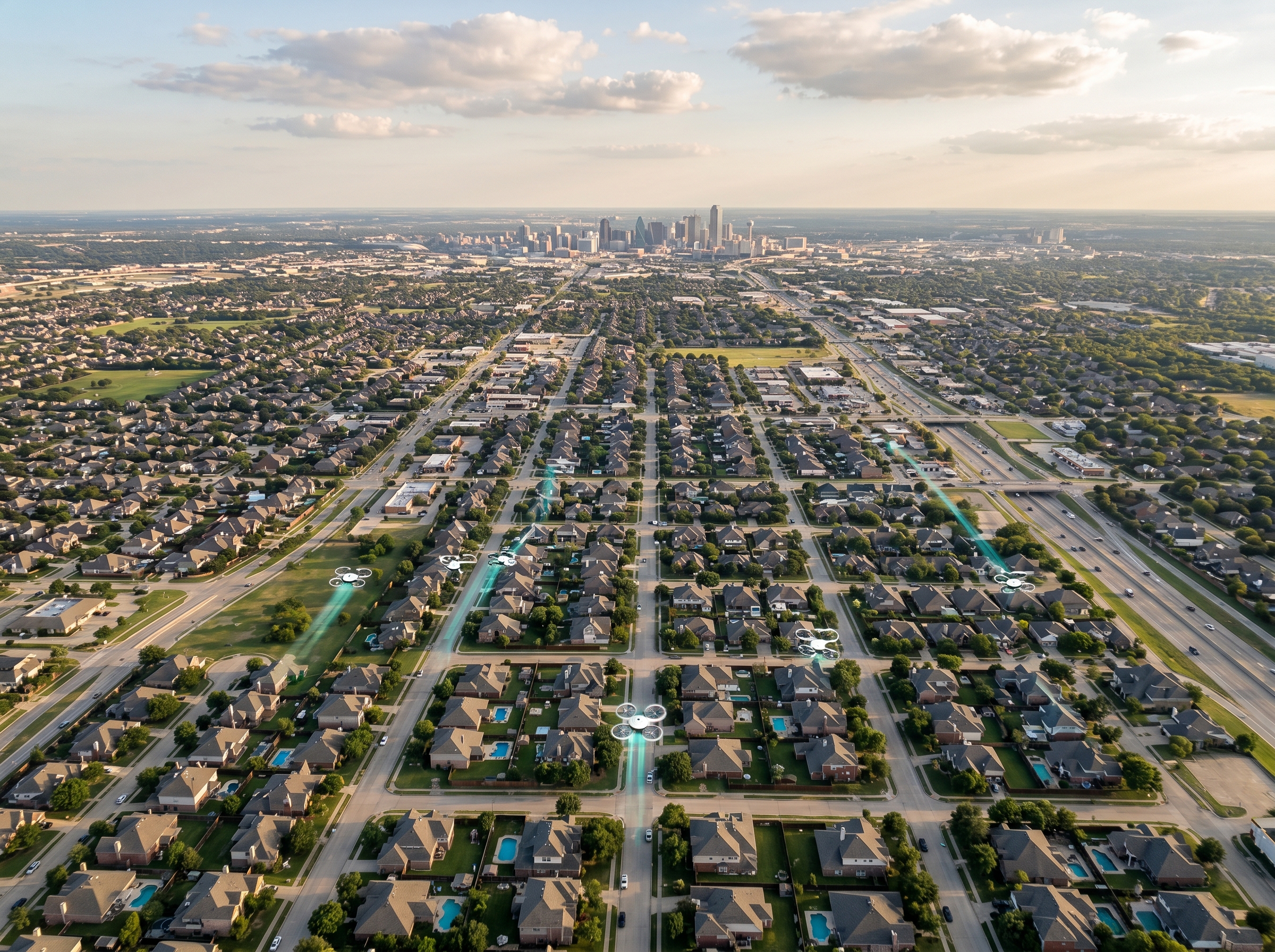
Bird's eye view of Dallas-Fort Worth suburbs with delivery drones dotting the sky
02

Walmart Now Drone-Delivers to 75% of Dallas-Fort Worth

When Walmart says it covers 75% of the Dallas-Fort Worth metroplex with drone delivery, across more than 30 municipalities, that's not a pilot program anymore. That's a logistics network. And it's the largest urban drone delivery footprint in the United States.

The integration is the story here. Customers select "Drone Delivery" directly in the Walmart app — no separate Wing app, no new behavior to learn. You're ordering groceries the way you already order groceries, except a drone shows up in 10 minutes instead of a human in 45. This is the DoorDash playbook applied to aerial logistics: ride the existing consumer behavior, don't fight it.

DFW isn't a random choice. It's flat terrain, favorable weather, and a population density sweet spot — urban enough to generate demand, suburban enough to have clear landing zones. Wing is essentially using DFW as a proving ground for the operational model that will scale to every sunbelt metro. If it works here, it works in Phoenix, Houston, Atlanta, and Charlotte.

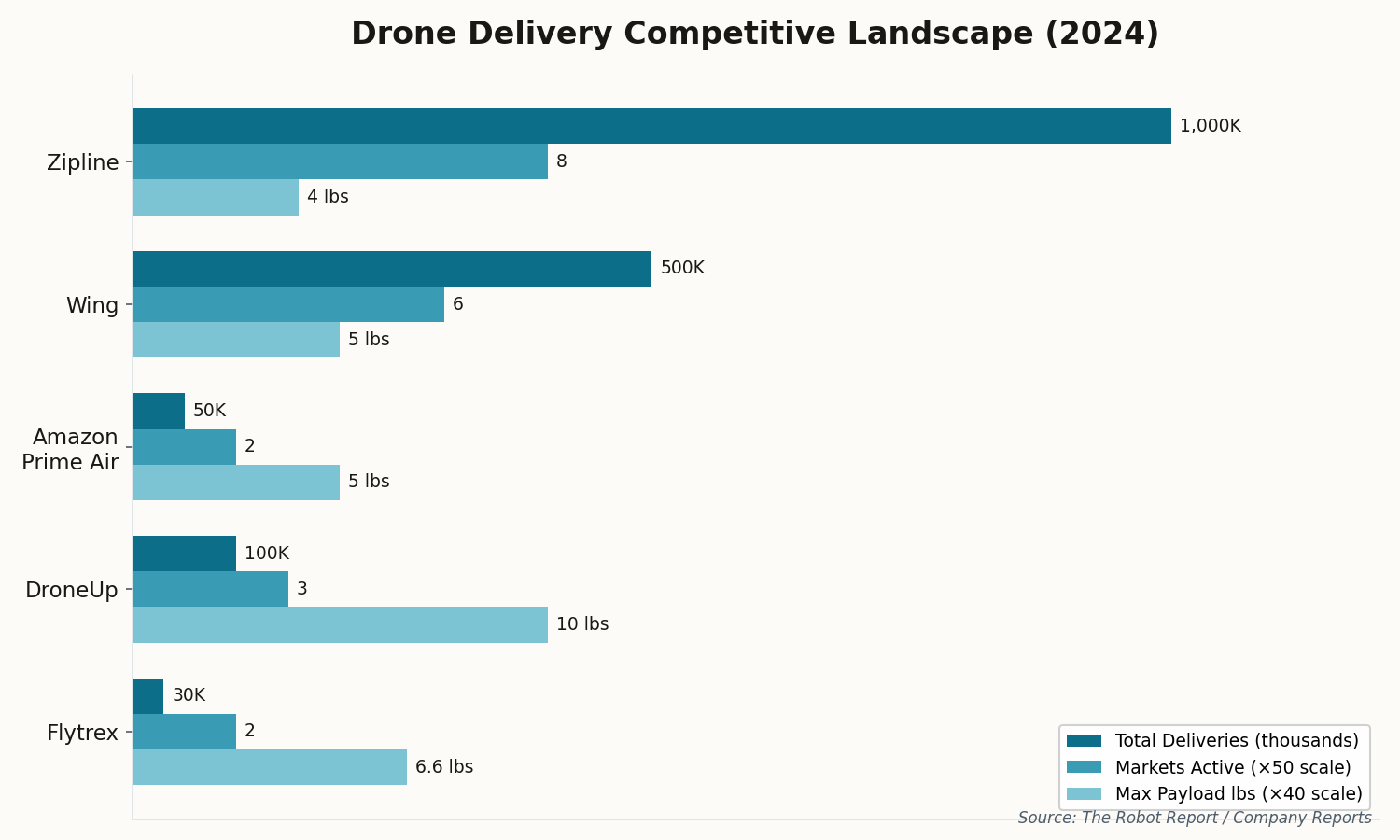
Horizontal bar chart comparing Wing, Zipline, Amazon Prime Air, DroneUp, and Flytrex across total deliveries, active markets, and max payload
Drone delivery competitive landscape: Wing leads on retail integration while Zipline dominates total volume. Source: The Robot Report / Company Reports (2024)

As SVP Prathibha Rajashekhar put it: "Drone delivery is not just a concept of the future, it's happening now." The understatement of the decade. What Walmart has quietly built in North Texas is the template for how drone delivery actually reaches mass adoption — not through a standalone app, but embedded invisibly into the retail platforms people already use.

Single operator in a modern control room monitoring a curved wall of 50 drone feeds
03

One Pilot, Fifty Drones: The Ratio That Makes the Math Work

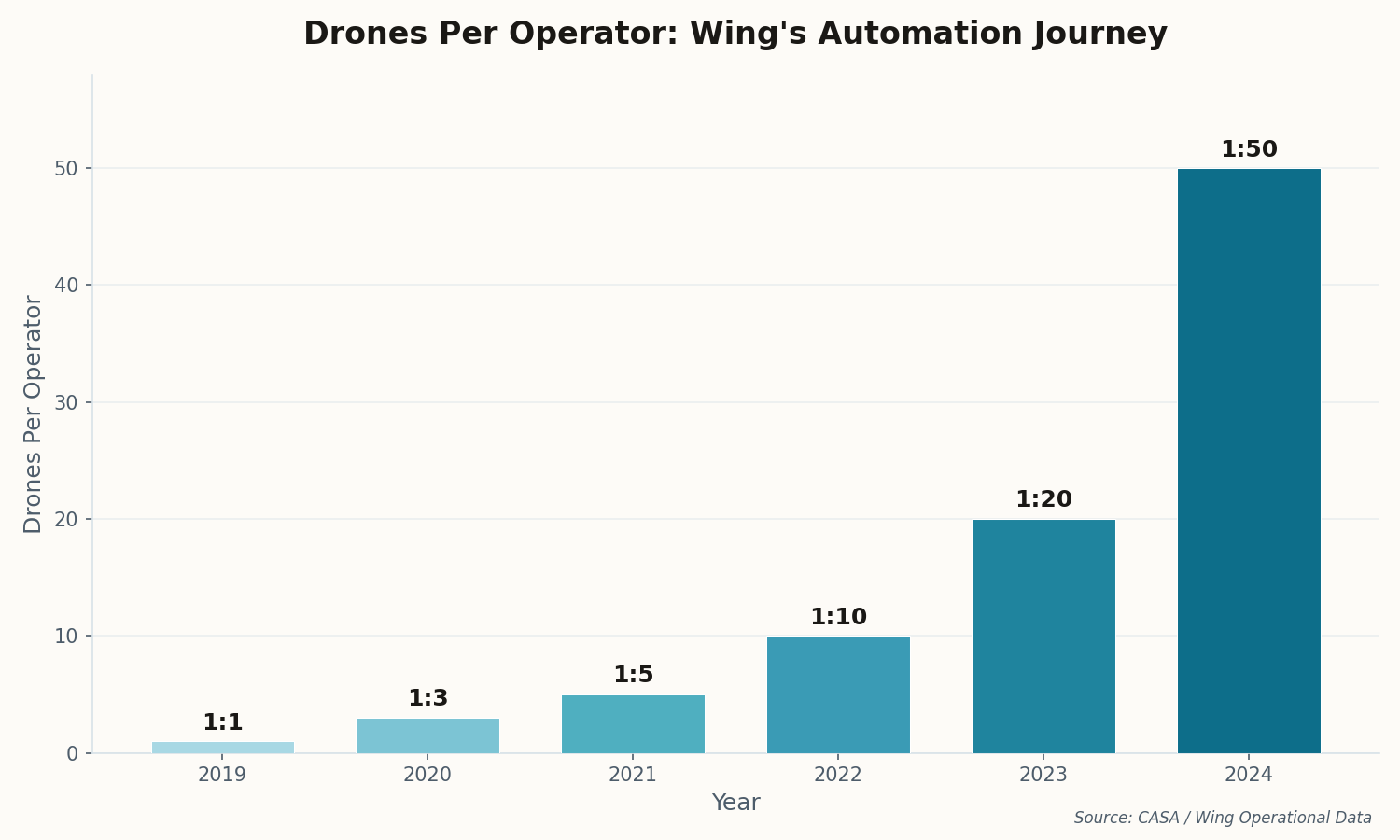
Australia's Civil Aviation Safety Authority just authorized Wing to operate with a 1:50 pilot-to-drone ratio in Logan City. One human. Fifty autonomous aircraft. This is a 3x increase from previous limits, and it's the number that logistics analysts have been calling the "magic ratio" — the point where labor cost per delivery becomes negligible compared to traditional couriers.

Think about what this means in practice. A single remote operator in a control room oversees 50 drones making deliveries simultaneously. At Wing's reported peak throughput of one delivery every 25 seconds in high-volume markets, that operator is supervising roughly 120 deliveries per hour. Try getting that ratio from a fleet of delivery vans.

Bar chart showing Wing's pilot-to-drone ratio evolution from 1:1 in 2019 to 1:50 in 2024
Wing's automation journey: from one-to-one supervision to a single operator managing 50 autonomous drones. Source: CASA / Wing Operational Data

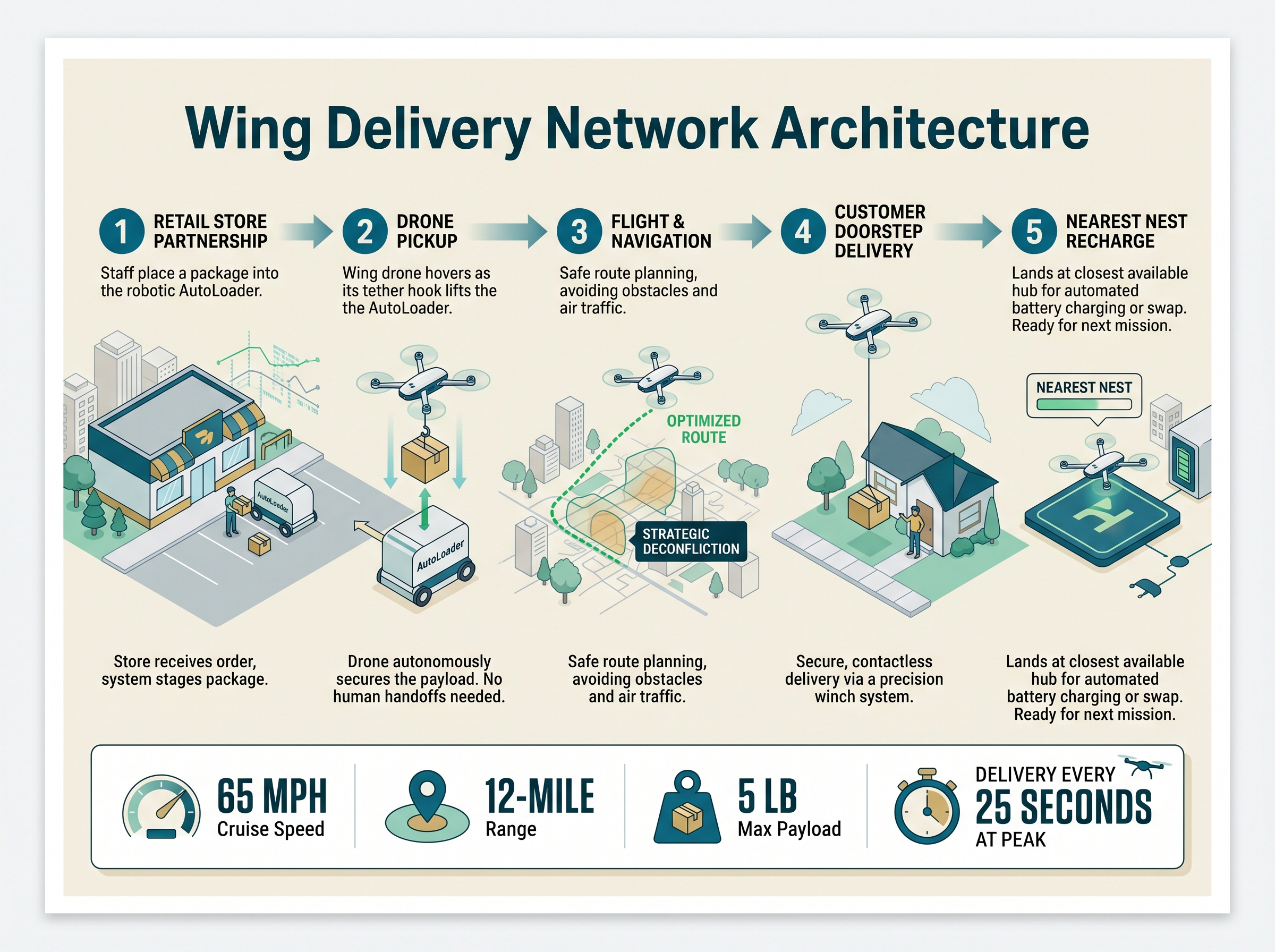
Australia has consistently been Wing's regulatory laboratory. Logan City is where Wing first proved the commercial model, and it's where they're now stress-testing the operational limits. The 1:50 ratio isn't the ceiling — it's the proof point. Wing's architecture, the decentralized "Nests" and "AutoLoaders" that form the Wing Delivery Network, is designed to scale well beyond this. As CEO Adam Woodworth has described it: "We see drone delivery at scale looking more like an efficient data network than a traditional transportation system."

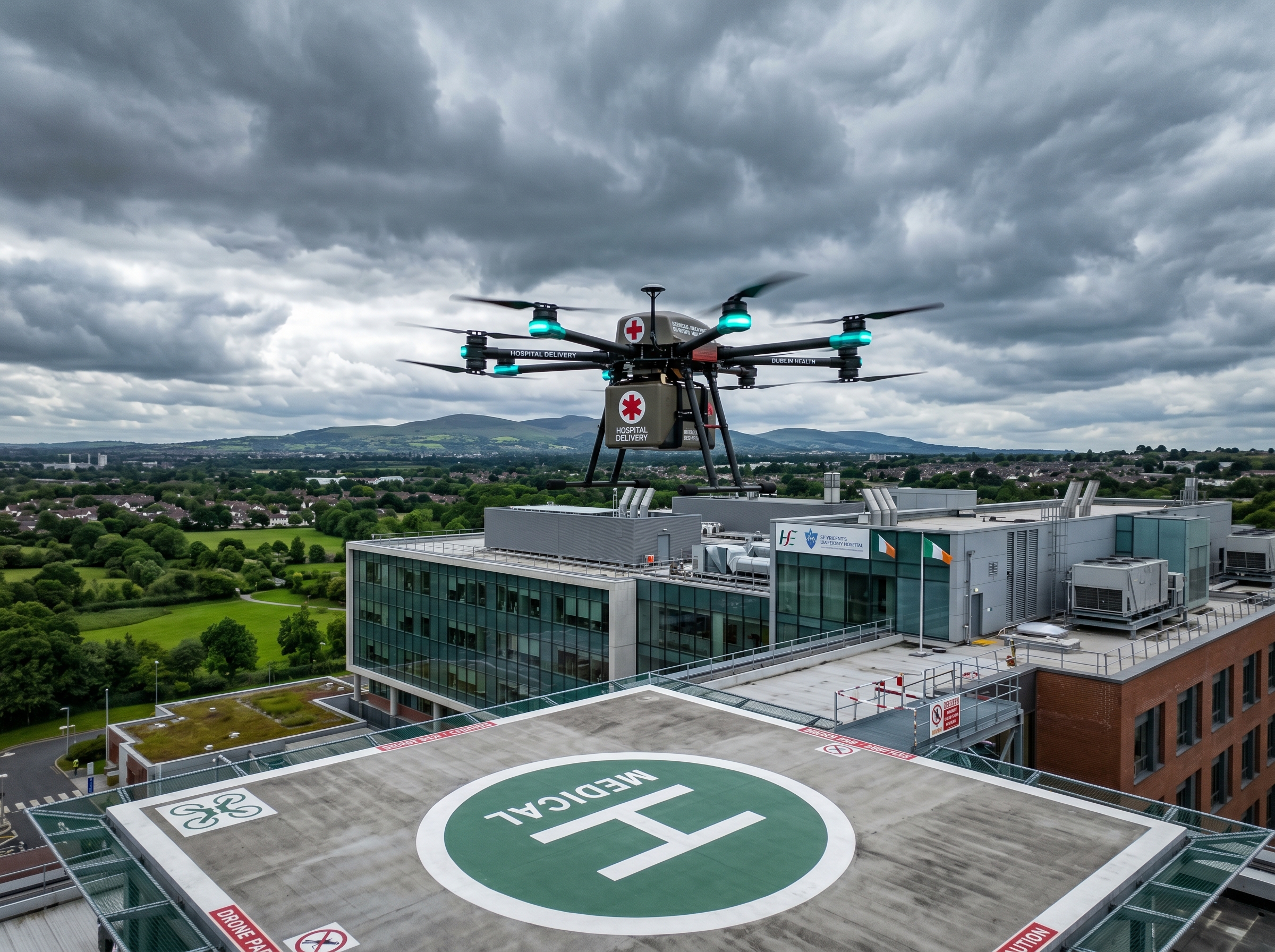
Delivery drone approaching a hospital rooftop landing pad in Dublin with dramatic Irish sky
04

Wing's Quiet Bet on Hospital Corridors in the Sky

While the DFW headlines are about Walmart shoppers getting their eggs faster, Wing is running a very different playbook in Dublin. Partnering with Apian and Blackrock Health, Wing launched a medical drone trial focused on provider-to-provider logistics — transporting laboratory samples, pharmacy items, and time-sensitive materials between hospitals.

This is strategically brilliant for three reasons. First, the margins are dramatically higher. A hospital paying for guaranteed 15-minute lab sample delivery doesn't haggle over a $5 delivery fee the way a consumer comparison-shopping between DoorDash and Uber Eats does. Second, the regulatory path is smoother — medical transport has natural regulatory allies in health ministries. Third, it diversifies Wing away from the consumer whims that make retail delivery a volume game.

Infographic showing Wing Delivery Network architecture with Nests, AutoLoaders, strategic deconfliction, and delivery flow
Wing Delivery Network Architecture: decentralized Nests and AutoLoaders replace traditional hub-and-spoke logistics — Generated with Nano Banana 2.0

The B2B medical angle also lets Wing prove reliability metrics that consumer delivery never will. When a drone carries a blood sample from Blackrock Clinic to a pathology lab, the delivery success rate becomes a clinical data point. That kind of track record is what Wing needs to unlock healthcare logistics globally — a market where "your order is delayed" isn't an inconvenience, it's a patient outcome.

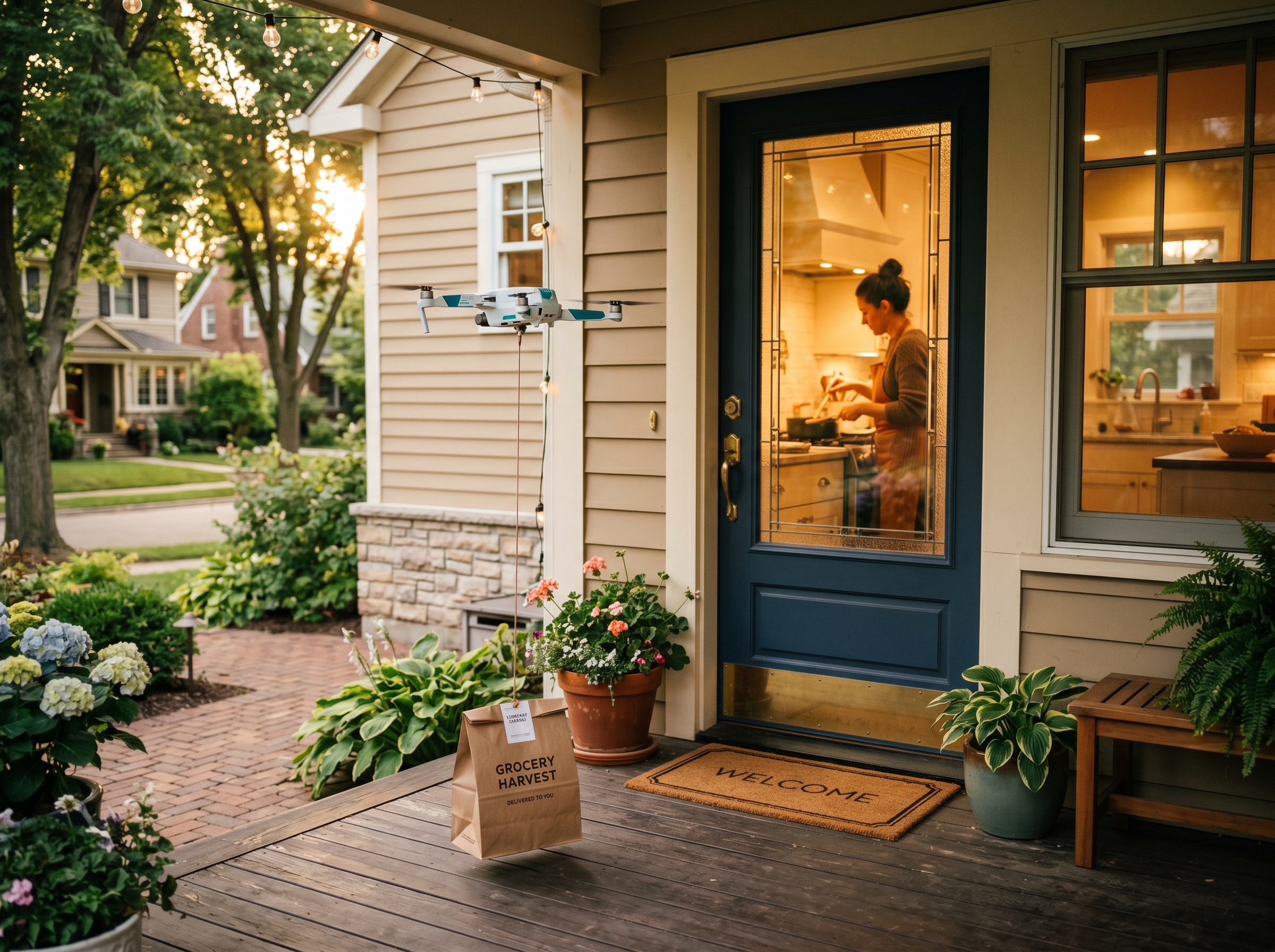
Drone lowering a paper bag to a suburban front porch at golden hour, person cooking visible through kitchen window
05

Nobody Films the Drone Anymore

The most telling data point from Wing's Q1 report isn't a revenue number — it's a behavioral observation. The top 25% of customers in active markets use the service three times per week. The dominant use case? "Forgotten recipe ingredients." Milk, eggs, limes. The unglamorous stuff you realize you need when you're already mid-cook and the store is a 20-minute round trip.

This is the transition from novelty to utility, and it matters because utility creates retention. A Wing operational manager captured it perfectly: "People aren't filming the drone anymore; they're just getting their eggs and going back to the kitchen." When a technology stops being interesting and starts being invisible, that's when it wins.

The three-times-per-week frequency in the top quartile is remarkable. That's higher than most Americans' grocery store visit frequency. Wing isn't replacing grocery shopping — it's filling the gaps that grocery shopping leaves. The "oh no, I forgot the" moment. At current pricing, that's a niche. At $2 per delivery, it's a category.

The DoorDash and Wendy's integration in Christiansburg, Virginia tells the same story from the restaurant side. After a successful Australia pilot, Wing and DoorDash launched U.S. drone delivery that lets customers order from Wendy's through the DoorDash app. Same app, same ordering flow, except the food arrives by air. The most powerful technology is the one you don't notice.

Abstract visualization of shrinking delivery costs with a small drone representing efficiency
06

From Thirty Dollars to Two: The Delivery Cost Curve Nobody's Talking About

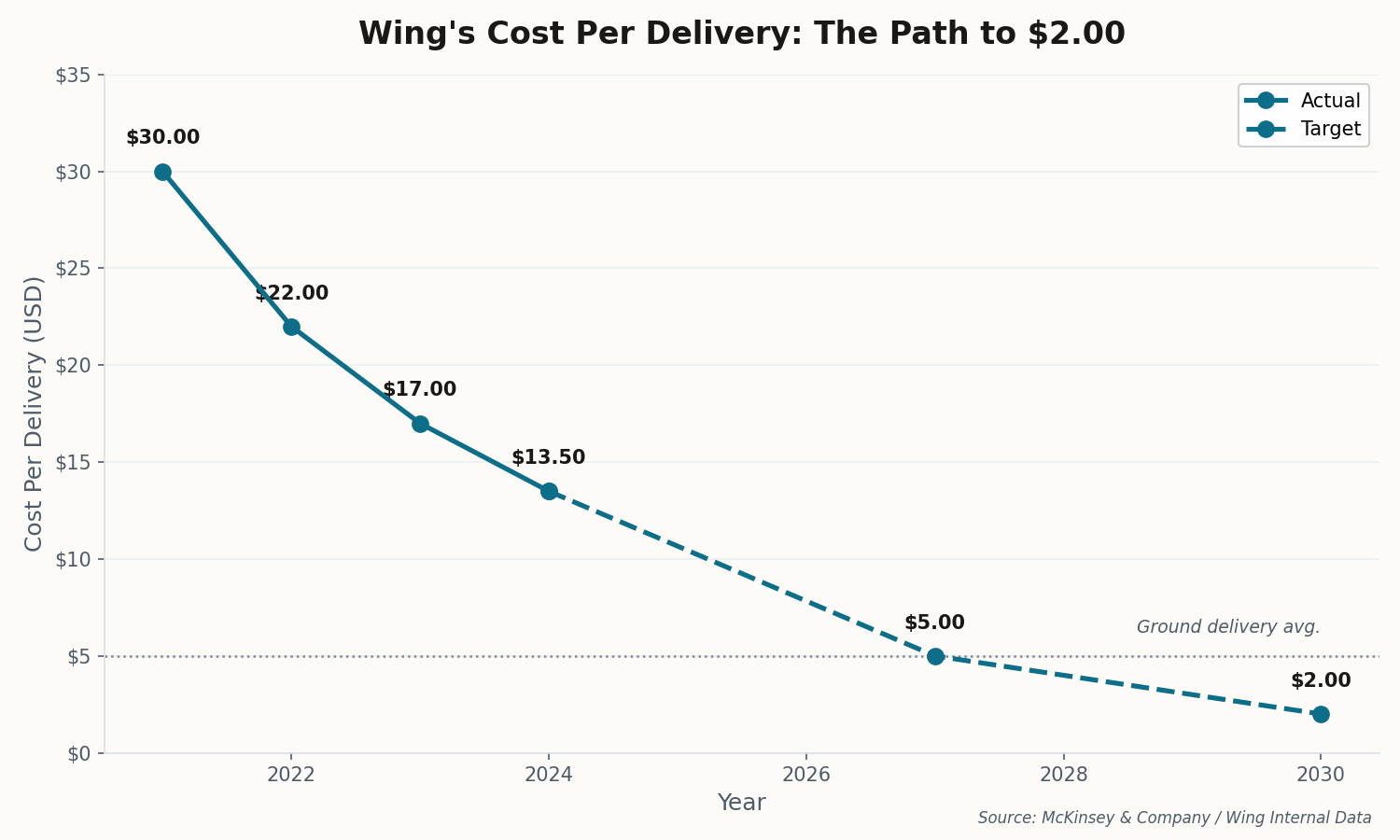
In 2021, a single Wing drone delivery cost over $30. Today, it's approximately $13.50. Wing's internal target: below $5 by 2027, eventually reaching $2. That trajectory isn't aspirational — it's mechanical. Every step in the cost reduction is tied to a specific operational milestone that Wing is methodically hitting.

Line chart showing Wing's cost per delivery declining from $30 in 2021 to a target of $2 at scale, with ground delivery average marked at $5
Wing's unit economics trajectory: from $30+ per delivery in 2021 to a $2.00 target at scale. The ground delivery average sits at ~$5.00. Source: McKinsey & Company / Wing Internal Data

The cost drivers are straightforward. Remove the visual observer (BVLOS): cut labor costs by 60%. Scale the pilot-to-drone ratio from 1:10 to 1:50: cut remaining operator costs by 80%. Deploy the "Big Box" drone with 5 lb capacity: consolidate 30% of multi-drone orders into single flights. Each of these isn't a hope — it's a milestone Wing has already demonstrated in at least one market.

As McKinsey noted: "The efficiency gains are not just in fuel, but in the 'unbundling' of the delivery — matching a 10lb vehicle to a 2lb package instead of a 4,000lb car." That framing matters. A delivery van is absurdly over-provisioned for a carton of eggs. Drones are cited as being 50 times more energy-efficient than gas-powered delivery cars. At a $2–$5 price point, drone delivery becomes cheaper than almost every form of ground-based last-mile logistics — including the gig economy drivers that companies like DoorDash and Instacart currently rely on.

Watch this: The $2 delivery isn't just a Wing story — it's a supply chain inflection point. When aerial delivery costs less than ground, the entire calculus of what's worth delivering changes. Medicine, components, documents, samples — categories that don't make economic sense for last-mile ground delivery suddenly become viable at drone-scale unit economics.

The Package Is the Point

Wing isn't really a drone company. It's a network company that happens to use drones. The "Aircraft Library" approach — standardized components across different airframes — is how cloud providers think about servers, not how aviation companies think about planes. The Wing Delivery Network's decentralized Nests and AutoLoaders are CDN edge nodes for physical goods. Adam Woodworth's comparison to "an efficient data network" isn't marketing language; it's the actual architecture. The question isn't whether drone delivery will work. DFW has already answered that. The question is whether Wing can reach the $2 price point before the regulatory window closes or a competitor builds a better network. Right now, nobody else is even close.

Share X LinkedIn