
Retirement & Expat Life

The Mediterranean Mirage

Five EU countries are rewriting the rules for American retirees. Portugal slams the citizenship door shut. Greece rolls out the red carpet. Here's where your money actually goes furthest in 2026.

Listen
Panoramic Mediterranean coastline with terracotta rooftops cascading toward azure waters at golden hour
Portuguese parliament building in Lisbon bathed in golden light
01

Portugal Just Doubled the Wait for Your EU Passport

For years, Portugal was the darling of the American expat retirement circuit. Affordable Algarve coastline, world-class healthcare at a fraction of U.S. prices, and a path to EU citizenship in just five years. That last part? Gone.

The Portuguese Parliament has passed a landmark amendment to the Nationality Law, stretching the residency requirement for citizenship from five years to ten. And the clock doesn't start when your plane touches down in Lisbon—it starts when your physical residency card is issued, which can take months of bureaucratic limbo. On top of that, applicants now face a civic knowledge test covering Portuguese history and culture, stacked on top of the existing A2 language exam.

This is a calculated move. Portugal watched its NHR tax regime attract waves of wealthy foreigners who used the country as a springboard to broader EU access. Domestic backlash was inevitable. The reform aligns Portugal with the stricter naturalization timelines of Spain and Italy (both 10 years), effectively ending its competitive advantage on the citizenship clock.

The D7 visa itself remains intact—you can still retire to Portugal on just €920 per month in passive income. But if your retirement plan hinged on a Portuguese passport by 2031, add another half-decade to that spreadsheet. The lifestyle is still there. The fast track to EU citizenship is not.

Whitewashed Spanish coastal village with terracotta roofs overlooking the Mediterranean
02

Spain Killed the Golden Visa. Prices Went Up Anyway.

The conventional wisdom was simple: kill the Golden Visa, kill foreign demand, watch prices cool. Spain abolished its investor residency program in 2025. Q1 2026 numbers are in, and the conventional wisdom was dead wrong.

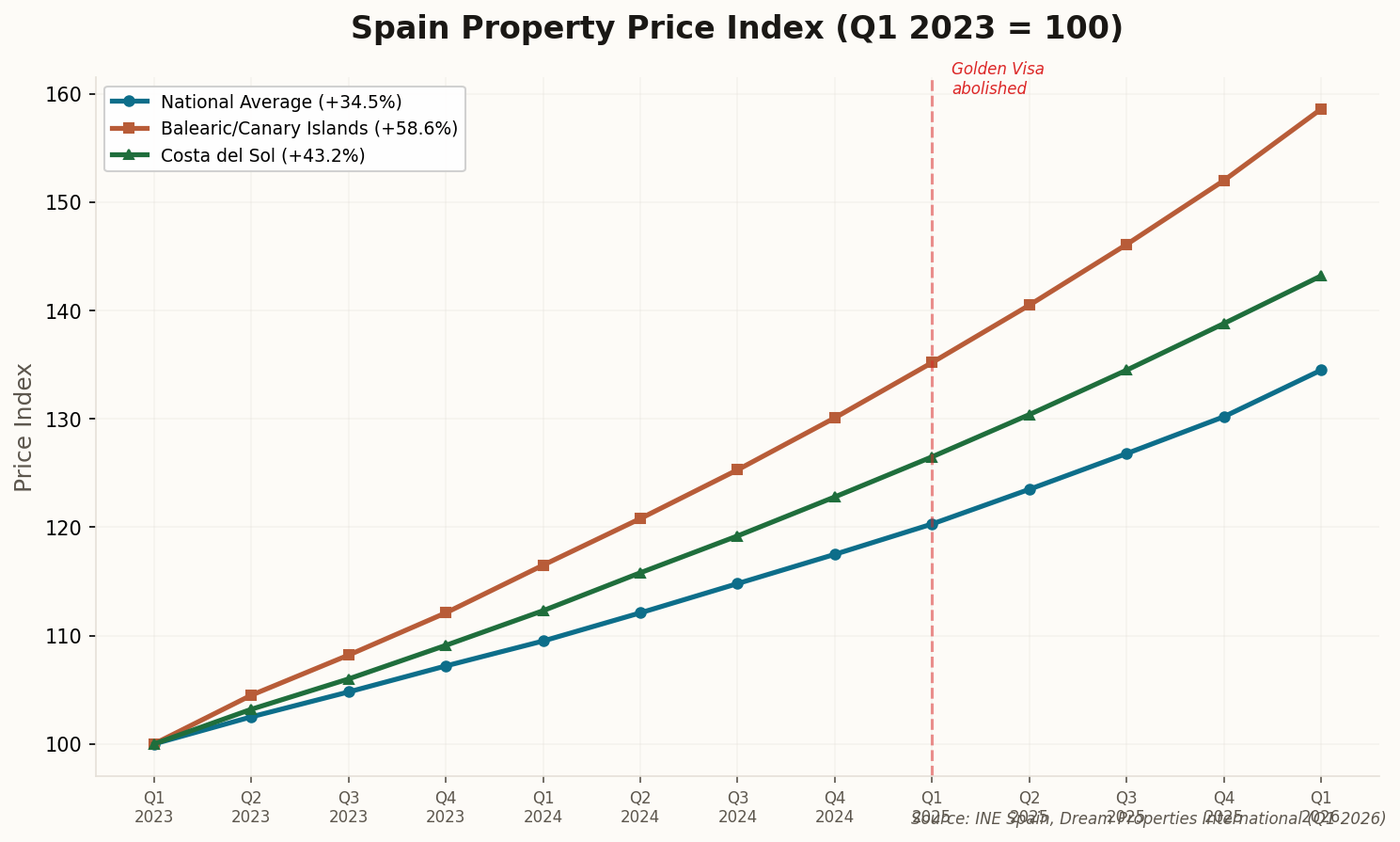
National property prices surged 14.3% year-over-year. The Balearic and Canary Islands? A staggering 21.6%. Málaga and Alicante—the two regions most popular with American retirees—are seeing Americans replace traditional European buyers as the fastest-growing non-EU investor group.

Line chart showing Spain property price index from Q1 2023 to Q1 2026, with Balearic/Canary Islands rising 58.6%, Costa del Sol 43.2%, and national average 34.5%
Spain's property boom continues despite the Golden Visa abolition in early 2025. Islands lead the surge. Source: INE Spain, Dream Properties International.

Why? Spain has a structural deficit of 600,000 housing units. The Golden Visa was never the demand driver—it was the lifestyle: 300 days of sunshine, healthcare that actually works, and a cost of living that lets your Social Security check stretch further than it does in Phoenix. American buyers aren't purchasing for a visa anymore. They're purchasing because they want to live there. That's a fundamentally different—and more durable—kind of demand.

If you're waiting for a correction before making a move on the Costa del Sol, you may be waiting a long time. The non-lucrative visa (€2,400/month income required, no work permitted) remains the standard path. Budget accordingly—both for the visa and the property.

Santorini blue-domed church overlooking the caldera at sunset
03

Greece Is Now Europe's Tax Haven for American Retirees

Here's a number that should make every American retiree with a six-figure 401(k) sit up: 7%. That's the flat tax rate Greece charges on all foreign-sourced income for qualifying retirees. Not 22%. Not 32%. Seven percent, locked in for fifteen years.

Q1 2026 enrollment data from Global Citizen Solutions shows a 40% increase in American applicants compared to the same period last year. The demographic is clear: high-net-worth retirees fleeing Portugal's post-NHR landscape and looking for the next tax-efficient Mediterranean perch. Greece is eagerly absorbing them.

The math is brutal in its simplicity. A retiree pulling $80,000 annually from a 401(k) and Social Security would owe roughly $5,600 in Greek taxes. The same income in the U.S. could easily generate a $12,000–$15,000 federal tax bill depending on your state. The savings alone can cover your rent in the Peloponnese or a comfortable apartment in Athens.

The catch? Greece's Financially Independent Person (FIP) visa now requires €3,500 per month in strictly passive income (plus 20% for a spouse). Remote work income doesn't count. And the initial permit has been extended from two to three years, which eases the renewal burden. If you have the income floor, Greece is positioning itself as the retirement destination that pays for itself.

American passport and Social Security card on a Mediterranean table with euro coins
04

Uncle Sam Finally Stopped Punishing You for Retiring Abroad

For decades, American retirees who'd worked abroad faced a cruel arithmetic. The Windfall Elimination Provision (WEP) and Government Pension Offset (GPO) slashed their Social Security benefits if they also received a foreign pension—sometimes by $500 or more per month. You paid into Social Security your whole career, then got penalized for also contributing to a French or German pension system.

That era is over. The Social Security Fairness Act has fully eliminated both provisions, and as of Q1 2026, most retroactive payments dating back to 2024 have been processed. American retirees in the EU are seeing their monthly checks increase by $300–$500, with some receiving lump-sum back payments of $10,000 or more.

Meanwhile, the IRS has raised the Foreign Earned Income Exclusion to $132,900 for 2026, and a new $6,000 "Senior Expat Deduction" is now available for retirees over 65 living permanently abroad. Greenback Expat Tax Services calls 2026 "the most tax-advantageous year for American expats in over a decade."

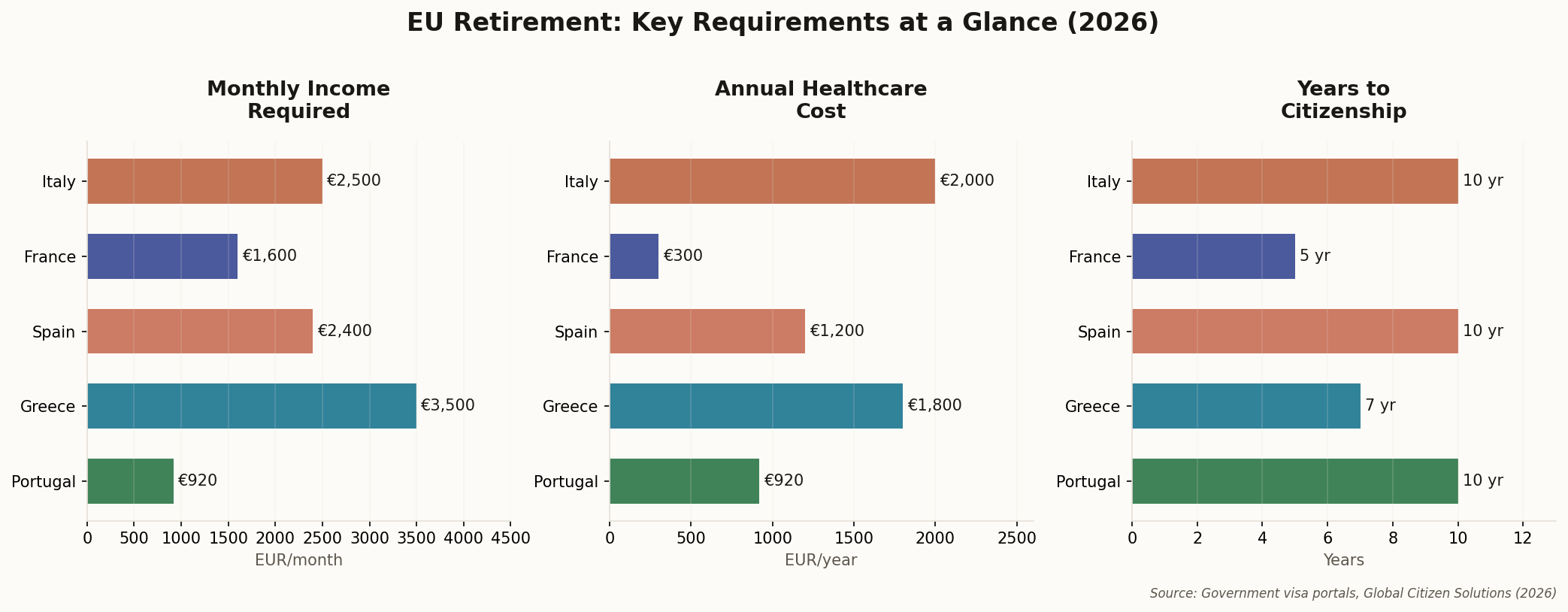
Triple bar chart comparing income requirements, healthcare costs, and citizenship timelines across Portugal, Greece, Spain, France, and Italy
The key numbers at a glance: monthly income requirements range from €920 (Portugal) to €3,500 (Greece). Healthcare costs and citizenship timelines vary dramatically. Source: Government visa portals, Global Citizen Solutions.

The combined effect of the WEP repeal, higher FEIE, and the new deduction means a retired couple receiving $4,000/month in Social Security can now keep significantly more of it—making even "expensive" EU destinations like France suddenly viable for middle-income Americans. The financial case for retiring in Europe hasn't been this strong since the euro was at parity with the dollar.

Charming French pharmacy with green cross sign on a Parisian side street
05

France's Healthcare Isn't Free Anymore—But It's Still a Bargain

American retirees in France got spoiled. After three months of legal residence, you could enroll in PUMa—France's universal healthcare system—at no additional cost. World-class hospitals, subsidized prescriptions, 70% coverage on most procedures, all funded by the French taxpayer. For non-EU retirees not paying French income tax on their pensions, it was an extraordinary deal.

Too extraordinary, apparently. Under the LFSS 2026 law, non-EU retirees on Visitor visas must now pay an annual contribution of €300–€600 per person to access PUMa. Residency permit renewals will require proof of payment.

The annual fee tops out at €600. That's $50 a month. Medicare Part B alone costs $185/month in the U.S., and it doesn't cover prescriptions, dental, or vision. Even with the new fee, a retired American couple in Provence pays roughly €1,200 per year for healthcare that would cost them $8,000–$12,000 annually back home. The "free ride" is over. The bargain is very much not.

The Visitor visa itself requires about €1,600/month in income and prohibits employment—you're there to spend, not to earn. France's path to citizenship remains the fastest of the five countries at just five years, which partly explains why roughly 30,000 Americans currently call it home.

Italian hilltop village in Tuscany with cypress trees and a medical clinic
06

Italy's €2,000 Health Pass: The Clearest Deal in European Healthcare

If there's one thing that keeps Americans up at night about retiring abroad, it's healthcare. Not the quality—most EU systems outperform the U.S. on outcomes—but the uncertainty. What does it cost? What's covered? Can I actually see a doctor when I need one?

Italy's SSN (Servizio Sanitario Nazionale) has answered those questions with rare clarity. The 2026 voluntary enrollment rate for non-EU retirees is locked at a flat €2,000 per year minimum. For that, you get a dedicated general practitioner, specialist referrals, emergency care, and subsidized prescriptions. High-income retirees may pay up to 7.5% of global income, but the €2,000 floor covers most standard pension holders.

Grouped bar chart comparing monthly costs across Portugal, Spain, Greece, France, and Italy for housing, healthcare, groceries, utilities, and dining
Monthly cost of living breakdown for retirees across five EU countries. Greece offers the lowest total at roughly €1,380/month; France the highest at €2,780/month. Source: Numbeo, Expatistan, local government data.

Compare that to the U.S., where a 65-year-old couple on Medicare can easily spend $12,000–$15,000 annually on premiums, co-pays, and supplemental coverage. Italy's €2,000 flat fee is about $2,200—for coverage that's genuinely comprehensive. The Elective Residency visa requires roughly €2,500/month in passive income and doesn't allow work, but for retirees with adequate savings, it's a clean equation: predictable healthcare, beautiful country, and a cost structure that makes financial planning straightforward.

The path to Italian citizenship takes ten years—identical to Portugal and Spain—but nobody moves to Tuscany for the passport. They move for the life.

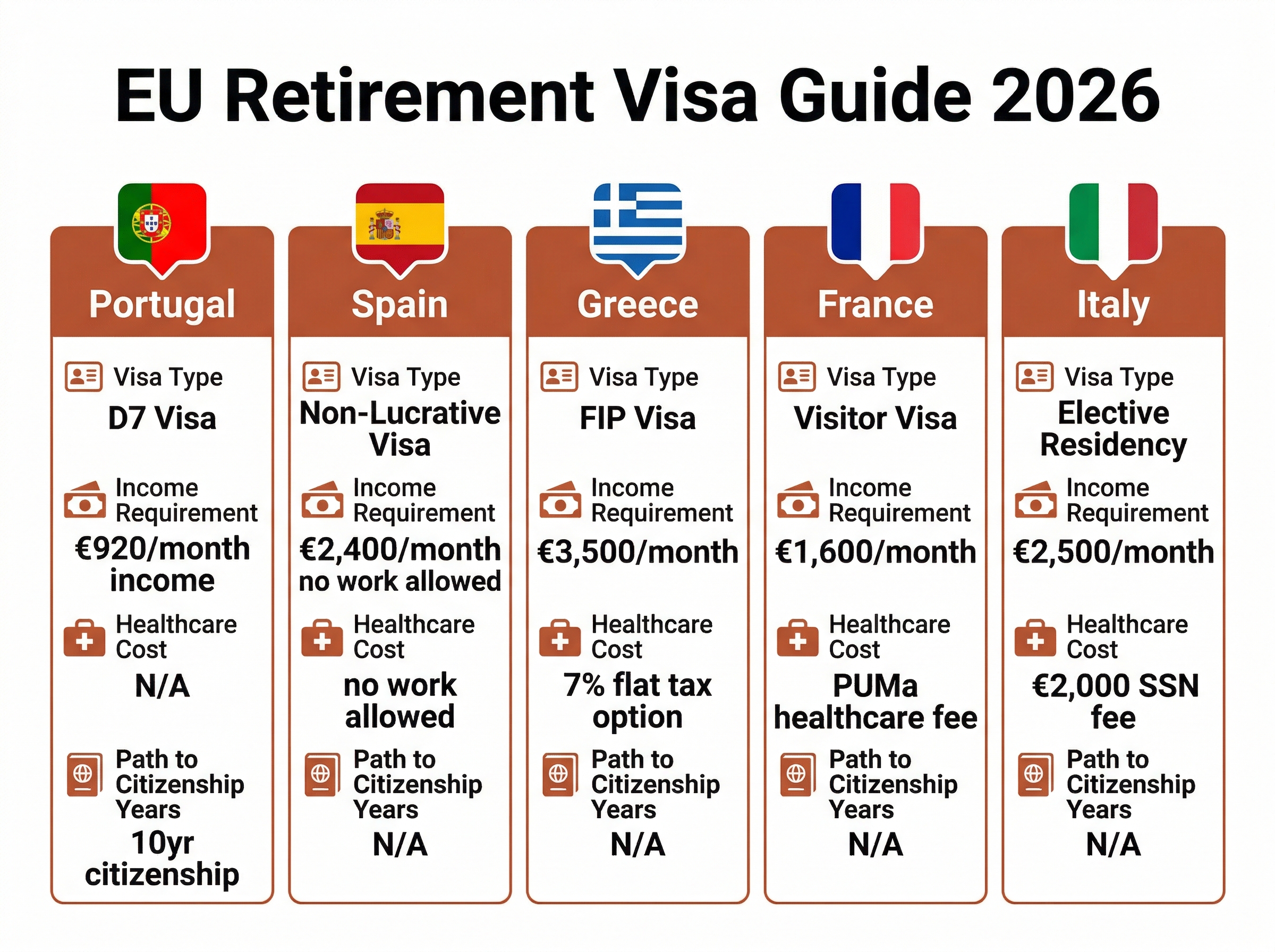
Comparison infographic showing retirement visa requirements across Portugal, Spain, Greece, France, and Italy including income thresholds, healthcare costs, and citizenship timelines
EU Retirement Visa Guide 2026 — key requirements at a glance across all five countries. Generated with Nano Banana 2.0.

The Biometric Border Is Coming. On April 10, 2026, the Schengen Entry/Exit System (EES) goes live across all 29 countries. Physical passport stamps are being replaced by facial recognition and fingerprint scans. If you've been "splitting time" between the U.S. and Europe without a formal residency visa—stretching the 90/180-day rule and relying on border guards not to notice—that window has officially closed. Get a visa or get a return ticket.

The Bottom Line

The fantasy of "just moving to Europe" has never been more accessible in raw financial terms—the WEP repeal and new tax breaks see to that. But the bureaucratic landscape is shifting fast. Portugal is tightening. Greece is opening. Spain doesn't care about your visa, just your bank account. The smart move in 2026 isn't picking the cheapest country. It's picking the one whose rules you can actually live with for the next decade.

Share X LinkedIn