
Pet Care

The Click That Costs You

From smart grinders that see through dark nails to the one-nail-per-day protocol rewriting how vets think about cooperative care — the science of keeping Beamer's paws quiet on hardwood.

Listen
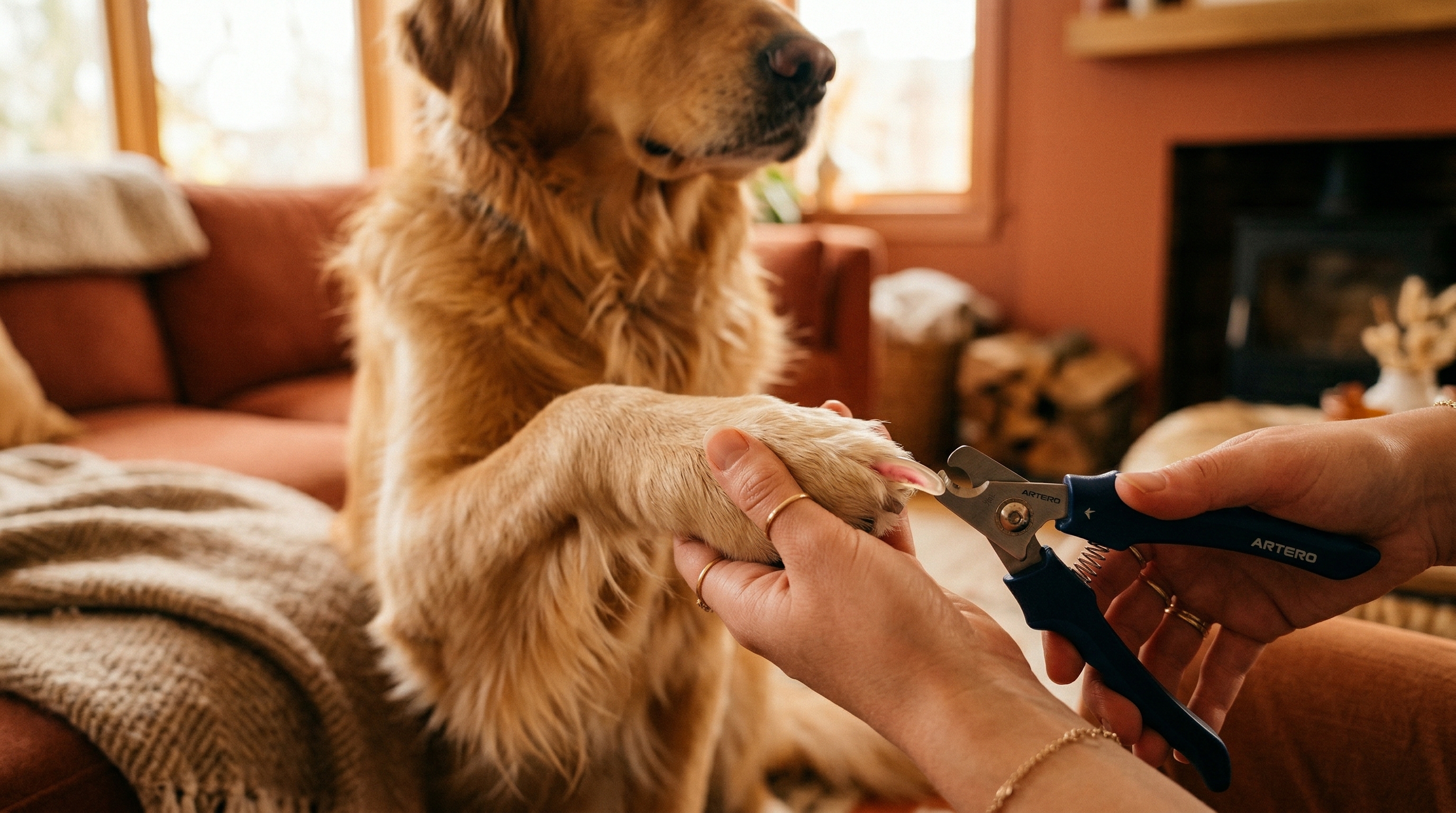
A golden retriever's paw being gently held for nail trimming in a warm, cozy living room
Split view comparing a mobile grooming van in a driveway with a busy pet salon interior
01

The $40 House Call vs. the $15 Salon Clip: Where Your Money Actually Goes

Here's the math nobody does before booking a nail trim: a basic clip at a brick-and-mortar salon runs $15–$25. A mobile groomer pulling into your driveway? That's $40–$65 for the same service. On paper, the salon wins. In reality, it depends entirely on your dog.

The Groomer's Choice Industry Report for 2026 reveals that "behavioral surcharges" — the polite industry term for your dog losing its mind in a kennel environment — add $10–$25 per visit at busy salons. For anxious dogs like Beamer, that erases the price gap entirely. Meanwhile, subscription-based mobile visits every four weeks are trending, with 15% discounts that keep the quick from ever getting ahead of you.

The real question isn't "which is cheaper?" — it's "which produces a dog that doesn't associate grooming with trauma?" Because a dog with positive nail care experiences is a dog whose quick stays short, whose joints stay aligned, and whose owner isn't white-knuckling through every session. That's not a luxury. That's preventative medicine with a payment plan.
Bar chart comparing nail trimming costs between salon and mobile grooming services across four service tiers
Average nail trimming costs in 2026. Mobile groomers command a premium, but behavioral surcharges at salons can close the gap for anxious dogs. Source: Groomer's Choice Industry Report, March 2026.
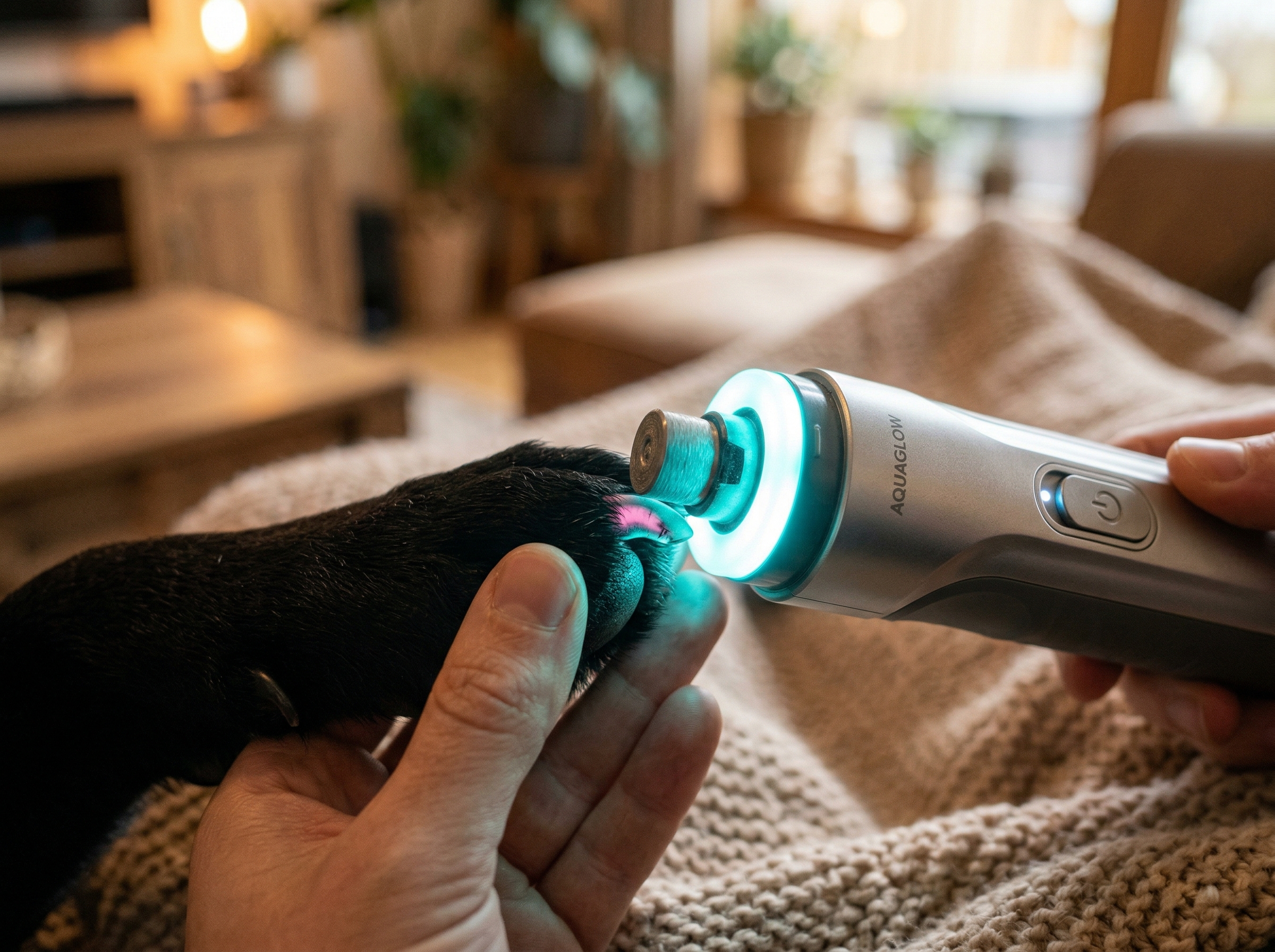
A futuristic pet nail grinder with glowing LED lights illuminating a dark dog nail
02

The Grinder That Sees Through Dark Nails

For years, trimming a dog with black nails was an act of faith. You clipped. You prayed. You kept the styptic powder within arm's reach. The 2026 generation of grinders changes that equation entirely.

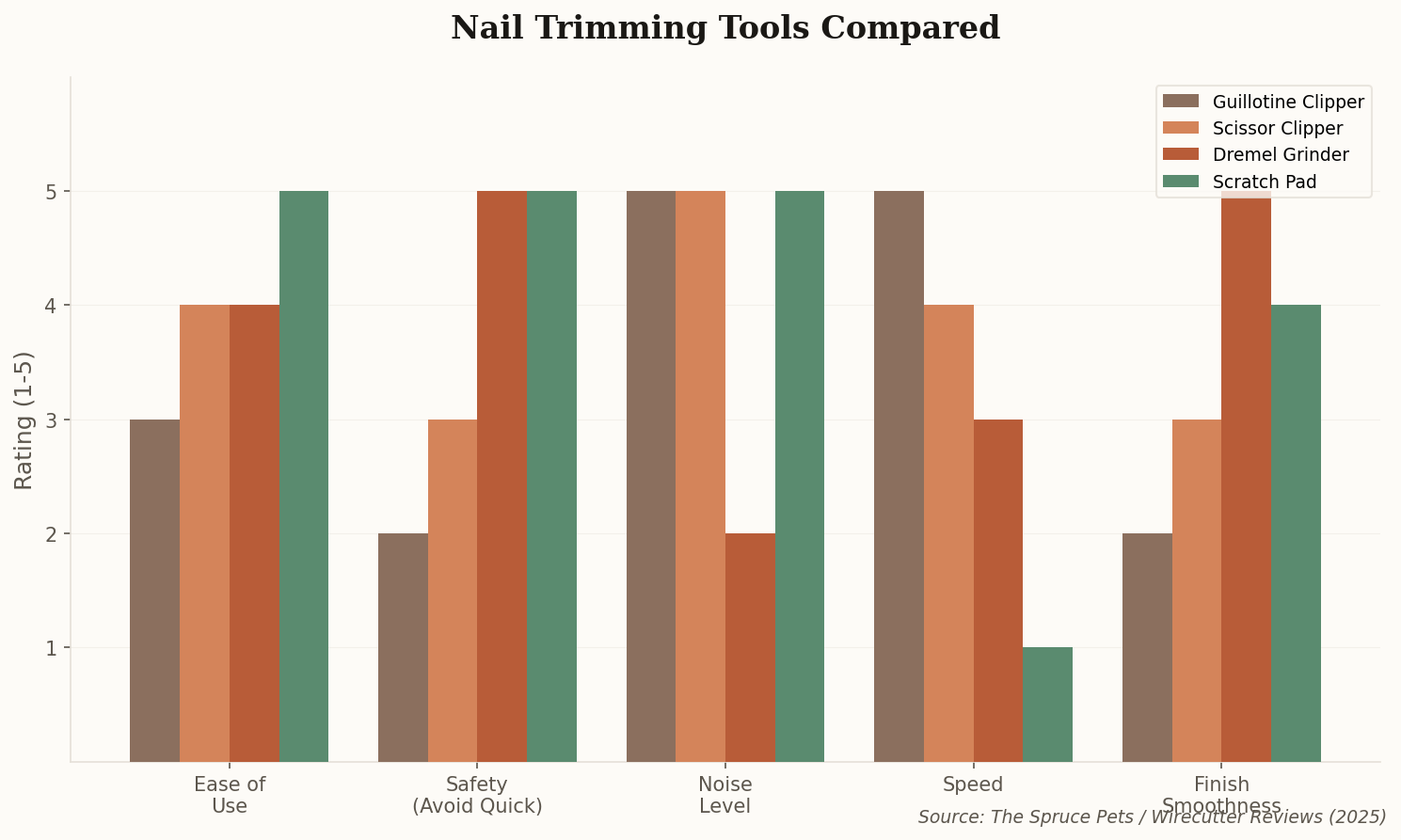
The NBC Select Pet Awards highlight tools like the iToleeve Smart and Casfuy 6-Speed that now ship with electronic moisture sensors — they detect the quick's blood supply before the blade touches it, then alert you with a light or vibration. Dual-LED illumination has become the standard, using specific light frequencies that penetrate pigmented nails to reveal the internal bloodline. And the noise? Brushless motors have dropped decibel levels to 30–35 dB. That's library-quiet — half the decibels of a normal conversation.

This matters because the number-one reason pet owners avoid DIY nail care is fear of hitting the quick. When a $35 grinder eliminates that risk, the calculus shifts from "pay a professional every month" to "handle it yourself in five minutes on the couch." For Beamer-sized dogs who need trims every 3–4 weeks, that's $180–$780 in annual savings.

Horizontal bar chart comparing six nail trimming tools across ease of use, safety, noise level, and affordability
How 2026 nail trimming tools stack up. Smart sensor grinders lead in safety and ease of use; scratch boards win on noise and dog comfort. Source: NBC Select Pet Awards, Wirecutter, March 2026.
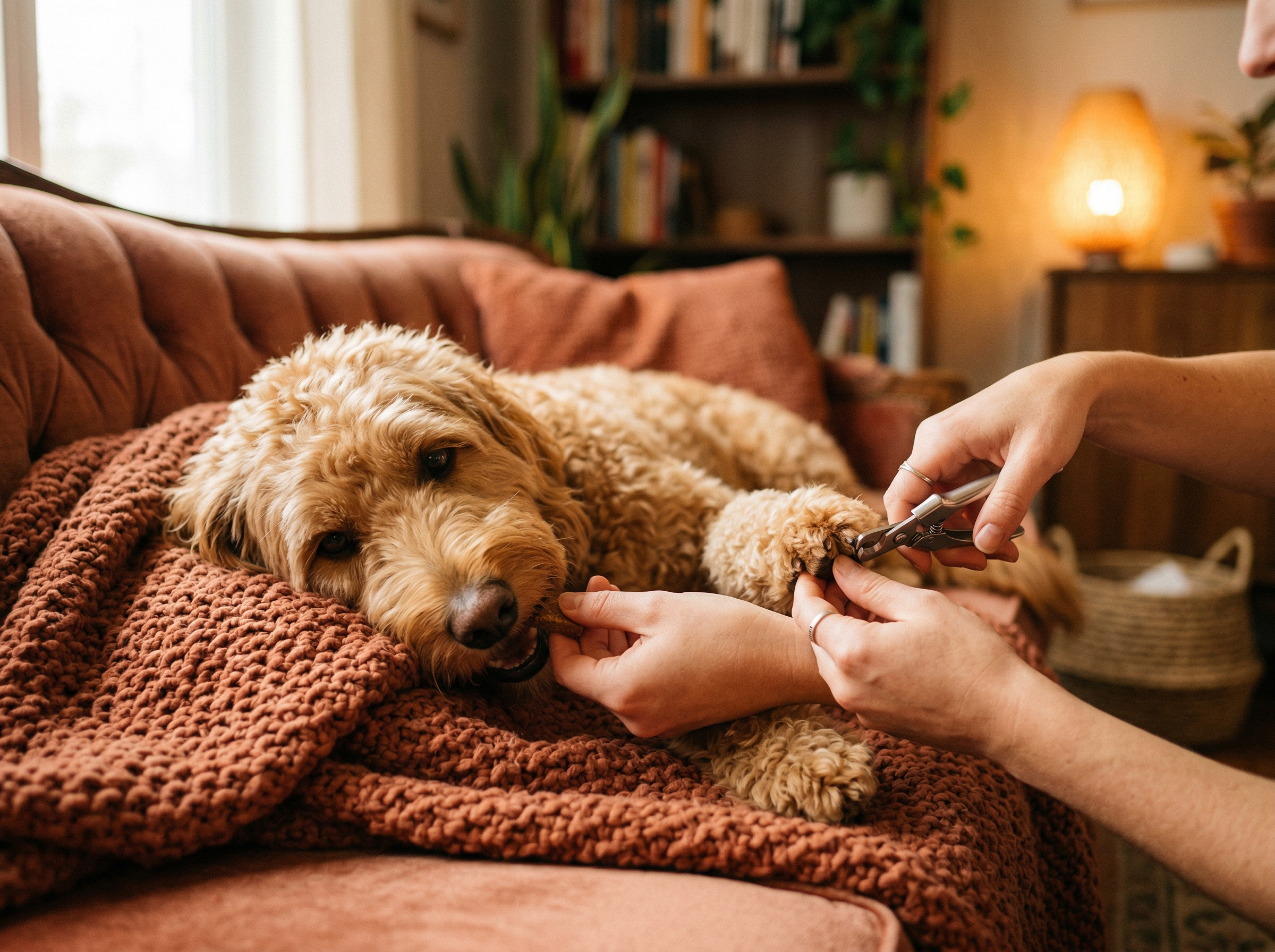
A calm dog receiving a single nail clip while simultaneously getting a treat
03

One Nail Per Day Beats Four Paws in a Panic

The old model was simple: restrain the dog, clip all four paws, survive. The new model, endorsed by Fear Free veterinary guidelines for 2026, flips that entirely. One nail per day. That's it. A single successful clip, paired with a "jackpot" treat delivered during the moment of contact, rewires the dog's neurological response to the tool.

The science behind this is cooperative care — a framework that treats the animal as a willing participant, not a patient to be managed. If Beamer shows a curled tongue, whale eyes (whites visible), or panting, the session stops immediately. No exceptions. As the guidelines put it: "We are no longer trimming nails; we are trimming the dog's perception of the experience."

This isn't soft-hearted indulgence — it's strategic. A dog that tolerates (or even enjoys) nail care is a dog whose quick recedes naturally over time, whose sessions get faster and calmer, and whose owner never has to book a sedated trim at the vet. The "One Nail Rule" is an investment in a lifetime of easy maintenance. It takes 18 days to do all four paws and both dewclaws. Do that twice, and you've built a dog who offers its paw voluntarily.

The Beamer Protocol: One nail, one high-value treat (squeeze cheese, fresh chicken), one calm session. If stress signals appear — curled tongue, whale eyes, panting — stop immediately. Resume tomorrow. Progress over perfection.

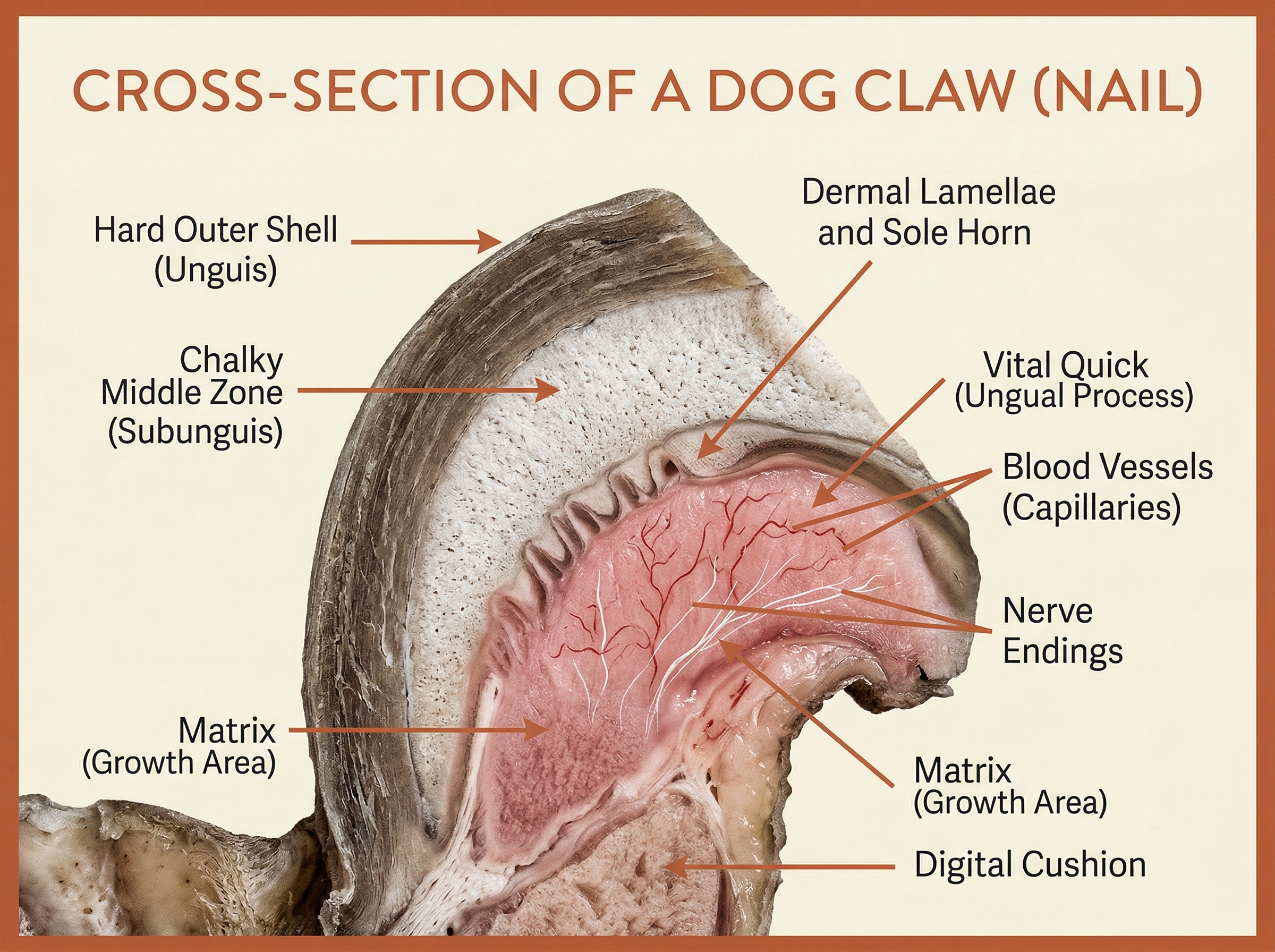
Macro cross-section of a dog nail showing the chalky ring and quick anatomy
04

Reading the Nail: The Chalky Ring That Says "Stop"

Every dog nail tells a story if you know how to read it. The AKC's updated grooming guide breaks it down into two scenarios: white nails and black nails.

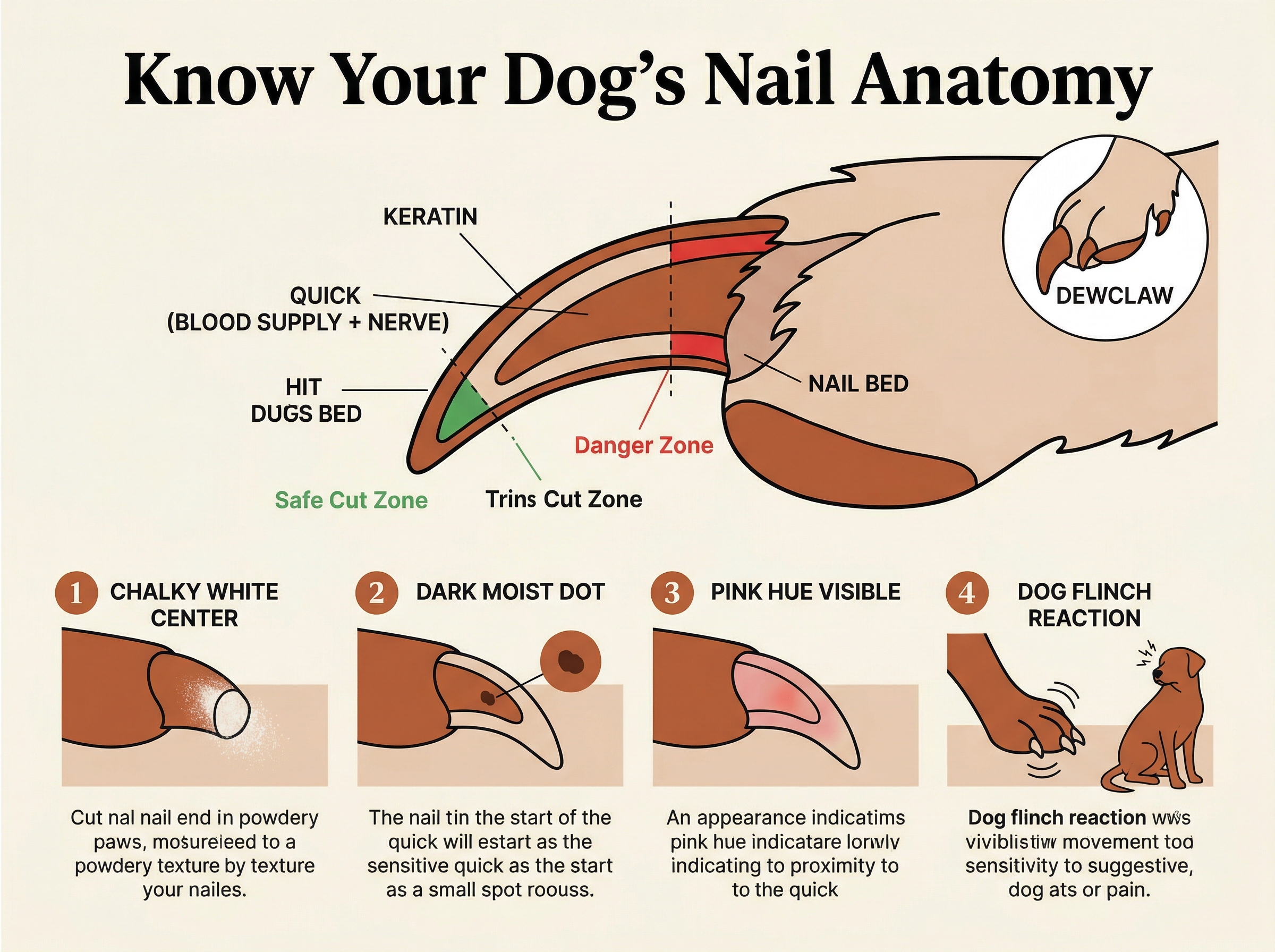
For white or light nails, look for the quick — it's the pink bloodline visible through the translucent shell. Easy. For black nails (Beamer's situation if he's got dark pigmentation), it's subtler. Cut in 1–2mm increments and examine the cross-section after each cut. You're looking for a progression: dry, flaky outer layers give way to a firmer texture, then a "chalky white" ring appears in the center. That ring is your stop sign. Push past it, and you'll hit the "black dot" — a small, dark, moist-looking circle that means the quick is millimeters away.

There's also the "Underside Scrape" technique: run the flat of the clipper blade along the nail's underside. Where the hollow channel ends and solid tissue begins is the safest cut line. For overgrown nails with a long quick, the only path forward is incremental shaving — 1–2mm every few days — which gradually signals the quick to recede. It's a months-long project, but it works.

Infographic showing dog nail cross-section anatomy with labeled safe and danger zones
Know Your Dog's Nail Anatomy — Safe cut zones, danger indicators, and the four visual cues that tell you when to stop. Generated with Nano Banana 2.0.
Medical illustration showing a dog's skeletal alignment shift caused by overgrown nails
05

The Silent Orthopedic Crisis Living Under Your Dog's Paws

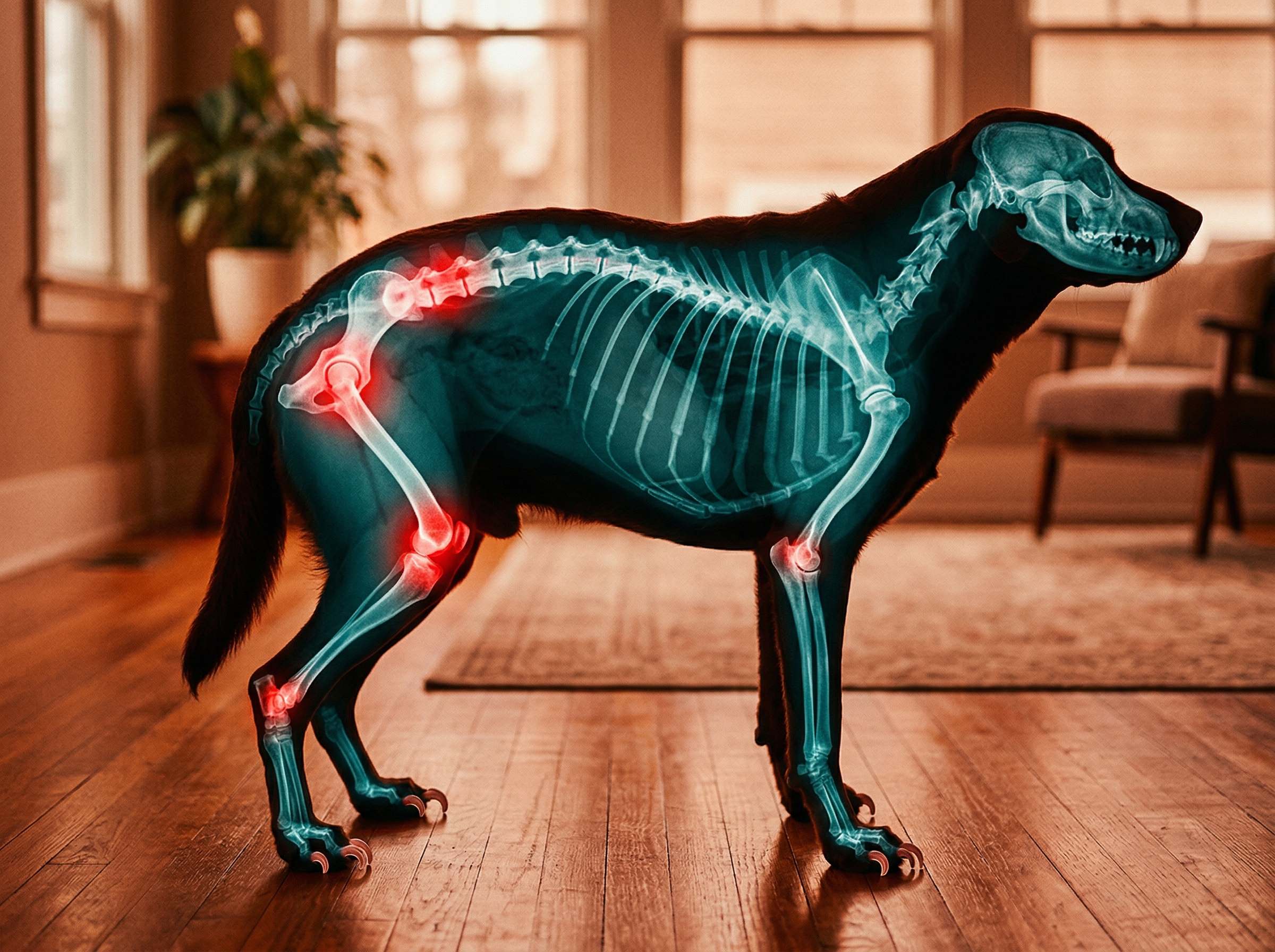
If you can hear Beamer clicking across the hardwood, stop and listen to what that sound actually means. The Royal Veterinary College's 2026 VetCompass study has reclassified overgrown nails as a "skeletal threat" — not a cosmetic problem, not a grooming oversight, but a direct contributor to musculoskeletal damage.

Here's the mechanism: when nails hit the ground before the paw pad, the dog's brain receives false proprioceptive signals — it thinks the ground is tilted upward. The body compensates by shifting weight backward, creating a characteristic "butt tuck" or plantigrade stance. Hips rotate. Stifles (knees) absorb unnatural lateral forces. The spine curves to maintain balance. Over months and years, this cascade accelerates osteoarthritis and is a primary contributor to Cranial Cruciate Ligament (CCL) tears — the $4,000–$6,000 surgery that nobody budgets for.

The rule of thumb: with the dog standing on a flat surface, you should not be able to hear the nails contact the floor. Sighthound specialists at Sighthound Health & Rescue add a tactile check — you should be able to slip a sheet of paper between the nail tip and the ground. If you can't pass either test, you're already behind.

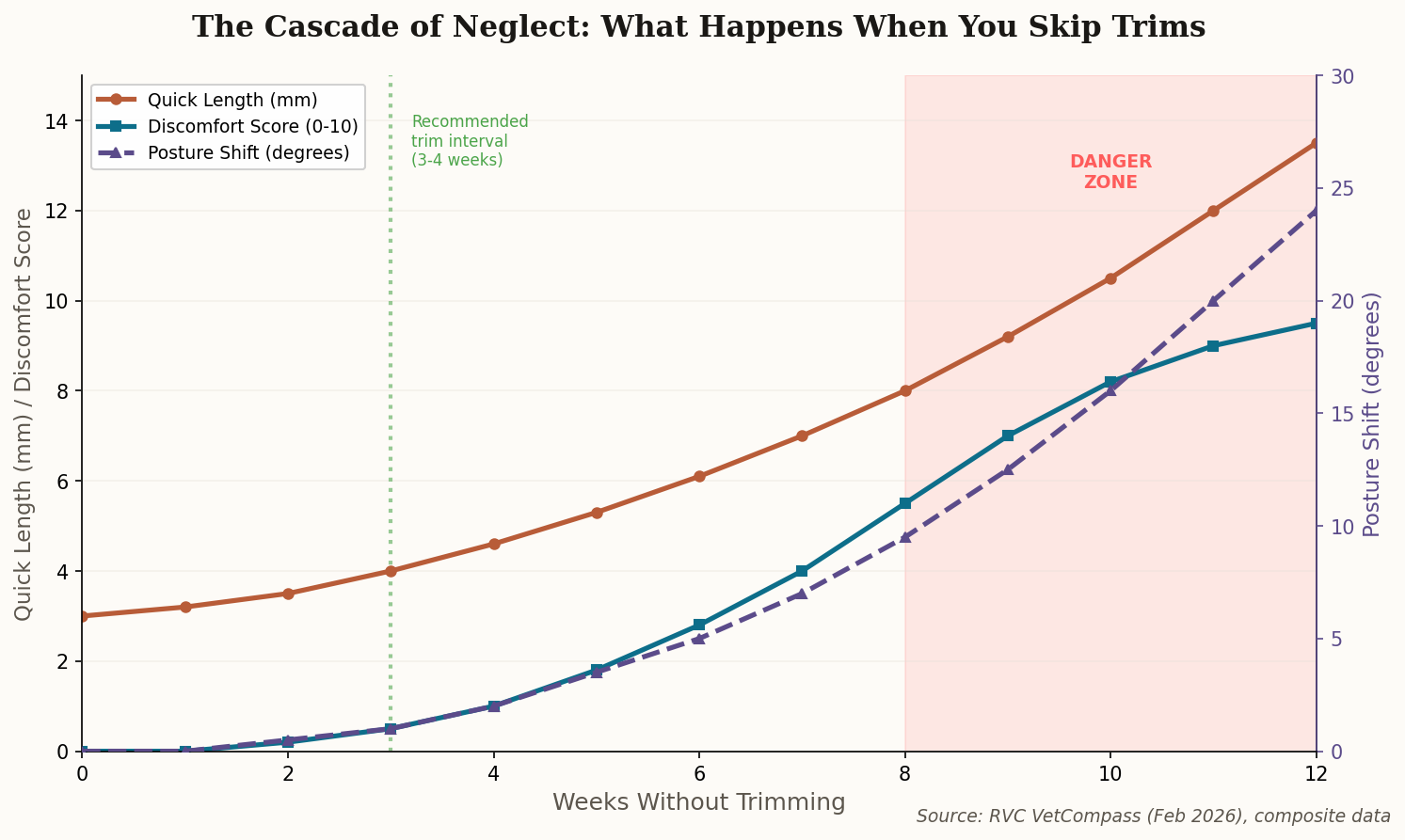
Line chart showing the cascading health effects of skipping nail trims over 12 weeks
The Cascade of Neglect: how skipping trims compounds over 12 weeks. Quick length increases, pain scores rise, and posture shifts accelerate — all of which are reversible with consistent 3-4 week trimming. Source: RVC VetCompass, February 2026.
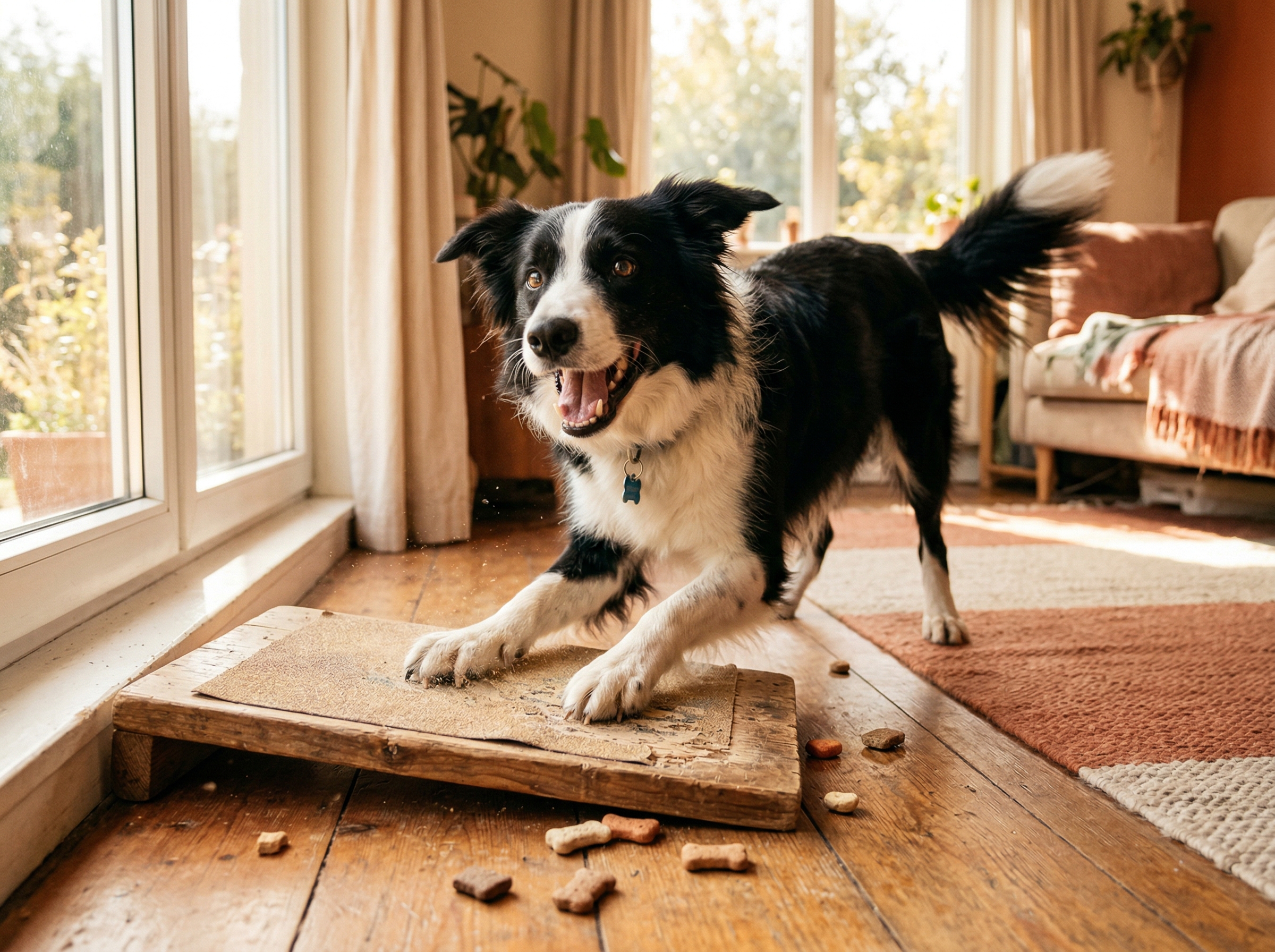
A happy dog enthusiastically scratching at a sandpaper-covered scratch board with treats nearby
06

Let the Dog File Its Own Nails (Yes, Really)

For the dogs who have decided — with absolute conviction — that no clipper, grinder, or human hand is touching their paws, there's the scratch board. It's a flat board covered in 60–80 grit sandpaper that lets the dog use its natural digging instinct to file its own front nails. The dog controls the pressure. The dog controls the duration. The dog controls whether it participates at all.

DogSpeak 101 reports that 2026 "Sandbox" versions have taken this further: treats hidden beneath the abrasive surface automate the training entirely. The dog digs for the reward and files its nails in the process. No restraint, no stress signals, no cooperative care protocols needed — because the dog is choosing to participate.

The limitation is clear: scratch boards only work for front paws (the digging motion), and they file rather than cut, which means they're maintenance tools, not solutions for severely overgrown nails. But for Beamer, once the quick is back to a healthy length, a scratch board two to three times a week can replace clipper sessions entirely for the front feet. The back paws still need manual attention — but that's only 8 nails instead of 18.

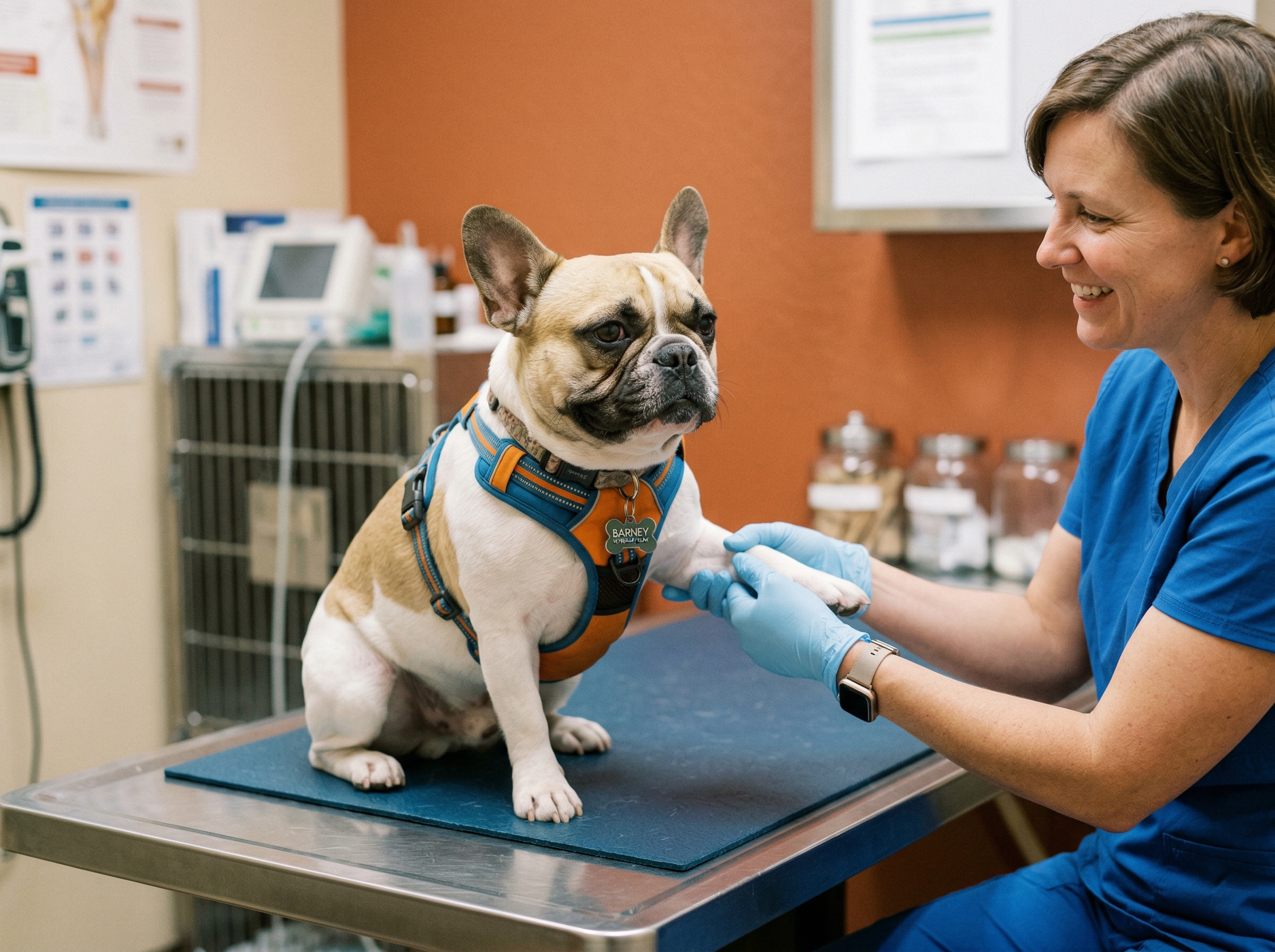
A French Bulldog being gently handled by a veterinarian for nail care, wearing a comfortable harness
07

For Flat-Faced Dogs, a Nail Trim Can Become an Airway Emergency

This section isn't about Beamer (assuming he can breathe just fine), but it's about every Pug, Bulldog, and Frenchie owner reading over your shoulder. Texas A&M's College of Veterinary Medicine has issued stark guidance: for brachycephalic breeds, the stress of a nail trim can trigger a full respiratory crisis.

The mechanism is BOAS — Brachycephalic Obstructive Airway Syndrome. When these dogs struggle, their already-compromised airways narrow further. The "Pug Scream" — that distinctive high-pitched vocalization during grooming — isn't just drama. It can lead to oxygen deprivation, overheating, and in extreme cases, cardiac events. The 2026 guidelines are explicit: no muzzles that prevent panting, period. Pre-Visit Pharmaceuticals like Trazodone are now recommended to keep heart rates manageable.

The takeaway for all breeds: if your dog is panicking during nail care, the session has already failed regardless of how many nails you got through. Stop. Regroup. Try again tomorrow with one nail and one very good treat. The cooperative care approach from Section 03 isn't just nice — for some breeds, it's medically necessary.

The Sound of Silence

Here's the goal: Beamer walks across the kitchen floor and you hear nothing but the soft pad of paws. No clicking. No scraping. No orthopedic time bomb ticking down with every step. Get there with one nail at a time, one treat at a time, one calm session at a time. The quick recedes. The trust builds. The clicking stops. And you both end up exactly where you should be — on the couch, paw in hand, with nothing left to worry about.

Share X LinkedIn