Sports · Policy · Science

The Finish Line Moved

Twenty years of research. One executive order. How the IOC and NCAA rewrote the rules on trans athletes — and what the science actually says.

Listen
01
Scales of justice balanced on an athletic starting block, symbolizing the federal-state legal confrontation over trans athlete policies

The Federal Government Just Sued a State for Letting Trans Athletes Compete

Here's where we are: the Department of Justice filed a lawsuit yesterday against the state of Minnesota for daring to maintain an inclusive sports policy. The charge? That Minnesota's "Transgender Refuge" law — which allows trans athletes to compete based on gender identity — violates federal Title IX mandates as redefined by the White House's 2025 executive order.

Let that sink in. Title IX, the law written to expand access to women's sports, is now being weaponized to restrict it. Acting Assistant Attorney General Todd Graves put it bluntly: "State laws cannot circumvent federal protections for biological women in sports." The word "protection" is doing a lot of heavy lifting in that sentence.

Minnesota isn't backing down. Governor Tim Walz's office called the lawsuit "a direct attack on the dignity and rights of transgender Minnesotans." The state is one of six that have passed "refuge" laws, creating a patchwork where a trans teenager's right to play depends entirely on which side of a state line they live on.

The so what: This isn't about one state anymore. It's about whether the federal government can force every state to adopt the same exclusionary standard — and whether courts will let them. The answer arrives in June, when the Supreme Court rules.
02
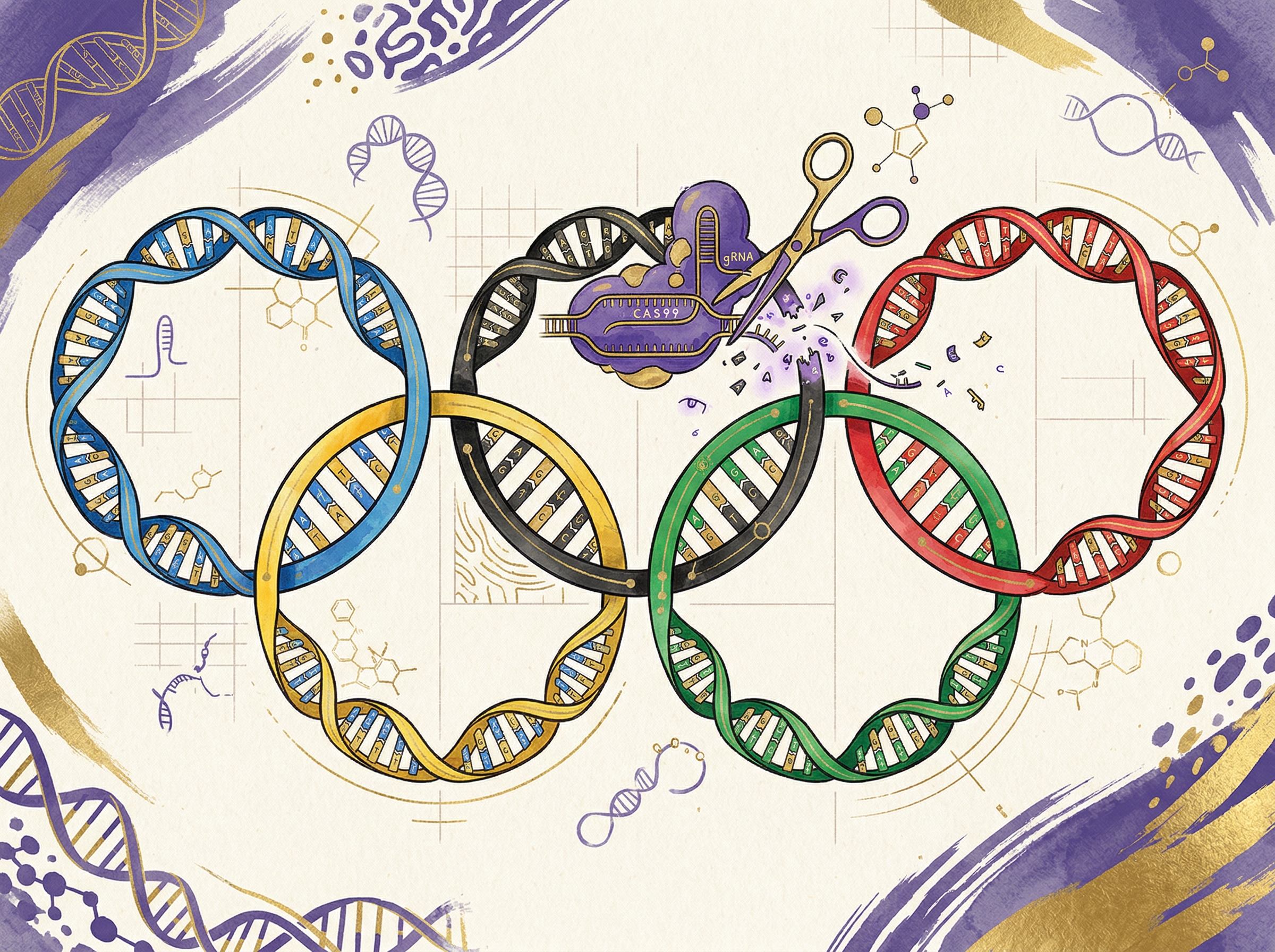
Olympic rings rendered as DNA double helix strands, one being cut by molecular scissors — representing the IOC's shift to genetic testing

The Olympics Just Made It Genetic: SRY Testing and the End of Hormone-Based Eligibility

The International Olympic Committee has dropped a bomb that will reshape the LA 2028 Games before a single athlete steps on the track. The new "Policy on the Protection of the Female Category" requires a one-time SRY gene screening for all athletes entering the female category. If you carry the SRY gene — typically found on the Y chromosome — you're out.

This is the most dramatic reversal in Olympic gender policy history. In 2021, the IOC adopted a framework that discouraged sex testing and declared inclusion the default. Five years later, they've swung to the opposite pole: a hard genetic line with zero room for nuance. IOC President Kirsty Coventry framed it as pragmatism: "We must rely on the objective biological reality of male puberty, which confers advantages that cannot be fully mitigated by hormone suppression."

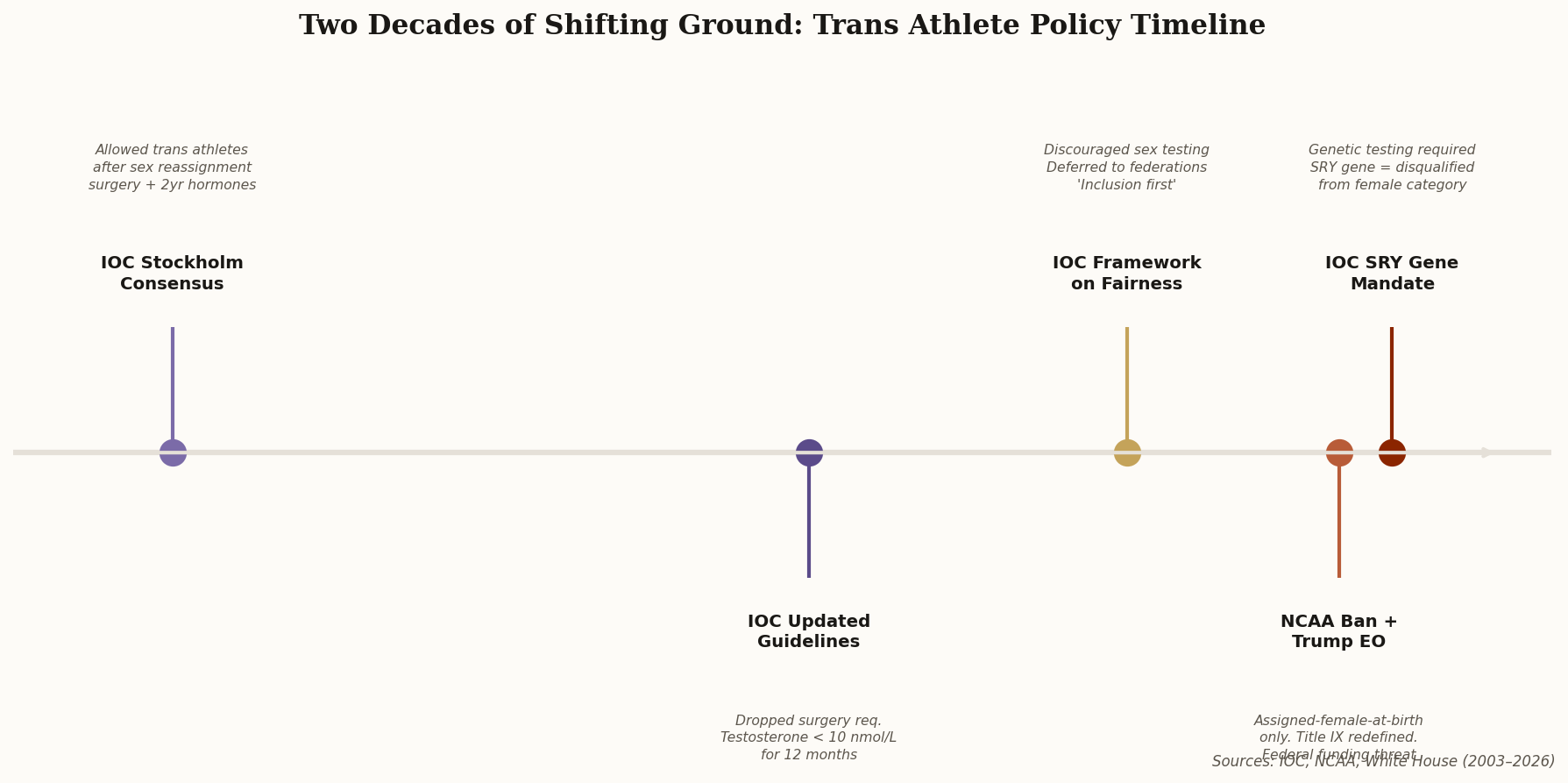
Timeline showing the evolution of trans athlete policy from the 2003 Stockholm Consensus through the 2026 IOC SRY gene mandate, illustrating the shift from inclusion to restriction
Two decades of shifting ground: From surgical requirements (2003) to inclusion-first (2021) to genetic gatekeeping (2026). The pendulum has swung further than where it started.

The timeline tells the story. The 2003 Stockholm Consensus required surgery and two years of hormones. The 2015 update dropped the surgery requirement. The 2021 framework was the high-water mark for inclusion. Then, in under 18 months, the entire edifice collapsed — not because the science changed, but because the politics did.

There's an uncomfortable irony here: athletes like Laurel Hubbard, who competed in the 2020 Tokyo Games under the previous testosterone-based rules, would now be categorically barred. Not because new evidence showed she had an unfair advantage (she finished last in her weight class), but because the rules moved beneath her feet.

03
Scientific laboratory with athletic equipment and floating data overlays — representing the intersection of sports science and policy

The Largest Study Ever Says There's No Strength Advantage After Three Years. The IOC Doesn't Care.

Here's the research the governing bodies would prefer you not read too carefully. A comprehensive meta-analysis published in the British Journal of Sports Medicine — 52 studies, over 6,400 participants, the largest systematic review ever conducted on this question — found no statistically significant differences in upper-body strength, lower-body strength, or aerobic capacity between trans women and cisgender women after three years of hormone therapy.

Read that again. No significant difference. After three years.

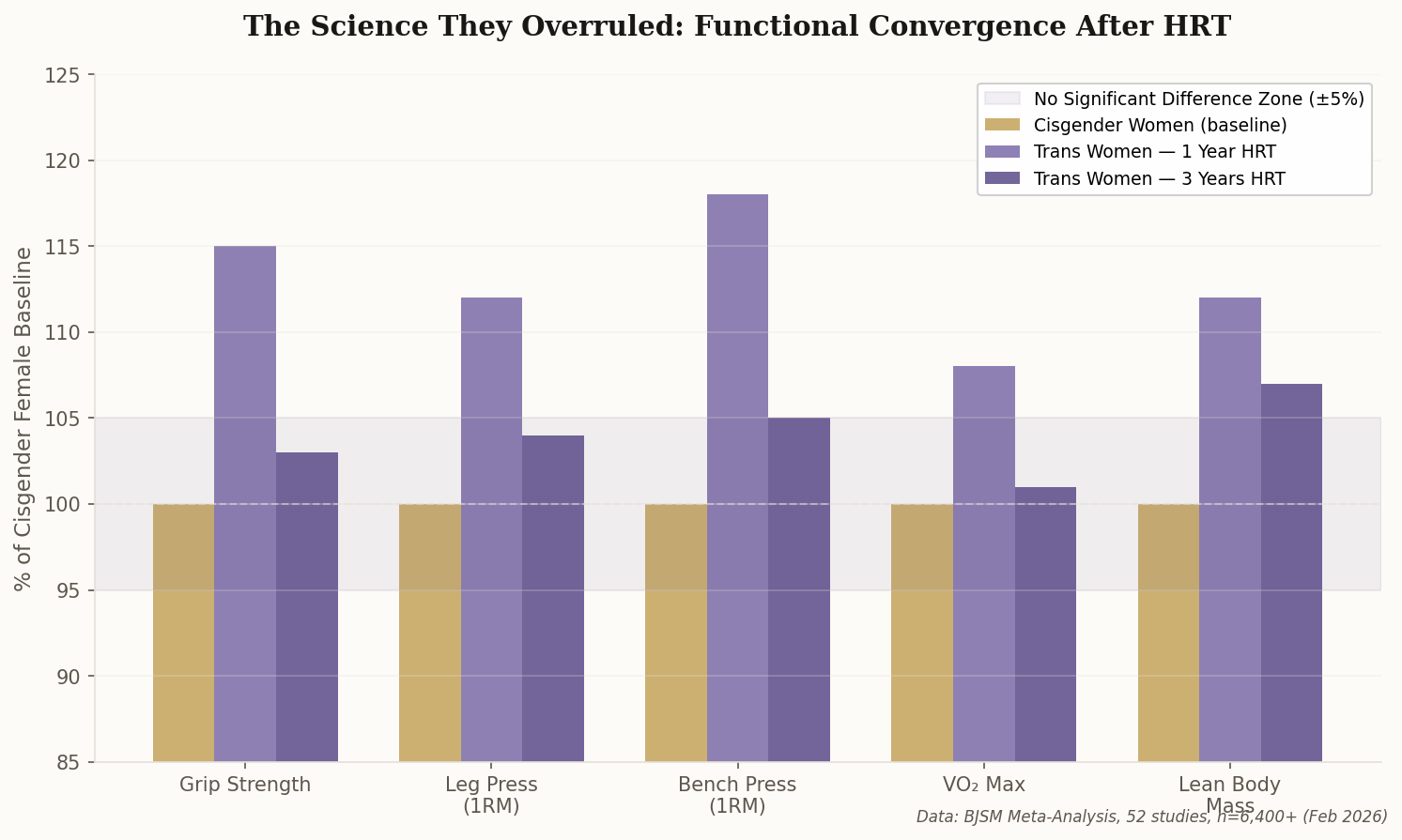
Bar chart comparing strength metrics between cisgender women and trans women after 1 year and 3 years of hormone therapy, showing convergence toward baseline at the 3-year mark
Functional convergence after hormone therapy. At one year, trans women retain measurable advantages. By three years, those gaps close to within the margin of normal variation. Data from BJSM meta-analysis (52 studies, n=6,400+).

The nuance matters. At one year — the threshold most policies have used — trans women do retain some measurable advantages in grip strength and lean mass. But the study's lead researcher, Dr. Alun Williams, pointed out what the data actually shows: "Functional convergence is possible, and the focus on 'retained advantage' may be overstated in non-elite populations."

The IOC's SRY gene mandate doesn't acknowledge this research at all. It doesn't distinguish between athletes who have been on hormone therapy for six months versus six years. It doesn't ask whether the advantage is theoretical or demonstrated. It just draws a genetic line and calls it "objective." Twenty years of research reduced to one gene.

The quiet part: The one-year data does show retained advantages — and that's what most headlines cite. The three-year data tells a different story, but most competitive windows don't wait three years. The science is more complicated than either side admits.

04
Abstract visualization of neural pathways reorganizing in a brain, with dissolving old connections and forming new ones in violet and gold

Your Brain on Transition: The Neuroscience Nobody's Talking About

While the policy debate fixates on muscles and testosterone, researchers at Nature Neuroscience just added a dimension that complicates every talking point on both sides. Their finding: gender-affirming hormone therapy causes "receptor-driven cortical remodeling" — the brain's physical structure reorganizes to align more closely with the person's gender identity within six months of treatment.

This isn't metaphor. This is fMRI data showing neural architecture physically restructuring. The study's lead author, Dr. Elena Hüpen, put it precisely: "Biological transition is not just about muscle; it is a systemic shift that includes the central nervous system."

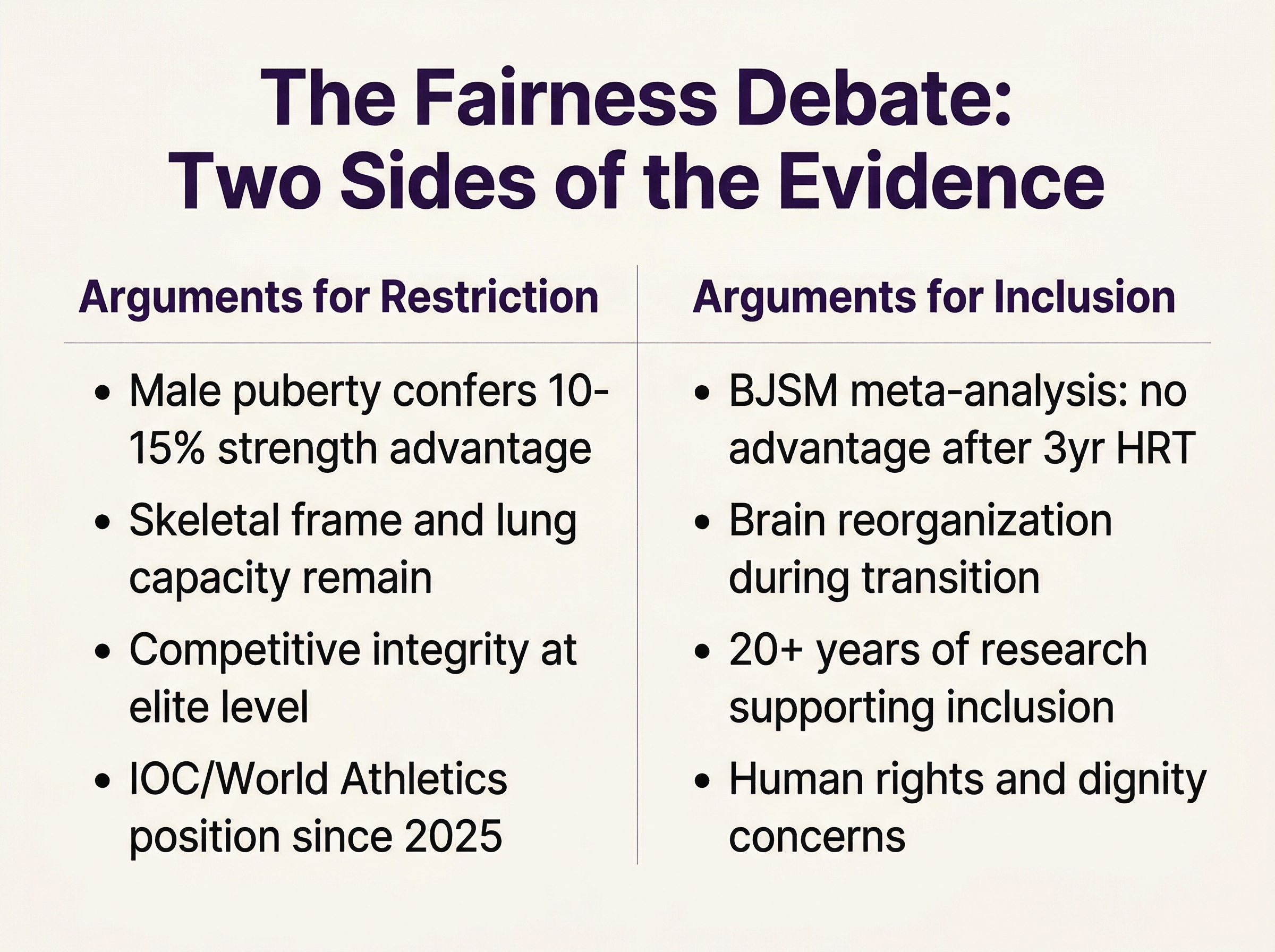
Infographic comparing arguments for restriction versus arguments for inclusion in the trans athlete debate, showing evidence on both sides
The Fairness Debate: A summary of the evidence and arguments on both sides — showing why this isn't as simple as either camp claims.

Why does this matter for sports? Because the "fairness" argument has always been framed in purely mechanical terms — muscle fiber density, bone structure, lung capacity. This research suggests that transition rewrites more than the musculoskeletal system. Motor control, spatial processing, reaction patterns — all of these are mediated by cortical structures that the study shows are actively remodeling.

Neither side of the debate has fully reckoned with what this means. If transition is truly systemic — not just hormonal but neurological — then both the "it's just hormones" argument and the "hormones can't undo puberty" argument are incomplete. The biology is more fluid than the binary policies being built on top of it.

05
Supreme Court building columns with athletic track lane markings on the steps, symbolizing the intersection of law and sport

Nine Justices, Fifty State Bans, One Question: Does the Constitution Protect Trans Athletes?

The Supreme Court heard oral arguments in January for the cases that will define this era: Little v. Hecox (Idaho) and West Virginia v. B.P.J. — two challenges to state laws banning transgender women and girls from female sports at every educational level.

ACLU attorney Joshua Block framed the constitutional question with precision: "The question before this Court is whether the Equal Protection Clause allows a state to categorically exclude an entire class of people based on a trait they cannot change." The states countered that sex-based categories serve a compelling interest in competitive fairness — an argument that would have been unremarkable a decade ago but now carries the weight of 26 state laws behind it.

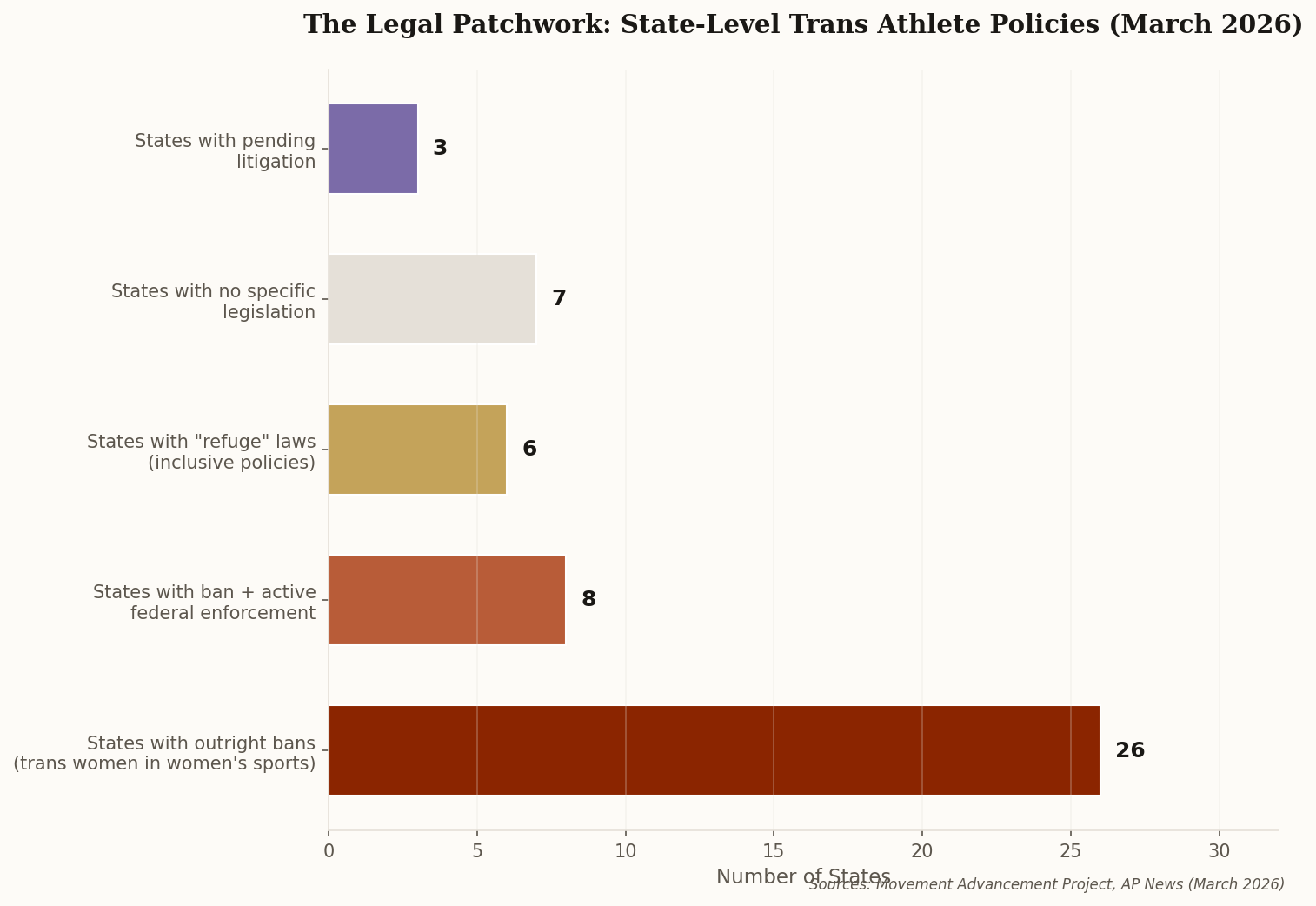
Horizontal bar chart showing the distribution of state-level trans athlete policies: 26 states with bans, 8 with federal enforcement, 6 with refuge laws, 7 with no legislation, and 3 with pending litigation
The legal patchwork: Where you live determines whether you can play. 26 states ban trans athletes outright; 6 have passed "refuge" laws protecting them. The Supreme Court ruling in June will likely collapse this into a single national standard.

The math is grim. Twenty-six states have enacted outright bans. Eight of those face active federal enforcement from the DOJ. Six states have gone the other direction with refuge laws. The remaining states are either silent or litigating. A ruling is expected by June 2026, and it will either validate the nationwide patchwork or impose a single standard.

The Court's composition suggests where this is heading, but the legal reasoning matters more than the outcome. If the majority rules that sex-based sports categories survive heightened scrutiny under the Equal Protection Clause, it won't just affect trans athletes — it will set precedent for how courts treat sex and gender in every context from schools to workplaces to healthcare.

06
Overhead view of domino pieces cascading in a chain reaction, the first gold-colored and larger, the rest violet — representing the policy domino effect

How One Executive Order Toppled Twenty Years of Policy in Eighteen Months

Trace the domino chain back to February 5, 2025. That's when the executive order titled "Keeping Men Out of Women's Sports" landed, directing federal agencies to withhold funding from any school that allowed "biological males" in women's competition. The order redefined "sex" under Title IX to mean biological sex assigned at birth. Full stop.

The NCAA fell first. Within 24 hours, its Board of Governors scrapped the sport-by-sport approach that had governed trans athlete participation for years and adopted a blanket "assigned female at birth" standard. NCAA President Charlie Baker called it "a clear, consistent, and uniform national standard." Critics called it capitulation to a funding threat.

Then World Athletics moved. By July 2025, president Lord Sebastian Coe had implemented mandatory SRY gene testing for all female-category athletes, declaring that "gender identity cannot be allowed to trump biological sex in elite competition." The IOC followed suit eight months later.

The speed is the story. The 2003 Stockholm Consensus stood for 12 years before being updated. The 2015 guidelines lasted six. The 2021 inclusion framework survived barely four. Each iteration took years of research, consultation, and stakeholder engagement. The 2025-2026 reversal happened in months, driven not by new science but by political pressure and funding leverage.

The athletes caught in between: Lia Thomas, whose UPenn swimming records have now been re-categorized. CeCé Telfer, who was already barred from the 2024 Olympic Trials. Chris Mosier, a trans man who advocated for the very policies now being dismantled. These aren't abstractions. They're people whose competitive lives were governed by rules that shifted under them — sometimes multiple times within a single career.

The Finish Line Keeps Moving

The June Supreme Court ruling will likely settle the legal question for a generation. But the scientific question remains genuinely open — the BJSM meta-analysis and the Nature Neuroscience study are just the beginning of understanding what transition actually does to the body. The tragedy is that policy has outrun the research by years, and real athletes are paying the price for a debate that treats their lives as hypotheticals. Whatever you believe about competitive fairness, it's worth sitting with this: the people most affected by these policies had the least say in writing them.

Share X LinkedIn