University History

The Dragon's Ascent

How a Gilded Age banker's radical bet on practical education built Philadelphia's most improbable university—from 70 students to 21,000, from near-bankruptcy to a billion-dollar endowment.

Listen
Victorian-era financier before a grand building under construction in 1891 Philadelphia
01

The Banker Who Bet on the Working Class

In 1891, while the Ivy League was busy minting lawyers and clergymen for America's aristocracy, Anthony J. Drexel had a different idea. The man who'd bankrolled J.P. Morgan's rise to financial supremacy looked at Philadelphia's working class and saw not charity cases, but untapped potential. His diagnosis was blunt: "The world is full of people who are looking for something to do, but who have never been taught how to do anything."

So he sank $2 million—roughly $70 million in today's dollars—into founding the Drexel Institute of Art, Science, and Industry. Not a finishing school. Not a gentlemen's club. A place where people would learn to do things. The original Main Building at 32nd and Chestnut, designed by Joseph M. Wilson of Reading Terminal fame, featured the Great Court—a four-story atrium engineered to force social interaction. Andrew Carnegie and Thomas Edison showed up for the dedication. The message was clear: practical education wasn't second-rate. It was the future.

Three radical commitments set Drexel apart from day one. Co-education—women walked through the doors alongside men from the first class. Religious neutrality—no denominational tests, no chapel requirements. And class mobility—this was explicitly for people who needed to work for a living. In an era when Harvard's student body was 100% male and overwhelmingly Protestant, Drexel's founding charter reads like it was written a century ahead of schedule.
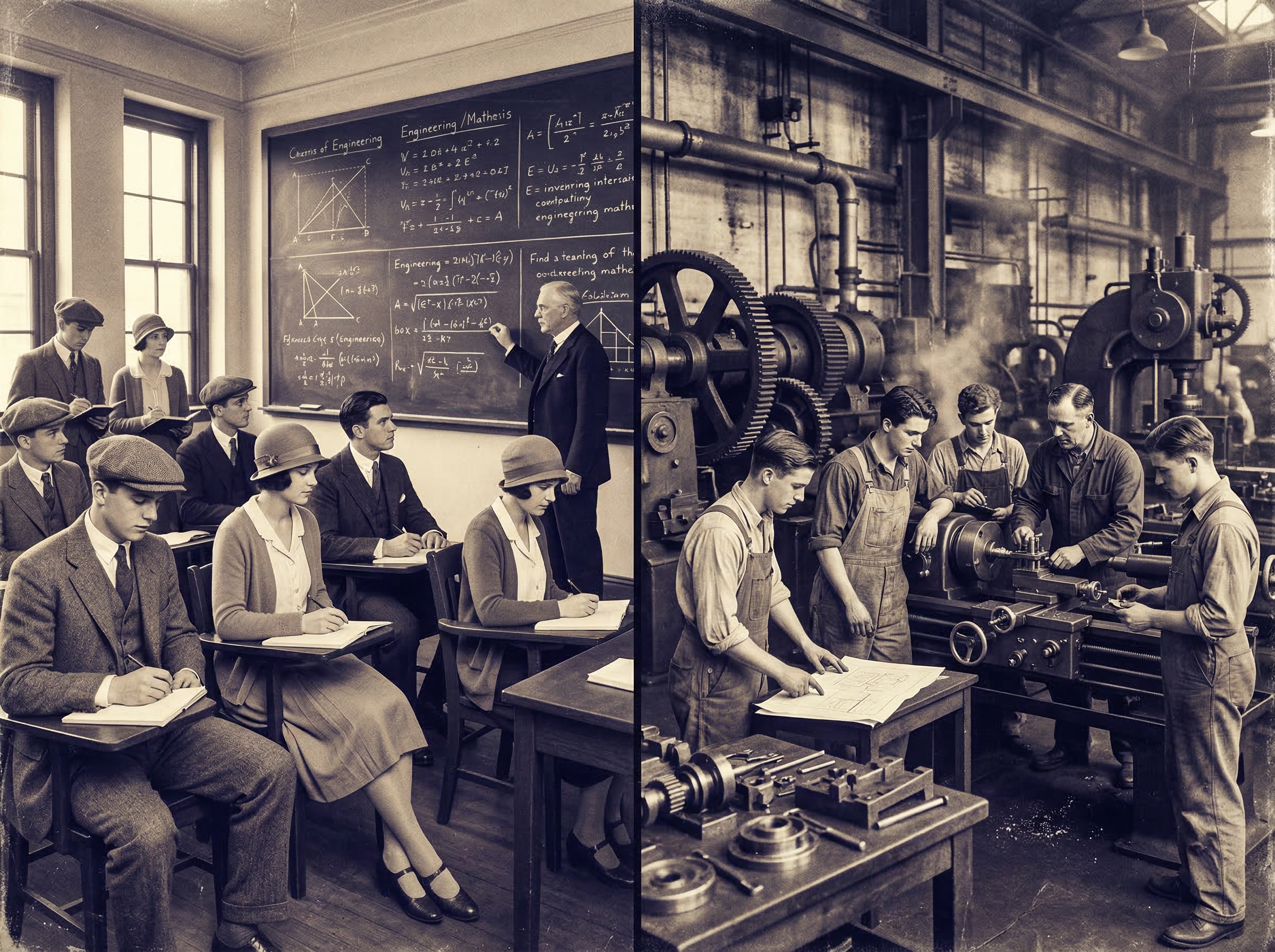
1920s students alternating between classroom and industrial factory floor
02

Learning by Doing: The Program That Defined a University

If the founding was the spark, cooperative education was the engine. In 1919, Drexel became one of the first institutions in the country to formalize the co-op model—students alternating between classroom study and full-time professional employment. It wasn't an internship. It wasn't a summer job. It was a fundamental restructuring of what education meant: half your degree was earned in the real world.

The timing was no accident. America had just emerged from World War I with a manufacturing economy that desperately needed skilled workers, not more theorists. Drexel's answer was to make its students useful before they graduated. By 1927, the Commonwealth of Pennsylvania was sufficiently impressed to grant master's degree authority. The institute that started teaching domestic science and basic commerce was now producing engineers and scientists with six months of industry experience before they even crossed the graduation stage.

The co-op advantage, then and now: Drexel's co-op program has grown into one of the largest in the country, with over 1,700 employer partners across 36 countries. The average co-op student completes 18 months of professional work before graduating—and 90% receive at least one job offer from a co-op employer.

The early milestones came fast. In 1914, the first Bachelor of Science degrees were conferred. By 1918, the campus was training the Student Army Training Corps for the war effort. What had started as a vocational experiment was rapidly becoming a genuine academic institution—one that happened to take the radical position that learning and doing were the same thing.

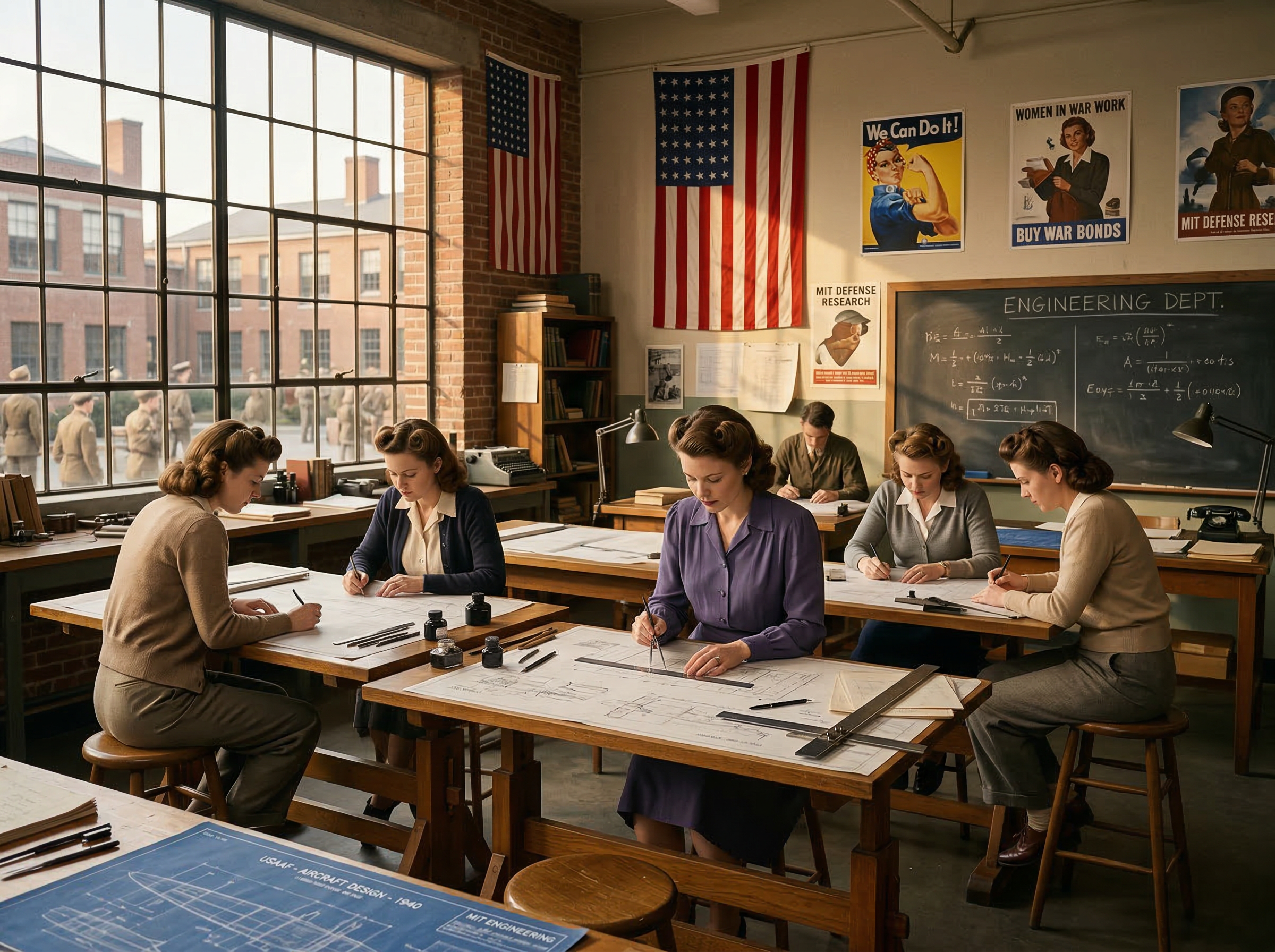
1940s women engineers at drafting tables in a WWII-era technical college
03

Rosie the Riveter Went to Drexel

The 1936 rebrand to Drexel Institute of Technology wasn't vanity—it was an acknowledgment that the school had outgrown its original vocational mission. Engineering and the sciences now dominated the curriculum, and the name needed to match the ambition. Then the war arrived, and Drexel proved exactly why practical education mattered.

While many universities struggled to adapt to wartime demands, Drexel pivoted seamlessly. The institute trained thousands of defense workers and enrolled its first significant cohort of women engineering students—not as a social experiment, but because the country needed every capable engineer it could find. The co-op program, already over two decades old, meant Drexel students were industry-ready from day one. They didn't need to be retrained. They could build things.

Timeline of key milestones in Drexel University history from 1891 to 2025
Key milestones spanning 135 years of institutional evolution. Source: Drexel University Archives.

The postwar decades brought explosive growth under President James Creese (1945–1963). A critical 1943 bequest from George Childs Drexel—Anthony's son—rescued the institute from Depression-era financial strain and funded an aggressive building campaign: Stratton Hall (1955), the Rush Building (1961), Kelly Hall (1967). The campus was physically becoming a university, even if the name hadn't caught up yet. That particular formality would wait until 1970.

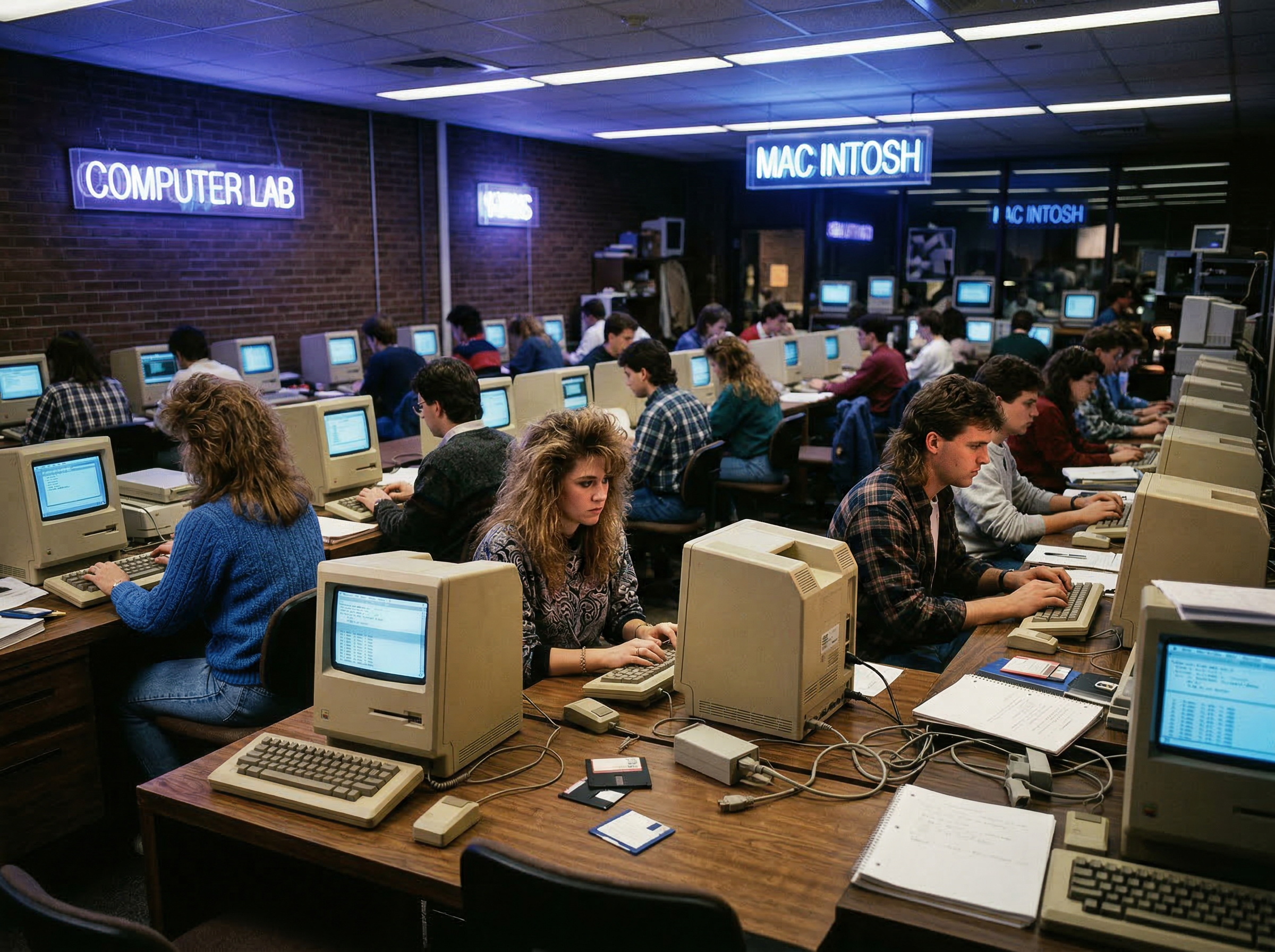
1980s university computer lab with original Apple Macintosh 128K computers
04

First in America—Then Nearly Last

In 1970, Drexel Institute of Technology officially became Drexel University—an acknowledgment of its doctoral programs (first Ph.D. awarded in 1965) and its evolution into a comprehensive research institution. The new name carried new expectations. And for a while, Drexel delivered.

The headline moment came in 1983, when Drexel became the first university in the United States to require all undergraduates to have access to a personal computer—the Apple Macintosh 128K. This wasn't a gimmick. It was a strategic bet that computing would become the backbone of every profession, and that students who couldn't use a computer were students who couldn't compete. History proved Drexel spectacularly right. The "Macintosh mandate" made national news and cemented the university's reputation as a technology-first institution.

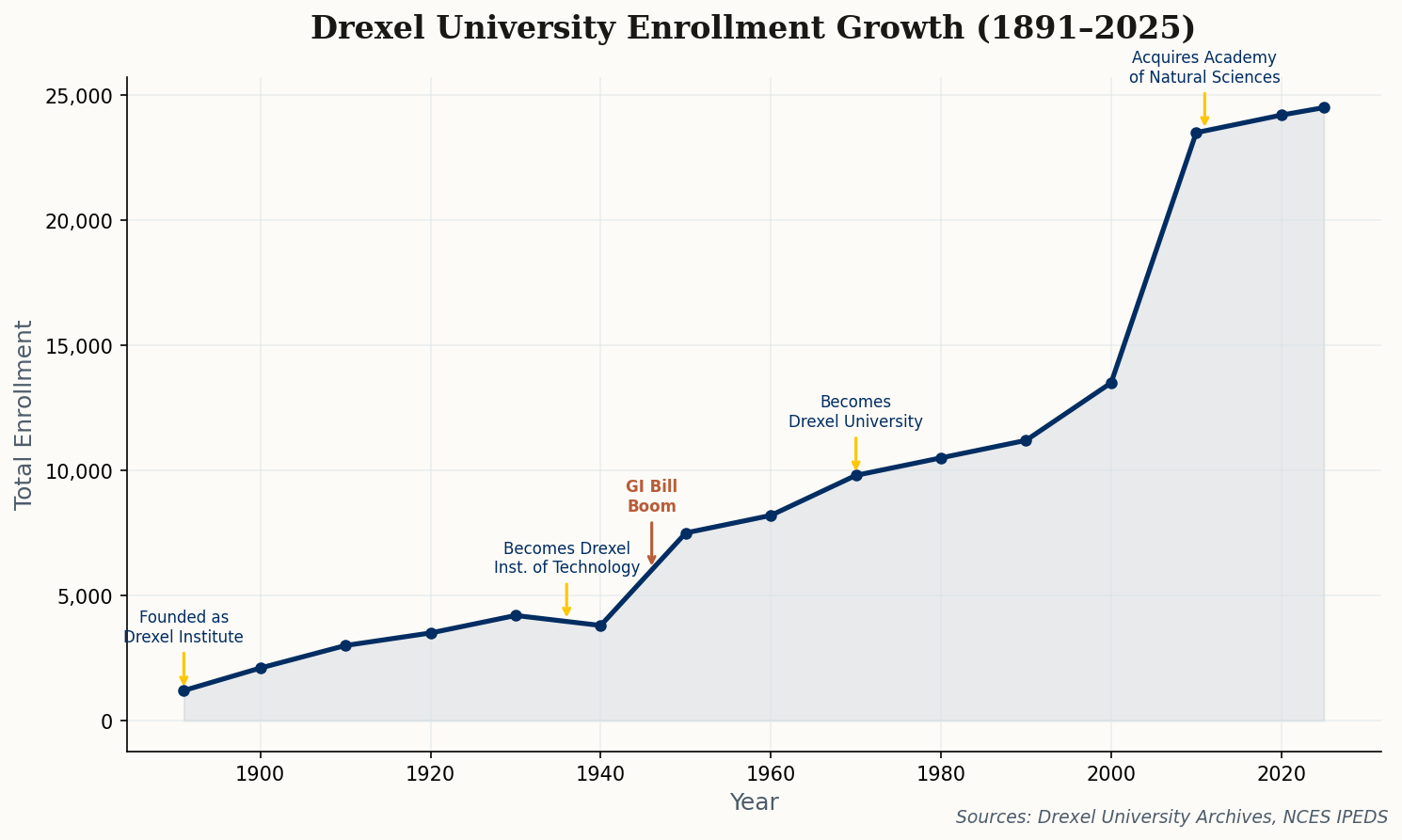
Line chart showing Drexel University enrollment from 1891 to 2024, with the 1994 low point of 9,711 highlighted
Enrollment trajectory showing the dramatic dip in the early 1990s and the Papadakis-era recovery. Source: Drexel OIR.

But technological vision couldn't outrun financial reality. Through the late 1980s and early 1990s, enrollment cratered. By 1994, total enrollment had fallen to 9,711 students—a modern low. The endowment was shrinking. Operating deficits were mounting. There were serious, not-whispered-about-in-hallways-but-discussed-in-boardrooms conversations about Penn absorbing Drexel entirely. The university that had once led America into the personal computer age was staring at institutional death.

The irony of 1994: The same year Drexel hit its enrollment nadir, the World Wide Web was exploding into public consciousness. The university that had bet on personal computing a decade earlier was now too financially weakened to capitalize on the internet revolution. It would take a new president—and a near-miracle—to reverse course.

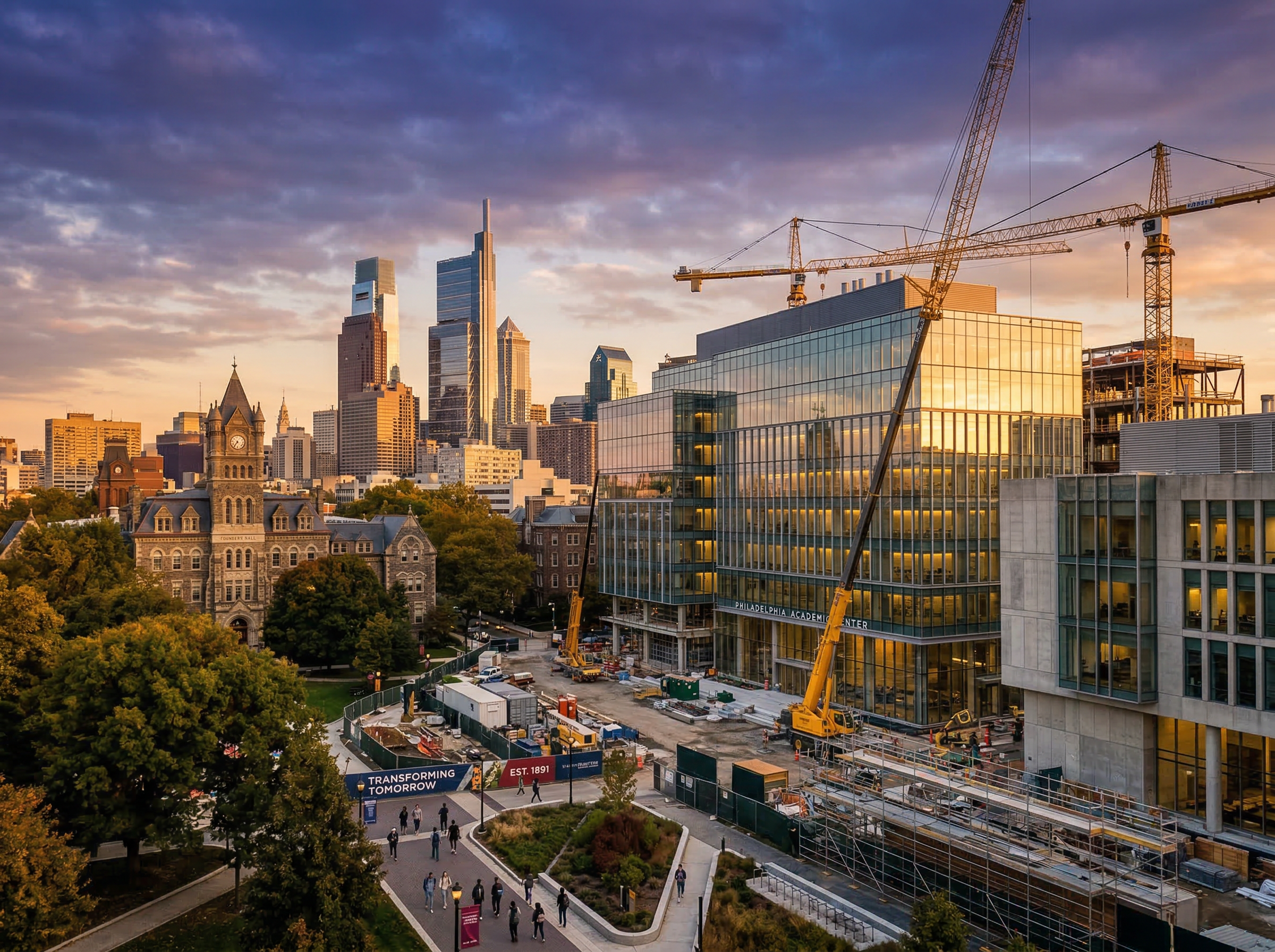
Modern university campus with construction cranes and new glass buildings alongside historic stone architecture
05

The Phoenix Rises: From 9,711 to 26,359

The turnaround has a name: Constantine Papadakis. Arriving as president in 1995, the Greek-born engineer inherited a university on life support and performed something close to institutional resurrection. Over 14 years, enrollment doubled. The endowment quadrupled. The physical campus expanded so aggressively that Drexel went from a commuter school to a genuine urban campus in University City.

The boldest move came in 2002: Drexel acquired MCP Hahnemann University, instantly establishing a College of Medicine and a College of Nursing and Health Professions. In 2006, the Thomas R. Kline School of Law opened—the first new law school at a major research university in decades. Drexel was no longer just an engineering school. It was a comprehensive research university, and the numbers proved it.

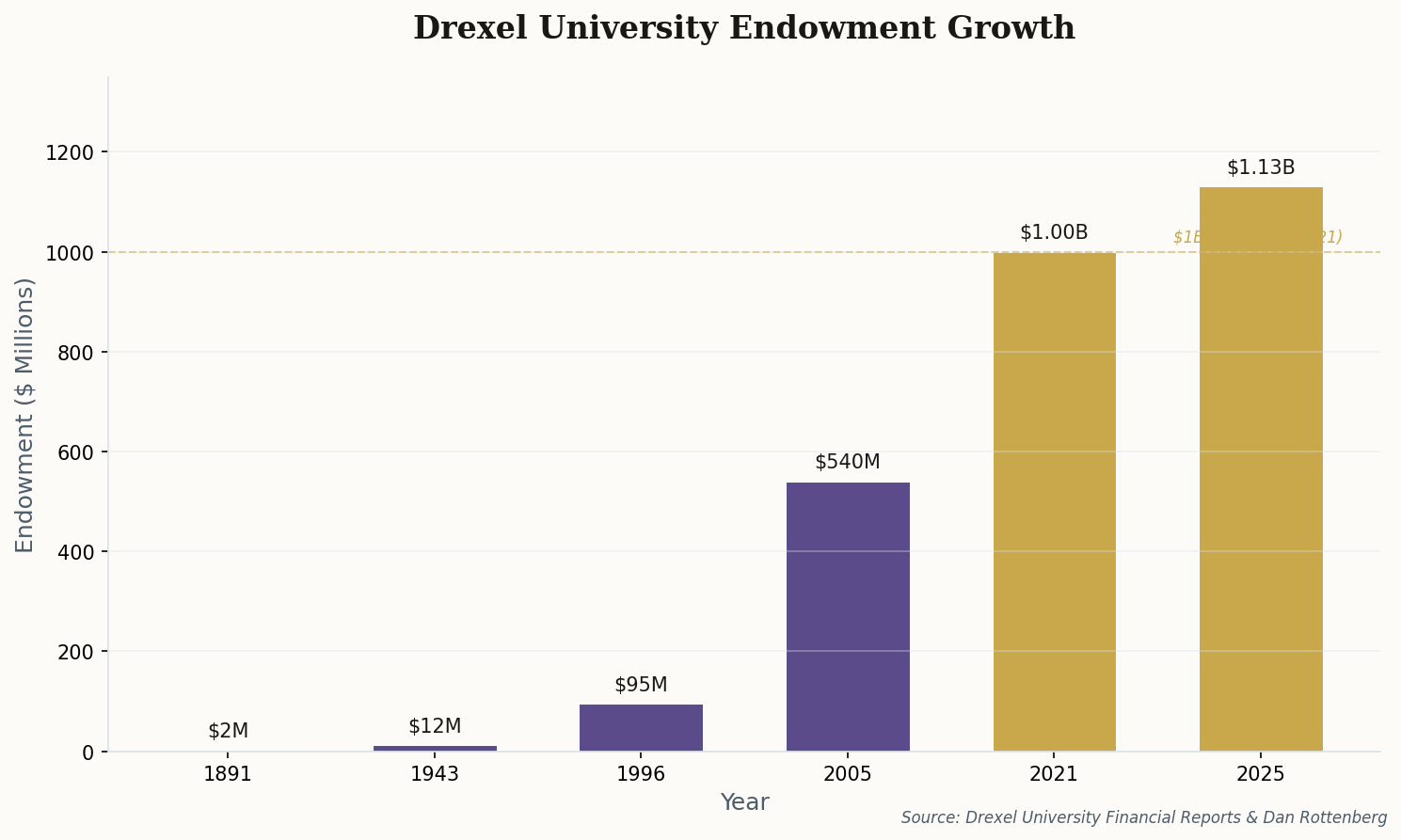
Bar chart showing Drexel endowment growing from $2M in 1891 to $1.13B in 2025
From Anthony Drexel's original $2M gift to a billion-dollar endowment—a 56,500% increase over 134 years.

Under John Fry (2010–2024), the focus shifted to civic engagement. The 2011 affiliation with the Academy of Natural Sciences—the oldest natural science institution in the Americas, founded in 1812—gave Drexel a museum, a research collection, and a 200-year head start in the natural sciences. Ground broke on Schuylkill Yards, a multi-billion-dollar innovation district. The College of Computing & Informatics launched in 2013, merging the "iSchool" and computer science into a single powerhouse. Peak enrollment hit 26,359 in 2014—a nearly threefold increase from the 1994 floor.

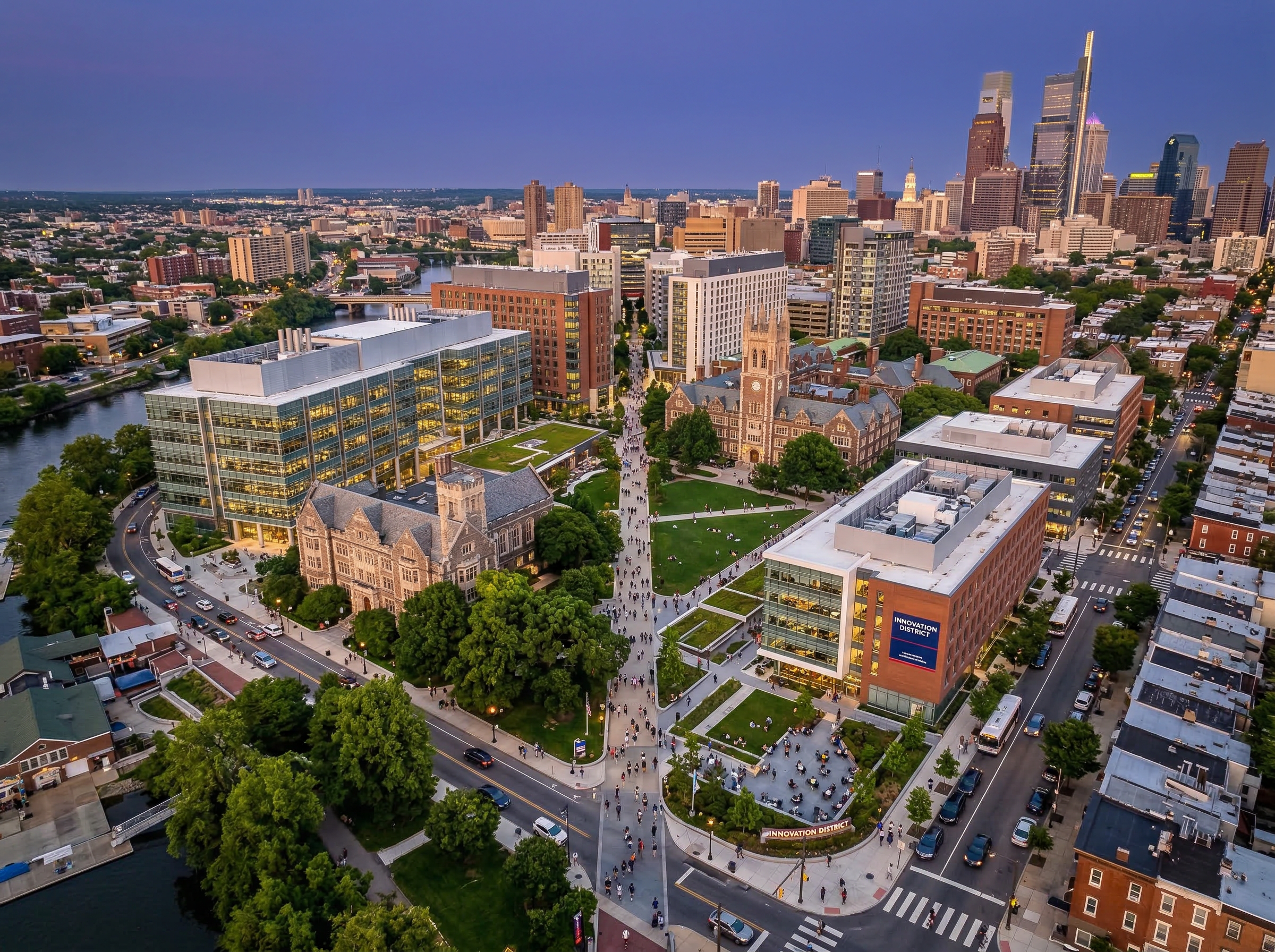
Aerial view of a vibrant modern university campus in an urban Philadelphia neighborhood
06

The Semester Shift: Drexel Rewrites Its Own DNA

Under President Antonio Merlo, Drexel is making the most structurally ambitious change in half a century: abandoning the quarter system that has defined the university's academic rhythm since the co-op program's earliest days. The transition to a semester-based calendar, with full implementation expected by 2027, is more than an administrative tweak. It's a philosophical statement about what Drexel wants to become.

The quarter system was co-op's natural habitat—shorter terms meant easier alternation between classroom and workplace. Dropping it signals that Drexel believes its co-op program is strong enough to survive a calendar change, and that the academic depth enabled by longer semesters is worth the restructuring pain. It's a bet on maturity over tradition.

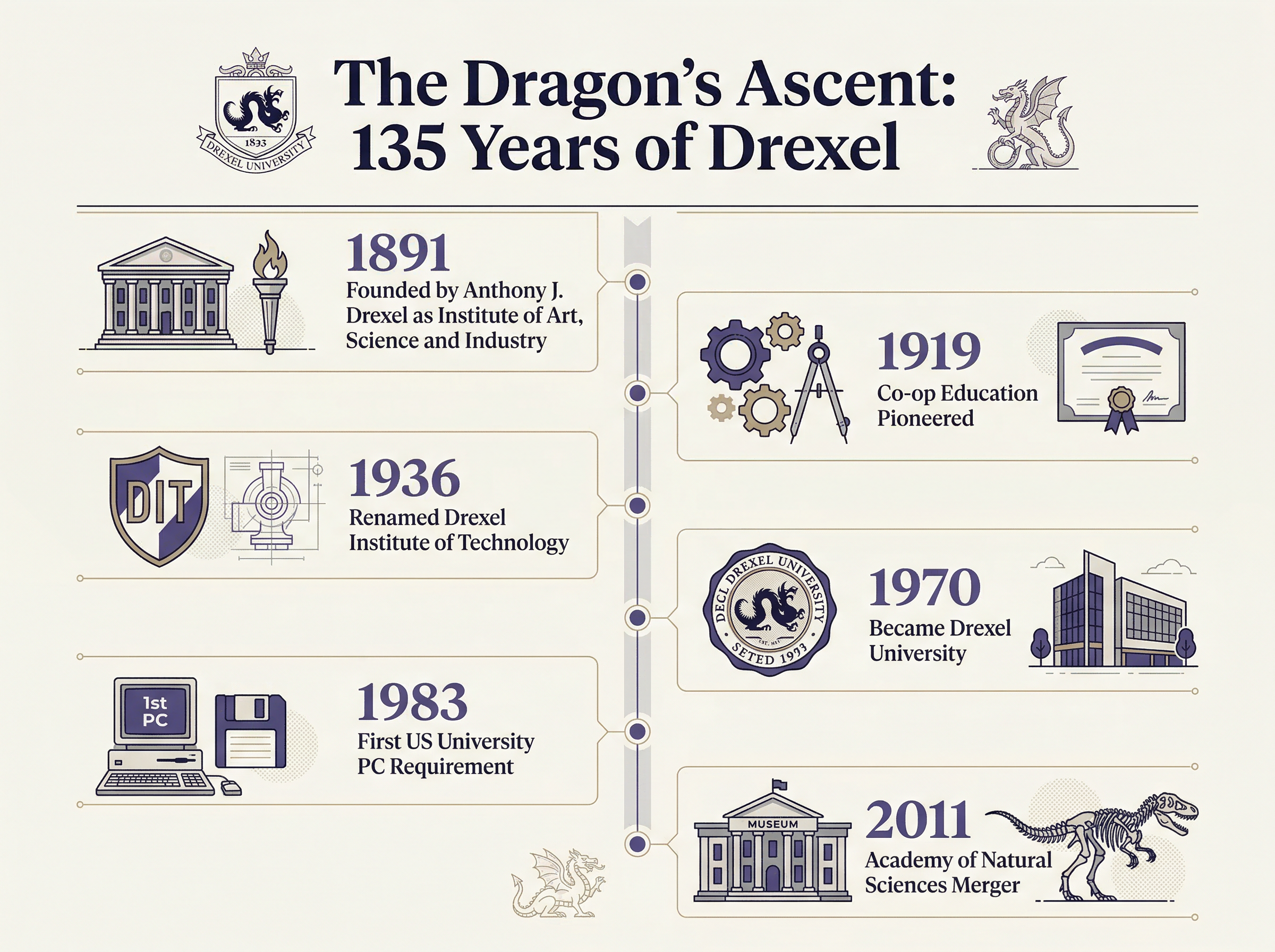
Infographic showing the 135-year evolution of Drexel University through 6 key milestones from 1891 to 2011
The Dragon's Ascent: 135 years of transformation from technical institute to R1 research university.

The 2025 Salus University merger added optometry and audiology programs, further expanding Drexel's health sciences footprint. Athletics continues to grow within the CAA, with the basketball program's profile rising after joining the expanded Philadelphia Big 5 in 2023. Current enrollment sits at 21,153—down from the 2014 peak, but stable and increasingly selective.

The Drexel alumni you didn't know about: Paul Baran co-invented packet switching, the foundation of the internet. Norman Joseph Woodland invented the barcode. Christopher Ferguson commanded the final Space Shuttle mission. And Katharine Drexel, the founder's niece, became a Catholic saint in 2000—canonized for founding over 60 schools for Native American and African American children.

From Chestnut Street to the World

Anthony J. Drexel died just two years after his institute opened—he never saw co-op education, the Macintosh mandate, or the billion-dollar endowment. But the DNA he encoded in 1891—practical over theoretical, inclusive over exclusive, useful over ornamental—is still the beating heart of the institution 135 years later. The dragon keeps climbing.

Share X LinkedIn