Economics & Culture

The Last Cent

America finally kills the penny. What happens next will cost you — or save you — more than you think.

Listen
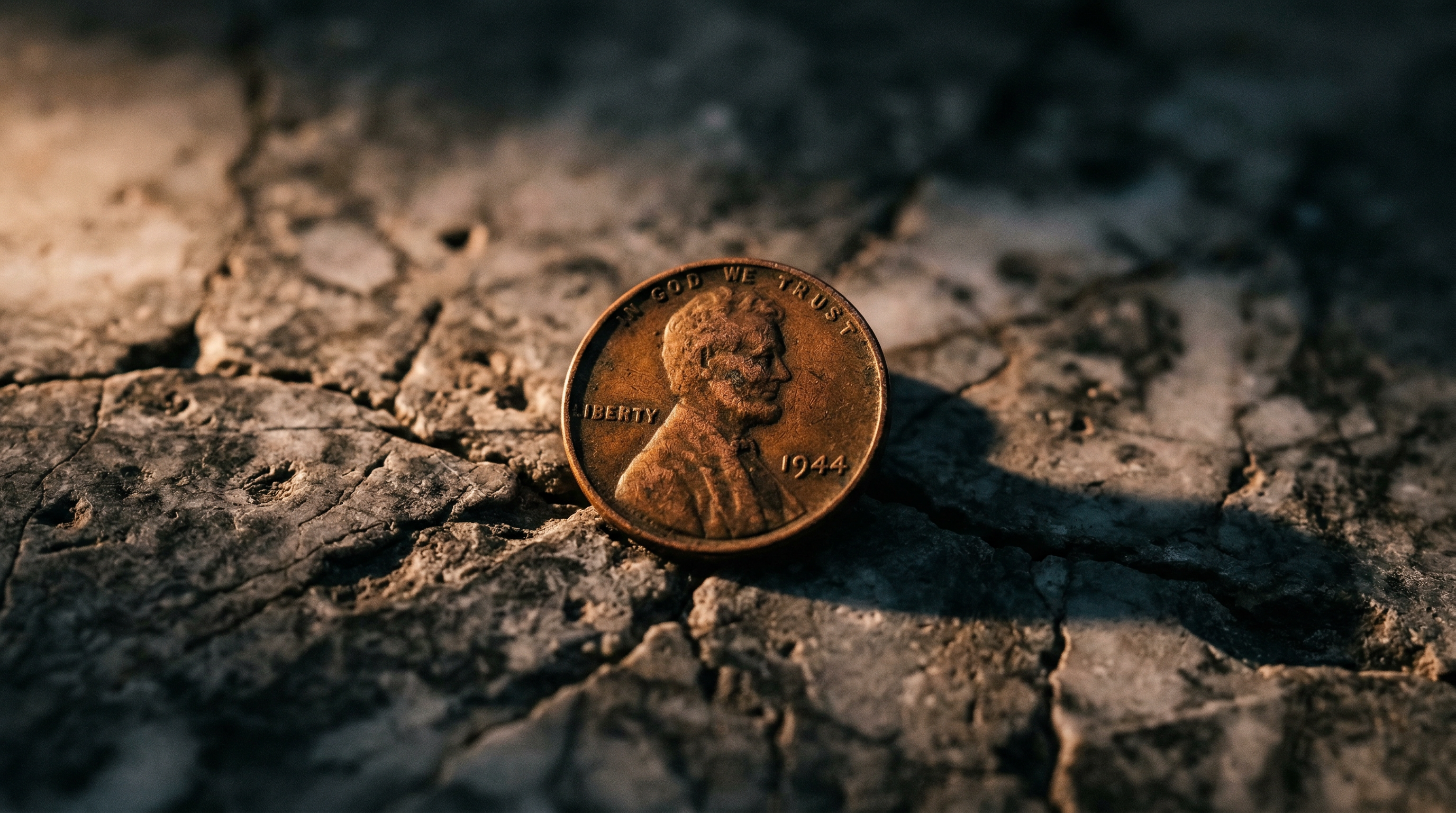
A worn Lincoln penny resting on cracked marble, dramatically side-lit, symbolizing the end of an era in American currency
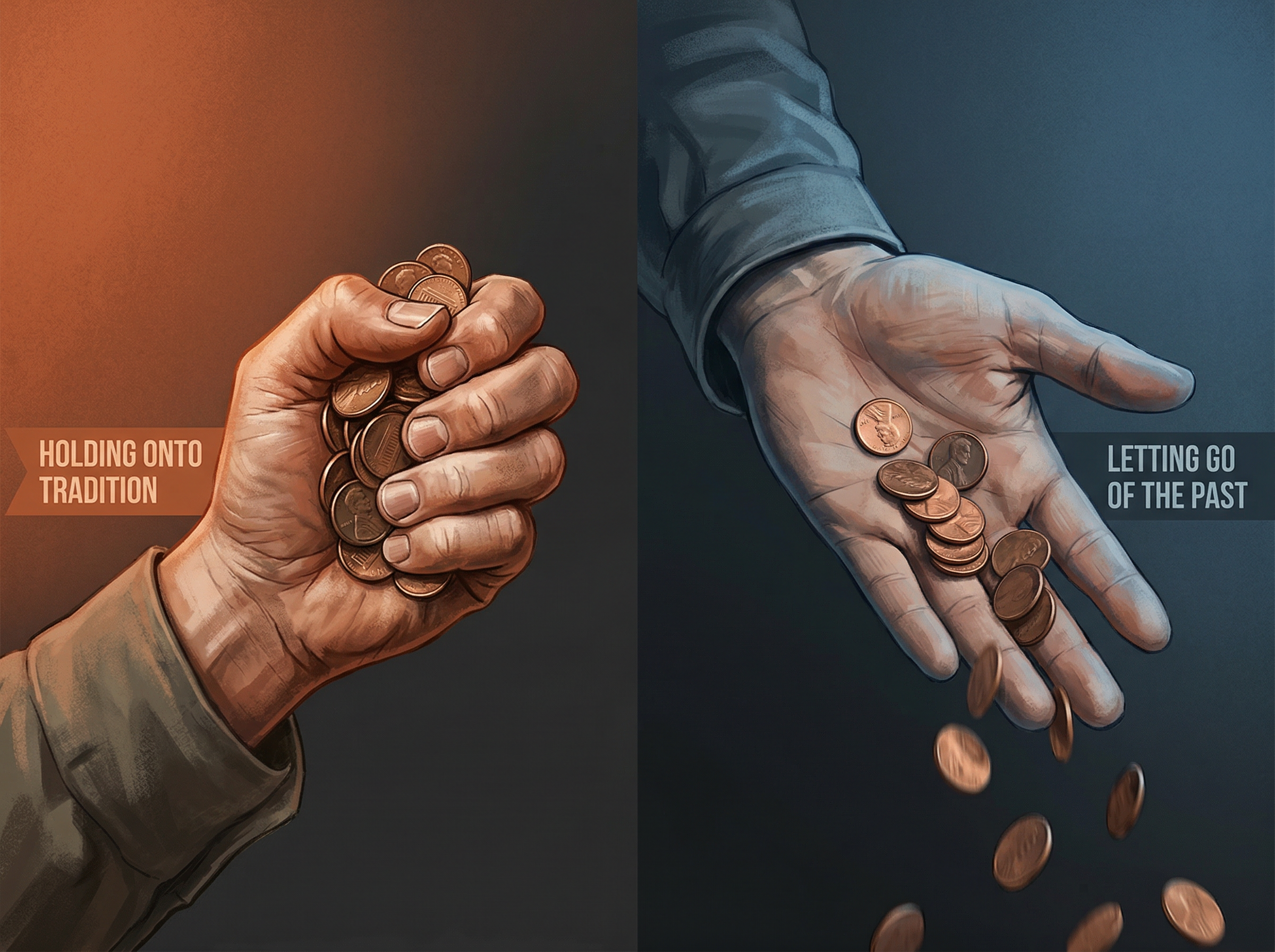
Two hands diverging — one clutching pennies, the other releasing them — representing America's divided opinion on penny elimination
01

Americans Love the Penny in Their Jars. They Hate It at the Register.

The penny's demise comes with a built-in contradiction: 40% of Americans support killing it, 39% oppose it, and essentially everyone agrees that fumbling for exact change is a miserable experience. A YouGov poll released this month reveals a country that doesn't so much disagree on the economics as wrestle with the symbolism.

The generational divide is telling. Among under-30s, 44% say they wouldn't even bother picking a penny up off the sidewalk — a small data point that speaks volumes about the coin's functional irrelevance. Yet older Americans, particularly those over 65, view the penny as a cultural artifact worth preserving, the way you'd fight to keep a covered bridge even if it slows traffic.

The real tension isn't nostalgia vs. pragmatism. It's the gap between ending production (46% support) and ending circulation (only 34% support). People are fine with the government saving money. They're less comfortable with someone deciding what coins they can and can't use. That distinction is going to haunt Congress when the Common Cents Act comes to a vote.
A modern cash register display showing a price being rounded down, representing retail adaptation to the post-penny era
02

Kwik Trip Would Rather Lose Two Cents Than Lose You in Line

While Congress deliberates on rounding rules, America's convenience stores are already solving the problem with brute-force customer service. Kwik Trip and Stewart's Shops have both announced they'll round all cash transactions down to the nearest nickel. If your total is $10.02? You pay $10.00. The chain eats the difference.

The math works in their favor. The National Association of Convenience Stores estimates that eliminating penny-handling saves roughly two seconds per cash transaction. Across thousands of stores processing millions of transactions, that adds up to labor hours worth far more than the fractional rounding losses. It's the same calculus that led airlines to stop printing paper tickets — the operational savings dwarf the transition cost.

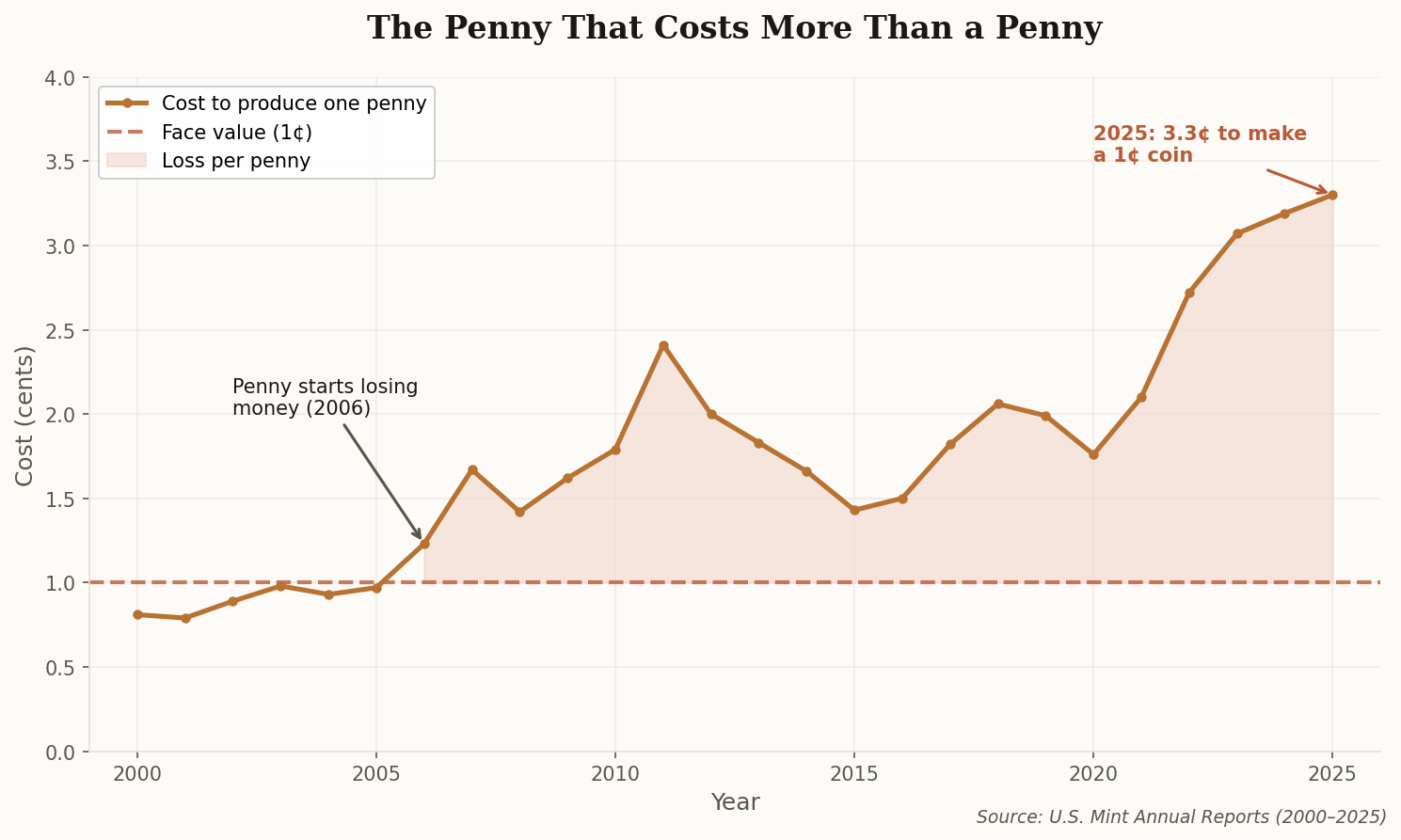
Line chart showing the cost to produce a penny has exceeded its face value since 2006, reaching 3.7 cents by 2025
The penny has been underwater since 2006. By 2025, it cost 3.7x its face value to produce — a manufacturing deficit that no amount of nostalgia can justify.

The more interesting signal is what this reveals about the power of corporate pragmatism over legislative process. Retailers aren't waiting for the Common Cents Act. They're implementing rounding policies because the penny shortage is already here, and customers standing at a register with $10.02 on the display and zero pennies in the till need an answer now, not whenever Congress gets around to it.

A Canadian maple leaf penny partially buried in snow, symbolizing a coin forgotten by a nation that moved on
03

Canada Killed Its Penny 13 Years Ago. Nobody Noticed.

If you want to know what a penny-less America looks like, look north. Canada eliminated its one-cent coin in 2013, and a freshly published 13-year retrospective delivers the most powerful argument the pro-elimination camp could ask for: absolutely nothing bad happened.

Zero measurable impact on inflation. Roughly $11 million CAD saved annually. Retailers reported meaningful gains in labor efficiency. And here's the detail that should end every "but what about rounding inflation?" argument: Canadian consumers forgot the penny existed within eighteen months. Not figuratively. Surveys show that by mid-2014, a majority of Canadians couldn't remember the last time they'd used one.

Horizontal bar chart showing 13+ countries that have already eliminated their lowest denomination coin, from New Zealand in 1990 to the UK planned for 2025
The US would join a growing roster of 13+ nations that have already ditched their smallest coin. The sky hasn't fallen in any of them.

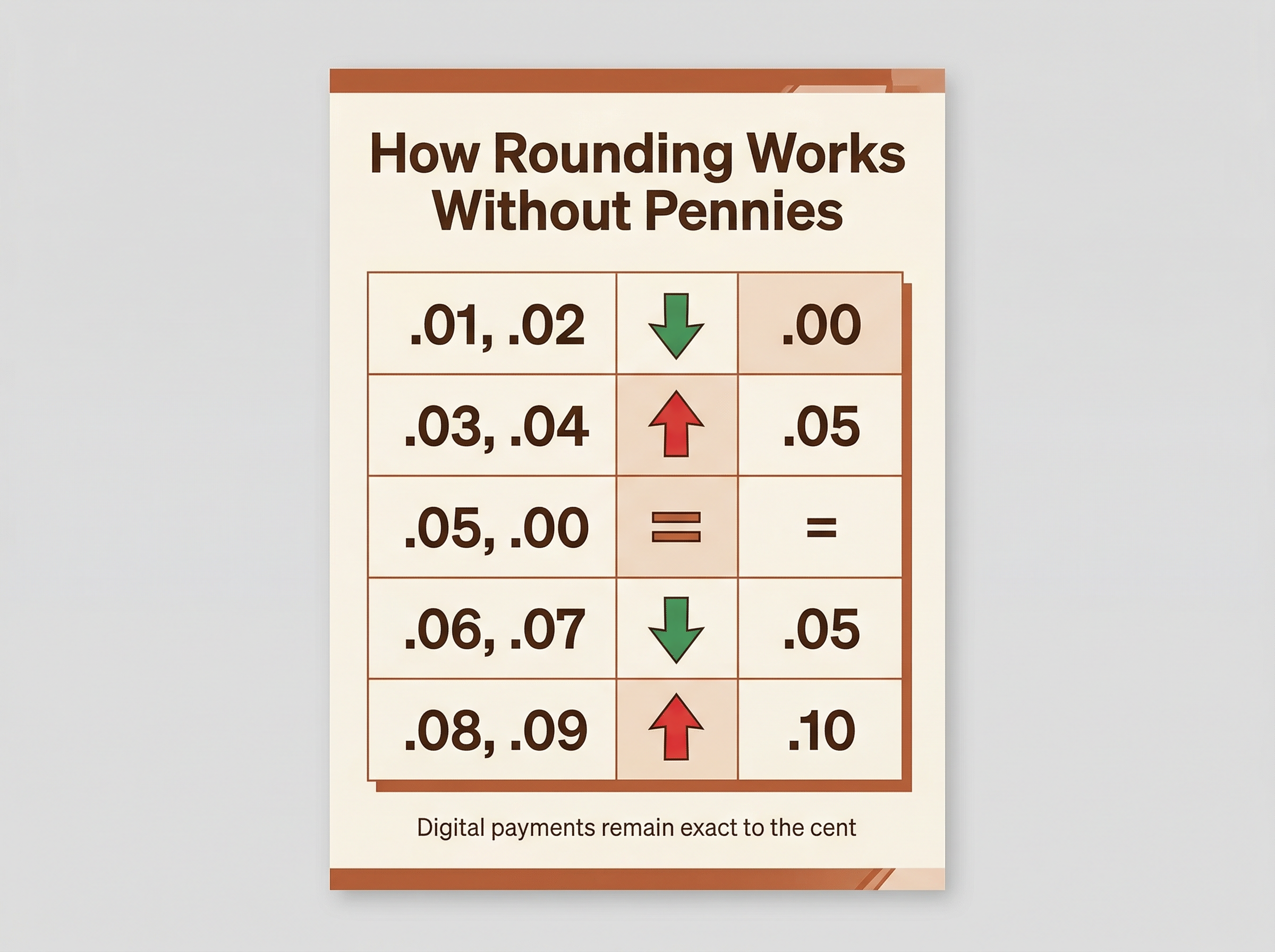
The Canadian model is also the template for American rounding legislation. Cash totals ending in .01 or .02 round down; .03 or .04 round up; .06 or .07 round down; .08 or .09 round up. Electronic payments remain exact to the cent. It's elegant, it's proven, and it's been working without controversy for over a decade. The only question is why the US took 13 years longer to follow suit.

A glass penny jar overflowing with copper coins next to a Donate sign, cracking under the weight — representing the cultural loss of penny-driven charity
04

The Penny Wasn't Just Money. It Was America's Smallest Unit of Generosity.

The economic case for killing the penny is airtight. The cultural case for keeping it is surprisingly emotional. Ronald McDonald House, the Salvation Army, and dozens of other charities that rely on "loose change" drives are reporting a 15-20% drop in physical coin donations in early 2026. The penny jar on the counter — that almost-invisible act of micro-generosity — is disappearing along with the coin itself.

Then there's the language. "A penny for your thoughts." "Penny-wise, pound-foolish." "See a penny, pick it up." Linguists quoted by the Times describe these phrases as potentially "fossilizing" — becoming historical artifacts that younger generations will use without understanding the physical object behind them, the way we say "hang up the phone" or "roll down the window."

Infographic explaining the Canadian rounding model: how cash prices ending in .01-.09 round to the nearest nickel, while digital payments stay exact
How rounding works in a penny-less economy — the Canadian model that the "Common Cents Act" would bring to the US.

But perhaps the most telling data point is this: the U.S. Mint reported record-breaking sales for the final 2025 "Lincoln Cent" collector sets. Americans are treating the penny like a departing celebrity — mourning it in public while simultaneously acknowledging that its best days were long behind it. The penny is becoming numismatic nostalgia, and that transformation says more about how we assign value than any production cost spreadsheet ever could.

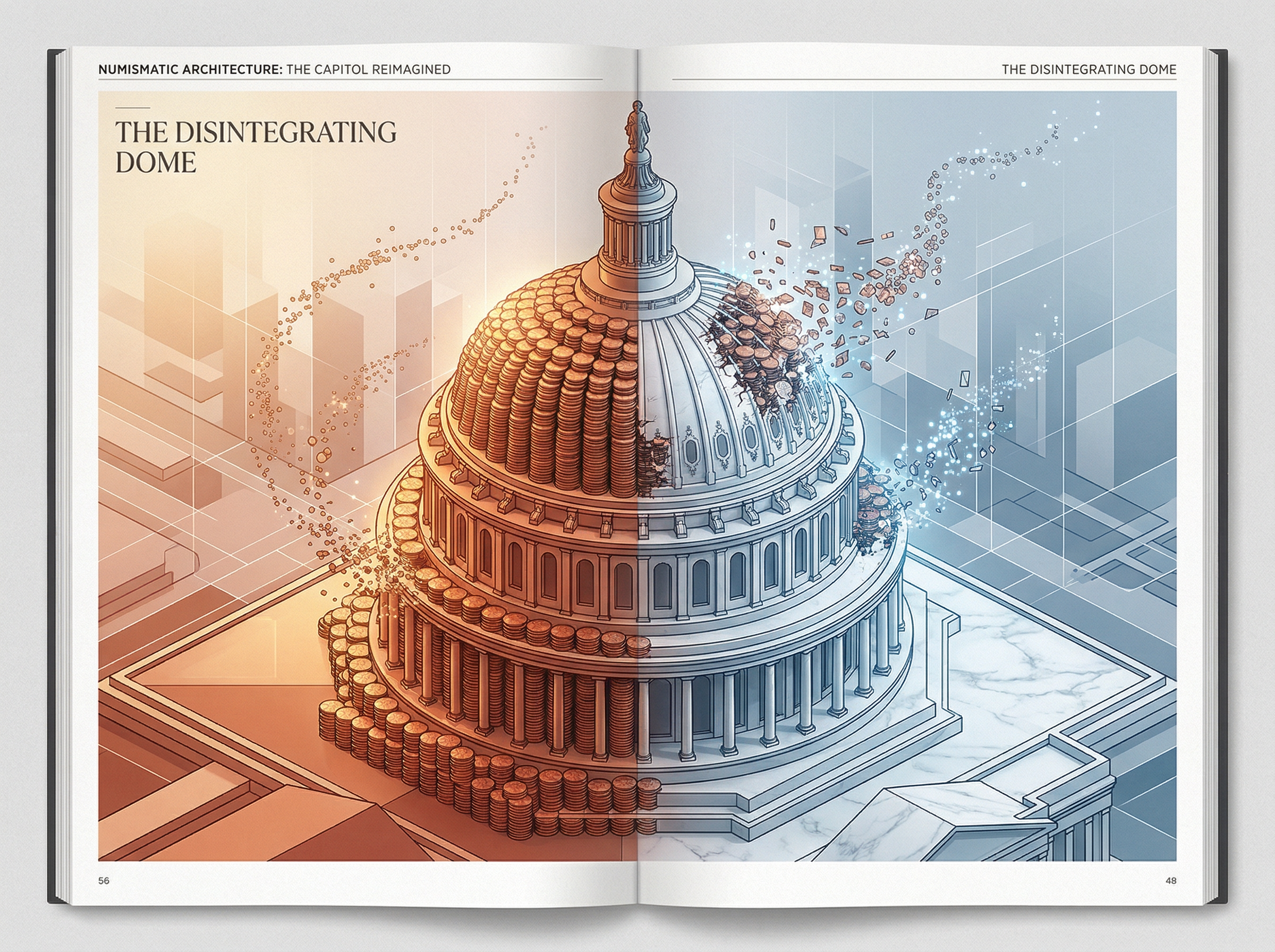
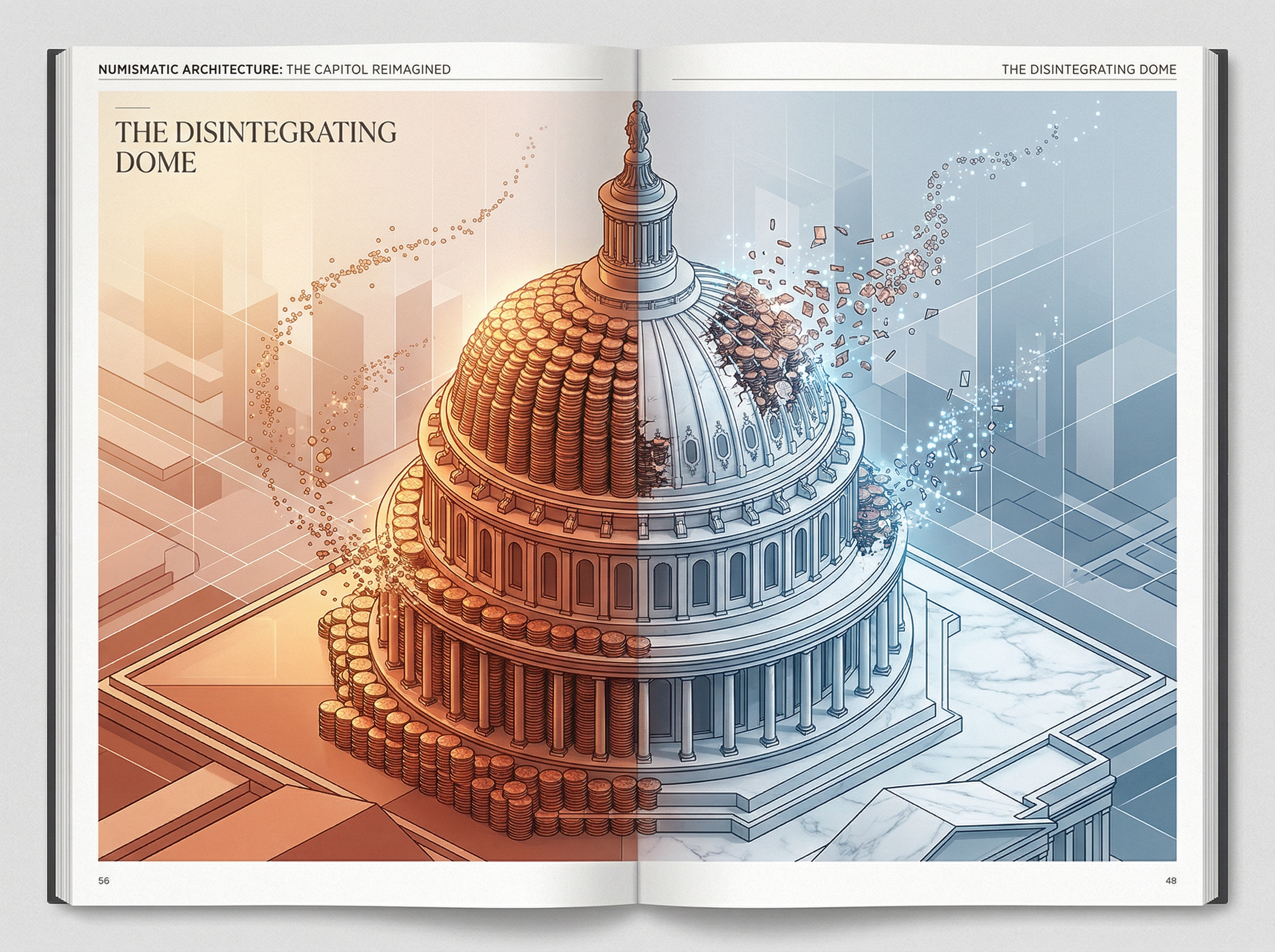
Abstract visualization of the US Capitol dome constructed from stacked copper pennies, some dissolving into digital particles
05

The "Common Cents Act" Is Congress's Attempt to Standardize the Math

Without federal rounding rules, America faces a patchwork nightmare. A consumer rounded up in New Jersey, rounded down in New York, and facing who-knows-what in Pennsylvania. That's the scenario the bipartisan "Common Cents Act" aims to prevent — and its name is the kind of legislative pun that tells you even Congress recognizes the absurdity of fighting over fractions of a cent.

The bill follows the Canadian model almost exactly: cash totals round to the nearest five cents using standard arithmetic rounding. Electronic payments — credit cards, Apple Pay, Venmo — remain exact to the cent and are completely unaffected. Given that over 80% of US transactions are already digital, the rounding question affects a shrinking minority of payments.

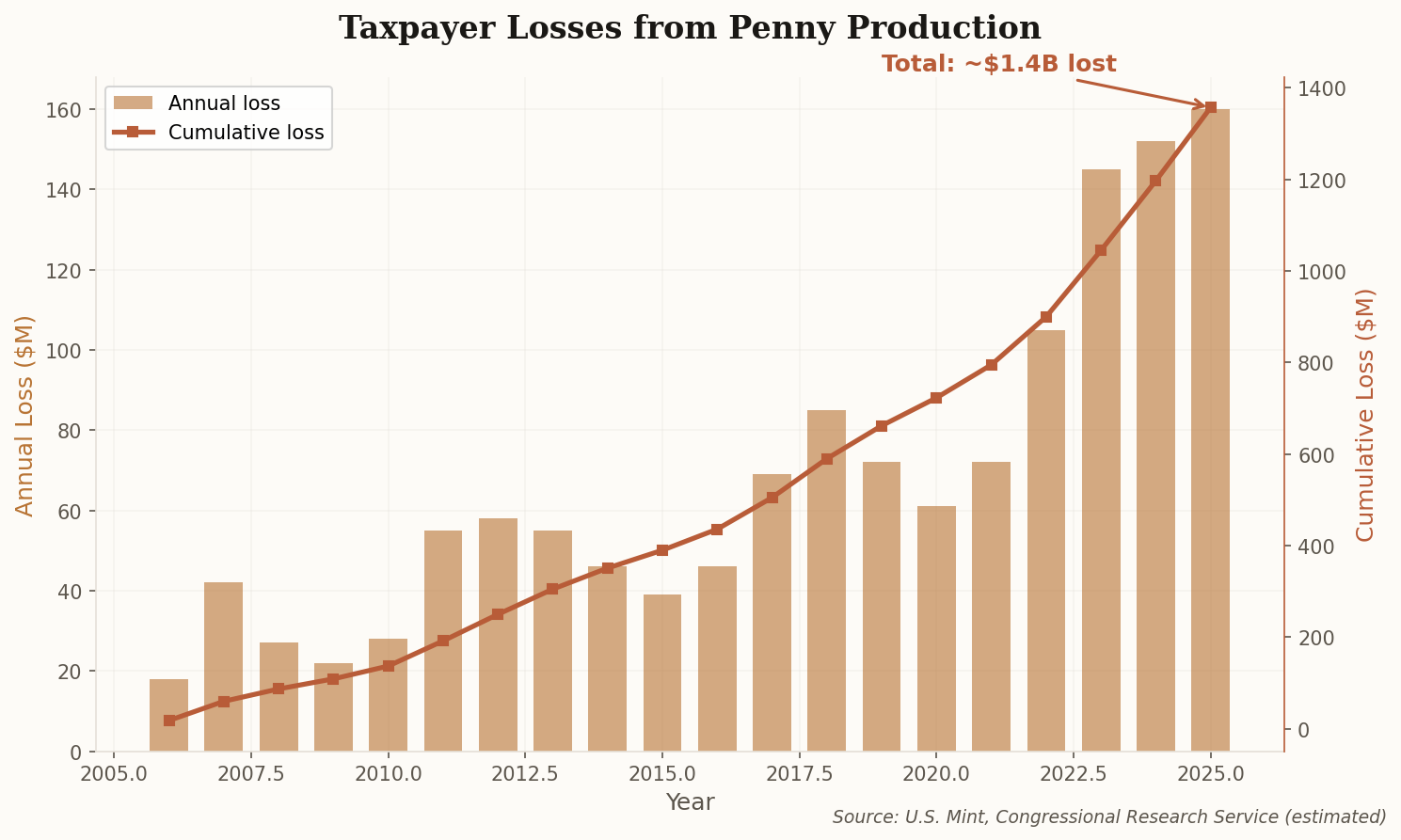
Dual-axis chart showing annual and cumulative taxpayer losses from penny production since 2006, totaling approximately 1.3 billion dollars
Since 2006, the US has lost an estimated $1.3 billion producing a coin that most Americans leave in cup holders. The cumulative waste makes the penny the government's most expensive small decision.

The zinc lobby's counterargument — that increased nickel demand will cost even more — is technically correct but strategically bankrupt. Yes, a nickel costs 14 cents to produce. But the Americans for Common Cents argument assumes a 1:1 substitution ratio, which ignores that most transactions are digital and that circulating nickels are reused far more efficiently than pennies, which famously end up in jars, fountains, and sidewalk cracks. The real question isn't whether rounding costs money. It's whether it costs less than the $85.3 million per year we were burning to mint a coin nobody wanted to carry.

A coin press stamping the final Lincoln penny, sparks and copper dust illuminated by dramatic industrial lighting
06

The Philadelphia Mint Strikes Its Last Penny After 233 Years

On November 12, 2025, the U.S. Mint's Philadelphia facility struck the final regular-issue Lincoln cent destined for general circulation. The moment was oddly anticlimactic — no ceremony, no speeches, just the rhythmic percussion of a coin press doing what it had done since 1792, and then stopping.

The backstory is pure government absurdity. The penny has been a money-losing proposition since 2006, when production costs first exceeded the coin's face value. By 2024, the deficit had widened to $85.3 million annually, with each penny costing 3.69 cents to manufacture. The directive to halt production came from the White House in February 2025, driven by the Department of Government Efficiency (DOGE), which identified the penny as a textbook example of waste — a rare bipartisan consensus in an era of anything but.

The existing supply — an estimated 100+ billion pennies scattered across American couches, car cup holders, and wishing fountains — will remain legal tender indefinitely. They'll circulate until they don't, gradually absorbed into collections, recycling streams, and the great American junk drawer. The Mint will continue producing collector-grade "numismatic" pennies for hobbyists, because even in death, the penny has a fan club willing to pay a premium for the privilege of owning one.

The bottom line: The penny's 233-year run ended not with a bang but with a spreadsheet. It cost 3.7 times its face value to produce, generated nearly $1.3 billion in cumulative losses since 2006, and proved that Americans will tolerate almost any level of fiscal absurdity as long as it fits in their pocket. The post-penny era has begun — and if Canada is any guide, you'll forget it ever existed within two years.

A Penny Saved Is a Penny That No Longer Exists

The penny was America's longest-running experiment in stubbornness over arithmetic. Its demise isn't a story about coins — it's a story about how long a democracy can keep doing something everyone agrees is irrational, simply because nobody wants to be the one to say stop. Canada proved the math works. Kwik Trip proved the customer experience works. Now it's just a question of whether Congress can write a rounding rule before the penny shortage writes one for them. Keep an eye on the Common Cents Act — and maybe, just maybe, hold onto a few of those last Lincoln cents. Not because they'll be worth anything. Because someday your grandkids will ask you what that tiny coin was for, and "everything and nothing" is a hell of an answer.

Share X LinkedIn