Photography History

The Red Dot — 111 Years of Leica Camera

From a brass prototype in a Wetzlar workshop to a €596 million luxury empire — how one tiny camera changed the way humanity sees.

Listen
01

"I Hereby Decide: We Will Take the Risk"
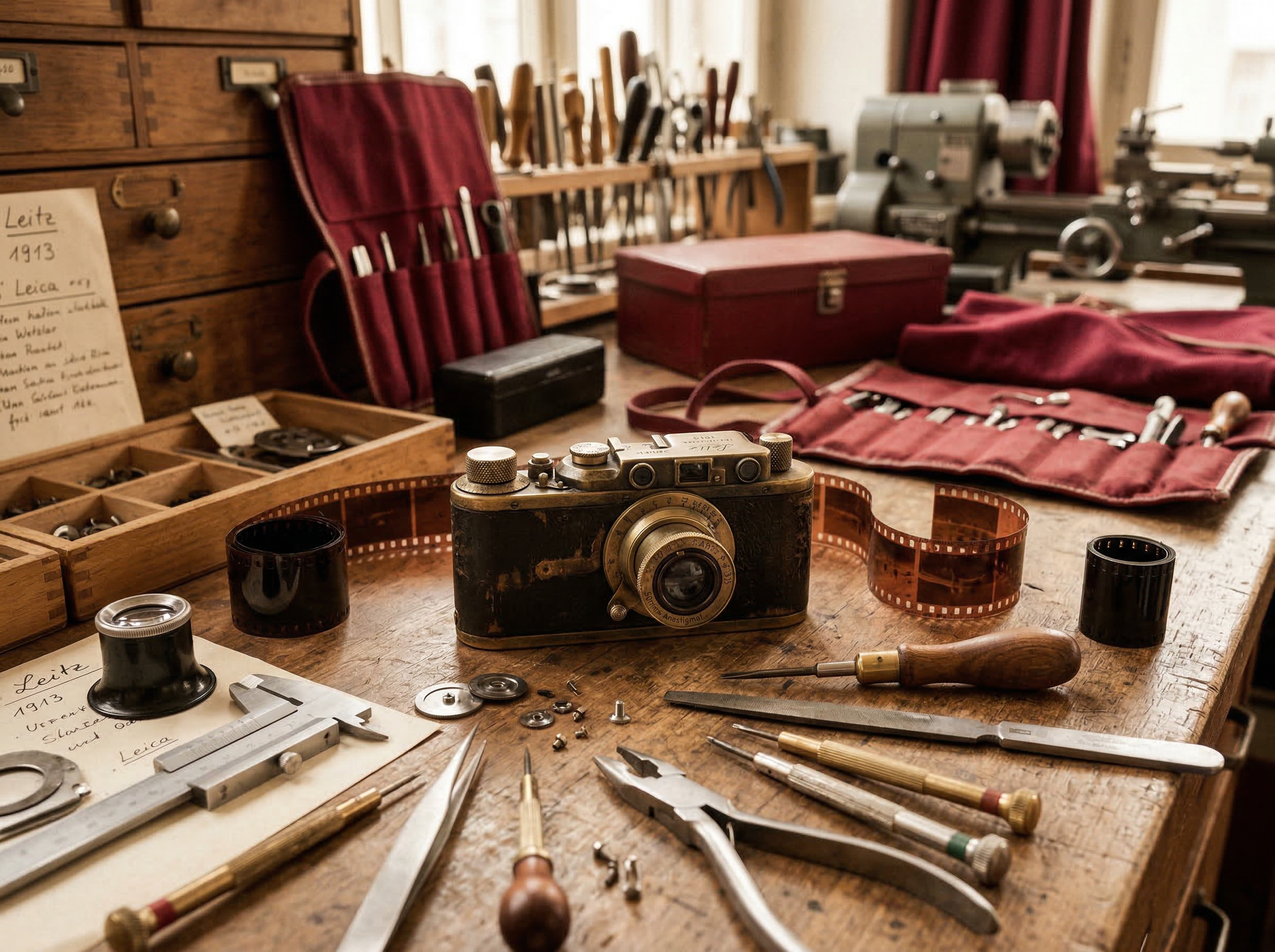
The Ur-Leica prototype camera from 1913, a tiny brass and leather device on a German workshop bench surrounded by precision tools

Every revolution starts with someone who's just tired of the way things work. In 1913, that someone was Oskar Barnack, a master mechanic at the Ernst Leitz optical works in Wetzlar, Germany. An asthmatic who found the era's heavy plate cameras physically unbearable, Barnack did something that would reshape a century of visual culture: he built a camera small enough to hold in one hand.

The prototype — now revered as the Ur-Leica — adapted 35mm cinema film but rotated it horizontally, doubling the frame from 18×24mm to 24×36mm. That 2:3 aspect ratio? It's still the "full-frame" standard in every professional camera made today. Barnack didn't just build a camera. He invented a format.

World War I shelved the project for a decade. When Ernst Leitz II finally confronted the decision in 1924 — in a Weimar Republic economy where risk could mean ruin — his response became the stuff of corporate legend: "I hereby decide: we will take the risk." The Leica I debuted at the Leipzig Spring Fair in 1925 and sold out immediately. Photography was no longer a tripod-bound, darkroom-adjacent ritual. It was mobile. Spontaneous. Alive.

The format that ate the world: Barnack's 24×36mm frame didn't just define Leica — it defined photography. Every "full-frame" sensor in every Canon, Nikon, and Sony today traces its dimensions directly to an asthmatic mechanic's prototype from 1913.
02

The Freedom Train That History Almost Forgot

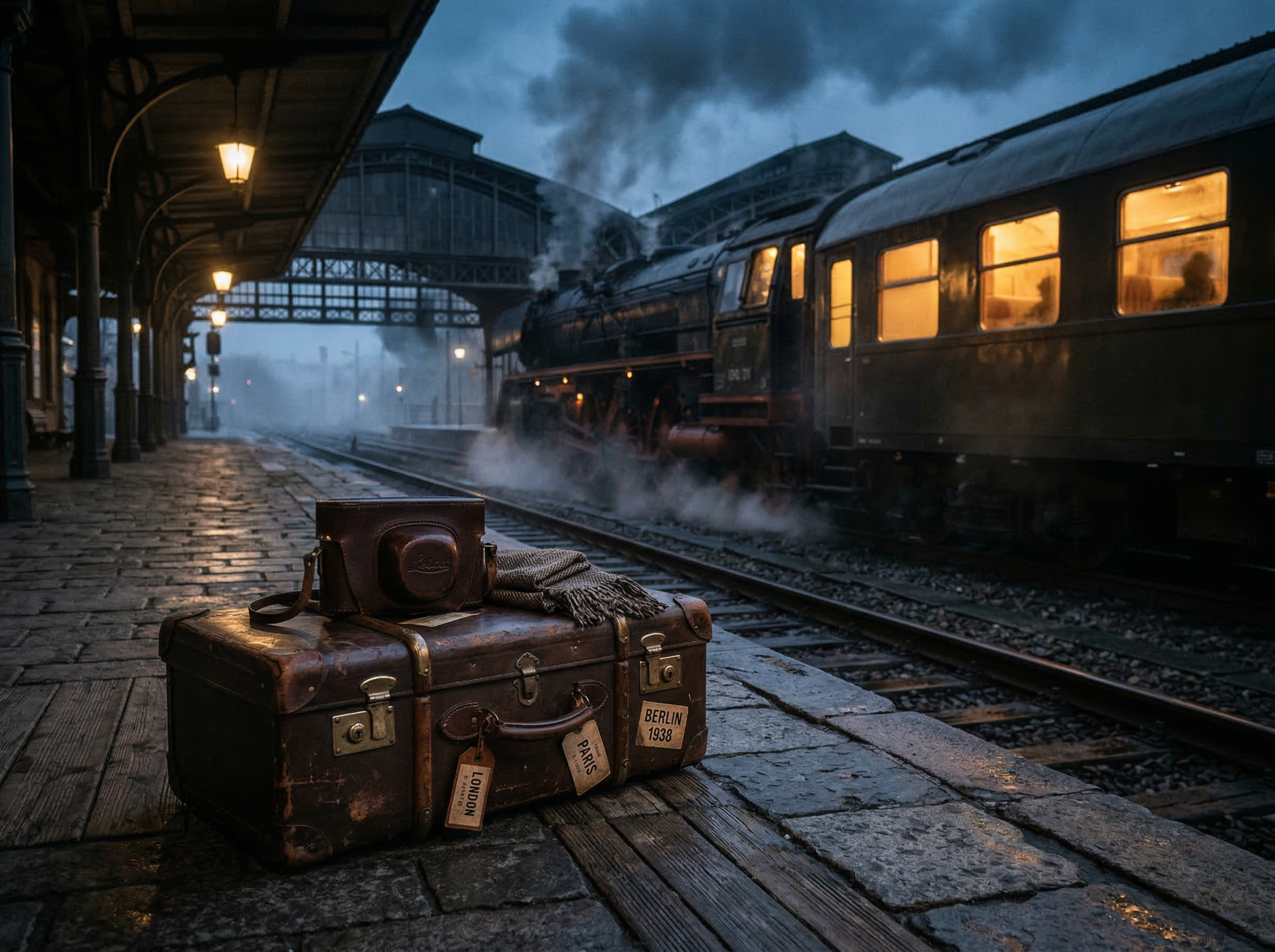
Silhouetted figures at a 1930s European train station at dusk, carrying suitcases toward a departing steam train, one figure clutching a small camera case

Leica's greatest chapter has nothing to do with f-stops or shutter speeds. Between 1933 and 1939, Ernst Leitz II ran one of the most remarkable — and least known — rescue operations of the Nazi era.

The plan was elegant in its simplicity: Leitz "assigned" Jewish employees and their families to overseas offices in New York, London, and Hong Kong. On paper, business transfers. In reality, escape routes. Upon arriving in New York, each refugee received a Leica camera — a valuable asset worth several months' wages that could be sold immediately or used to start a new career. The program saved between 200 and 300 lives.

The risks were not abstract. Leitz's own daughter, Elsie Kühn-Leitz, was later imprisoned by the Gestapo for helping Jewish women cross into Switzerland. The family kept the entire operation secret for over half a century — the story didn't emerge until the late 1990s, when historian Frank Dabba Smith documented what he called "The Leica Freedom Train."

Why it stayed hidden: The Leitz family never sought recognition. The phrase "the Leica Freedom Train" has become shorthand for moral courage conducted without fanfare.

03

The Camera That Saw the 20th Century

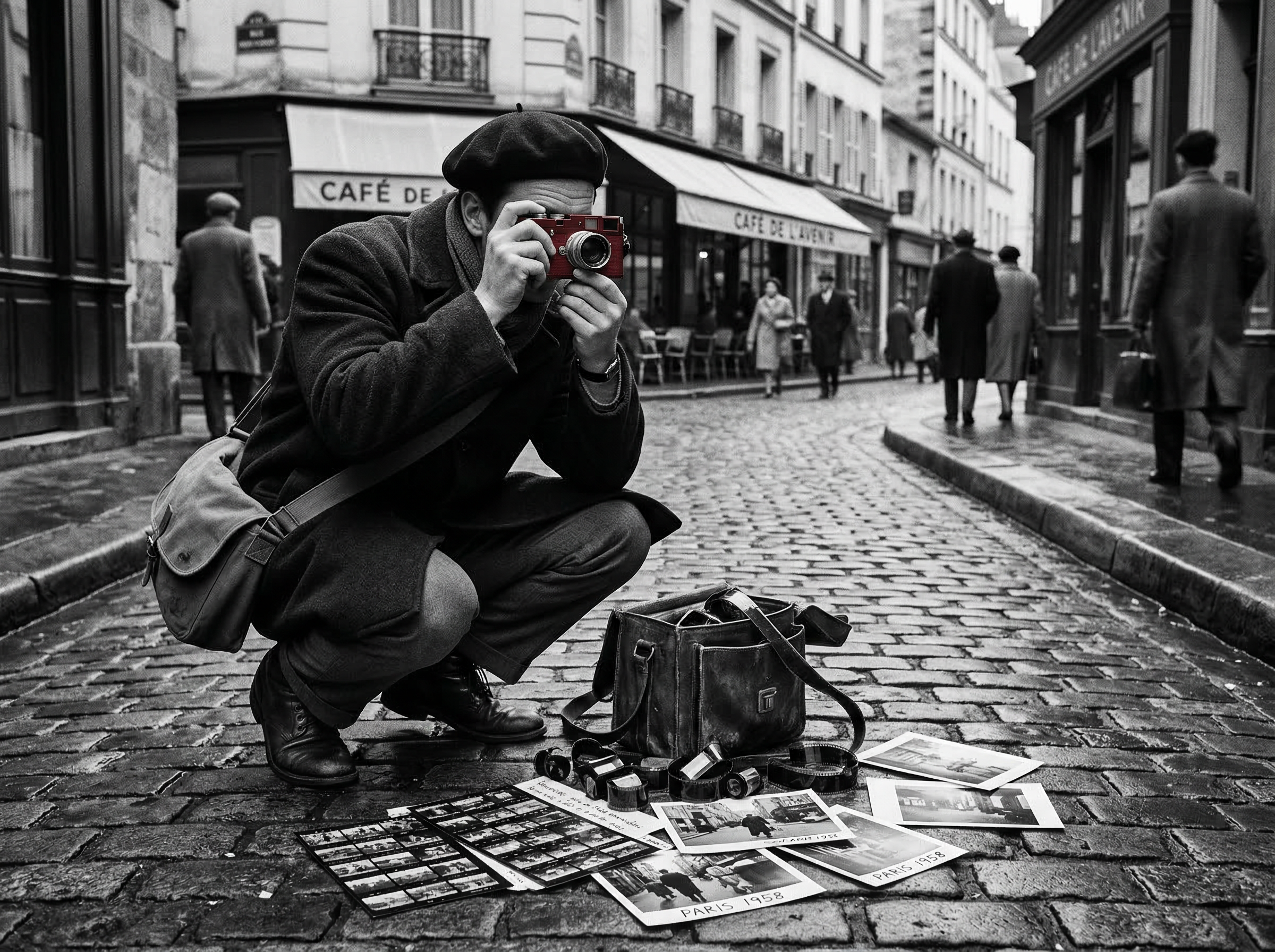
A 1950s photojournalist crouching on a cobblestone Parisian street with a Leica M3 raised to eye, contact sheets scattered nearby

If you've seen the iconic photographs of the 20th century — Cartier-Bresson's perfectly composed Paris street scenes, Robert Capa's blurred Normandy landings, Nick Ut's searing Vietnam images — you've seen the world through a Leica M.

The Leica M3, launched in 1954, wasn't just an improvement. It was a paradigm shift. The new M-bayonet mount replaced the fiddly screw mount with instant lens changes. The bright-line viewfinder combined focusing and framing into a single window. And the shutter — that whisper-quiet shutter — let photographers work without being noticed. It was the tool that made "the decisive moment" possible, not just as a concept but as a practice.

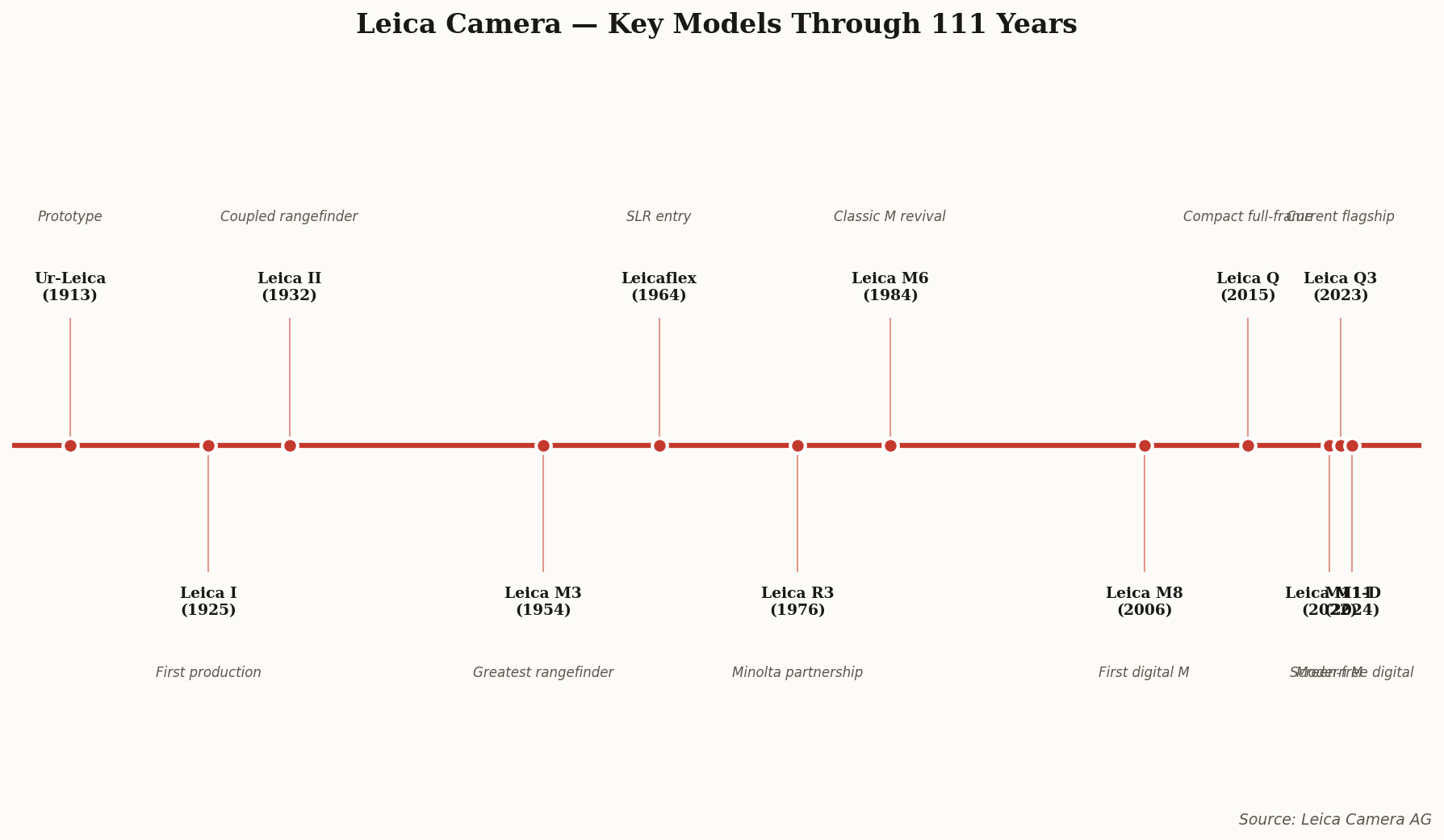
Timeline chart showing key Leica camera models from 1913 to 2024, including the Ur-Leica, Leica I, M3, Leicaflex, M8, Q, and M11-D
Key Leica camera models across 111 years — from the Ur-Leica prototype to the screen-free M11-D

Capa once said: "If your pictures aren't good enough, you aren't close enough." The M3 was built for getting close. Its near-silent operation made photographers invisible. Cartier-Bresson, who shot exclusively with Leica for decades, would wrap his chrome M3 in black tape to eliminate reflections. The camera became an extension of the eye — and the eye became the witness of history.

The M-system didn't just serve photojournalism. It defined it. The look of 20th-century conflict, culture, and candid life — from the jungles of Vietnam to the jazz clubs of Harlem — was shaped by the optics and ergonomics of that small German rangefinder.

04

When Perfection Wasn't Enough

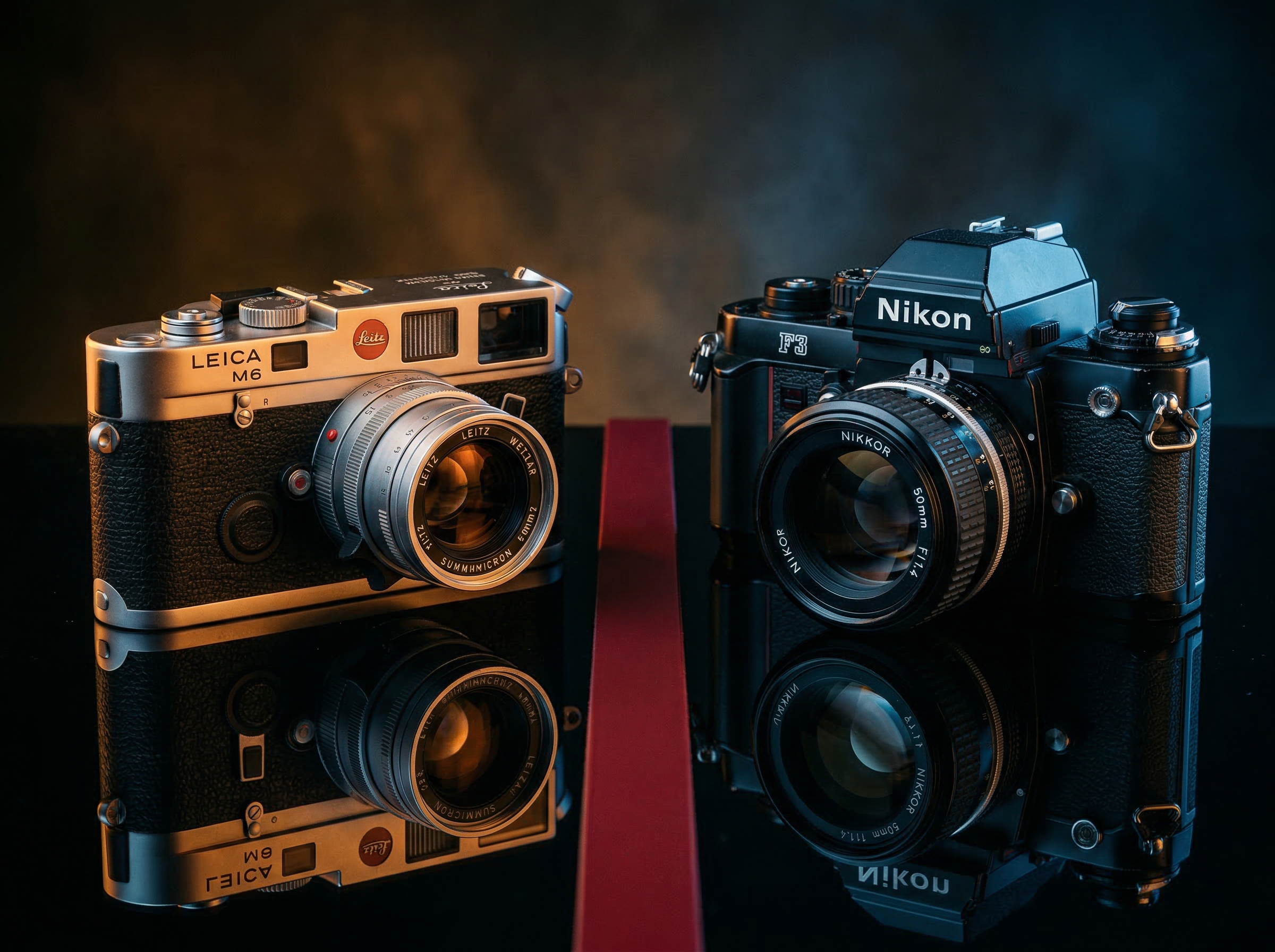
A German rangefinder camera and a Japanese SLR camera facing each other on a reflective surface like chess pieces, split lighting creating competitive tension

Here's the tragedy of being the best at something the world stops wanting: by the 1960s, the single-lens reflex (SLR) camera had arrived, and Leica was catastrophically late to the party.

The Nikon F launched in 1959 and immediately became the professional's workhorse. You could see through the actual taking lens. You could mount a motor drive. You could swap lenses for everything from macro to 300mm telephoto. Leica's response — the Leicaflex in 1964 — was beautifully machined but lacked the through-the-lens metering that Japanese cameras already offered as standard.

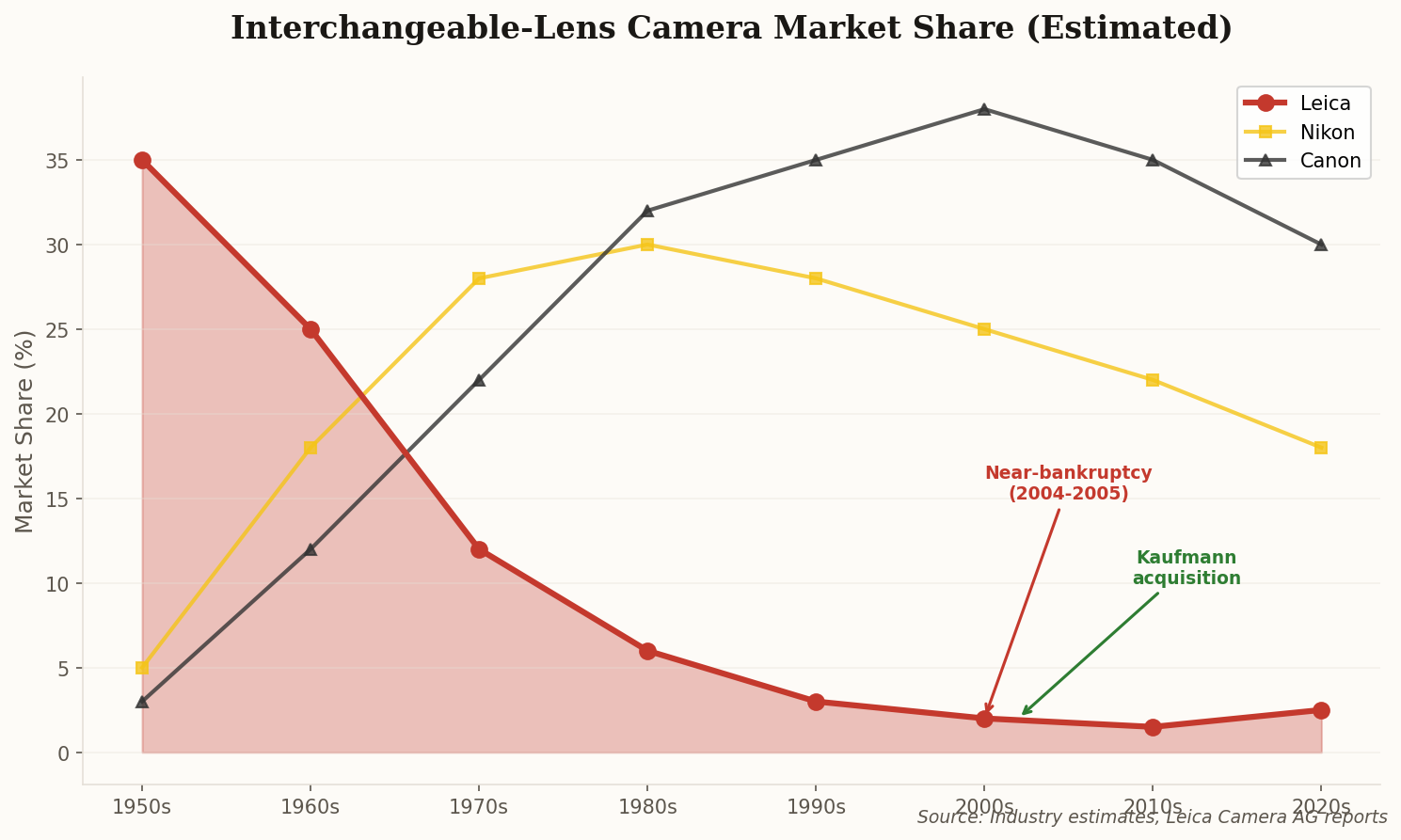
Line chart showing Leica's market share declining sharply from the 1950s through the 1990s as Nikon and Canon rose to dominance
Leica's market share collapsed as Japanese SLRs dominated — from an estimated 35% in the 1950s to a niche fraction by the 1990s

The decades that followed were a slow-motion crisis. Leica partnered with Minolta on the R-system to cut development costs. Canon and Nikon raced ahead with autofocus — a technology Leica famously dismissed, insisting manual focus was superior for professionals. They weren't wrong about the craft. They were wrong about the market.

By 2004, Leica Camera AG was on the verge of insolvency. Revenue had cratered. The brand that had defined photography for 80 years couldn't figure out how to survive in a world of pixels and autofocus. It took an Austrian businessman with a passion for cameras and a very different vision of what "Leica" could mean.

05

The Man Who Turned a Tool Company Into a Luxury Empire

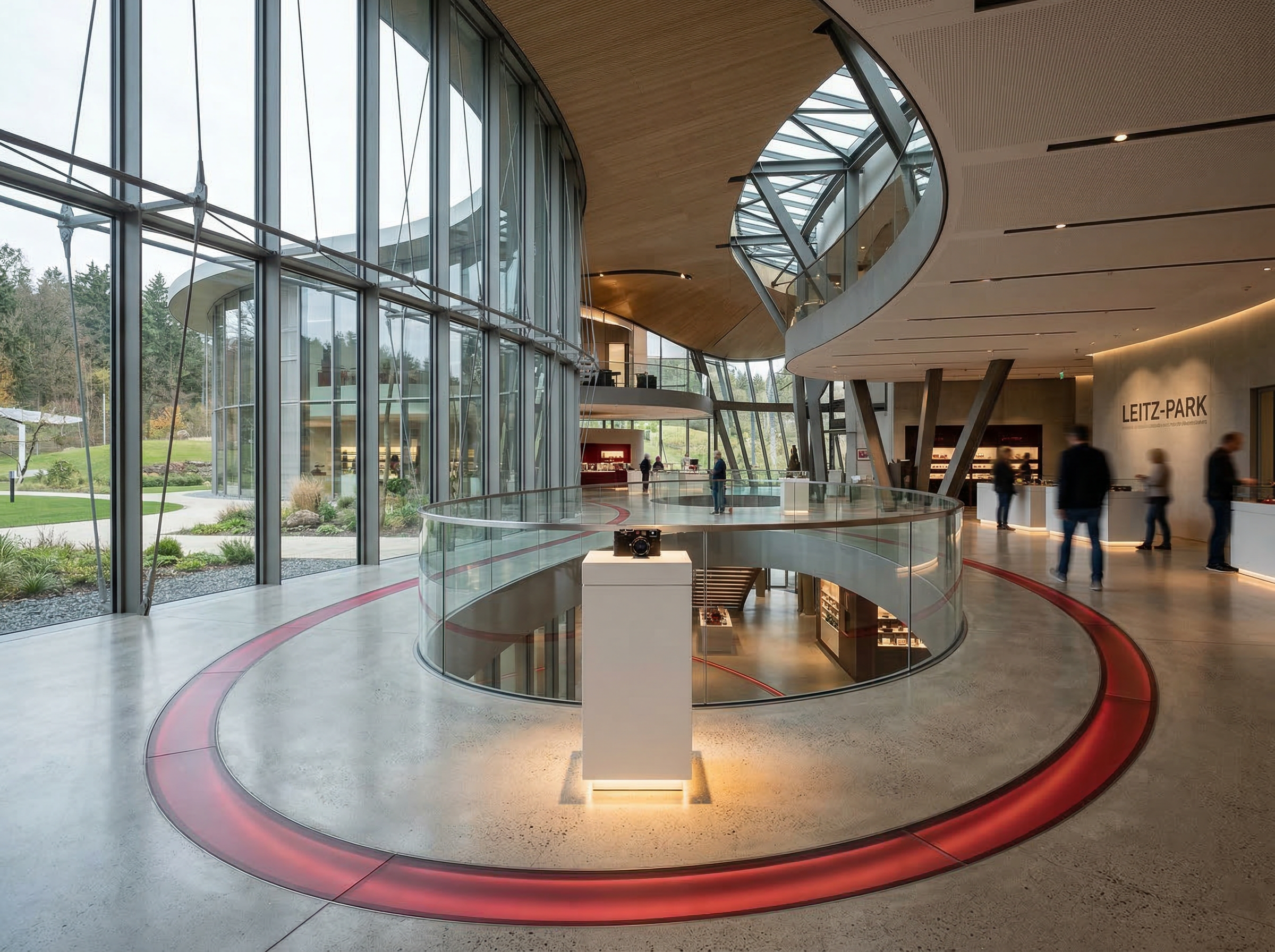
Modern architectural interior of Leitz-Park Wetzlar with sweeping glass and steel curves, a single Leica camera displayed on a minimalist white pedestal under a spotlight

Dr. Andreas Kaufmann didn't rescue Leica by making it cheaper or faster. He rescued it by making it more expensive — and by understanding that in a world drowning in images, scarcity and craftsmanship are the ultimate luxury.

When Kaufmann acquired the company in 2005, Leica was bleeding cash and identity. His diagnosis was counterintuitive: Leica's problem wasn't that it was too expensive or too slow. It was that it had lost its story. He repositioned Leica from "tool manufacturer" to luxury lifestyle brand, a move that horrified purists and saved the company.

The symbolic capstone came in 2014, when Kaufmann moved Leica's headquarters from the nondescript facilities in Solms back to Wetzlar — the city where Barnack had built the Ur-Leica a century earlier. The new campus, Leitz-Park, is a stunning glass-and-steel complex that functions as factory, museum, gallery, and retail experience. It's Willy Wonka's chocolate factory for camera nerds, and it sends a clear message: Leica is a place, not just a product.

Strategic partnerships with Panasonic (technology sharing) and the L-Mount Alliance with Sigma ensured Leica had access to modern autofocus and sensor technology without compromising its identity. The result? The most profitable era in the company's 111-year history.

06

From Pixels to Phones: The €596 Million Red Dot

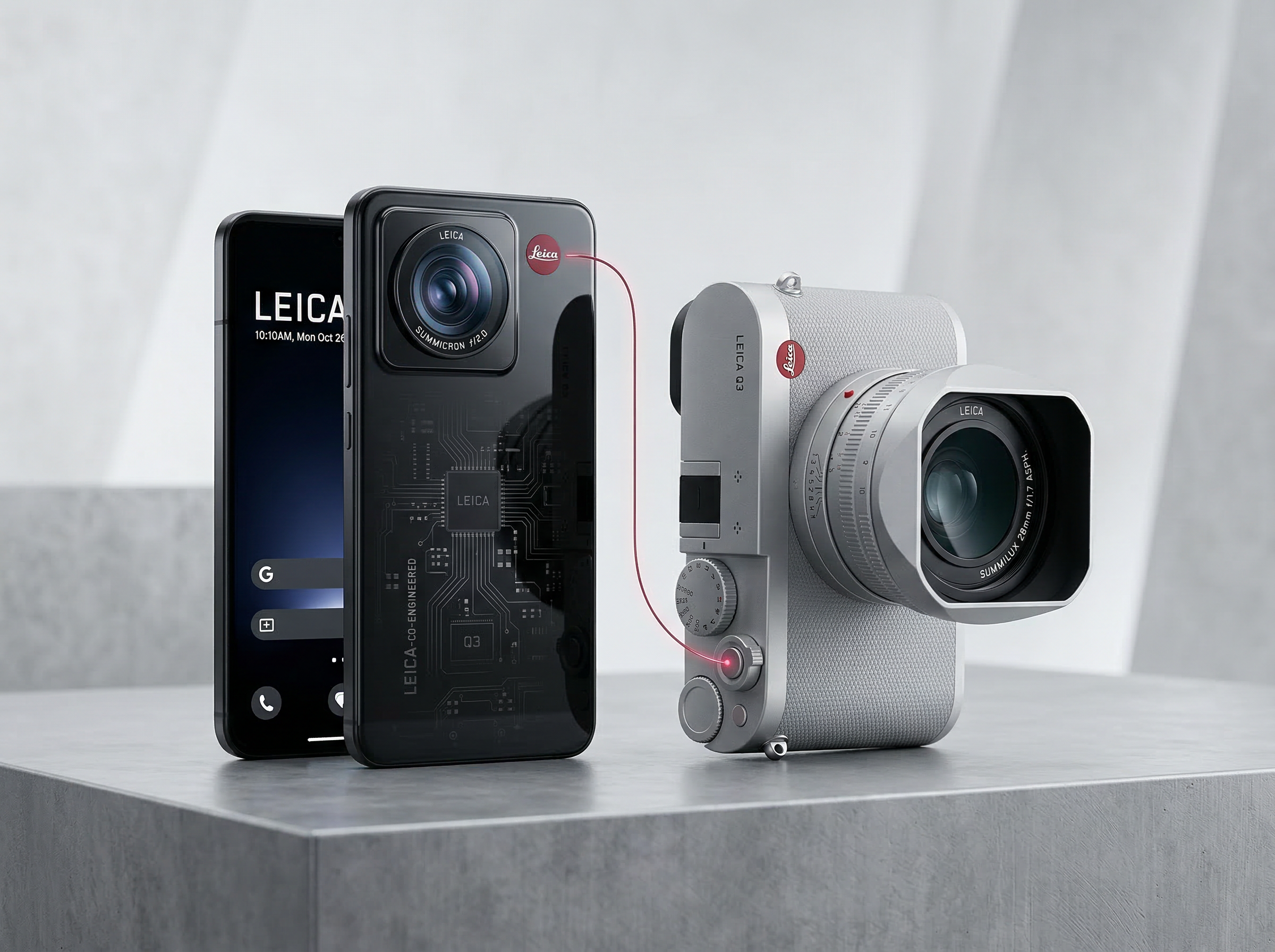
A Leica Q3 camera and a smartphone with Leica branding side by side, the phone's lens reflecting classic Leica optical design

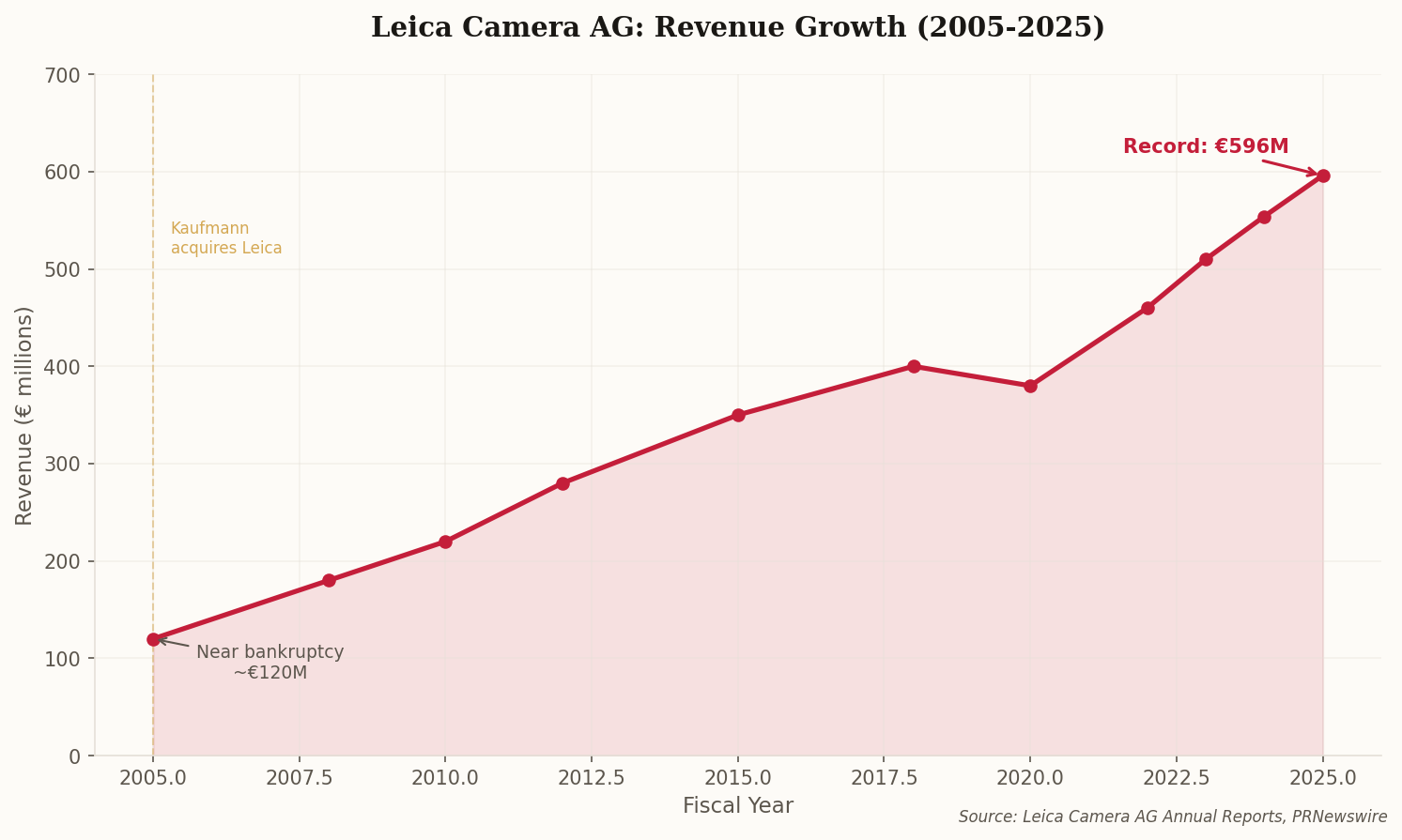
The numbers tell a story that would have seemed impossible in 2004: €596 million in revenue for fiscal year 2024/25 — Leica's fourth consecutive record-breaking year. The company that nearly died is now more profitable than at any point in its history.

Bar chart showing Leica Camera revenue growing from €420M in FY 18/19 to a record €596M in FY 24/25, with four consecutive record years highlighted
Four consecutive record years — Leica's revenue has grown 42% since FY 18/19, driven by the Q-series, luxury positioning, and smartphone partnerships

The Leica Q, launched in 2015, cracked the code that had eluded the company for decades: a full-frame, autofocus camera with Leica optics at a (relatively) accessible price point. The current Q3 is their most popular camera ever. Meanwhile, the M11-D — a digital M with no rear screen — caters to purists who believe photography is about the moment, not the chimping.

But the real multiplier is smartphones. A partnership with Xiaomi has brought the "Leica Look" — the company's distinctive color science and optical philosophy — to millions of mobile users who will never hold a rangefinder. The latest move: the Leitz Phone, a Leica-branded smartphone powered by Xiaomi hardware, launched in February 2026. It's Leica's way of saying: the red dot belongs everywhere a photograph is made.

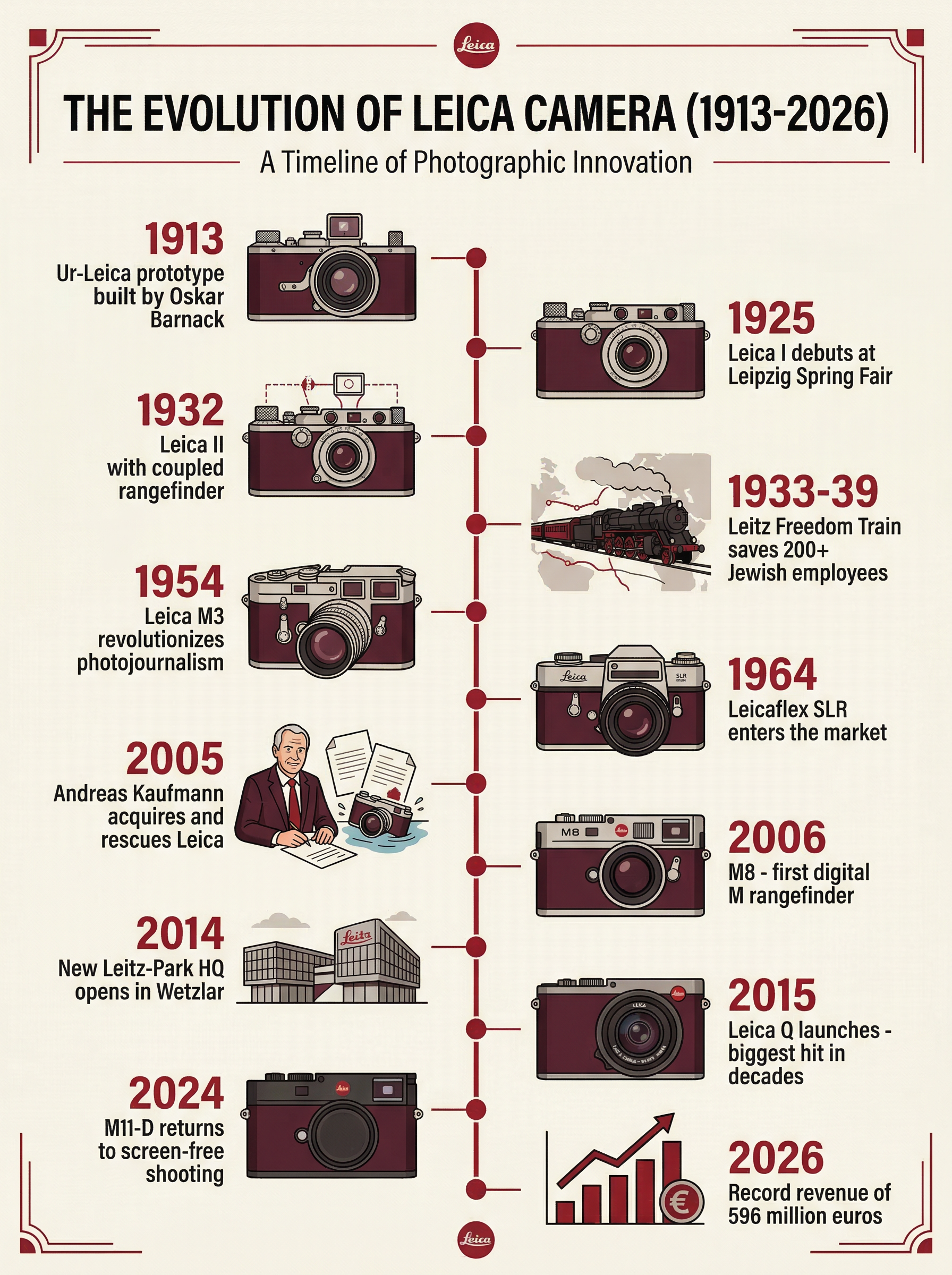
Timeline infographic showing the complete evolution of Leica Camera from the 1913 Ur-Leica prototype through the 2026 Leitz Phone, with 12 key milestones connected by a vertical red line
111 Years of the Red Dot — From Oskar Barnack's Prototype to a Global Luxury Brand — Generated with Nano Banana 2.0

Today, Leica is positioned as the "Rolex of cameras" — limited editions sell out instantly, boutiques dot the world's fashion capitals, and the red dot has become a status symbol that transcends photography. But underneath the luxury veneer, Barnack's original insight still holds: the best camera is the one that disappears in your hand and lets you see.

Small Negative, Large Picture

Oskar Barnack's mantra — "small negative, large picture" — was about film economics. But 111 years later, it reads like a philosophy of seeing. The smallest possible tool. The largest possible vision. In a world of computational photography and AI-generated imagery, there's something quietly radical about a company that still believes a photograph begins with light passing through glass, and a human choosing when to press the shutter. The red dot endures — not because Leica makes the best camera, but because it makes the most intentional one.

Share X LinkedIn