American History

The Quiet Radical

How a closed Moravian utopia became the secret capital of the global music industry — and America's coolest small town.

Listen
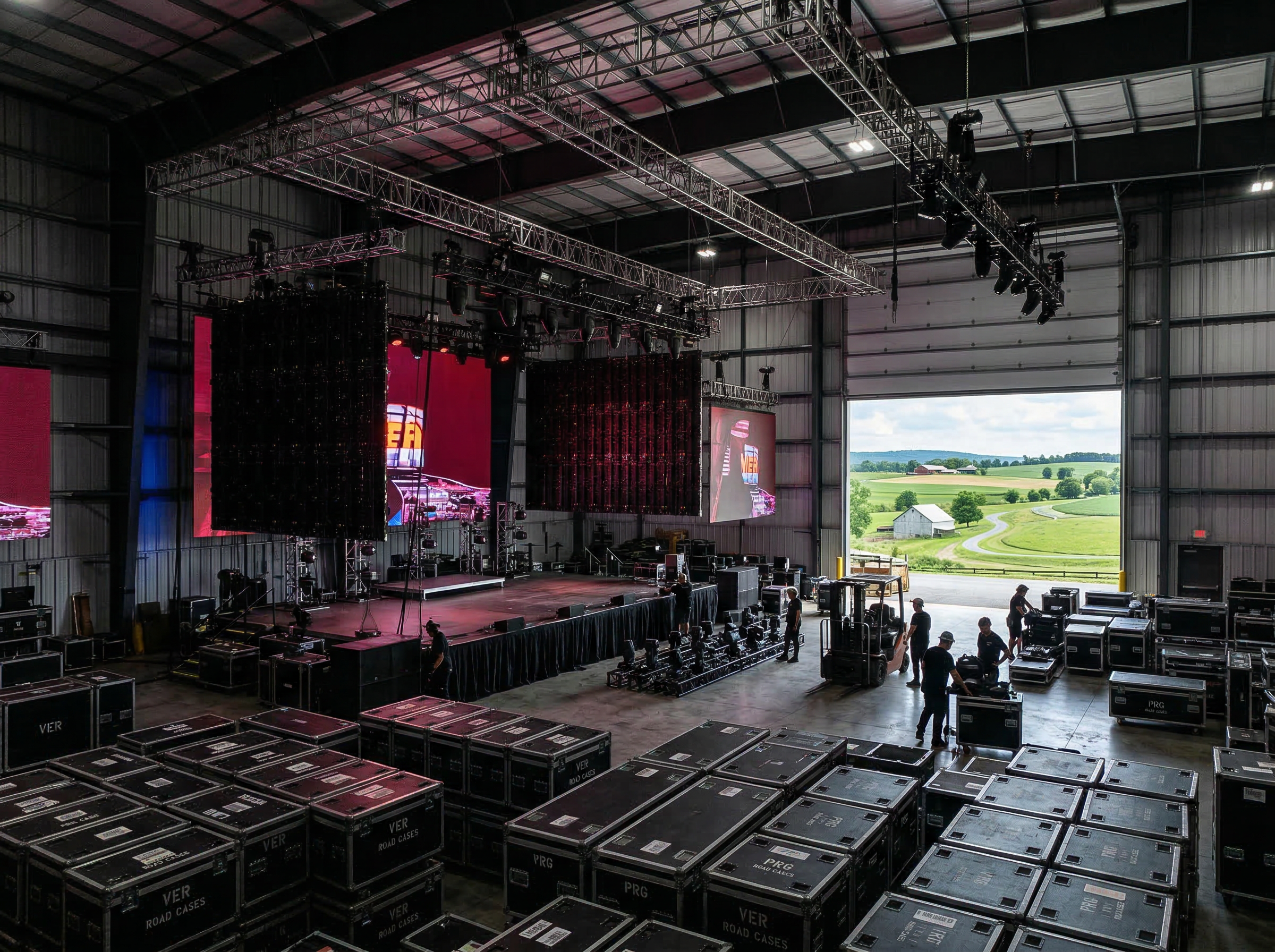
Concert production campus with LED walls and stage rigging, rural Pennsylvania visible through warehouse doors
01

The Secret Capital of the Music Industry

Here's a fact that will rearrange your mental map of America: before Taylor Swift's Eras Tour sold a single ticket, before Beyoncé's Renaissance world tour lit up its first stadium, the shows were built in a small town of 9,500 people surrounded by Lancaster County dairy farms. Rock Lititz — a 96-acre production campus — is where the world's biggest concert tours are designed, rehearsed, and stress-tested before they hit the road.

Rolling Stone once called Lititz "the secret capital of the global music industry," and they weren't exaggerating. The campus houses companies like Tait (the stage engineering firm behind most major tours), and the rehearsal facilities can accommodate full-scale arena productions. When U2 needed to rehearse a show involving a 100-foot-tall LED screen, they didn't go to LA or Nashville. They went to Lititz, Pennsylvania.

This isn't a coincidence born of cheap real estate. It's the latest chapter in a 270-year tradition of a community that builds things with extraordinary precision and craft — whether that's limestone churches, hand-twisted pretzels, or the rigging for a stadium tour. The Moravian founders who insisted on excellence in craft would recognize the ethic, if not the LED screens.
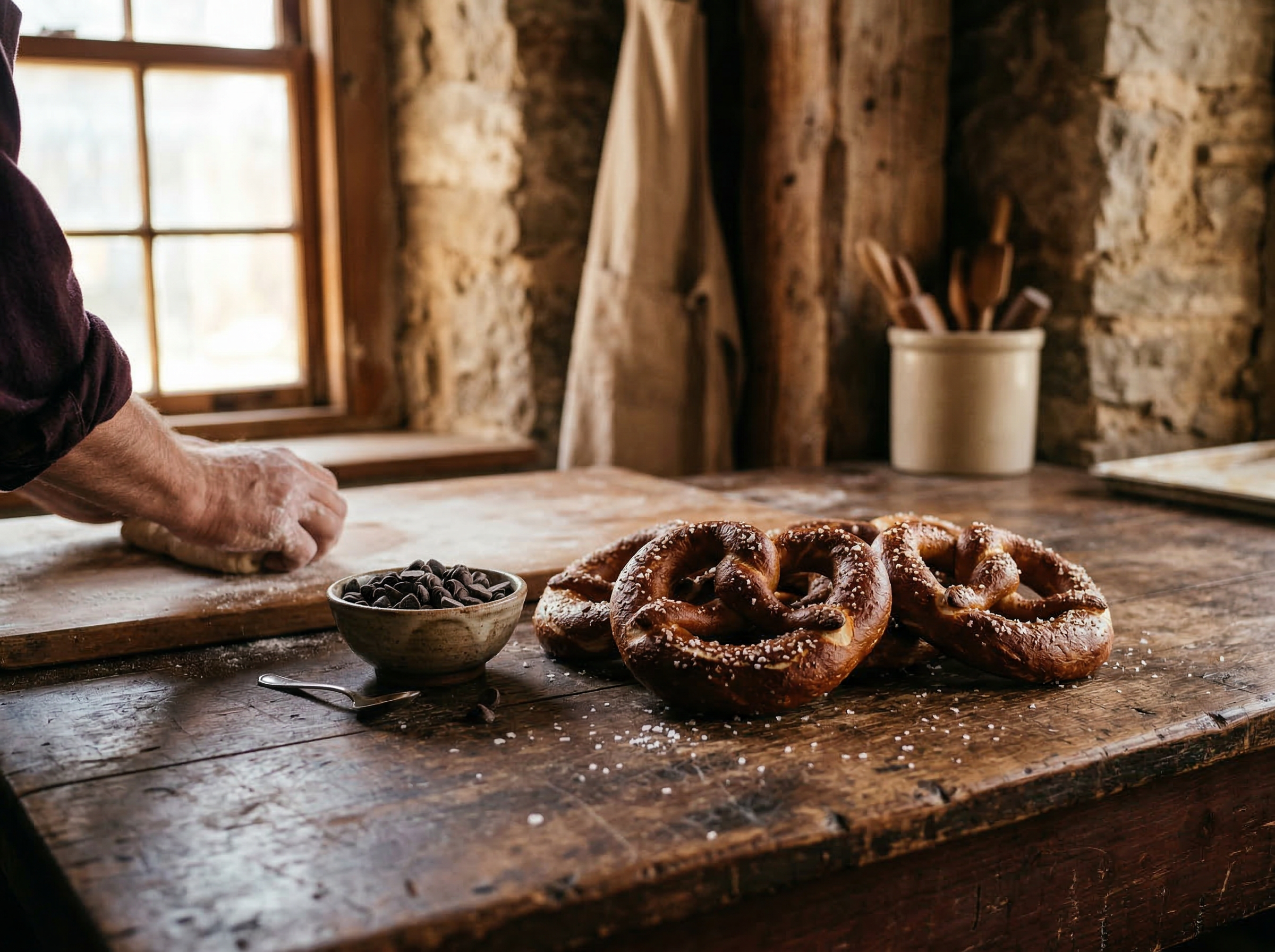
Artisan pretzel being hand-twisted in an old stone bakery, with Wilbur Buds chocolate nearby
02

Before Hershey, There Was Lititz

The origin story is almost too good: in 1861, a grateful traveler repaid Julius Sturgis for a meal by teaching him a pretzel recipe. Sturgis opened what became the first commercial pretzel bakery in America, and the building still stands on East Main Street. You can still twist your own pretzel there. It's been running for 165 years.

But Lititz's real power move in the snack world came when the Wilbur Chocolate Company relocated to town in the 1930s. Here's the detail most people miss: Wilbur's signature product, the Wilbur Bud, was introduced in 1894 — more than a decade before Hershey's Kiss. The Bud came first. On certain days, the scent of chocolate still wafts through downtown Lititz, a sensory reminder that this town helped establish Pennsylvania as the snack food capital of the world.

The Wilbur factory itself tells the modern story too. In 2016, it was converted into the Wilbur Lititz — a Tapestry Collection by Hilton hotel — preserving the industrial architecture while bringing luxury hospitality to the north end of town. It's preservation that pays for itself.

18th century Moravian limestone buildings on a village square in colonial Pennsylvania
03

When the Moravians Built a Utopia in Lancaster County

In 1742, a Bohemian nobleman named Count Nikolaus Ludwig von Zinzendorf visited Warwick Township in Lancaster County and envisioned something radical: a "settlement congregation" where spiritual life and daily life were one and the same. Fourteen years later, he named it Litiz, after Litice Castle in Bohemia — the fortress where the Moravian Brethren had taken refuge three centuries earlier.

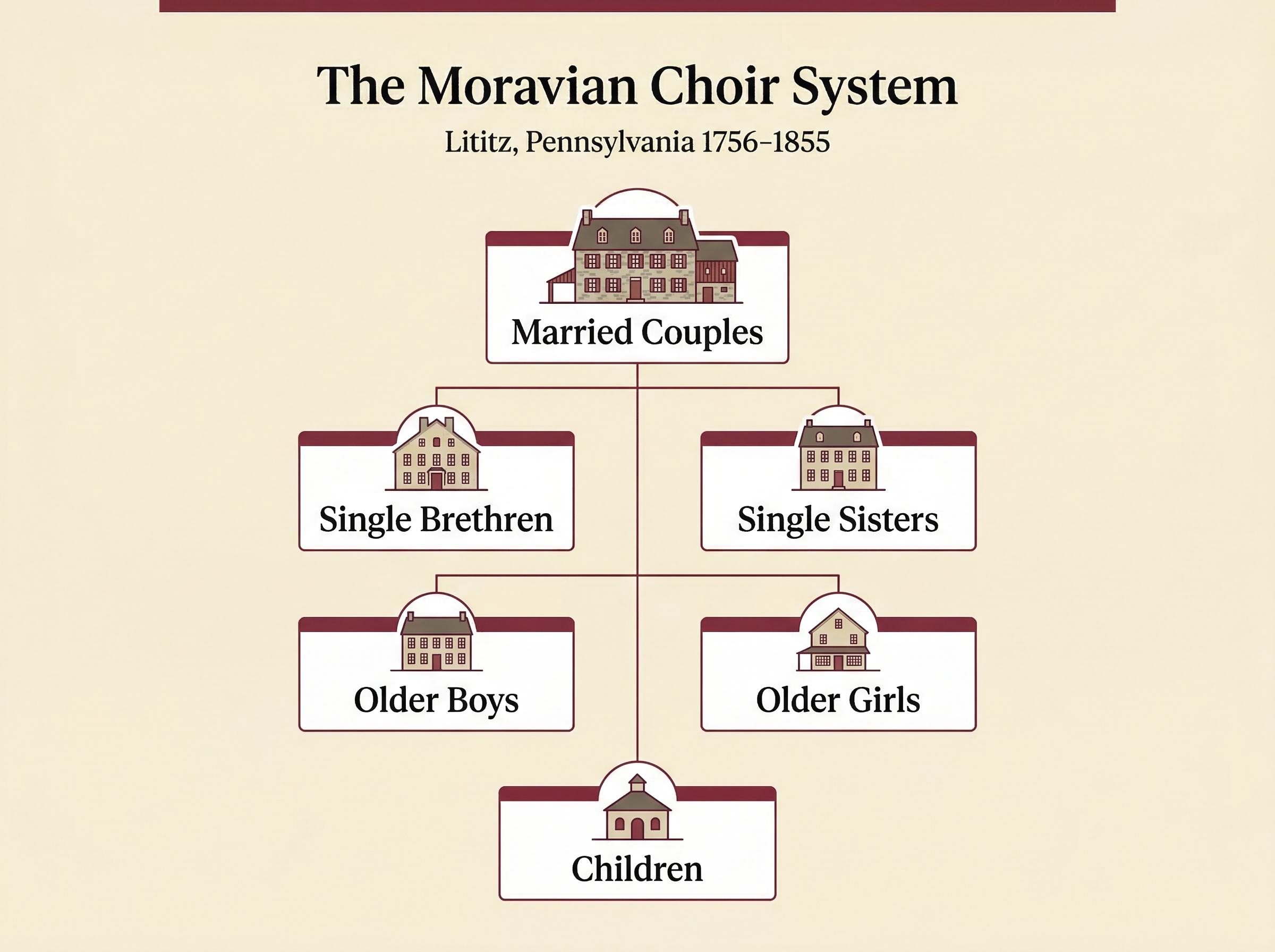
What emerged was one of the most intentionally designed communities in colonial America. For nearly a century — from 1756 to 1855 — Lititz was a "closed" town. Only members of the Moravian Church could own property. Residents were organized into "Choirs" based on age, gender, and marital status: married couples, single brethren, single sisters, older boys, older girls, and children. Each choir had its own house — the Gemeinhaus (1746), the Brethren's House (1759), the Sisters' House (1758) — all built from the local limestone that still defines the town's visual identity.

Infographic showing the Moravian Choir System organizational structure: Married Couples, Single Brethren, Single Sisters, Older Boys, Older Girls, and Children — each with their own dedicated house
The Moravian Choir System — organizational structure of the closed community (1756–1855)

The cemetery tells you everything about their values. God's Acre, the Moravian burial ground, features flat headstones all of identical size — a statement of radical equality that feels almost subversive for the 18th century. In death, as in life, no one stood above anyone else.

"I have but one passion: It is He, it is He alone." — Count Zinzendorf, on the Christ-centered focus of Moravian life

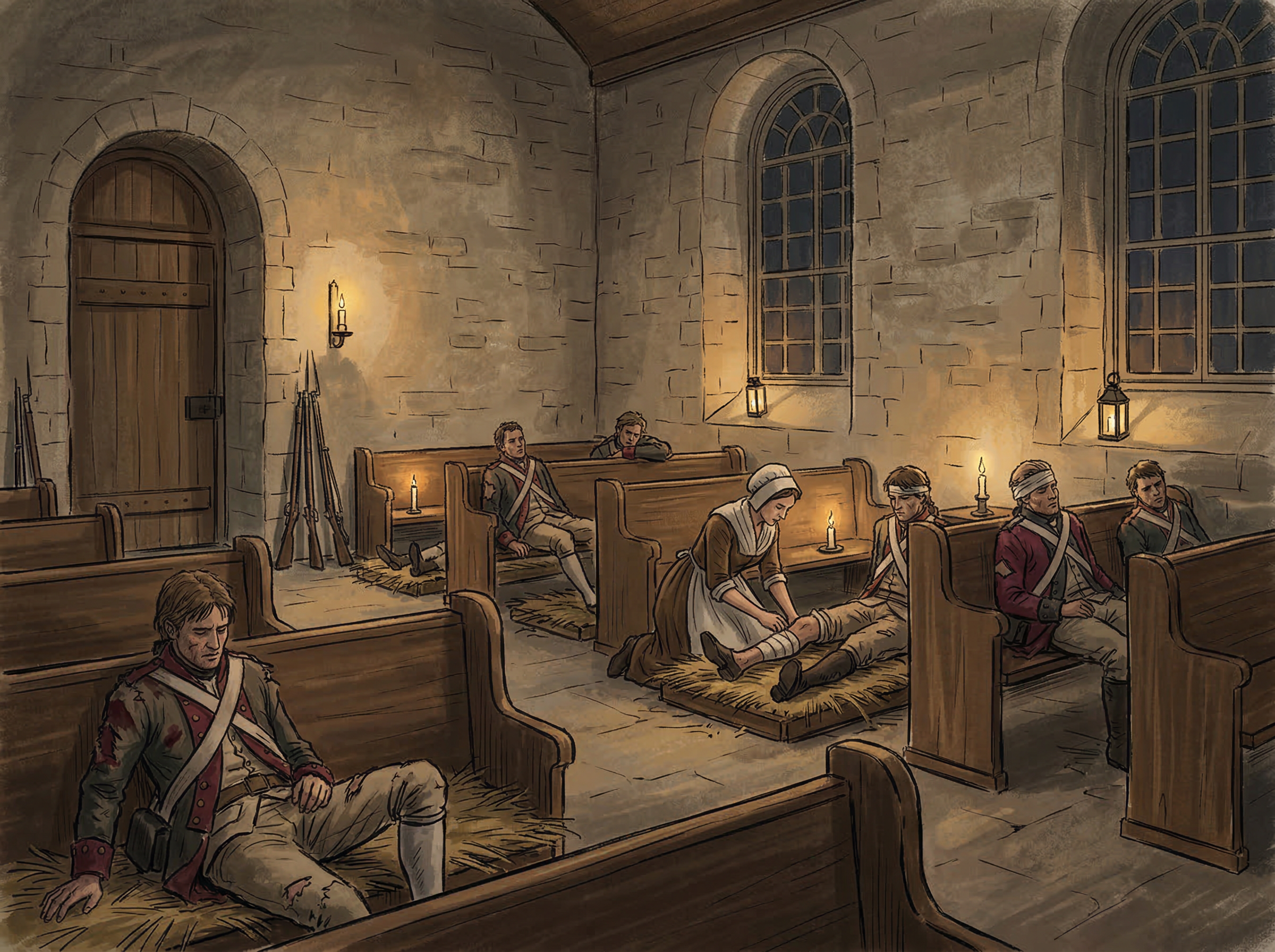
Continental Army hospital inside a converted Moravian church, soldiers on cots tended by candlelight
04

The Revolution Came to Church Square

The Moravians were pacifists. They had built their closed community precisely to avoid the conflicts of the outside world. But in 1777, after the Battles of Brandywine and Germantown, the outside world came to them. The Brethren's House — the residence for unmarried men, the very heart of the Choir system — was commandeered as a Continental Army hospital.

What followed was brutal. Approximately 110 soldiers died there, mostly from typhus, and were buried in a mass grave at the edge of the Moravian Cemetery. Meanwhile, the community's pacifist convictions bent under the weight of necessity. At nearby Elizabeth Furnace, ironmaster Robert Coleman — who would become Pennsylvania's first millionaire — oversaw the production of cannonballs, grapeshot, and artillery shells for Washington's army. Hessian prisoners of war, captured at Trenton, were put to work digging a mile-long ditch through solid rock to increase water power for the furnace.

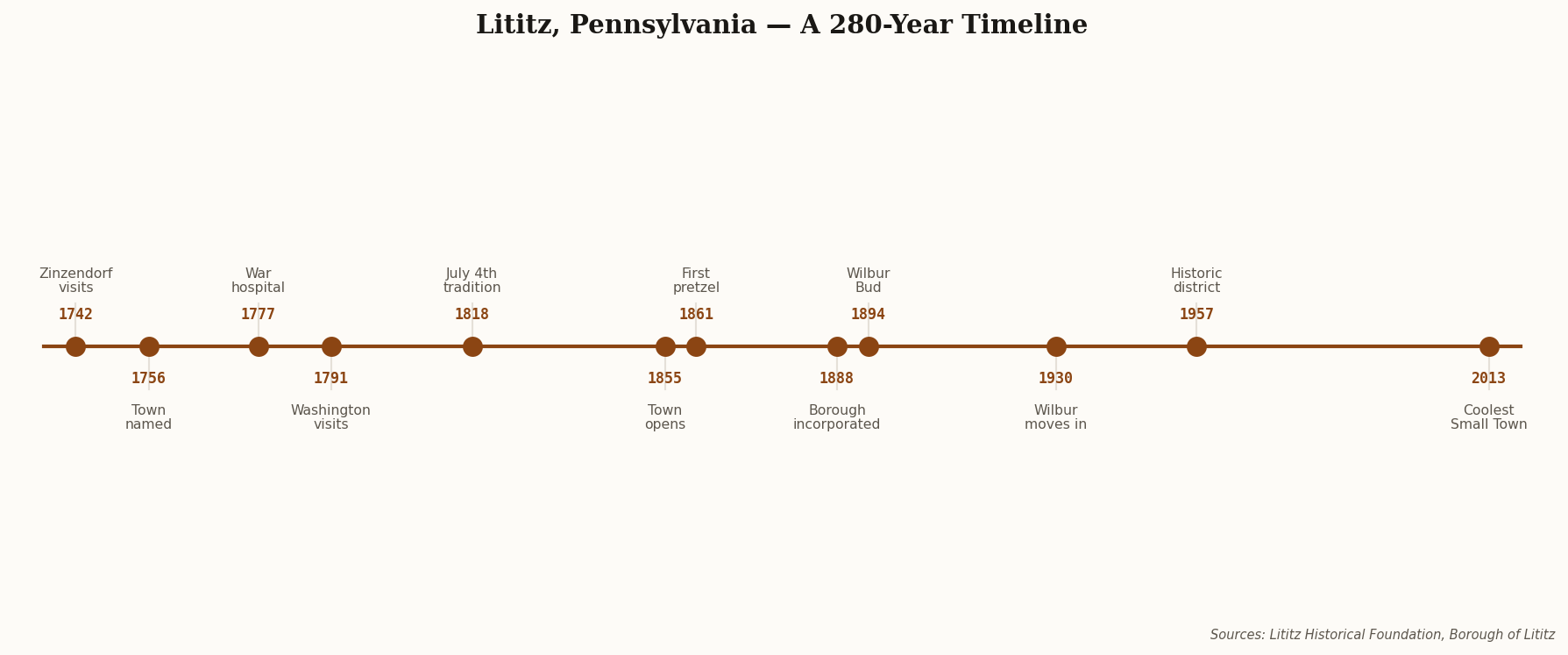
Timeline of Lititz history from 1742 to 2024, showing key events from Zinzendorf's visit through the Academy of Live Technology
280 years of Lititz history — from Moravian settlement to global music industry hub

The trombone choir kept playing through all of it. Historical accounts describe "the clear deep music of the trombone choir" breaking the morning silence even as wounded soldiers filled the town's most sacred buildings. That trombone choir — the oldest of its kind in the United States — still performs at every Easter sunrise service.

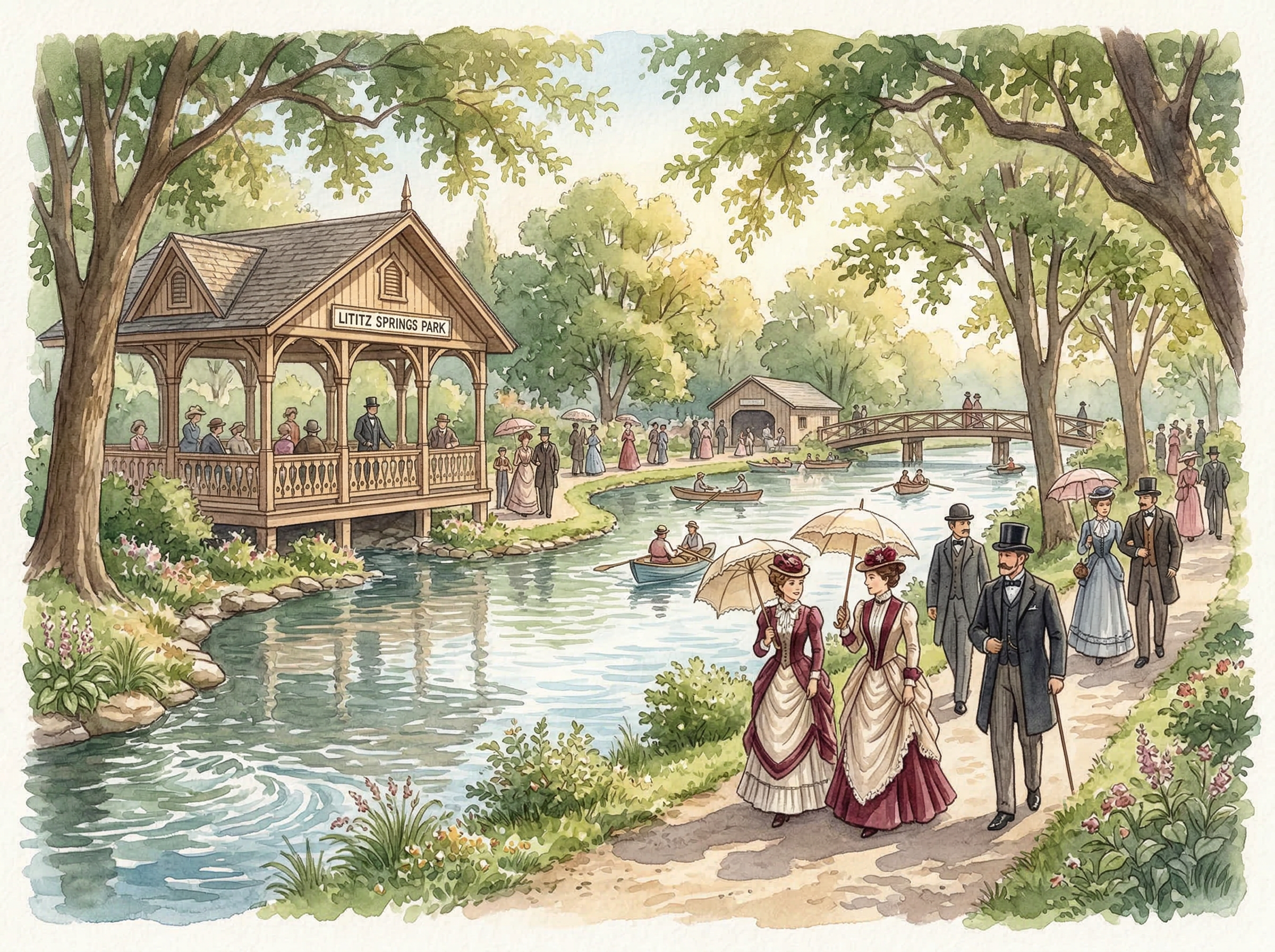
Victorian-era resort scene at Lititz Springs, elegant guests strolling through a park with flowing spring water
05

Healing Waters and High Society

When the Moravian community finally opened its gates in 1855, something unexpected happened: the world came rushing in, and it came for the water. Lititz Springs Park — often cited as the oldest continuously managed community park in America — became the centerpiece of a 19th-century health tourism boom.

The natural springs were believed to cure everything from rheumatism to general malaise (the 1800s were generous with their medical claims). Grand hotels sprang up to accommodate the visitors, most notably what became the General Sutter Inn, which had been operating since 1764 and became the epicenter of high-society tourism in the region.

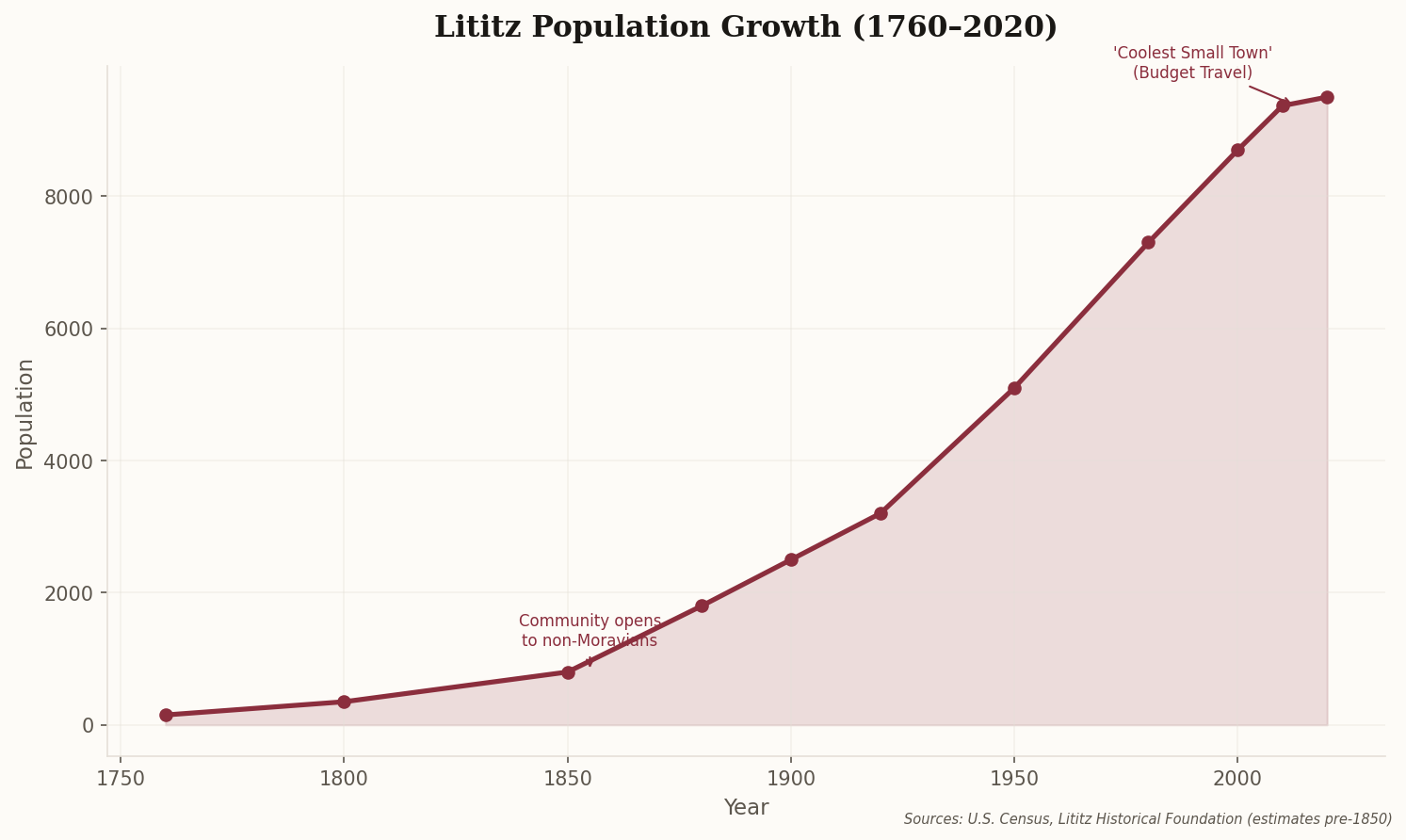
Line chart showing Lititz population growth from 150 in 1760 to 9,500 in 2020, with annotations for key moments
Lititz population growth — from 150 Moravian settlers to nearly 10,000 residents

And then there's General John Sutter himself — yes, that Sutter, the man whose land discovery triggered the California Gold Rush. After decades of legal battles over his land claims, Sutter retired to Lititz in 1871, drawn by the healing springs and the town's quiet dignity. He spent his final nine years there, lobbying Congress for compensation that never came, and was buried in the Moravian Cemetery's God's Acre in 1880. Even in Lititz's cemetery, the flat headstones made a Gold Rush pioneer equal to everyone else.

Night scene at Lititz Springs Park with thousands of floating candles along a stream, a Moravian Star glowing above
06

The Night the Stream Catches Fire

Every Fourth of July, Lititz does something that feels like it belongs in a different century — because it does. The town's Independence Day celebration has run continuously since 1818, making it one of the oldest in America. But it's the Grand Illumination, a tradition since 1843, that stops you cold.

As darkness falls on Lititz Springs Park, thousands of candles are lit and placed along the Lititz Run stream. The candlelight reflects off the water, creating the illusion that the stream itself is on fire. Families line the banks. A Moravian Star — the multi-pointed geometric symbol representing the Star of Bethlehem — hangs luminous above the scene. It's not a fireworks show. It's older than that, and stranger, and more beautiful.

Then there's Linden Hall, founded in 1746 — making it the oldest girls' boarding school in continuous operation in the United States. It predates the Declaration of Independence by 30 years. The school evolved from the Moravian Sisters' House, and its campus still occupies those original limestone buildings. When people talk about Lititz's commitment to continuity, they're not speaking in metaphors.

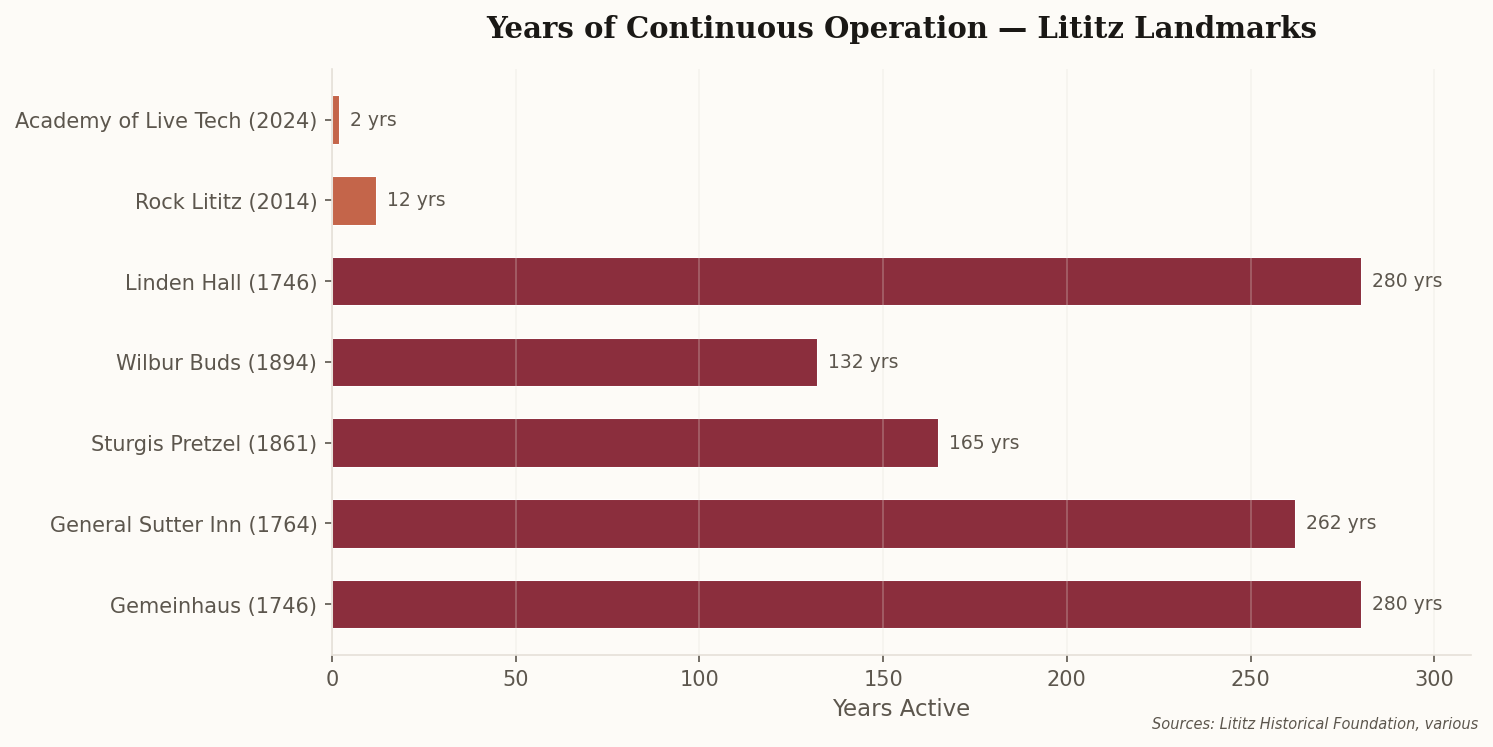
Horizontal bar chart showing years of continuous operation for Lititz landmarks, from Rock Lititz (12 years) to Gemeinhaus and Linden Hall (280 years)
Years of continuous operation — some Lititz institutions have been running since before the American Revolution
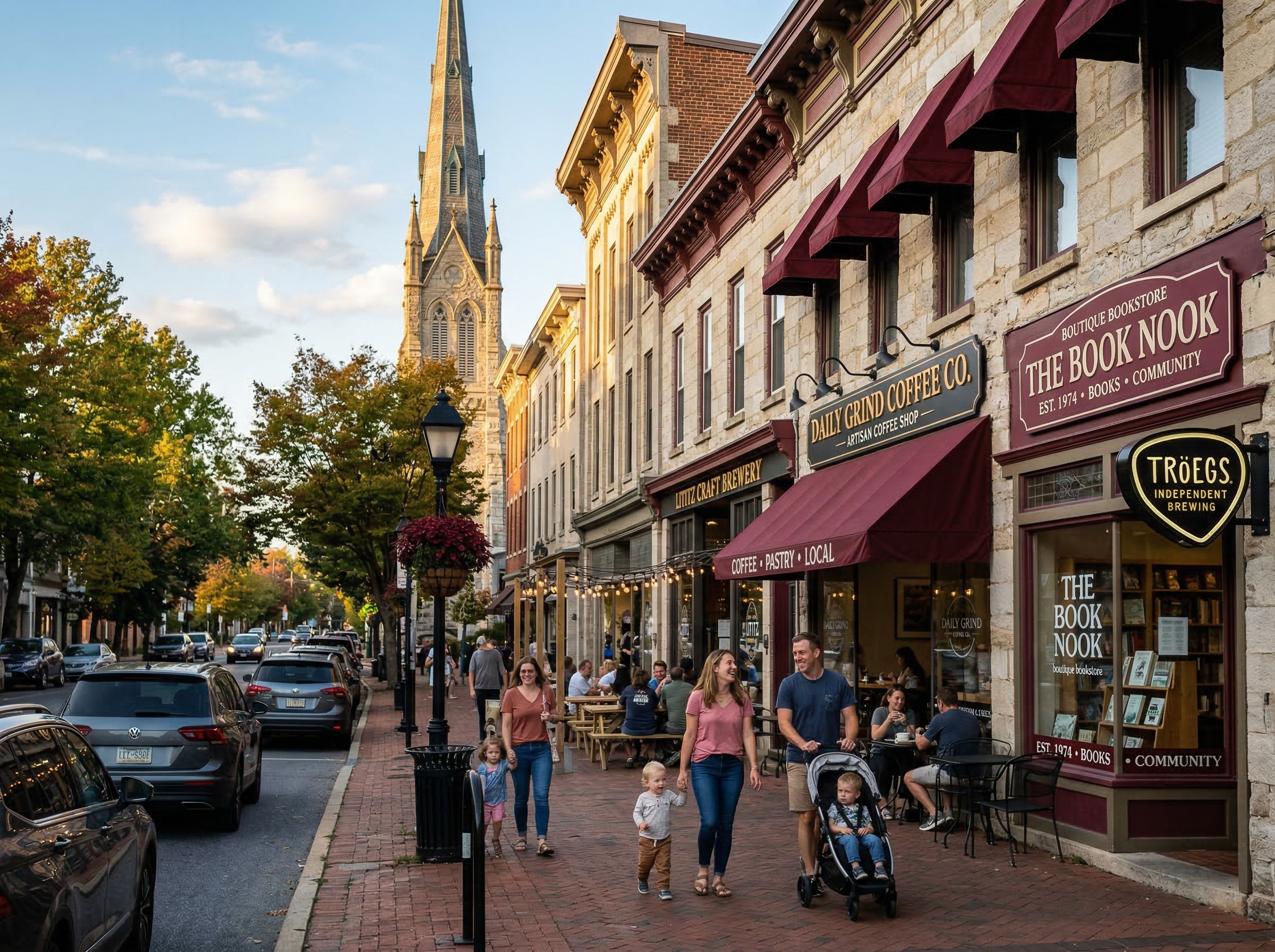
Modern aerial view of Lititz blending 18th-century limestone architecture with contemporary development, Lancaster County farmland beyond
07

270 Years Later, Still Cool

In 2013, Budget Travel named Lititz "America's Coolest Small Town." It was validation, but also an accelerant. The decade since has been a careful balancing act: how do you absorb the attention without losing what made you interesting in the first place?

The answer, so far, has been characteristically Lititz — deliberate and craft-focused. The Academy of Live Technology (ALT), launched in 2024 at Rock Lititz, now offers the first-of-its-kind BFA in live event production. It's a school that literally did not exist as a concept a decade ago. Meanwhile, Lititz Springs Park is undergoing a multi-million-dollar infrastructure renovation (2025–2026) to preserve its bridges and waterways — ensuring the springs flow for another century. The Bulls Head Public House, consistently ranked among the best beer bars in America, anchors a craft beverage scene that draws visitors from across the region.

And there's the Regional 2030 Plan — a joint effort by Lititz and surrounding townships to manage the town's massive popularity while preserving the Lancaster County farmland that gives it context. It's the Moravian planning instinct, updated for the 21st century: thoughtful, communal, and playing the long game.

Lititz has successfully modernized without losing its soul — proof that historical towns can be global leaders in innovation, if they play the long game.

The Stones Tell the Story

Most towns preserve their history in museums. Lititz preserves it by still living in it — baking pretzels in a 165-year-old bakery, singing in a trombone choir that predates the Constitution, lighting candles along a stream that's been flowing since the Moravians first knelt beside it. The genius of the place isn't that it resists change. It's that it absorbs change on its own terms, the way limestone absorbs rain — slowly, and without losing its shape.

Share X LinkedIn