Presentations & Storytelling

It's the Narrative, Stupid

Why the most powerful skill in presentations isn't design, data, or delivery — it's the story you choose to tell.

Listen
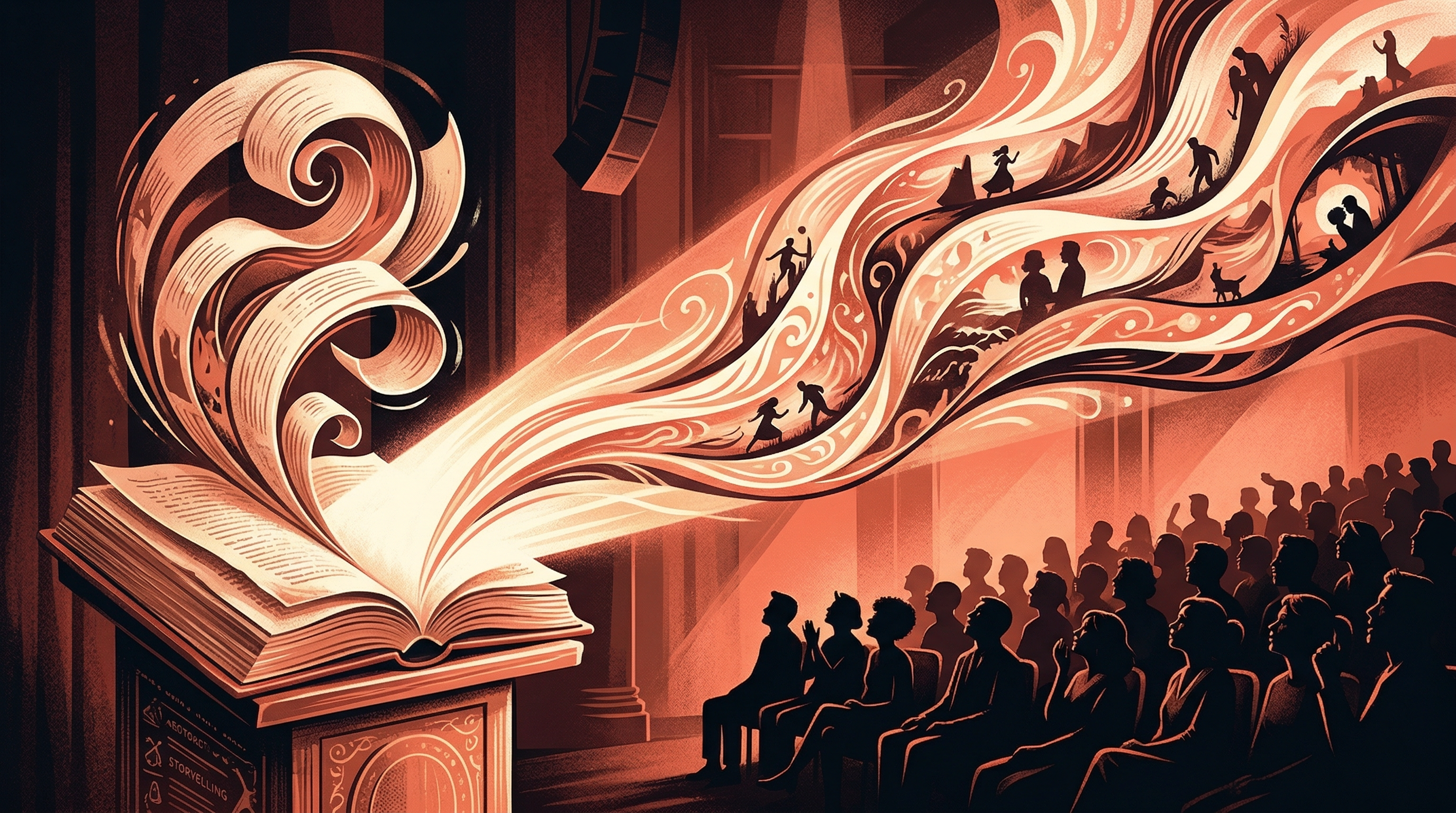
An open book transforming into narrative arcs flowing toward an audience bathed in warm coral light
A speaker at a podium whose words transform into luminous story arcs flowing over the audience
01

You're Not a Presenter. You're a Storyteller.

Here's a question that should make every executive uncomfortable: when was the last time a PowerPoint deck actually changed someone's mind? Not informed them. Not impressed them with your data hygiene. Actually rewired what they believed was possible?

HBR's latest piece on organizational change makes the argument with surgical precision. Researcher Jay Barney has found that "authentic and memorable stories" are the only reliable mechanism for overwriting existing organizational culture. Not memos. Not all-hands meetings. Not that beautifully designed slide with the three concentric circles. Stories.

The most provocative recommendation? Storyboard with a pen before you touch software. The logic must precede the visuals, not the other way around. Too many presenters open Keynote first and reverse-engineer a narrative from whatever template looked prettiest. That's not storytelling — that's decorating.

"The most effective communicators don't just present data; they architect a narrative where the audience is the protagonist facing a necessary change."

This reframes the entire job. You're not delivering information. You're engineering a moment where your audience sees themselves differently. That's the difference between a presentation and a performance — and in 2026, it's the only competitive advantage AI can't replicate.


Generic AI-generated slides crumbling apart, revealing hand-drawn storyboards beneath
02

AI Slop Is the New Slidument — And It's Everywhere

Garr Reynolds — the man who literally wrote Presentation Zen and spent two decades fighting the "slidument" — has a new nemesis. He calls it AI Slop: the tendency to let AI fill your slides with generic paragraphs that you then read aloud to an audience who could have read them faster.

The irony is devastating. We spent years telling people to stop cramming slides with text. Then AI made it effortless to generate even more text, and suddenly we're back to square one — except now the mediocrity is grammatically flawless and has consistent font sizing.

Reynolds advocates for what he calls the "Rebel Alliance" approach: massive typography, wide margins, and high-impact visuals that are deliberately incomplete without the speaker's narration. The slide should raise a question. Your voice should answer it. If the audience can read your slides faster than you can speak, you've already lost.

"If your audience can read your slides faster than you can speak, you have failed the performance."

This is the uncomfortable truth about AI presentation tools. They've dramatically lowered the floor — anyone can make something that looks professional. But they've done nothing to raise the ceiling. The gap between "competent-looking" and "actually persuasive" has never been wider. And narrative is what fills that gap.

Abstract visualization of brain chemistry during storytelling with golden oxytocin molecules
03

Your Brain on Story: The 30-Second Trust Hack

Here's the neuroscience that should permanently end the "just give me the data" argument. The NeuroLeadership Institute has found that character-driven stories — even in bone-dry B2B technical sales — trigger oxytocin, the neurochemical responsible for trust and empathy.

Without a human in the story, your audience's brain stays parked in the prefrontal cortex: skeptical, analytical, looking for flaws. That's the mode you don't want. But introduce a 30-second "vulnerability moment" — a real person facing a real problem — and you get up to 40% more narrative transportation. The audience stops evaluating and starts experiencing.

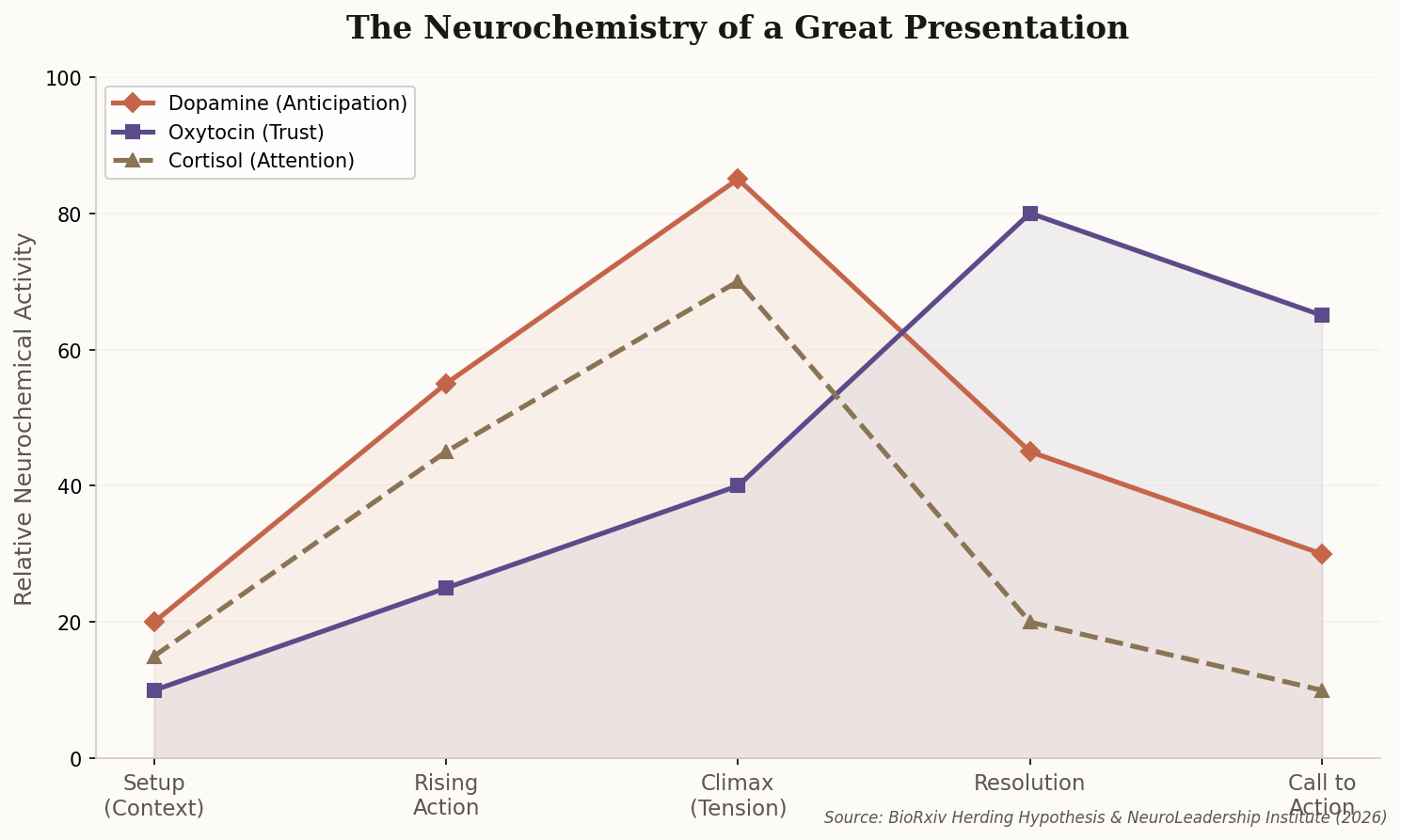
Line chart showing dopamine, oxytocin, and cortisol levels through the five stages of a narrative-driven presentation
The neurochemistry of a great presentation: dopamine drives anticipation during rising action, cortisol maintains attention at the climax, and oxytocin builds trust during the resolution.

This isn't soft skills mysticism. It's biochemistry. When you open a pitch with "Let me tell you about a customer named Sarah who was about to miss her quarterly target," you're not being folksy — you're triggering a measurable chemical cascade that makes your data land harder when it arrives three slides later.

"Trust is the precursor to persuasion, and oxytocin is the currency of trust."

The implication for every presenter reading this: your "skip the intro, get to the numbers" instinct is actively sabotaging your effectiveness. The story is the setup that makes the numbers meaningful.

Traditional presentation slides dissolving into a flowing, scrollable web interface
04

70 Million Users Later, the Slide Is Dead

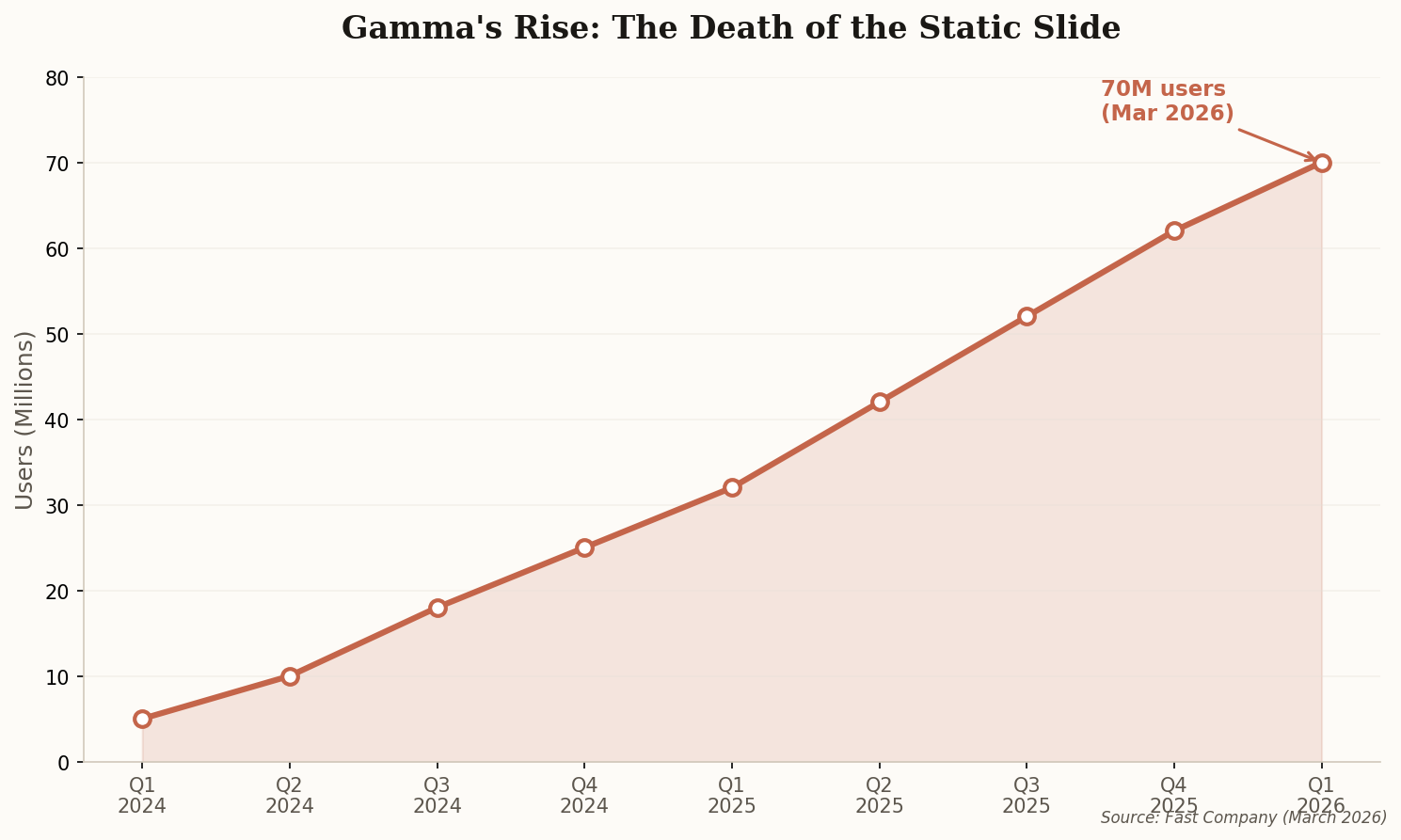
Gamma just crossed 70 million users, and the reason has nothing to do with prettier templates. It's because they killed the slide.

Instead of the 4:3 rectangle — a relic of the overhead projector era that we've been inexplicably dragging into the 2020s — Gamma uses "cards" and web-native scrolls. Your presentation isn't a stack of discrete frames anymore. It's a flowing narrative surface, responsive, interactive, and designed for how people actually consume information in 2026: scrolling, not clicking.

Line chart showing Gamma's user growth from 5 million in Q1 2024 to 70 million in Q1 2026
Gamma's explosive growth mirrors the market's hunger for narrative-first presentation tools that break free from the static slide paradigm.

The real innovation is their "Structural Reasoning" AI. Instead of just making things look nice (the AI Slop trap from Reynolds' critique), it analyzes your content and breaks it into a logical narrative hierarchy. It's asking "what's the story here?" before it asks "what's the layout?" That's the right order of operations.

Perhaps most telling: Gamma now offers an "AI Agent" for bulk tone shifting — "Make this entire deck feel 20% more urgent." The fact that urgency is a dial you can turn tells you everything about where presentation tools are heading. It's not about slides. It's about emotional architecture.

"The 4:3 slide is a relic of the overhead projector; the future of storytelling is a responsive, interactive web surface."

Audience silhouettes with synchronized glowing brain patterns
05

The Herding Hypothesis: Your Story Literally Syncs Brains

If the oxytocin research was the opening act, this is the headliner. A new neuroscience paper on BioRxiv proposes the "Herding Hypothesis": a well-told story doesn't just align the audience with the speaker — it causes the audience's brains to synchronize with each other.

Using fMRI data, researchers demonstrated that high-quality narratives produce "neural coupling" across listeners. The tension-driven arc — setup, rising action, climax, resolution — triggers dopamine during anticipation, physically wiring information into long-term memory. Bullet points, by contrast, activate only the language processing centers. The story activates the whole brain.

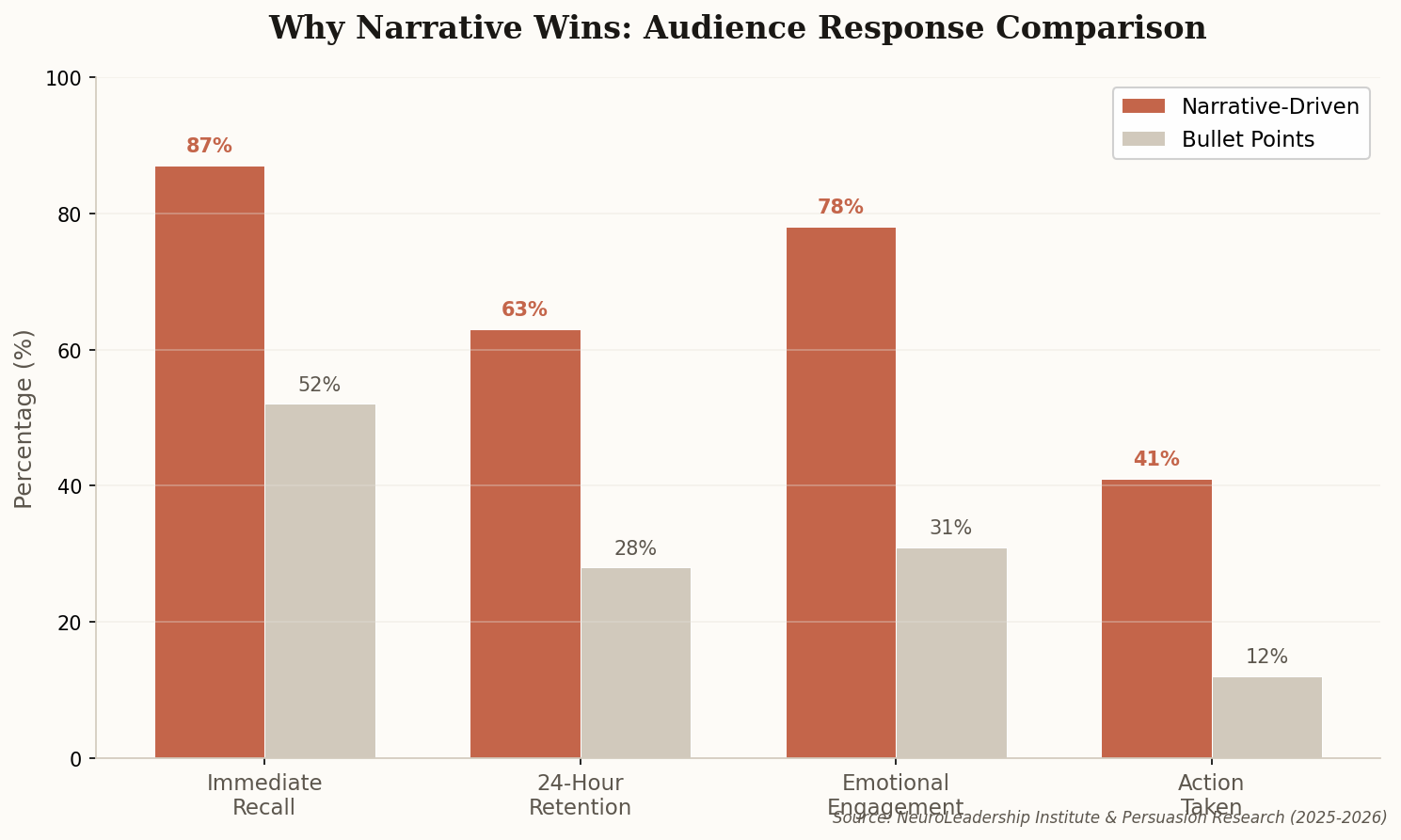
Bar chart comparing narrative-driven versus bullet point presentations across recall, retention, engagement, and action metrics
Narrative-driven presentations outperform bullet points across every measurable dimension, with the most dramatic gap in long-term retention and action taken.

Think about what this means in practical terms. When a room full of executives watches a data dump, each brain is processing independently — finding different things interesting, getting confused at different points, checking out at different moments. When the same room experiences a narrative, their brains are literally moving together. That's not metaphor. That's measured neural synchronization.

"A story is not just a sequence of events; it is a mechanism for collective neural alignment."

This is the scientific foundation for everything else in this newsletter. Narrative isn't a nice-to-have presentation skill. It's a biological requirement for group persuasion. If you want a room to move in the same direction, you need to synchronize their brains first. And the only tool that does that reliably is story.

A geometric pyramid merging with a circular hero's journey arc in blueprint style
06

The Boardroom Formula: Minto's Logic Meets Campbell's Heart

So you're convinced narrative matters. Now what? Duarte Design and McKinsey have converged on what's becoming the gold standard for high-stakes 2026 presentations: the Hybrid Strategy.

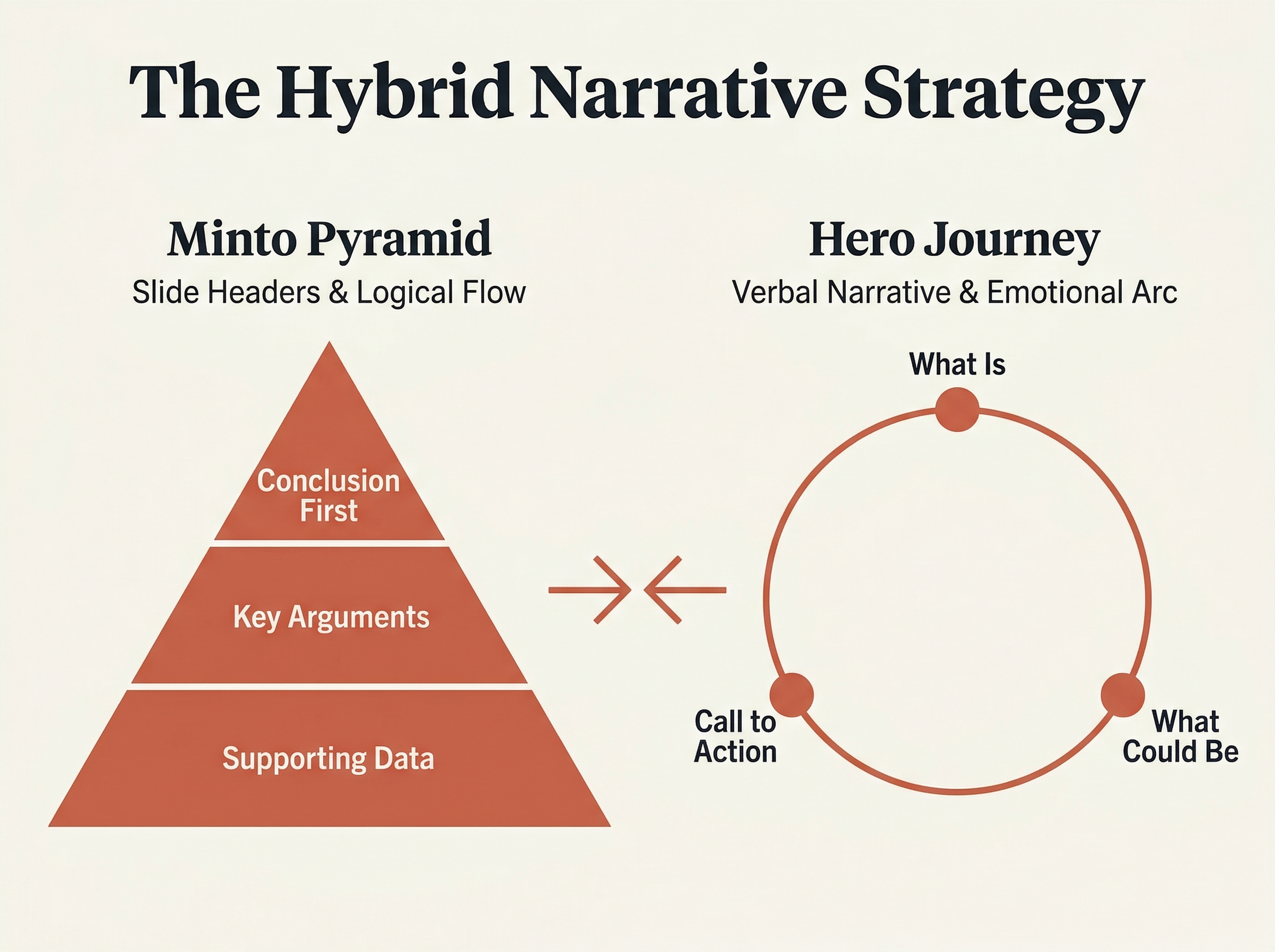
The concept is elegantly simple. Use the Minto Pyramid for your slide headers — conclusion first, then supporting arguments, then data. This gives skimmers and note-takers the logical flow they need. But use the Hero's Journey for your verbal narrative — the presenter (as mentor) guides the audience (as hero) from "What Is" through tension to "What Could Be."

Infographic showing the Hybrid Narrative Strategy: Minto Pyramid for logical slide headers on the left merging with the Hero's Journey emotional arc on the right
The Hybrid Strategy: slides speak to the analytical brain (Minto Pyramid), while the verbal narrative speaks to the emotional brain (Hero's Journey).

The genius is that both channels work simultaneously. The CFO scanning your slide headers gets "Bottom Line Up Front." The room listening to your voice gets a story with stakes, tension, and resolution. Logic makes people think, but emotion makes them act. You need both to win a boardroom.

"The spark of every great presentation is the contrast between 'What Is' and 'What Could Be.' That gap is where urgency lives."

If you take one actionable framework from this entire newsletter, make it this one. Before your next important presentation, write two outlines: one for the slide headers (pyramid down from the conclusion) and one for the verbal arc (journey from pain to possibility). When those two documents are aligned but distinct, you've built something that no AI template can replicate: a presentation that satisfies both halves of the brain.

The Story You Choose to Tell

Every presentation is a choice between two modes: transmitting information or transforming perspective. The research is unambiguous — narrative doesn't just work better than bullet points, it works on a fundamentally different neurological channel. It synchronizes brains. It triggers trust chemistry. It wires information into long-term memory. The question isn't whether to tell a story. It's whether you're brave enough to start with one.

Share X LinkedIn