
AI · Open Source · Frontier Models

The Intelligence Gap Is Dead

Open source AI models have reached 95% parity with proprietary frontiers. The question is no longer if — but what happens when a trillion parameters cost fourteen cents.

Listen
Twin towers of light — one crystalline and open, one solid and corporate — converging at equal height against a dark sky, connected by pulsing teal energy
A premium price tag being cut, revealing open-source code underneath
01

OpenAI Blinks: The $8 Admission That Open Source Won

When OpenAI quietly launched an $8/month "Lite" tier offering GPT-5.2 capabilities — roughly half the price of ChatGPT Plus — nobody in the industry pretended this was about generosity. This is a defensive move, pure and simple. The company that once held an unchallenged monopoly on frontier intelligence is now competing on price with models you can download for free.

The Lite tier includes limited access to GPT-5.4's "Thinking" mode, positioning it as a gateway drug to the full subscription. But the subtext screams louder than the marketing: developers are migrating to DeepSeek and Llama in sufficient numbers that OpenAI's growth metrics are under threat. When your product was once priceless and now has a budget tier, the market has spoken.

The real question isn't whether $8 is competitive — it's whether any price is competitive against free. OpenAI is betting that reliability, brand trust, and integrated tooling justify the premium. They're probably right, for now. But "for now" has a short half-life in this market.

A vast neural network of a trillion nodes with sparse active pathways glowing teal
02

DeepSeek V4: A Trillion Parameters, Fourteen Cents

This is the model that broke the narrative. DeepSeek V4 is a natively multimodal 1-trillion parameter Mixture-of-Experts architecture that activates only 32 billion parameters per token. Read that again: 32B active out of 1T total. It's the most aggressive sparsity ratio ever deployed at production scale, and it works.

The benchmarks tell a story that would have been science fiction eighteen months ago: 90% on HumanEval (matching GPT-5.4), 92% on MATH, and competitive scores across every major evaluation suite. All at $0.14 per million tokens — roughly 1/85th the cost of GPT-5.4's Thinking tier. The MoE architecture isn't just an efficiency trick anymore; it's a fundamental rethinking of how intelligence scales.

Bar chart comparing cost per 1M tokens across proprietary and open source models, showing DeepSeek V4 at $0.14 versus GPT-5.4 at $15.00
The price collapse is real. DeepSeek V4 delivers frontier-class performance at roughly 1/85th the cost of GPT-5.4's Thinking tier.

The Chinese AI lab has effectively commoditized what was once the most exclusive product in technology. And unlike previous "GPT killers" that faded on closer inspection, V4's architecture paper is public, its weights are downloadable, and independent evaluations are confirming the claims. This isn't disruption — it's demolition.

A GPU chip as an architectural marvel with efficient teal data pathways
03

NVIDIA Makes Local Frontier Inference Actually Viable

If DeepSeek V4 is the engine, NVIDIA's Nemotron 3 optimization is the fuel system that makes it run locally. The breakthrough: Sparse FP8 inference that lets 1-trillion+ parameter models run at 1.8x speed on H100/H200 hardware, with a "Tiered KV Cache Storage" system that cuts memory overhead by 40% for million-token context windows.

This is the unsexy infrastructure work that actually determines whether open source models can compete in practice, not just on leaderboards. Running DeepSeek V4 at full capability on a rack of H100s that a mid-sized enterprise could afford? That went from theoretical to practical this week. The Nemotron 3 stack is specifically designed for MoE sparsity patterns — NVIDIA is betting that sparse, open-weight architectures are the future, and they're building the hardware-software stack to prove it.

Jensen Huang's quote captures the shift perfectly: they're moving from general-purpose AI hardware to "architecturally aware" optimization. When the GPU monopolist starts co-designing its stack for open-source model architectures, the center of gravity has shifted.

An hourglass filled with flowing code instead of sand, glowing with adaptive thinking energy
04

Opus 4.6 Proves the Last 5% Is the Hardest

Anthropic's Claude Opus 4.6 achieved a 12-hour autonomous task time horizon on METR's evaluation suite — meaning it can work independently on complex software engineering tasks for half a day without losing coherence or needing human intervention. Its "Adaptive Thinking" feature dynamically scales compute budget based on task difficulty, spending more reasoning tokens on hard problems and cruising through simple ones.

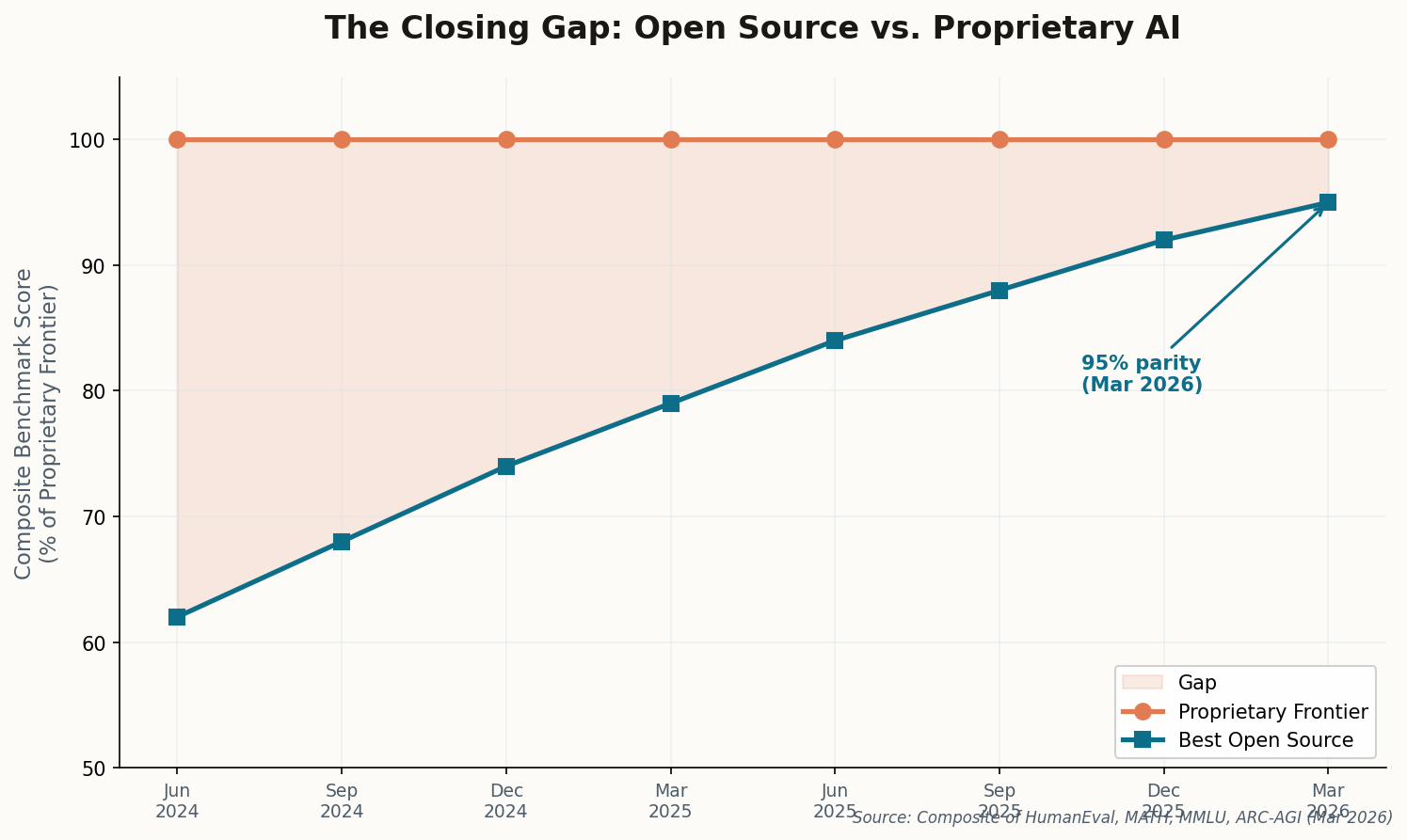
Line chart showing open source models closing from 62% to 95% of proprietary frontier performance between June 2024 and March 2026
The gap has narrowed from 38 percentage points to just 5 in less than two years. But that last 5% encodes the hardest capabilities: sustained autonomous agency and reliability at scale.

Here's the critical nuance that benchmark scores miss: Opus 4.6 maintains a roughly 5% lead over the best open-weight models (Qwen 3.5, DeepSeek V4) — but that 5% is disproportionately concentrated in reliability-at-scale. It's not that open models can't solve the same problems; it's that they fail more often at the 8-hour mark, lose context at the 500k-token boundary, and hallucinate more under sustained autonomous operation. The METR evaluators noted something striking: "We are running out of tasks difficult enough to distinguish these models." The gap isn't in intelligence. It's in stamina.

For most use cases — chatbots, code completion, document analysis, even multi-step reasoning chains under 30 minutes — the open models are functionally equivalent. The proprietary premium now buys you the long tail: the 12-hour coding marathon, the million-token research synthesis, the autonomous agent that doesn't drift. Whether that's worth 100x the price is a question each team has to answer for themselves.

A smartphone emanating neural intelligence with a privacy shield aura
05

Your Pocket Holds 85% of a Frontier Model

Apple announced that its on-device models now run 9-billion-parameter architectures with 4-bit quantization using "Unified Neural Memory" on the iPhone 17 Pro's NPU, achieving approximately 85% of GPT-4o's performance entirely on-device. Sub-100ms latency. Zero server calls. Complete privacy.

This is the convergence story nobody predicted would happen this fast. While the industry obsessed over data center scaling and trillion-parameter monsters, Apple quietly proved that a 9B model running on a phone is good enough for the vast majority of consumer AI tasks. Summarization, writing assistance, photo understanding, code suggestions — all at speeds that make cloud-based inference feel sluggish by comparison.

The privacy implications are enormous. When frontier-adjacent intelligence never leaves your device, entire categories of regulatory and trust concerns evaporate. Apple's bet is that "good enough AI that's always private" beats "slightly better AI that requires sending your data to a server." Given the regulatory trajectory in the EU and the growing consumer awareness of data practices, this might be the most strategically important development on this list.

A massive teacher figure made of light sharing knowledge with smaller student models below
06

Llama 4 Behemoth: The Teacher That Trains Everything Else

Meta confirmed that Llama 4 "Behemoth" — a 2-trillion parameter model — has completed its first stage of teacher-student distillation. The model itself won't be deployed directly; it exists to generate synthetic training data for a new generation of 7B and 70B models that inherit the Behemoth's reasoning capabilities at a fraction of the compute cost.

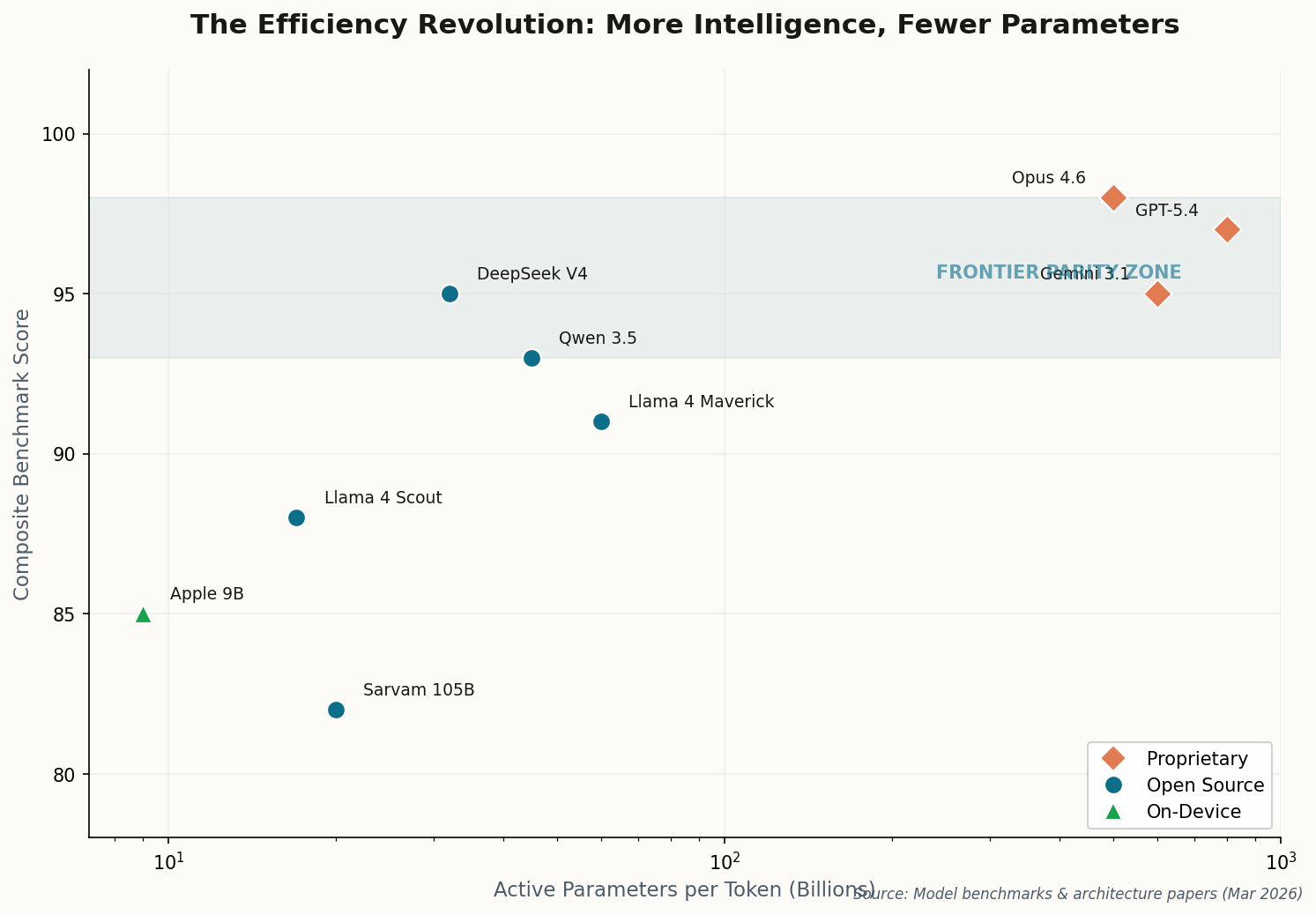
Scatter plot showing model efficiency: open source models achieving frontier scores with far fewer active parameters
The efficiency revolution in one chart. DeepSeek V4 achieves 95% of Opus 4.6's benchmark score with 1/15th the active parameters per token.

This is Meta's masterstroke and their most important strategic contribution to the open source ecosystem. By building the biggest model in the world and then distilling it down into models anyone can run, they're establishing a pattern that makes the proprietary labs' advantage permanently temporary. Every breakthrough at the frontier gets compressed into the next generation of open-weight models within months.

Meta's "Open-First" strategy — releasing weights as soon as safety red-teaming concludes, likely Q2 2026 — ensures the Llama ecosystem remains the default starting point for anyone building custom AI. With Behemoth-distilled 70B models potentially matching current-generation Opus in coding and reasoning, the value proposition of paying for API access looks increasingly questionable. Mark Zuckerberg isn't doing this out of altruism; he's making sure no single company can gatekeep intelligence. The side effect is that intelligence becomes a commodity, and Meta's real products (social, metaverse, commerce) get an AI subsidy that competitors have to pay for.

Abstract visualization of precise instruction following with geometric origami patterns guided by teal laser lines
07

Qwen 3.5: The Model That Follows Orders Better Than Anyone

Alibaba's Qwen team published evaluation results confirming that Qwen 3.5-397B leads the industry in instruction following, scoring 76.5 on IFBench — ahead of every proprietary model. The model also features "Visual Agentic" capabilities for autonomous mobile GUI navigation and is optimized for Sparse FP8 decoding, making it faster to serve locally than Meta's Llama 4 Scout.

Here's why instruction following matters more than raw reasoning for most real-world applications: a model that scores 2% lower on math benchmarks but consistently does exactly what you asked — no more, no less — is infinitely more useful in production. Enterprise teams don't care about exotic reasoning puzzles. They care about whether the model follows their system prompt, respects output formats, and handles edge cases in their specific domain. Qwen 3.5 is purpose-built for this.

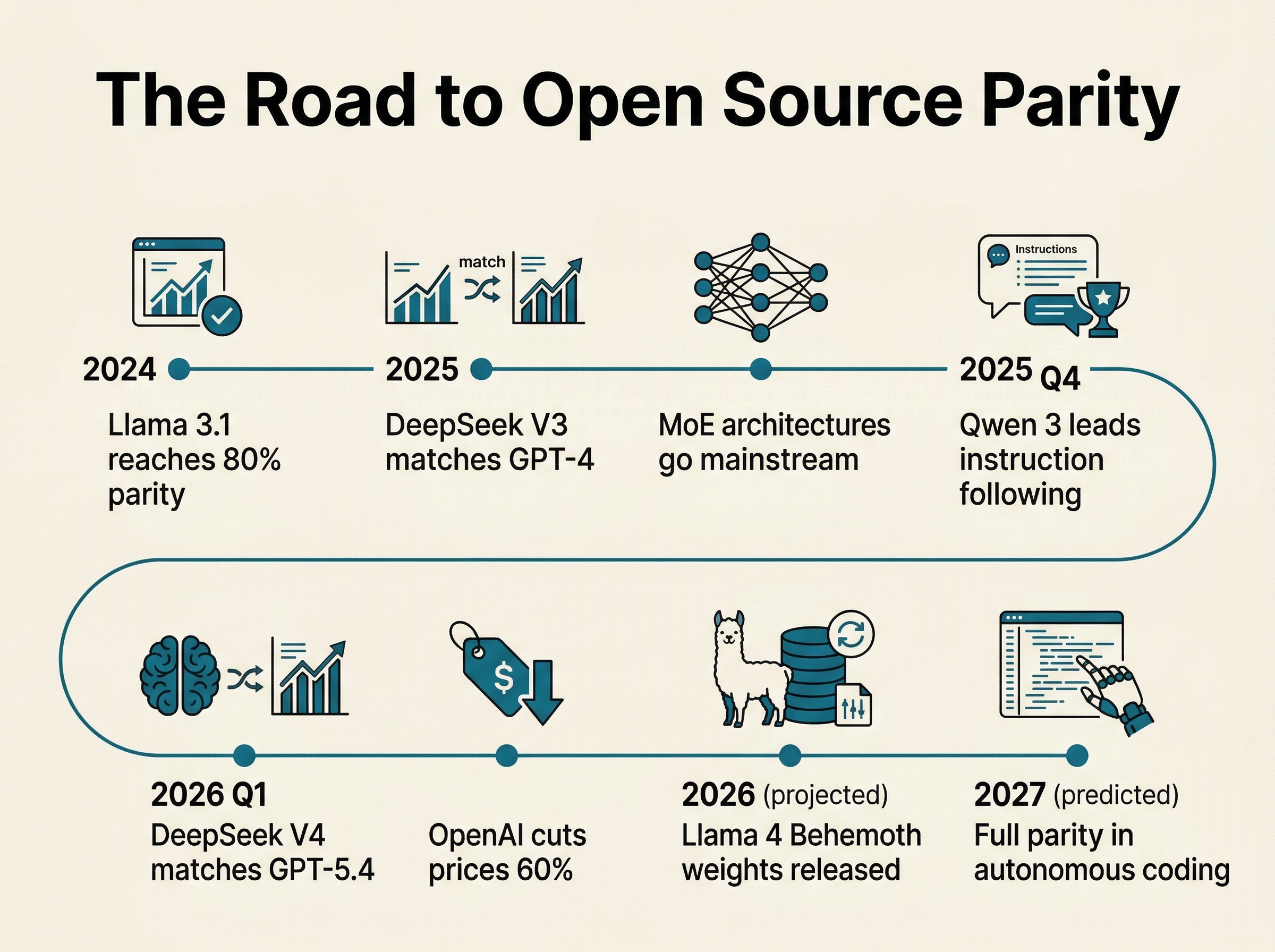
Timeline infographic showing the evolution of open source AI parity from 2024 to 2027, with key milestones for Llama, DeepSeek, and Qwen models
Infographic: The Road to Open Source Parity — From 80% in 2024 to projected full parity in 2027

The broader pattern is unmistakable: open source models are no longer just closing the gap on aggregate benchmarks — they're leading in specific, high-value sub-capabilities. Instruction following today, multilingual efficiency tomorrow, domain-specific reasoning next quarter. The frontier isn't a single point anymore; it's a surface, and open models are claiming territory across it faster than any proprietary lab can defend.

The Five Percent That Changes Everything

The question "when will open source match proprietary?" was framed wrong from the start. It assumed a single finish line. Reality is messier and more interesting: open models already match or exceed proprietary offerings in cost, instruction following, multilingual support, and standard reasoning tasks. Proprietary models maintain a lead in sustained autonomous agency, extreme context windows, and reliability under marathon operation. The real question for 2026 isn't about parity — it's about whether that last 5% of capability justifies a 100x price premium. For 90% of use cases, the answer is already no. For the other 10%, ask again in six months.

Share X LinkedIn