The Ridge You Might Mistake for a Tumor
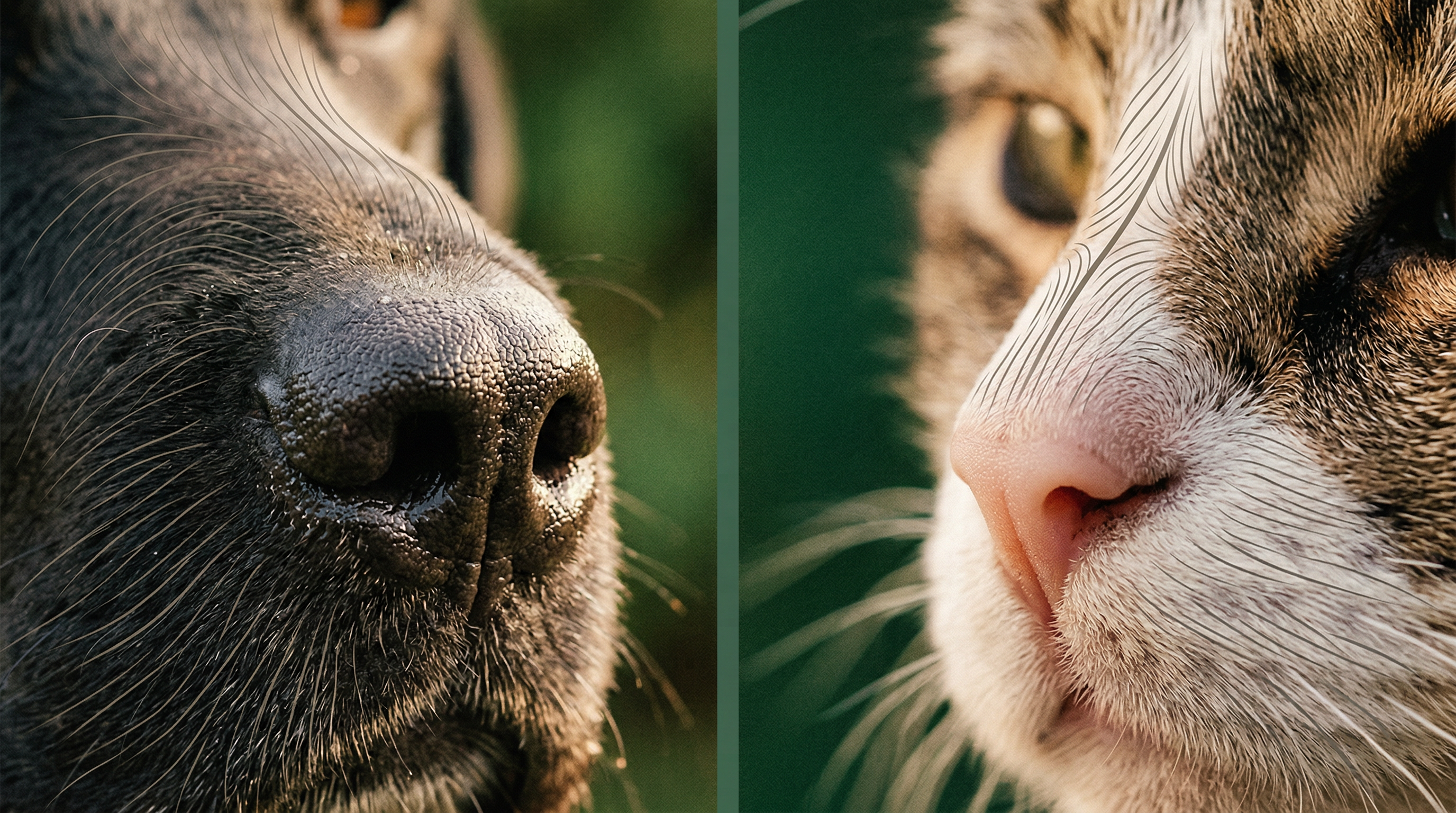
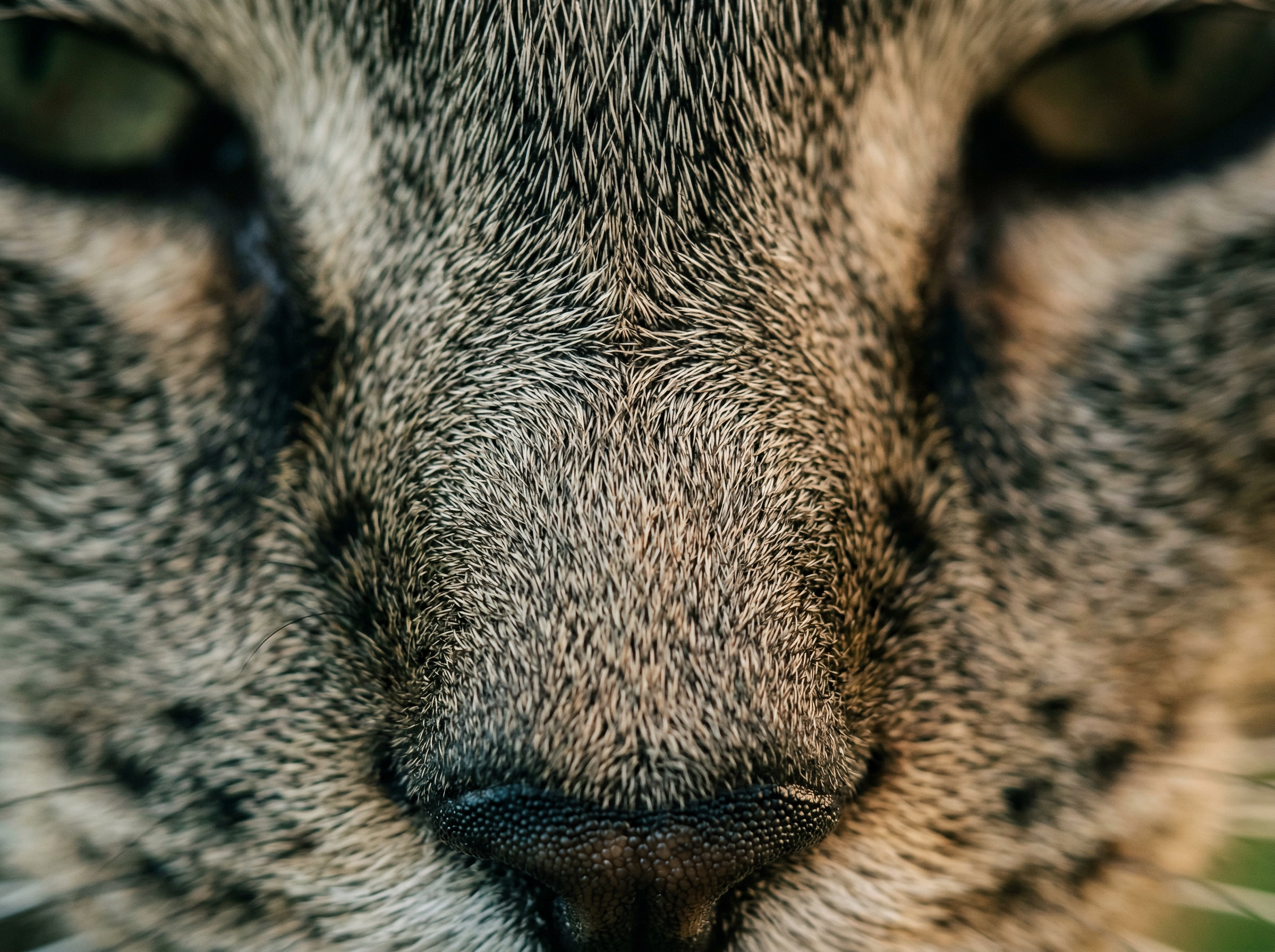
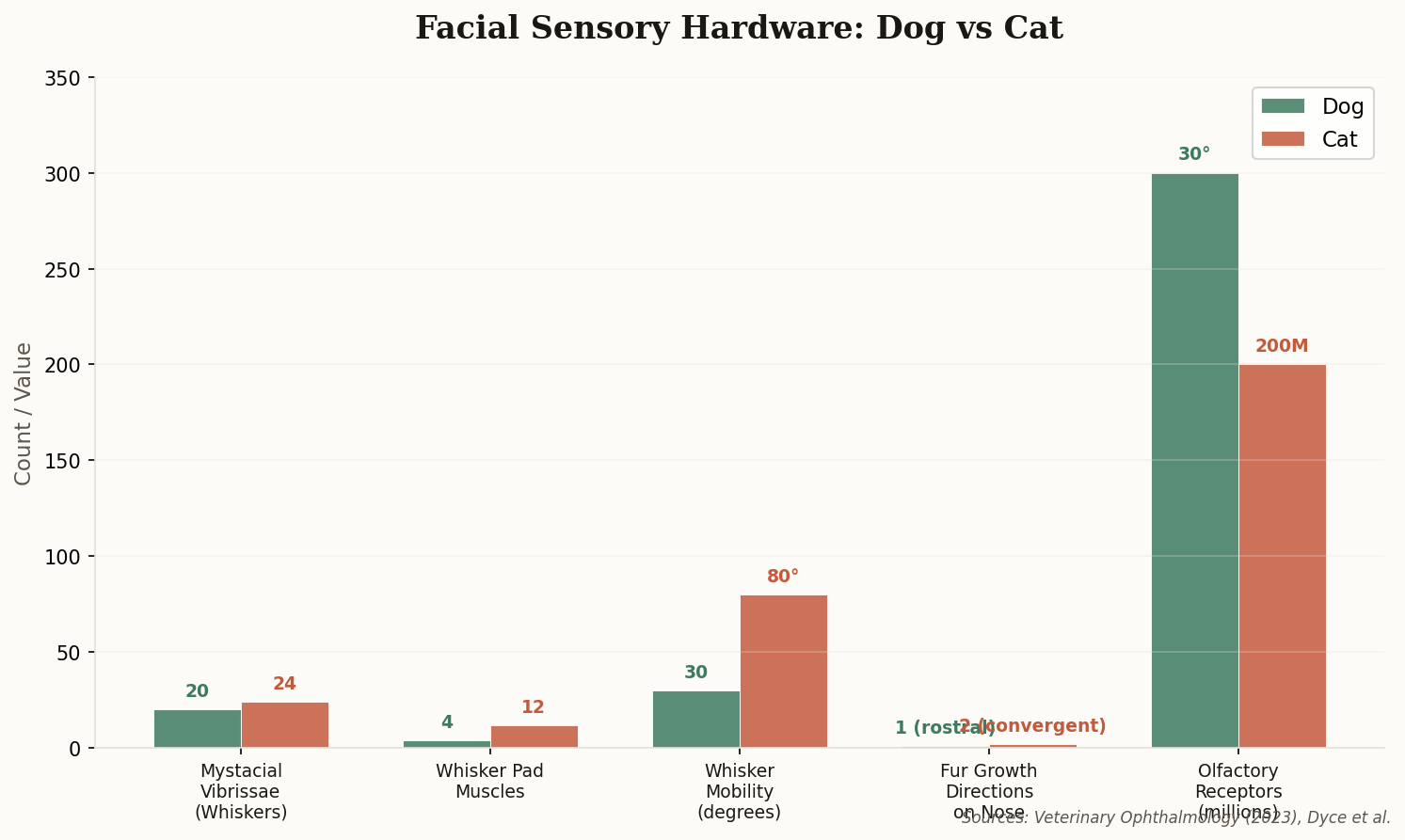
Run your finger down a dog's nose. The fur flows like a river — smooth, uniform, all heading one direction: toward the tip. Now try it on a cat. Somewhere on the bridge, you'll hit a speed bump. A visible ridge where the fur seems to collide with itself.
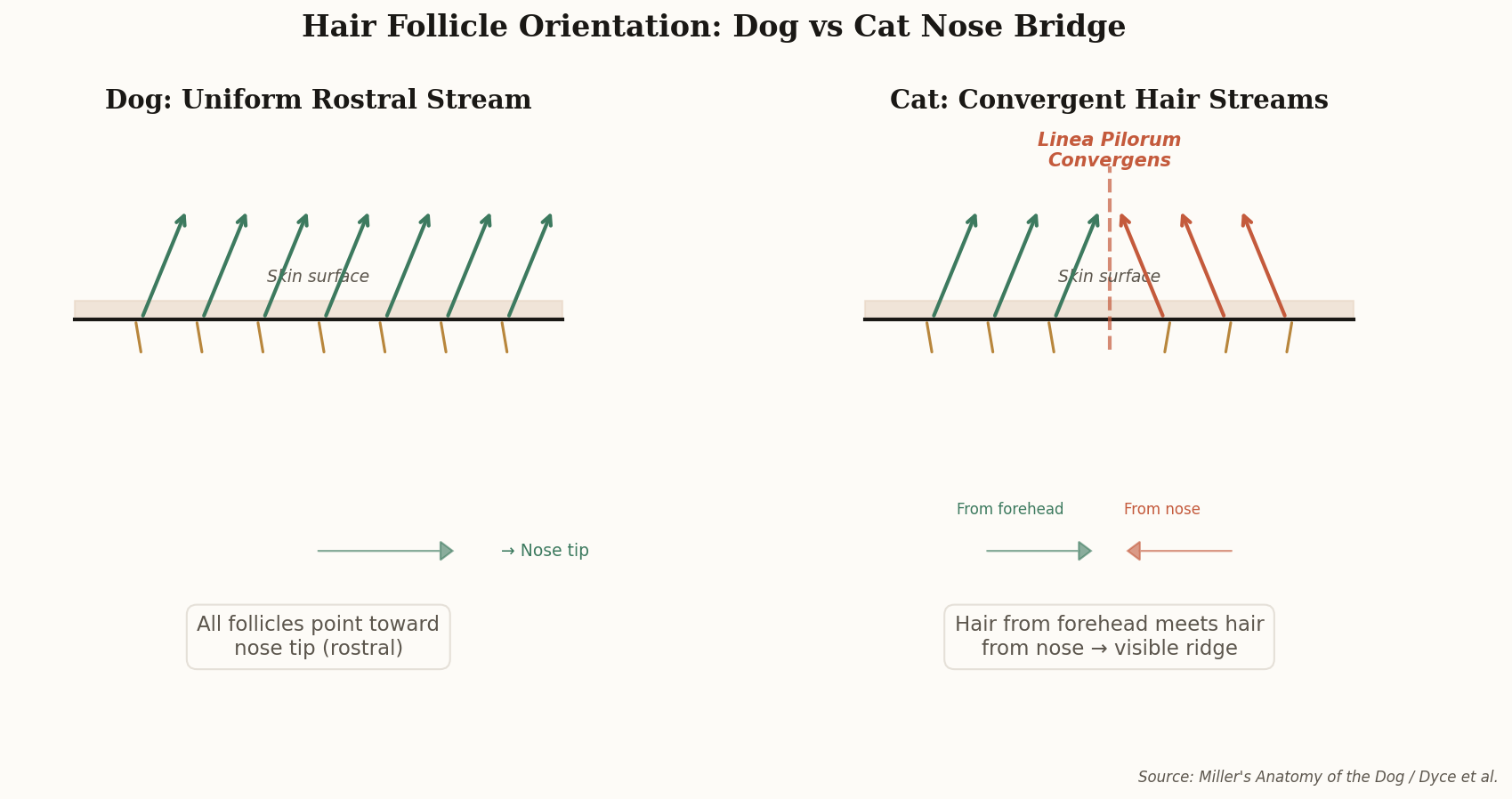
That ridge has a name: the linea pilorum convergens — a convergent hair line where two opposing streams of fur meet head-on. Hair from the forehead grows rostrally (downward toward the nose), while hair from just above the nose leather grows caudally (upward toward the eyes). They crash into each other on the bridge, and the resulting seam is prominent enough that veterinarians regularly see owners who've booked appointments convinced their cat has a lump.
Dogs don't have this. Their muzzle fur follows what anatomists call a uniform rostral stream — every follicle tilted from the stop (the indent between the eyes) toward the rhinarium (the wet nose tip). It's a one-way street. The question isn't really "why does dog fur grow downward?" It's "why did cats evolve a traffic collision on their face?"
Every Follicle Gets a Compass Needle
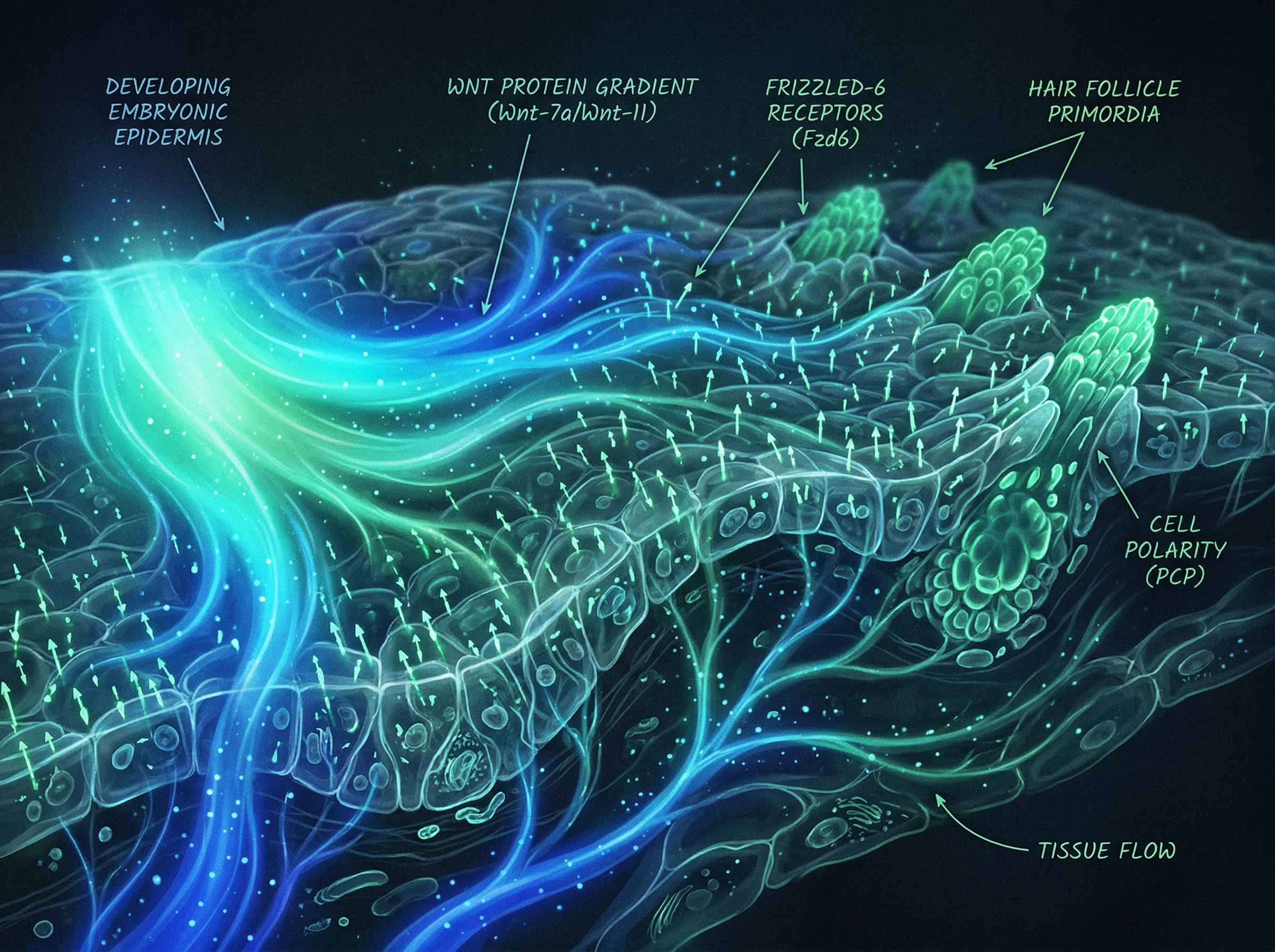
The answer starts in the womb. During embryonic development, a molecular system called the Planar Cell Polarity (PCP) pathway acts as an invisible compass embedded in every skin cell. Two proteins do the heavy lifting: Frizzled-6 (Fz6) and Celsr1. Fz6 acts as the compass needle — it tells each developing hair follicle which direction to point. Celsr1 handles cell-to-cell communication, ensuring neighboring follicles align with each other rather than sprouting at random angles.
Here's where dogs and cats diverge. A mammalian face forms from the fusion of embryonic tissue "buds" — the frontonasal prominence (which becomes the forehead and nose bridge) and the maxillary prominences (which become the sides of the face). In dogs, these buds fuse cleanly, and the Wnt signaling gradient flows uniformly from forehead to nose tip. Result: all follicles point one way.
In cats, the fusion creates a boundary zone where two conflicting Wnt gradients collide. The frontonasal prominence sends "grow this way" signals from the top; the maxillary tissue pushes signals from the bottom. The follicles at the collision site — your cat's nose bridge — receive contradictory instructions. Some point down, some point up. The linea pilorum convergens is, quite literally, a scar of embryonic diplomacy.
A 2020 study in PLOS Genetics proved this by deleting the Fz6 gene in mice. Without their compass needles, the orderly hair streams dissolved into chaotic whorls — confirming that these patterns aren't accidents of growth but genetically hard-wired blueprints.
Built for the Chase: Why Dogs Are One-Way Streets
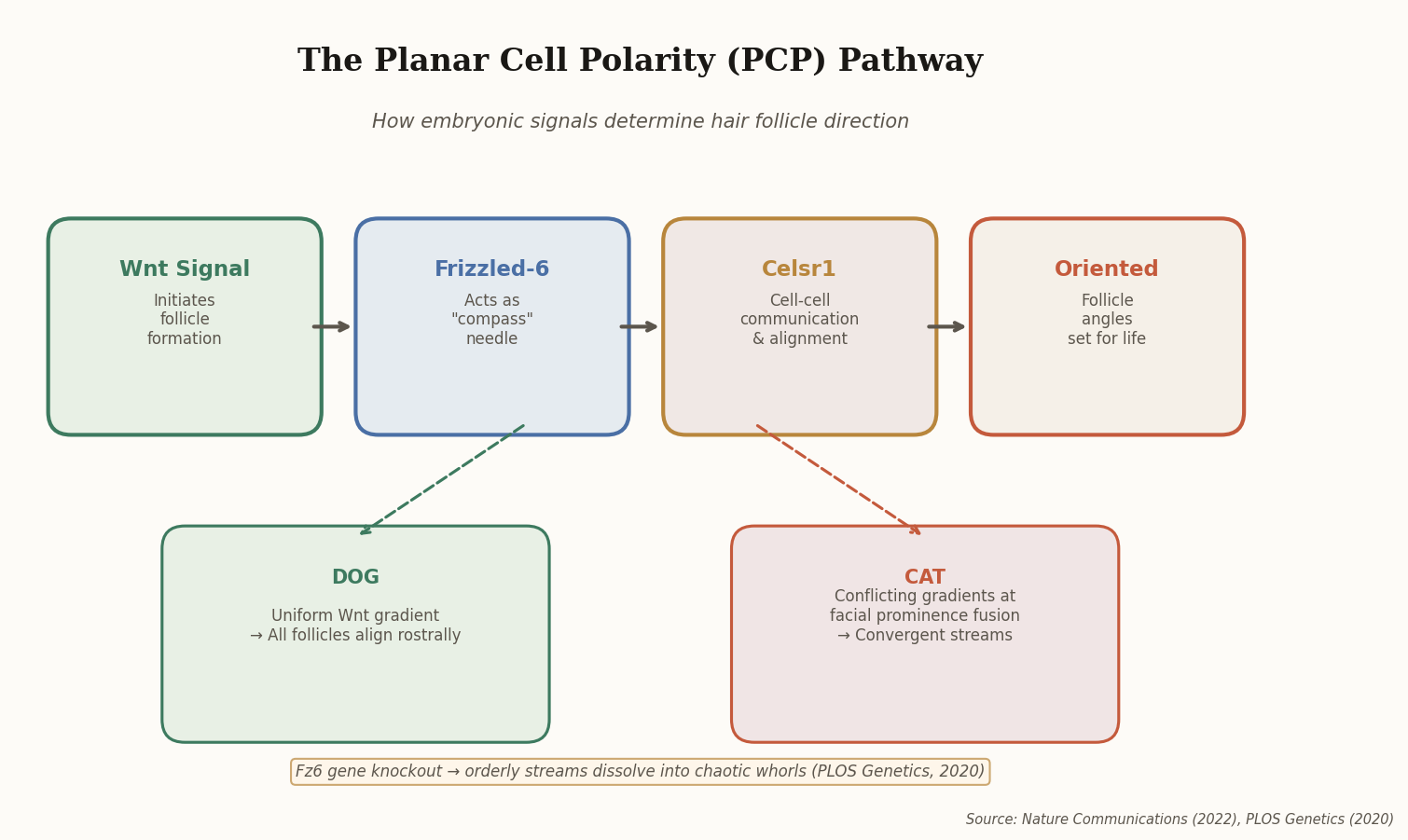
Dogs are persistence hunters. Their ancestors — wolves — didn't ambush prey; they tracked it for miles, nose hovering inches from the ground, reading a chemical autobiography left in every footprint. This behavioral niche exerted enormous evolutionary pressure on the muzzle.
The uniform rostral fur stream isn't decorative. It's aerodynamic plumbing. When a dog drops its nose to the ground, the downward-flowing fur channels moisture and scent-laden air toward the rhinarium — that wet, textured patch at the nose tip. The rhinarium works like a chemical sensor: its moist surface captures odor molecules, and the textured pattern (unique to each dog, like a fingerprint) helps determine wind direction. Fur flowing toward this sensor is essentially a funnel system.
There's a water-management angle too. When hunting in rain or crossing streams, rostral fur sheds water away from the eyes and toward the nose tip, where the dog can lick it off. Evolution optimized for clear vision during a chase, even in a downpour. Every hair on a dog's muzzle is, in a sense, a raindrop slide.
Built for the Ambush: Why Cats Need a Warning System
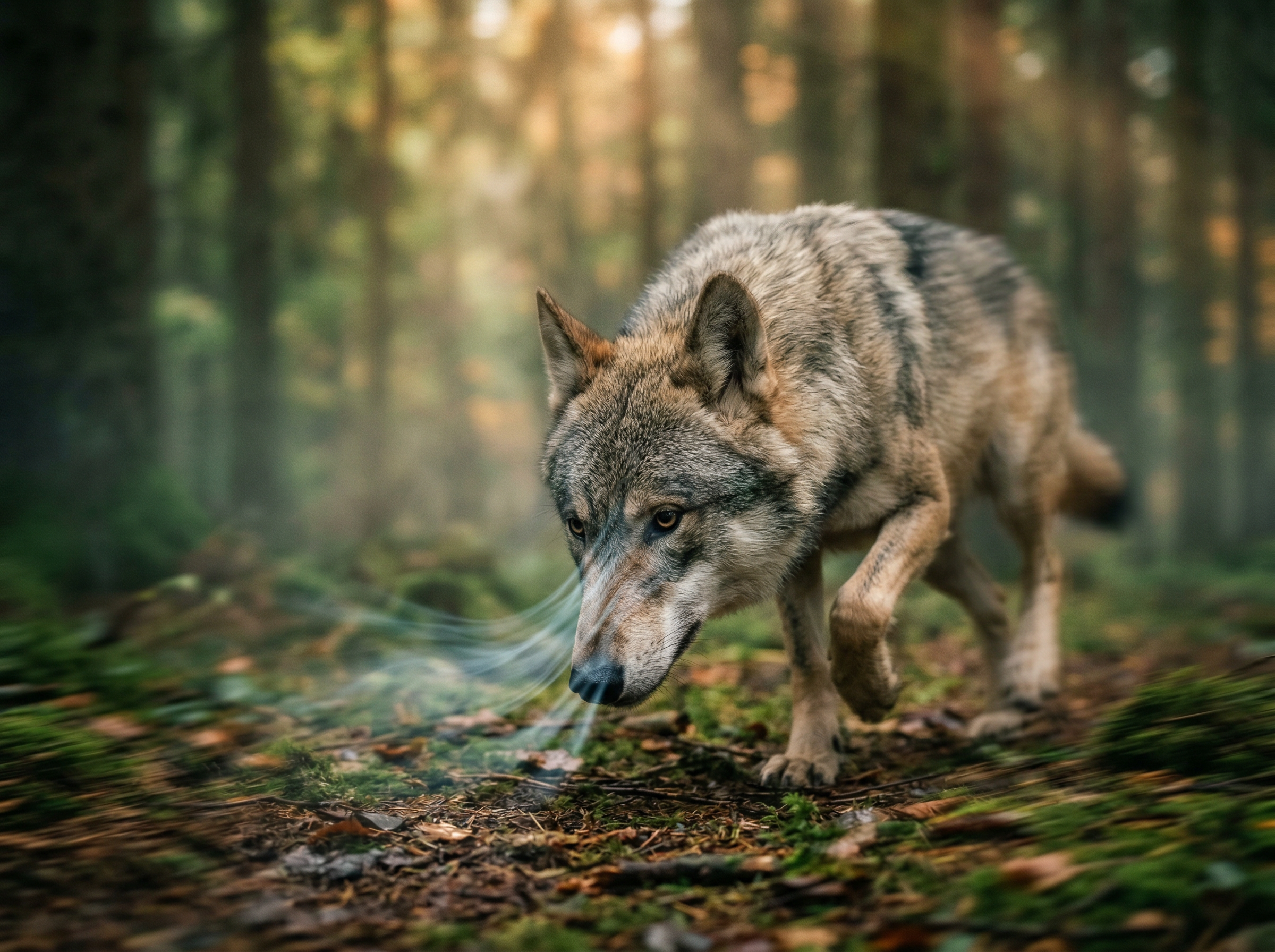
Cats are ambush predators. They don't track — they wait, stalk, and explode into action at close range. Their face evolved for a completely different job than a dog's: spatial awareness at whisker distance.
The convergent fur on a cat's nose creates an accidental genius of tactile engineering. Because hair points in multiple directions, any contact with a surface — the walls of a narrow burrow, the edge of a gap, a blade of grass — ruffles fur against the grain somewhere on the muzzle. That "wrong way" stimulation triggers a stronger nerve response than fur bending in its natural direction. The cat's face is, in effect, an omnidirectional proximity sensor.
There's a thermal angle too. The "upward" growth on the nose bridge may help insulate the feline sinus cavity, which is more compact and coiled than a dog's. A cat sitting motionless in a cold ambush spot for an hour needs to keep the internal nasal turbinates warm — they're doing chemical analysis in there, and temperature affects scent detection sensitivity. The convergent fur creates a thicker, more insulating layer right over the sinuses.
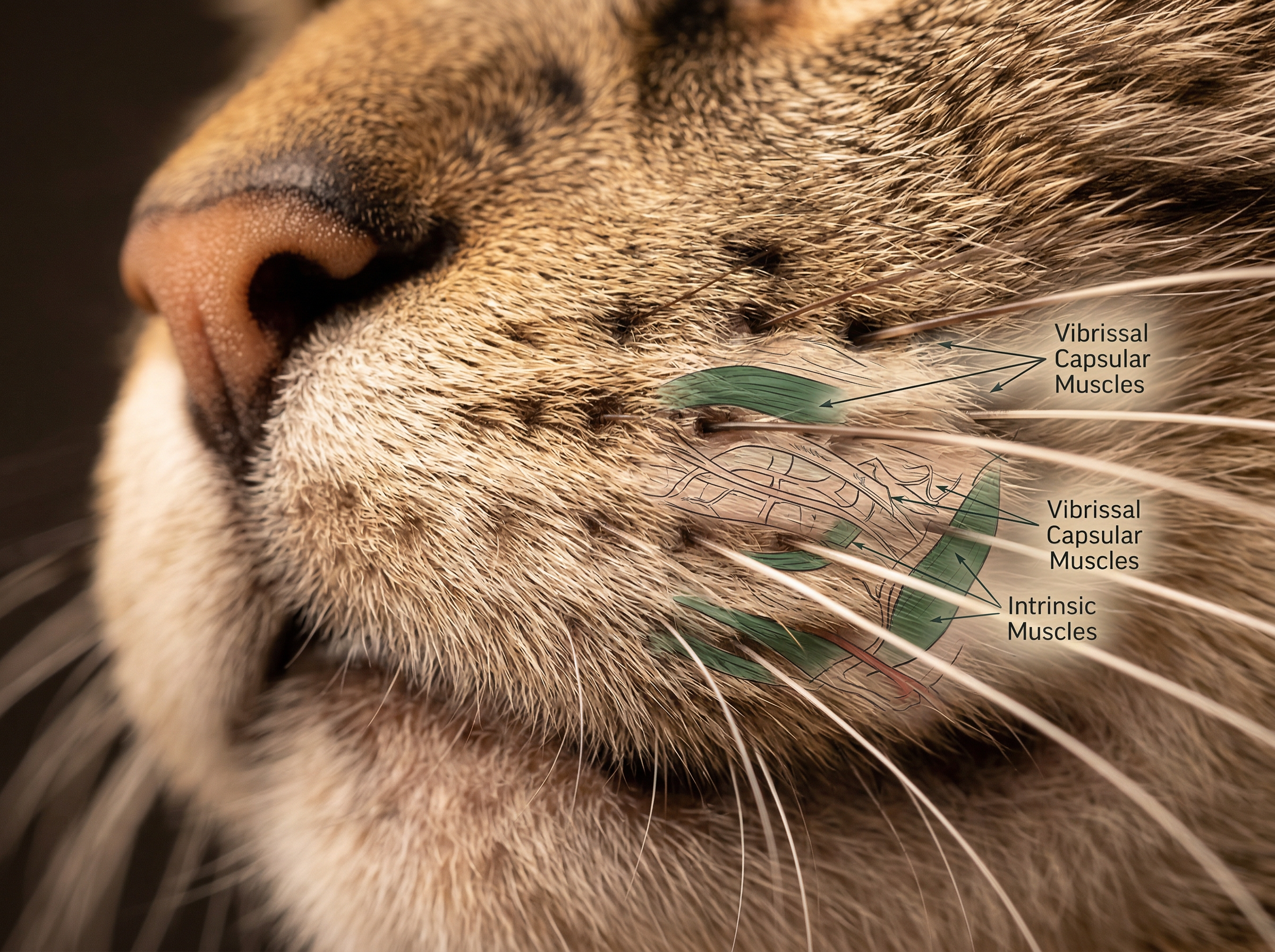
Your Cat's Whisker Pad Is Running Its Own Operating System
The fur pattern difference extends beyond the nose bridge into the mystacial pads — the fleshy mounds from which whiskers sprout. Here, the gap between species is enormous.
A cat's mystacial pad contains highly developed muscles — including the levator nasolabialis and caninus — that allow independent control of whisker groups. During a hunting strike, cats fan their whiskers forward into a basket-like array to track prey position at the moment of the killing bite. It's a real-time targeting system, and it operates at frequencies too fast for the cat's own eyes to follow.
To prevent surrounding fur from interfering with these high-frequency whisker vibrations, the fur around each mystacial pad grows in a radiating "clock-face" pattern — diverging outward from the whisker follicles. This ensures no fur crosses a whisker's path of motion. Dogs have less developed mystacial musculature and far less whisker mobility, so they don't need this precise fur arrangement.
Your Cat's Nose Is a Gas Chromatograph
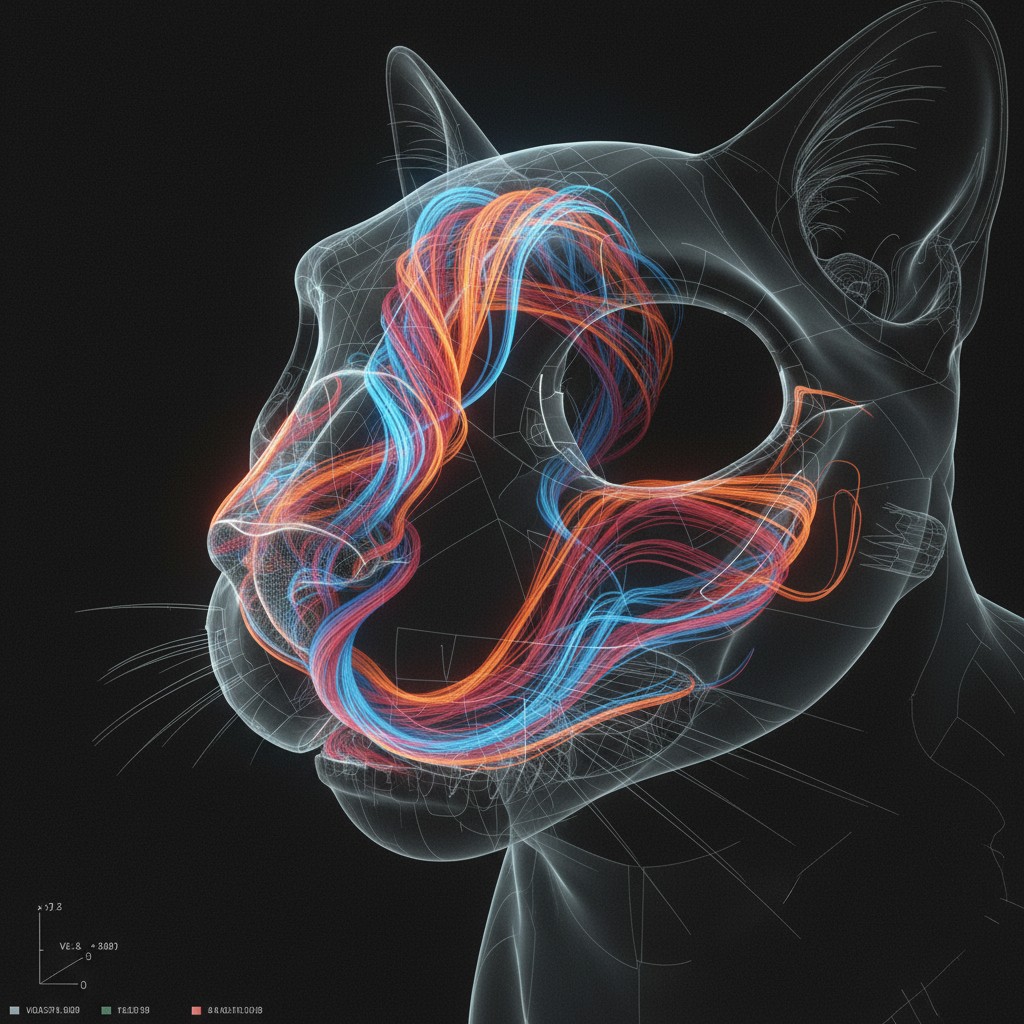
The most surprising recent finding ties everything together. A 2023 study using Computational Fluid Dynamics (CFD) modeled airflow through a feline nasal cavity and discovered something remarkable: a cat's nose functions as a biological gas chromatograph.
The internal nasal turbinates — the coiled bony structures inside the nose — create spiraling airflow patterns that separate chemical compounds by molecular weight, just like the column in a laboratory gas chromatograph. Lighter molecules hit olfactory receptors first; heavier ones arrive later. This gives cats the ability to perform time-resolved chemical analysis of a single sniff.
The convergent fur on the outside of the nose may play a supporting role. The collision zone could help maintain the laminar airflow required for this precision analysis, ensuring a uniform sample enters the chromatographic nasal passages. A dog's laminar fur flow, by contrast, channels air smoothly — great for volume (tracking faint scent trails over distance) but less suited to the precision analysis cats perform at close range.
The bottom line: Dogs evolved noses for quantity — tracking faint trails over kilometers. Cats evolved noses for quality — high-resolution chemical analysis at whisker distance. The fur growth patterns on the outside are visible signatures of these radically different scent-processing architectures on the inside.