Tech History

The Pocket Crystal That Predicted Everything

How General Magic invented the smartphone in 1990, failed spectacularly, and seeded the entire modern tech landscape.

Listen
A luminous handheld crystal device floating in space, projecting holographic UI elements of rooms and hallways — evoking General Magic's 1990 vision of the Pocket Crystal
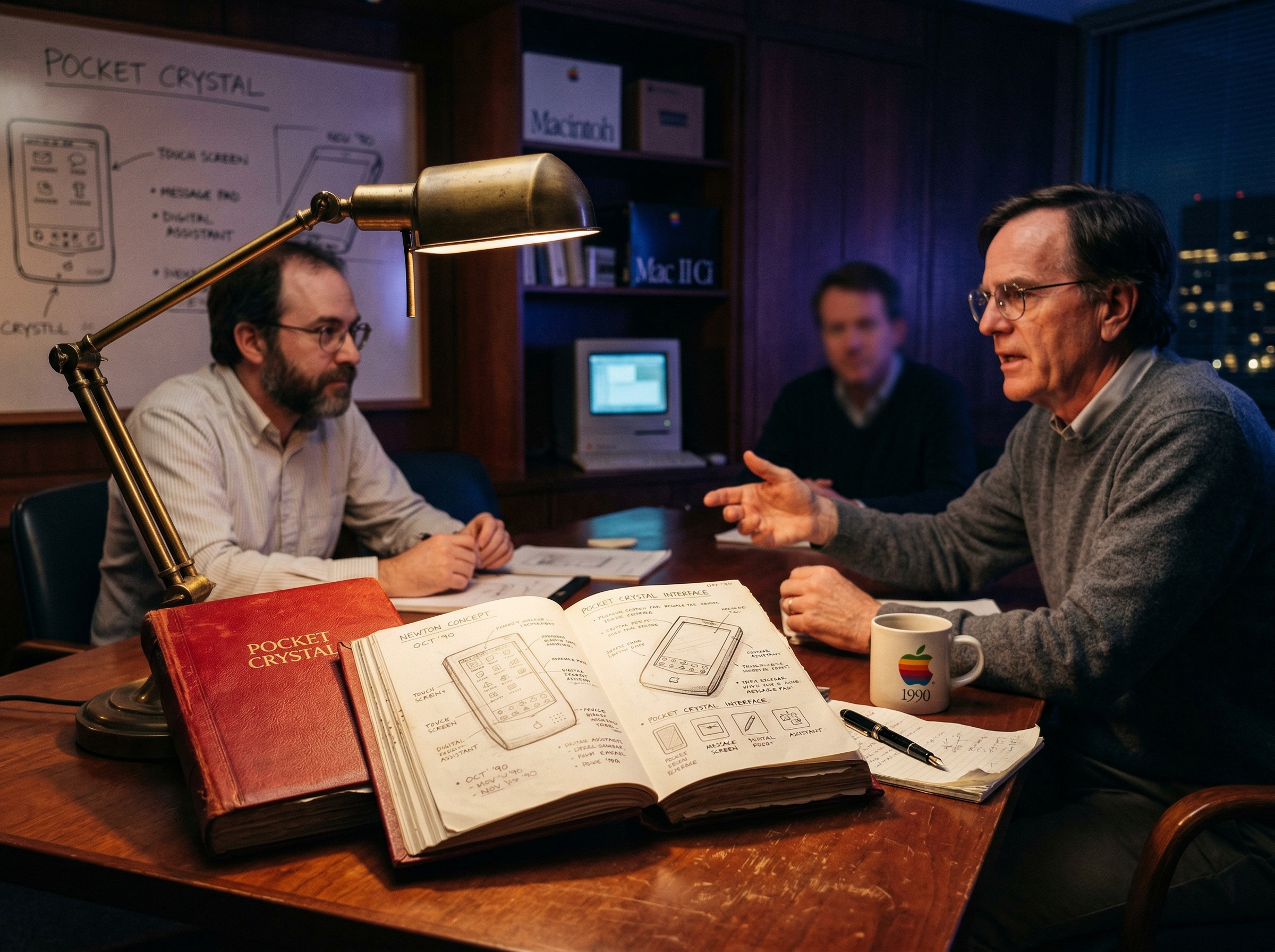
A dimly lit conference room with a red book of sketches open on the table, evoking Marc Porat's Pocket Crystal pitch at Apple in 1990
01

The Red Book That Started It All

In 1989, a young engineer named Marc Porat walked into John Sculley's office at Apple with something he called the "Big Red Book." Inside were sketches of what he called a "Pocket Crystal" — a handheld device that would serve as phone, personal organizer, and window into a global digital marketplace. He described it as a piece of "jewelry" that users would find as essential as their wallet.

The pitch worked. Porat assembled what might be the most stacked founding team in Silicon Valley history: Andy Hertzfeld, the primary software architect of the original Macintosh. Bill Atkinson, creator of MacPaint and HyperCard. Joanna Hoffman, the marketing force behind the Mac launch. And Susan Kare, the designer who gave the Macintosh its visual soul. These weren't just good engineers. They were the people who had already changed personal computing once.

"A tiny computer, a phone, a very personal object. It must be beautiful... it should offer the tactile satisfaction of a seashell." — Marc Porat, 1990

By May 1990, Porat convinced Sculley the project — code-named "Paradigm" — was too ambitious for Apple's internal bureaucracy. Apple spun it out as a separate company, taking a minority stake. Then Porat did something no startup had done before: he built a global consortium of partners that read like a who's-who of the world's biggest electronics and telecom companies. AT&T would provide the network. Sony and Motorola would build the hardware. Philips, Matsushita, and NTT would ensure global scale. The company raised hundreds of millions before shipping a single product.

This was either visionary coalition-building or the most ambitious case of premature optimization in tech history. It turned out to be both.
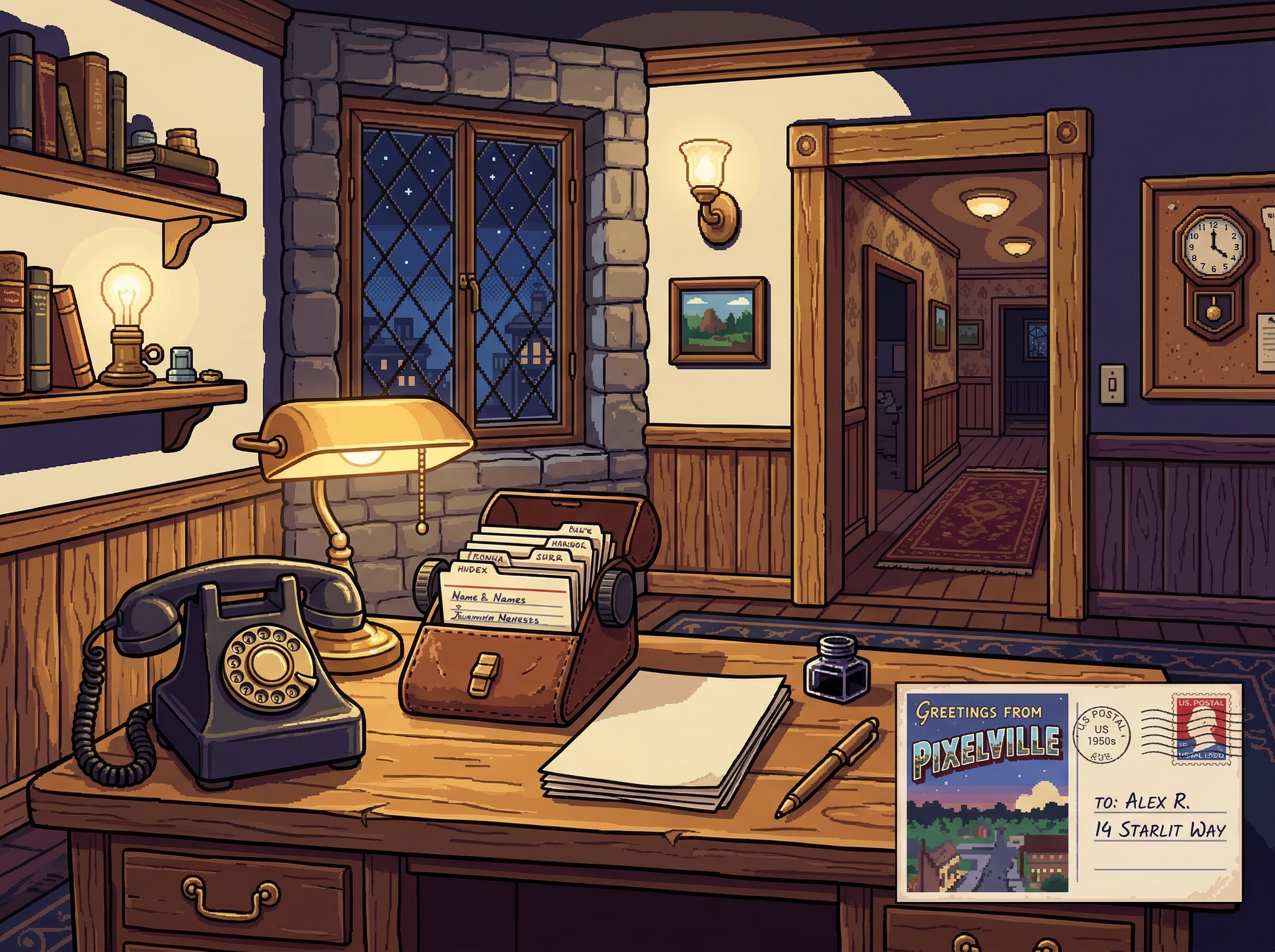
A skeuomorphic virtual office room with desk, rotary telephone, and Rolodex — the Magic Cap operating system's spatial metaphor
02

Rooms, Hallways, and a Downtown You Could Visit

Magic Cap — the Magic Communicating Applications Platform — wasn't just an operating system. It was a world. While every other OS was organizing files into folders, Magic Cap asked a different question entirely: What if your computer felt like a place you could walk through?

The answer was a spatial metaphor that still feels audacious three decades later. Your home screen was a literal office desk, complete with a rotary telephone for making calls, a leather Rolodex for contacts, and a stamped postcard for sending messages. Step back from the desk and you were in a hallway lined with doors — each leading to different "rooms" like a Library for help or a Game Room for entertainment. Step outside and you found yourself on a virtual city street called "Downtown," where third-party services occupied storefronts. AT&T's PersonaLink network had its own building. So did AOL.

This wasn't just skeuomorphism for aesthetics. It was a radical bet on spatial cognition — the idea that humans navigate digital information more naturally when it's organized like physical space. You didn't open an app. You walked to a place. The distinction sounds subtle, but it fundamentally changes how you think about what a computer is for.

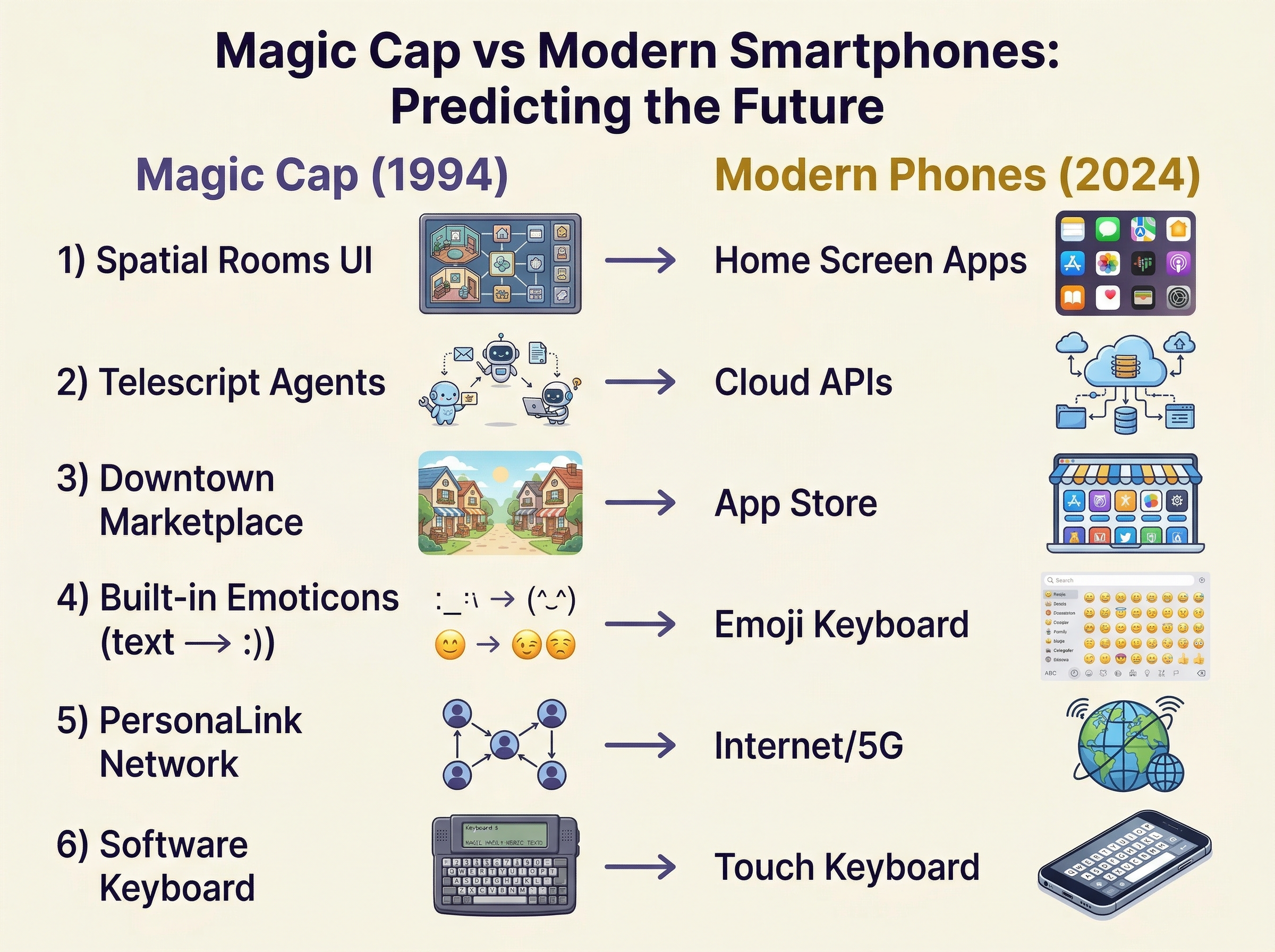
Infographic comparing Magic Cap features from 1994 to their modern smartphone equivalents: Spatial Rooms became Home Screen Apps, Telescript Agents became Cloud APIs, Downtown Marketplace became App Store, Built-in Emoticons became Emoji Keyboard
Magic Cap vs. Modern Smartphones — nearly every feature we take for granted was prototyped in 1994.

Magic Cap also introduced the first graphical emoticons, the concept of mobile notifications, and a software keyboard — all decades before they became standard. The team was building 2007 in 1992. The problem was that 1992 wasn't ready for 2007.

Luminous digital agents traveling through network cables between server monoliths, representing General Magic's Telescript mobile agent language
03

The Language That Predicted the Cloud

If Magic Cap was the face of General Magic, Telescript was its brain — and arguably the more revolutionary invention. Designed by Jim White, Telescript was the world's first "mobile agent" programming language, and it predicted cloud computing, mobile apps, and intelligent agents with eerie precision.

In Telescript, a program could execute a go command that serialized its entire state — its code, its data, its execution context — and physically moved it to a remote server called a "Place." Your digital agent would literally travel across the network, visit a travel agency's server, negotiate the cheapest flight, book it, and return to your device with the ticket. All while you were offline. In 1992.

This is essentially what happens today when you open a travel app, except we've replaced the elegance of autonomous agents with a patchwork of REST APIs, push notifications, and background sync. Telescript was a more coherent vision of mobile computing than what we actually built.

Telescript's fatal flaw wasn't the concept — it was the requirement. It demanded specialized servers running Telescript Places, creating a walled garden that couldn't compete with the open Web. The irony is devastating: General Magic built the app store model before the web existed, then the web arrived and made their approach look proprietary and restrictive.

The concept of code-as-traveler — software that autonomously moves between machines to complete tasks — is now seeing a renaissance in AI agent architectures. Today's LLM-powered agents that browse the web, call APIs, and execute multi-step plans are distant descendants of Jim White's Telescript vision. We just took a 30-year detour to get here.

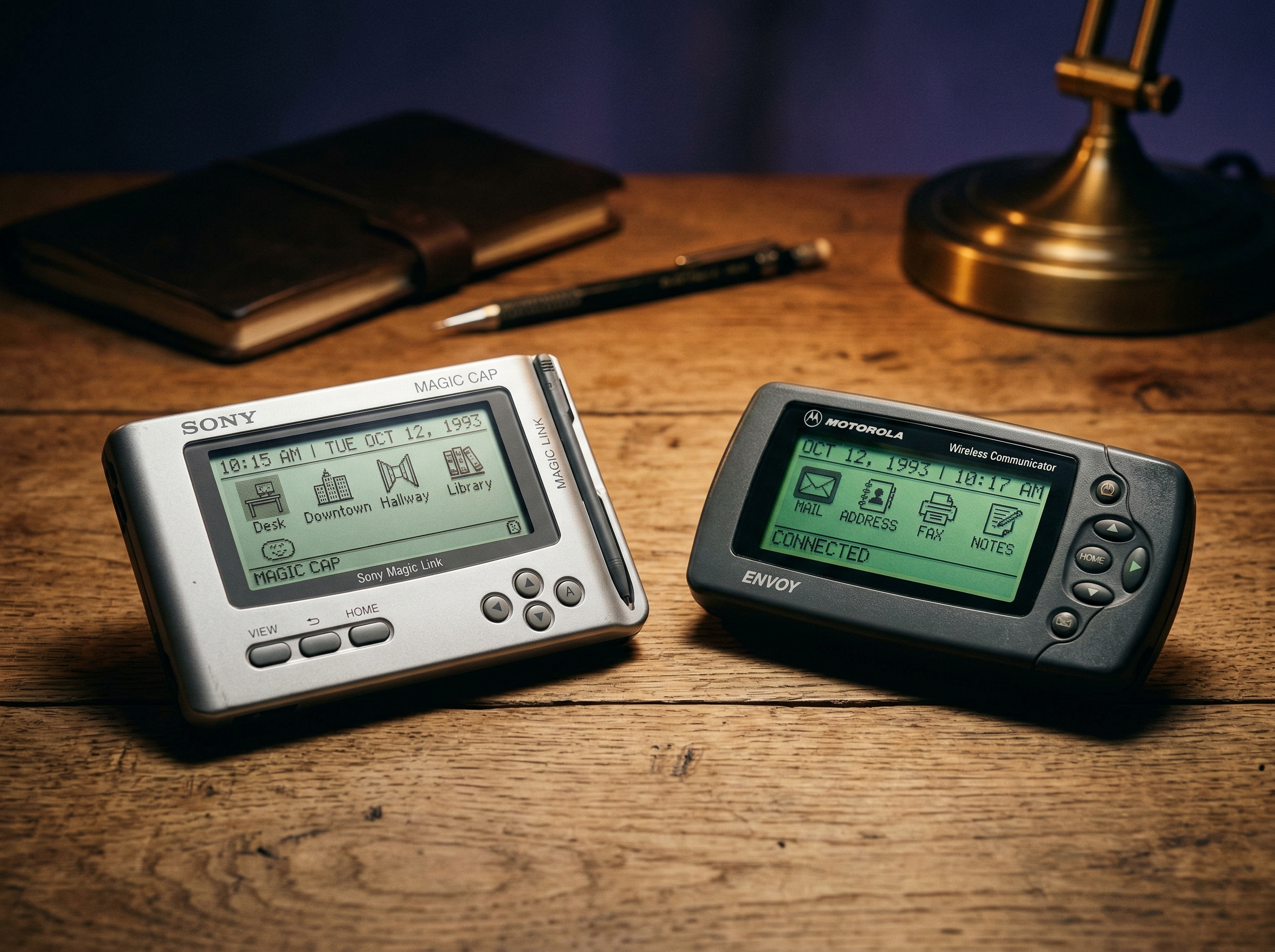
Sony Magic Link PIC-1000 and Motorola Envoy personal communicator devices from the mid-1990s
04

A Thousand-Dollar Dream That Weighed Too Much

The software was from 2007. The hardware was emphatically from 1994.

The Sony Magic Link PIC-1000 arrived in September 1994 at $999. It ran a 16MHz Motorola "Dragon" processor with 1MB of RAM, driving a 480×320 reflective LCD that lacked a backlight. Connectivity came through a 2400-bps modem — slow enough that sending a simple email felt like watching paint dry. The Motorola Envoy followed in February 1995 at $1,500, adding always-on wireless via the ARDIS packet-radio network. It was the first truly wireless personal communicator — and it cost more than most people's monthly rent.

The market's verdict was swift and brutal. The Sony Magic Link sold roughly 15,000 units against a target of 100,000. Both devices were too slow, too heavy, too expensive, and too disconnected from the real-time web that was about to explode.

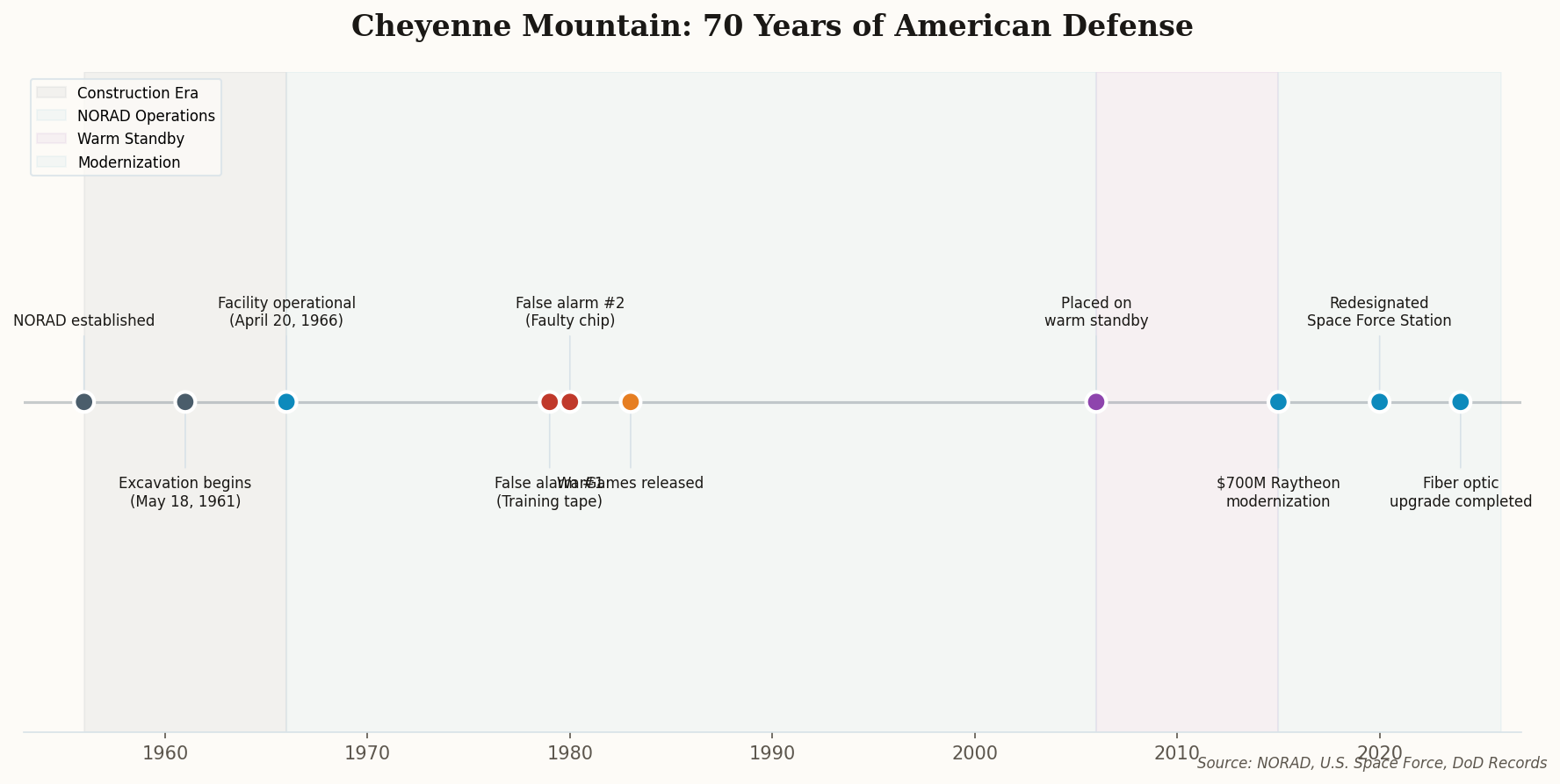
Timeline chart showing General Magic's key milestones from 1989 Pocket Crystal pitch through 2007 iPhone launch
From Pocket Crystal pitch (1989) to iPhone launch (2007) — General Magic's vision took 17 years and different hands to realize.

The fundamental problem wasn't engineering talent — it was physics. Moore's Law hadn't yet delivered the processors, batteries, screens, and wireless radios needed to make the Pocket Crystal real. General Magic was writing software for hardware that wouldn't exist for another decade. In tech, being early and being wrong produce the same financial outcome.

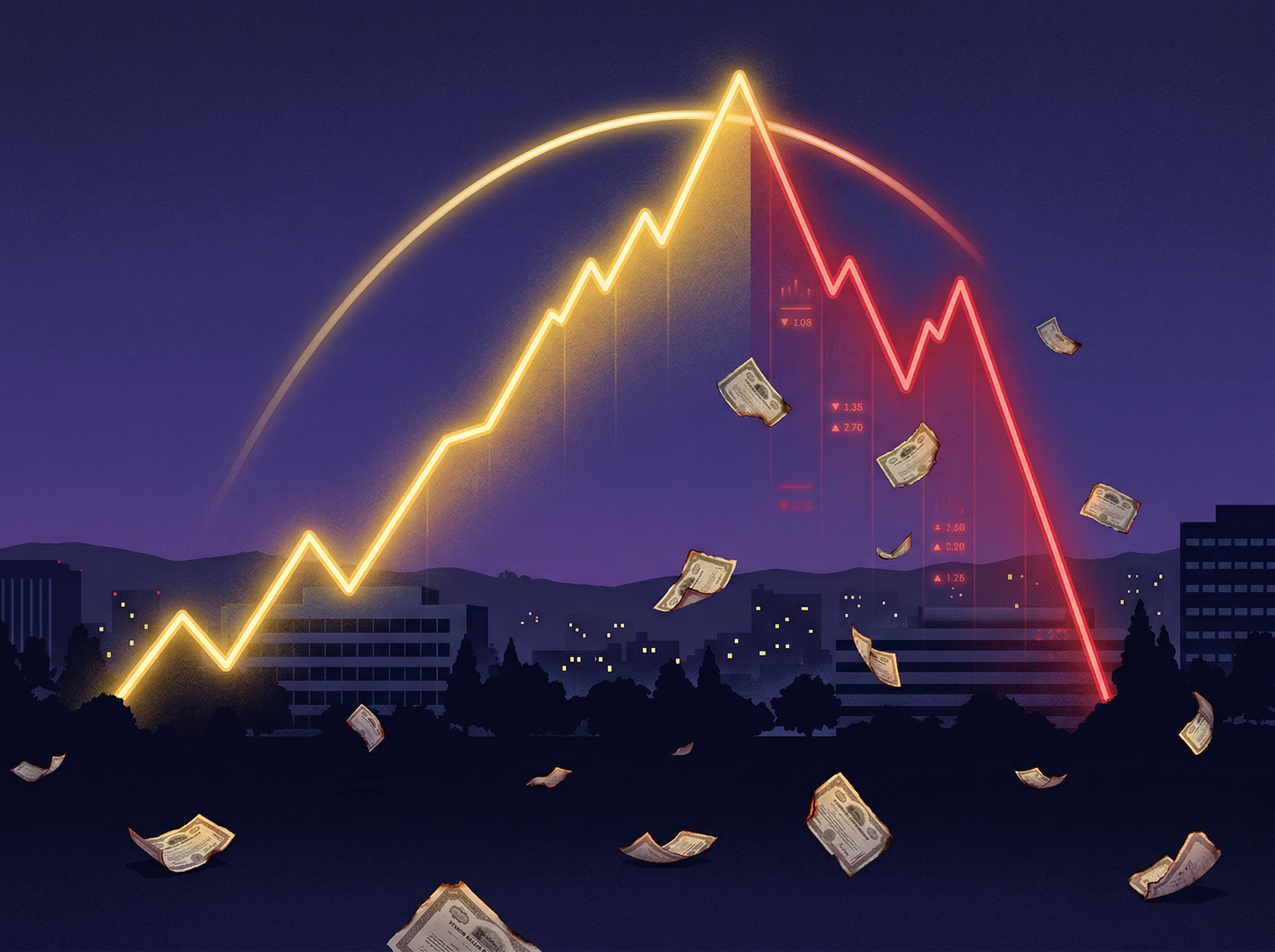
A dramatic stock chart arc rising then plummeting against a Silicon Valley skyline at dusk
05

The Billion-Dollar Mirage

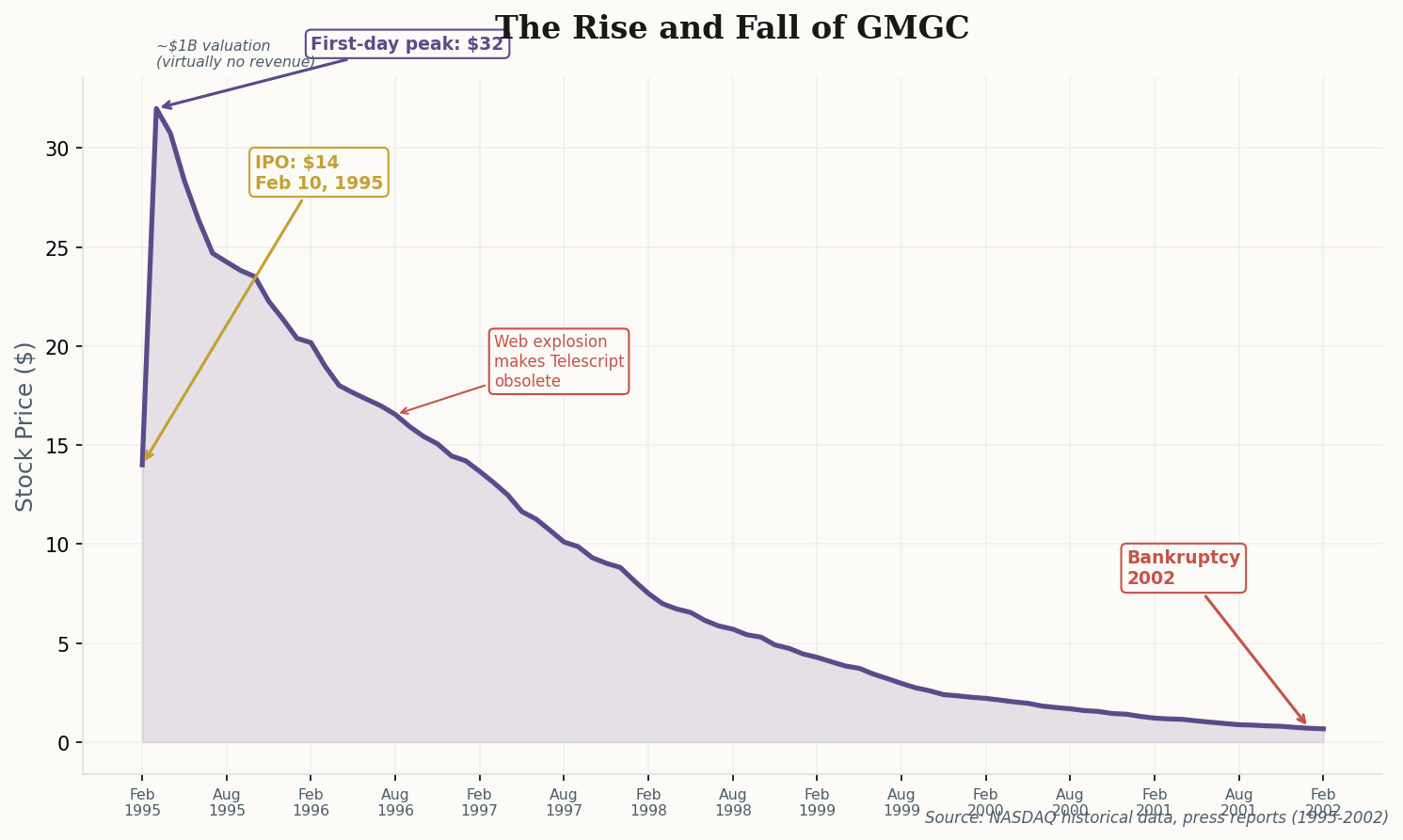
On February 10, 1995, General Magic went public. The IPO priced at $14 per share and soared to $32 on its first day, valuing a company with virtually zero revenue at nearly $1 billion. Wall Street was betting on the dream, not the reality — and the dream was running on a 16MHz processor with a 2400-baud modem.

Chart showing General Magic stock price rising from $14 IPO to $32 peak then declining to near zero by 2002 bankruptcy
GMGC stock trajectory: from $14 IPO to first-day peak of $32, then a long slide to bankruptcy. The market valued the vision, then punished the execution.

Three forces conspired to destroy the company. First, the Sculley betrayal: while sitting on General Magic's board, John Sculley had greenlighted Apple's own competing device, the Newton. Launched in 1993, the Newton "sucked the oxygen" out of the entire PDA market — and Apple's implicit endorsement of a competitor shattered confidence in General Magic's partnership model.

Second, the Web. Netscape's 1995 IPO didn't just launch a browser — it launched a paradigm. The open, decentralized World Wide Web made Telescript's walled-garden architecture of proprietary servers and "Places" look like a horse-drawn carriage on the day the Model T rolled off the line. General Magic had built the future's app store, but the future had chosen a different architecture entirely.

Third, the Palm problem. Palm shipped the Pilot in 1996 — a device that did far less than Magic Cap but did it quickly, simply, and for $299. It proved that the market wanted a good tool now, not a magical vision someday.

In desperation, General Magic pivoted to Portico (code-named Serengeti), a voice-recognition assistant that was essentially Siri fifteen years early. It wasn't enough. The company filed for bankruptcy in 2002 and liquidated its assets. The Pocket Crystal had shattered.

A constellation diagram showing General Magic at center connected to iPod, Android phone, Nest thermostat, and Apple Watch
06

The Company That Built Everything by Failing Once

The company died, but its people went on to build literally everything.

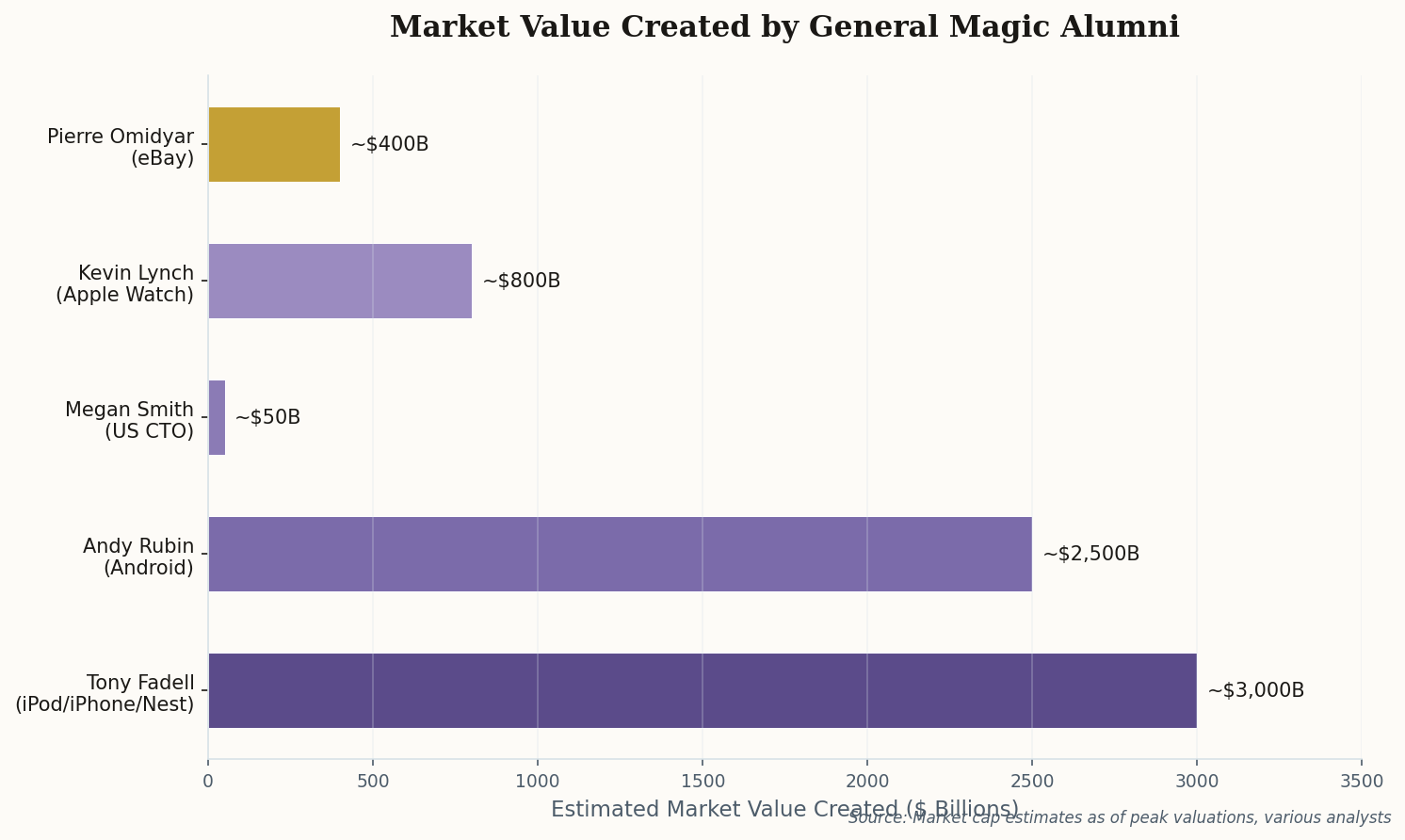
Tony Fadell became the "Father of the iPod," co-created the iPhone, and founded Nest. Andy Rubin left to create Danger (the Sidekick), then co-founded Android — which is, in many ways, the open-platform realization of what Magic Cap tried to be. Megan Smith became a VP at Google before being appointed the 3rd U.S. Chief Technology Officer under President Obama. Kevin Lynch became CTO of Adobe, then VP of Technology at Apple where he leads the Apple Watch team. And Pierre Omidyar? He wrote the original code for eBay's auction site while still an engineer at General Magic.

Horizontal bar chart showing market value created by General Magic alumni: Tony Fadell (iPod/iPhone/Nest) ~$3,000B, Andy Rubin (Android) ~$2,500B, Kevin Lynch (Apple Watch) ~$800B, Pierre Omidyar (eBay) ~$400B, Megan Smith (US CTO) ~$50B
Estimated market value created by General Magic alumni — collectively, they shaped trillions of dollars in modern tech.

The 2018 documentary General Magic captures this bittersweet legacy with rare archival footage of remarkably young engineers trying to "invent the future" in a windowless office in Mountain View. Watching Tony Fadell debug code in 1993 while talking about a device that would change everything — knowing he'd eventually build that device at Apple — is both heartbreaking and electrifying.

General Magic didn't fail because the vision was wrong. It failed because the vision was too right, too early. Every smartphone in every pocket on the planet is a Pocket Crystal. We just don't call it that.

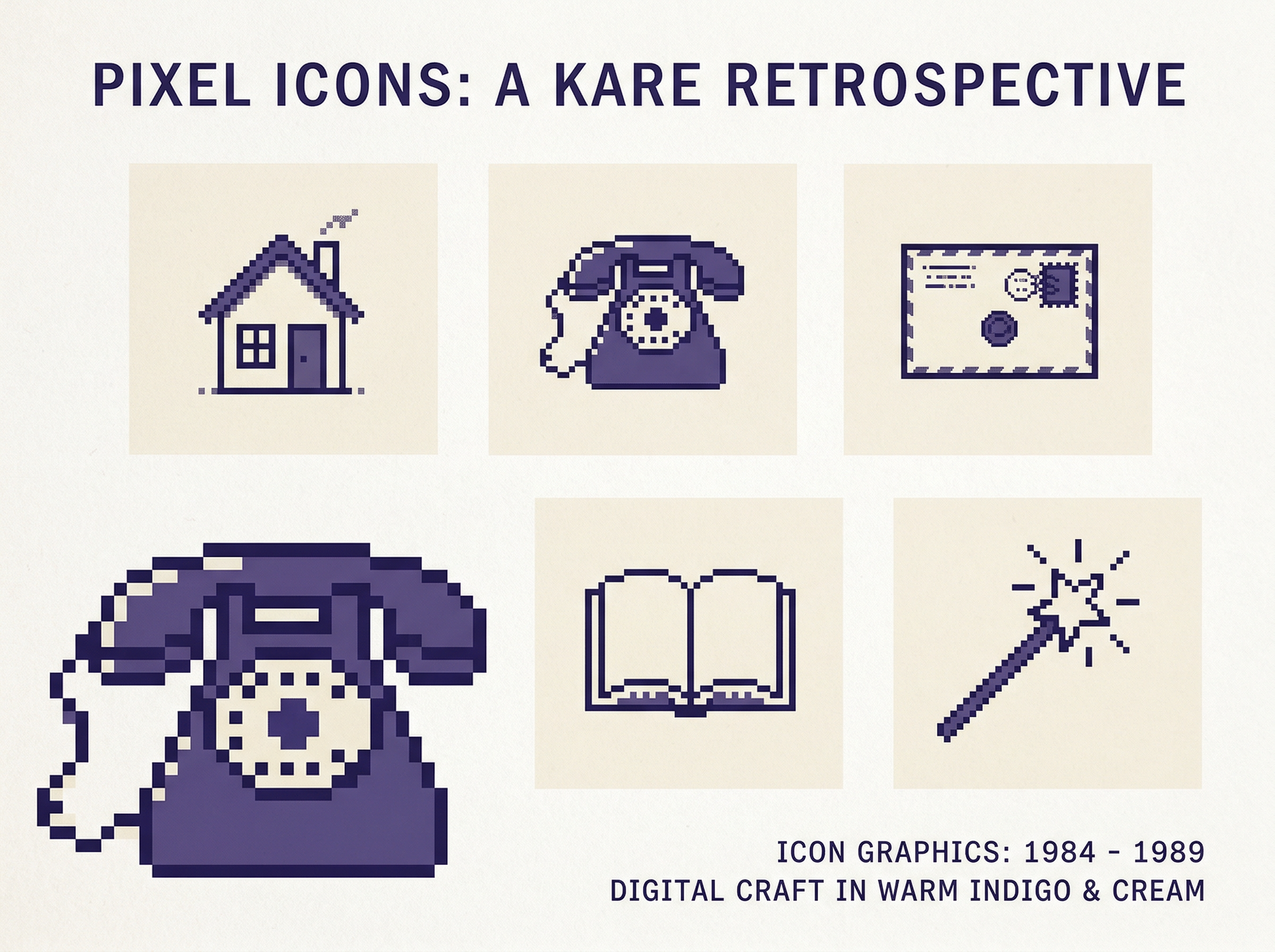
A grid of pixel art icons in Susan Kare's distinctive style — house, telephone, envelope, book, and magic wand — in warm indigo and cream
07

Road-Sign Clear: Susan Kare's Philosophy of Friendly Computing

Susan Kare had already proven that pixel art could have a soul. Her Macintosh icons — the Happy Mac, the bomb, the watch cursor — had turned a beige box into something that felt human. At General Magic, she applied the same philosophy to an even harder problem: making a computer feel like a place.

Magic Cap's skeuomorphism was the most ambitious implementation of the style before Apple made it famous with iOS. But there's a crucial difference. Apple's early iOS skeuomorphism was decorative — leather textures on a calendar app, wood grain on a bookshelf. Kare's skeuomorphism was navigational. The rotary phone wasn't just a pretty icon; it told you exactly where you were and what you could do there. The hallway wasn't decoration; it was a wayfinding system.

Her philosophy was what she called "road-sign clear" — every interface element should be as instantly legible as highway signage at 70 miles per hour. No ambiguity. No learning curve. If a button looked like a physical telephone, you knew it was for calling. Magic Cap's interface wasn't a utility belt of tools; it was a narrative. It told the story of where you were, not what file you were editing.

This "context over tools" approach died with Magic Cap, replaced by the app grid paradigm that the iPhone eventually popularized. But the question Kare asked — can a computer feel like a place rather than a toolbox? — is being asked again by every spatial computing team at Apple, Meta, and beyond. The Vision Pro's "environments" are, in a sense, Magic Cap's rooms with 30 years of Moore's Law behind them.

The Future Is Always Arriving

General Magic saw every piece of the smartphone puzzle — touchscreens, mobile apps, cloud agents, social connectivity, the app store — and assembled them fifteen years too early. The company's greatest product wasn't the Magic Link or Telescript. It was its people, who carried the vision forward into the devices that now define modern life. Next time you unlock your iPhone, remember: you're holding a Pocket Crystal. Someone dreamed it in 1989.

Share X LinkedIn