Real-Time Strategy

Construct Additional Pylons

The RTS genre's second golden age is here. From StarCraft's eternal perfection to Stormgate's community evolution, real-time strategy is building faster than ever.

Listen
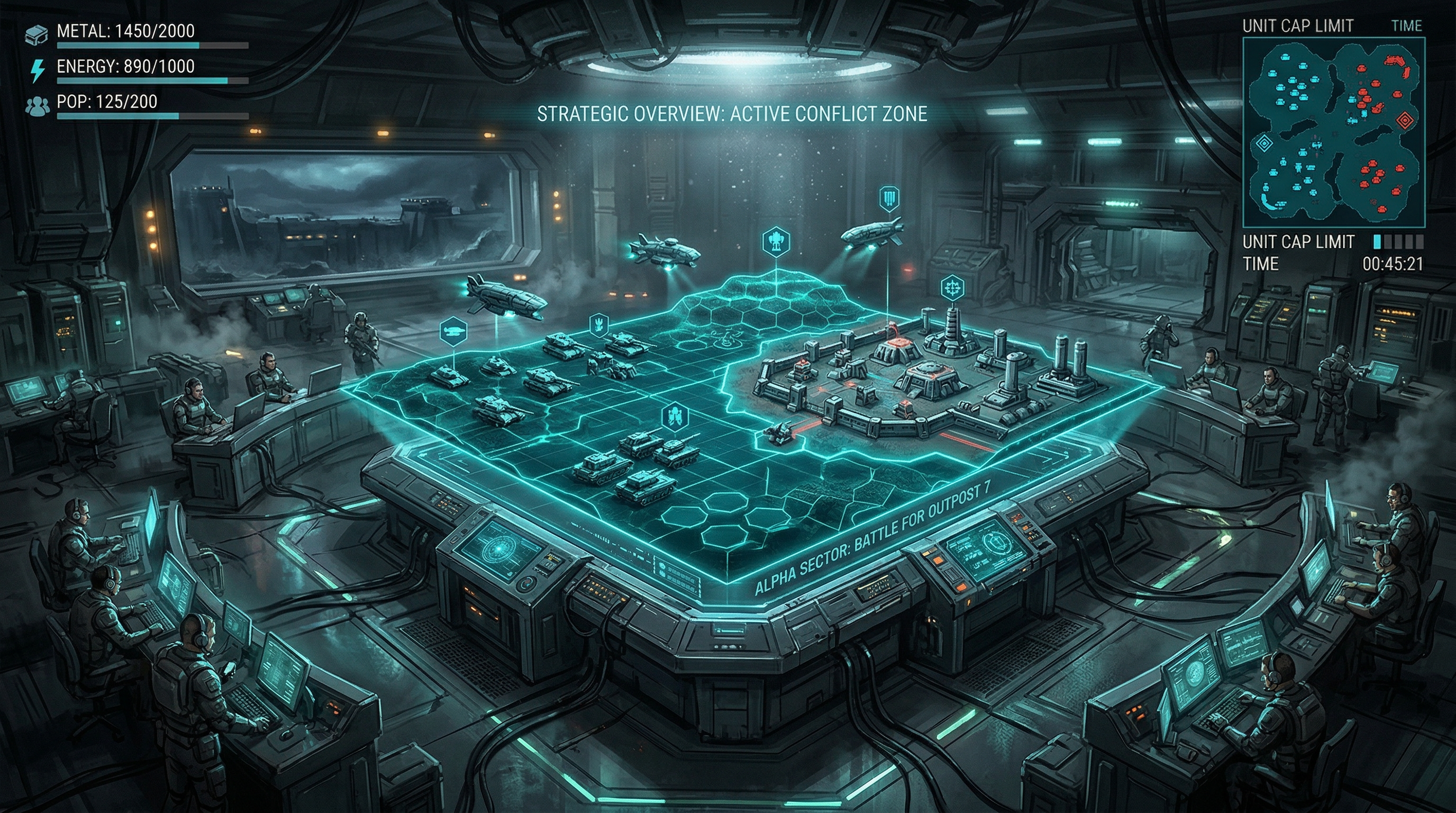
Epic RTS command center with holographic battle map showing unit formations and base layouts, teal glowing grid lines against dramatic lighting
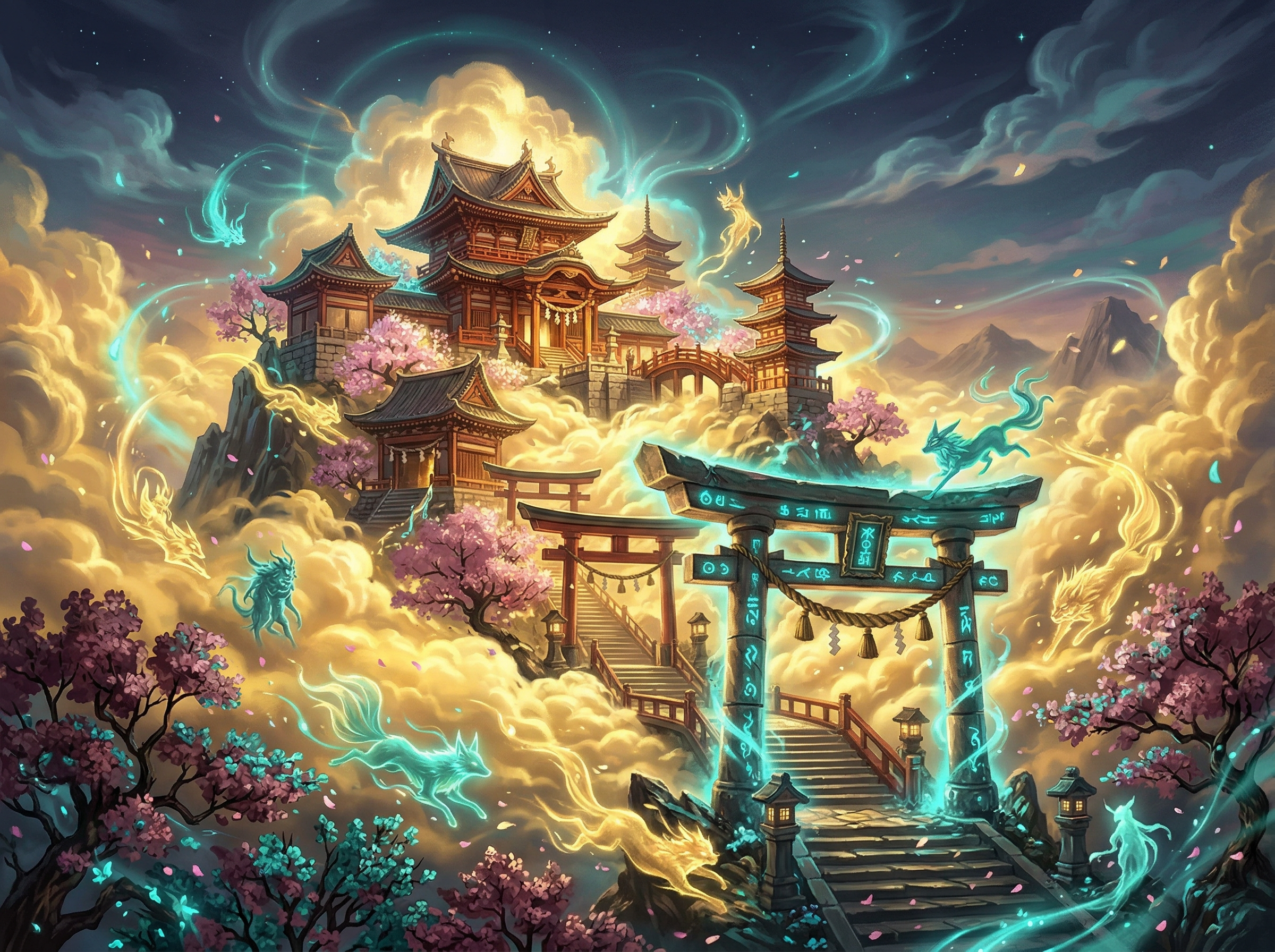
Japanese temple emerging from golden clouds with mythological yokai spirits and cherry blossoms
01

The Gods of the East Finally Join the Pantheon

For over two decades, the Age of Mythology community asked for one thing above all else: a Japanese pantheon. With the Heavenly Spear expansion, World's Edge finally delivers—and they didn't phone it in.

The expansion introduces Yokai units that run on an entirely new spiritual energy resource, breaking free from the standard resource economy that's defined the Age franchise for decades. A 12-mission cinematic campaign threads Japanese mythology through the game's existing Greek, Norse, and Egyptian lore. It's the kind of bold mechanical divergence that separates a great expansion from a reskin.

What matters here isn't just the content—it's what it proves. Age of Mythology: Retold launched to strong reviews, but Heavenly Spear shows that the "live service" model can actually work for strategy games. Consistent, high-quality expansions keep an RTS relevant for years. Steam chart positions tell the story: Retold has held a top-20 strategy slot since launch. The question isn't whether the RTS renaissance is real. It's whether the old franchises can keep pace with the hungry newcomers.
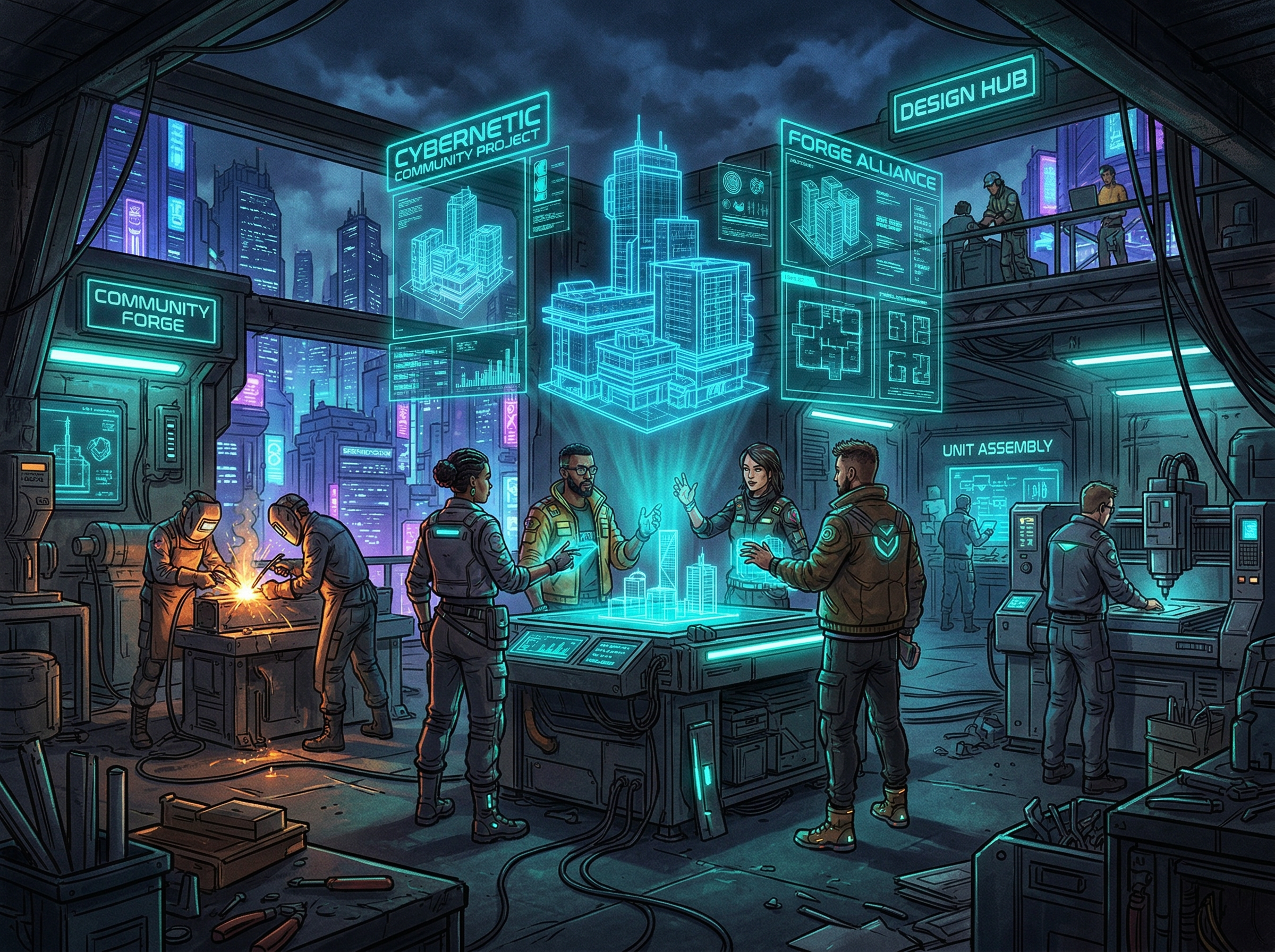
Futuristic community forge with holographic building blueprints in a collaborative space with teal neon accents
02

Stormgate Hands Over the Keys to the Kingdom

Stormgate—the spiritual successor to StarCraft II, built by ex-Blizzard veterans at Frost Giant Studios—just made its most consequential move yet. The "Community Evolution" update ships a full Editor Suite, completing the Infernal and Celestial faction tech trees, and launches a $10,000 grassroots tournament series.

CEO Tim Morten frames it plainly: "Our goal was always to give the keys to the kingdom back to the players." This isn't corporate generosity. It's a calculated bet that the community-content model that powered StarCraft II's Arcade and Warcraft III's custom games—the ecosystem that literally spawned the MOBA genre—can work again.

The Editor Suite is the real prize. If modders can build Defense of the Ancients inside your game, you're not selling a product anymore. You're running a platform. Stormgate's early access numbers were solid but not spectacular. This update is its make-or-break moment: can a community of creators turn a good RTS into a generational one?

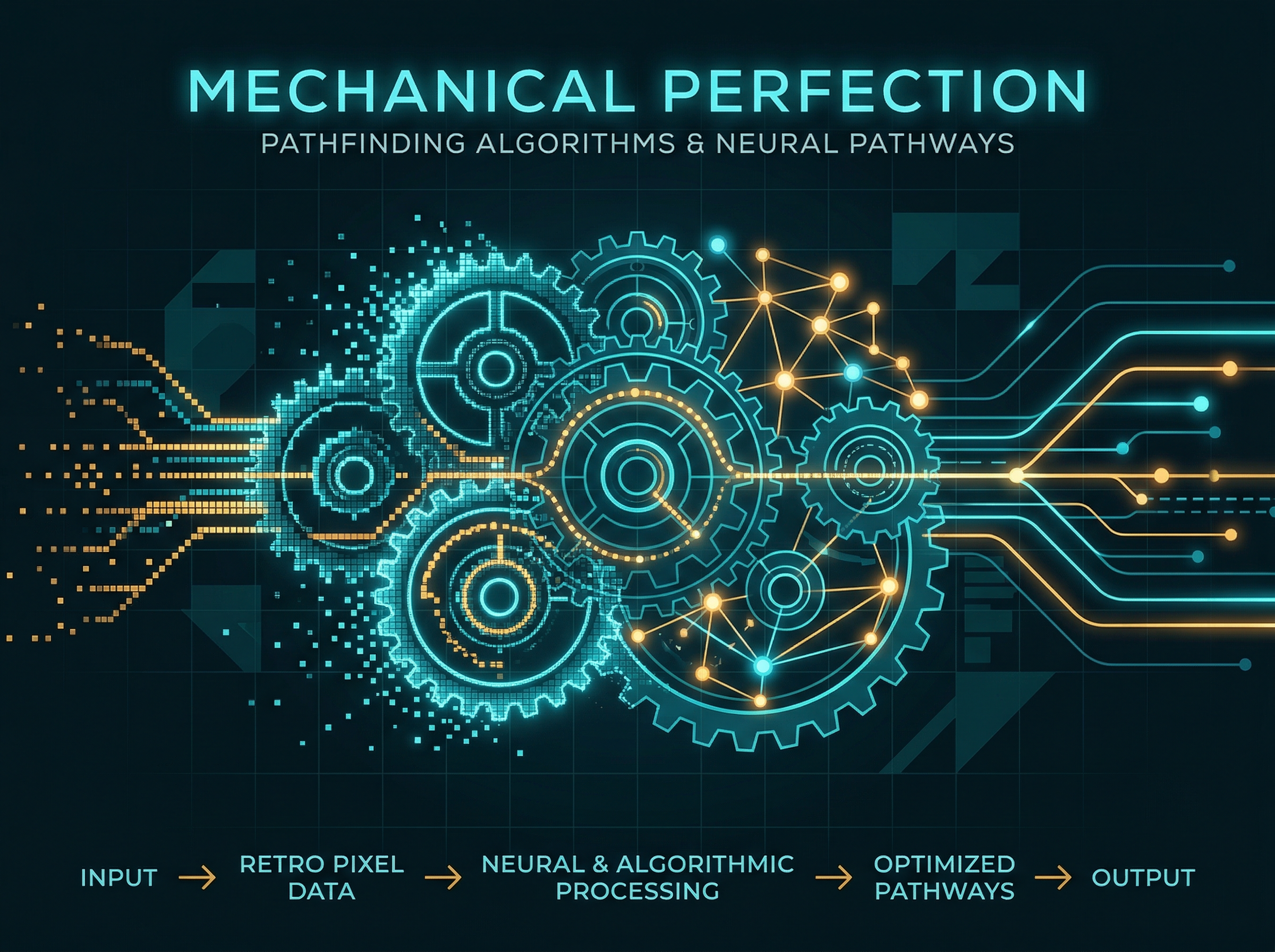
Abstract visualization of mechanical perfection with interlocking gears and pathfinding algorithms as glowing neural pathways
03

Brood War Is Still the Perfect Game (And That's the Point)

PC Gamer's latest deep-dive on StarCraft: Brood War asks a question that sounds absurd until you think about it: what if the "bugs" are the game?

Brood War's unit pathing is famously terrible. Its 12-unit selection cap feels archaic. Modern RTS games have solved these "problems" with smart pathfinding and infinite selection groups. But here's the thing—those limitations created depth. When your Dragoons get stuck on a ramp, your ability to micro them through the choke becomes a skill expression. When you can only select 12 units, you have to make split-second triage decisions about which cluster needs your attention. The friction is the game.

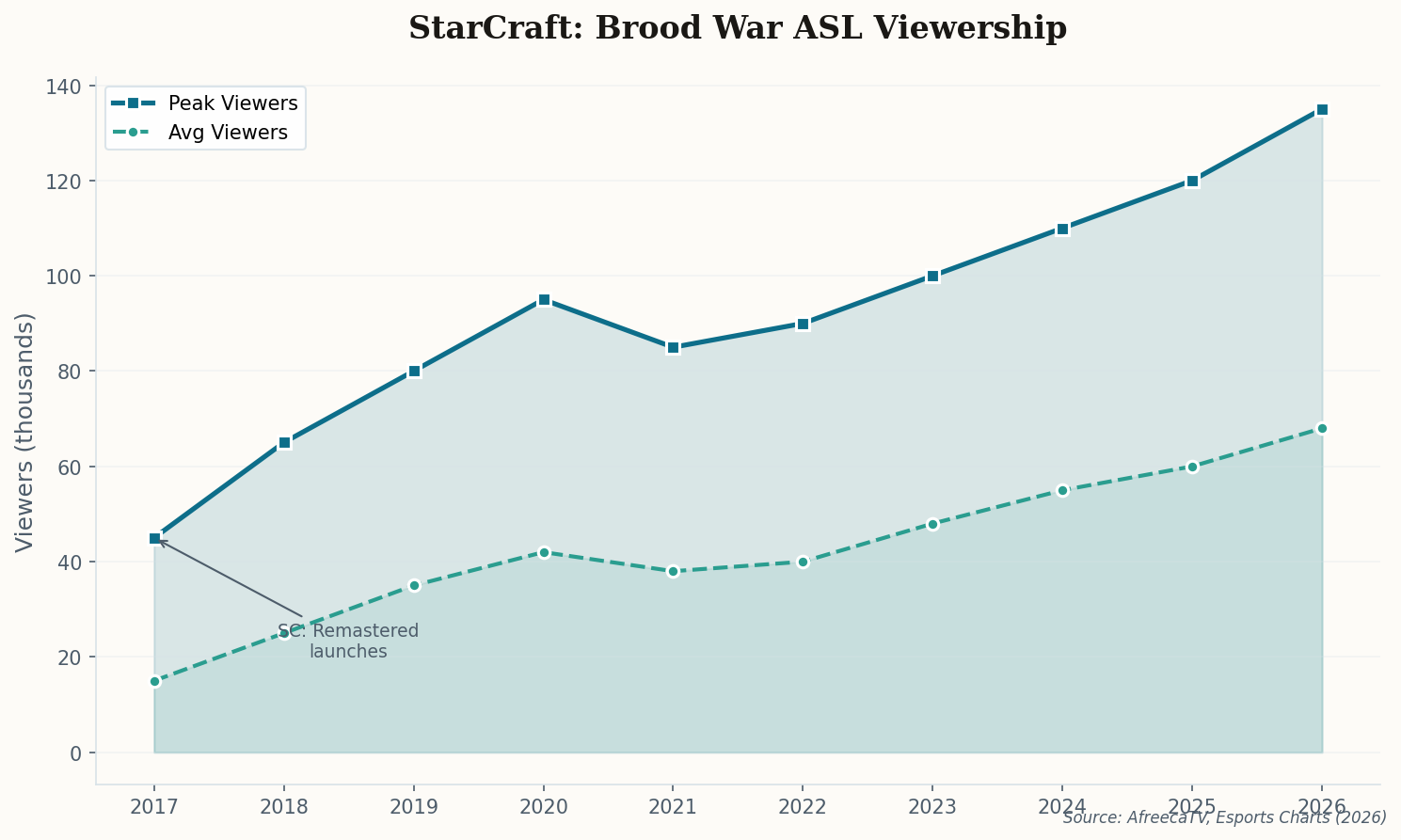
Line chart showing StarCraft Brood War ASL viewership steadily climbing since 2017, remaining higher than many modern esports titles in 2026
AfreecaTV StarCraft League viewership continues climbing. A 28-year-old game outdraws most modern esports titles.

The AfreecaTV StarCraft League viewership numbers back this up: peak viewership in 2026 that remains higher than many modern esports titles. "Brood War is the chess of our generation," the piece argues—"a set of immutable rules that humans will spend lifetimes trying to master." That's not nostalgia. That's a design lesson every modern RTS developer should internalize.

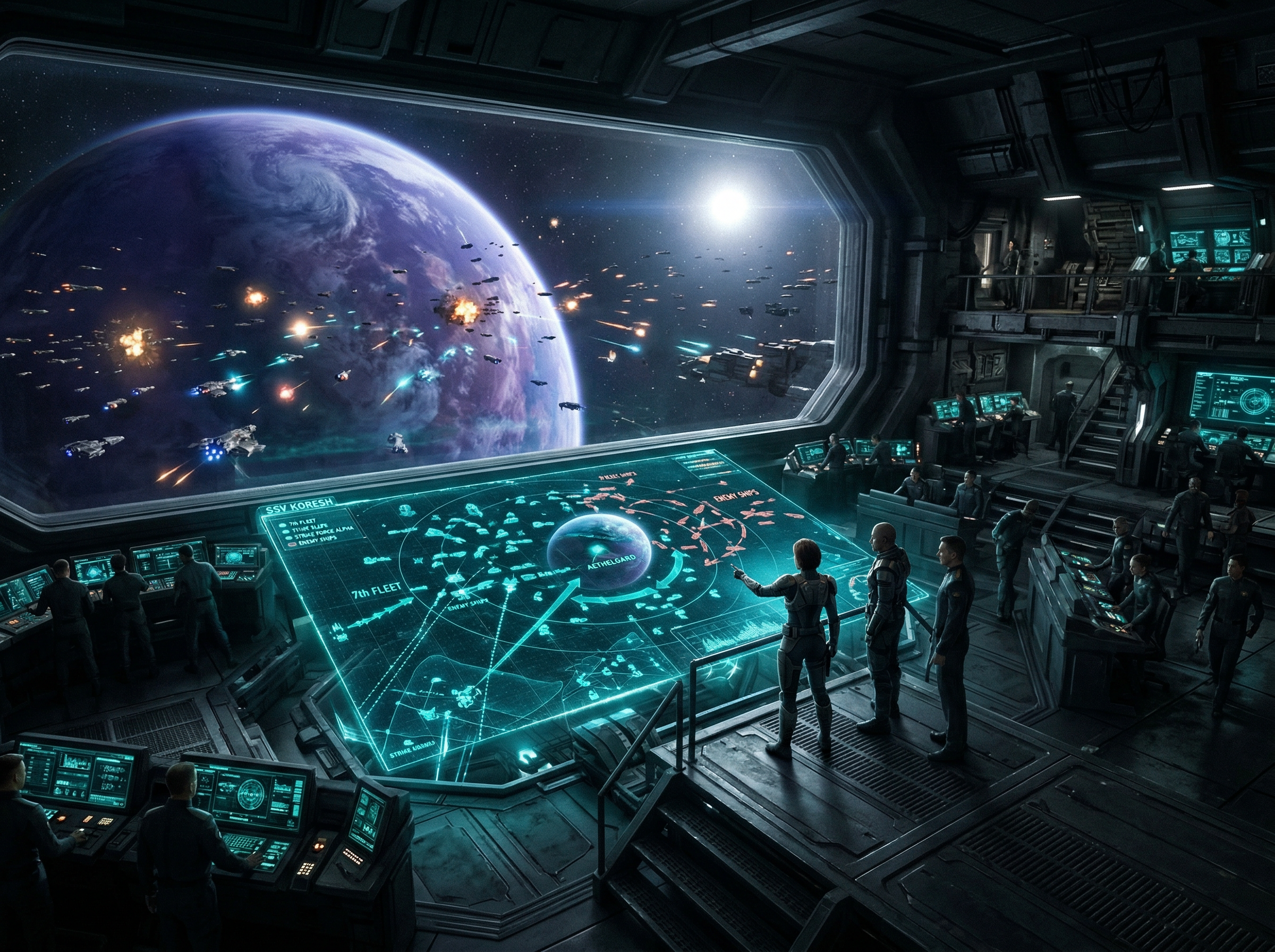
Cinematic sci-fi fleet command bridge with holographic star map and fleet battle formations
04

ZeroSpace Wants You to Feel Like a Commander, Not a Clicker

The "Next Big Thing" conversation in RTS always comes down to a tension: do you optimize for competitive depth or cinematic experience? ZeroSpace says both. Its freshly revealed 2026 roadmap confirms a Summer early access launch with over 100,000 players from the February Steam Next Fest demo already in the pipeline.

The headline feature is "Galactic War"—an MMO-lite metagame where competitive matches contribute to persistent territory control across a galactic map. It's the kind of feature that sounds wildly overambitious until you realize that the most successful modern strategy games (Helldivers 2, Foxhole) have proven that persistent community stakes transform how people engage with competitive mechanics.

Execution is everything. Blending StarCraft-speed micro with Mass Effect-style narrative is a design tightrope. But if Starlance Studios can pull it off, ZeroSpace won't just be another entry in the renaissance. It'll redefine what an RTS can be.

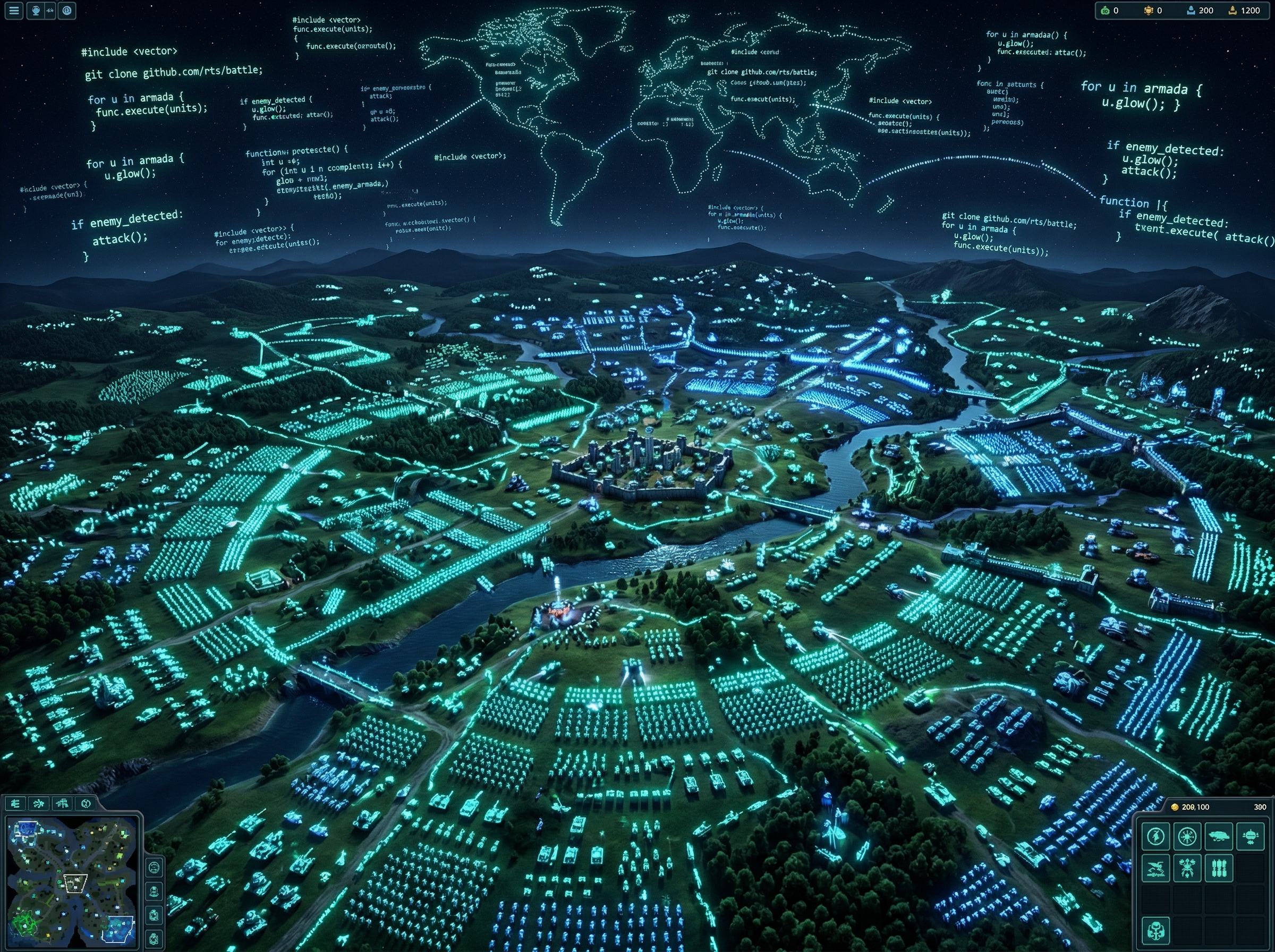
Massive birds-eye battlefield with thousands of glowing units forming intricate patterns across a verdant landscape
05

500,000 Players Proved That the Best RTS Can Be Free

Beyond All Reason is the open-source spiritual successor to Total Annihilation and Supreme Commander that nobody outside the strategy hardcore talks about—and that's a crime. It's completely free. It renders 10,000 units simultaneously without breaking a sweat. And it just hit 500,000 unique monthly players.

BAR represents something philosophically important about the RTS renaissance: the genre's future isn't owned by any corporation. A dedicated community of volunteer developers has built what billion-dollar studios couldn't—a massive-scale strategy game that runs on practically any hardware, updates weekly, and answers to no shareholders.

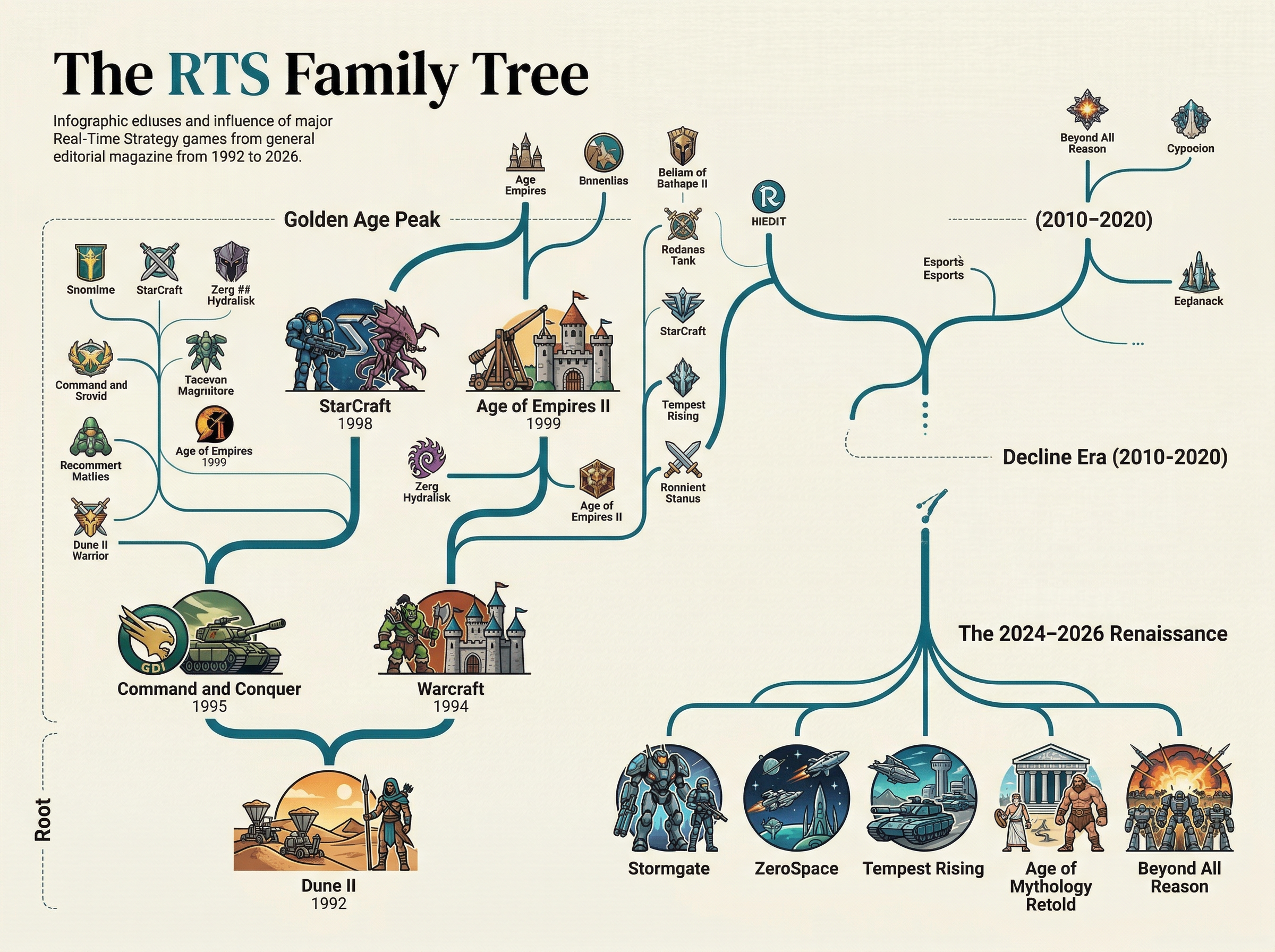
Infographic showing the RTS family tree from Dune II (1992) through the golden age to the 2024-2026 renaissance
The RTS Family Tree: From Dune II's genesis to 2026's second golden age, three decades of real-time strategy evolution.

The implications extend beyond gaming. BAR is proof-of-concept for the open-source model in entertainment. When the tools are good enough and the passion is real, you don't need a publisher. You need a community. Every aspiring indie RTS developer should be studying what BAR did right.

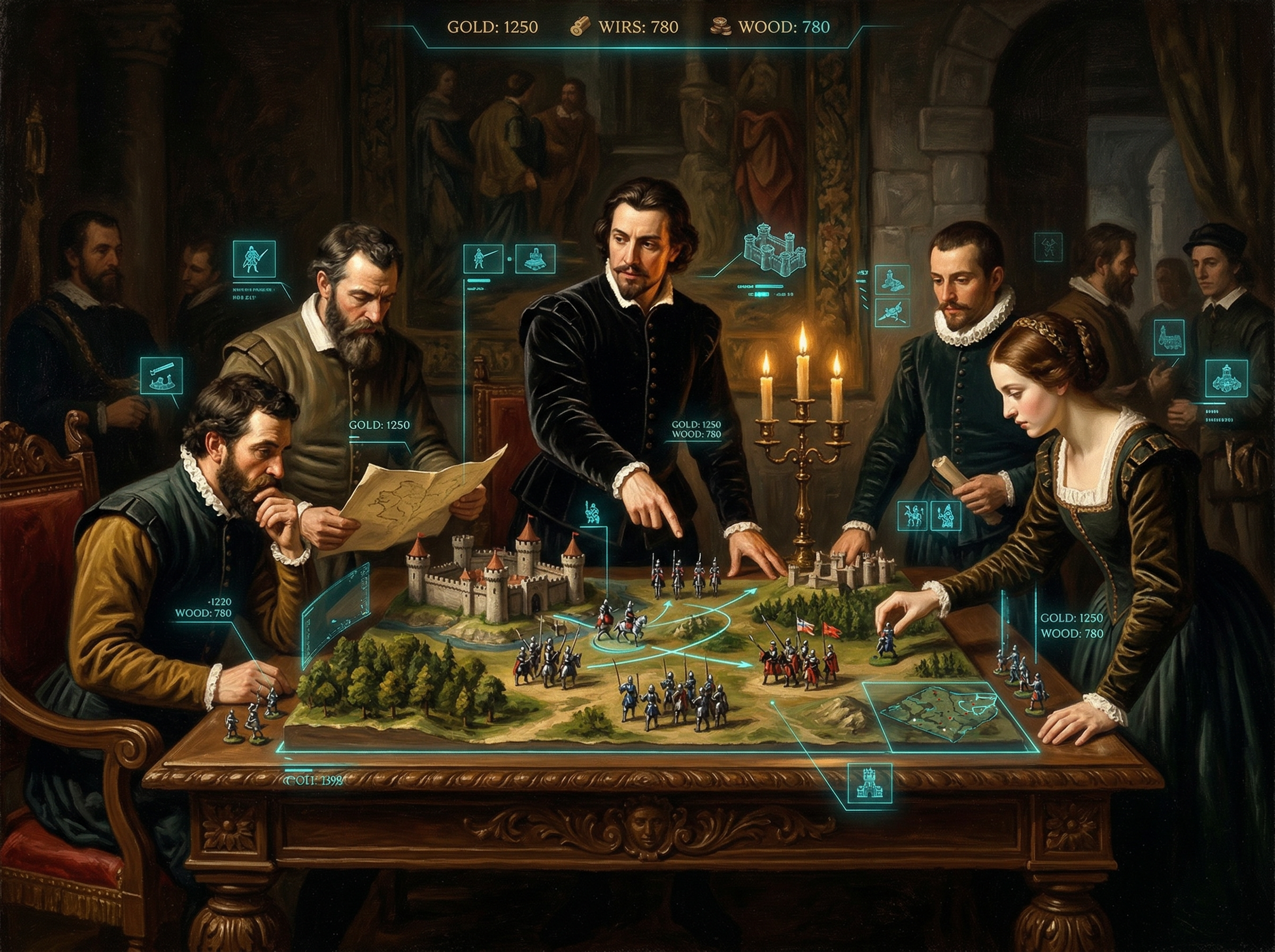
Renaissance painting reimagined with RTS game elements, classical figures around a strategy board with miniature armies
06

Why 2026 Is the New 1998 (And This Time It Might Stick)

GameDeveloper.com's definitive state-of-the-union for the genre answers the question everyone's been asking: why now? The answer is structural, not sentimental.

Three forces converged. First, the MOBA genre that cannibalized RTS in the 2010s has matured and plateaued—players who cut their teeth on League of Legends are hungry for deeper strategic experiences. Second, Game Pass and similar subscription services eliminated the $60 risk barrier that killed mid-tier RTS games. Third, AA studios realized they don't need AAA budgets to ship a great strategy game—they just need a clear design vision.

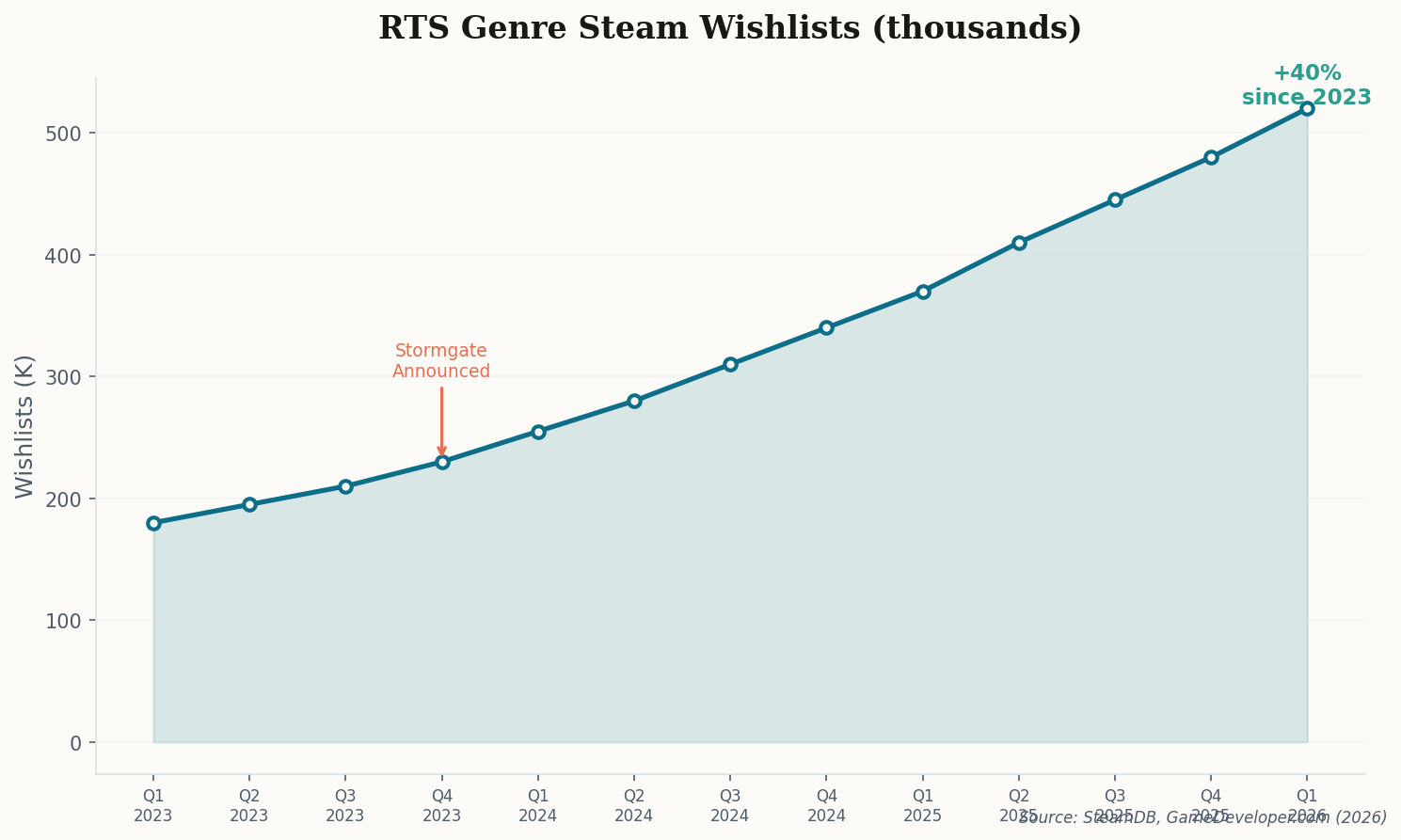
Line chart showing RTS genre Steam wishlists growing 40% between 2023 and 2026
RTS wishlists on Steam grew 40% since 2023. The appetite for strategy games hasn't been this strong since the original golden age.

The most interesting insight: "Social RTS" is the key innovation. Three-player co-op with shared bases is driving new player retention in ways that hyper-competitive 1v1 ladders never could. The RTS "didn't die," the analysis argues—"it just went to the gym. It's leaner, more social, and finally stopped trying to be an esport first and a game second."

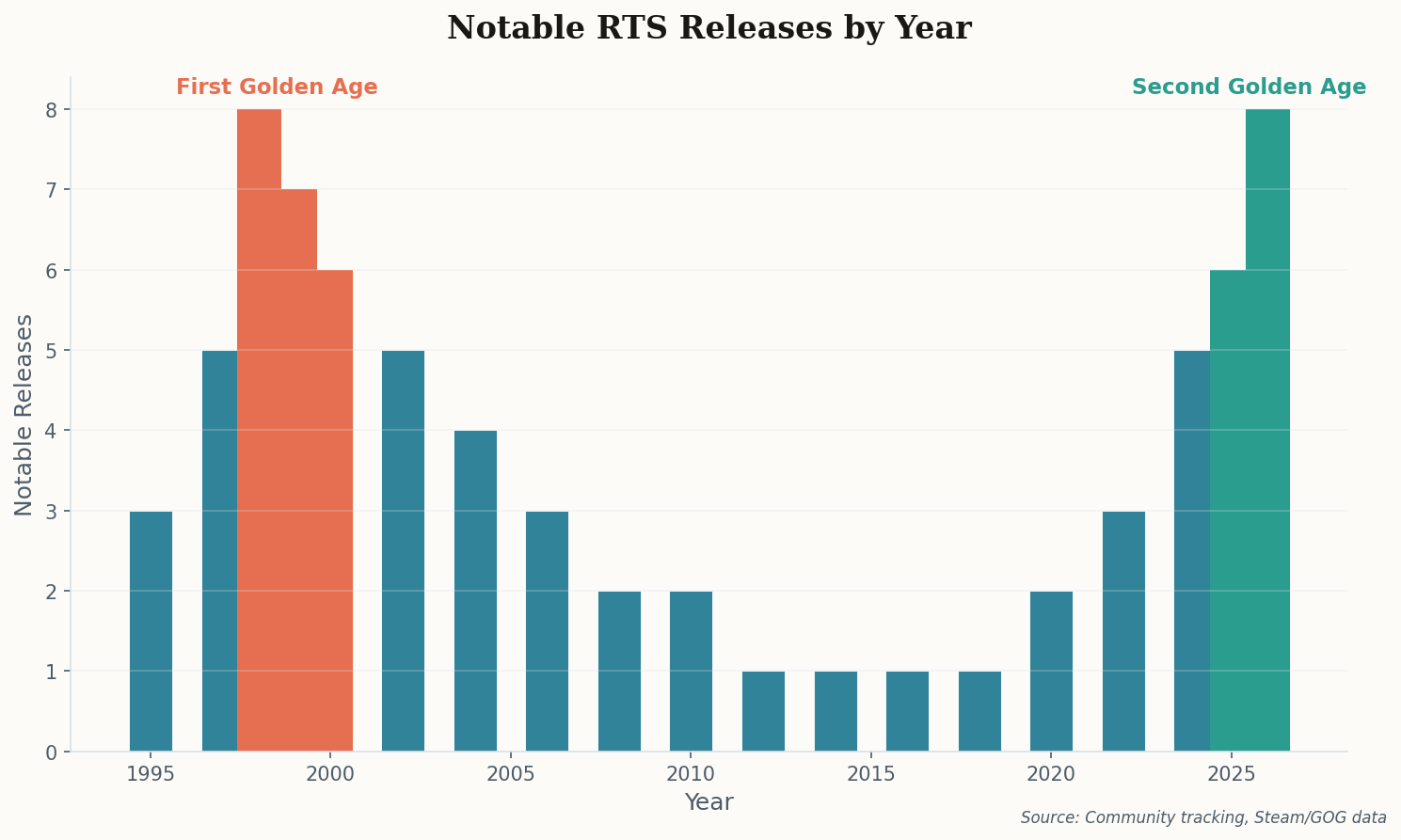
Bar chart comparing notable RTS releases by year, highlighting the First Golden Age (1998-2000) and Second Golden Age (2025-2026)
Two golden ages, separated by a generation. The 2025-2026 release volume matches the legendary 1998-2000 era.
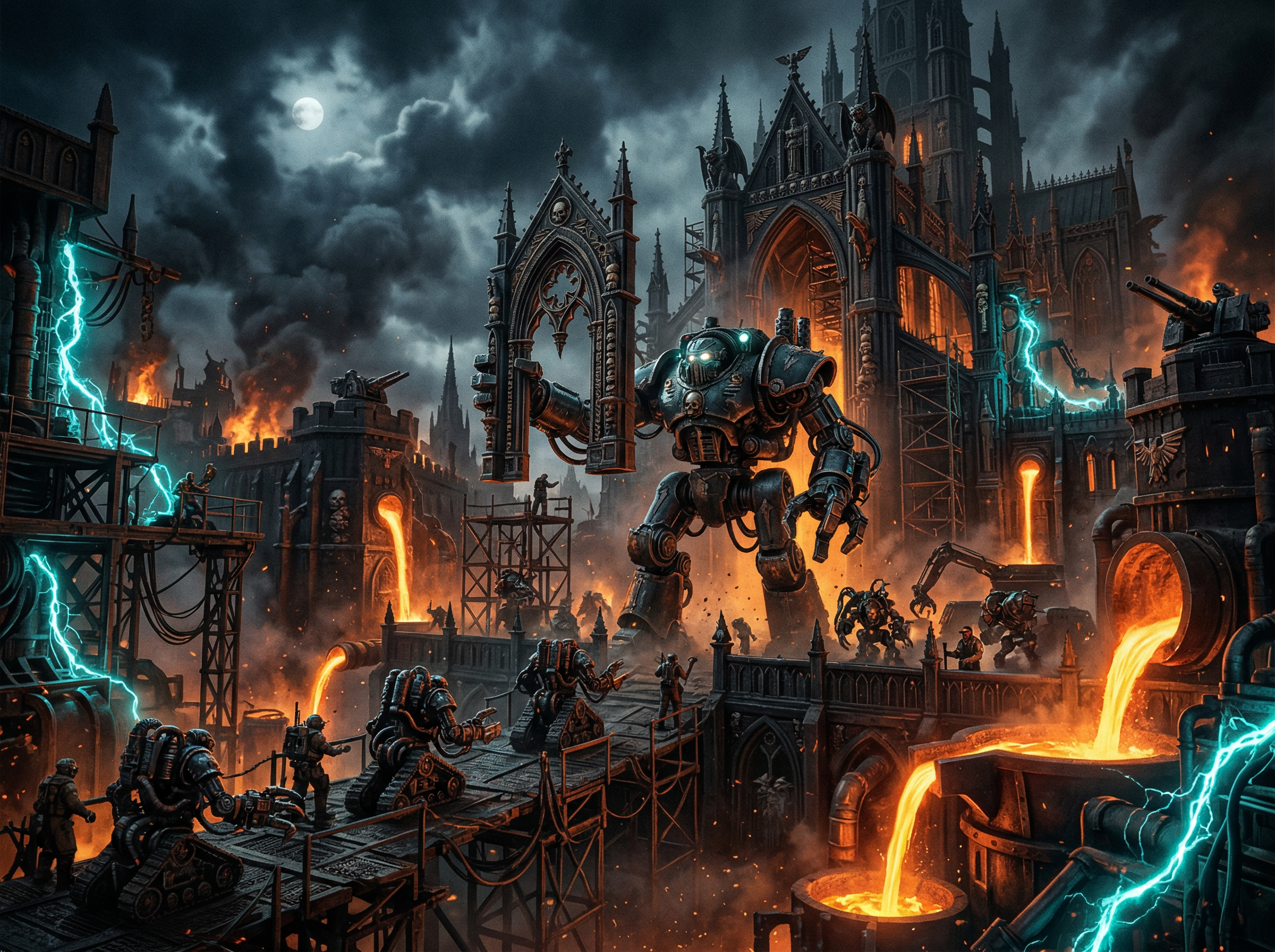
Gothic cathedral-fortress being constructed by massive mechanical servitors with molten metal and teal energy streams
07

Dawn of War IV Admits What Everyone Already Knew

Dawn of War III tried to be a MOBA. The fans revolted. The game died. Now King Art Games—the studio behind Iron Harvest—is building Dawn of War IV, and the pitch is refreshingly honest: base building is back, squad combat is back, and the MOBA-lite mechanics are gone.

The reveal makes two things clear. First, you're getting the Warhammer 40,000 Adeptus Mechanicus as a core launch faction for the first time in series history—cog-worshipping cyborgs with walking cathedrals and lightning-arc weapons. Second, King Art understands why Dawn of War I was beloved: it wasn't just about tactics. It was about building a fortress and watching an Ork Waaagh! crash against it.

This is the most significant "rehabilitation" of a major RTS franchise in the genre's history. Dawn of War III's failure nearly killed the series and sent a chilling message to publishers: don't mess with base building. Dawn of War IV is the apology tour, and if King Art nails the scale and spectacle, it could be the franchise's finest hour. The 40K universe has never been more popular—the audience is there. The question is whether the game can match the lore.

GG WP

The first golden age gave us StarCraft, Age of Empires, and Command & Conquer—games that defined a generation of PC gamers. The second golden age isn't trying to recapture that lightning. It's building something new on the same foundation: the irreplaceable thrill of watching your plan come together in real time, one build order at a time. Whether you're a Brood War purist or a Stormgate convert, the supply depots are being constructed. The pylons are going up. And the genre that everyone wrote off? It's warping in reinforcements.

Share X LinkedIn