Travel

Three Days in London

72 hours in the city that never stops surprising — a blueprint for the traveler who's done with Big Bus tours.

Listen
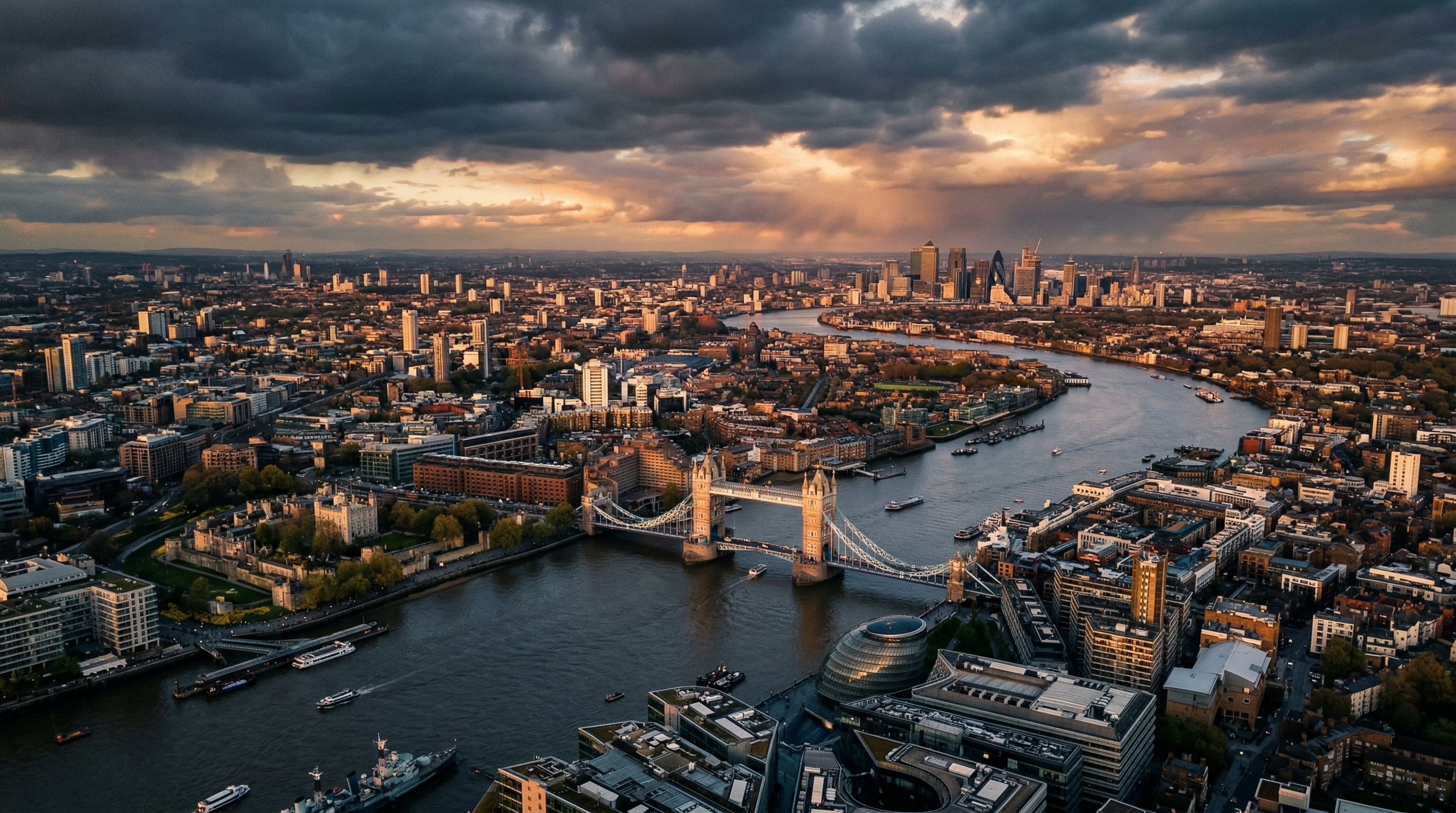
London skyline at golden hour in March, Tower Bridge and the Thames winding through the city under dramatic clouds
Three London neighborhoods: Georgian Marylebone, gritty Shoreditch, and riverside Southwark
01

Your Base Defines Your Trip

Here's an opinion that will save you hundreds of pounds and hours of transit frustration: forget the sterile hotels near Paddington and the overpriced chaos around Leicester Square. Your neighborhood isn't just where you sleep — it's your first impression every morning and your last drink every night. Choose wrong and you'll spend half your trip on the Tube. Choose right and London starts feeling like yours.

The Hoxton, Southwark (from ~£209/night) is the power base. You wake up steps from the Thames, the Tate Modern, and London's best food market. The rooftop bar Albie draws actual Londoners — always a reliable signal. Walk score: 98. For the traveler who wants to maximize every hour, this is the move.

Dorset Square Hotel in Marylebone (~£250/night) is for the person who fantasizes about living in a Georgian townhouse. It's a Firmdale property — meaning bold interiors, impeccable service, and a cricket-themed bar that somehow works. The village-within-a-city vibe here is genuine. Walk score: 96.

One Hundred Shoreditch (~£175/night) delivers the best design-to-dollar ratio in the city. If you want graffiti art on your morning coffee run and a proper DJ set by midnight, this is your pick. Walk score: 97. The downside? Shoreditch can be relentless — there's no quiet Tuesday here.
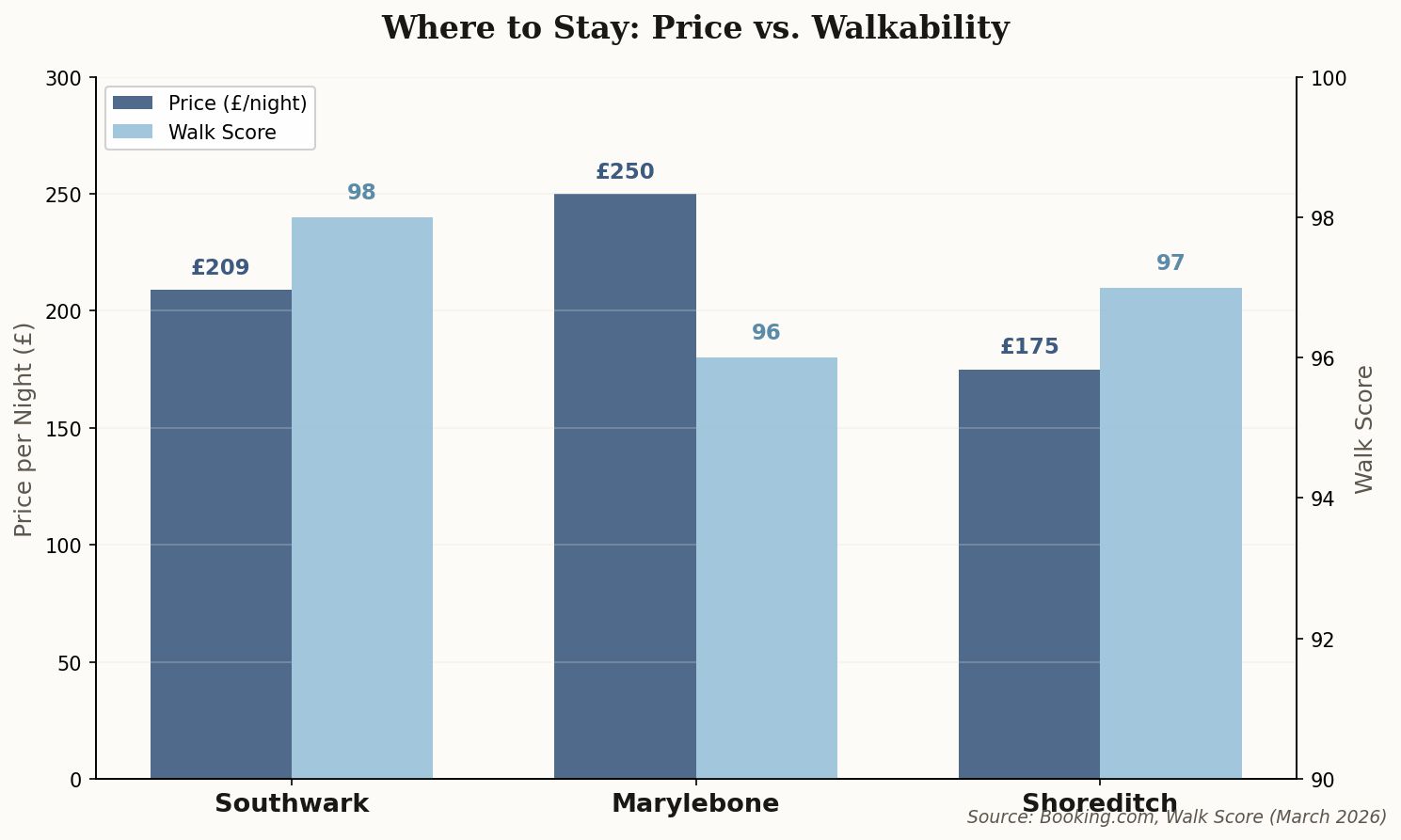
Bar chart comparing neighborhood prices and walk scores: Southwark £209/98, Marylebone £250/96, Shoreditch £175/97
Neighborhood comparison: price per night vs. walkability score. All three score 96+ for walkability — the real differentiator is vibe, not logistics.
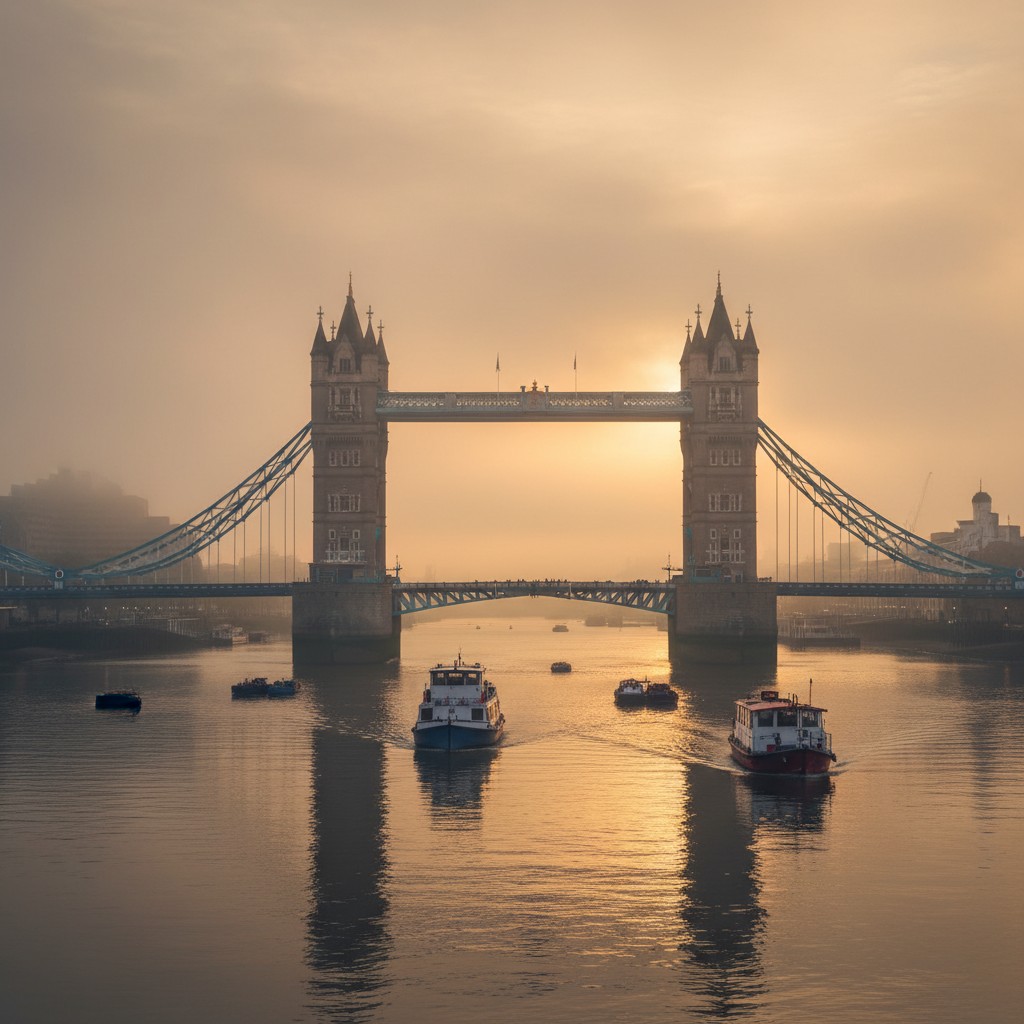
Tower Bridge at dawn, misty Thames with warm light breaking through clouds
02

Day One — The Iconic Loop, Done Right

Every first-timer guidebook will tell you to "see Tower Bridge" and "visit Borough Market." That advice isn't wrong — it's just incomplete. The difference between a forgettable first day and a magnificent one comes down to timing, routing, and knowing which crowds to dodge.

9:00 AM — The Tower of London. Be at the gates when they open. Not 9:30, not "after breakfast" — 9:00 sharp. Walk directly to the Crown Jewels. By 11 AM, the queue for that room alone stretches 45 minutes. You'll be through in ten. The rest of the Tower is better without a mob, too. Skip the generic Yeoman Warder group tour if you're short on time and use the Tower's official app for a self-guided "Dark History" route — it covers the same ground with better pacing.

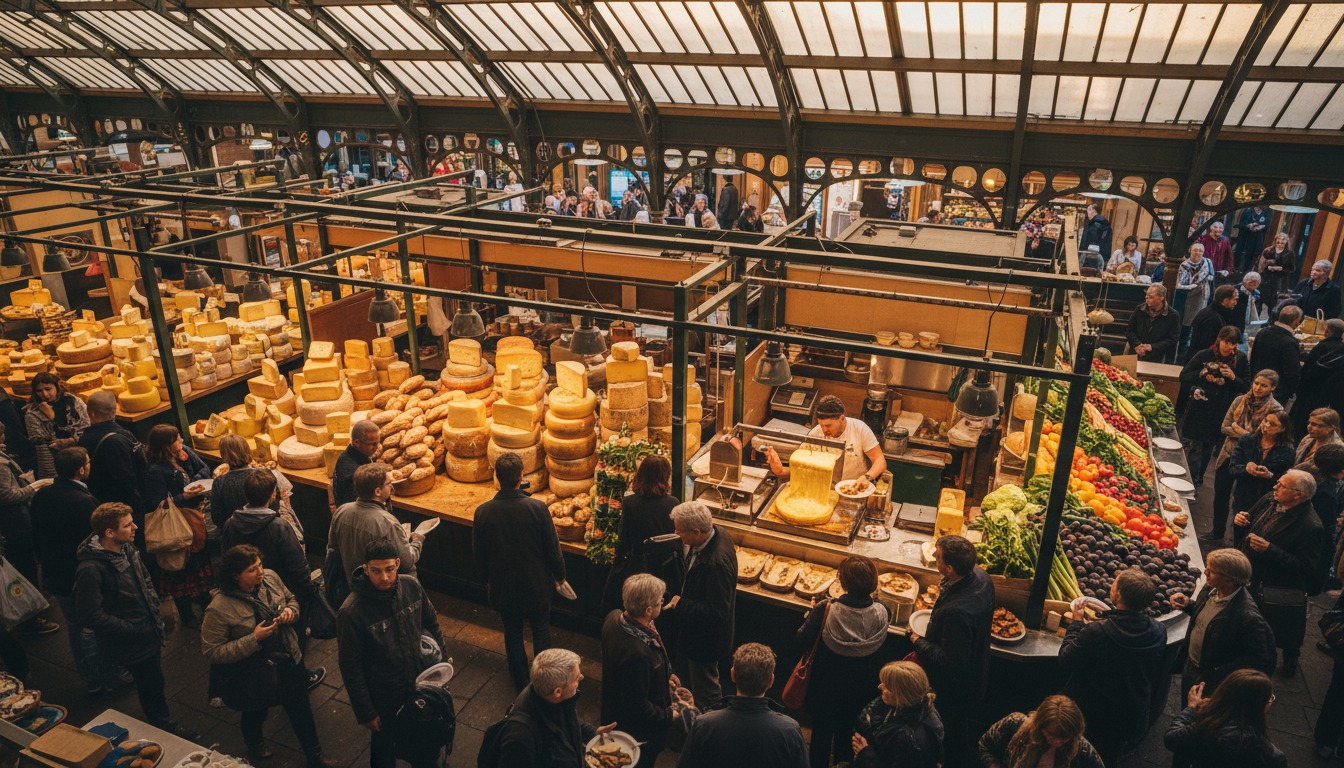
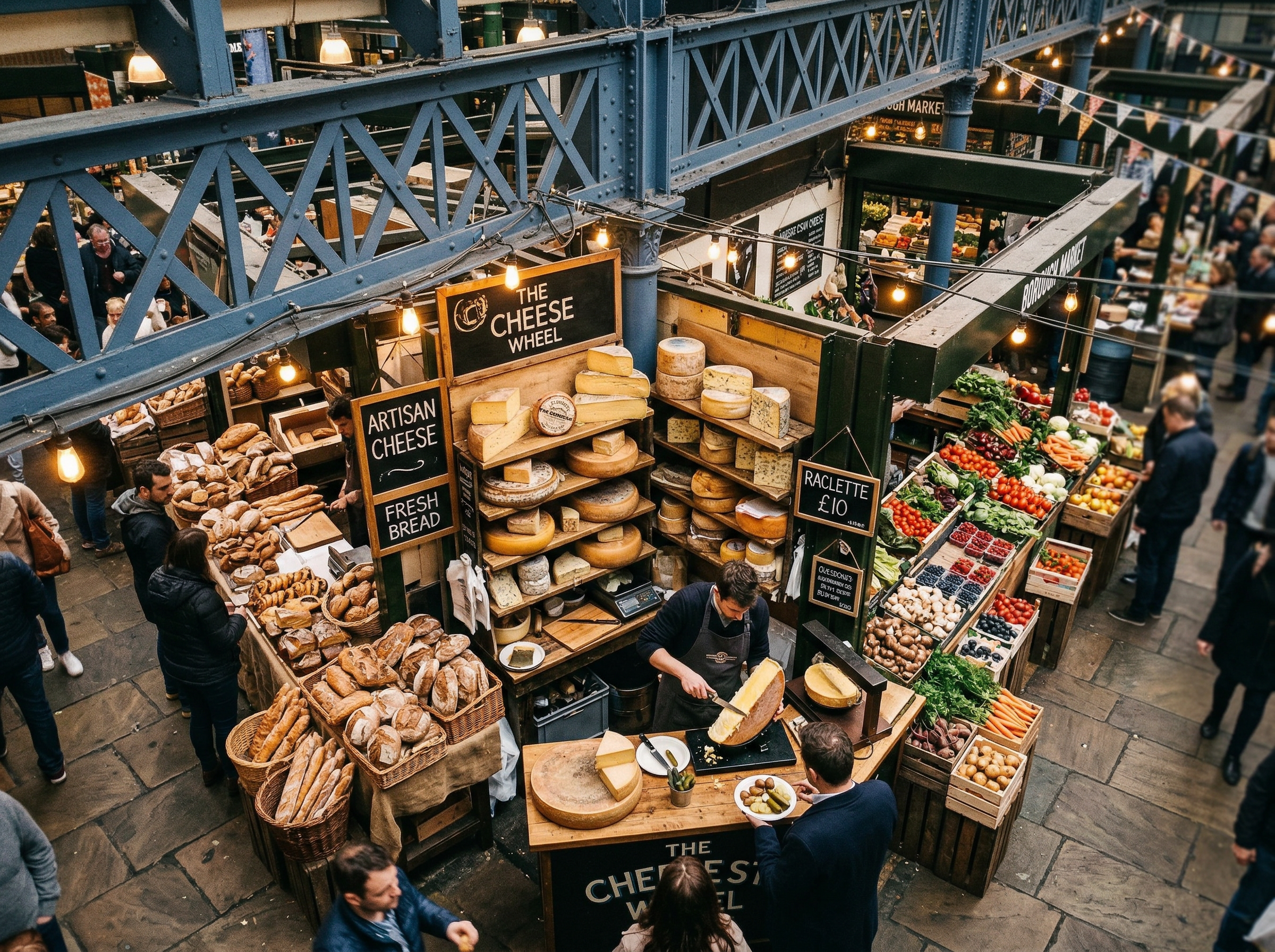
12:30 PM — Borough Market. It's a 10-minute walk across Tower Bridge (itself worth the stroll). The critical move here: avoid the center of the market where Instagram tourists congregate around the same three cheese stalls. Head to the Three Crown Square area for Kappacasein's legendary raclette — molten cheese scraped over potatoes and pickles. Or grab a Humble Crumble for dessert. Both are worth the detour from the main drag.

3:00 PM — The South Bank Stroll. Walk west along the river past the Globe Theatre and the Golden Hinde. Eventually you'll hit The Anchor Bankside. Yes, it's touristy. But sitting on that terrace with a pint of London Pride while the tide rises and St Paul's Cathedral catches the late afternoon light — that's the London postcard that actually delivers.

Insider tip: If you're walking the South Bank on a clear evening, continue past the National Theatre to the Sky Garden at 20 Fenchurch Street. It's free (book ahead), and the sunset views rival the Shard at a fraction of the cost — which is zero.

Interior of Leighton House Arab Hall, shimmering blue Islamic tiles and golden dome ceiling
03

Day Two — Culture Without the Crowds

The British Museum is extraordinary, but spending four hours in its central galleries surrounded by 6,000 other visitors is how you drain the joy out of a London trip. Day Two is about going deeper — the spaces that reward curiosity over obligation.

Morning — Choose your weapon. The Sir John Soane's Museum is free, weird, and wonderful. It's a neoclassical maze crammed with architectural fragments, an Egyptian sarcophagus, and Hogarth's A Rake's Progress paintings. The building itself is the exhibit — Soane designed trick walls that fold open to reveal hidden galleries. It feels like discovering a secret. Alternatively, Dennis Severs' House in Spitalfields (£16) offers an immersive "still life drama" — you walk through a 17th-century silk weaver's home where candles gutter, bread cools on tables, and the residents seem to have just stepped into the next room. It's theatrical, unsettling, and unlike anything else in the city.

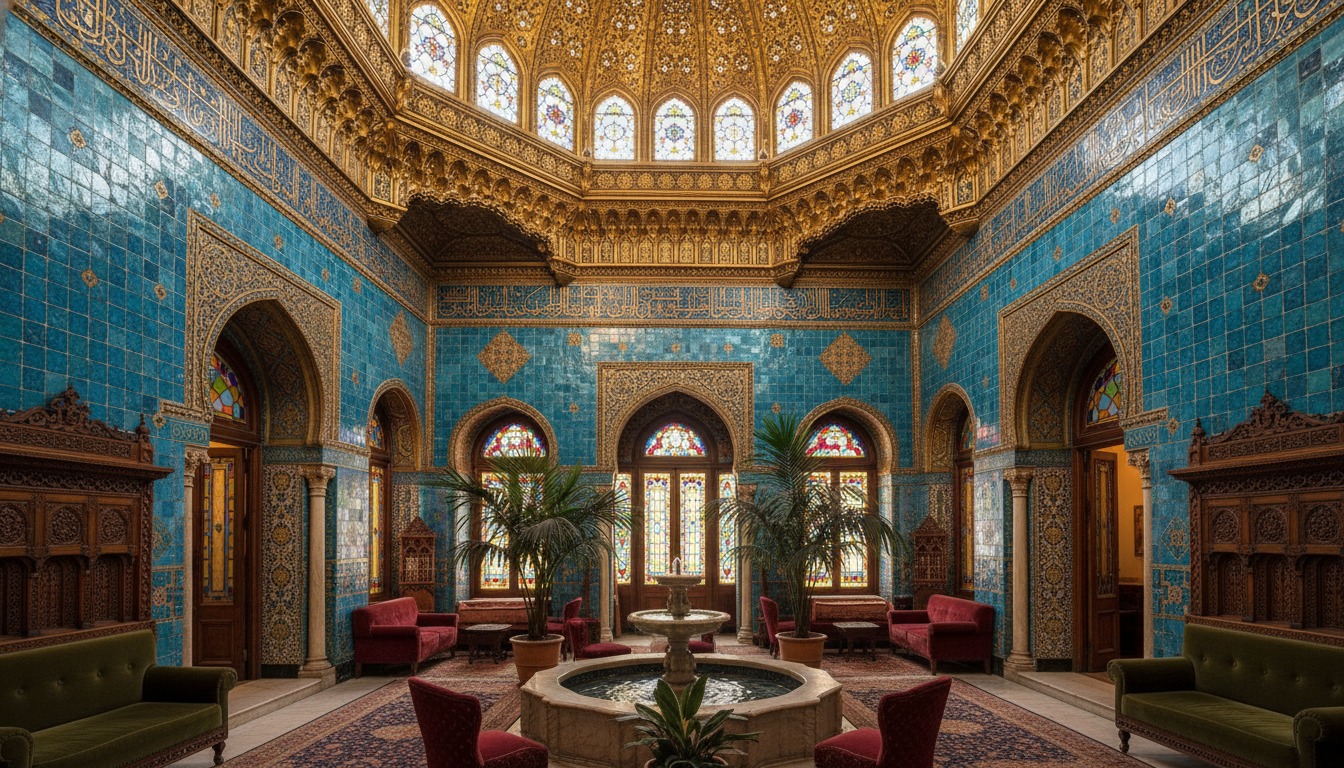
Afternoon — Leighton House, Kensington. The Arab Hall alone justifies the visit. Shimmering blue-and-turquoise Islamic tiles line the walls, a golden dome catches the light above, and a small fountain murmurs in the center. It's arguably the most beautiful single room in London, and most tourists have never heard of it. Lord Leighton built it as his personal studio — the rest of the house is a Victorian time capsule of Pre-Raphaelite art and velvet ambition.

Evening — The stage or the vinyl bar. 2026's West End is deep in its immersive era — check the Barbican or the Old Vic for high-concept revivals that justify London's reputation as the world's best theater city. But if you want something quieter and cooler, head to Bambi in Hackney — a vinyl listening bar where the sound system is as curated as the wine list, and the volume stays at "conversation possible."

Borough Market food stalls overhead, artisan cheese, fresh bread, and steaming raclette
04

Day Three — Eat, Browse, Float

Your last day should feel indulgent, not rushed. London's food scene in 2026 is in a "retro-revival" moment — classic institutions are reinventing themselves while underground supper clubs steal the spotlight from Michelin-starred temples. The trick is knowing which trend is worth your limited hours.

Morning — Columbia Road Flower Market (Sundays only). Get there at 8 AM for the full experience, or at 2:30 PM for the "everything must go" deals where vendors slash prices and practically throw bouquets at you. Even if you're not buying flowers, the street's independent shops — vintage furniture, artisan perfume, handmade pottery — open only on market day and are worth the browse.

Lunch — Simpson's-in-the-Strand (£60–80). This is a statement lunch. Tableside-carved roast beef from silver-domed trolleys in a dining room that's served writers, politicians, and chess grandmasters since 1828. It's old London in the best possible sense — the kind of meal that makes you sit up straighter. For something more adventurous, track down one of Peckham's supper clubs, particularly The Rebellious Wine Club — an "un-restaurant" where the menu changes nightly and the crowd is determinedly local.

Afternoon — Uber Boat by Thames Clipper from Westminster to Greenwich. This isn't a tourist boat — it's London's commuter ferry, which means it's fast, cheap (Oyster/contactless accepted), and gives you the same riverside panorama without the audio guide narrating facts you already know. Disembark at Greenwich and walk through the Royal Naval College, or just sit on the hill in Greenwich Park and watch the city sprawl below you.

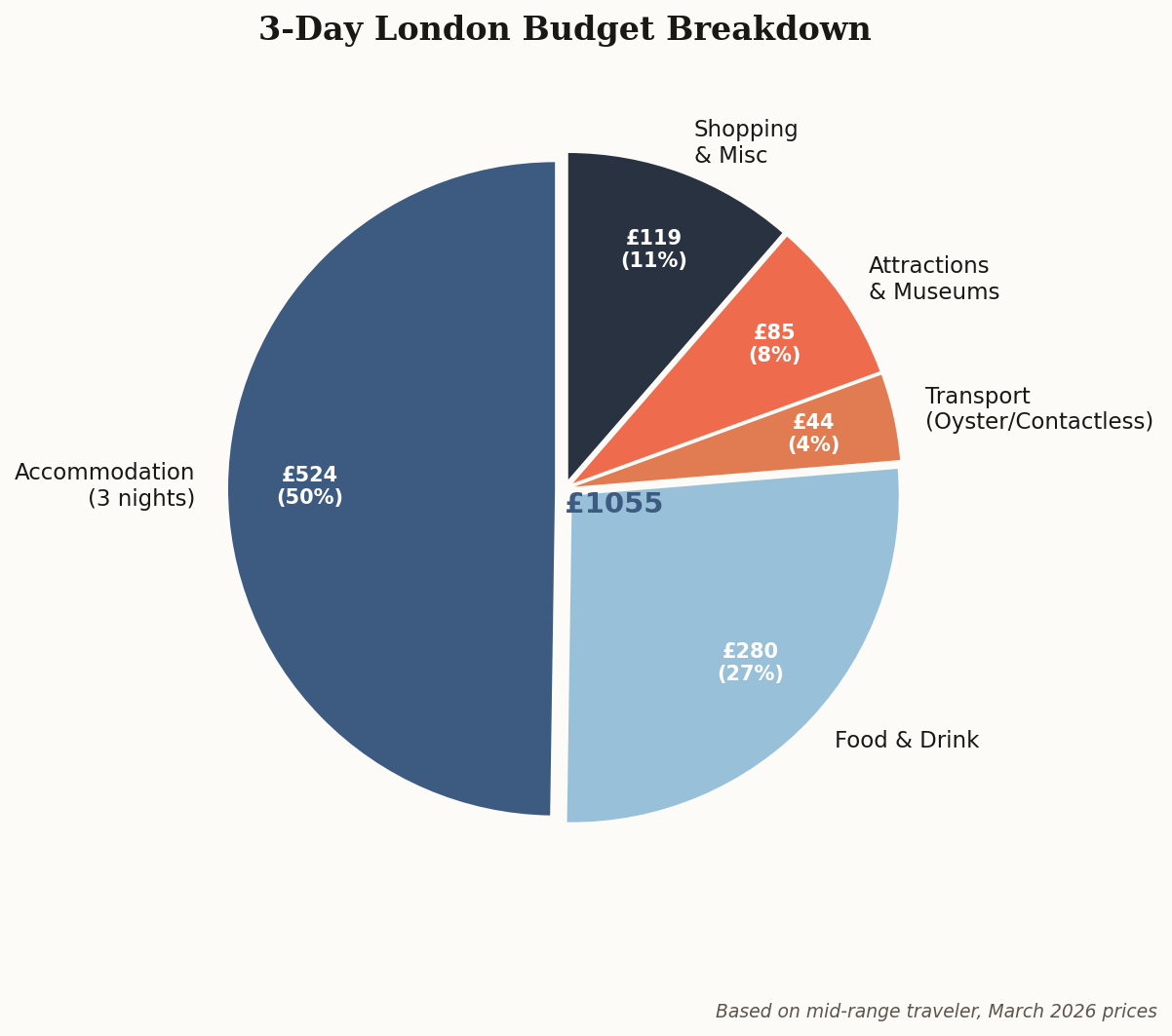
Pie chart showing 3-day London budget: Accommodation £525, Food £280, Transport £45, Attractions £85, Shopping £120, Total £1,055
A realistic mid-range budget for 72 hours in London, March 2026. Transport is the bargain — one contactless-linked Oyster covers everything.
Hand tapping contactless card on London Underground Oyster reader, TfL roundel in background
05

The Practical Stuff That Actually Matters

London travel "hacks" are mostly noise. But a few genuinely save you time and money.

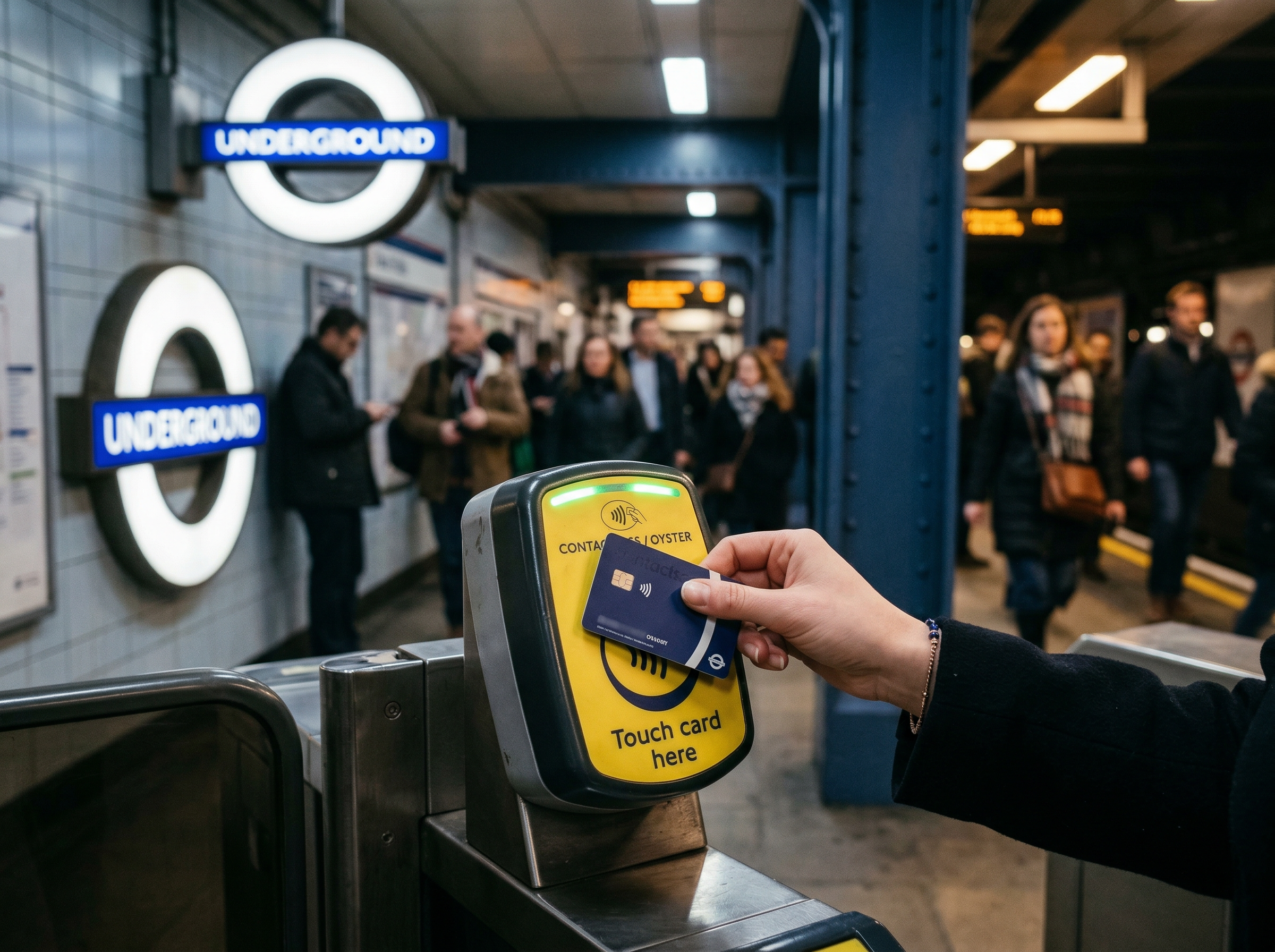
Transport: Digital Oyster is here. In 2026, you can load your Oyster card directly to your Apple or Google Wallet. The real upgrade? You can now link your Railcard for a 1/3 discount on every fare, directly on your phone. No more carrying a separate card. Contactless bank cards still work everywhere, but Digital Oyster with a Railcard is strictly cheaper.

Navigation: Citymapper remains the only app worth using. Its "Best Exit" feature tells you which train carriage to board so you emerge closest to your destination exit. On a complex system like the Tube, this saves 5-10 minutes per journey. That adds up.

Free stuff: National Lottery Open Week runs March 7–15, 2026. If you have a lottery ticket (they cost £2), you get free entry to dozens of top-tier attractions: Kew Gardens, Hampton Court Palace, and more. It's absurdly good value and most tourists have no idea it exists.

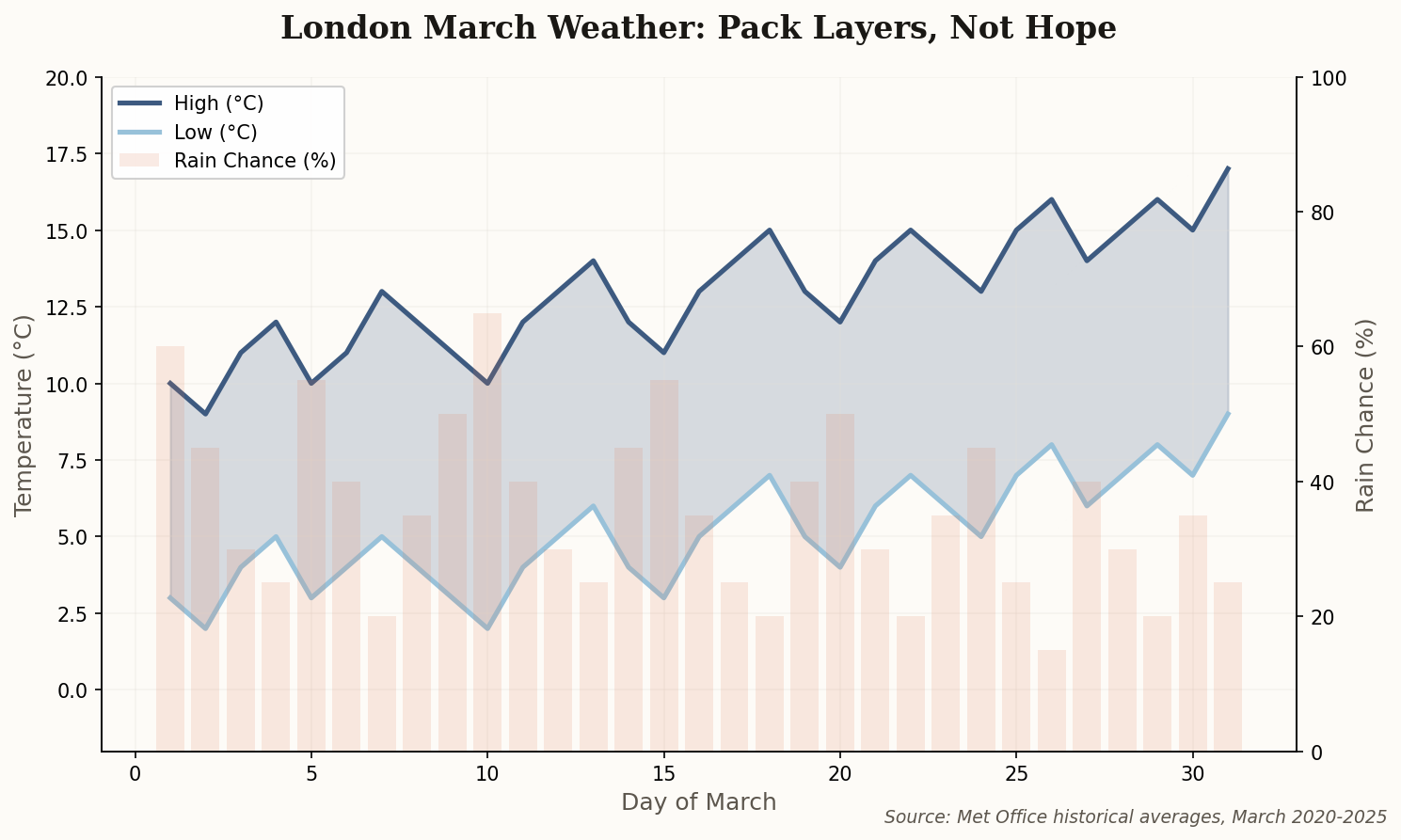
Weather reality: It's March in London. It will rain. Then it will be sunny. Then it will hail. Then it will be sunny again, all before lunch. Pack a Uniqlo Ultra Light Down (compact, warm, rain-resistant enough for drizzle) and a proper umbrella. Waterproof shoes beat fashion shoes every time in March.

Line chart showing London March temperatures ranging from 2-17 degrees C highs and lows, with rain probability bars showing 15-65 percent chance throughout the month
London March weather: highs hover around 10-17°C with rain chances between 20-65%. The warming trend in the second half of the month is noticeable — aim for late March if you can.
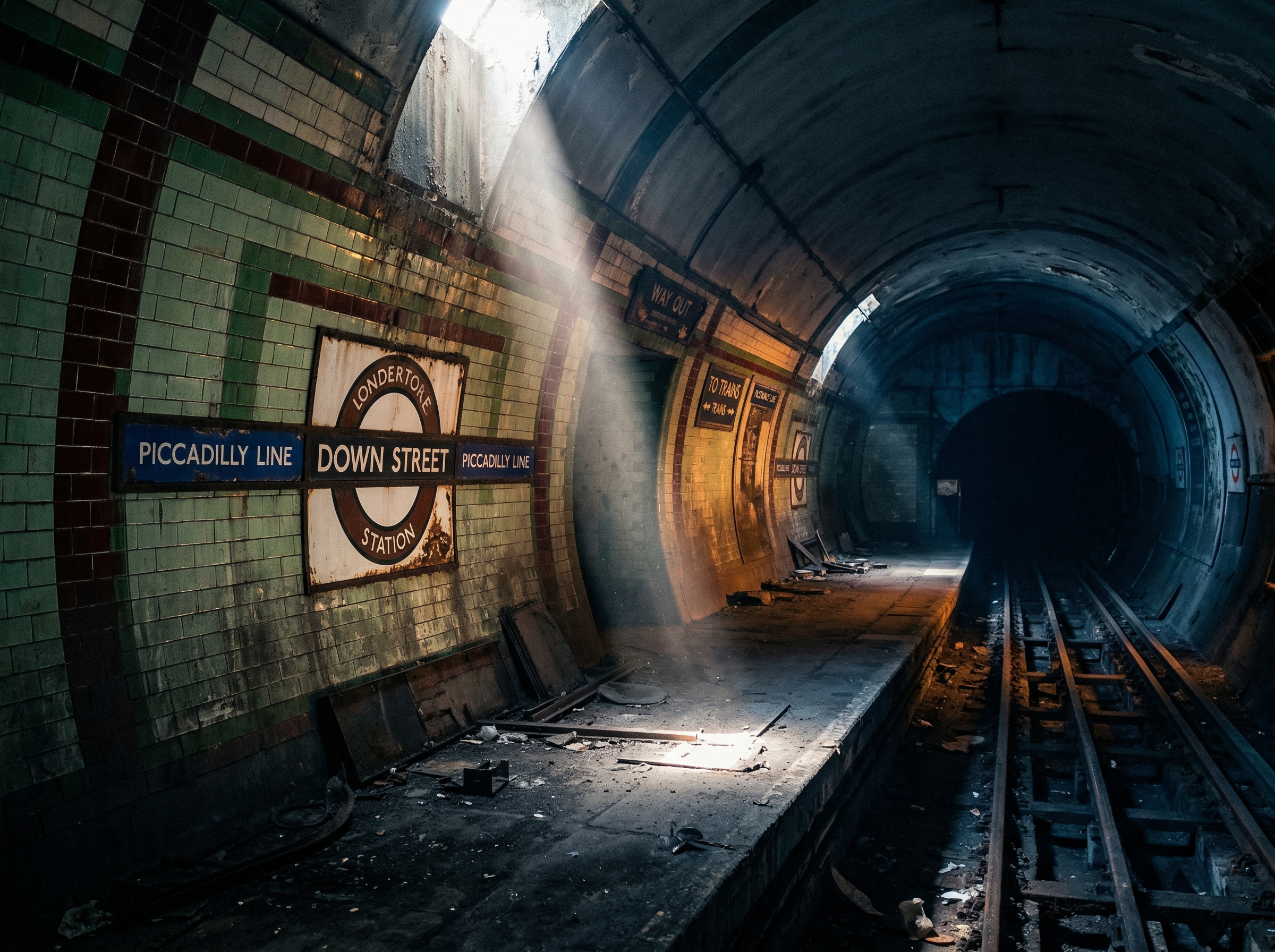
Abandoned ghost tube station platform with art deco tiles, dramatic light beam cutting through darkness
06

The London Everyone Misses

If you've done London before — or if you simply want to feel like you've discovered something most visitors never will — these three are your secret weapons.

The experience: Hidden London Tours. The London Transport Museum runs tours of "ghost" tube stations — platforms sealed off decades ago, frozen in time. The Down Street tour is the crown jewel: this is the station where Churchill and his War Cabinet sheltered during the Blitz, and the original bathroom tiles and sleeping berths are still visible. Tickets sell out weeks in advance, so book the moment they're released. It's hauntingly beautiful and unlike any other London experience.

The day trip: St. Albans (20 minutes from St. Pancras by Thameslink). Roman ruins, a massive medieval cathedral, and — the real draw — Ye Olde Fighting Cocks, which claims to be the oldest pub in England (since 793 AD). Whether the claim is accurate is debatable. Whether the beer is good is not. For under £10 return, it's the cheapest escape from London you'll find.

The best free thing in London: The Viewing Level at Tate Modern. Better views than the Shard, zero cost, and you're surrounded by world-class art on the way up and down. The 360-degree panorama from the 10th floor takes in St Paul's, the City skyline, the Houses of Parliament, and the bend of the Thames. Go at sunset. Thank me later.

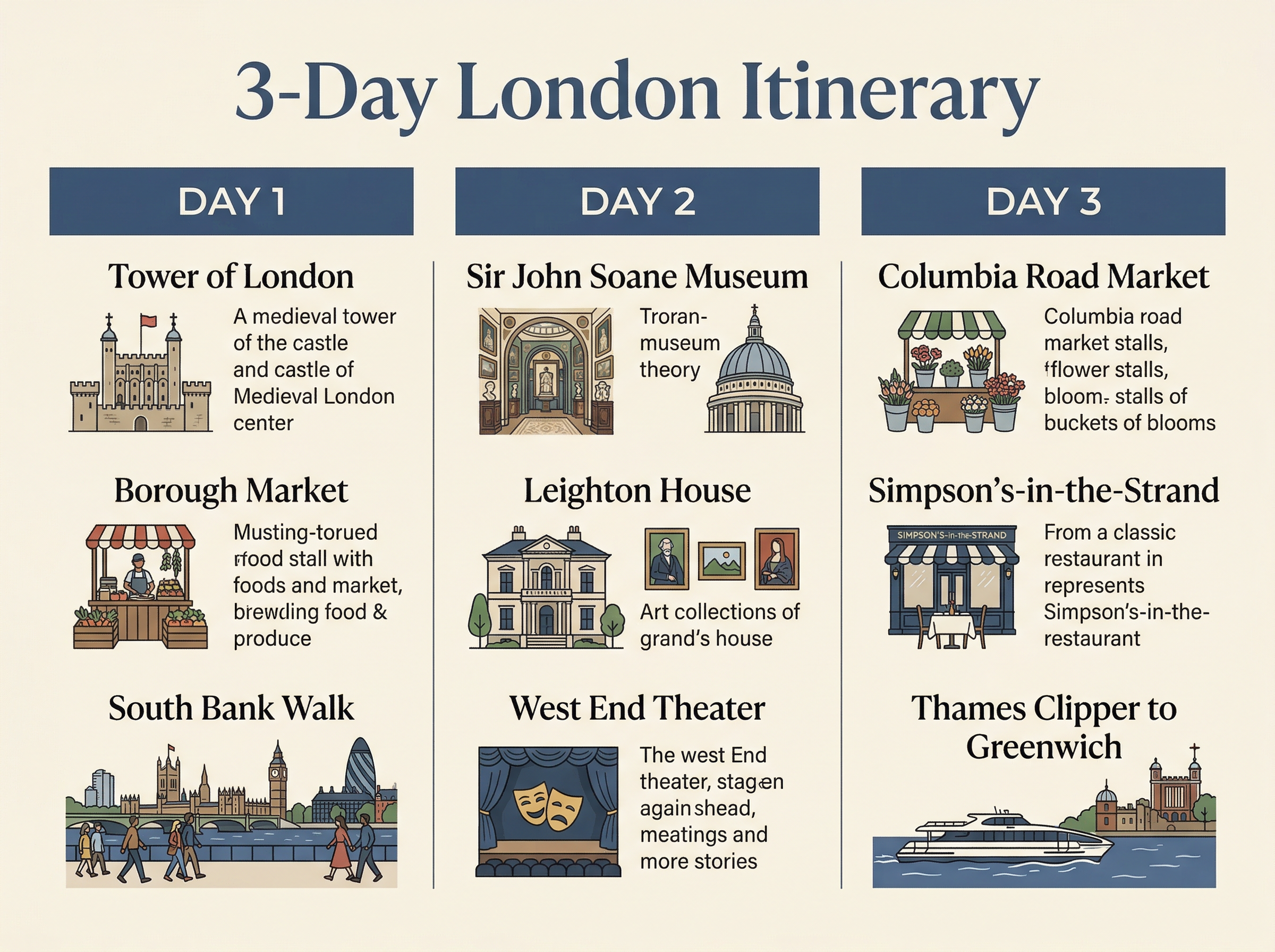
Infographic showing a 3-day London itinerary overview: Day 1 Tower, Borough Market, South Bank; Day 2 museums, Leighton House, West End; Day 3 Columbia Road, Simpsons, Thames Clipper
Your 72-hour London blueprint at a glance — Generated with Nano Banana 2.0

"A person who is tired of London is not necessarily tired of life; it might be that he just can't find a parking place." — Paul Theroux

Until Next Time

London rewards the curious and punishes the complacent. Skip the queue, take the side street, order the thing you can't pronounce. Three days isn't enough — but it's enough to know you'll be back.

Share X LinkedIn