
Productivity Software

The Suite Is Dead; Long Live the Suite

How monolithic productivity software rose, fractured, and is now reassembling around AI — but the new monolith isn't software. It's data.

Listen
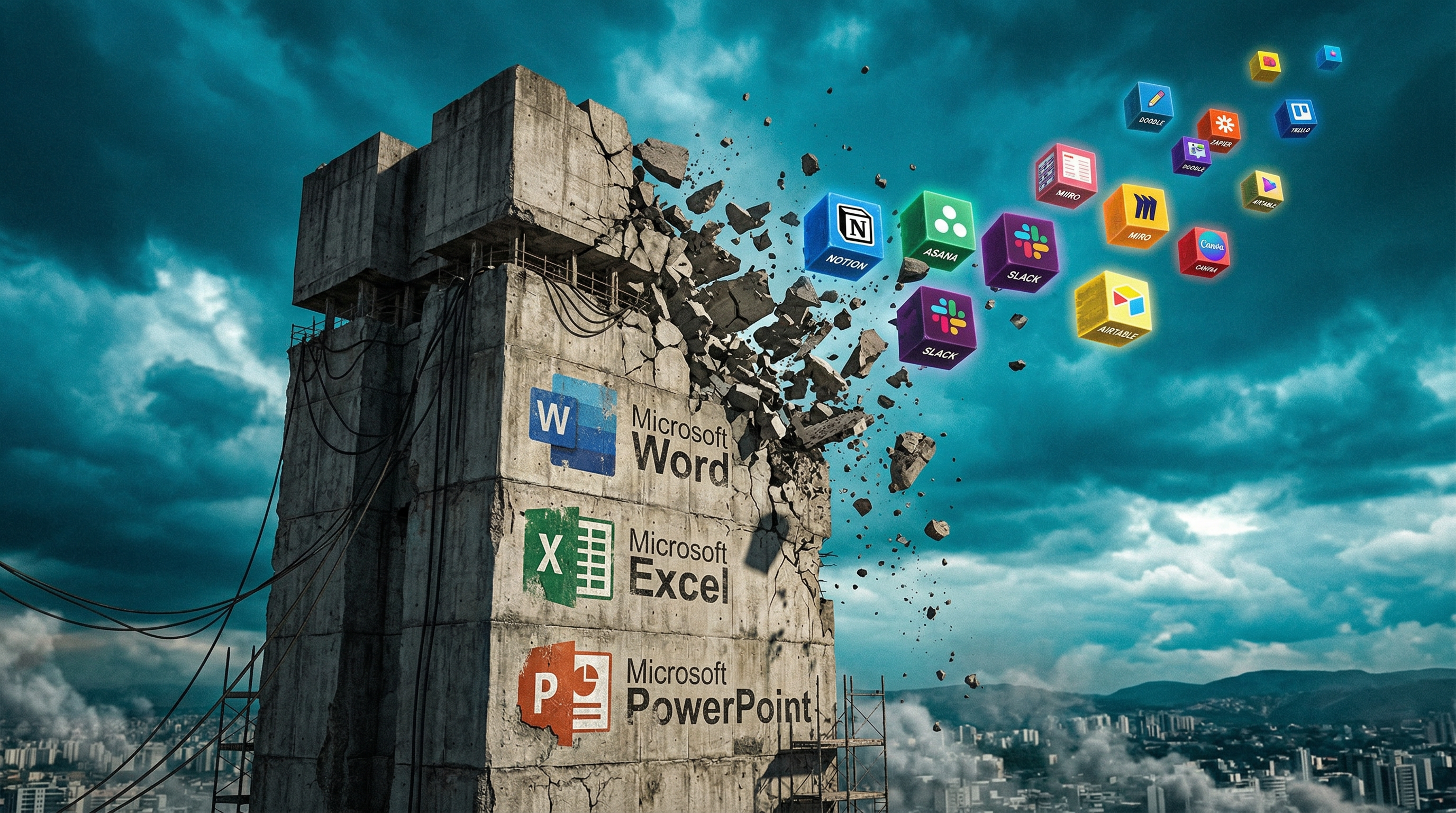
A crumbling monolithic tower of legacy software icons fragmenting into colorful modular blocks, representing the shift from bundled suites to specialized tools
Multiple AI agents from different vendors connected by translucent protocol bridges forming a mesh network
01

Seventy Percent of the Fortune 500 Just Admitted the Monolith Is Over

Here's a number that should make Microsoft and Google reach for the antacids: 70% of Fortune 500 companies now deploy AI assistants across their productivity stacks — and most aren't limiting themselves to a single vendor. They want agents from Salesforce, Microsoft, Google, and a dozen startups to collaborate on the same workflows, and they're using interoperability protocols like the Model Context Protocol (MCP) to make it happen.

This is the final admission that no single vendor's suite — no matter how deeply integrated — can do everything well. Companies aren't ditching Microsoft 365 or Google Workspace. They're demoting them from "the platform" to "a platform." The new organizational unit isn't "The Office Suite." It's the "Platform Engineering" team, tasked with wiring together a bespoke productivity stack where the best tool wins each job.

The irony? The death of the monolith isn't about the death of Microsoft. It's about the death of Microsoft as the only tool you use. That's a subtle but devastating distinction for anyone whose business model depends on owning the whole stack.

A sleek digital workforce of translucent AI agent silhouettes at minimalist desks
02

Salesforce's Billion-Dollar Bet: You'll Pay More for Fewer Humans

Salesforce just hit $1.5 billion in annualized revenue from Agentforce — faster than any product in the company's history. The premium pricing dwarfs their standard Enterprise CRM plan. This isn't a productivity tool anymore — it's a "digital workforce," in Marc Benioff's words.

The pitch: unmetered AI agent usage across sales, service, and marketing. Early adopter Lumen Technologies reports reclaiming over 300 hours of weekly productivity through specialized telecom agents. That's not a feature upgrade. That's a replacement for headcount.

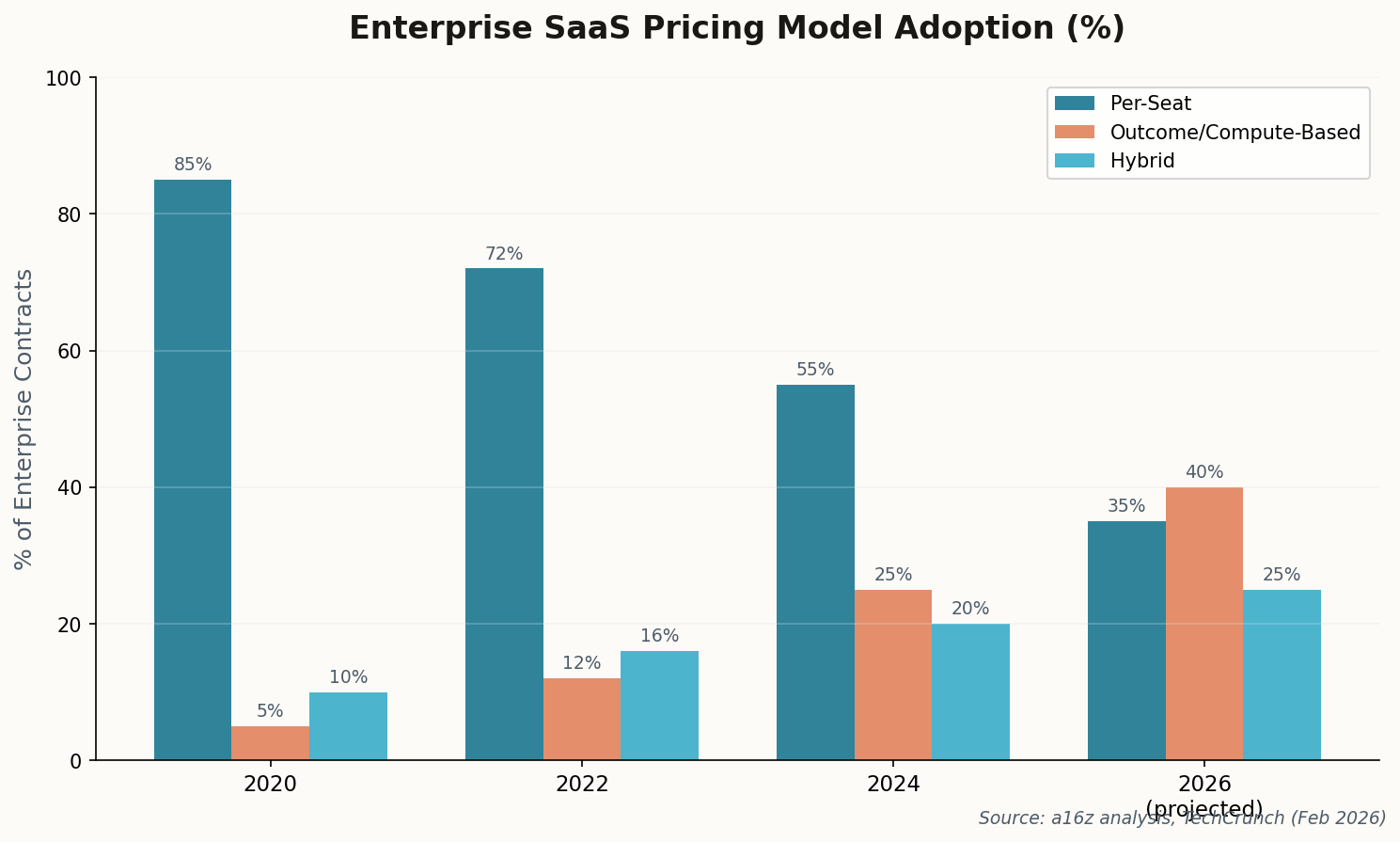
Bar chart showing enterprise SaaS pricing model adoption shifting from per-seat (85% in 2020) to outcome-based (40% projected in 2026)
The per-seat model is collapsing. By 2026, outcome-based pricing is projected to surpass traditional per-user licensing in new enterprise contracts.

This is the monolith's last gambit: if you can't keep every seat occupied, charge dramatically more for the ones that remain. The "human tax" — paying for every pair of eyes on a screen — is giving way to paying for work done. And the vendors who adapted their pricing fastest will survive the transition. The ones still charging per-seat for commodity features? They're already dead; they just don't know it yet.

Colorful modular workspace blocks assembling into a flexible tower structure
03

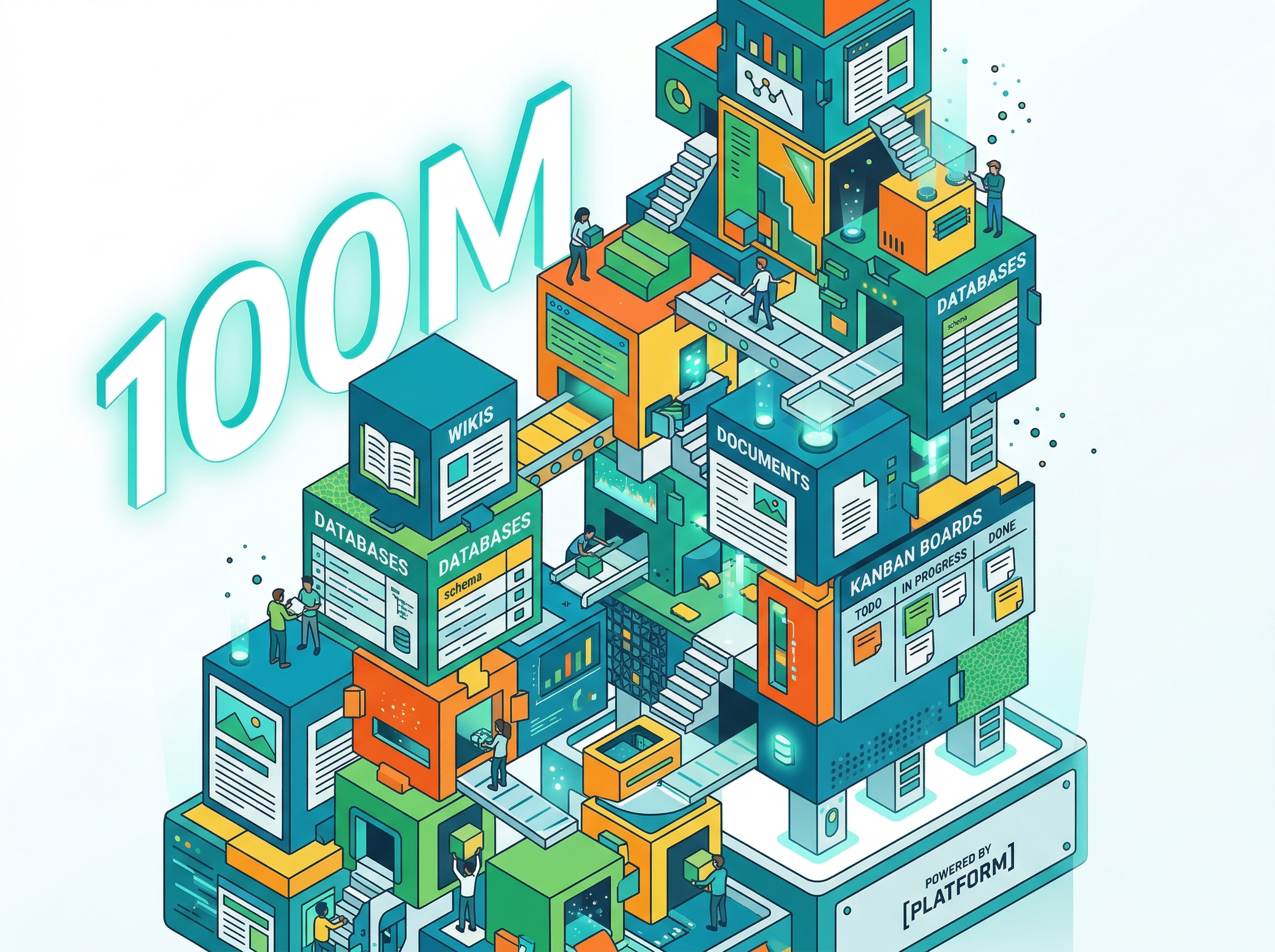
Notion at 100 Million: The Unbundler Becomes the Bundle

There's a delicious paradox in Notion hitting 100 million users. A tool that rose to prominence by unbundling the productivity suite — replacing Confluence here, Trello there, Evernote somewhere else — has quietly become its own mini-monolith. It's now absorbing functions of Slack and Jira, transitioning from a document tool into what CEO Ivan Zhao calls a "Project Brain."

The lesson isn't that unbundling failed. It's that the best unbundlers eventually rebundle — just around a better user experience instead of enterprise lock-in. Notion didn't win by locking companies into multi-year enterprise agreements. It won by being the tool knowledge workers actually wanted to open every morning.

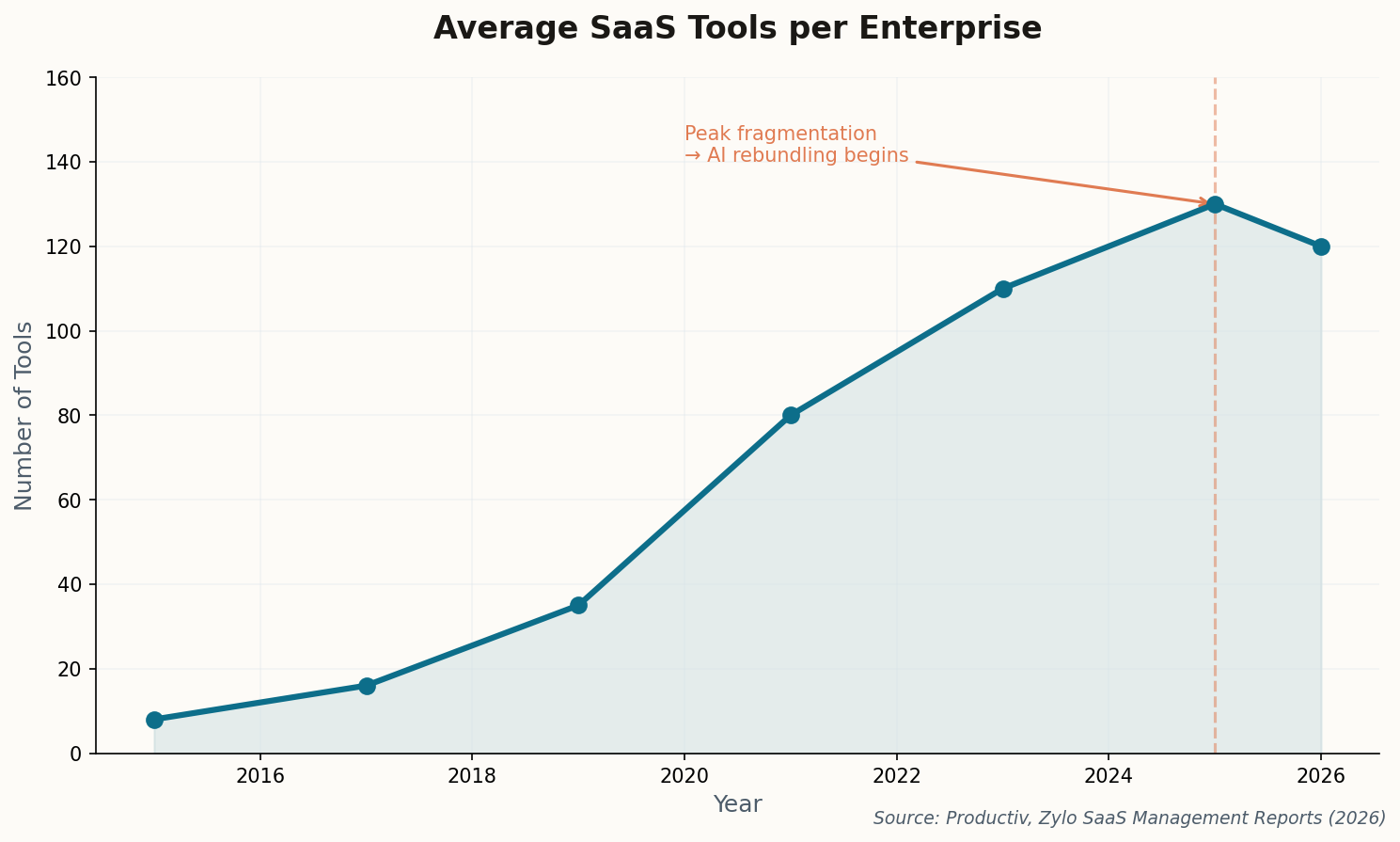
Line chart showing average SaaS tools per enterprise rising from 8 in 2015 to peak of 130 in 2025, then declining slightly to 120 in 2026
Peak fragmentation hit in 2025. The slight decline in 2026 signals the beginning of AI-driven consolidation — not back to monoliths, but toward smarter integration.

That said, Notion's success reveals the ceiling of unbundling. At 100 million users, it's no longer the scrappy alternative. It's the incumbent. And incumbents attract the same gravitational forces — feature bloat, enterprise sales cycles, the temptation to become the very thing they disrupted.

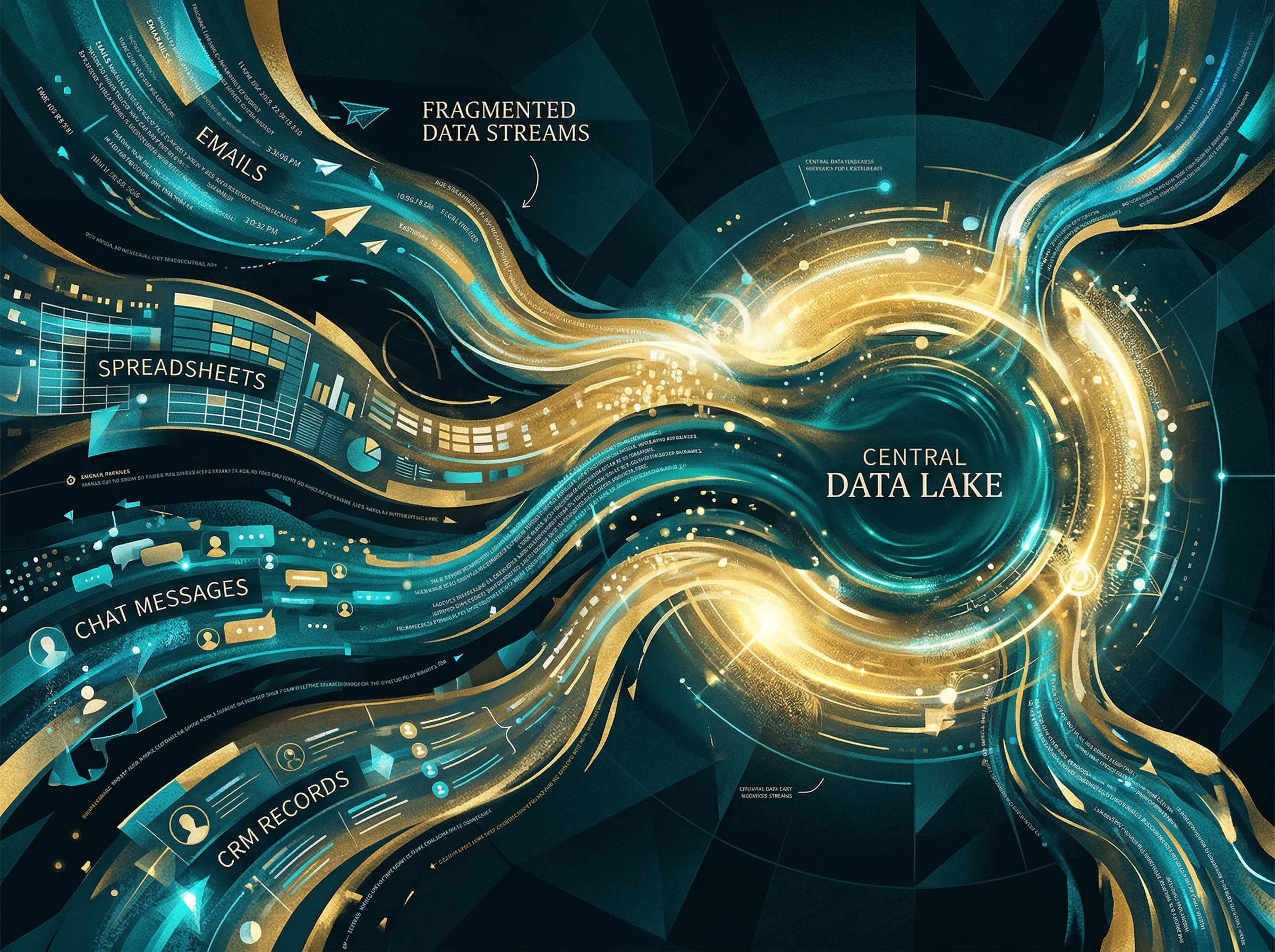
Fragmented data streams flowing from scattered tools into a unified data lake at the center
04

The Plot Twist: AI Needs the Monolith Back (Sort Of)

Just when you thought the "unbundling" story was settled, here comes the counter-argument: AI agents need unified data to function. An agent that can only see your CRM but not your calendar, your email but not your project board — that agent is half-blind and fully useless. So while the software is fragmenting, the data is rebundling.

Forbes reports that 64% of enterprises now run both Google and Microsoft stacks simultaneously, but they're centralizing their data lakehouses to feed their AI agents. The choice of "Gemini vs. Copilot" is becoming more important than "Gmail vs. Outlook." The suite is dead, but the data ecosystem is the new monolith.

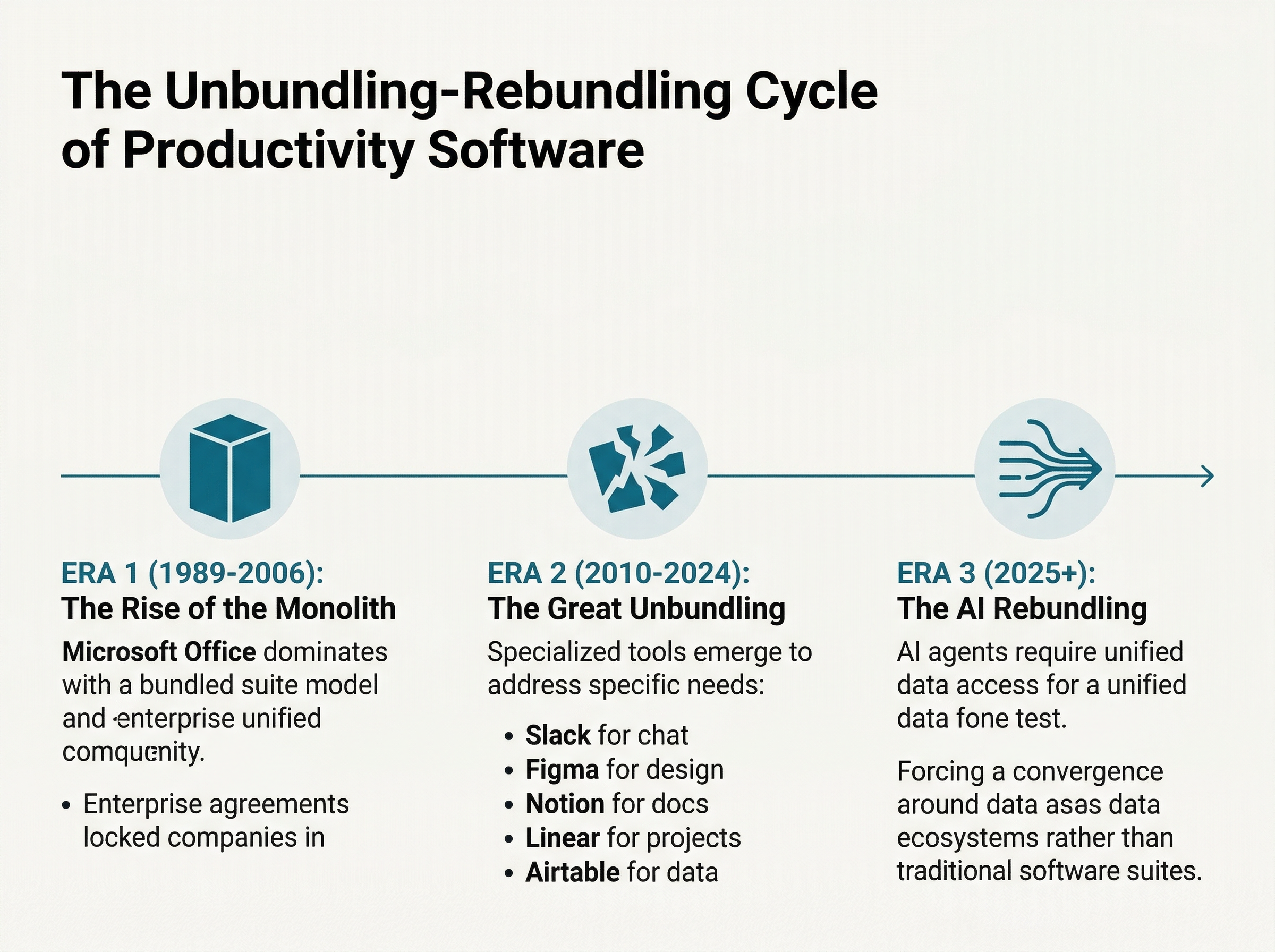
Infographic showing three eras of productivity software: The Rise of the Monolith (1989-2006), The Great Unbundling (2010-2024), and The AI Rebundling (2025+)
The Unbundling-Rebundling Cycle: productivity software follows a predictable pattern — consolidation breeds fragmentation breeds reconsolidation, each time around a different axis.

This is the real insight buried in the data: the battle is no longer about which application you use. It's about which vendor controls the unified data layer that makes all your applications intelligent. Microsoft Copilot and Google Gemini aren't competing on features. They're competing on data gravity.

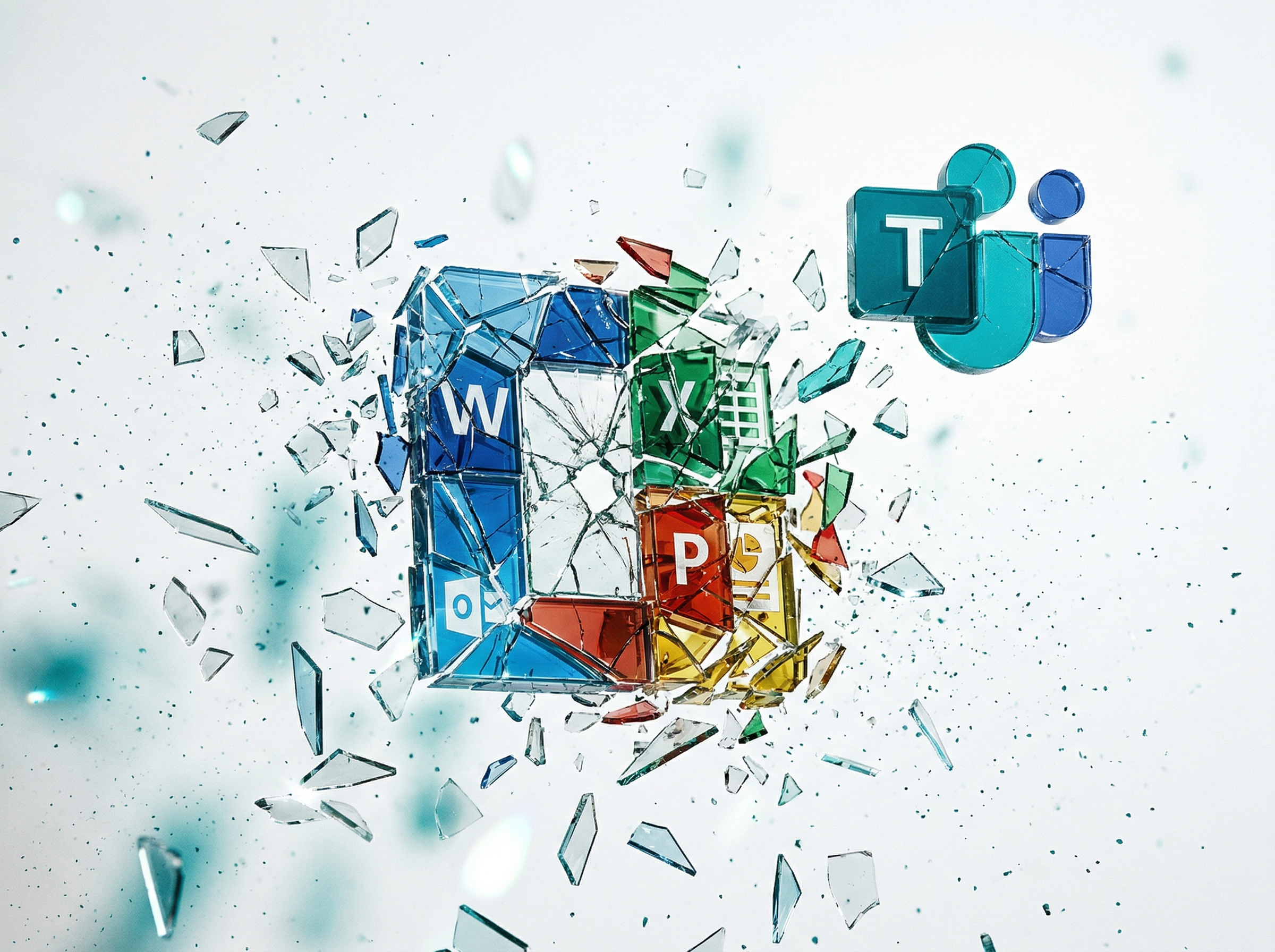
The Microsoft Office suite logo fracturing like shattered glass with the Teams icon breaking free
05

Microsoft Blinks: Teams Gets Unbundled Worldwide

It took the EU threatening another round of antitrust fines, but Microsoft finally did it: Teams is now globally unbundled from Office 365 and Microsoft 365. A "no-Teams" tier costs $1.50–$2.00 less per user per month, and Microsoft must provide interoperability for Slack and Zoom for at least seven years.

This is the most significant structural change to the Office suite since its inception in 1989 — the first time Microsoft has been forced to break apart the bundle that defined enterprise software for three decades. The mandatory package era is over.

Stacked area chart showing Microsoft's enterprise productivity market share declining from 95% in 2000 to 58% in 2026, while Google and specialized tools grow
Microsoft still holds roughly 58% of the global productivity market — down from near-total dominance in 2000. But the real story is the rise of "specialized tools" — from 2% to 20% — which now represent a genuine third force.

For enterprises, this is liberating. You can finally adopt best-of-breed communication tools without paying the "Microsoft tax" on features you never wanted. For Microsoft, it's a reckoning: the bundle was never about user value. It was about distribution. And when regulators break your distribution, you have to compete on merit. That's a different game entirely.

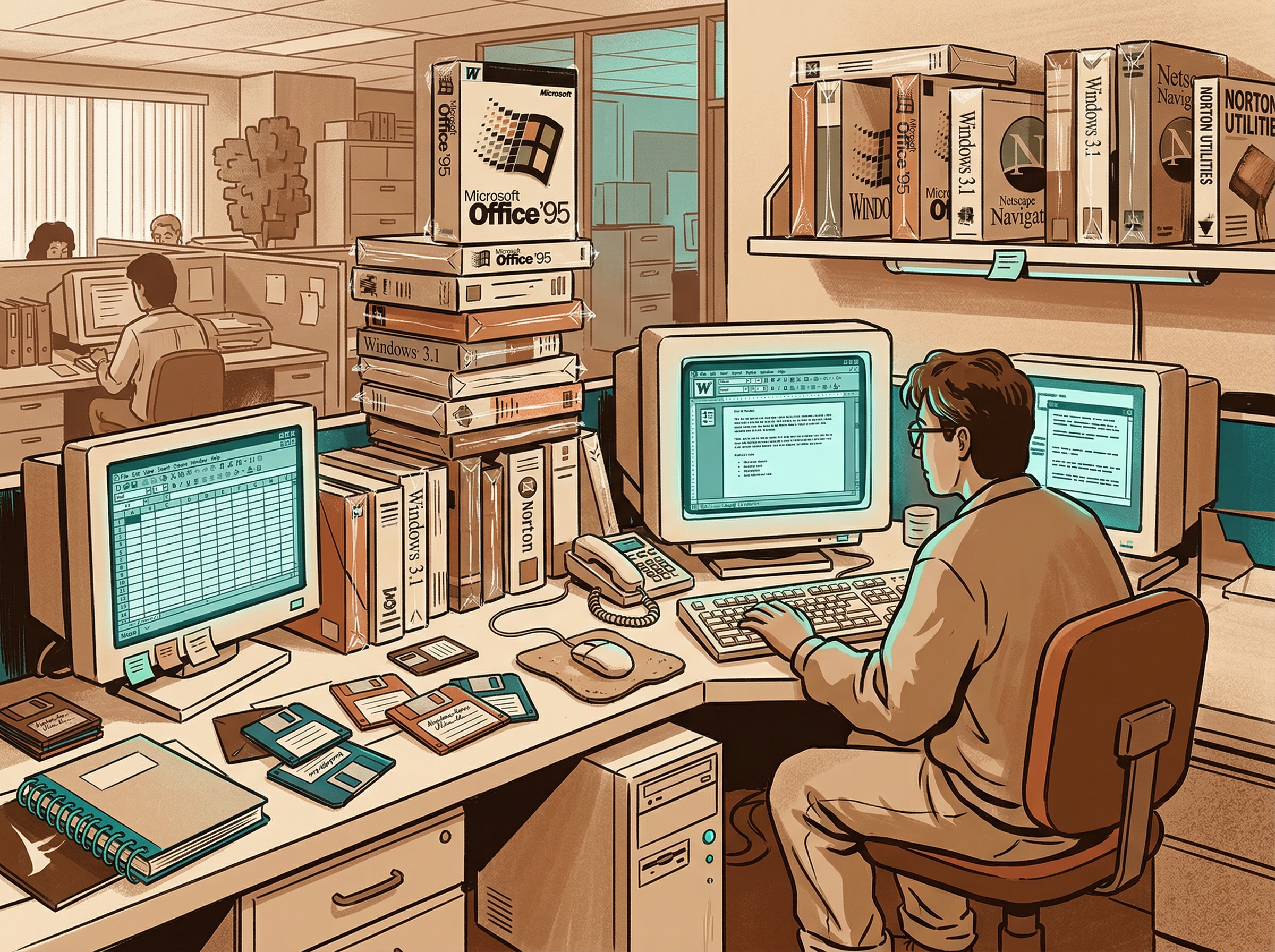
A vintage 1990s office scene with CRT monitors and shrink-wrapped software boxes, rendered in modern editorial illustration style
06

How We Got Here: The Bundle Was Always a Pricing Trick

In 1989, Microsoft did something revolutionary: it bundled Word, Excel, and PowerPoint into a single product called "Office." This wasn't a technology innovation — each product existed as a standalone. It was a pricing innovation. By selling three products for less than the combined individual price, Microsoft made it economically irrational to buy competitors' alternatives. Why pay full price for Lotus 1-2-3 when Excel came "free" with your Word license?

This pattern — bundling as a distribution weapon — defined enterprise software for 35 years. Enterprise Agreements locked corporations into multi-year commitments with massive switching costs. By 2000, Microsoft held 95% of the productivity market. It wasn't until 2006, when Google launched Apps for Your Domain, that the first viable cloud-native alternative appeared.

Understanding this history matters because it reveals what AI is actually disrupting. It's not disrupting the software — Word and Excel work fine. It's disrupting the distribution model. When an AI agent can write your document, build your spreadsheet, and send your email without ever opening an "application," the bundle loses its reason to exist. The monolith didn't fall because the tools got worse. It fell because the tools stopped mattering.

The Next Monolith Won't Have an Icon

We spent 35 years living inside software suites. Then a decade tearing them apart. Now AI is stitching the pieces back together — not into applications, but into invisible intelligence layers that sit beneath everything. The monolith isn't dead. It just moved underground. The question for every enterprise isn't "which suite do we use?" It's "whose data layer do we trust?" And that question has far higher stakes than any licensing negotiation ever did.

Share X LinkedIn