Software History

The Database That Said Yes

From a garage in Concord, Massachusetts to 100+ consecutive profitable quarters — how FileMaker Pro became the tool that never told you "no."

Listen
A visual journey through four decades of FileMaker Pro, from vintage Macintosh to modern cloud platforms
01

The Nutshell That Cracked Open Personal Computing
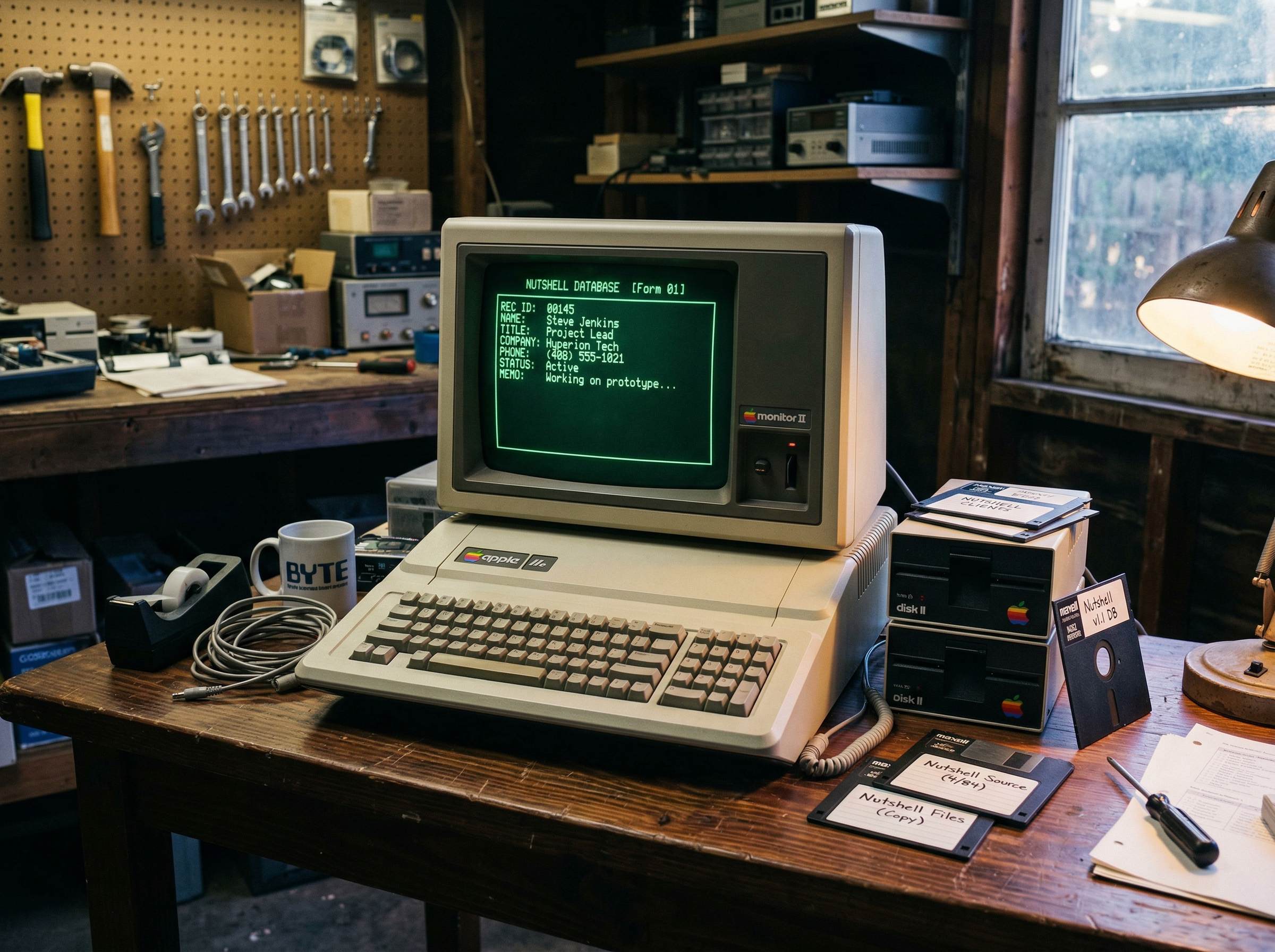
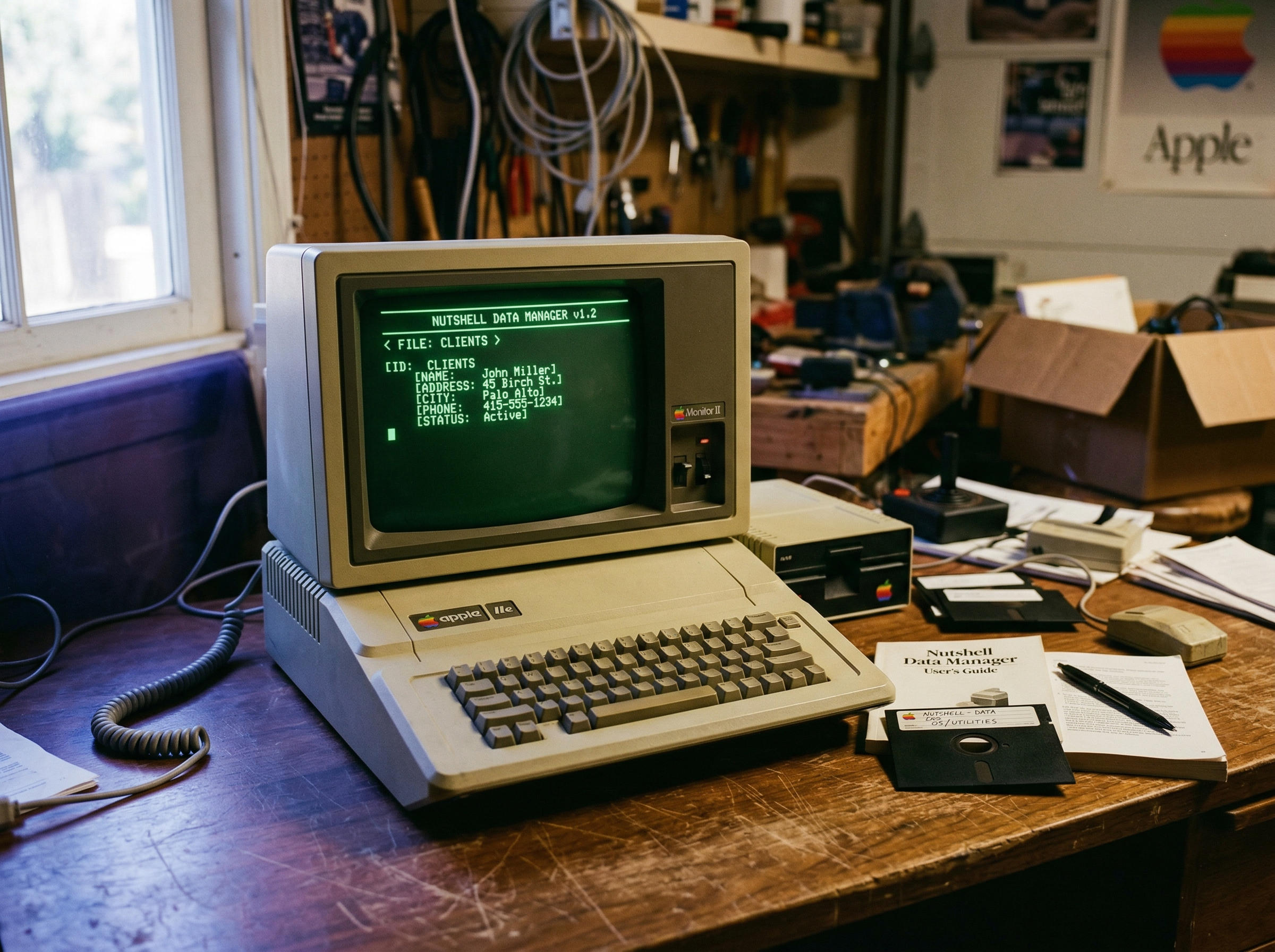
Vintage Apple II computer displaying an early database form, evoking the birth of FileMaker

Before FileMaker was FileMaker, it was Nutshell — a flat-file database for MS-DOS built by Nashoba Systems in Concord, Massachusetts. In a world dominated by dBase and its arcane command-line syntax, Nutshell dared to be friendly. You could build layouts. You could search your data. You could do it all without writing a single line of code.

The real story, though, is what happened next. Leading Edge, Nashoba's DOS distributor, took one look at the Macintosh version and said no. Too risky. Too niche. So Nashoba partnered with a Sunnyvale startup called Forethought Inc. to distribute the Mac version — which they called FileMaker — in April 1985.

Here's the twist that belongs in a movie: while Forethought was distributing FileMaker, they were building a presentation tool called Presenter. They renamed it PowerPoint. In 1987, Microsoft acquired Forethought for $14 million — primarily for PowerPoint — and suddenly found themselves as FileMaker's distributor. Bill Gates wanted the database code too. Nashoba said no. Microsoft retaliated by launching "Microsoft File." FileMaker outsold it so thoroughly that Microsoft quietly killed the product. Sometimes the best revenge is survival.
02

Apple's Secret Weapon Gets a Name

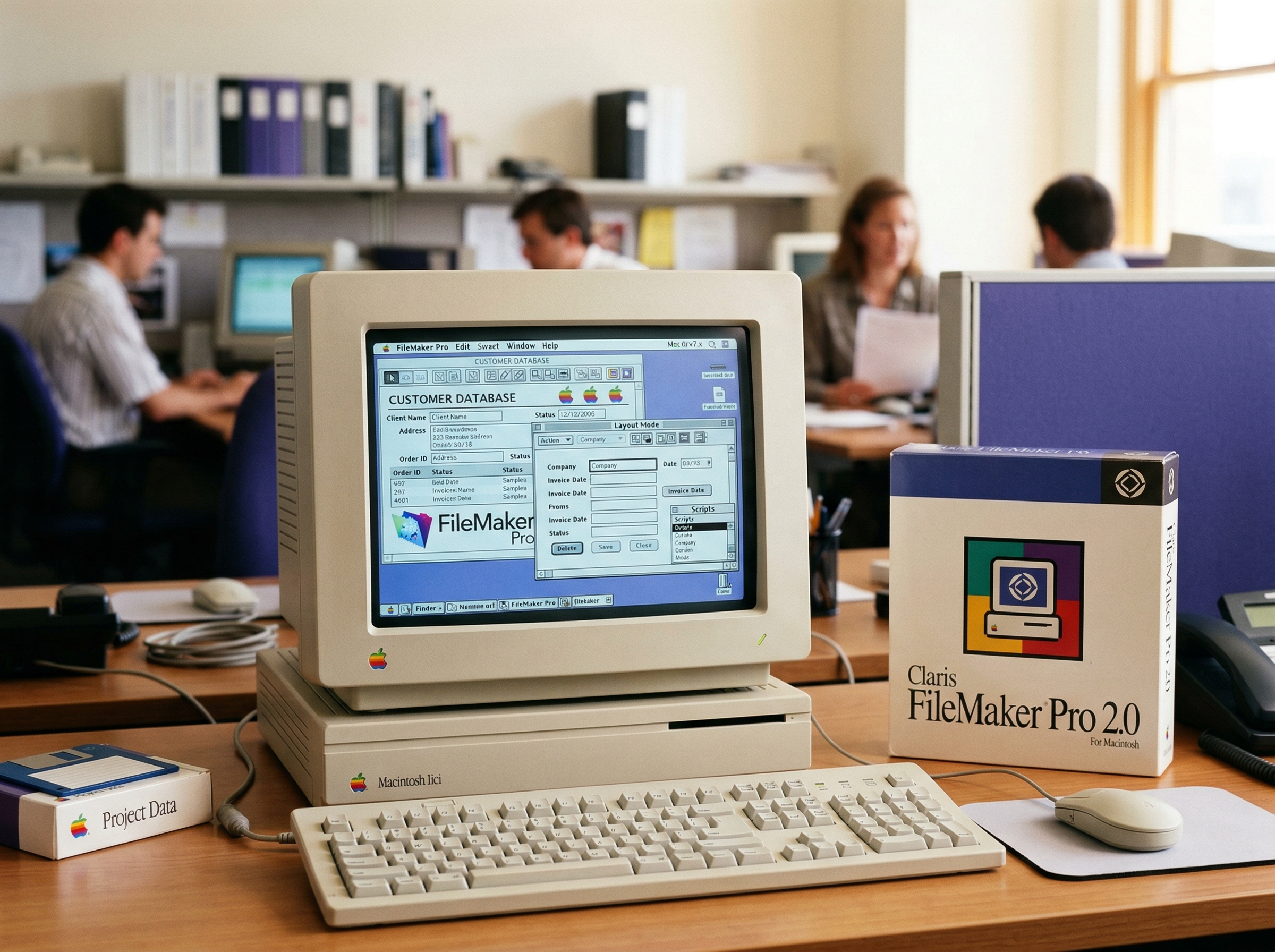
Classic Macintosh running Claris FileMaker Pro with the iconic rainbow Apple logo

In 1987, Apple did something it almost never does: it formed a software subsidiary. Claris Corporation was born to handle Apple's application software — ClarisWorks, MacWrite, MacPaint — and in 1988, Claris acquired Nashoba Systems, bringing FileMaker into the Apple family.

The rebrand to FileMaker Pro 1.0 in 1990 marked the beginning of something remarkable. But the real watershed was version 3.0 in 1995, which introduced relational database capabilities and ScriptMaker — a point-and-click automation engine that let non-programmers build complex workflows. This was low-code before anyone coined the term. A teacher could build a student tracking system. A small business owner could create an inventory manager. No programming degree required.

Meanwhile, Microsoft Access arrived in 1992, bundled with Office, and dominated Windows. But FileMaker became the Swiss Army knife for mixed-platform environments. In Mac-heavy industries like publishing, education, and creative agencies, FileMaker was the database. By the mid-90s, press reports cited its use in "virtually every Fortune 500 company."

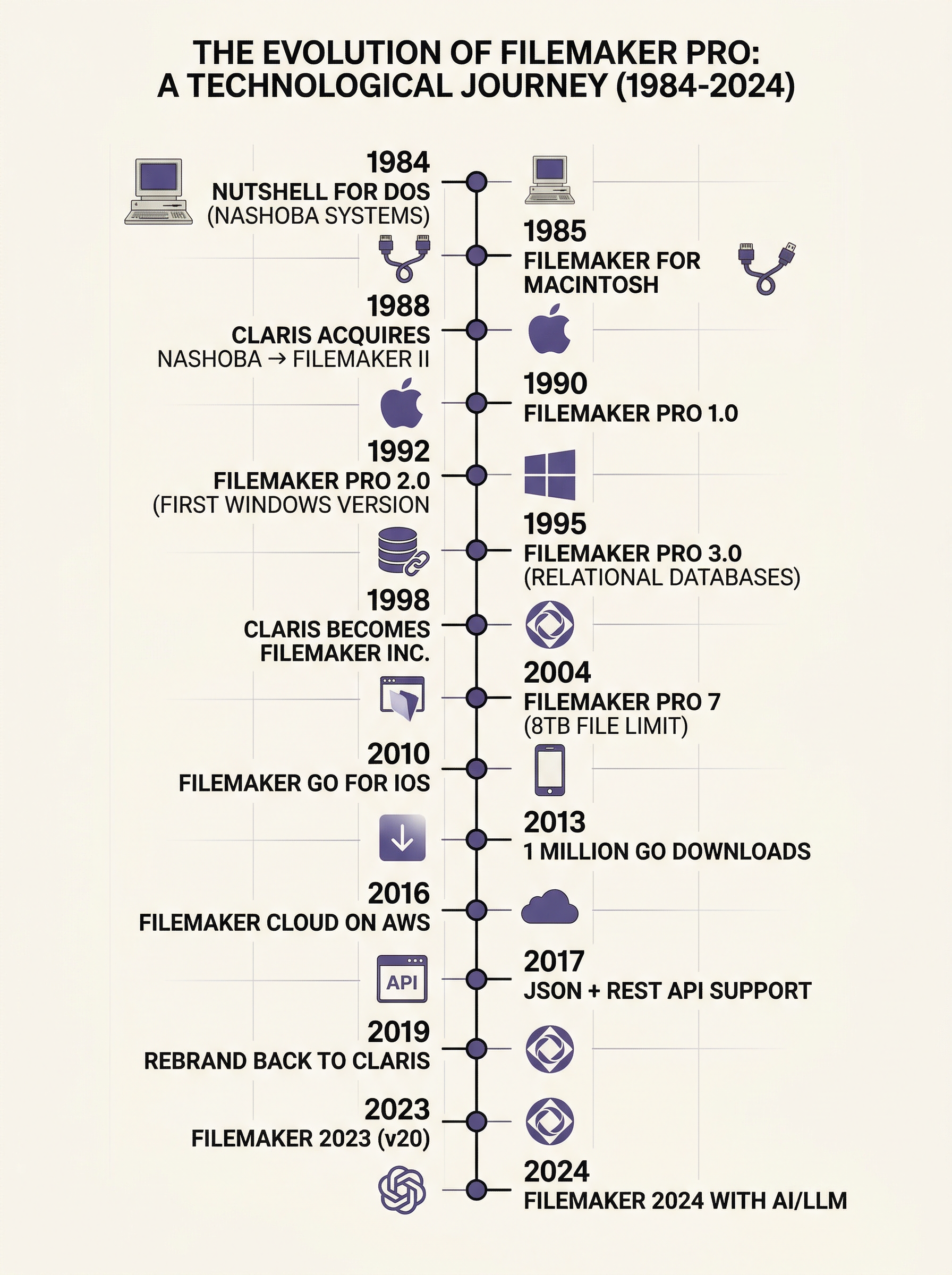
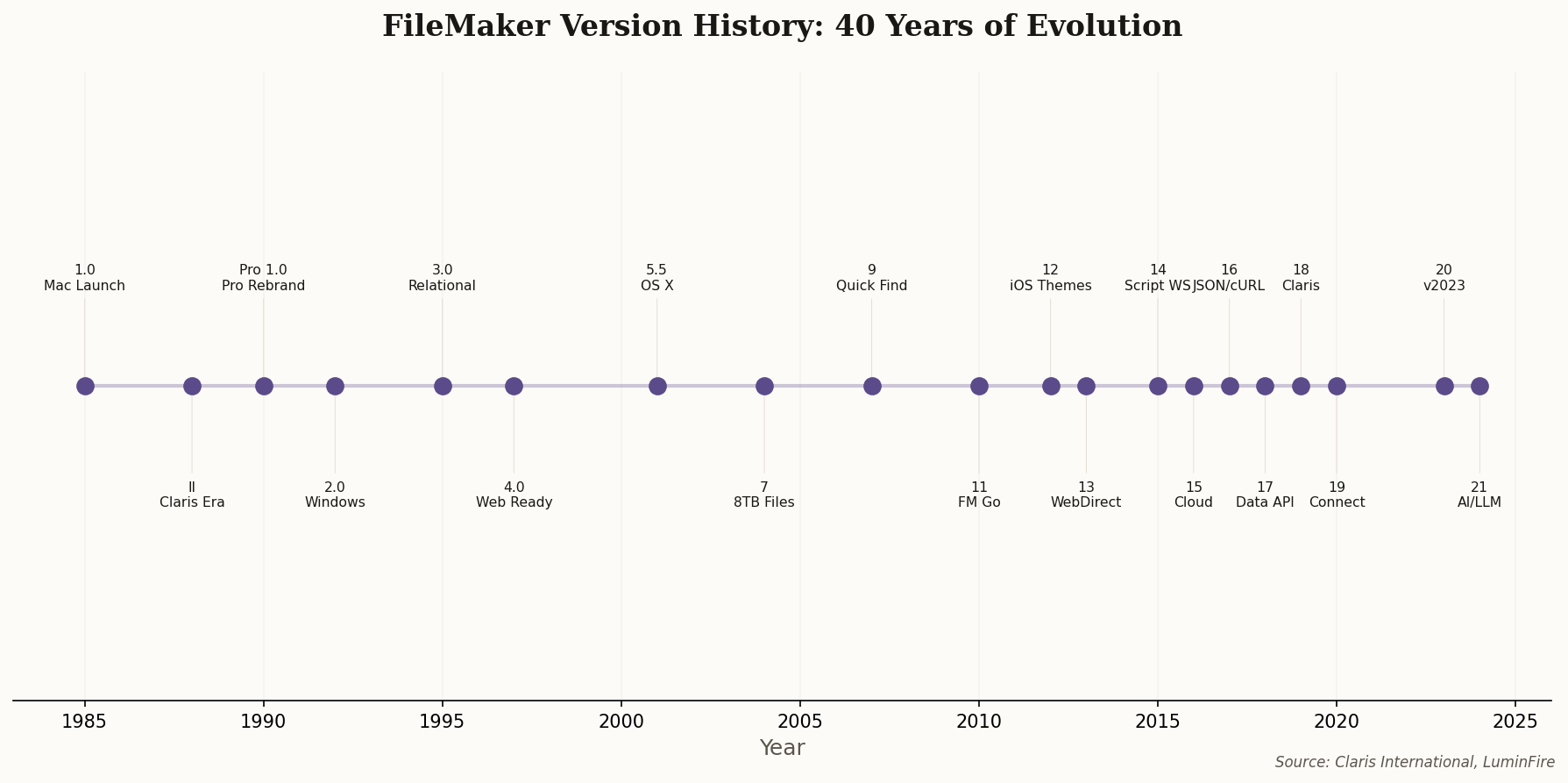
Timeline showing FileMaker versions from 1985 to 2024, with key features noted for each release
40 years of versions: from flat-file simplicity to AI-powered relational platform. Source: Claris International, LuminFire.
03

The Database That Refused to Die

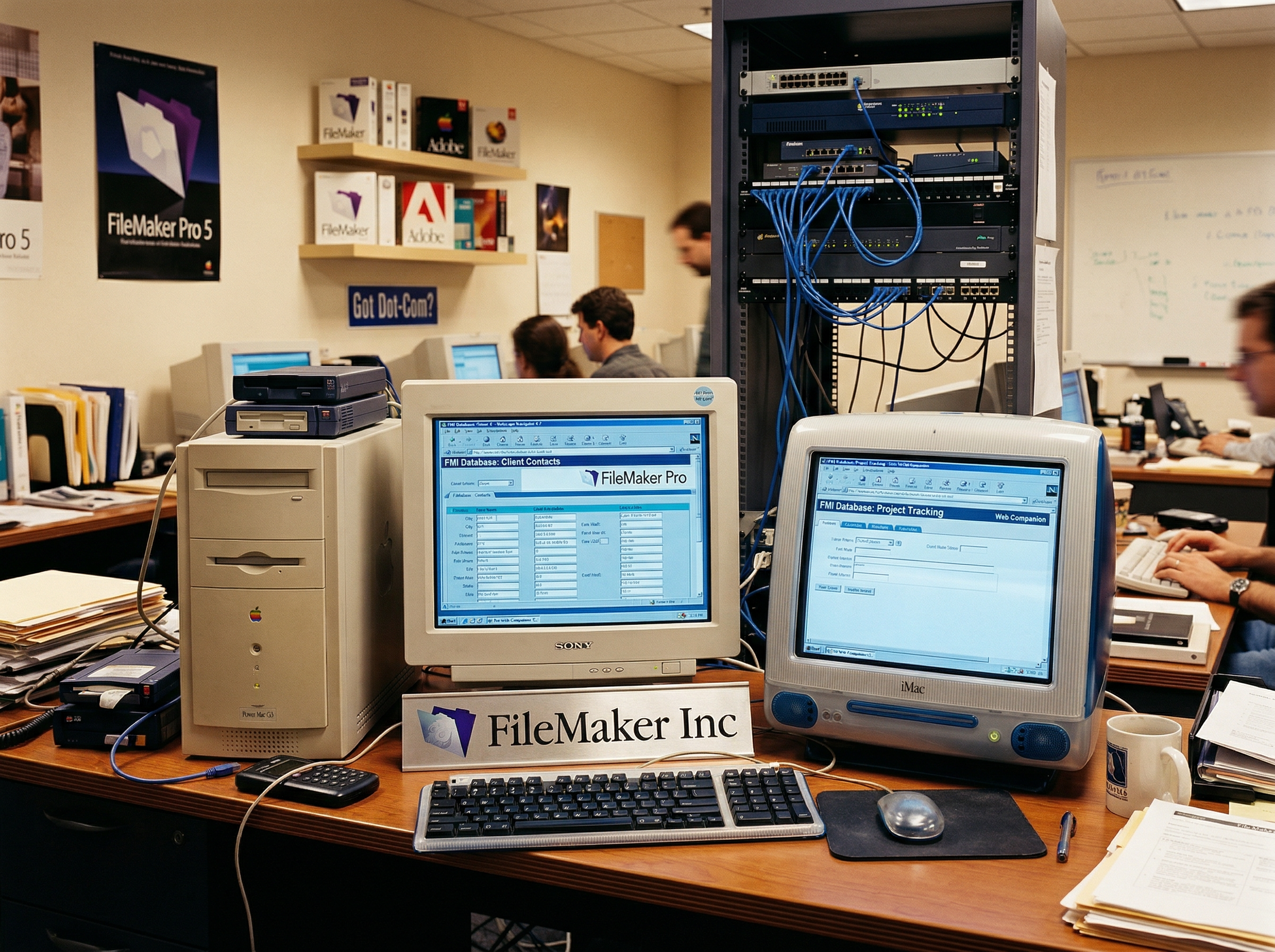
Early 2000s office with Power Mac G3 and iMac displaying web-connected FileMaker databases

In 1998, Apple reorganized Claris. ClarisWorks was pulled back in-house (eventually becoming AppleWorks, then dying quietly). Every other Claris product was discontinued. Every product except one. FileMaker was so profitable that Apple spun it off into FileMaker, Inc. — an independent subsidiary that would focus exclusively on the database platform.

Apple — the company famous for killing its own products — looked at FileMaker and said: this one stays. Former Claris CEO Bill Campbell had called it "the database for the rest of us," echoing Apple's original Macintosh marketing. That positioning held.

FileMaker Pro 7 in 2004 was the biggest technical leap since version 3.0. It introduced multi-table files, an 8-terabyte file size limit, and a completely new file format (.fp7). Instant Web Publishing let users host their databases as websites with a single click — a feature that sounds obvious now but was genuinely revolutionary for small teams who couldn't afford dedicated web developers.

While Microsoft Access was "winning" the desktop database market through Office bundling, FileMaker quietly pivoted to workgroup computing — shared databases for teams of 5 to 50 people who needed real solutions, not enterprise consulting engagements.

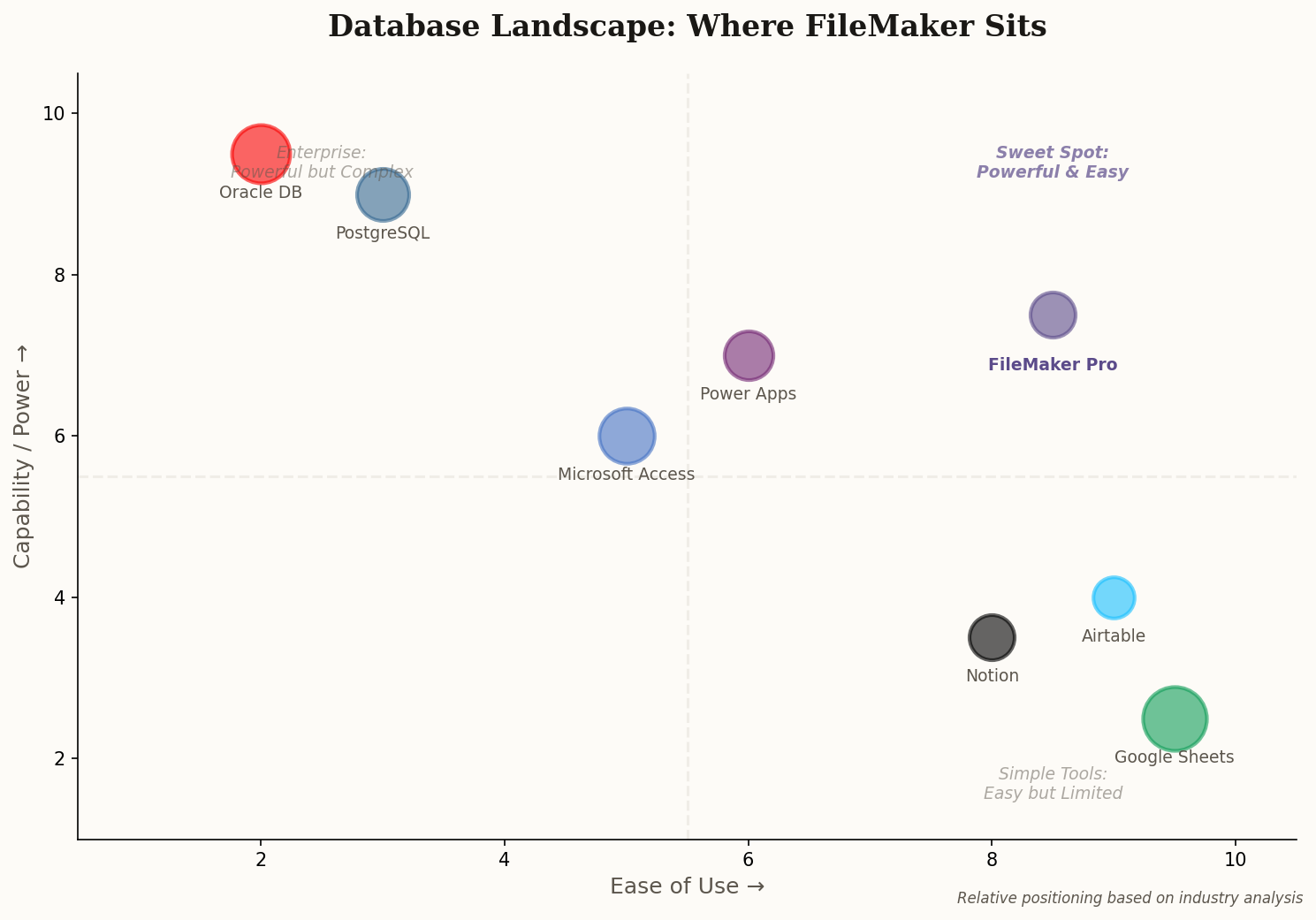
Bubble chart showing FileMaker's unique position in the database landscape, balancing ease of use with capability
FileMaker occupies a unique quadrant: powerful enough for real applications, accessible enough for non-programmers. Most competitors sacrifice one for the other.
04

Four Million Downloads and an iPad

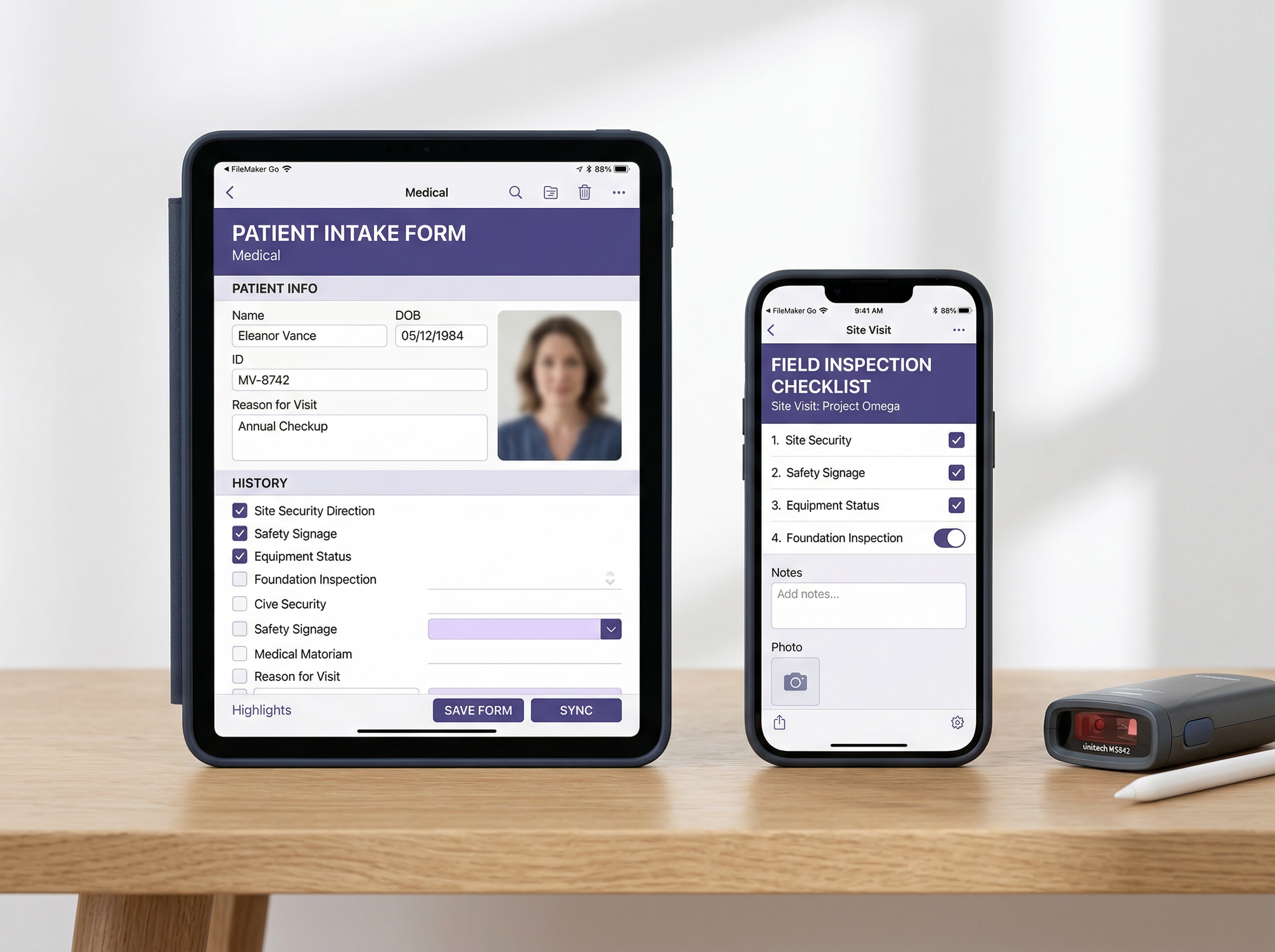
iPad and iPhone displaying colorful FileMaker Go database apps for mobile field work

When Steve Jobs unveiled the iPad in January 2010, most enterprise software vendors panicked. Their applications were designed for mice, keyboards, and 22-inch monitors. The iPad was a finger-driven 9.7-inch slab. Rewriting everything for mobile would take years and millions of dollars.

FileMaker shipped FileMaker Go that same year. It ran existing FileMaker databases natively on iOS. No rewrite. No new development team. The same database a small business had built on their desktop now ran on an iPad with touch-optimized controls, signature capture, GPS tracking, and barcode scanning as native script steps.

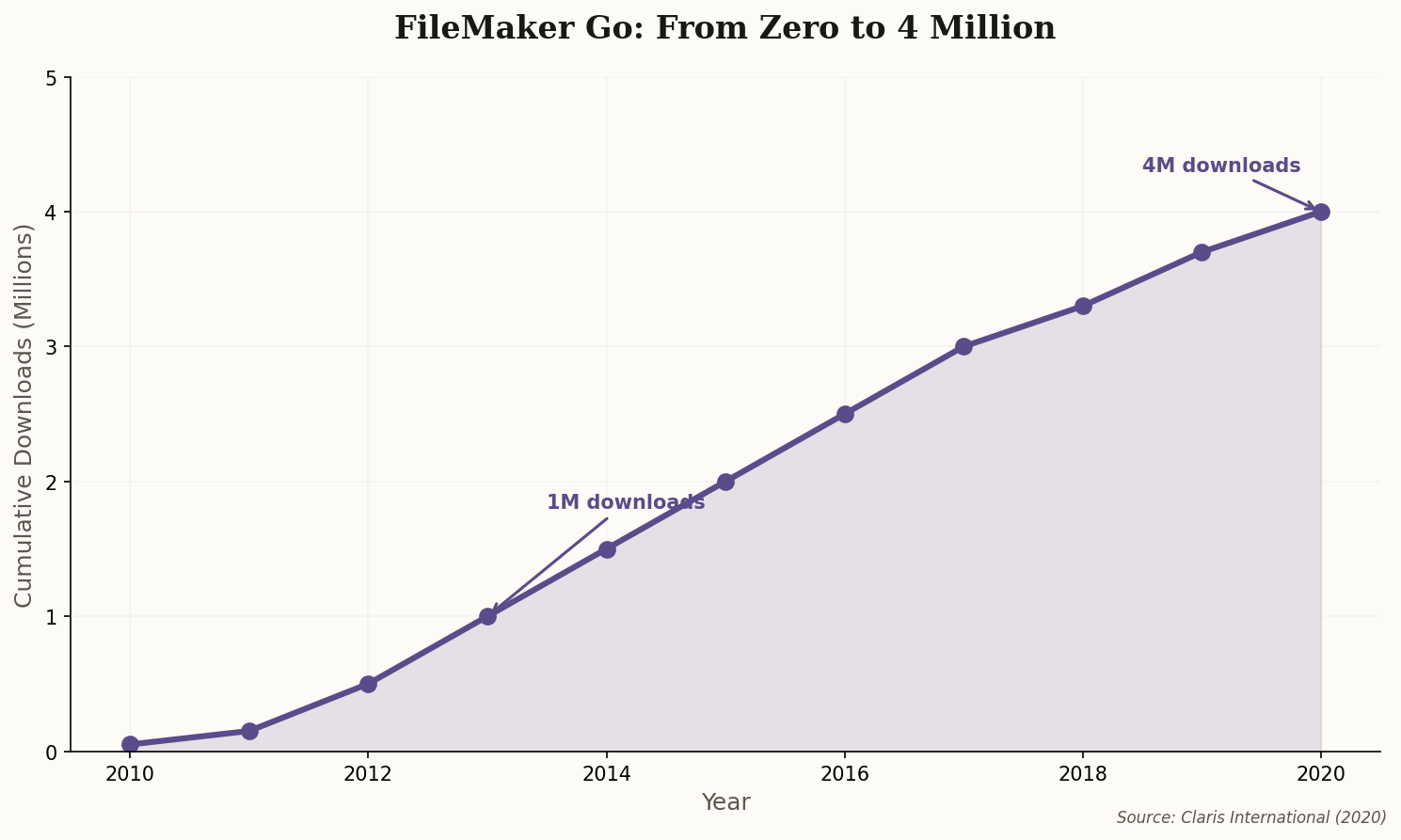
The numbers tell the story: 1 million downloads by 2013, 4 million by 2020. FileMaker Go became the #1 business database app on the App Store. Medical professionals used it for patient intake. Building inspectors used it for field reports. Travis County Fire Rescue built a COVID-19 vaccine tracking app with it. While competitors like Oracle and SQL Server required massive development teams to port their mobile clients, a citizen developer could build an iPad app in FileMaker in a single afternoon.

Line chart showing FileMaker Go's growth from launch in 2010 to 4 million downloads by 2020
FileMaker Go's download trajectory: from zero to 4 million in a decade, powered by the iPad revolution. Source: Claris International (2020).

The Citizen Developer Advantage: While enterprise vendors spent 18-24 months porting to mobile, FileMaker users were deploying iPad apps on day one. This wasn't just a speed advantage — it was a philosophical one. The person closest to the problem built the solution.

05

From Product to Platform

Abstract visualization of cloud computing with data streams and API connections

For most of its life, FileMaker was a product — a thing you bought, installed, and ran. Starting around 2016, the company began transforming it into a platform. FileMaker Cloud launched on AWS. FileMaker 16 in 2017 introduced JSON parsing and cURL integration, letting FileMaker talk to modern web services like Slack, Stripe, and Twilio. The REST Data API opened FileMaker data to any web application.

In 2018, CEO Brad Freitag declared FileMaker a "Workplace Innovation Platform" — positioning it between the rigid appliance apps that don't fit your workflow and the enterprise systems that cost a fortune to customize. "Our job," Freitag said, "is to fill the gap where standard software isn't enough."

It was a smart bet. Every organization has processes that live in spreadsheets, sticky notes, and email threads because no off-the-shelf software quite fits. FileMaker's pitch was simple: those processes deserve real applications, and you don't need a CS degree to build them. WebDirect — the HTML5 web client introduced in FileMaker 13 — eliminated plugins entirely, and Claris Connect (workflow automation, launched 2020) rounded out the platform story.

06

The Return of Claris — and the AI Question

Modern MacBook displaying Claris FileMaker 2024 with AI-powered features

In 2019, FileMaker Inc. changed its name back to Claris International Inc. — resurrecting the brand that Apple had buried two decades earlier. The message was clear: this wasn't just a database anymore. Claris was building a broader low-code platform with Claris Connect for workflow automation and Claris Studio for collaborative app development.

FileMaker 2024 (version 21) made the boldest move in the platform's 40-year history: native AI and LLM integration. Semantic search across database records. AI-powered script steps that let developers embed large language models directly into their applications. Natural language queries against structured data. The database that empowered non-programmers in 1985 was now empowering them to build AI-powered applications in 2024.

As of 2024, Claris has been independently profitable for over 100 consecutive quarters — more than 25 years without a single unprofitable quarter. In an industry where even well-funded companies bleed cash for years, FileMaker has quietly been printing money since the Clinton administration. The Claris Community numbers over 50,000 developers worldwide, building solutions in healthcare, education, government, and every industry where problems don't fit neatly into off-the-shelf software.

Visual timeline infographic showing the complete evolution of FileMaker from 1984 to 2024
The complete FileMaker journey: from Nutshell on DOS to AI-powered Claris — 40 years of empowering citizen developers.

The question now is whether FileMaker can maintain its relevance in a world of Airtable, Power Apps, and Notion. These newer tools borrowed heavily from FileMaker's playbook — the same "build without coding" promise, the same focus on empowering non-technical users. But FileMaker offers something most of them don't: the depth to handle genuinely complex applications. It's the difference between a tool that helps you organize a spreadsheet and one that runs a hospital department.

The Software That Never Said No

FileMaker Pro's real legacy isn't features or versions — it's a philosophy. For 40 years, it bet that the person closest to the problem was the best person to build the solution. Teachers, doctors, small business owners, and scientists didn't need to wait for IT. They didn't need to learn to code. They just needed a tool that said yes. In an industry obsessed with disruption, the most radical thing FileMaker ever did was simply refuse to quit.

Share X LinkedIn