LaTeX × AI

The Compiler in the Machine

LaTeX was supposed to be a relic. Instead, it became the language AI uses to think.

Listen
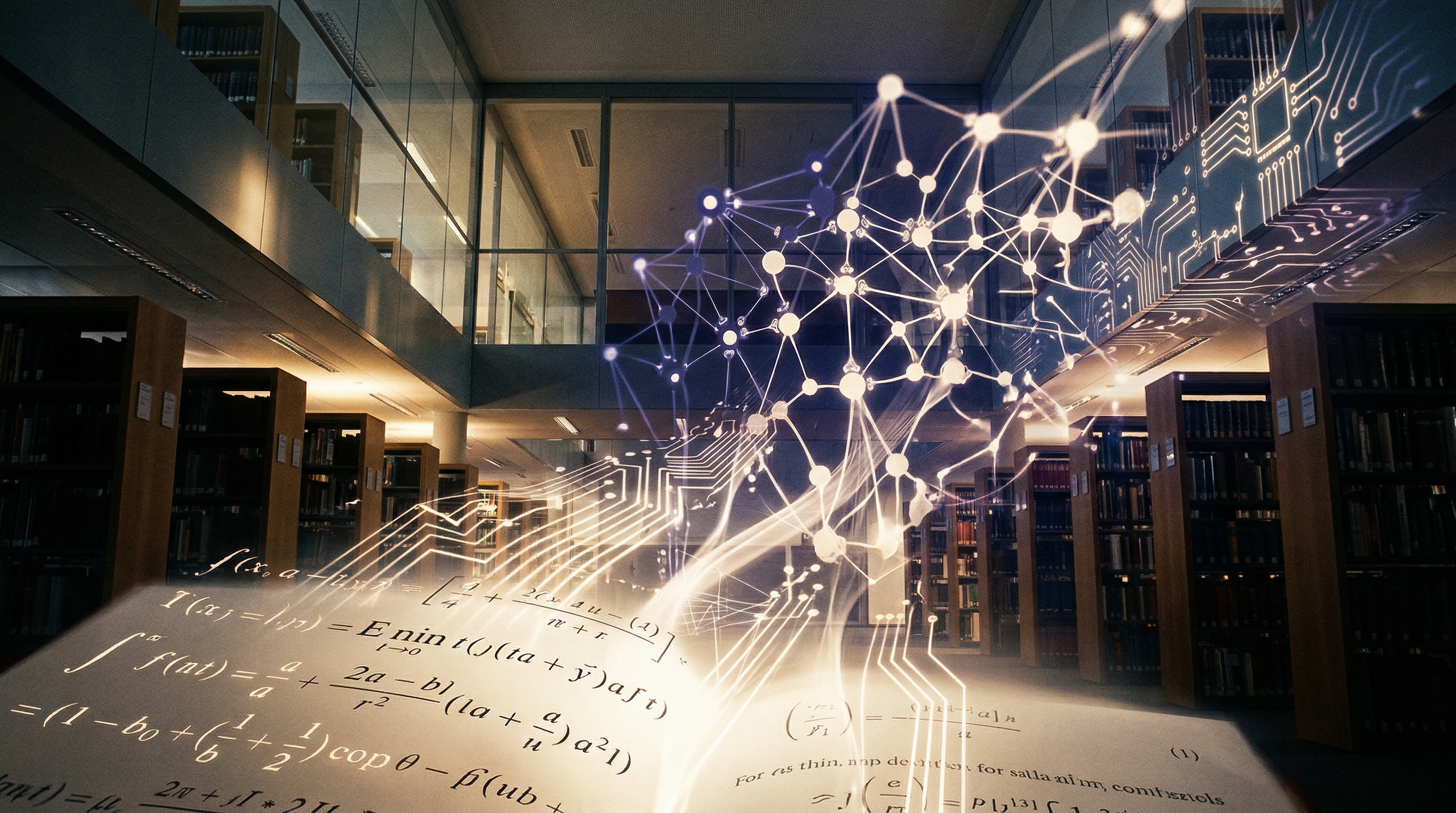
LaTeX mathematical equations transforming into neural network architectures, indigo and cream palette
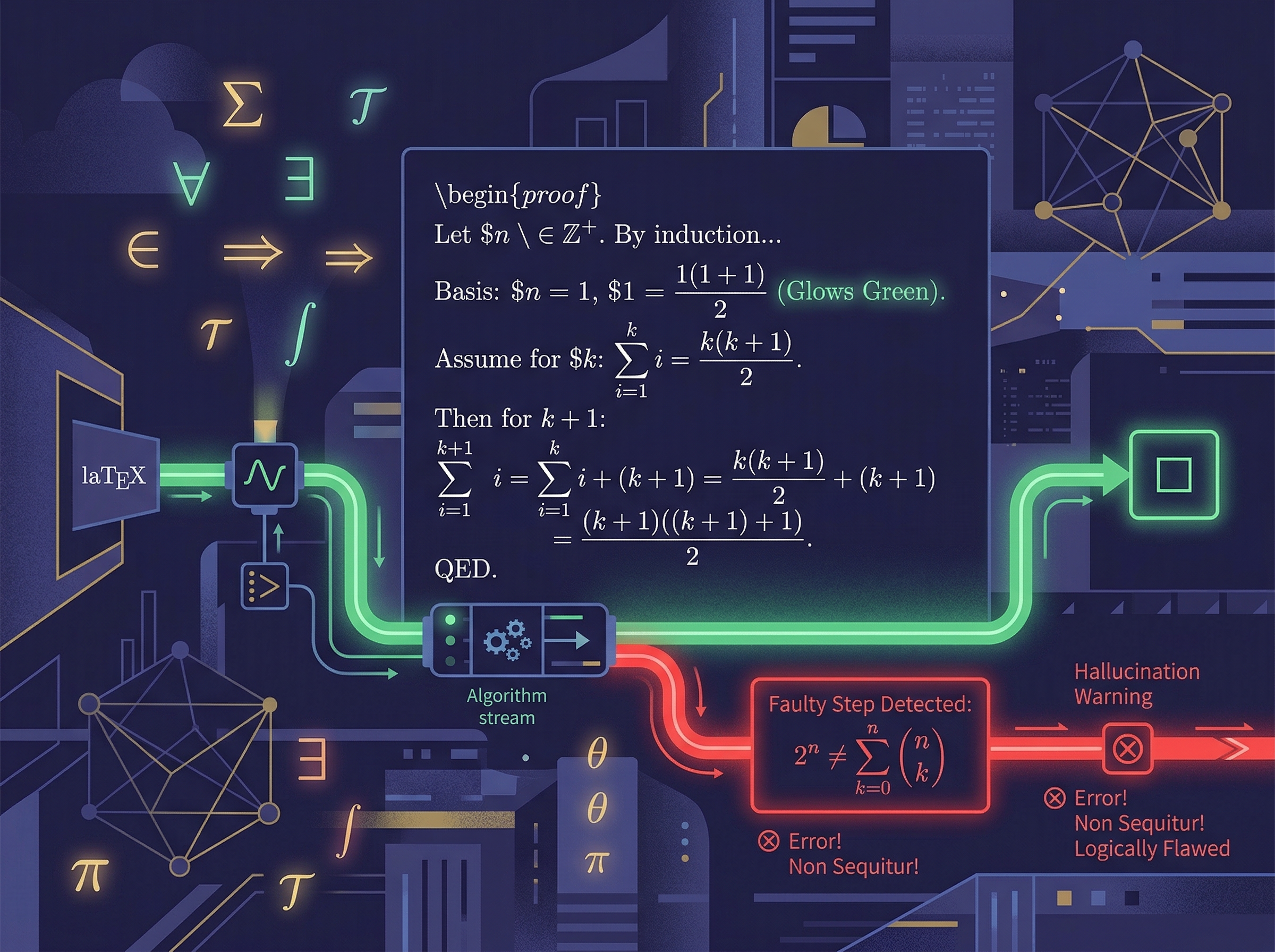
Mathematical proof flowing through a verification pipeline that glows green when correct
01

If the Math Won't Compile, Grok Won't Say It

Here's a sentence that would have sounded insane five years ago: xAI's latest model uses a LaTeX compiler as a hallucination filter. Grok 4.2 "Fast" doesn't just generate mathematical answers—it compiles them internally, verifying that every equation actually typechecks before showing it to you. If the LaTeX breaks, the answer gets rejected and regenerated.

The numbers back up the audacity. On the MATH-500 benchmark, Grok 4.2 hit 97.2% accuracy—a figure xAI attributes directly to the LaTeX-verification loop. The secret is a 4-agent architecture where one agent writes, another compiles, a third checks logical consistency, and a fourth decides whether to ship or retry.
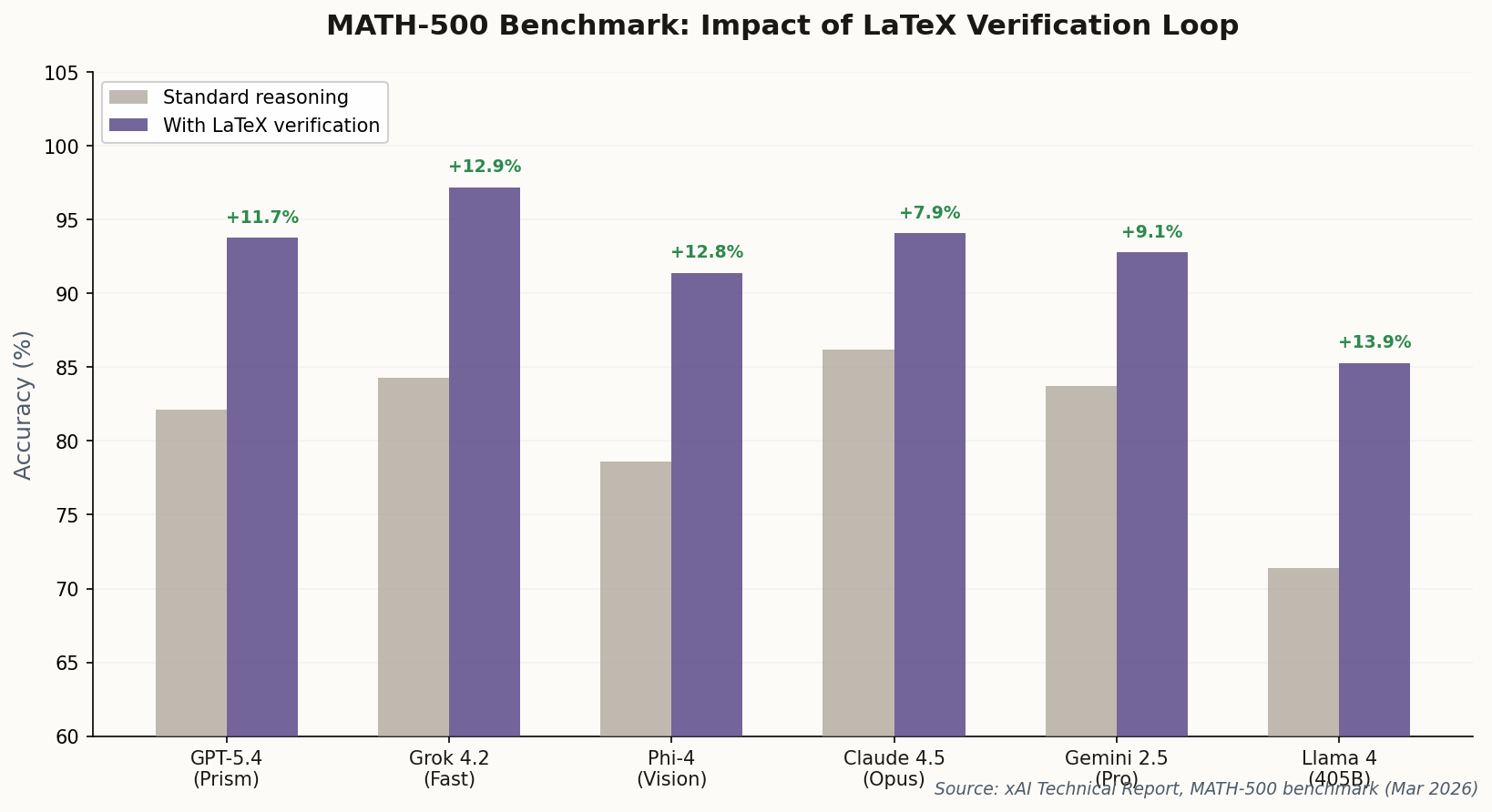
Bar chart comparing MATH-500 benchmark accuracy with and without LaTeX verification across major LLMs
MATH-500 accuracy with and without LaTeX verification loops. Grok 4.2 shows the largest improvement at +12.9 percentage points.

What's quietly revolutionary here isn't the accuracy itself—it's the philosophical shift. For years, the AI industry treated mathematical reasoning as a "scale will fix it" problem. xAI is saying: no, you need a formal verification layer, and LaTeX happens to be the most battle-tested one we have. The compiler isn't just formatting; it's a proof checker. Watch for every major lab to adopt some variant of this within six months.

Camera lens viewing a mathematical diagram with LaTeX code overlay
02

Phi-4 Thinks in LaTeX—Even When It's Looking at Pictures

Microsoft Research dropped details on Phi-4, their 14-billion-parameter model that does something genuinely novel: it uses LaTeX as an intermediate "thought language" for spatial reasoning. Show it a screenshot of a complex textbook diagram, and it doesn't just describe what it sees—it internally generates the TikZ code that would produce that diagram, then reasons over the structural representation.

This is a significant conceptual leap. Previous multimodal models treated vision as pixels-to-text: see a chart, describe the chart. Phi-4 treats vision as pixels-to-LaTeX-to-reasoning: see a chart, reconstruct it structurally, then reason about the relationships. It's the difference between reading a map and rebuilding the terrain model from satellite imagery.

The training methodology is equally interesting. Microsoft assembled massive LaTeX-OCR datasets—pairs of rendered math and their source code—and trained Phi-4 to "see" through the rendering back to the structure. The result is a model that understands mathematical notation not as visual patterns but as compilable, verifiable logic. At 14B parameters, it's small enough to run locally, which means researchers can use it offline—a genuine practical advantage over cloud-only alternatives.

Scientific writing workspace with holographic LaTeX equations floating above a tablet
03

OpenAI Bets That Researchers Want a LaTeX-Native AI

OpenAI launched Prism this week, and it's their most explicit bet on the academic market yet. Built entirely on a LaTeX-native engine, Prism isn't a chatbot with export-to-LaTeX bolted on—it's a writing tool where LaTeX is the primary representation from keystroke one. The headline feature: "Whiteboard-to-LaTeX," which converts handwritten math from tablets directly into compilable TikZ or LaTeX code.

But the real story is the proof verification layer. Prism uses GPT-5.4 "Prism-Optimized" to not just generate LaTeX but to check whether the mathematical arguments it produces are logically valid. It's the same instinct as Grok 4.2's verification loop, but applied to the writing process itself rather than to a chatbot response. The pitch: your AI co-author should be able to catch a flawed proof before your reviewer does.

The bigger signal: When one of the world's most valuable AI companies builds a dedicated product for researchers who speak LaTeX, it tells you something about where the revenue is. Academic software has been a backwater for decades. The fact that both OpenAI and xAI are investing heavily here suggests they see scientific reasoning as the next frontier—not just another vertical.

This is also a direct shot at Overleaf's dominance. Overleaf has owned the collaborative LaTeX market for years with a simple, reliable cloud editor. Prism is saying: what if your editor didn't just compile your LaTeX, but understood it?

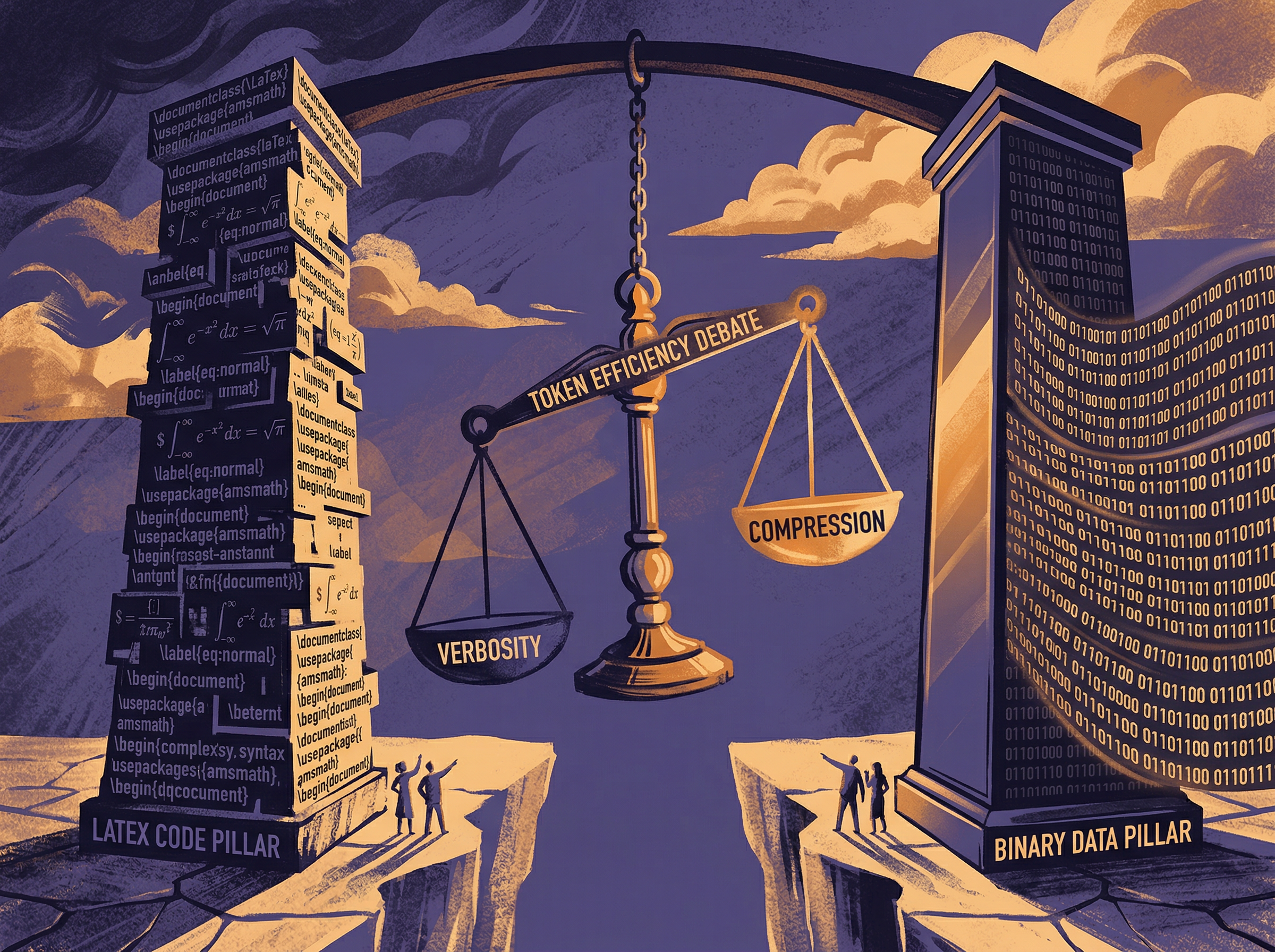
Two pillars of LaTeX code and compressed data facing each other with a scale between them
04

LaTeX Has a Token Problem—and Someone Wants to Fix It

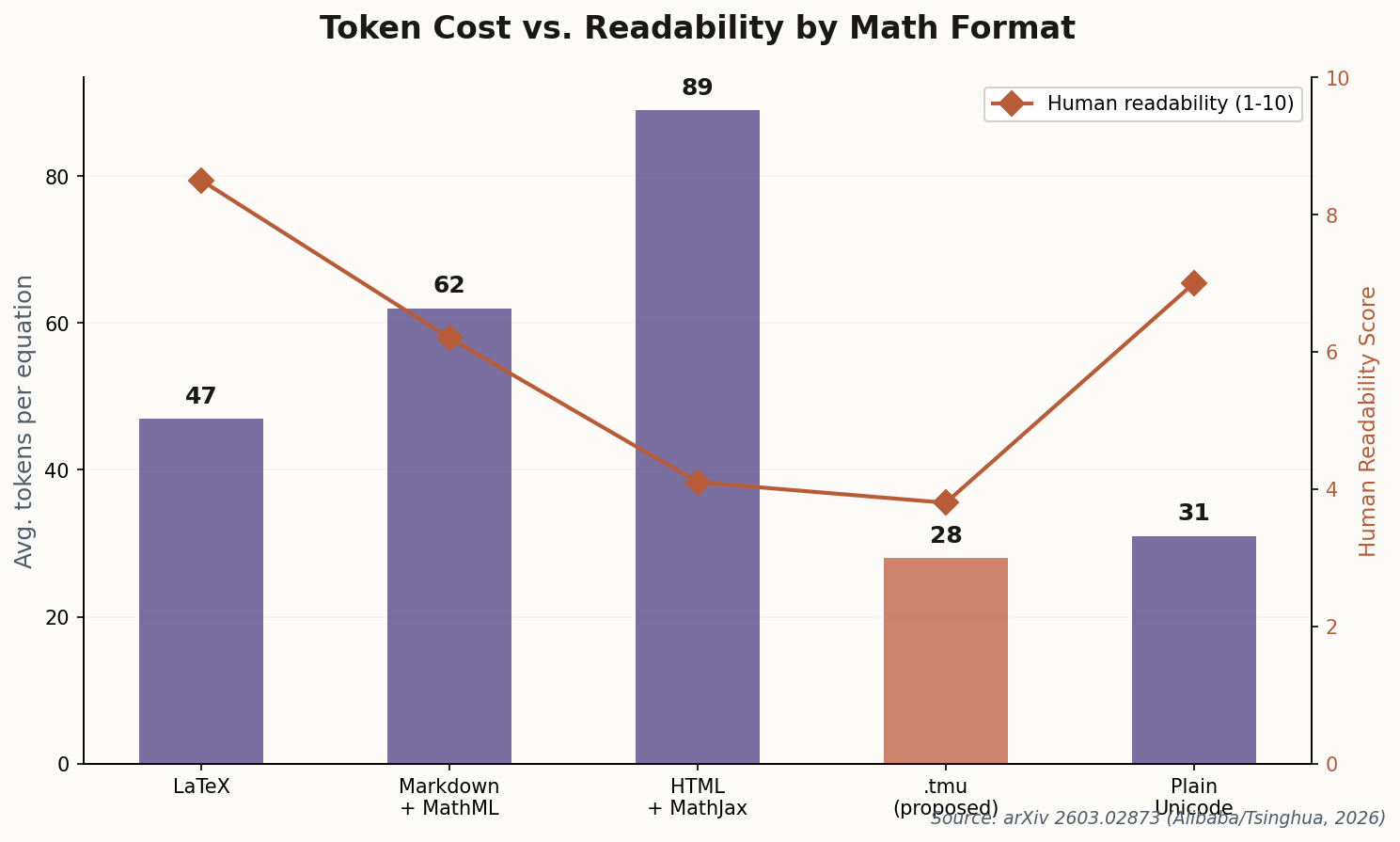
Not everyone is celebrating LaTeX's renaissance. Researchers from Alibaba and Tsinghua University published a paper this week arguing that LaTeX's verbose syntax is actively wasteful for AI training. Their proposal: .tmu, a structured WYSIWYG format designed to encode the same mathematical semantics with significantly fewer tokens.

Bar chart comparing token cost and readability across math formats including LaTeX, Markdown+MathML, HTML+MathJax, .tmu, and plain Unicode
Token cost vs. human readability by math format. LaTeX sits in the sweet spot of high readability with moderate token cost. The proposed .tmu format saves tokens but sacrifices human readability.

The argument has teeth. LaTeX's markup for even simple equations carries significant token overhead, and across a training corpus of millions of papers, that overhead translates directly into compute cost. The ML community has been debating this furiously on social media, with the predictable fault lines: systems researchers love the efficiency argument, while mathematicians point out that LaTeX's "verbosity" is actually its readability.

Here's the thing the .tmu advocates are missing: LaTeX's token overhead isn't a bug, it's a feature. The redundancy in \frac{}{} and \begin{align}...\end{align} provides structural scaffolding that helps models understand context and intent. Stripping that away for token efficiency is like compressing a building's blueprints to save paper—you lose the information that makes the document navigable. This debate will simmer for years, but LaTeX's installed base of nearly five decades of scientific literature means .tmu would need to be dramatically better, not just marginally cheaper.

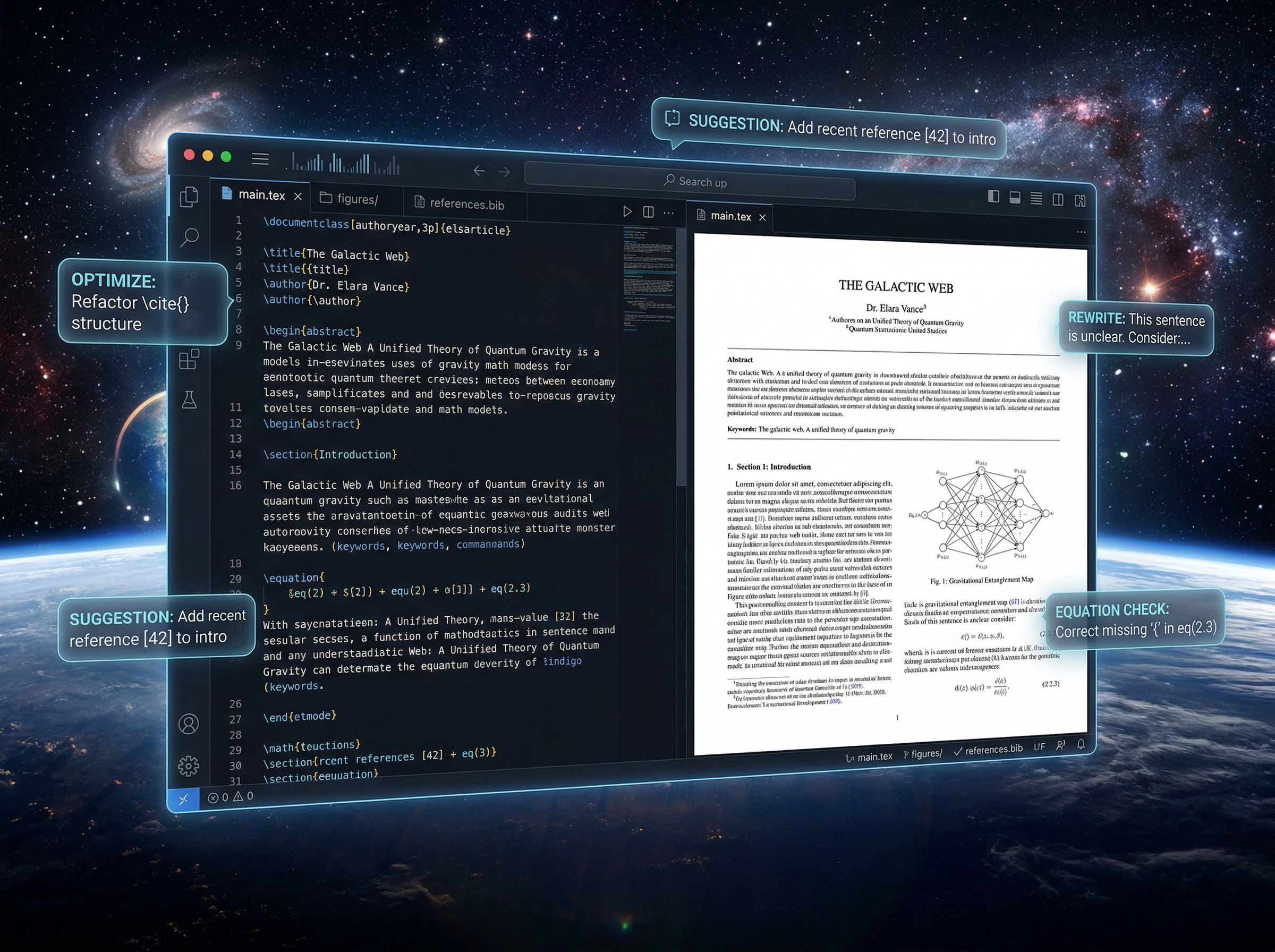
Futuristic code editor showing LaTeX source on one side and rendered paper on the other
05

GranthOS: The IDE That Treats LaTeX Like Code

A new editor called GranthOS has quietly amassed 200,000 users in its first month by doing something no LaTeX editor has done well before: treating LaTeX documents like codebases. Sub-half-second incremental compilation. Diff-style change review. AI-powered "Autonomous Editing" that can refactor across multi-file projects. And a direct Zotero integration that reads your local library and generates bibliography-aware content on the fly.

If Overleaf is Google Docs for LaTeX, GranthOS is VS Code for LaTeX. It applies every good idea from modern IDEs—language server protocol, tree-sitter parsing, inline diagnostics, multi-cursor editing—to the specific problem of academic writing. The AI features aren't just autocomplete; they understand project structure. Tell it "add a theorem that follows from Lemma 3.2" and it traces the dependency chain across your files.

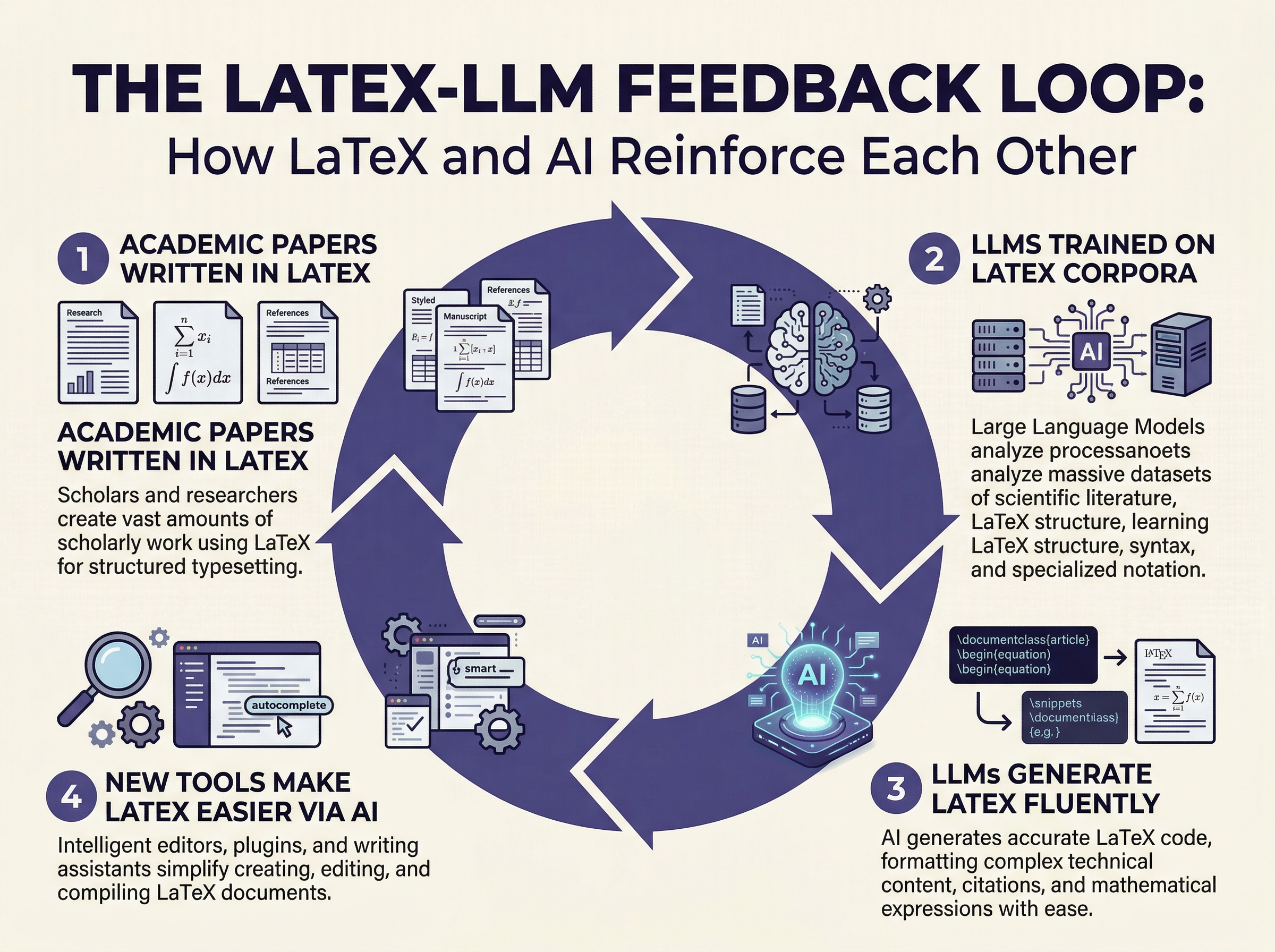
Infographic showing the LaTeX-LLM feedback loop: academic papers in LaTeX, LLMs trained on LaTeX, LLMs generate LaTeX, new AI tools make LaTeX easier
The LaTeX-LLM feedback loop: each stage reinforces the next, accelerating adoption of both technologies.

The 200k user number is remarkable for a LaTeX editor launch. For context, it took Overleaf years to reach that milestone. What's driving the velocity is the AI-native angle: students and researchers who already use LLMs for drafting are discovering that a LaTeX-aware editor makes the LLM output dramatically more useful. It's the feedback loop made tangible—better tools create better workflows create better tools.

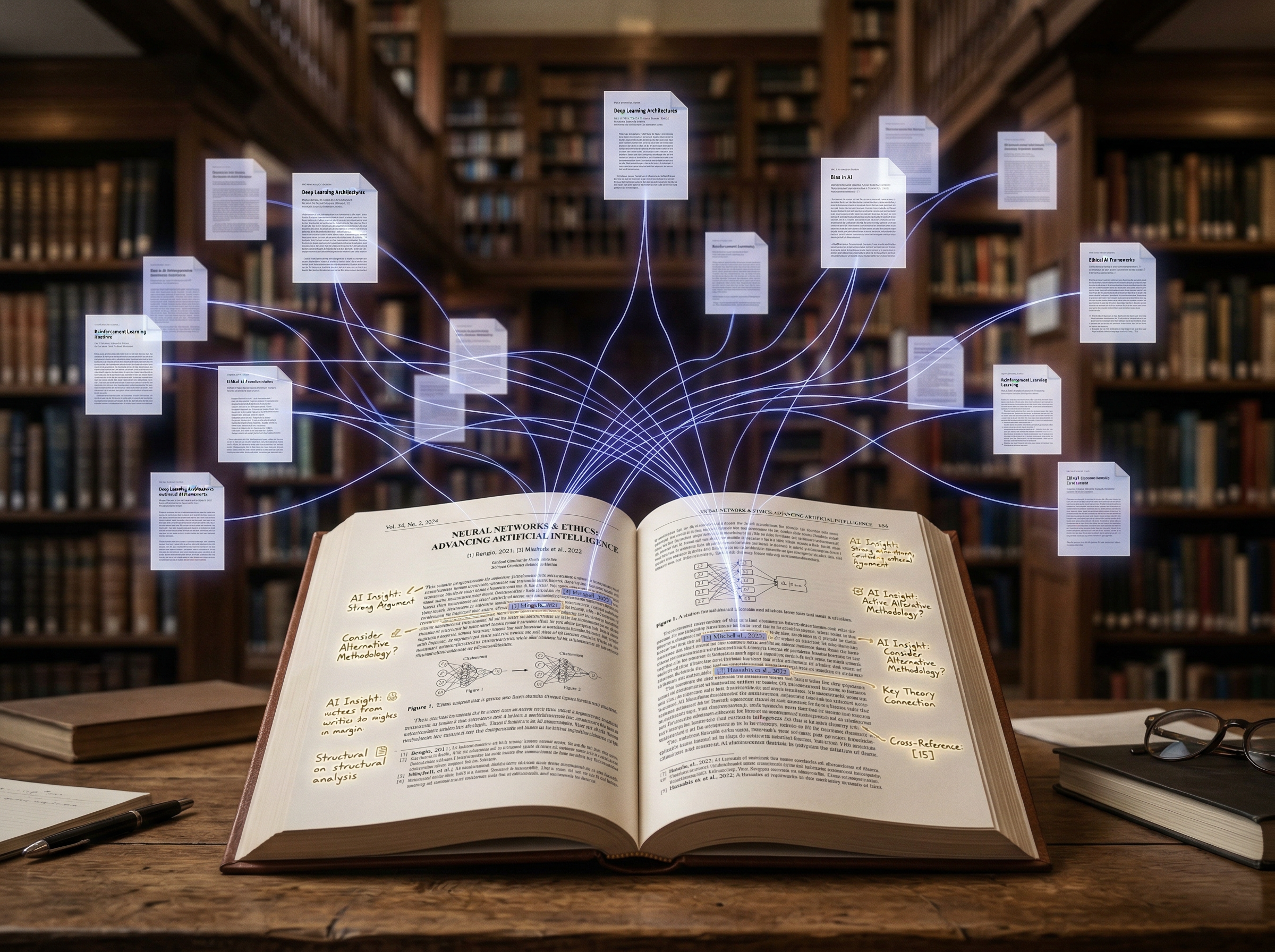
Academic paper with citation links glowing and connecting to floating research papers like a constellation
06

Overleaf Turns the Editor Into a Research Supervisor

Overleaf isn't ceding the AI-native ground without a fight. Their latest "AI Assist" update, powered by the Dimensions database, transforms the editor from a passive compilation engine into something that actively reviews your work. The Citation Reviewer scans your LaTeX draft in real-time, suggests missing high-impact papers, and flags citations that have been retracted or disputed.

The "Error Assist" feature is even more practical. Anyone who's spent 45 minutes debugging a cryptic TeX compilation error knows the pain. Error Assist translates TeX's notoriously unhelpful error messages into natural language explanations with specific fixes. It's the kind of quality-of-life improvement that sounds minor but fundamentally changes who can use LaTeX productively.

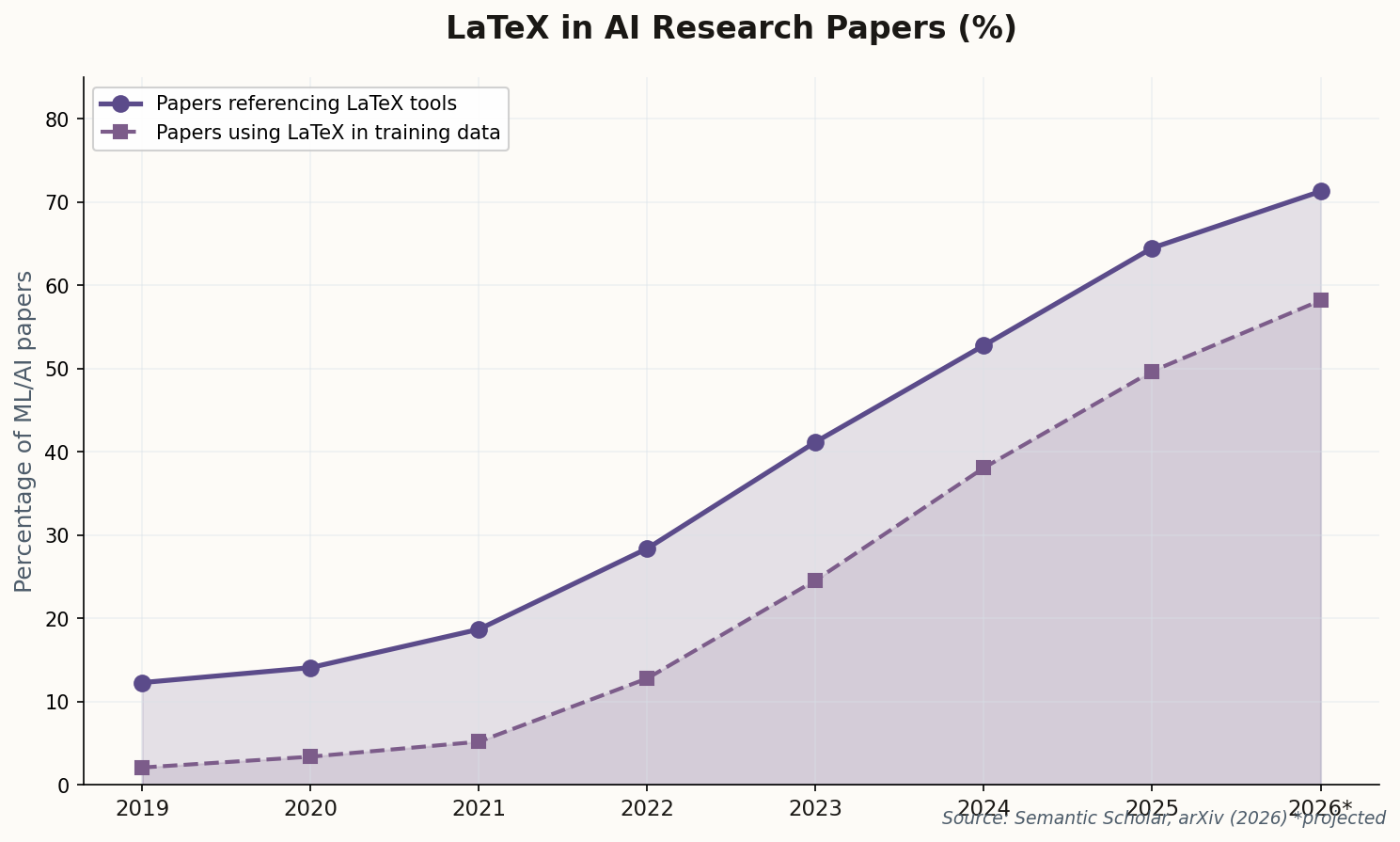
Line chart showing the percentage of AI/ML papers referencing LaTeX tools and using LaTeX in training data from 2019 to 2026
LaTeX's footprint in AI research has grown exponentially. By 2026, over 70% of ML papers reference LaTeX-related tools, and 58% use LaTeX corpora in training.

Overleaf's strategy is clear: they can't out-innovate a well-funded startup on the IDE front, so they're leveraging their data advantage. With millions of papers flowing through their servers, they have unmatched insight into what researchers actually cite, what errors they actually make, and what patterns lead to successful papers. GranthOS may treat LaTeX like code, but Overleaf is treating it like a dataset—and in the age of AI, that might be the smarter bet.

The Unexpected Renaissance

Donald Knuth started TeX in 1978 because he was annoyed by the typesetting of his math textbook. Nearly fifty years later, his creation has become the Rosetta Stone of artificial reasoning—not because anyone planned it, but because a language designed to express mathematical truth turned out to be exactly what machines needed to verify mathematical truth. The irony is delicious: the most human-centric typesetting system ever built is now more valuable to machines than to humans. As LLMs get better at thinking in LaTeX, and as LaTeX tools get better at leveraging LLMs, we're watching a flywheel spin up that could redefine how scientific knowledge is created, verified, and disseminated. The compiler in the machine isn't going anywhere.

Share X LinkedIn