Gaming History

The Tank That Built the Internet

How a Macintosh shareware game from 1989 quietly invented zero-configuration networking — and why its community refuses to die.

Listen
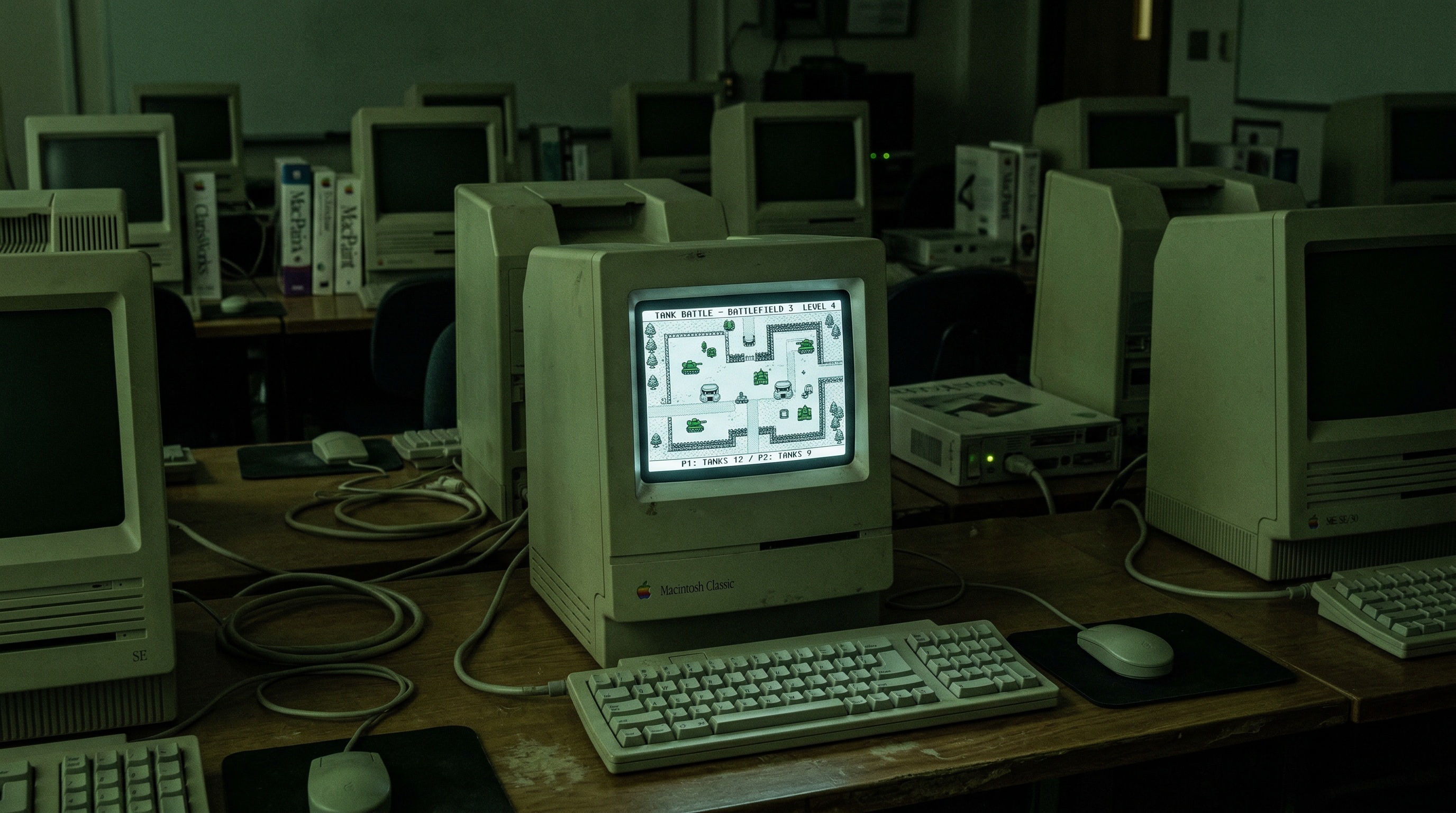
A vintage Macintosh computer in a dark university lab, its screen glowing with a top-down tank battlefield
01

A Cambridge Undergraduate, a BBC Micro, and a Hindi Word

A young computer scientist at a wooden desk with a BBC Micro, prototyping an early game in a Cambridge University office

In 1987, a computer science undergraduate named Stuart Cheshire sat in a Cambridge University lab and started building something that would quietly reshape how computers talk to each other. He wasn't trying to change networking. He was trying to make tanks shoot at each other over a wire.

The first prototype ran on a BBC Micro — the beige educational computer that was the UK's answer to the Apple II. Cheshire named it Bolo, the Hindi word for "speak" or "communicate." Not destroy. Not conquer. Speak. The name was a mission statement: this wasn't a game about violence. It was a game about what happens when you connect people and give them shared stakes.

By 1989, Cheshire had ported Bolo to the Macintosh and released it as shareware — or more precisely, "plea-ware." There was no registration key, no nag screen. Just a polite message: "If you like it, tell your friends." They did. Within a year, Bolo had infected university computer labs across the English-speaking world like a benign, tank-shaped virus.

Cheshire would go on to Stanford for his PhD, where Bolo's networking challenges became the core of his doctoral research. The game wasn't a side project from his academic work. His academic work was the game. And the game was about to teach the world something important about how networks should behave.
02

Pillboxes, Little Green Men, and the Art of the Diplomatic Betrayal

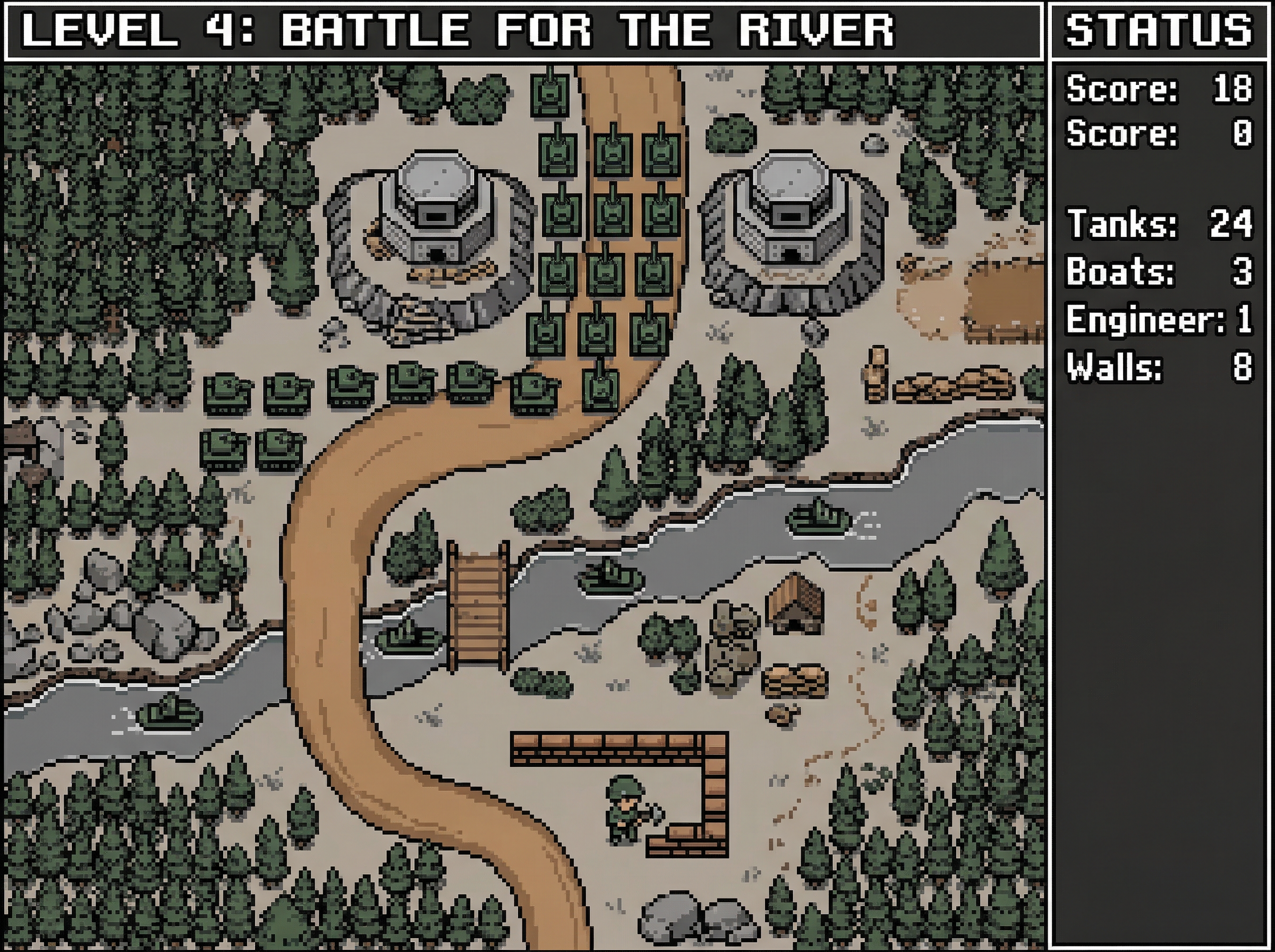
Stylized top-down view of a Bolo battlefield with tanks, pillboxes, forests, and a Little Green Man engineer

Strip away the nostalgia and Bolo's design is remarkably sophisticated — a real-time strategy game hiding inside a tank shooter's chassis. You control a tank, yes. But you also command a tireless assistant: the Little Green Man (LGM), an engineer who hops out whenever your tank stops moving. The LGM builds walls, lays mines, harvests trees for lumber, and captures enemy infrastructure. Lose your LGM to a stray shell and you're a tank without thumbs — all firepower, no finesse.

The map is dotted with two critical assets: Bases (refueling stations for ammo and armor) and Pillboxes (automated turrets that shoot anything that moves). Capture a pillbox and you can physically relocate it — pick it up, drive across the map, and drop it at a chokepoint. The strategic depth this creates is staggering. You're not just fighting. You're terraforming.

Forests grow dynamically. Roads increase speed. Water requires building boats. And here's where it gets genuinely brilliant: the fog of war hides everything outside your line of sight, including enemy mines. The only way to see another player's mines? Form an alliance. And alliances in Bolo are fragile, voluntary, and exquisitely breakable. The game incentivized diplomacy, then gave you every tool to betray your allies at the worst possible moment.

No levels. No ending. Bolo maps are massive, persistent battlefields. Victory means capturing every base and pillbox — a goal that could take hours of coordinated play among 16 simultaneous players. Some matches ran for over 12 hours straight.

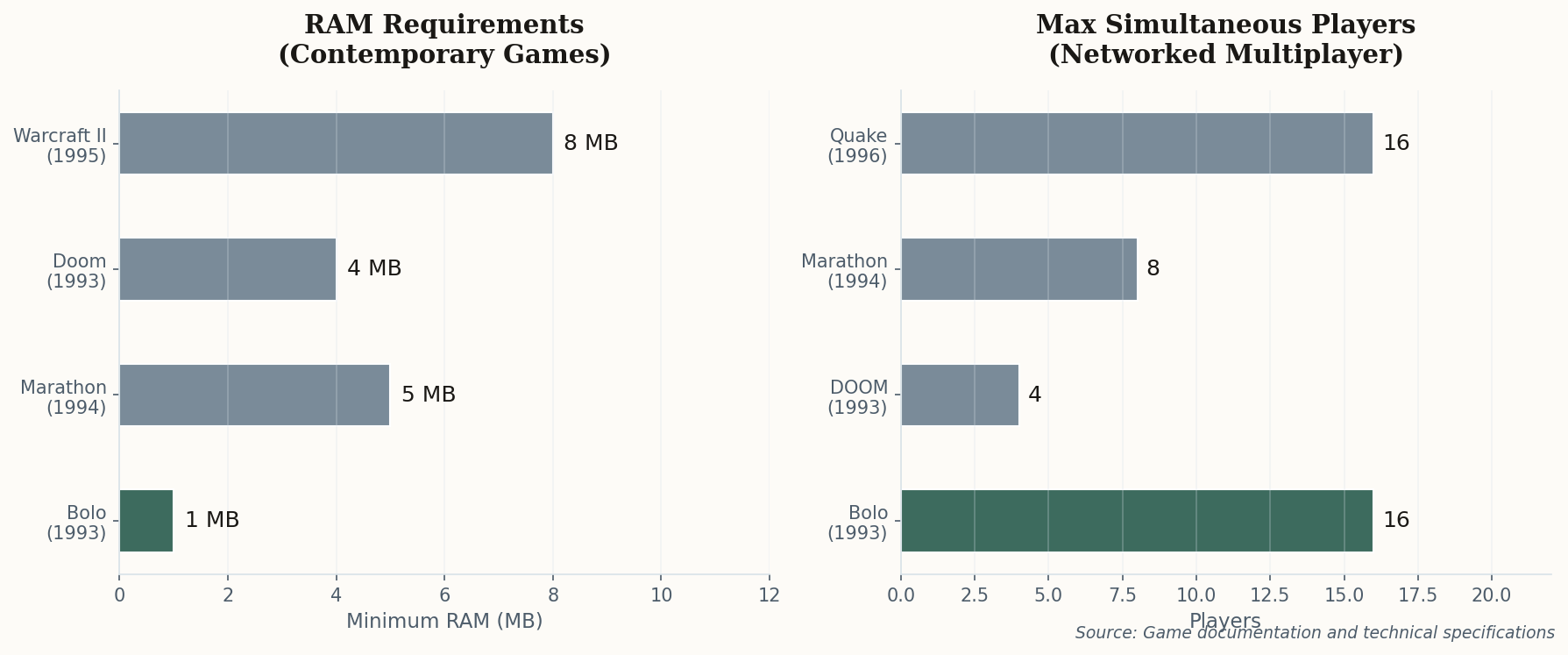
Two charts comparing Bolo's system requirements and player counts against contemporary games like Doom, Marathon, and Warcraft II
Bolo supported 16 simultaneous networked players from its 1989 Mac release — seven years before Quake matched that count — while requiring just 1 MB of RAM.
03

One Packet to Rule Them All: The Protocol That Shouldn't Have Worked

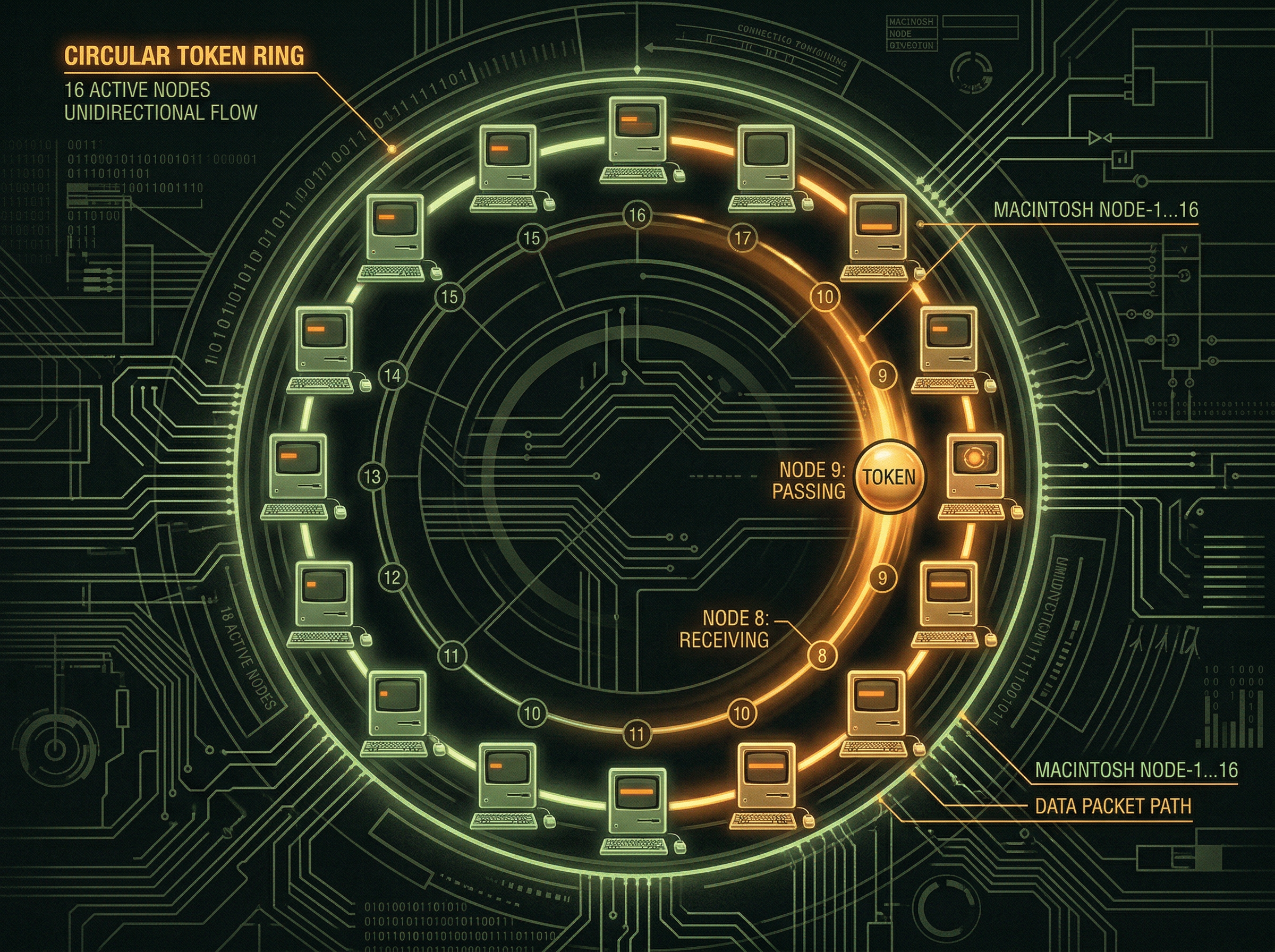
Abstract visualization of a token-passing network: a glowing packet circulating between 16 vintage Macintosh computers in a ring

Here's the problem Cheshire faced: it's 1989, you have 16 Macintoshes connected via LocalTalk — Apple's built-in networking that ran at a screaming 230.4 kilobits per second — and you need real-time multiplayer with no perceptible lag. A client-server model would choke on the bandwidth. Peer-to-peer mesh networking would drown the wire in packets. What do you do?

Cheshire invented what he called the "daisy chain" — a token-passing ring protocol. One packet circulates continuously among all 16 players in a logical ring. When the packet arrives at your machine, you read everyone else's state (position, turret angle, velocity), append your own state vector to a fixed-size slot, and pass it to the next player. The entire game state for 16 players lives in a single packet making laps around the network.

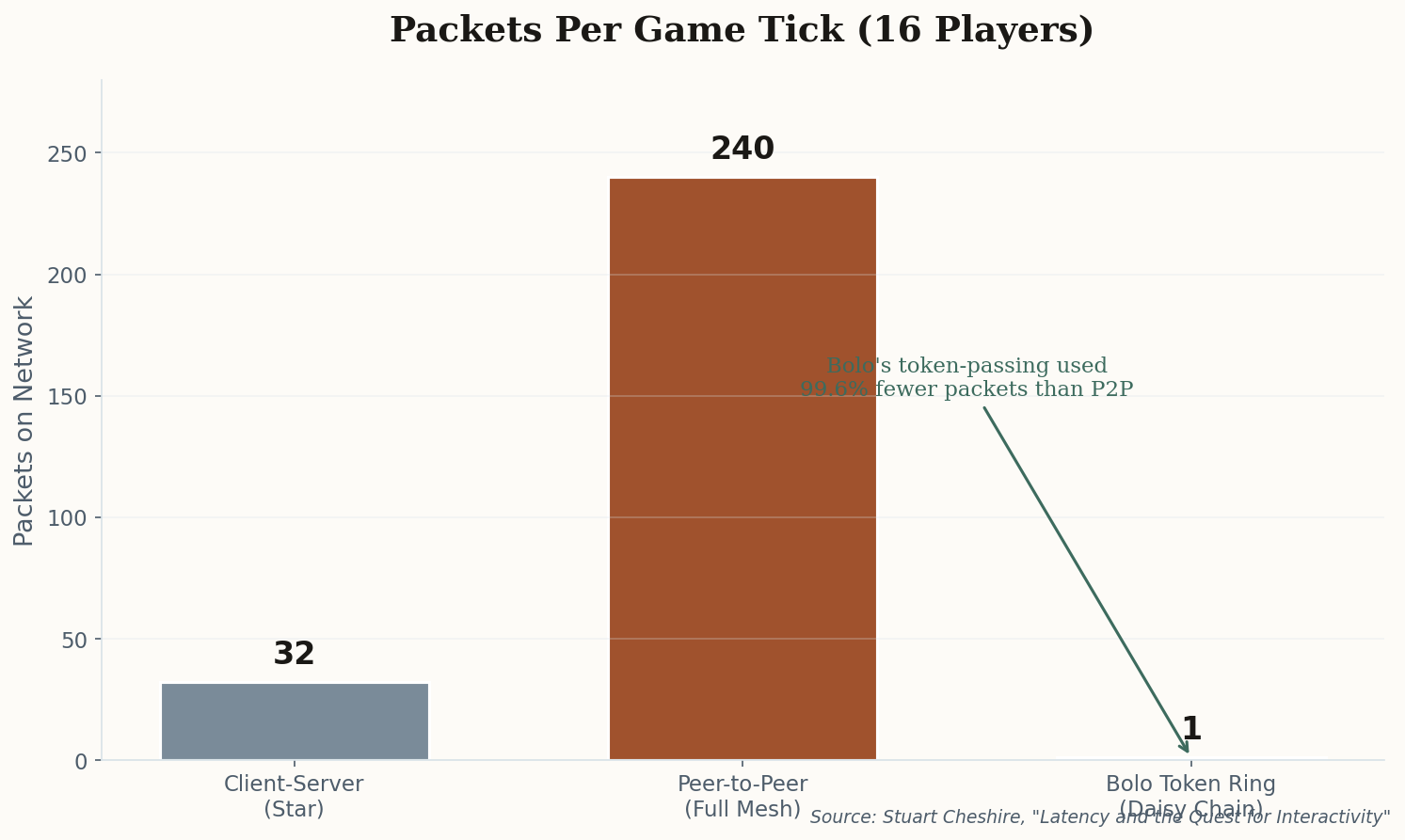
Bar chart showing packets per game tick: Client-Server sends 32, Peer-to-Peer sends 240, Bolo's Token Ring sends just 1
Bolo's token-passing protocol used 99.6% fewer packets than a peer-to-peer mesh for 16 players, making real-time play possible on 230kbps LocalTalk.

The elegance is almost offensive. Client-server needs 32 packets per tick for 16 players. Peer-to-peer mesh needs 240. Bolo needs one. The tradeoff is latency — your state update doesn't reach all players until the token completes a full circuit — but on a LAN, that round-trip was fast enough that nobody noticed. And if a packet dropped? The ring would detect the timeout and regenerate the token automatically. No central server to crash. No single point of failure.

Later versions added UDP/IP support, letting Bolo games span the early internet. The protocol was so bandwidth-efficient that Cheshire claimed it could run a 16-player game over a 9600-baud modem. That's roughly the speed of loading a single modern webpage — except it was sustaining real-time multiplayer for 16 people.

04

Four Thousand Maps and a Usenet Newsgroup: The First Online Gaming Community

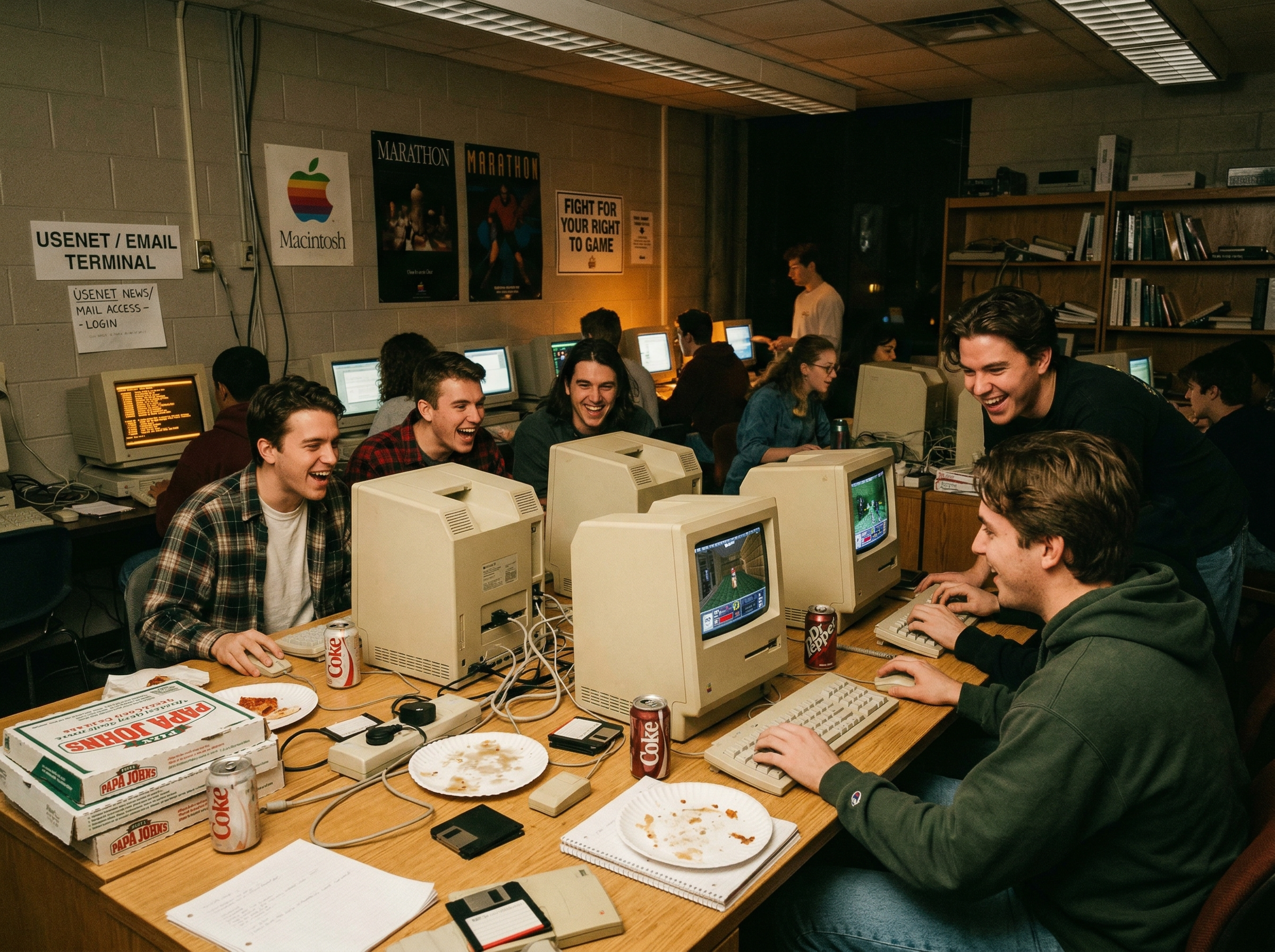
A bustling 1990s university computer lab at night with students gathered around Macintosh computers playing a networked game

Before Twitch streams and Discord servers, before modding communities had names, the Bolo community was building something that looked a lot like the future of online gaming — they just didn't know it yet.

The epicenter was rec.games.bolo, a Usenet newsgroup that served as town hall, strategy wiki, and trash-talk arena in equal measure. Alongside it ran the Bolo-L mailing list, where hundreds of players coordinated matches, shared maps, and argued about pillbox placement with the passion of medieval generals debating siege tactics.

And the maps. Good lord, the maps. The community produced over 4,000 custom battlefields using editors like BoloStar and BoloMapEdit, ranging from tight tactical arenas to sprawling continental campaigns. "The Great Bolo Map Archive" catalogued them all, a digital library of player-generated geography that predated Minecraft's creative mode by fifteen years.

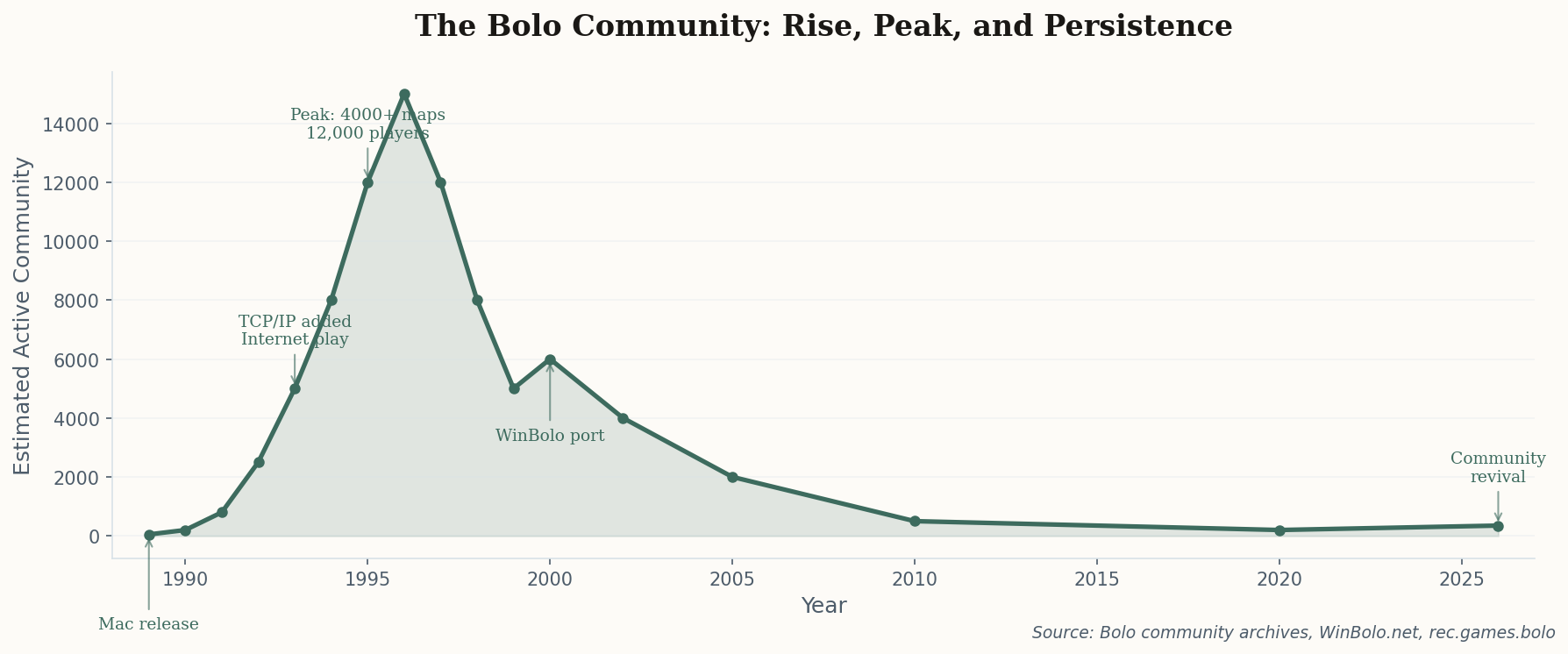
Line chart showing the Bolo community growing from its 1989 origins to a peak of thousands of active players around 1996, then declining but persisting through 2026
The Bolo community peaked in the mid-1990s with thousands of active players across university labs and the early internet. A small but dedicated community persists today.

But the most remarkable feature was Bolo Brains — an API that let players write AI programs in C or Pascal to control their tanks. This turned Bolo into something unprecedented: a competitive AI programming environment disguised as a game. "Brain vs. Brain" tournaments pitted player-authored AIs against each other, and the sophistication of these programs — some implementing rudimentary pathfinding, resource management, and even alliance negotiation — was remarkable for the early 1990s. Stuart Cheshire had accidentally created one of the first accessible platforms for game AI development.

05

From Tank Protocol to Bonjour: How Bolo Rewired Apple

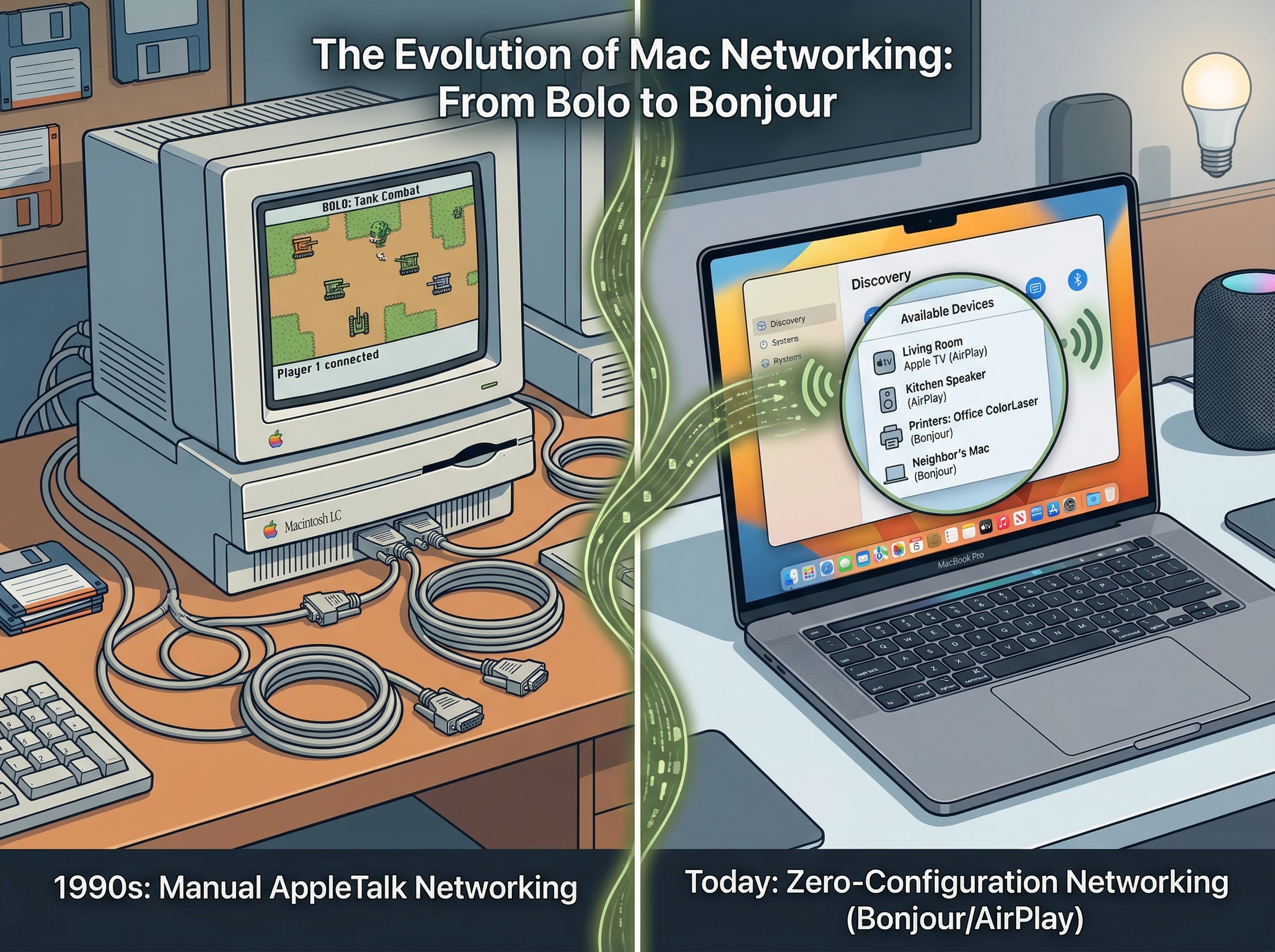
Conceptual split image: a vintage Macintosh with AppleTalk cables on the left connected by a glowing thread to a modern MacBook using AirPlay on the right

Here's the punchline that most people miss: the reason your MacBook can find a printer without you typing an IP address, the reason AirPlay just works, the reason your iPhone discovers nearby AirDrop targets instantly — all of it traces back to a tank game.

Stuart Cheshire joined Apple and created Bonjour (originally Rendezvous), the zero-configuration networking protocol built on mDNS and DNS-SD. The core insight — that devices on a network should discover each other automatically, without manual configuration — came directly from Bolo. In Bolo, you didn't type in an IP address to join a game. You launched the app, and it found every game on the network using AppleTalk's Name Binding Protocol. Cheshire spent his career generalizing that principle.

The influence radiates further. Network engineers cite Bolo as one of the first practical demonstrations of distributed shared memory in a consumer application. Its token-passing protocol influenced the networking stacks of later titles like Age of Empires. And alongside Marathon (Bungie's pre-Halo masterpiece), Bolo proved that the Macintosh — widely dismissed as a "business machine" — could handle sophisticated real-time networked gaming.

The hidden lineage: Bolo's "plug-and-play" game discovery (1989) → Cheshire's PhD research on zero-config networking (1990s) → Apple's Bonjour/mDNS protocol (2002) → AirPlay, AirDrop, printer discovery, HomeKit (today). Every Apple device ships with technology descended from a shareware tank game.

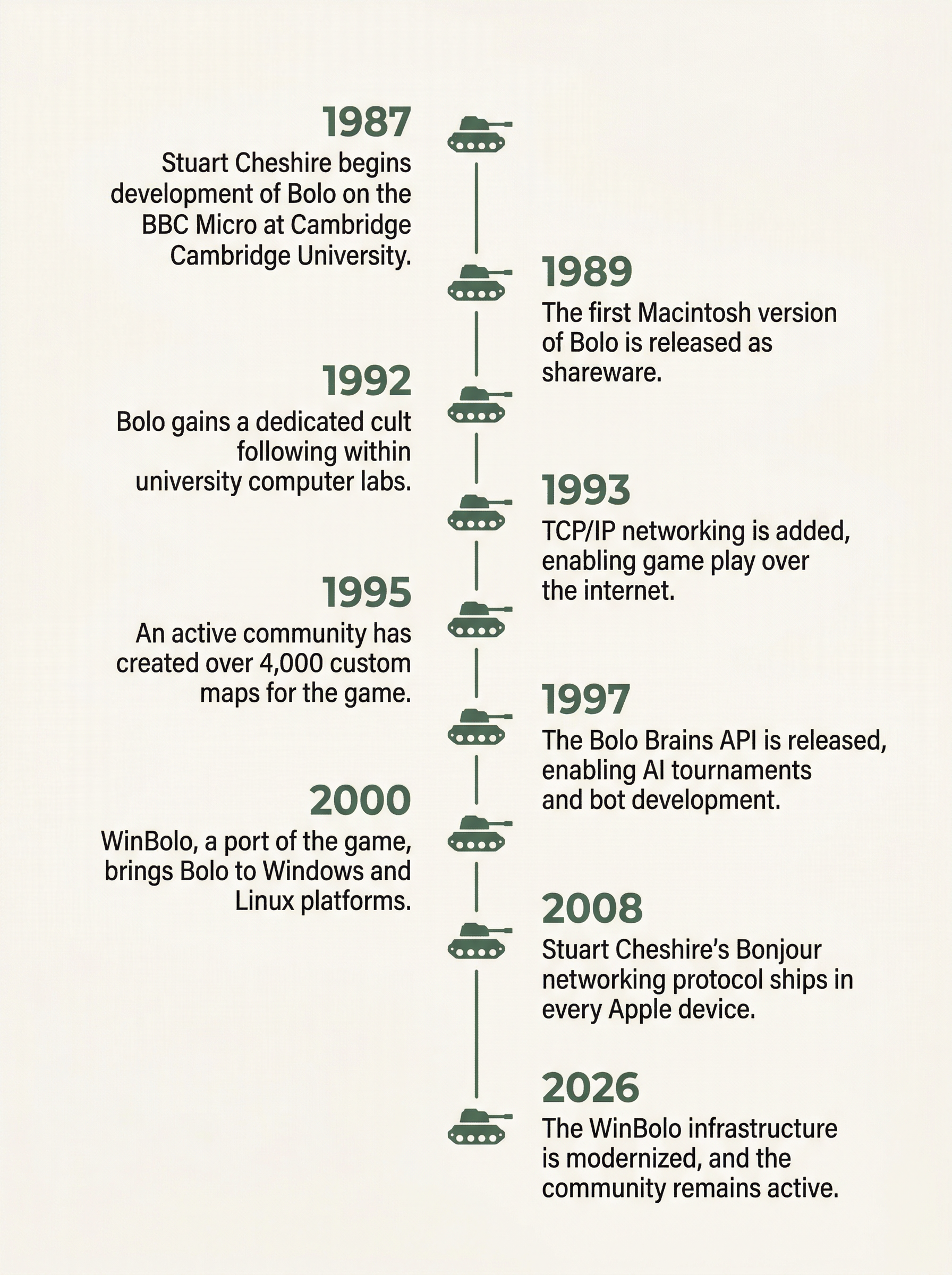
Timeline infographic showing key milestones in Bolo's history from 1987 to 2026
Infographic: The Bolo Timeline — From BBC Micro to Bonjour
06

Still Rolling: Where to Play Bolo in 2026

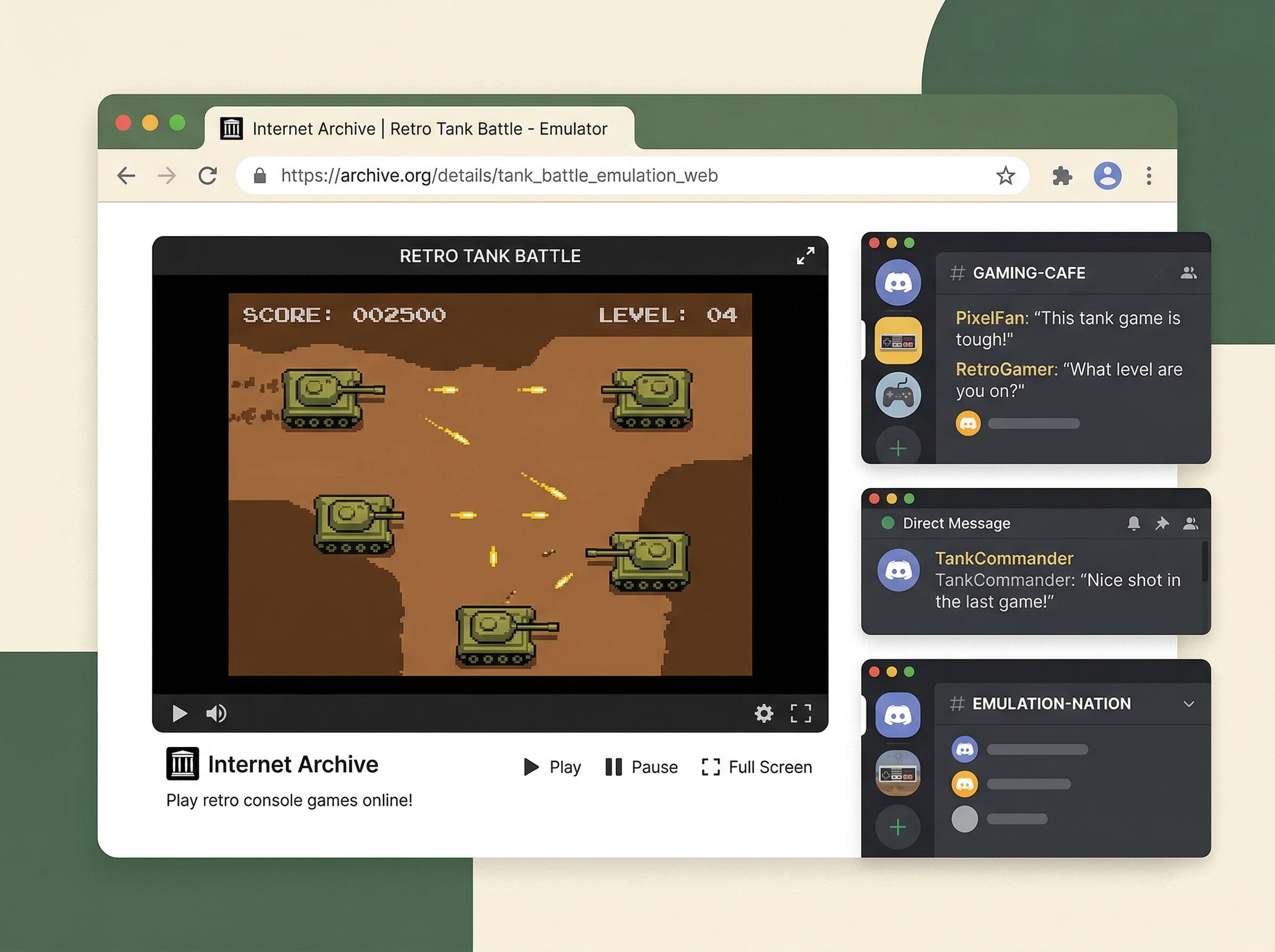
A modern browser window showing Bolo running via web emulation on the Internet Archive, with Discord chat windows alongside

Bolo refuses to die. Not in the "retro gaming nostalgia" sense where people talk about old games more than they play them. People are actually playing Bolo, right now, in 2026.

WinBolo, John Morrison's definitive port to Windows and Linux, received a major infrastructure update in February 2026 — containerized backend, Discord integration, modernized matchmaking. It's not a museum piece. It's a living platform. For modern macOS users, nuBolo keeps the native experience alive. And for the truly committed, the original 68k Macintosh version runs in-browser through the Internet Archive's PCE-MacPlus emulator — complete with authentic System 7 startup chimes and the particular warmth of 1-bit graphics.

The community holds monthly "Game Nights" via Discord, small-scale affairs that would look quaint next to a Fortnite tournament but carry the weight of thirty-seven years of continuous play. Some participants have been playing since the early 1990s. Their children have started playing too.

Meanwhile, Stuart Cheshire remains at Apple as a Distinguished Engineer, now focused on HTTP/3 and QUIC — still solving the same fundamental problems of making networked communication faster and more reliable that he first encountered when 16 tanks needed to share a 230kbps wire. Bolo is frequently used in university CS courses to teach networking fundamentals, which means the game has come full circle: born in a university lab, still teaching in university labs, nearly four decades later.

The Wire Remembers

Most games from 1987 are footnotes. Bolo is infrastructure. Every time a device discovers another device on your network without you lifting a finger, a tiny ghost of a Macintosh tank game flickers across the wire. Stuart Cheshire didn't just build a great game — he built a philosophy of networking that assumed machines should find each other as naturally as people do. The name, after all, means "speak." And the conversation hasn't stopped.

Share X LinkedIn