Corporate History

The White Star: 120 Years of Montblanc

How a leaky pen from Hamburg became the world's most powerful signature — from a bombed-out factory to a €2.8 billion luxury empire.

Listen
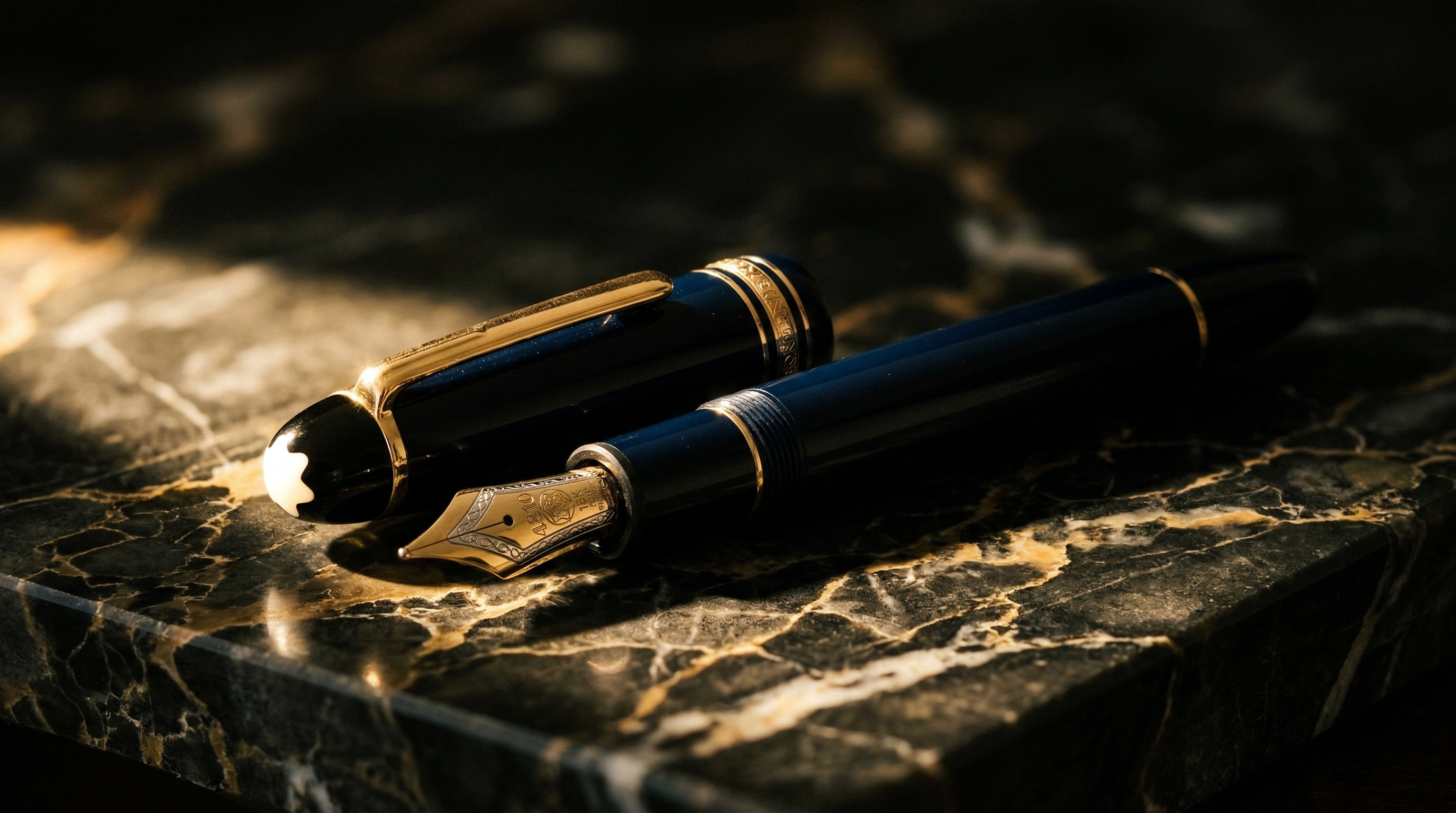
A Montblanc fountain pen resting on dark marble, the white star cap emblem catching golden light
A warm atmospheric scene of a 1906 Hamburg workshop with early fountain pen prototypes
1906–1924 01

Three Men, One Leaky Pen, and the Audacity to Call It a Mountain

Every empire starts with a problem nobody else cares enough to solve. In 1906, that problem was ink on your shirt. Montblanc's origin story isn't glamorous — it's three men in Hamburg who were sick of fountain pens that leaked like punctured balloons. August Eberstein (an engineer), Alfred Nehemias (a banker), and Claus-Johannes Voss (a stationery merchant) pooled their frustrations and formed the Simplo Filler Pen Co. in 1908.

The name "Montblanc" arrived in 1909, supposedly coined during a card game when someone compared their pen — the pinnacle of writing instruments — to the highest peak in the Alps. Apocryphal or not, the metaphor stuck. By 1910 the name was trademarked. By 1913, the six-pointed white star had appeared on the cap, representing Mont Blanc's snow-capped peak and its six glaciers. It would become one of the most recognized symbols in luxury, right alongside the Cartier panther and the Hermès horse.

Then came the move that turned a pen company into a legacy: the Meisterstück in 1924. German for "Masterpiece," it featured a sophisticated piston-filling system and came with a lifetime guarantee — a radical promise in an era when pens were consumable goods. By the late 1920s, the number 4810 was engraved on every nib: the height of Mont Blanc in meters. It wasn't just a pen. It was a declaration.

The 4810 detail matters. Most luxury brands engrave logos. Montblanc engraved an altitude — an aspiration baked permanently into the metal. Every time someone signs a document with a Meisterstück, they're writing at the summit.
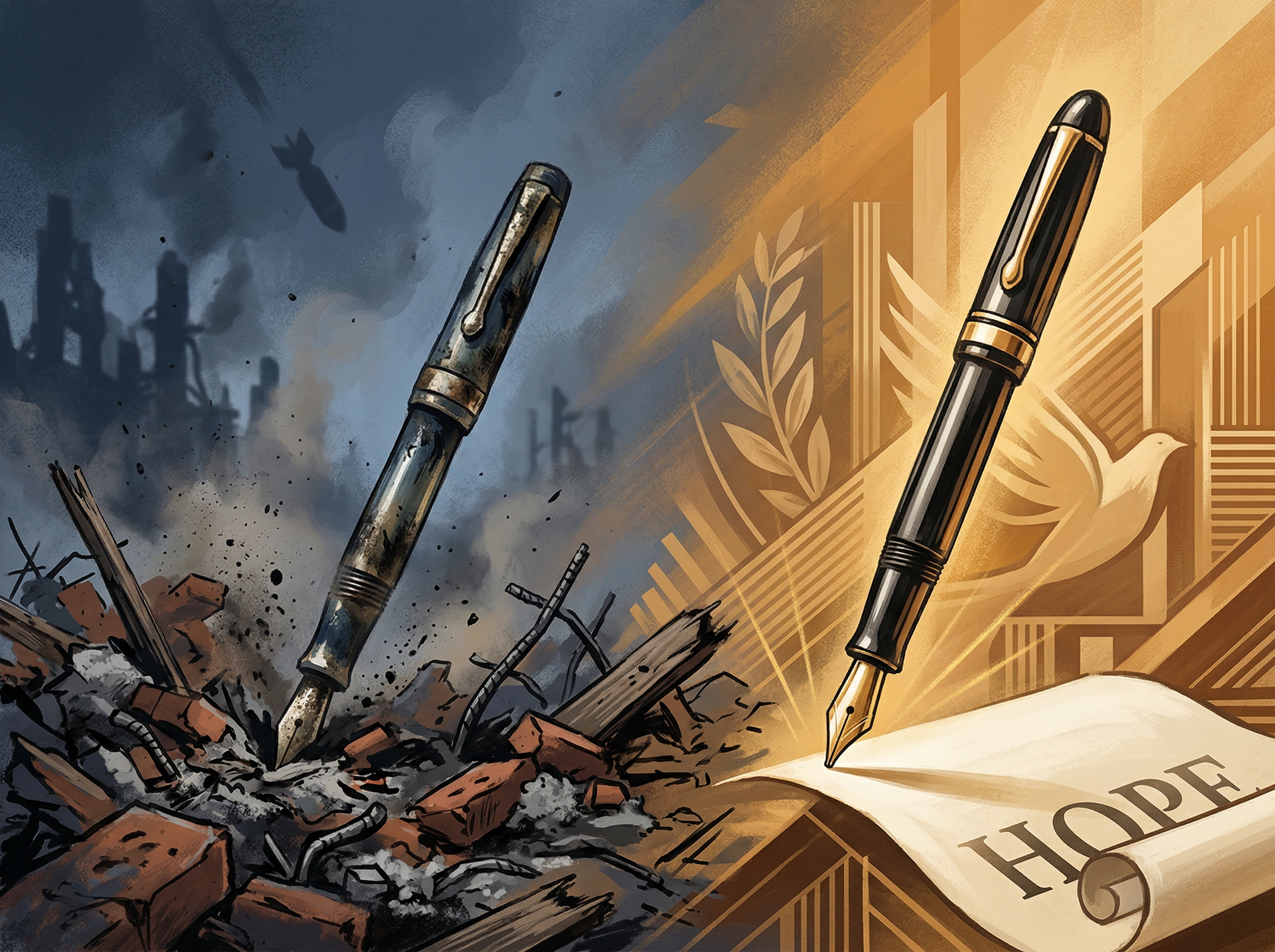
A fountain pen emerging from wartime rubble, symbolizing resilience
1930s–1952 02

The Masterpiece That Survived Bombs

The 1930s were Montblanc's golden decade. The 13x series — including the massive 139 — introduced a telescopic piston mechanism that nearly doubled ink capacity. These weren't writing instruments; they were engineering achievements that happened to produce beautiful handwriting. The flat-top design became the pen that closed deals across Europe.

Then the war came for everything. The Nazi government banned gold for civilian use, forcing Montblanc to produce "War Nibs" made of steel or palladium, marked with a "P" like a brand of shame. In 1944, the Allied bombing of Hamburg didn't just damage the factory — it destroyed it. Decades of archives, prototypes, machinery: gone in a single night. The company that had built its identity around permanence watched its physical history turn to ash.

What happened next is the part they don't teach in business school. Montblanc shifted production to Denmark, focused on exports to earn hard currency, and began rebuilding from memory. By 1952, they had not only recovered — they'd created the pen that would define the next seven decades: the Meisterstück 149, the "Diplomat." Its oversized cigar-shaped barrel, 18K gold nib, and unmistakable heft became the default instrument for heads of state and C-suite executives worldwide.

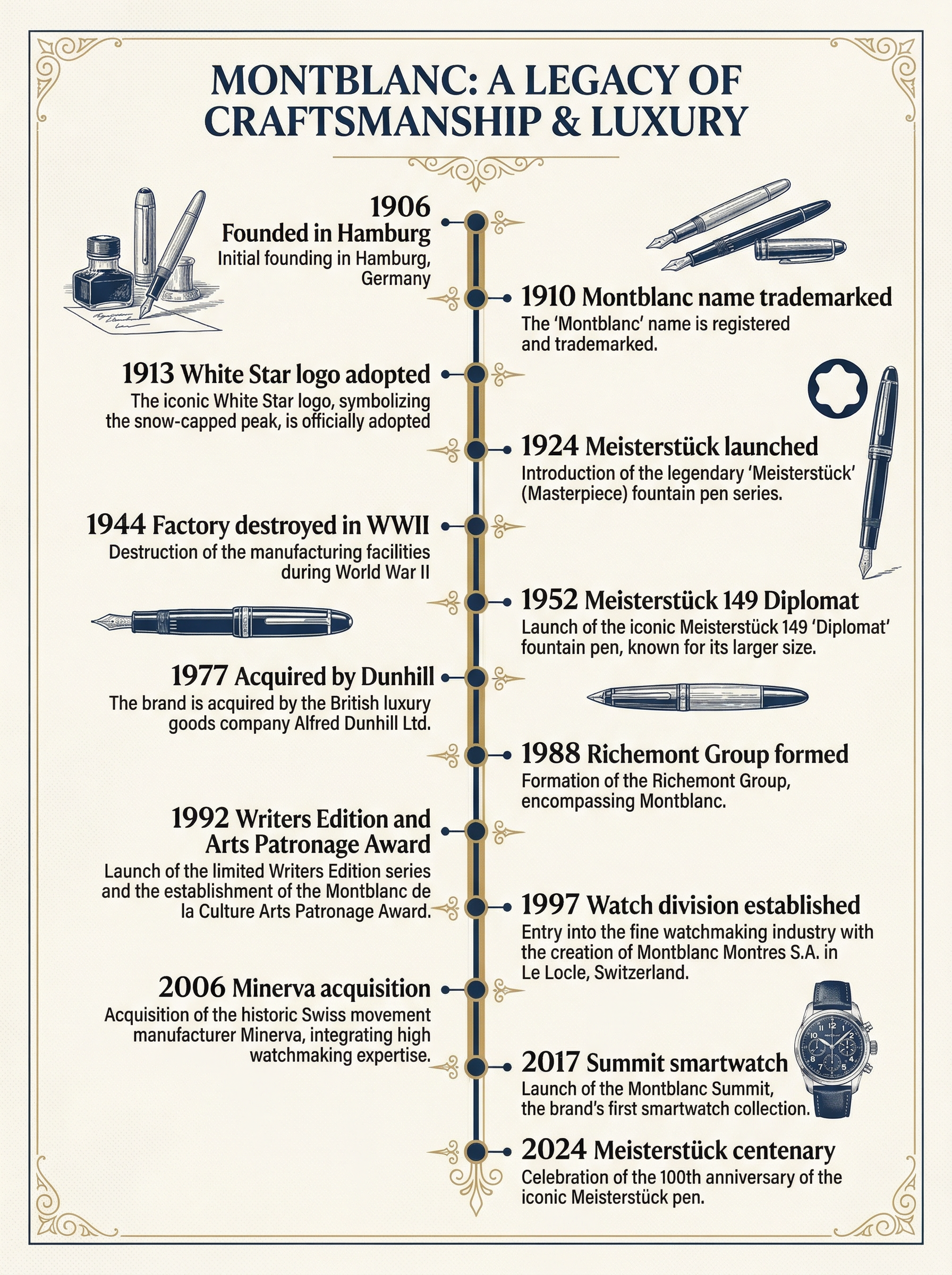
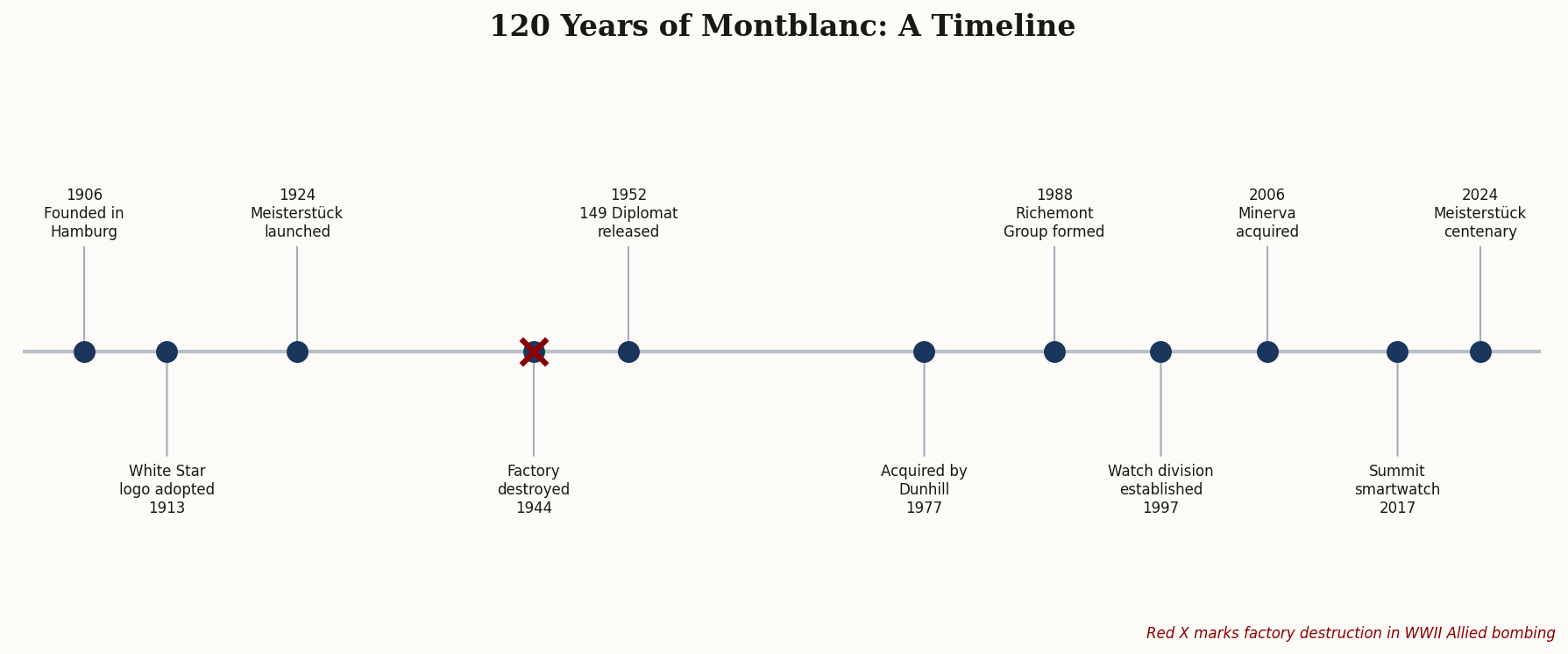
Timeline showing 120 years of Montblanc milestones from 1906 founding through 2024 Meisterstück centenary
Key milestones in Montblanc's 120-year journey — the red X marks the 1944 Hamburg factory destruction
Extreme macro of a Montblanc Meisterstück 149 gold nib with 4810 engraving
The Icon 03

The 4,810-Meter Nib: Why One Pen Rules Them All

Let's be direct: the Meisterstück 149 is not the best-writing fountain pen in the world. Enthusiasts will point you to Pelikan, Sailor, or Nakaya for pure nib feel. What the 149 is — and has been since 1952 — is the most recognized luxury pen on Earth. The pen doesn't just write. It signals.

Every 149 nib is hand-ground from 18-karat gold. The barrel is made from "Precious Resin" — Montblanc's proprietary name for a high-grade polycarbonate that critics love to dismiss as "luxury plastic." But the material is genuinely exceptional: its deep black luster, resistance to temperature changes, and satisfying weight distribution are the result of decades of polymer engineering. The white star sits on the cap like a crown. Pull off the cap, and the gold 4810 nib catches light like a tiny monument.

In 1963, John F. Kennedy lent his personal 149 to German Chancellor Konrad Adenauer to sign a guestbook — a moment that crystallized the pen's role as an instrument of diplomatic power. The Writers Edition series, inaugurated with the Ernest Hemingway release in 1992, became the most collected limited-edition pens in history, turning literary heroes into objects you could hold.

The materials debate: Fountain pen purists criticize the Meisterstück's resin as overpriced. They're missing the point. Montblanc never sold a writing experience — they sold the idea of one. The 149 is a semiotic object: it means "I have arrived" in every boardroom on the planet. That's worth more than any ink flow rating.

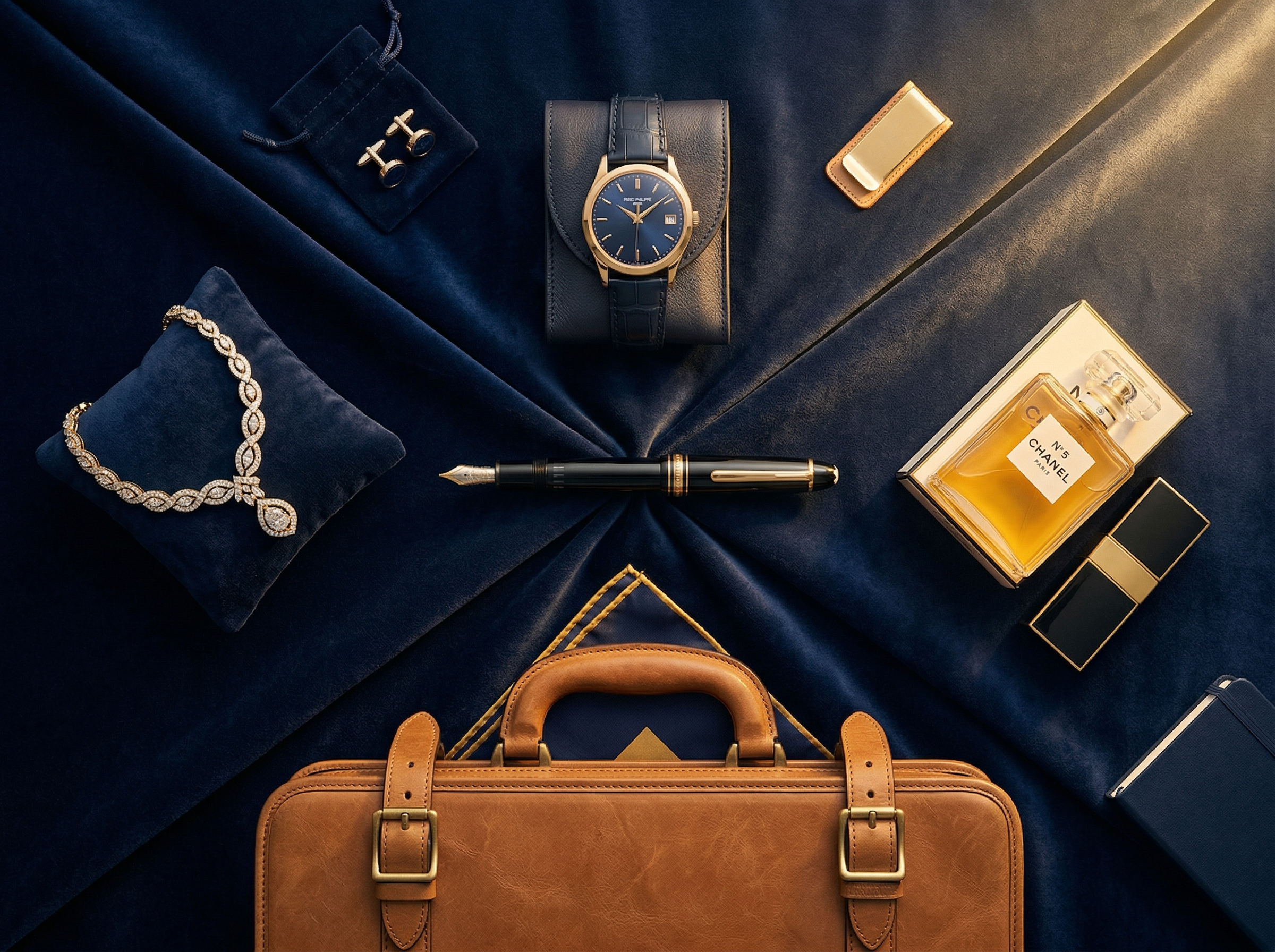
Elegant flat-lay of luxury goods radiating from a central fountain pen
1970s–1990s 04

When Pens Stopped Being Enough

By the 1970s, Montblanc faced an existential question that every single-product luxury brand eventually confronts: what happens when the world moves on? The ballpoint pen had done to fountain pens what the quartz watch did to Swiss horology — made them functionally obsolete for most people. Montblanc could have slowly faded into a collector's niche. Instead, it chose empire.

The pivot began in 1977 when Alfred Dunhill Ltd. acquired a 59.6% stake for DM 6.4 million — a steal that would look even more absurd with every passing decade. Under CEO Norbert Platt (1987–2004), Montblanc made the counterintuitive decision to abandon all lower-priced, mass-market pens. No more mid-range. No more accessibility. Every product would be premium, or it wouldn't exist.

Then came the diversification blitz: leather goods starting in 1992 (with the Pelletteria established in Florence by 1995), jewelry in 1996, and watches in 1997 with the founding of Montblanc Montre S.A. in Le Locle, Switzerland. The 2006 acquisition of Minerva — a legendary Swiss manufacture founded in 1858 — gave Montblanc genuine horological credibility rather than the licensed-movement shortcuts most fashion brands take.

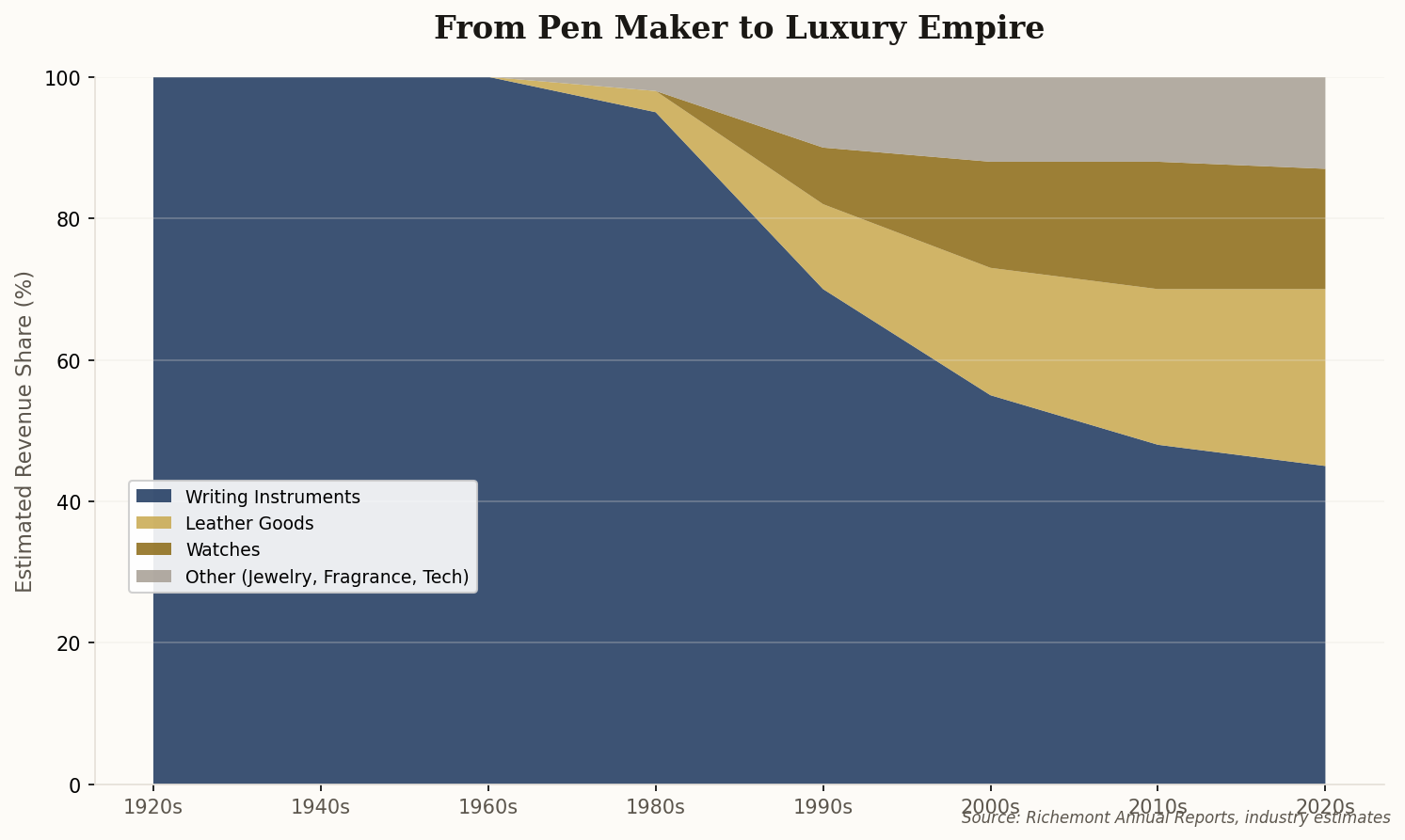
Stacked area chart showing Montblanc's evolution from 100% pens to a diversified luxury portfolio
From pen maker to luxury empire: estimated revenue share by category (1920s–2020s). Writing instruments now account for roughly 45% of sales.

The genius of Platt's strategy was that every new category carried the Meisterstück DNA. A Montblanc briefcase wasn't just leather — it was leather with a white star clasp and the same implicit promise: this object is the pinnacle of its category. Whether that promise was always deserved is debatable. That it was believed is not.

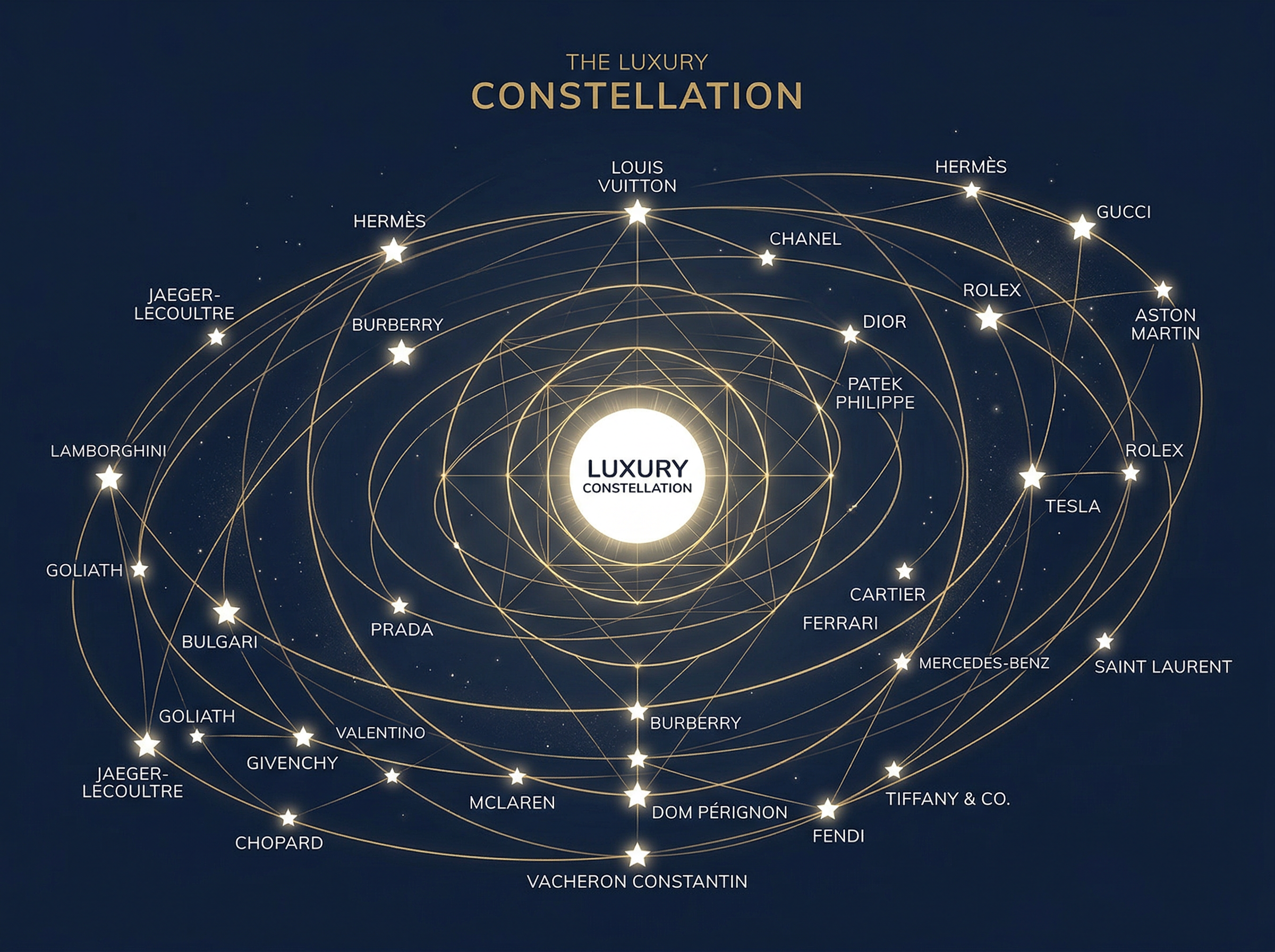
Abstract corporate constellation of luxury brands orbiting a central point
1988–Present 05

The Richemont Empire Play

In 1988, South African billionaire Johann Rupert formed the Richemont Group, and Montblanc was folded into a portfolio that reads like the Avengers of luxury: Cartier, IWC, Vacheron Constantin, Jaeger-LeCoultre. Being part of Richemont gave Montblanc access to global distribution infrastructure, shared manufacturing excellence, and the kind of marketing budget that turns a German pen company into a worldwide luxury signifier.

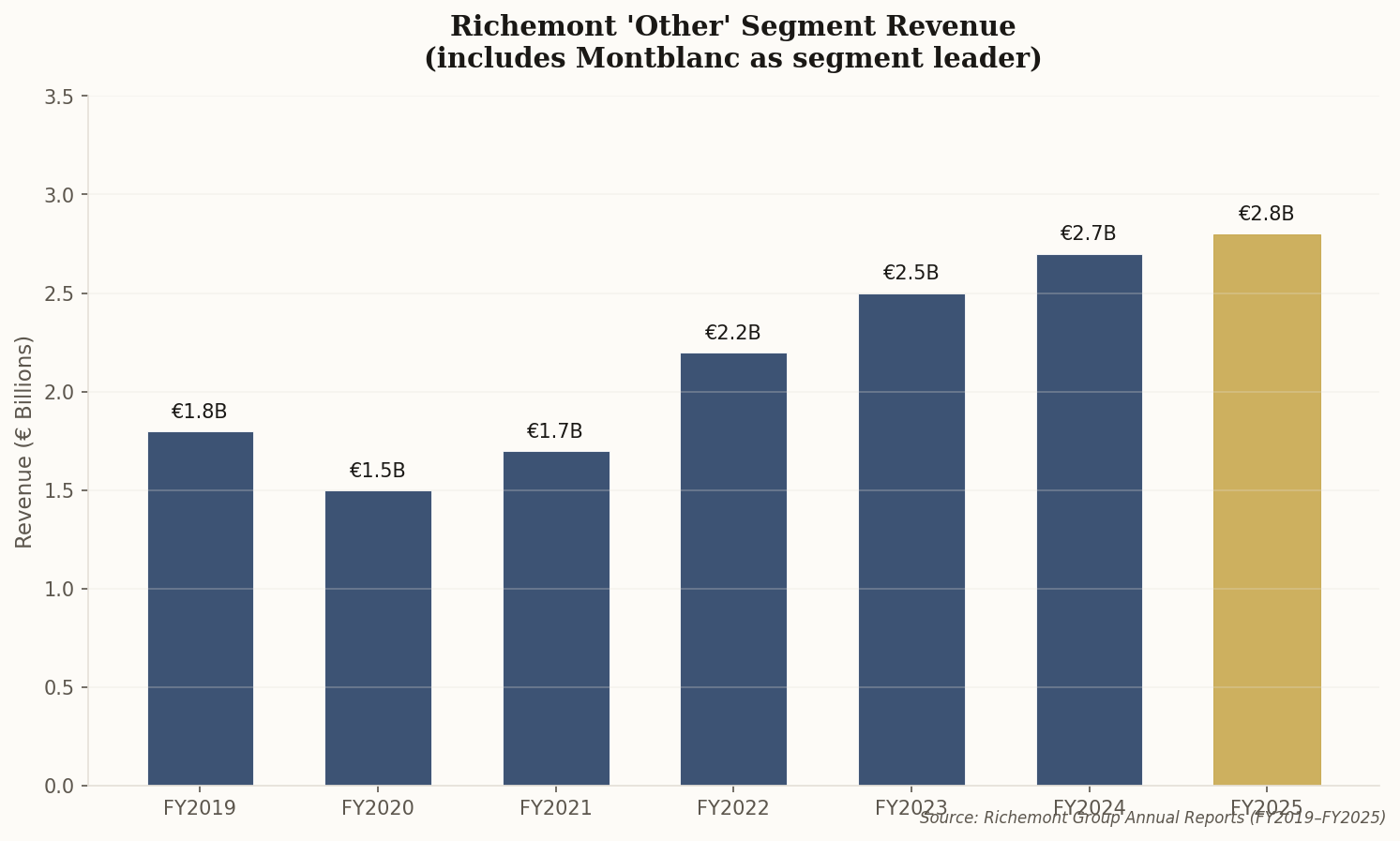
Richemont doesn't disclose standalone revenue for Montblanc, but the brand leads the group's "Other" segment (which also includes fashion and accessories), and that segment hit €2.8 billion in FY2025. Industry analysts estimate Montblanc contributes approximately 40-50% of that figure — putting the brand's annual revenue somewhere in the €1.1–1.4 billion range. Not bad for a company that started by fixing leaky pens.

Bar chart showing Richemont Other segment revenue growing from €1.8B in FY2019 to €2.8B in FY2025
Richemont's "Other" segment revenue (FY2019–FY2025), where Montblanc is the category leader. Gold bar highlights the latest fiscal year.

The Richemont model is instructive for anyone studying luxury conglomerates. Unlike LVMH, which runs a centralized machine, Richemont gives its maisons significant autonomy. Montblanc's Hamburg roots, its German engineering identity, its particular brand of "intellectual luxury" — none of that was diluted by corporate integration. If anything, Richemont amplified it by removing the operational constraints that come with being independent.

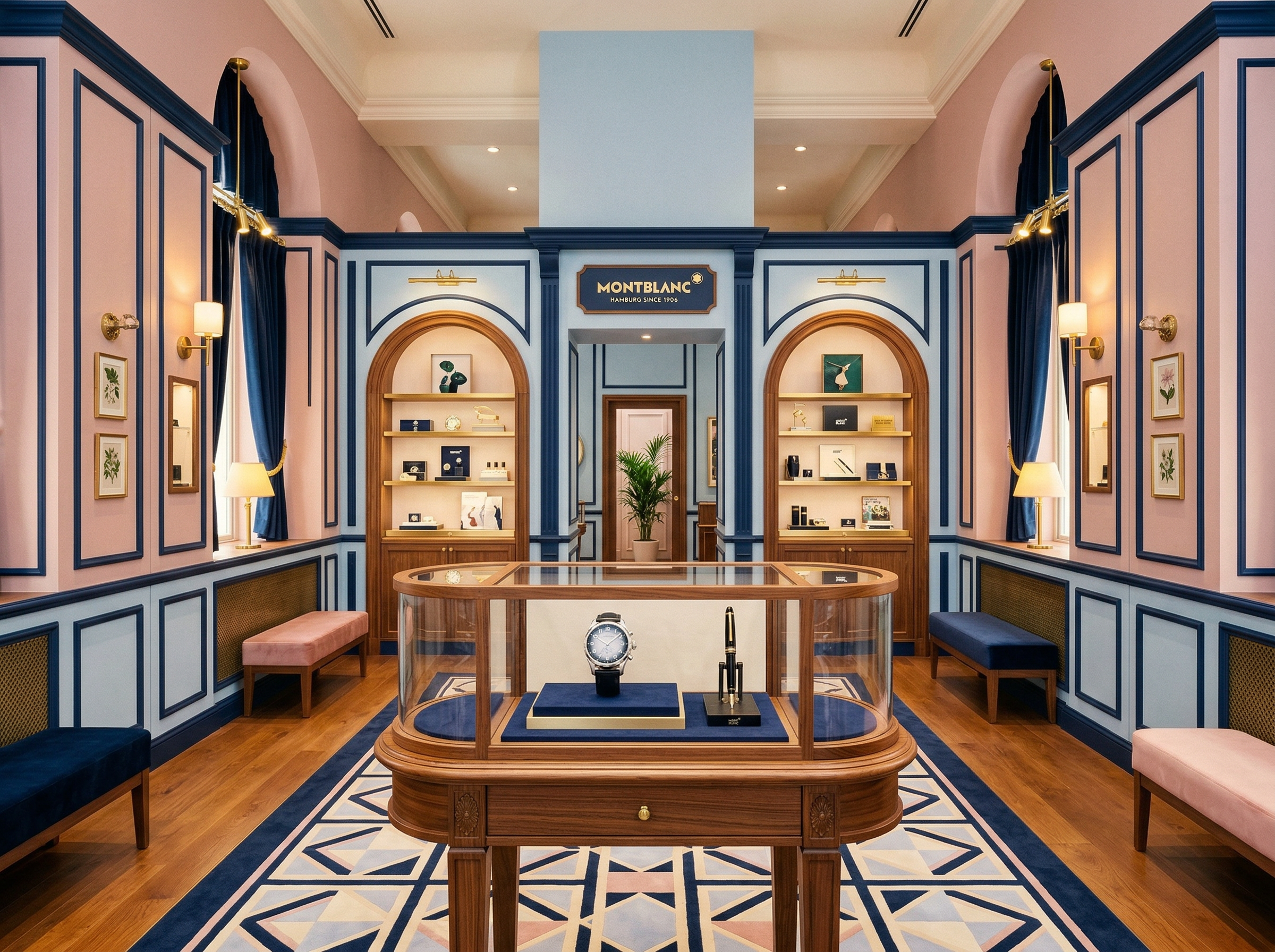
A Wes Anderson-inspired symmetrical Montblanc boutique with smartwatch and classic pen
2017–Present 06

Wes Anderson Meets the White Star

Here's the tension at the heart of modern Montblanc: how does a brand built on the permanence of handwriting survive in a world where most signatures are DocuSign clicks? Under CEO Nicolas Baretzki (2017–2023), Montblanc's answer was to embrace the contradiction head-on.

In 2017, the brand launched the Summit — its first luxury smartwatch. It also introduced "Augmented Paper," which digitized handwritten notes in real time, essentially arguing that analog and digital weren't opposites but complements. The message: we still believe in the hand, but we'll wire it to the cloud if that's what you need.

The real masterstroke was the Meisterstück centenary in 2024. To celebrate 100 years of its defining product, Montblanc collaborated with filmmaker Wes Anderson on a cinematic campaign — a perfect pairing of obsessive craftsmanship and meticulous visual style. The "Origin Collection" featured nib designs inspired by early archival prototypes, literally reconnecting the brand to the workbench where it all started. In November 2024, Giorgio Sarné was appointed CEO, tasked with steering Montblanc into its next century.

Timeline infographic showing Montblanc milestones from 1906 to 2024
Infographic: 120 Years of the White Star — Key milestones in Montblanc's journey from Hamburg workshop to global luxury powerhouse

The Montblanc de la Culture Arts Patronage Award, running since 1992, reinforces the brand's positioning as more than a luxury goods company — it's a patron of civilization itself. Whether you find that pretentious or admirable probably says more about you than about the brand. But here's what's undeniable: in a world drowning in disposable everything, Montblanc has spent 120 years betting that permanence is the ultimate luxury. The market — to the tune of billions — agrees.

The Summit, Not the Slope

Montblanc's story isn't about pens. It's about what happens when you decide that the thing you make should be the best version of itself — and then refuse to stop there. Three men in Hamburg fixed a leaky pen. A century later, their white star sits on everything from smartwatches to leather goods to the wrists of world leaders. The mountain hasn't moved. But the company named after it hasn't stopped climbing.

Share X LinkedIn