Library Science

Decimal Point of No Return

How a 21-year-old's 44-page pamphlet became the operating system for 200,000 libraries — and the reckoning that followed.

Listen
A grand Victorian-era library with towering mahogany bookshelves bathed in golden light
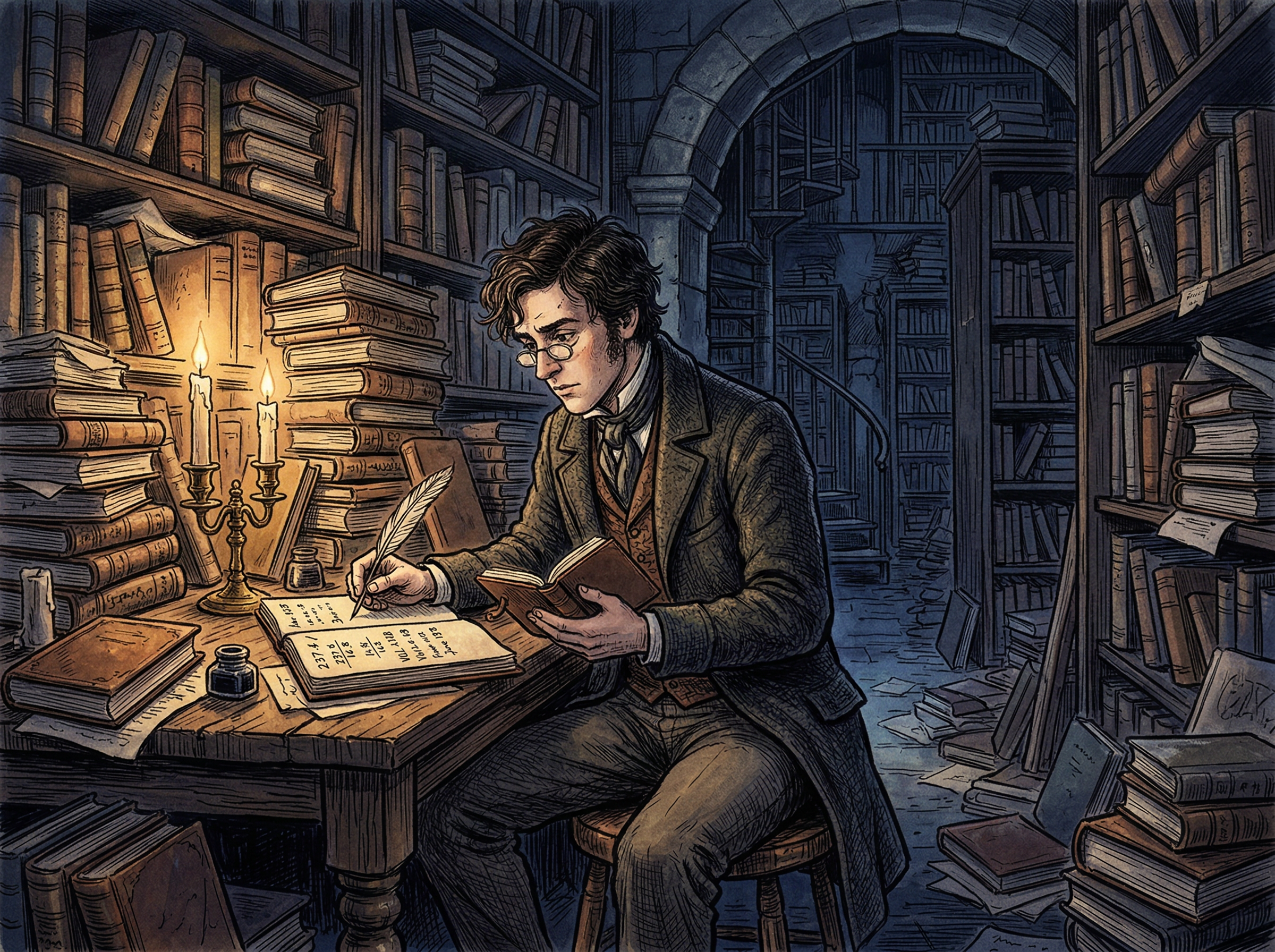
A young Victorian scholar in a candlelit library surrounded by unsorted books
01

The 21-Year-Old Who Organized Human Knowledge

Imagine walking into a library where books are shelved by height. Not by topic, not by author — by how tall they are. If the shelf fills up, your new book on astronomy gets tucked between a cookbook and a dictionary three rooms away. This was the state of library science in America before 1876, and it drove a 21-year-old Amherst College student named Melvil Dewey to what might be the most consequential act of organizational fury in history.

Dewey's insight was deceptively simple: classify books by what they're about, not where they physically sit. His "relative" system assigned decimal numbers to subjects, meaning a library could grow indefinitely without the classification breaking. In 1876, he published his scheme as a 44-page pamphlet — anonymously — titled A Classification and Subject Index for Cataloguing and Arranging the Books and Pamphlets of a Library. The same year, he co-founded the American Library Association and launched the Library Journal. Historians call 1876 the "annus mirabilis" of library science. One guy basically invented a profession in twelve months.

The real genius wasn't the ten classes (we'll get to those). It was the Relative Index — an alphabetical lookup that cross-referenced topics across classification boundaries. Looking for "clothing"? The index told you it could live under customs (300s) or manufacturing (600s), depending on your angle. It was, in essence, a search engine built from paper. Dewey understood that knowledge doesn't fit in boxes — it fits in webs.

"Reading is a mighty engine, beside which steam and electricity sink into insignificance." — Melvil Dewey
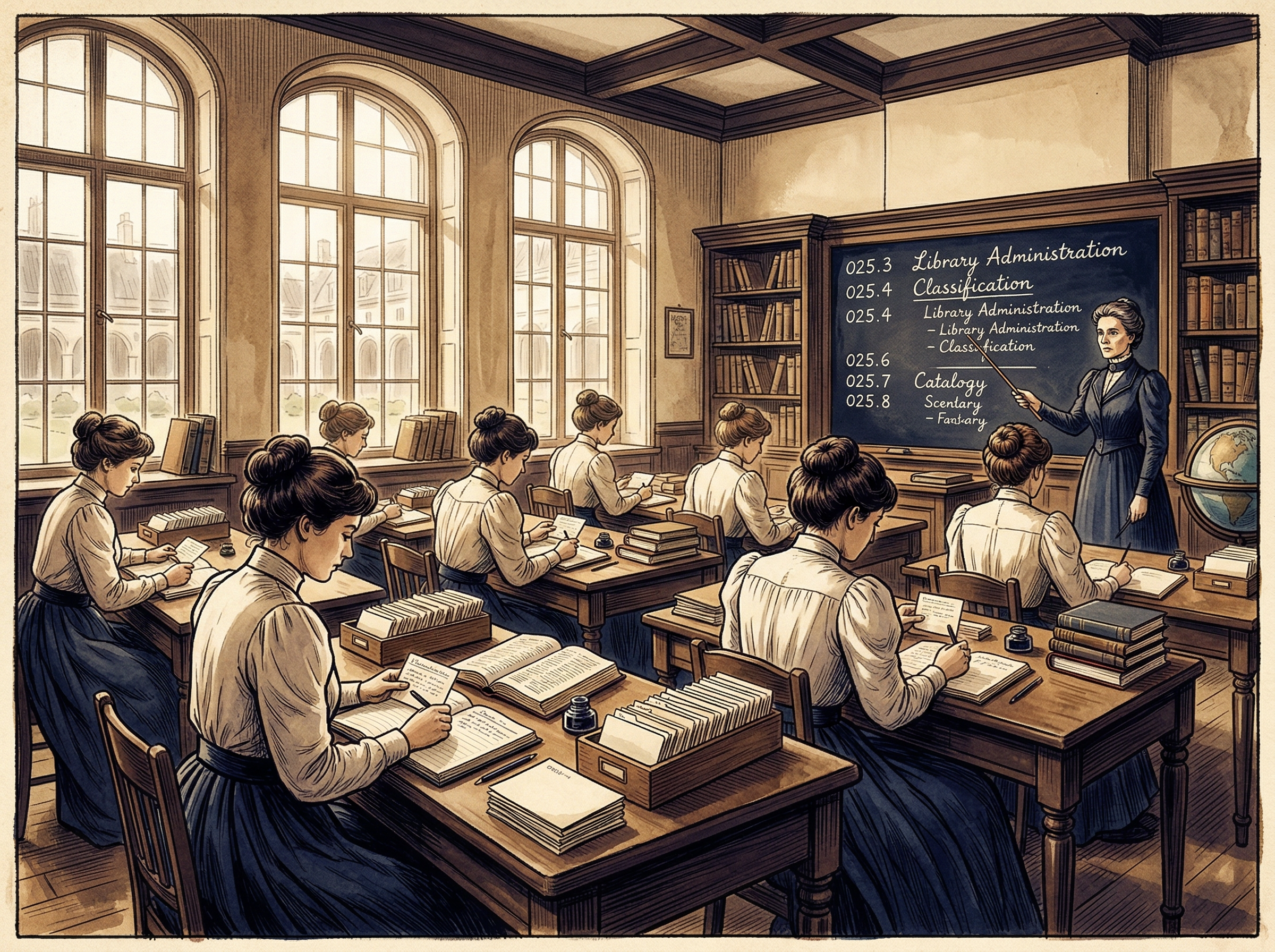
Victorian-era women learning cataloging in a 1890s library school classroom
02

From Columbia to the Country: When Libraries Went Professional

Dewey didn't just invent a system — he built the infrastructure to spread it. Appointed Chief Librarian at Columbia College in 1883, he opened the world's first formal library school on January 1, 1887: the School of Library Economy. In a move that infuriated the all-male board of trustees, he admitted women, arguing they were "better suited for the meticulous work of cataloging." It was both progressive and patronizing — a duality that would define Dewey's legacy.

After a falling-out with Columbia, Dewey relocated to Albany as Director of the New York State Library. There he launched America's first "traveling libraries" in 1892 — rotating collections shipped by mail to rural communities that had never seen a professional book collection. The Dewey Decimal System traveled with them, carried not just by the books but by the library school graduates Dewey had trained to deploy it.

The system's secret weapon for international growth was almost absurdly simple: Arabic numerals. While words need translation, numbers don't. A book classified as 523.1 (stars and their properties) reads the same in Tokyo, Buenos Aires, and Stockholm. By 1900, the DDC had jumped continents, becoming something close to a universal language for organized information — decades before the internet made that aspiration commonplace.

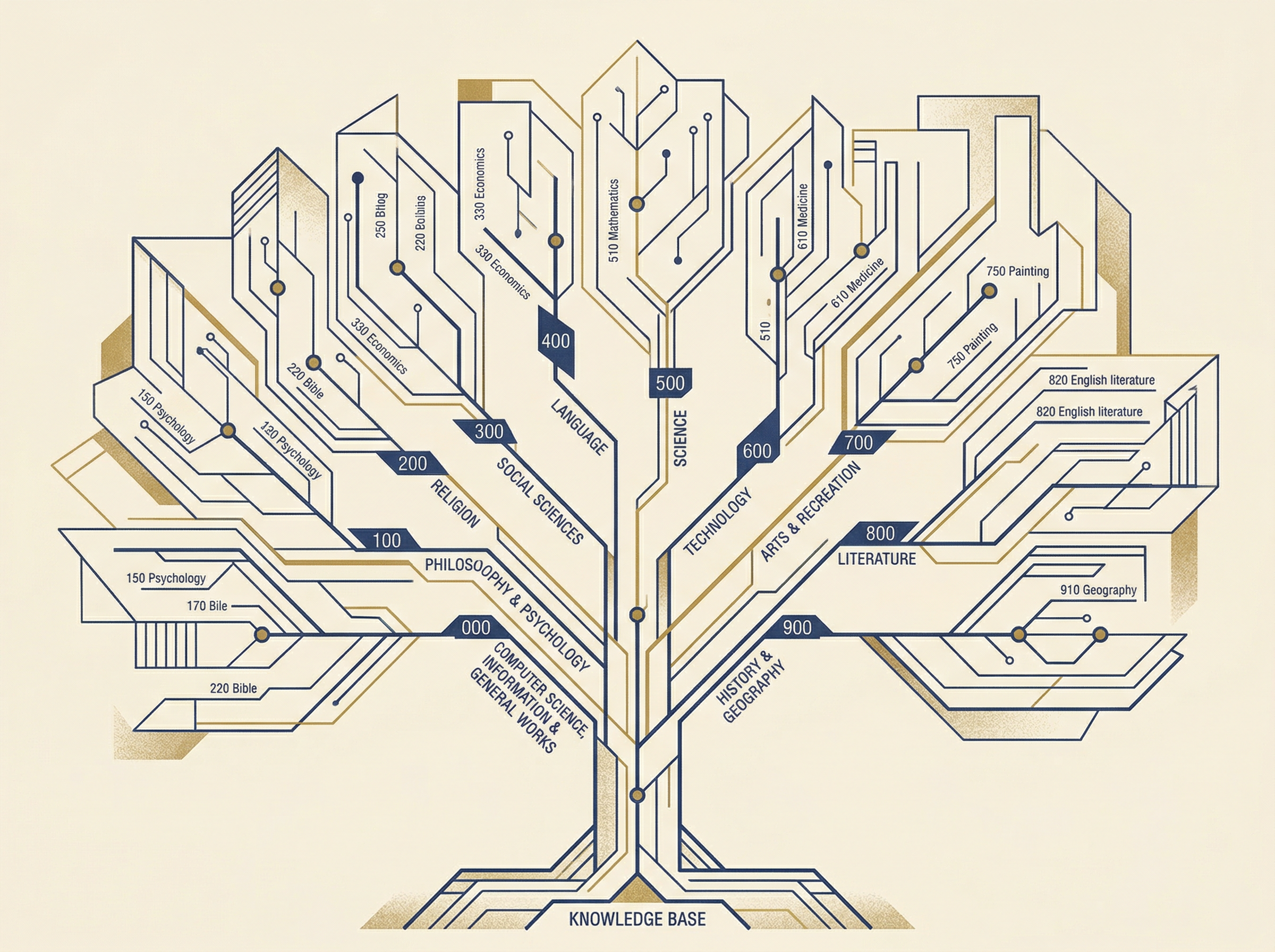
Abstract architectural visualization of the Dewey Decimal System tree structure
03

The Machine Behind the Magic: How 000–999 Maps Everything

The DDC is elegant because it's recursive. Ten main classes. Each class has ten divisions. Each division has ten sections. After the first three digits, a decimal point opens up infinite further subdivision. You never run out of room. Want to classify a book about the geology of Mars? Start at 500 (Science), narrow to 550 (Earth sciences & geology), then extend past the decimal to reach planetary geology. The system breathes.

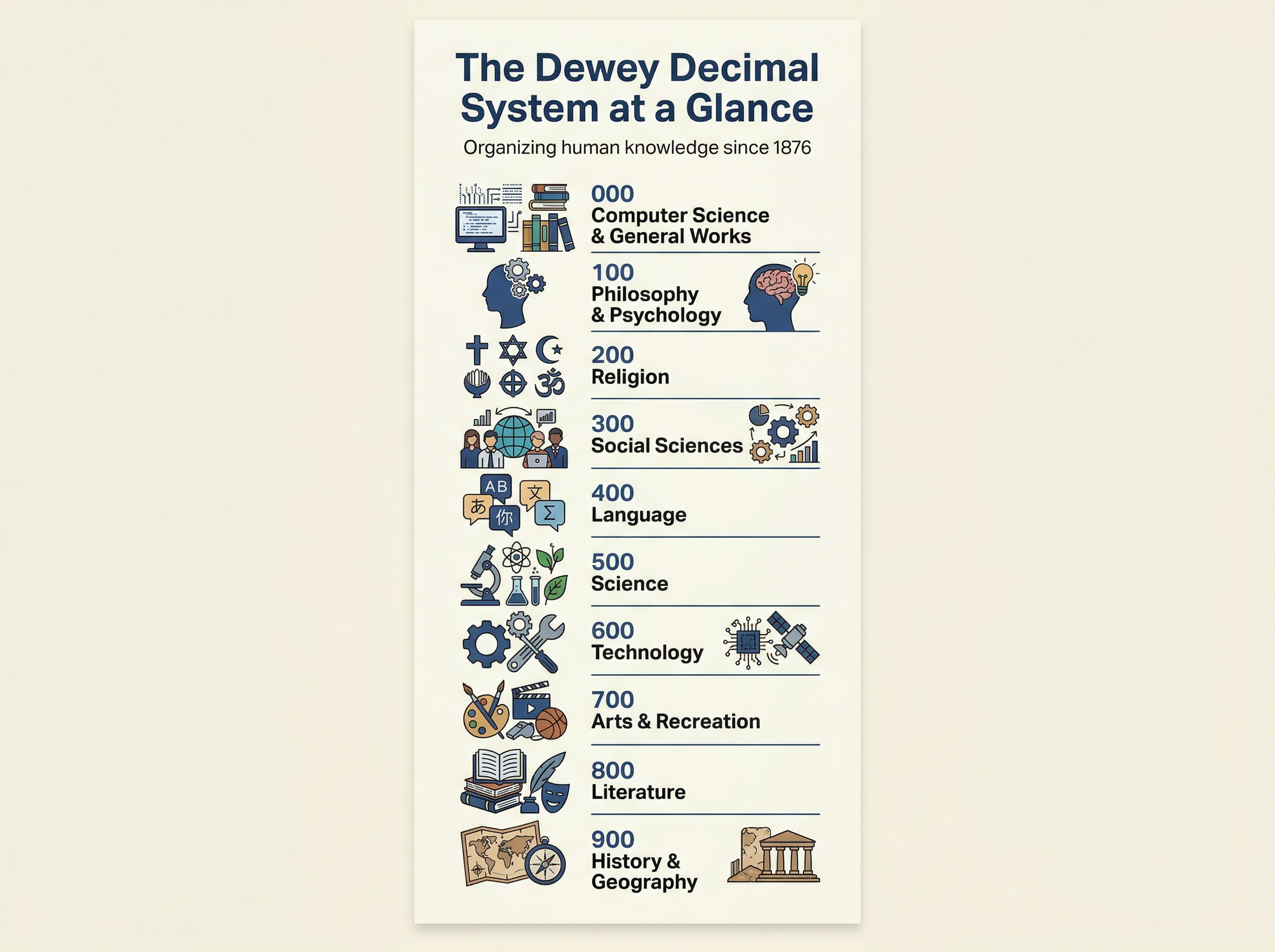
Infographic showing the 10 main Dewey Decimal classes from 000 to 900 with descriptions and icons
The Dewey Decimal System at a Glance: Ten classes, infinite depth — Generated with Nano Banana 2.0

The ten classes themselves reveal the intellectual priorities of 1876 America. 000 (General works) is the catch-all — now home to computer science, which didn't exist when Dewey was alive. 200 (Religion) is overwhelmingly Christian. 400 (Language) treats English as the default. These aren't neutral categories — they're a snapshot of who got to decide what "knowledge" meant in the late 19th century. But the mechanism — the decimal notation, the hierarchical discipline-first approach, the Relative Index — was genuinely revolutionary. It separated the structure from the content, which meant the content could evolve even if the structure stayed.

Here's the part that surprises people: the DDC classifies by discipline, not subject. A book about water might be classified under chemistry (540s), engineering (620s), or geography (910s) depending on the angle. This is a feature, not a bug. It means the system respects that knowledge about the same thing can serve fundamentally different purposes.

Split composition showing a vintage card catalog transforming into a modern database terminal
04

When Dewey Met OCLC: 150 Years of Editions, Controversies, and Code

A classification system is only as good as its governance. Dewey established Forest Press in 1911 to manage publishing, and the 7th Edition carried its first Forest Press imprint that year. But the real institutional watershed came in 1930, when the Library of Congress began printing Dewey numbers directly on its catalog cards. Overnight, thousands of libraries could adopt standardized classifications without re-cataloging a single book. It was the library equivalent of USB-C: one connector, universal compatibility.

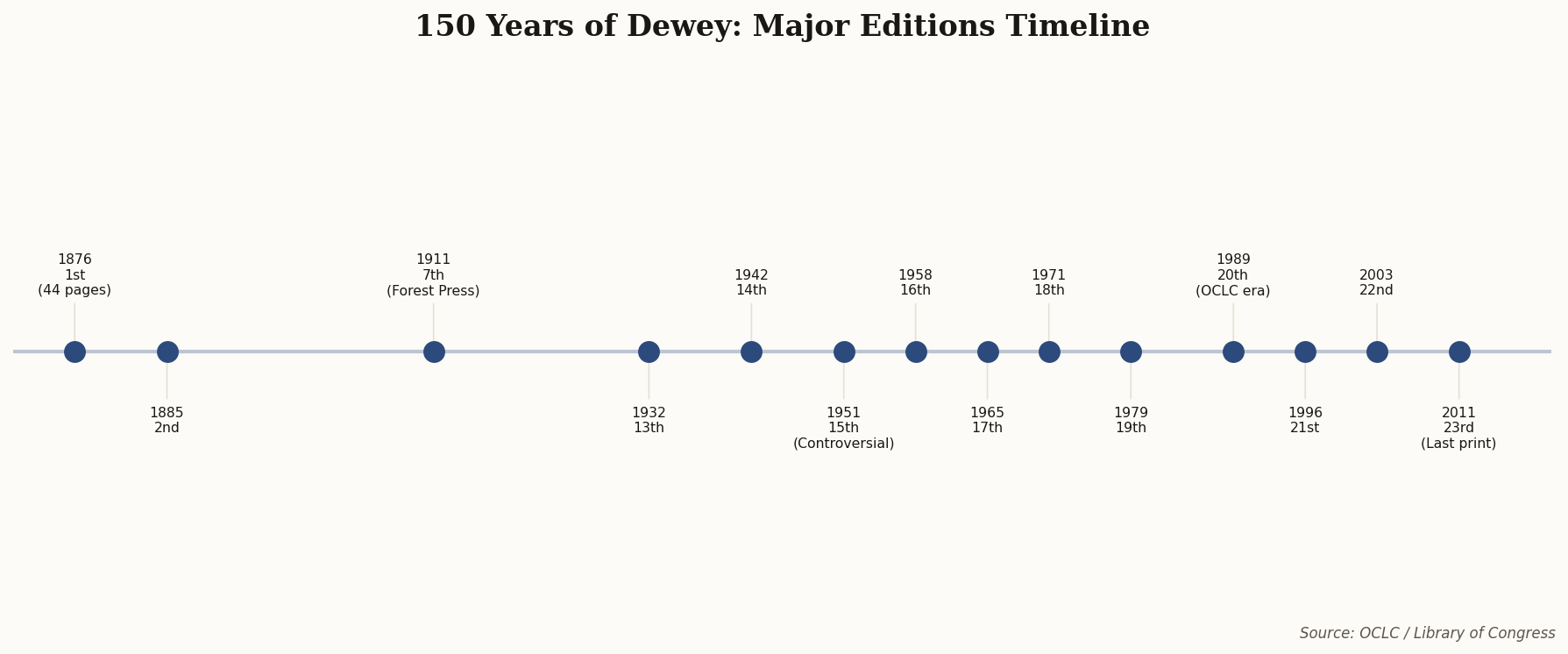
Timeline chart showing 23 major DDC editions from 1876 to 2011
150 years, 23 editions: The DDC has been continuously updated since Dewey's original 44-page pamphlet. Source: OCLC / Library of Congress

Then came the Edition 15 disaster of 1951. Dubbed the "Standard Edition," it tried to simplify the system so aggressively that librarians revolted. The backlash spawned the Editorial Policy Committee in 1953 — the collaborative governance body that still guides DDC updates today. It was an early lesson in what happens when you break backward compatibility without consulting your users.

In 1988, the Online Computer Library Center (OCLC) acquired Forest Press, bringing the DDC under the stewardship of a global nonprofit. OCLC launched WebDewey in 2000, enabling daily digital updates instead of decade-long print cycles. The 23rd Edition (2011) was the last generated primarily for print — and the first built from a database. The Dewey Decimal System had, somewhat ironically, been digitized by the very technology it helped organize.

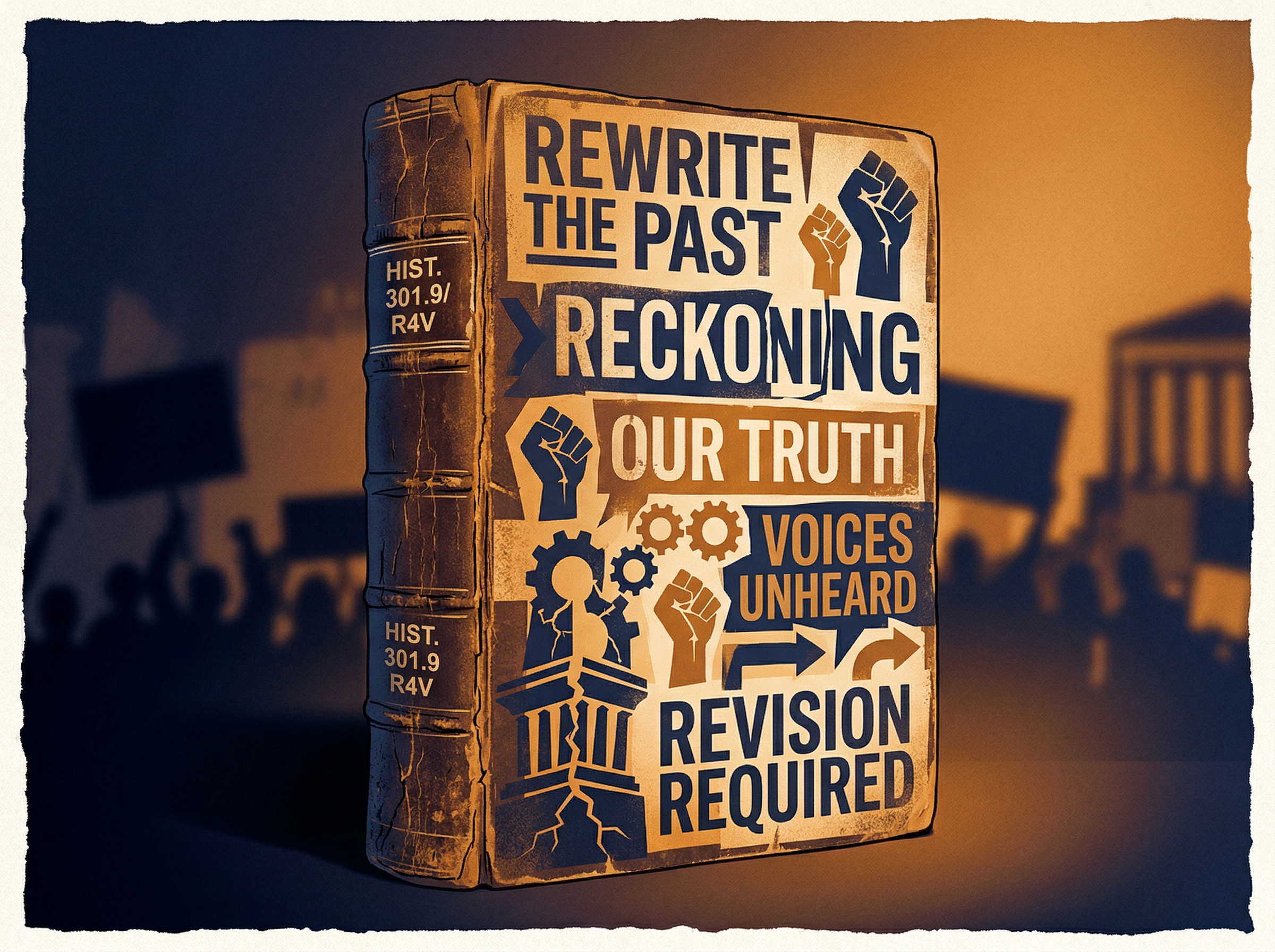
A cracked old classification book with reform symbols overlaid
05

A 19th-Century Lens on All of Knowledge

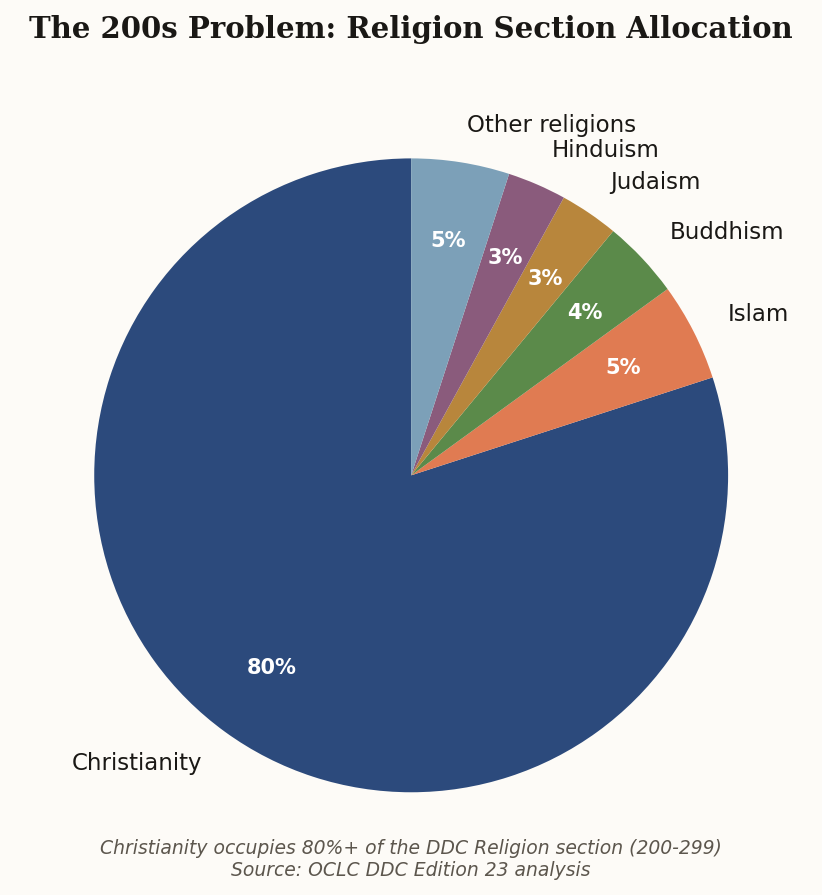
Here's the uncomfortable truth: a system designed in 1876 by a white Protestant American inevitably encoded the biases of that worldview. And the DDC's biases aren't subtle. Over 80% of the 200s section (Religion) is dedicated to Christianity. Every other world religion — Islam, Buddhism, Hinduism, Judaism — is compressed into the 290s. That's not a classification choice; it's a theological statement masquerading as organizational logic.

Pie chart showing Christianity occupying 80% of the DDC Religion section
The 200s problem: Christianity dominates the DDC's Religion section, with all other world religions compressed into a single subdivision. Source: OCLC DDC Edition 23 analysis

It gets worse. Historically, works by Black authors were cataloged under "Slavery" (326) or "Colonization" (325). LGBTQ+ topics were once filed under "Perversion" or "Medical Disorders." These weren't mistakes — they were the logical output of a classification system that reflected, rather than challenged, the prejudices of its era.

And then there's Dewey himself. The man was a serial sexual harasser whose behavior forced his resignation from the ALA in 1906. He founded the Lake Placid Club, which explicitly barred Jews and African Americans. In 2020, the ALA officially stripped his name from the profession's highest honor, renaming the "Melvil Dewey Medal" to the ALA Medal of Excellence. Librarian Dorothy Porter of Howard University was a pioneer in the counter-effort, reclassifying Black literature by subject to highlight its intellectual significance rather than treating it as a subcategory of oppression.

OCLC continues to issue updates that address these systemic biases. But decolonizing a 150-year-old taxonomy is painstaking work — every reclassification ripples through 200,000 libraries worldwide. The question isn't whether the DDC has biases. It's whether a system born from one worldview can evolve fast enough to serve a world that's moved on.

A vibrant modern public library with diverse patrons browsing Dewey-labeled shelves alongside digital devices
06

200,000 Libraries Can't Be Wrong (Or Can They?)

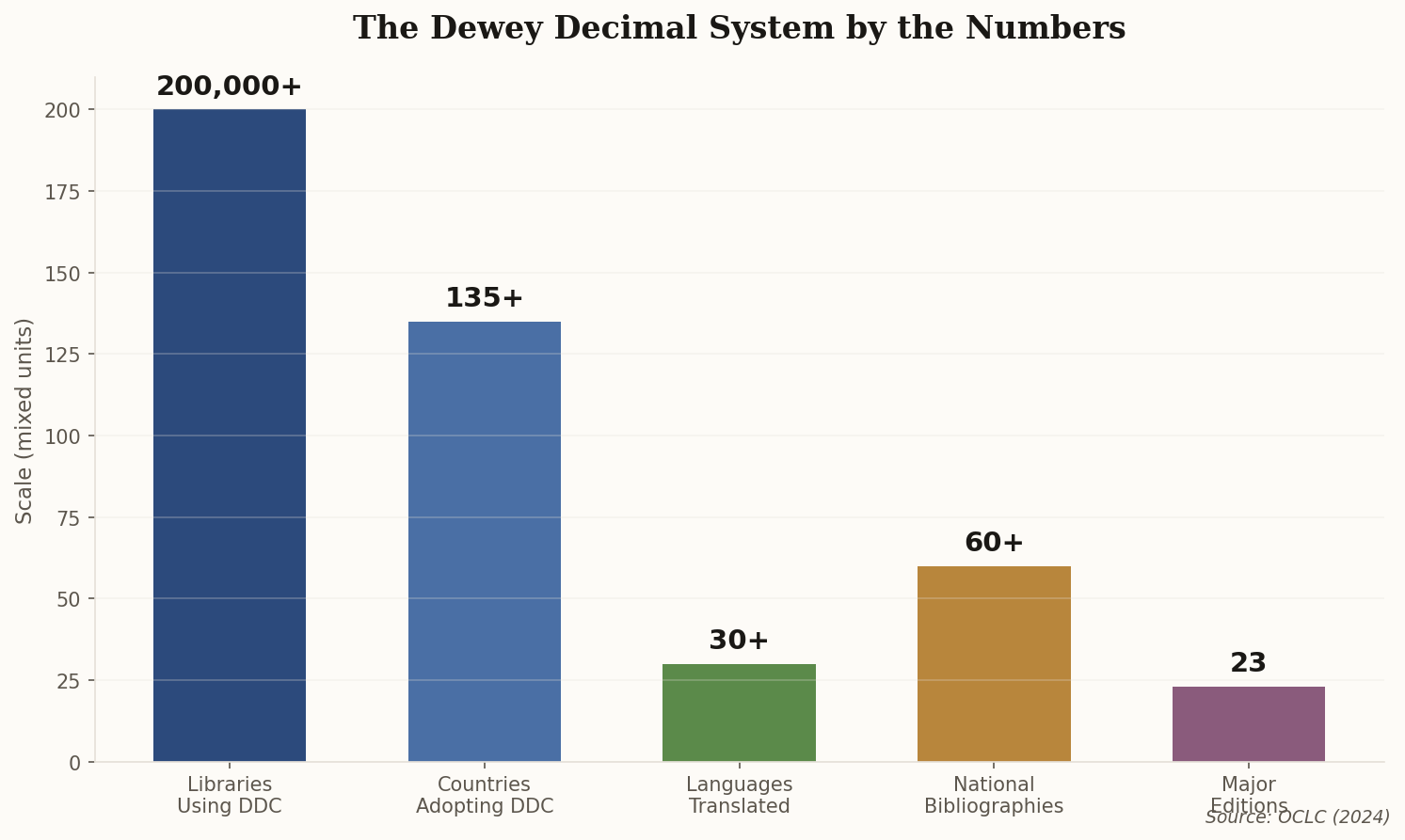
The Dewey Decimal System is used by over 200,000 libraries in more than 135 countries, translated into over 30 languages. Over 60 nations use it for their national bibliographies. Those are staggering numbers for a system designed before the telephone was common. But the real question is: does it still make sense?

Bar chart showing DDC global usage statistics: 200,000 libraries, 135 countries, 30 languages, 60 national bibliographies, 23 editions
The DDC by the numbers: 150 years later, it remains the world's most widely used library classification system. Source: OCLC (2024)

Competition is real. Large academic libraries increasingly prefer the Library of Congress Classification (LCC) for its alphanumeric granularity. Some public libraries are abandoning classification altogether in favor of BISAC — the bookstore-style categories you see at Barnes & Noble. The argument: modern patrons don't think in decimal hierarchies; they think in genres. Why force them to learn a 19th-century notation system to find a mystery novel?

And yet the DDC persists, partly because of sheer inertia — reclassifying millions of books is prohibitively expensive — and partly because it teaches something no search engine can: hierarchical thinking. When a child learns that 636.7 means "dogs" and 636 means "animal husbandry" and 600 means "technology," they're learning that knowledge has structure, that context determines meaning, that the same thing can be understood from different angles. That's not obsolete. That's information literacy.

The DDC has even infiltrated pop culture. In UHF (1989), Conan the Librarian growls: "Don't you know the Dewey Decimal System?!" In Party Girl (1995), Mary (Parker Posey) declares: "Screwing up the Dewey Decimal System is a very serious offense!" Lisa Simpson has called it "the only way to fly." For a classification system, that's a remarkable cultural footprint — proof that Dewey's invention transcended libraries to become a symbol of order itself.

The System Endures. The Reckoning Continues.

Melvil Dewey gave the world a gift and a burden in the same 44 pages. The gift was a way to find any book in any library on Earth using nothing but numbers. The burden was a worldview baked into those numbers — one that took 150 years to begin dismantling. The DDC's future depends on whether OCLC can modernize the content without losing the elegance of the structure. Whether they can or not, every time you walk into a public library and know where to find what you're looking for, you're living inside a system invented by a complicated 21-year-old in 1873. That's either remarkable or unsettling. Probably both.

Share X LinkedIn