Military History

Climb to Glory

How a ragtag band of skiers, mountaineers, and mule packers became one of the most storied divisions of World War II — then came home and built the American ski industry from scratch.

Listen
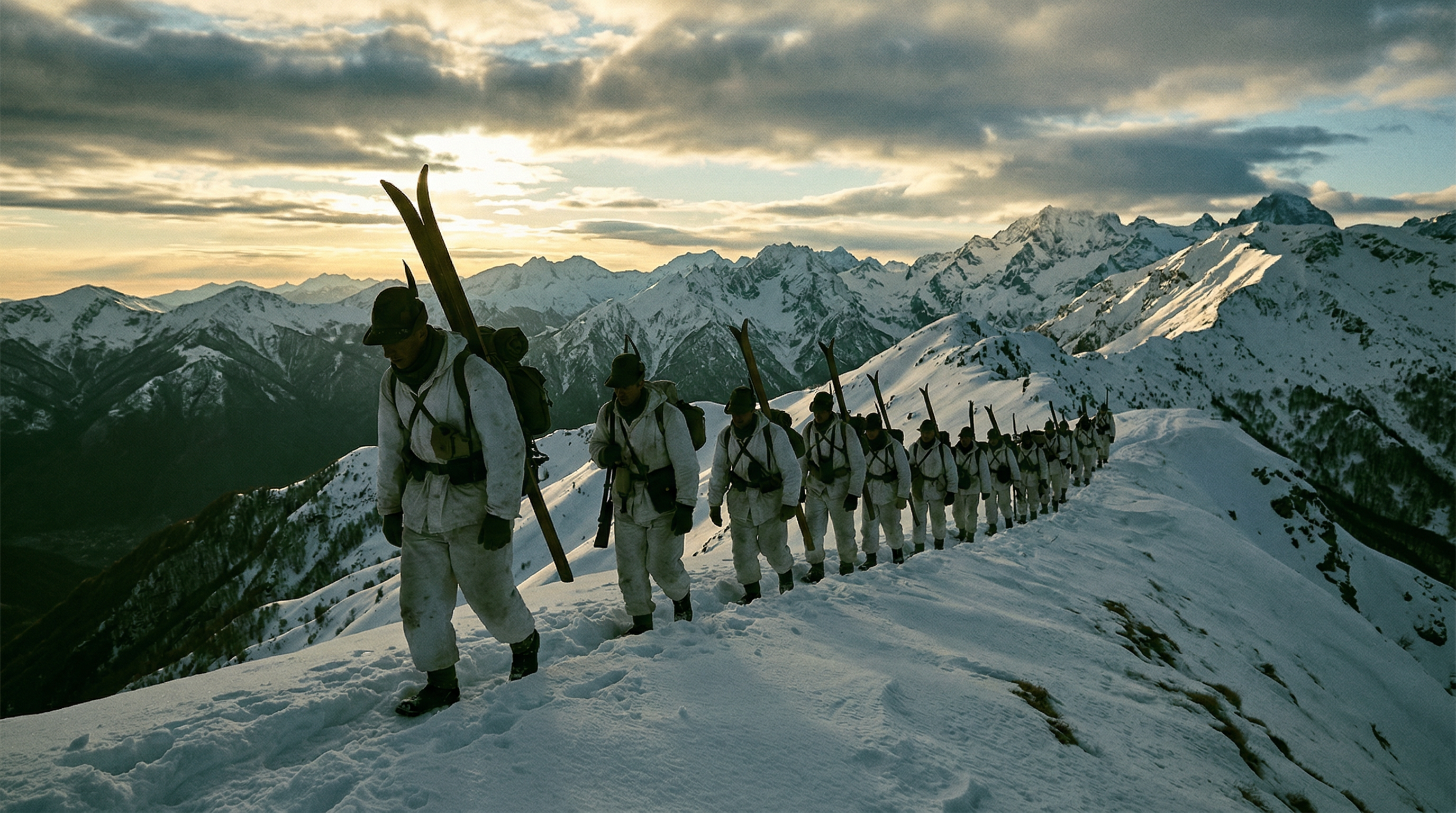
WWII-era mountain soldiers silhouetted against an Alpine ridgeline at dawn, carrying skis on their backs
Recruitment poster aesthetic showing American mountaineers volunteering for military service at Camp Hale, Colorado
01

The Ski Bum Who Built an Army

In November 1939, the Soviet Union invaded Finland — and the world watched in astonishment as 300,000 Finnish troops — many of them expert skiers — held off nearly a million Red Army soldiers for three brutal months. One American was paying closer attention than most. Charles Minot "Minnie" Dole, founder of the National Ski Patrol, saw what mountain warfare training could do. He spent two years lobbying the War Department — writing letters, pulling strings, making himself a general nuisance — until the Army finally relented.

The result was unlike anything the U.S. military had ever attempted. The 87th Mountain Infantry Regiment, activated in November 1941, didn't recruit through normal channels. Dole's National Ski Patrol screened volunteers personally. You needed three letters of recommendation from people who could vouch for your outdoor skills. The roster read like an adventure magazine: Olympic skiers, Dartmouth ski team captains, Swiss mountain guides, Colorado ranchers, forest rangers, and professional mule packers. One recruit was a Harvard-educated philosopher. Another was a champion dog sled racer from Alaska.

Their home would be Camp Hale, carved into a valley near Leadville, Colorado at 9,200 feet. The Army built it from nothing in 1942 — 1,000 buildings housing 15,000 troops in a place so harsh the soldiers called it "Camp Hell." The thin air made routine tasks exhausting. Temperatures plunged to -35°F during winter maneuvers. And this was before they shipped out to fight the Germans.

"We were the only division in the history of the U.S. Army where the weights and measures were taken by the civilian sector, not the Army. That should tell you something about who we were." — Former 10th Mountain Division soldier
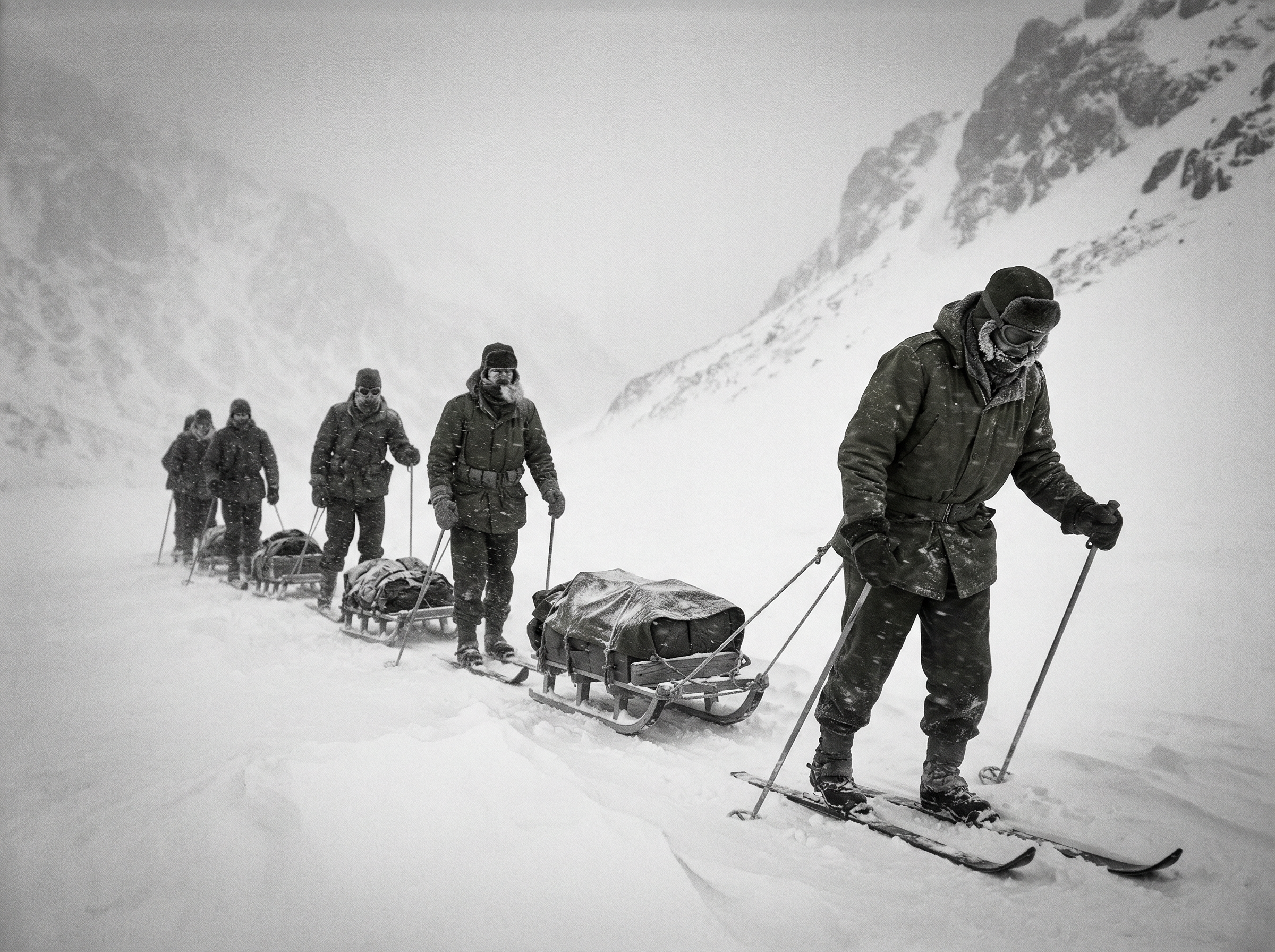
Soldiers training in extreme winter conditions at Camp Hale, white-out blizzard at high altitude
02

Forged at 9,200 Feet

The 10th Light Division — activated on July 15, 1943, and later redesignated as the 10th Mountain Division in November 1944 — trained like no American unit before or since. Every soldier learned to ski, rock climb, and survive in alpine conditions. They practiced building snow shelters, navigating by stars in whiteout blizzards, and hauling supplies up vertical cliffs with ropes and pitons. The mule skinners trained 6,000 pack animals to carry artillery and ammunition up trails too steep and narrow for vehicles.

The legendary D-Series maneuvers in the winter of 1943-44 remain some of the most grueling exercises in Army history. For weeks, entire regiments operated above treeline in temperatures that cracked rifle stocks and froze canteens solid. Men slept in snow caves. Frostbite casualties were constant. The Army was intentionally pushing these soldiers to their physical limits — and past them. "If you could survive D-Series," one veteran later recalled, "Italy was going to feel like a vacation."

It wasn't. But the training built something that would prove decisive: absolute confidence in the man next to you, and the certainty that your unit could go places no other unit could go.

In a final surreal twist, the division transferred to Camp Swift, Texas in the summer of 1944 for flatland infantry training before deployment. Colorado mountain men doing calisthenics in 100°F Texas heat. The culture shock was total — but the orders were clear. They shipped out for Italy in December 1944.

Soldiers scaling a sheer cliff face at night under moonlight during the Riva Ridge assault
03

The Night They Climbed the Impossible

The Gothic Line had stalled the Allied advance through Italy for months. The Germans held the high ground in the Northern Apennines, and every frontal assault had failed. The key to breaking the deadlock was a 1,500-foot ridgeline called Riva Ridge — a sheer rock face the Germans considered unclimbable. They didn't even bother stationing guards on the cliff side.

That was their mistake.

On the night of February 18, 1945, soldiers from the 86th Mountain Infantry Regiment began free-climbing the frozen cliff face in darkness. No artillery preparation, no air support — just ropes, pitons, and the rock-climbing skills they'd honed at Camp Hale. Eight hundred men scaled five separate routes up a wall that would challenge experienced civilian climbers in daylight. They climbed in silence, carrying full combat loads. One slip meant a fall of hundreds of feet.

By dawn on February 19, the Americans held the ridgeline. The Germans launched furious counterattacks for three days but couldn't dislodge them. The "impossible" position had been taken with fewer than 30 casualties in the initial assault. It was one of the most audacious small-unit actions of the entire war — and it was the essential precondition for what came next.

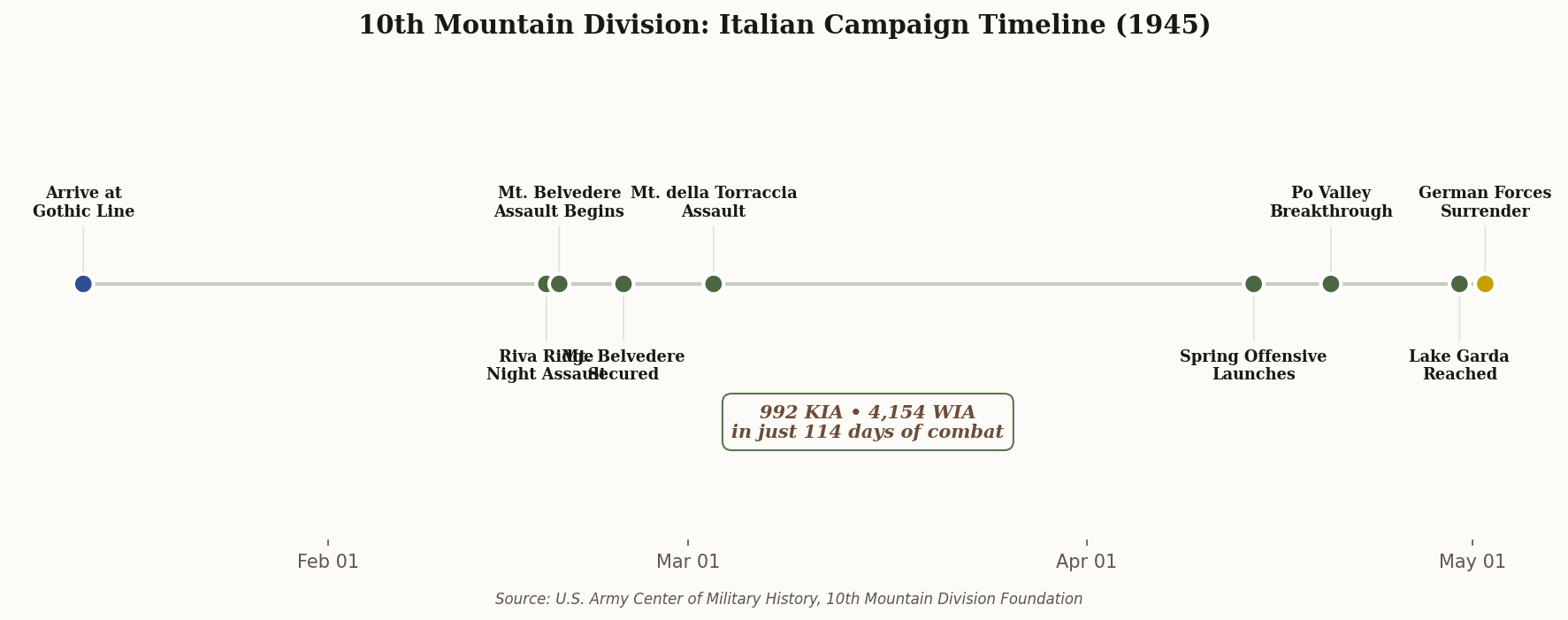
Timeline of the 10th Mountain Division's Italian Campaign from January to May 1945, showing key battles from Riva Ridge through German surrender
The 10th Mountain Division's Italian Campaign compressed devastating combat into just 114 days — from the Gothic Line to Lake Garda.
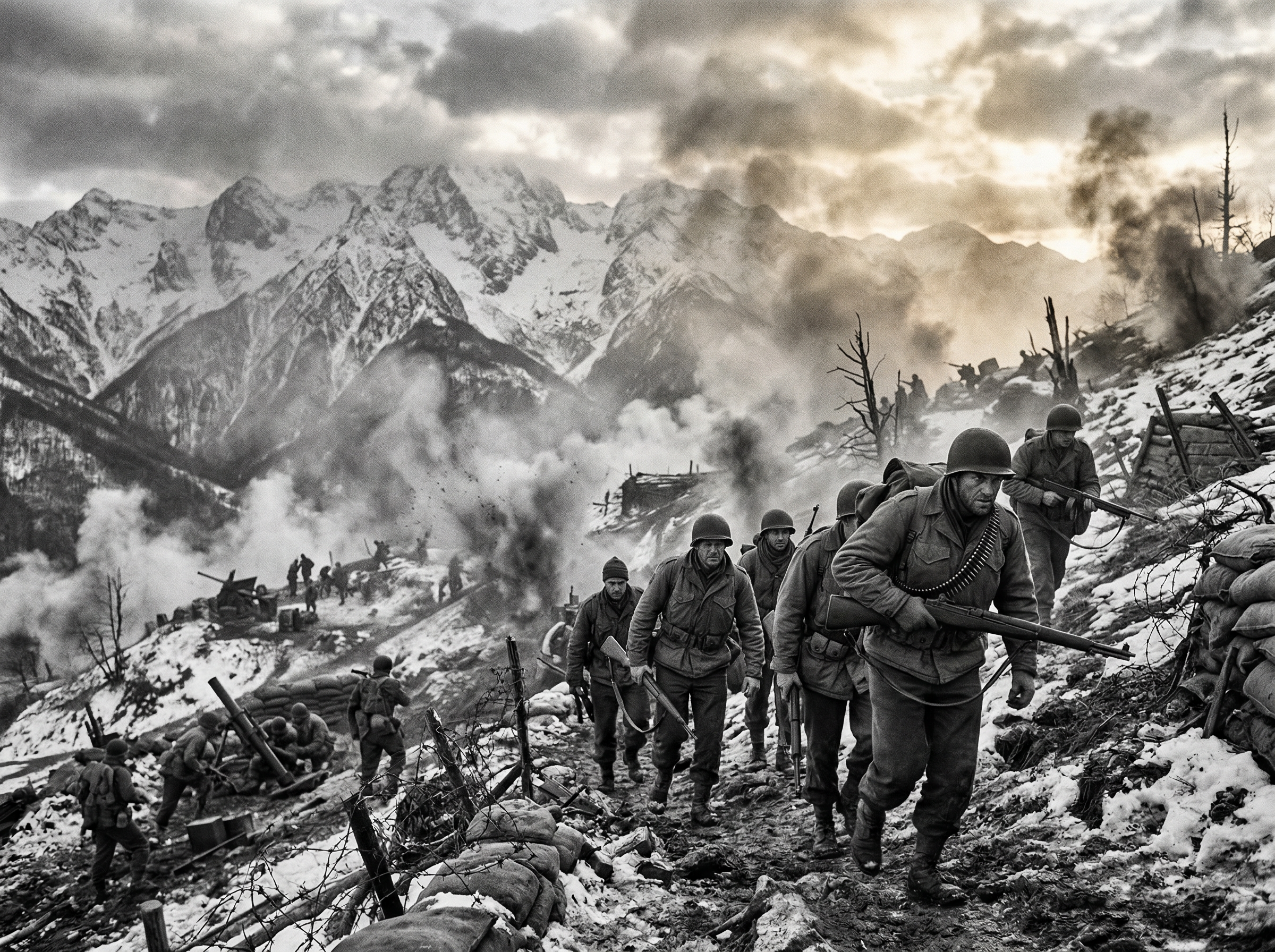
WWII battle scene on Mount Belvedere, soldiers advancing uphill through artillery smoke in the Italian Apennines
04

Belvedere to the Po Valley: 114 Days of Hell

The morning after Riva Ridge fell, the main assault began. Three regiments of the 10th Mountain Division attacked Mount Belvedere and the surrounding heights in what would become one of the most intense engagements of the Italian Campaign. The fighting was hand-to-hand in places — foxhole to foxhole across rocky terrain. It took six days to secure the mountain complex, and the cost was staggering: the division suffered over 850 casualties in the first week alone.

But Belvedere broke the back of the Gothic Line. Through March, the 10th pushed forward through a series of vicious ridge-by-ridge battles — Mount della Torraccia, Monte Grande d'Aiano, Castel d'Aiano. Each name represented a hill taken at terrible cost, often in close combat where the mountain training made the difference between units that could maneuver on steep terrain and units that couldn't.

Then came the Spring 1945 Offensive. On April 14, the 10th led the breakout from the Apennines into the Po Valley — open tank country where the German defenses finally crumbled. The division raced north, crossing the Po River and reaching Lake Garda by April 30. On May 2, 1945, German forces in Italy surrendered unconditionally.

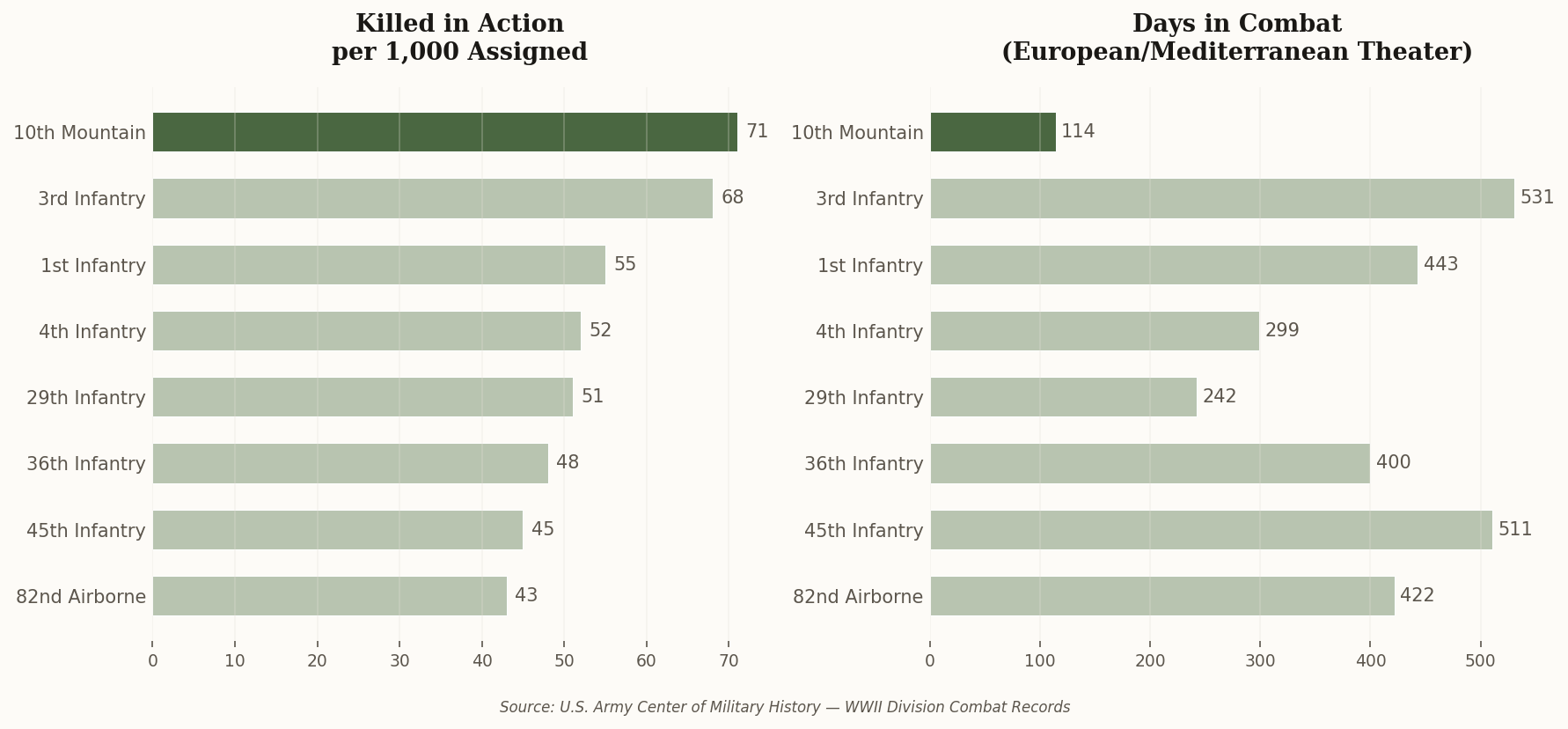
The 10th Mountain Division had been in combat for exactly 114 days. In that compressed span, 992 soldiers were killed and 4,154 wounded — a casualty rate that ranked among the highest of any American division in the entire war. They earned more decorations per capita than nearly any other Army division.

Comparison of 10th Mountain Division casualties against other WWII divisions, showing highest KIA rate per 1000 in fewest days of combat
The 10th Mountain Division sustained one of the highest KIA rates per 1,000 assigned troops — compressed into one of the shortest combat deployments of any WWII division.
Split composition showing WWII soldier on skis transforming into 1950s ski resort scene, the birth of American skiing
05

From Soldiers to Slopes: Building America's Ski Industry

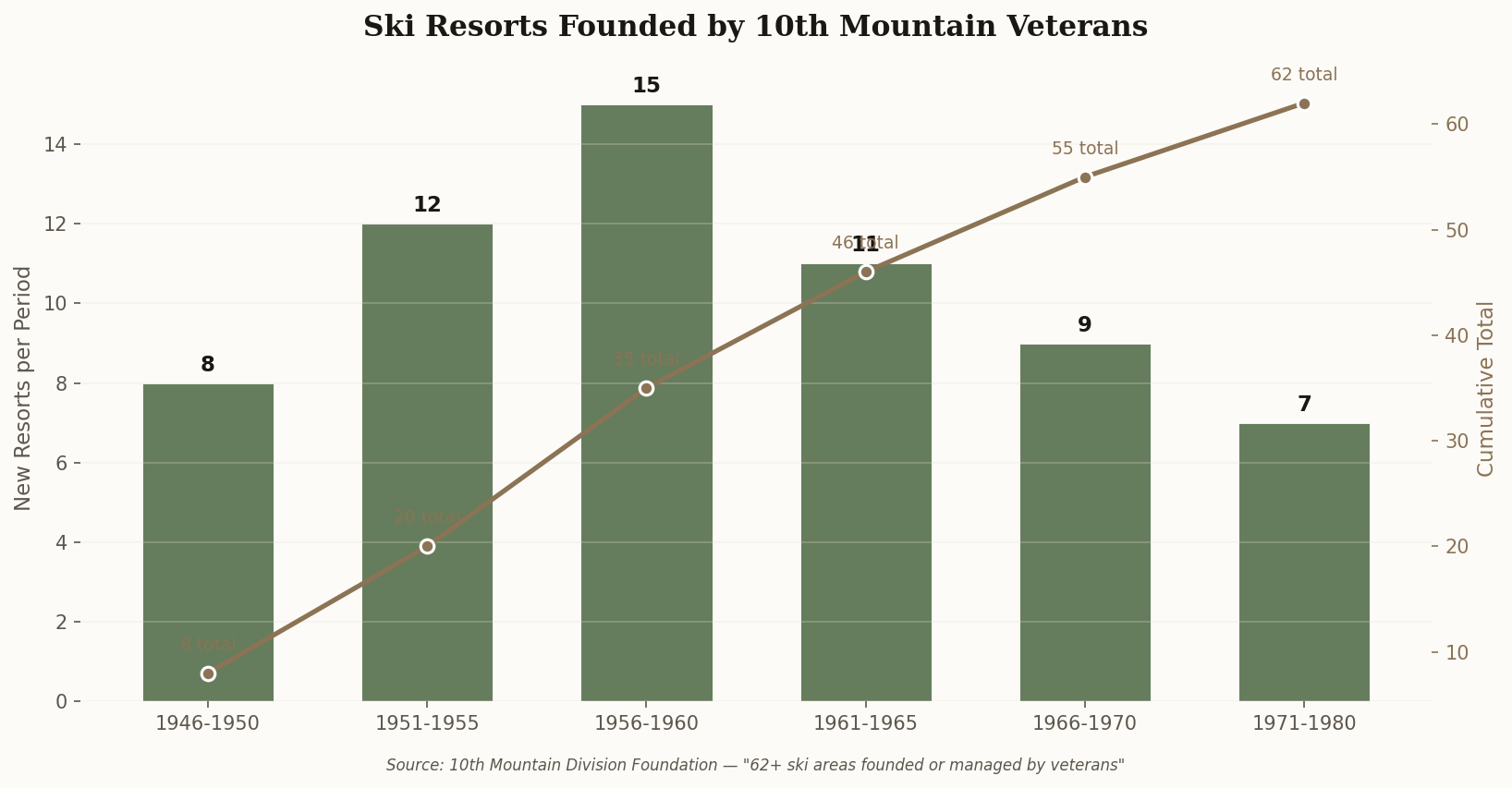
Here's a fact that sounds made up: more than 62 ski resorts across the United States were founded or managed by veterans of the 10th Mountain Division. These men came home from war with an extraordinary combination of skills — elite skiing ability, mountain engineering knowledge, small-unit leadership experience, and the kind of fearless ambition that comes from having already survived the worst.

The most famous example is Vail. Pete Seibert, who was badly wounded on Mount Belvedere (he took a burst of machine gun fire that shattered his kneecap), spent years in rehabilitation before climbing an unnamed peak in Colorado's Gore Range in 1957. He looked out at the vast, empty bowls of snow and saw a ski resort. Vail opened on December 15, 1962, built from nothing on a mountainside where Seibert's 10th Mountain training told him the terrain and snow conditions were perfect.

Friedl Pfeifer, an Austrian-born ski racer who served in the division, transformed Aspen from a played-out mining town into a world-class ski destination. Fritz Benedict became Aspen's defining architect. Other veterans built or ran Arapahoe Basin, Sugarbush, Crystal Mountain, Whiteface, and dozens more. They didn't just build ski lifts — they built the entire culture, economy, and infrastructure of American skiing.

Beyond the slopes, 10th Mountain veterans reshaped American outdoor culture entirely. David Brower became the first executive director of the Sierra Club and is considered the father of the modern environmental movement. Paul Petzoldt founded the National Outdoor Leadership School (NOLS). The outdoor recreation industry as we know it today — a $862 billion sector of the American economy — traces significant DNA back to these veterans.

Bar chart showing ski resorts founded by 10th Mountain Division veterans by decade, from 1946 to 1980, with cumulative total reaching 62+
The post-war ski resort boom peaked in the 1950s–60s, with 10th Mountain veterans founding or managing 62+ resorts across America — including Vail, Aspen, and Arapahoe Basin.
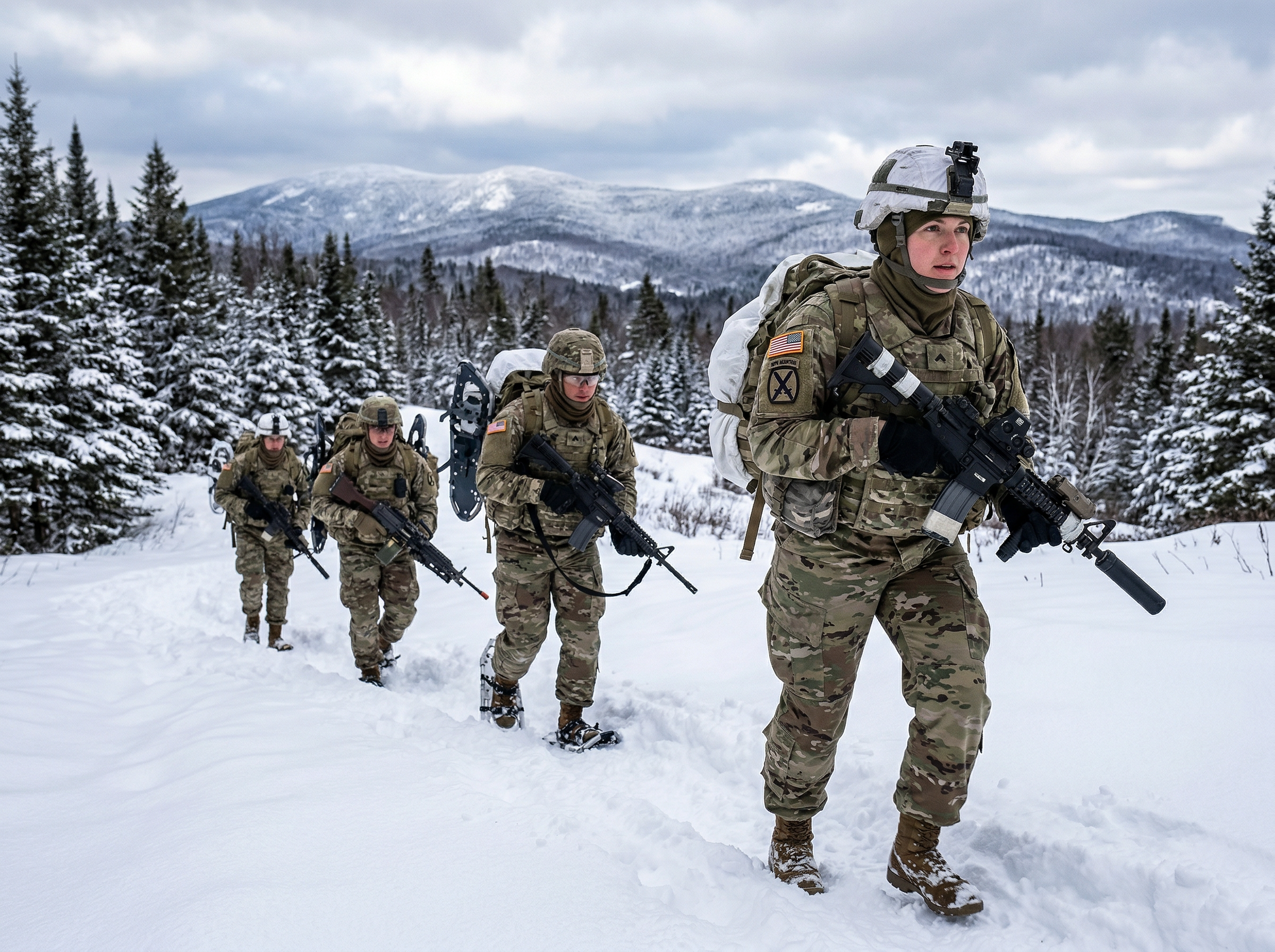
Modern U.S. Army 10th Mountain Division soldiers at Fort Drum, light infantry troops with modern equipment
06

Still Climbing: The 10th Mountain in the 21st Century

The original 10th Mountain Division was inactivated in 1945. For forty years, the name lived only in the memories of its veterans and the ski resorts they built. Then in 1985, the Army reactivated the division at Fort Drum, New York — this time as a light infantry division designed for rapid global deployment.

The modern 10th Mountain is a different kind of unit than its WWII predecessor. The mission shifted from mountain warfare to rapid-reaction light infantry. But the lineage carries weight. Since reactivation, the division has been one of the most deployed units in the U.S. Army. Soldiers from the 10th served in Somalia in 1993 — elements of the division were involved in the events depicted in Black Hawk Down. They deployed to Haiti, Bosnia, and Kosovo throughout the 1990s.

After September 11, the 10th Mountain became a workhorse of the War on Terror. The division has deployed to Afghanistan and Iraq more times than almost any other division — over 20 rotations between 2001 and 2021. In Afghanistan's mountainous terrain, the connection to the division's original mission felt almost poetic. Soldiers patrolling the Hindu Kush and the Korengal Valley were doing, in some ways, exactly what Minnie Dole had envisioned in 1939: American soldiers who could fight and win in the world's most forbidding mountain terrain.

Today the 10th Mountain Division remains headquartered at Fort Drum, with roughly 18,000 soldiers. Its motto — "Climb to Glory" — still resonates, a direct thread from the men who scaled Riva Ridge to the soldiers deploying to trouble spots around the world eight decades later.

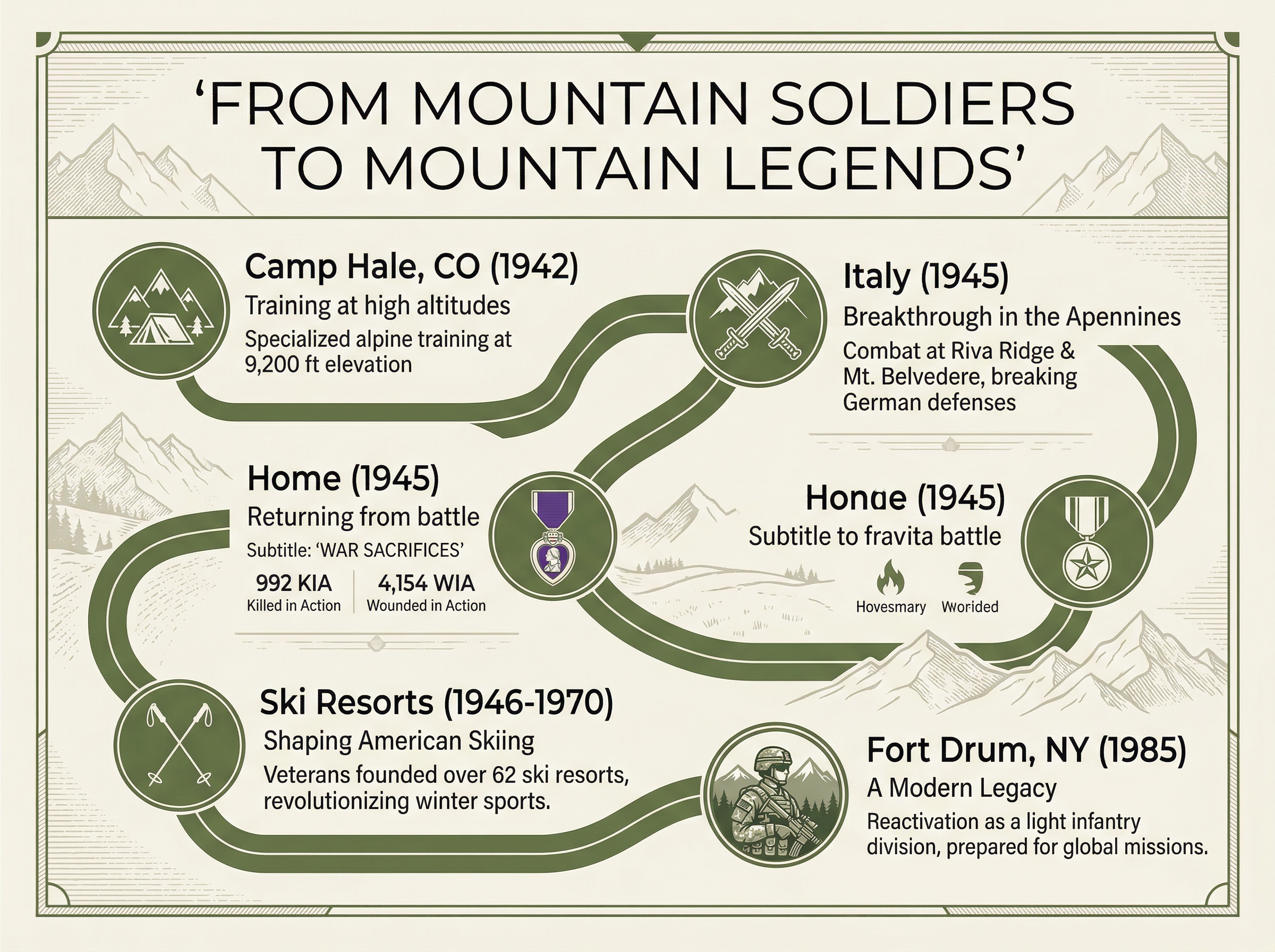
Infographic showing the journey of the 10th Mountain Division from Camp Hale to Italy to American ski resorts to Fort Drum
From Mountain Soldiers to Mountain Legends — the 10th Mountain Division's journey across eight decades.

The Mountains Remember

In October 2022, President Biden designated Camp Hale – Continental Divide as a National Monument — the first use of the Antiquities Act to protect a military training site. The 9,200-foot valley where young Americans once trained in -35°F blizzards is now protected forever. The last WWII-era 10th Mountain veterans are in their late 90s and early 100s. Their numbers thin each year. But walk into any ski resort in Colorado, Vermont, or California, and you're walking on ground they shaped. Strap into a chairlift at Vail, and you're riding the vision of a man who took a machine gun burst on Mount Belvedere and spent years learning to walk again — only to climb one more mountain and see, in its empty slopes, something no one else could see. That's the 10th Mountain Division. They climbed the impossible, and then they came home and built something beautiful on top of it.

Share X LinkedIn