The Quilt Walk: When Fabric Saved Lives on the Frontier
When we think of survival gear, we think of knives, rifles, fire starters. We don't think of bedding. But in the winter of 1864, in the remote settlement of Panguitch, Utah, a group of starving pioneers owed their lives to something their grandmothers made: quilts.
The snow was too deep and too soft to walk through. Supplies were miles away in a neighboring settlement. So the pioneers did something audacious: they laid their heaviest quilts flat across the snow, creating a stable path that supported their weight. They literally walked on fabric to reach food. The event is still commemorated annually as the "Quilt Walk Festival".
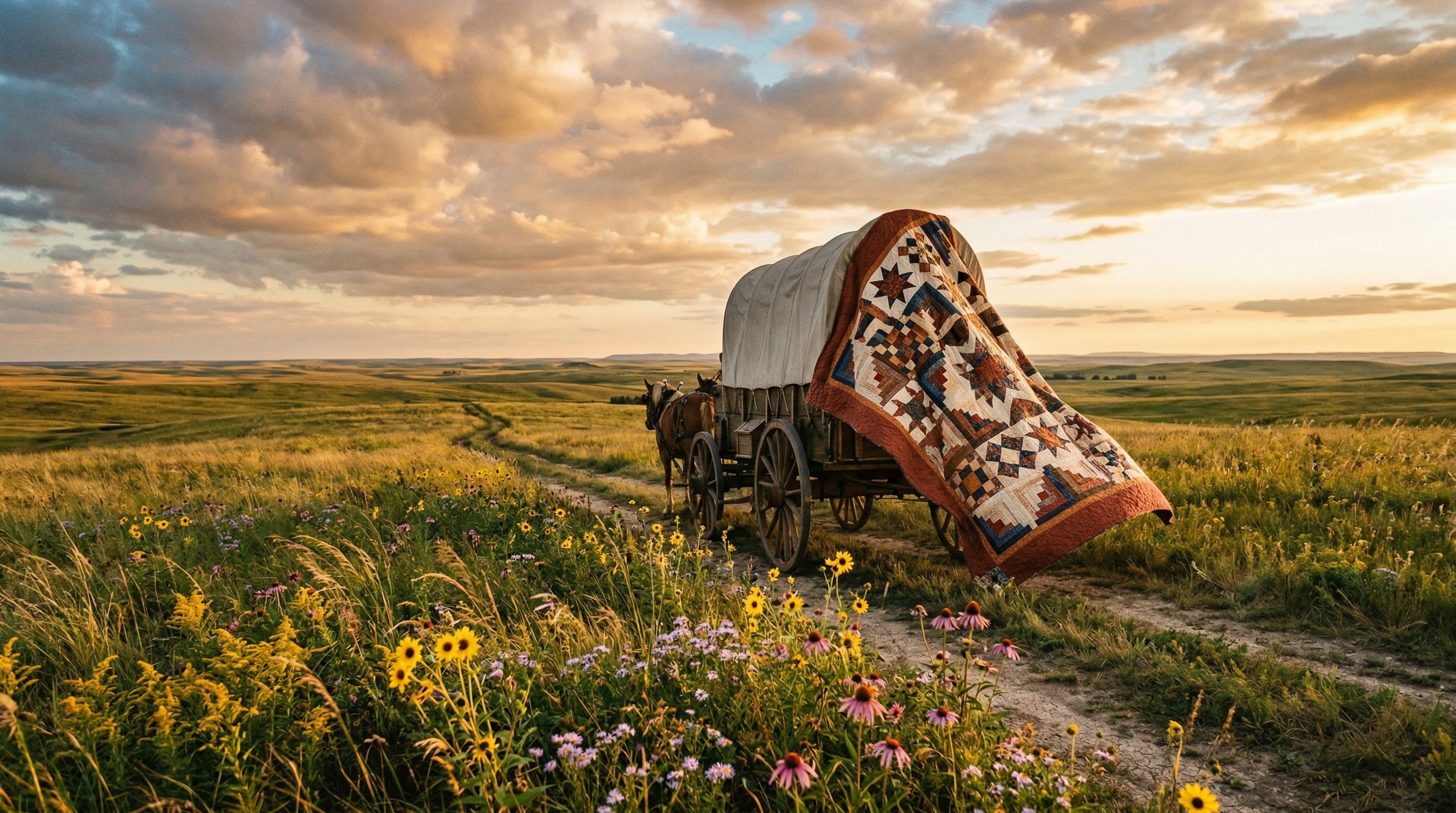
This wasn't an aberration. On the 2,000-mile journey west, quilts were the pioneer's Swiss Army knife. They padded fragile cargo — ceramic dishes, glass lamps — against the relentless jolting of wagon wheels. They divided one-room sod houses into something approaching private quarters. They hung as makeshift doors against dust storms on the Great Plains. And when wood for coffins was nonexistent on the open prairie, quilts became burial shrouds. A family quilt wrapped around a loved one in a lonely trail grave was the last embrace many pioneers could offer.
The "Good-bye Hug": Before a family departed for the frontier, the women staying behind would secretly stitch a friendship quilt — a tactile, portable memory bank. For women who knew they might never see their families again, these quilts were the 19th-century equivalent of a digital photo album. Except you could sleep under yours.
The Scrap Economy That Built the Frontier
On the cash-poor frontier, quilts were hard currency. Not metaphorically — literally. Historical records document pioneers trading handmade quilts to Native American tribes for food and safe passage. Quilts were bartered for livestock, tools, and in some cases, land.
Nothing was wasted. Pioneer women operated what we'd now call a "circular economy" with zero tolerance for textile waste. Worn-out coats became quilt batting. Calico dresses, once too threadbare to wear, found second life as quilt blocks. And then came the feed sacks: by the mid-1800s, flour and grain manufacturers had figured out that women repurposed their cotton sacking, so they started printing the bags with floral patterns. It's one of the earliest examples of packaging design driven by secondary use.
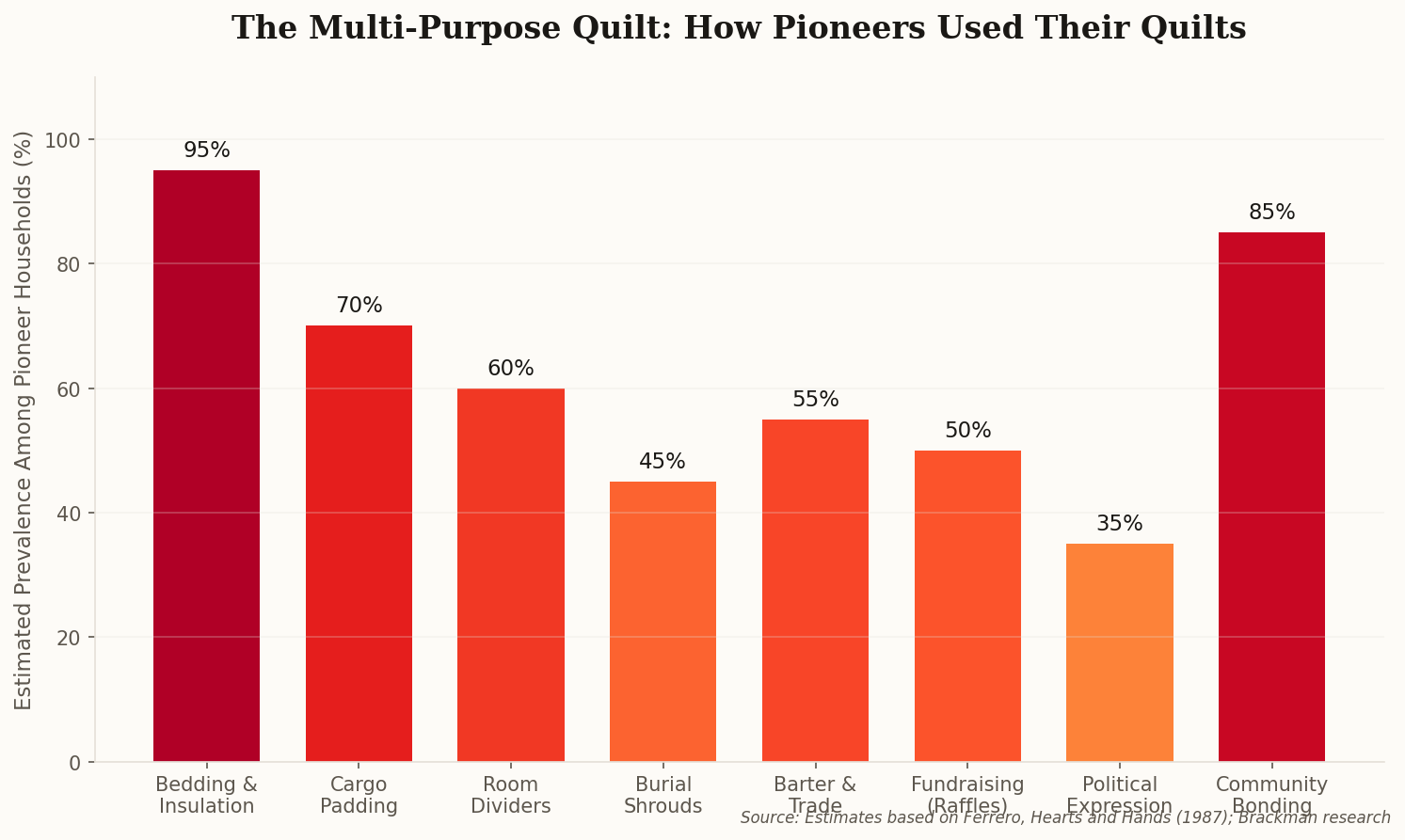
The "Signature Quilt" was the frontier's first crowdfunding mechanism. A community would charge a small fee — often a dime — to have your name stitched onto a quilt block. The finished quilt was then auctioned or raffled to fund a new church, school, or hospital. By the mid-1800s, "professional" quilters had emerged: women who turned long winters into income by sewing for bachelor ranch hands or selling finished pieces to passing travelers. Quilting wasn't a hobby. It was an industry.

Quilting Bees: The Original Social Network
Isolation was the frontier's silent killer. Homesteads could be days apart. There was no town square, no church yet, no newspaper. Into this void stepped the quilting bee — and it became the most important social institution on the American frontier.
Yes, quilting bees were about pooling labor on large projects. A quilt that might take one woman months could be finished in a single day with twelve hands working together. But the real product wasn't the quilt. It was information. While hands worked, women exchanged medical knowledge (forming what historians call "the midwife network"), shared community news, organized mutual aid for struggling families, and debated the moral questions of the day. The quilting bee was the frontier's town hall, newspaper, and social safety net — rolled into one.
"Friendship" and "Album" quilts served as physical records of social networks. Each block was signed with ink or embroidery by its maker. When a woman moved west, her album quilt functioned as a letter of introduction to new neighbors — tangible proof of her social standing, her community ties, and the web of relationships she carried with her across the continent.


Patterns That Mapped a Nation's Journey West
Quilt patterns are a language, and that language changed as America moved west. Traditional Eastern patterns — polite, geometric, named after domestic life — got renamed to reflect the grit and grandeur of the frontier. The twisting, arduous block known back East by a forgettable name became "The Road to California." Its cousin became "Rocky Road to Kansas." The patterns didn't change. The stories they told did.
The superstitions evolved too. The "Wandering Foot" pattern was believed to cause anyone sleeping under it to desert their family — a real fear in the transient frontier world. To neutralize the curse, women renamed it "Turkey Track." Same geometry. New name. Problem solved. (Or so they hoped.)
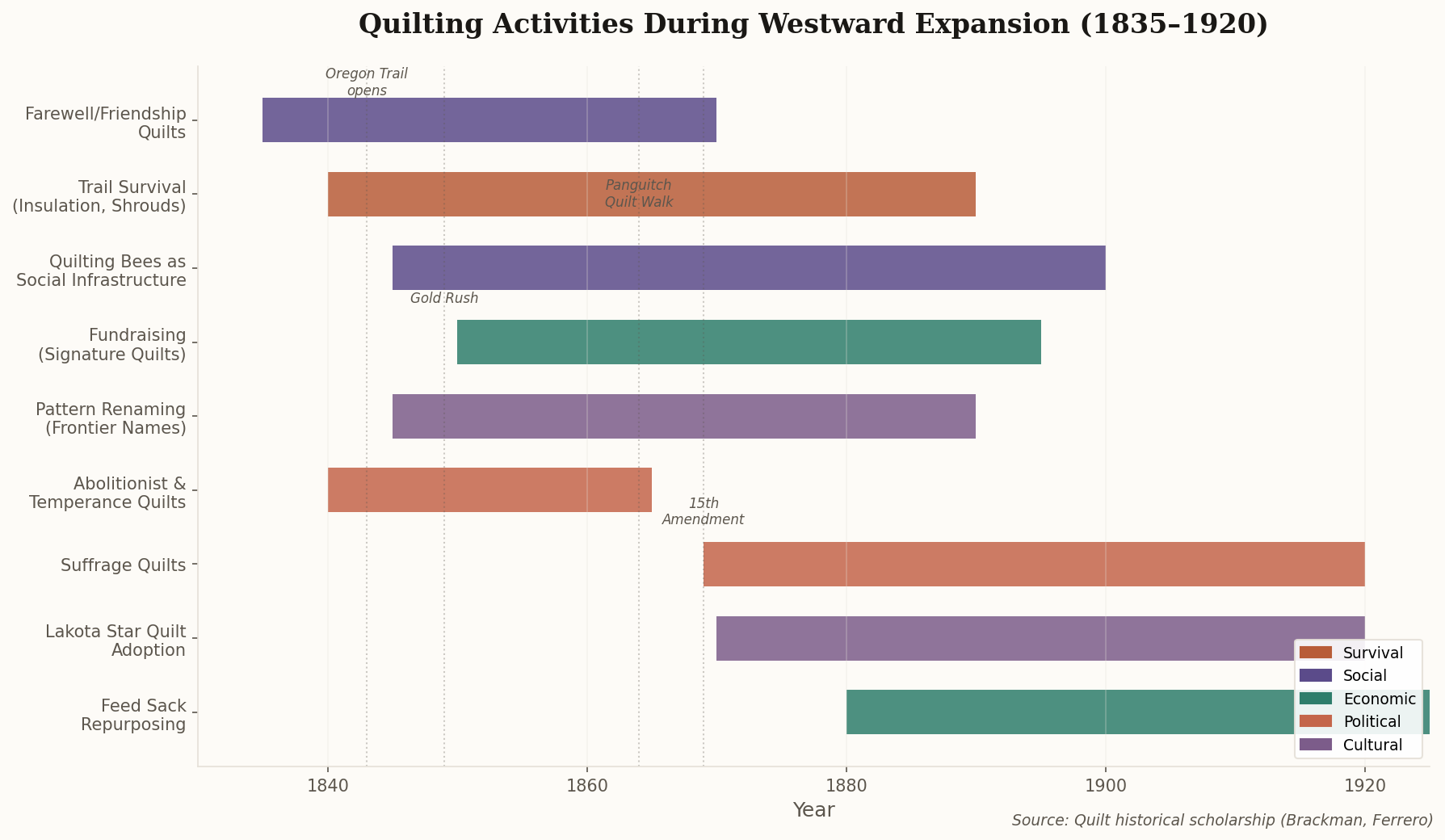
But the most profound pattern story is one of cultural exchange. When Christian missions introduced quilting to Indigenous communities, the Lakota and Plains tribes adopted the Morning Star (Lone Star) pattern — and transformed it into something sacred. The Star Quilt replaced buffalo robes in ceremonies for namings, funerals, and honor celebrations. Today, Star Quilts remain one of the most visible expressions of Indigenous cultural identity across the Northern Plains. The pattern traveled west as a colonial export and came back as something far more powerful than its makers intended.

Banners in Cloth: How Quilts Gave Women a Political Voice
In a society where women couldn't vote, couldn't own property in many states, and were legally invisible in most civic institutions, quilts became protest art. And nobody could confiscate your protest if it looked like a bedspread.
Northern women stitched "Anti-Slavery Quilts" to raise money for the abolitionist cause, embroidering slogans like "Am I Not a Man and a Brother?" directly into the fabric. The Drunkard's Path pattern — its erratic, staggering design symbolizing the walk of an intoxicated person — became a quiet declaration of allegiance to the temperance movement. Hang it on your wall and everyone who visited knew where you stood.
Suffragists took it further. Purple, white, and gold fabrics in a quilt were a political statement as legible as a campaign poster. And Abigail Scott Duniway, the "Mother of Woman Suffrage in Oregon," used her quilting skills to fund her suffrage newspaper, The New Northwest, and donated a 30-year-old quilt to the first National Woman Suffrage Bazaar. When the frontier denied women formal power, quilting gave them an organizational framework, a fundraising engine, and a medium for protest that men either couldn't see or couldn't object to.
The Quilt Code Myth: A Beautiful Story That Isn't True
Here's the story you've probably heard: enslaved people escaping via the Underground Railroad used quilts as secret maps. Specific patterns hung on fences signaled instructions — Monkey Wrench meant "gather your tools," Bear's Paw meant "follow animal tracks through the mountains," North Star meant "head north." It's a magnificent narrative of resistance, ingenuity, and coded communication hiding in plain sight.
It's also almost certainly not true.
The theory was popularized by the 1999 book Hidden in Plain View by Jacqueline Tobin and Raymond Dobard, based on the oral history of a single quilter in South Carolina named Ozella McDaniel Williams. The book became a bestseller. It was taught in schools. It entered the cultural bloodstream as established fact.
The problem? The evidence doesn't hold. Quilt historians including Barbara Brackman and Giles Wright have pointed out devastating flaws: there is zero mention of a quilt code in any of the 2,000+ WPA slave narratives. Neither Harriet Tubman nor Frederick Douglass ever mentioned quilts in their extensive accounts of escape routes. And many of the "code" patterns — including the Double Wedding Ring — weren't actually named or widely used until decades after the Civil War.
The scholarly consensus: The Quilt Code is a modern myth — a powerful story that speaks to the agency and ingenuity of enslaved people, but one that lacks the rigorous historical evidence that supports the many other documented roles quilts played in American expansion. The real story of quilts and resistance is fascinating enough without the embellishment.
This matters because the actual history of quilts on the frontier is extraordinary on its own terms. Quilts did encode messages — just not escape routes. They encoded community bonds, political allegiance, economic value, cultural identity, and the survival instincts of millions of women who stitched a civilization together, one scrap at a time. That's the story worth telling.