Lutherie & Legacy

The Greatest Guitar of Our Epoch

Why a family of Bavarian luthiers built the most valuable classical guitars in history—and why only 250 of them exist.

Listen
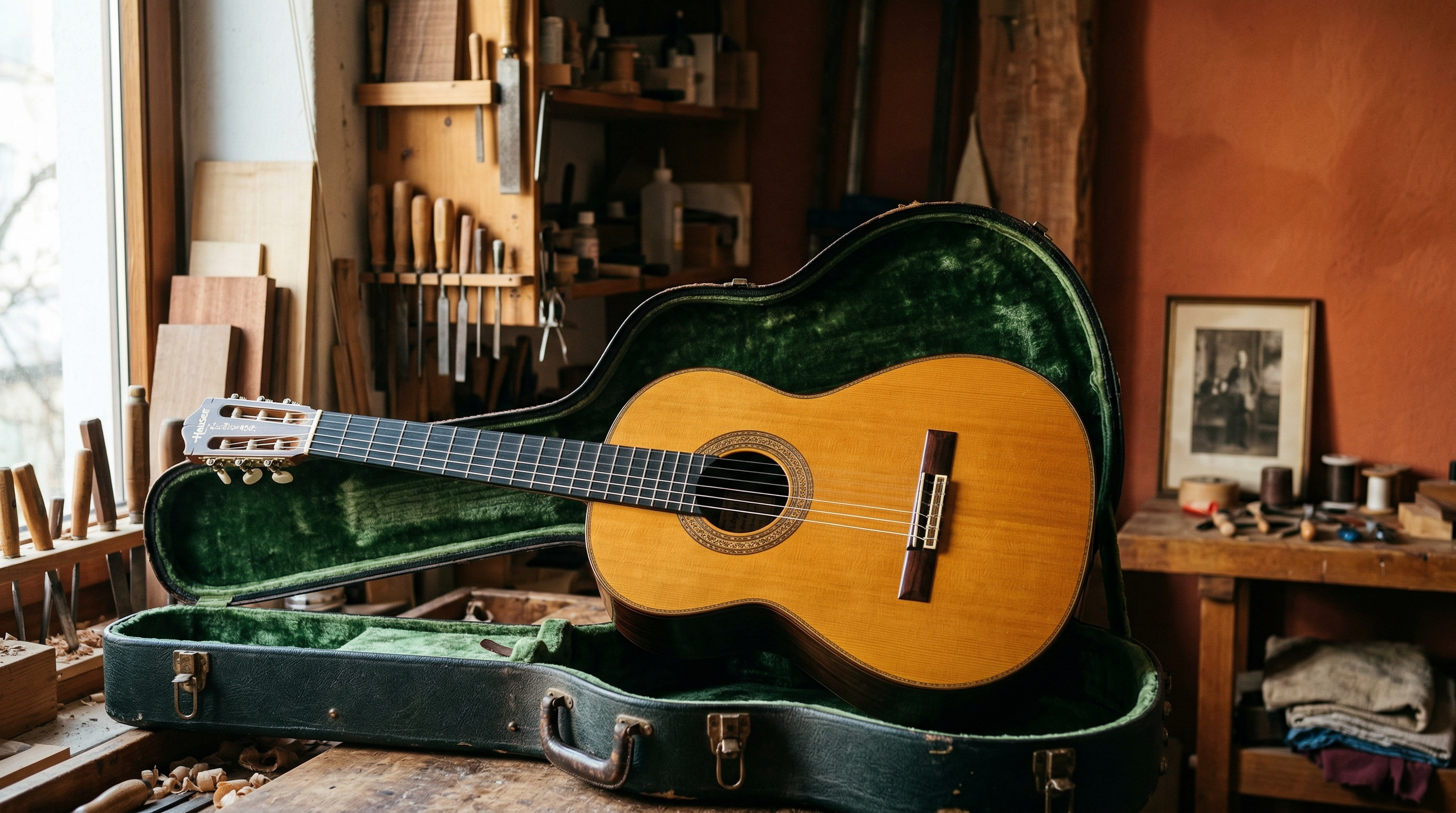
A masterfully crafted Hermann Hauser classical guitar in a traditional Munich luthier workshop
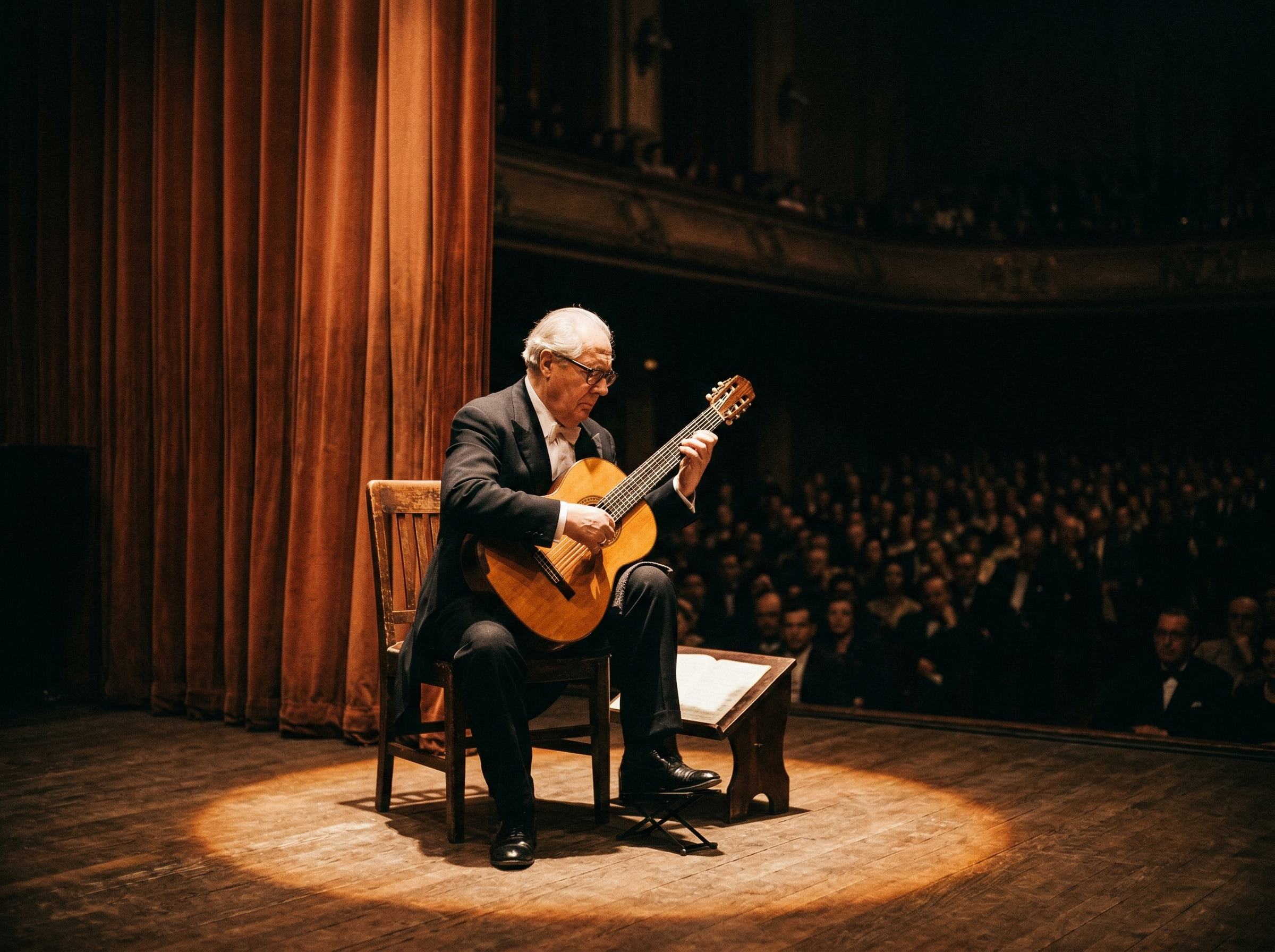
Andrés Segovia performing under a single spotlight in a grand concert hall
01

Twelve Years, One Guitar, and the Quote That Built a Dynasty

In 1924, a Bavarian zither-maker named Hermann Hauser I met a young Spanish guitarist in Munich. Andrés Segovia showed Hauser his beloved 1912 Manuel Ramírez and essentially said: build me something better.

What followed was a twelve-year obsession. Hauser sent prototype after prototype to Segovia, who returned each one with meticulous critiques. Too bright. Too heavy. Wrong balance. Not enough sustain. For a dozen years, a German craftsman chased the sound inside a Spaniard's head.

Then, in 1937, he delivered the one. Segovia played it and never picked up his Ramírez again. He called it "the greatest guitar of our epoch"—seven words that turned a Munich workshop into the most coveted name in classical guitar history. Segovia used that single instrument as his primary concert guitar for the next 25 years, across hundreds of performances on stages worldwide. When he finally retired it in 1962, he donated it to the Metropolitan Museum of Art in New York, where it sits today behind glass—a silent monument to what happens when genius meets obsession.

The lacquer incident: In the 1950s, Hauser II refinished the legendary 1937 guitar in nitrocellulose lacquer instead of the original French polish. Segovia was furious, saying the lacquer "suffocated" the wood's voice. It remains one of the great controversies in classical guitar history—and proof that with instruments at this level, a coat of varnish is a life-or-death decision.
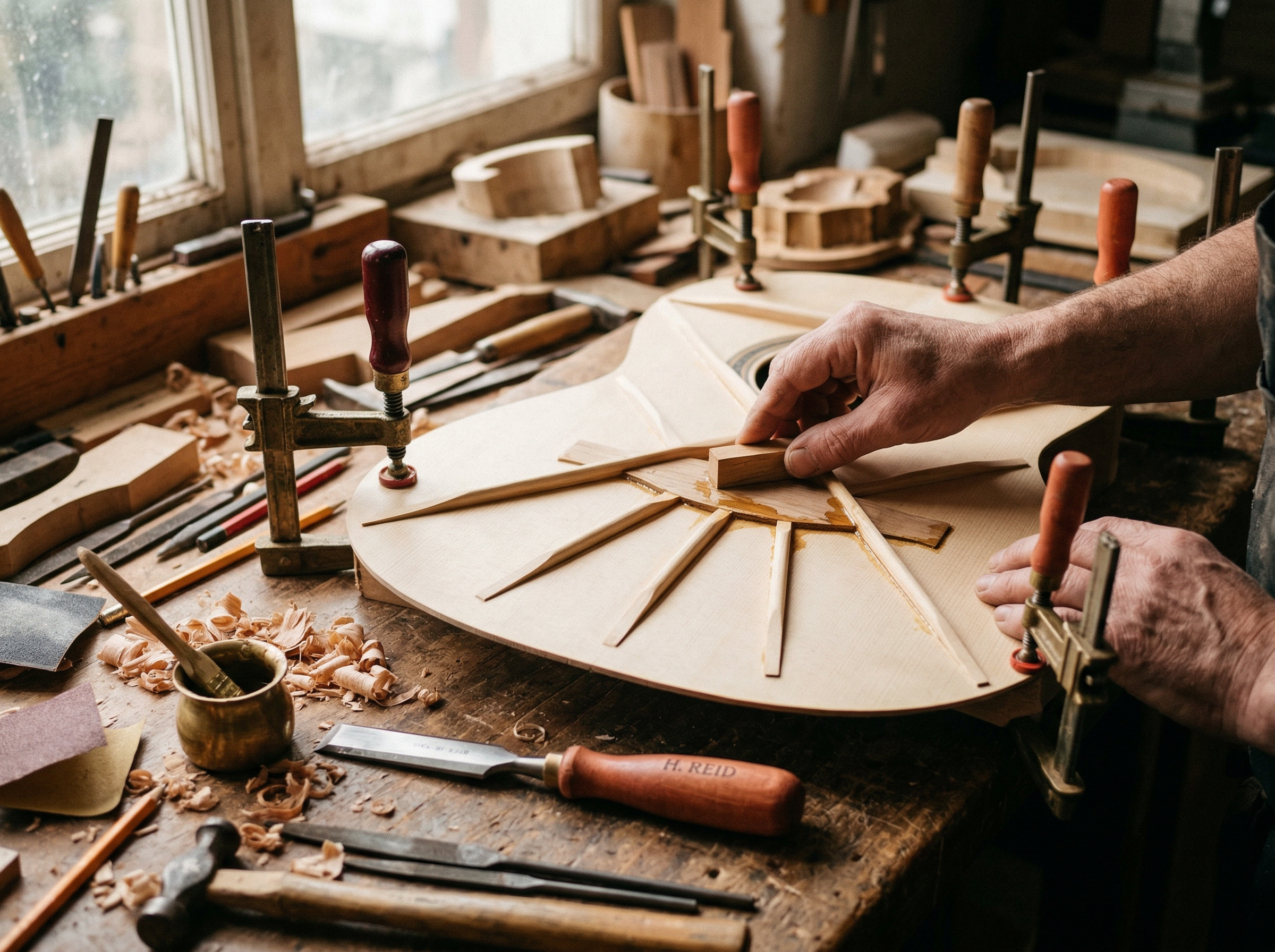
Close-up of classical guitar bracing and spruce top under construction in a luthier workshop
02

The Teutonic Ideal: Engineering What Spain Felt by Instinct

Spanish luthiers in the tradition of Antonio de Torres built guitars the way a poet writes—by feel, by ear, by decades of intuition passed hand to hand. Hauser respected that tradition, then did something very German to it: he measured everything.

Where Torres and his successors favored thin, flexible tops (often under 2.0mm), Hauser I used Alpine spruce plates at 2.5 to 3.0mm—thicker, stiffer, and more structurally stable. He paired them with Brazilian rosewood backs and sides, and deployed a refined seven-fan bracing system with asymmetrical strutting that stiffened the treble side more than the bass. The result was a guitar that didn't bloom warmly like a Ramírez or thunder darkly like an Ignacio Fleta—it rang with what players describe as "clinical clarity," a bell-like transparency where every note exists in its own space.

His V-joint headstock construction became a hallmark of precision that other luthiers still study. The Hauser sound isn't warm or cold—it's true. It gives the player absolute control over color and expression, which is exactly why the best concert artists gravitated toward it. A Hauser doesn't impose a personality; it amplifies yours.

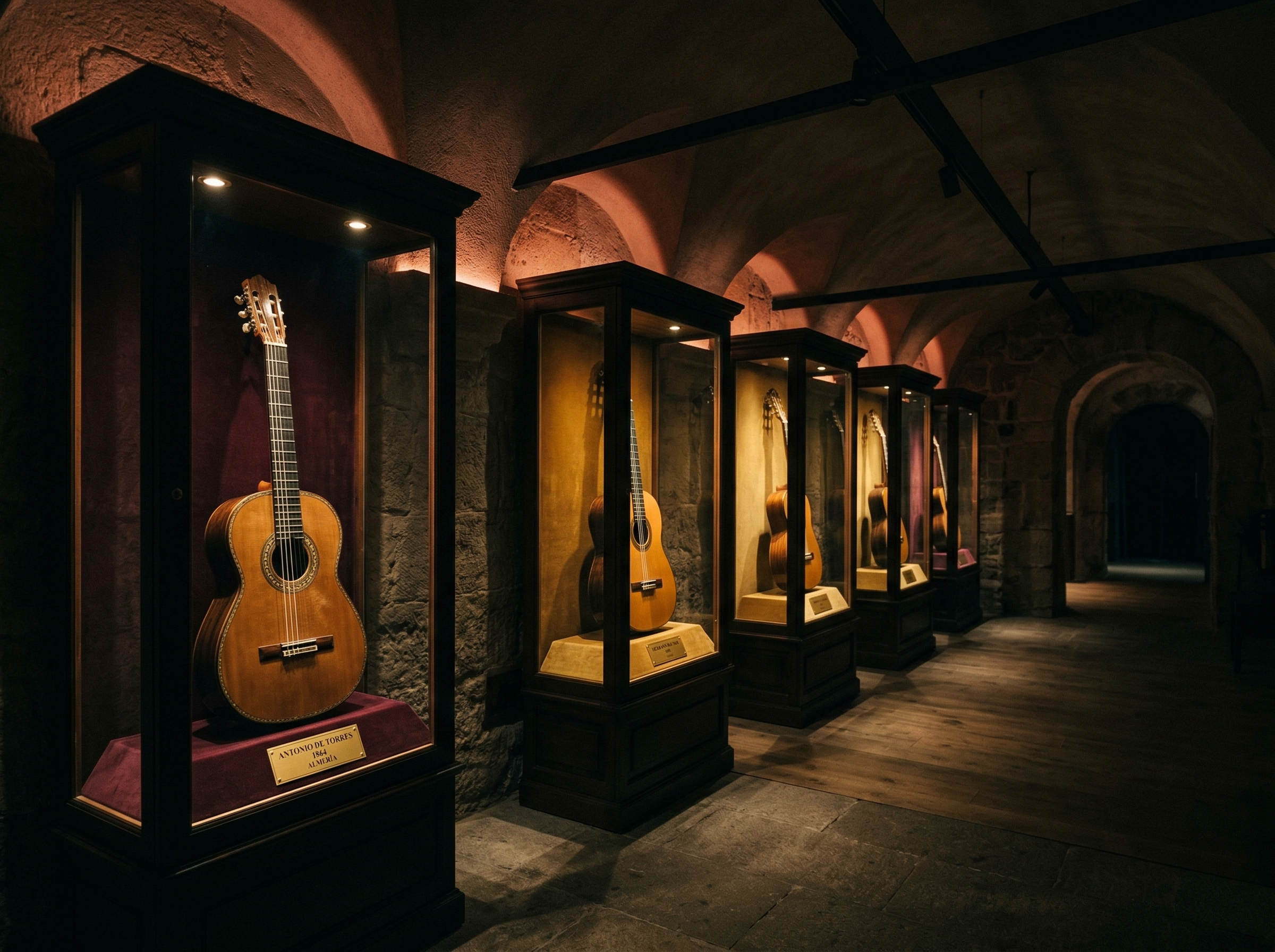
Rare classical guitars displayed in museum-quality glass cases with dramatic lighting
03

Only 250 Were Ever Made—And They Refuse to Die

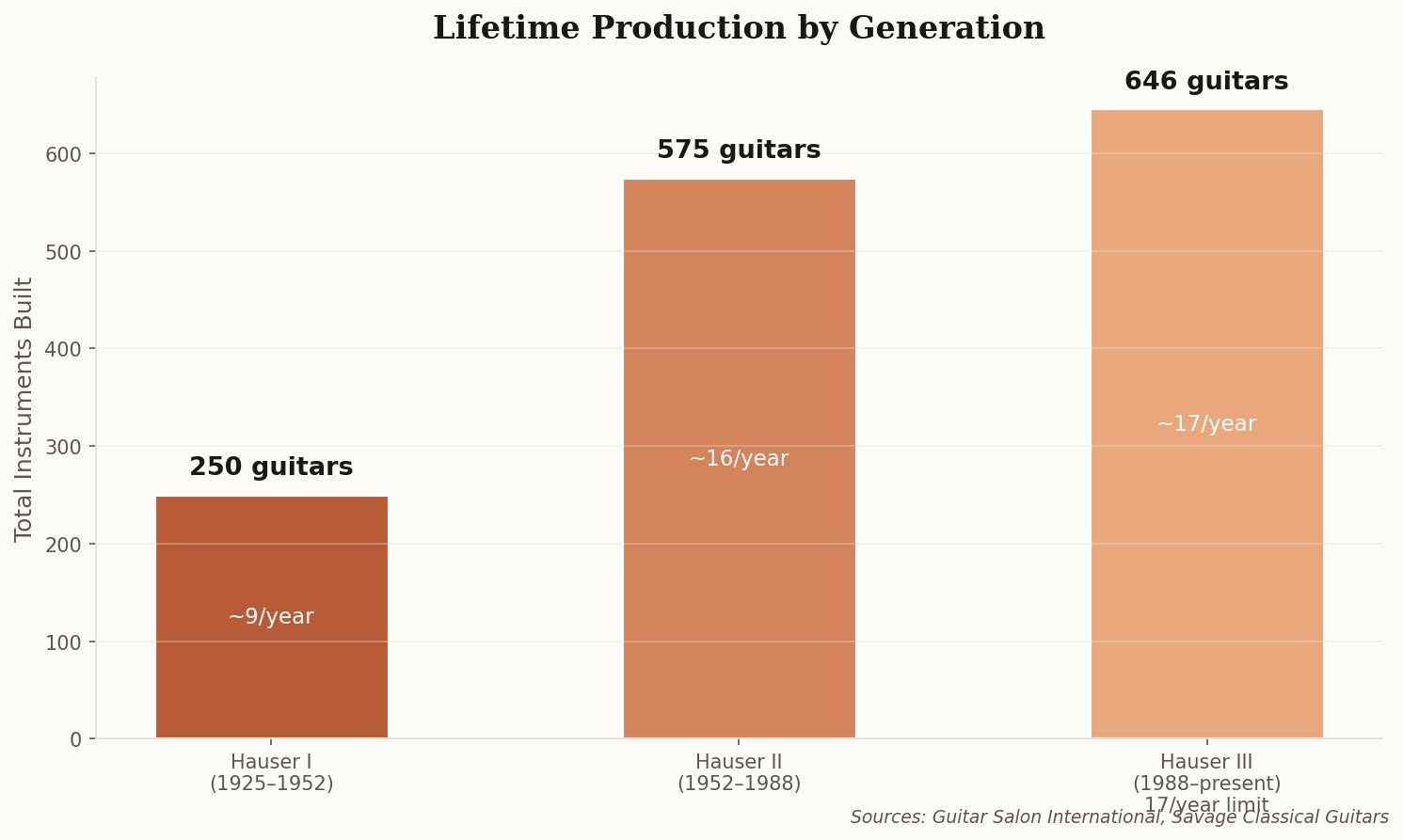
Here's the number that explains everything about Hauser pricing: Hermann Hauser I built approximately 250 Spanish-style guitars between 1925 and his death in 1952. That's fewer instruments in 27 years than some factories produce in a week. And because his thicker construction makes them more structurally robust than their Spanish counterparts, an unusually high percentage have survived in playable condition.

His son, Hauser II, was more prolific but still restrained—roughly 550 to 600 guitars numbered from #500 to about #1050 over three decades. And Hauser III? He limits himself to 17 guitars per year. Deliberately. Intentionally. In a world where demand far outstrips supply, he has chosen quality over revenue with a discipline that borders on stubbornness.

Bar chart comparing lifetime production numbers across three Hauser generations: ~250 for Hauser I, ~575 for Hauser II, and ~646 for Hauser III
Lifetime production by generation. Hauser III's self-imposed limit of 17 per year means his total after nearly four decades still doesn't match his grandfather's modest output.

The waiting list for a new Hauser III commission stretches five years or longer, with prices starting around $25,000. But the real premium is in provenance. A Hauser that passed through the hands of Segovia, Julian Bream, or the Romero family doesn't just cost more—it occupies a different category entirely.

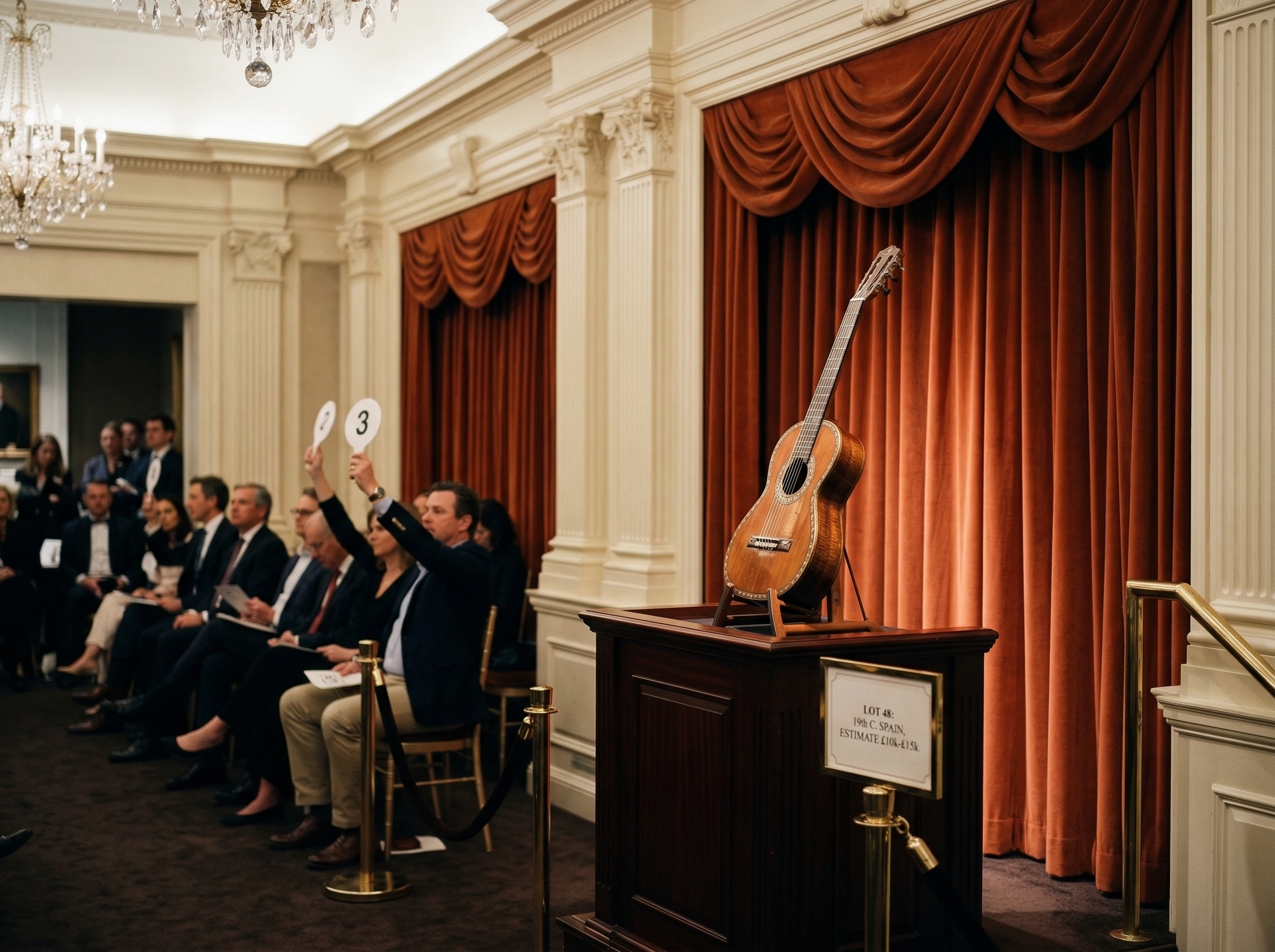
Elegant auction house with a classical guitar displayed on a podium under dramatic lighting
04

$180,000 for a Guitar—And It's Still Underpriced

In the violin world, a Stradivarius can fetch $16 million. In the guitar world, the ceiling is considerably lower—but Hauser I instruments consistently set the records. A 1948 Hauser I sold through Christie's for approximately $180,000, the highest documented price for a classical guitar at auction. Prime-era Hauser I models (1925–1952) typically trade between $80,000 and $160,000. Pre-1924 German-style Hauser instruments—before the Segovia influence—sell for a comparatively modest $10,000 to $25,000.

Bar chart showing Hauser guitar market value ranges: Hauser I from $80K to $180K, Hauser II from $35K to $65K, Hauser III from $15K to $30K
Current market value ranges by generation. The generational price cascade reflects both scarcity and the Segovia provenance premium that lifts Hauser I instruments into a class of their own.

Hauser II instruments command $35,000 to $65,000, with exceptional provenance pushing higher. And Hauser III guitars—still being built today—trade between $15,000 and $30,000 on the secondary market. In late 2025, a 1952 Hauser I (the Sophocles Papas model) changed hands privately for over $130,000. A 1998 Hauser III (#444) sold for about $22,000 in June 2024.

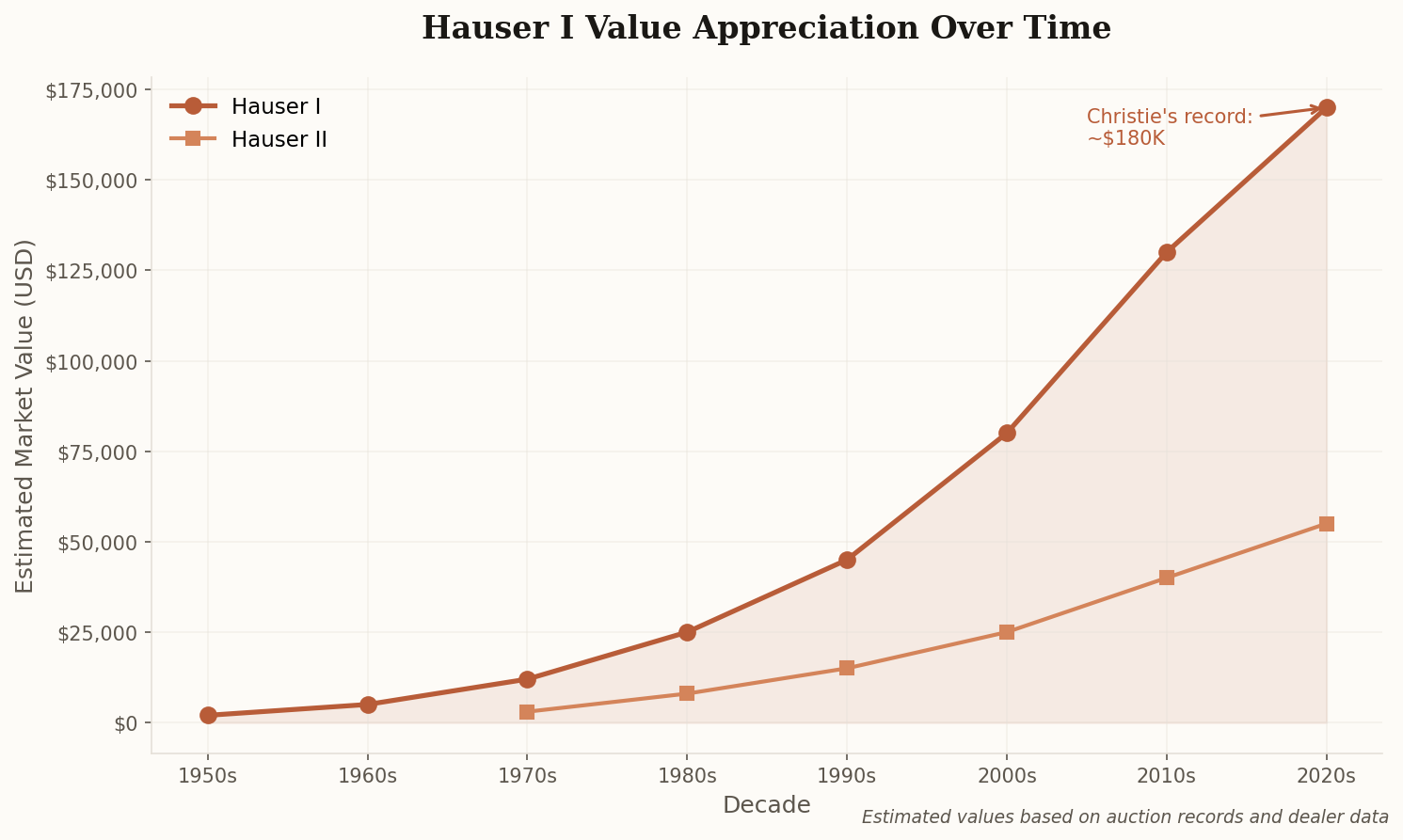
Line chart showing Hauser I guitar value appreciation from $2,000 in the 1950s to $170,000 in the 2020s
Estimated appreciation of Hauser I and Hauser II instruments over seven decades. The curve steepened dramatically after 2000 as the collector market matured and supply became functionally fixed.

The real story isn't the absolute numbers—it's the trajectory. A Hauser I that might have sold for $2,000 in the 1950s is now worth close to $170,000. That's an 85x return over seven decades, and unlike most collectibles, these instruments actually improve with age as the wood matures and the tone opens up. Try getting that from a stock portfolio.

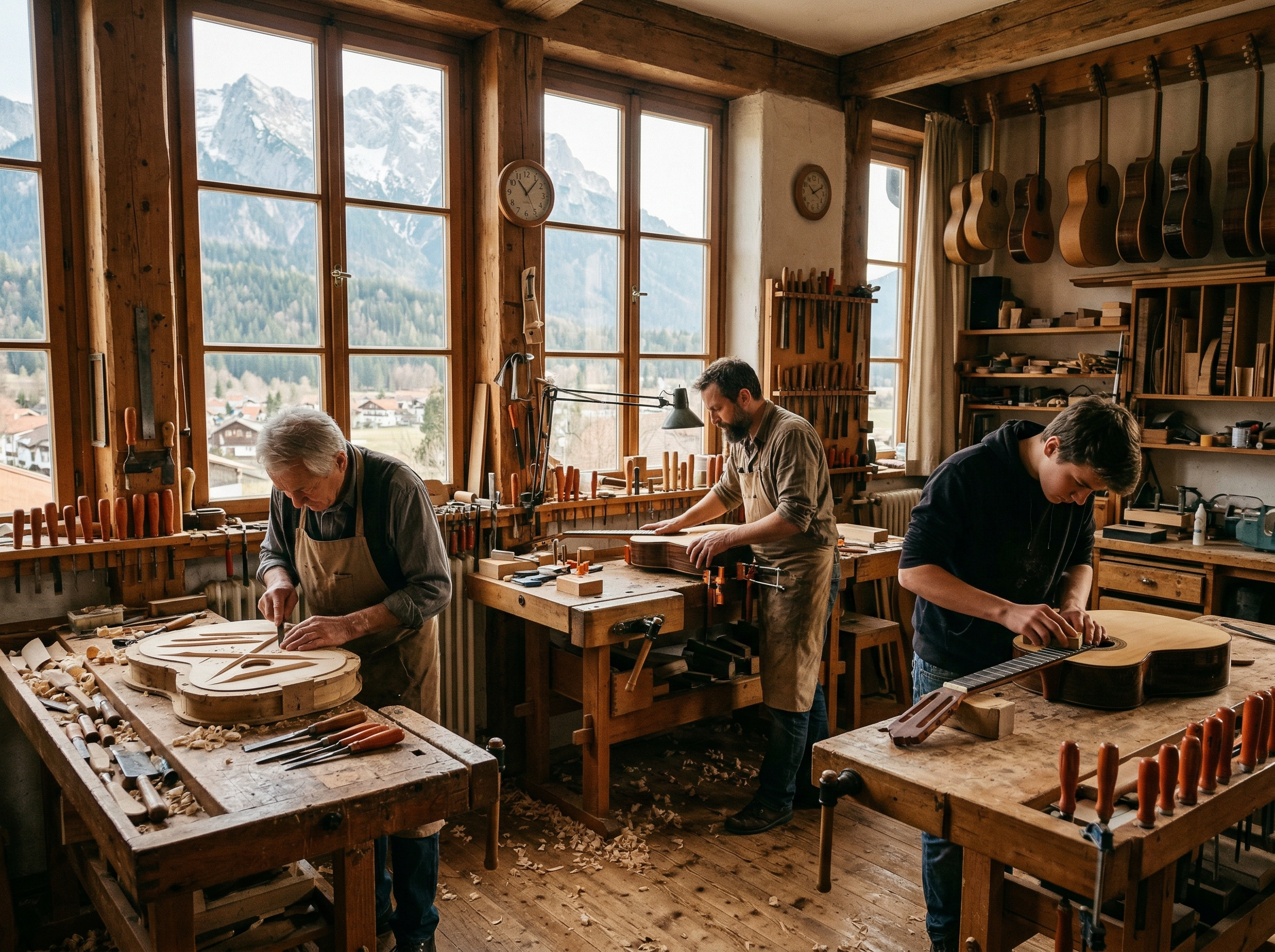
Multi-generational Bavarian luthier workshop with guitar construction in progress
05

Five Generations in Reisbach—The Workshop That Won't Scale

The Hauser workshop in Reisbach, Bavaria, is one of the few 19th-century luthiery traditions still operating within the same family. Hermann Hauser III continues building alongside Kathrin Hauser, representing the fifth generation of the family's craft. They still offer "Segovia" and "Llobet" commemorative models based on the original 1937 designs—instruments built to the same specifications that made Segovia stop playing his Ramírez overnight.

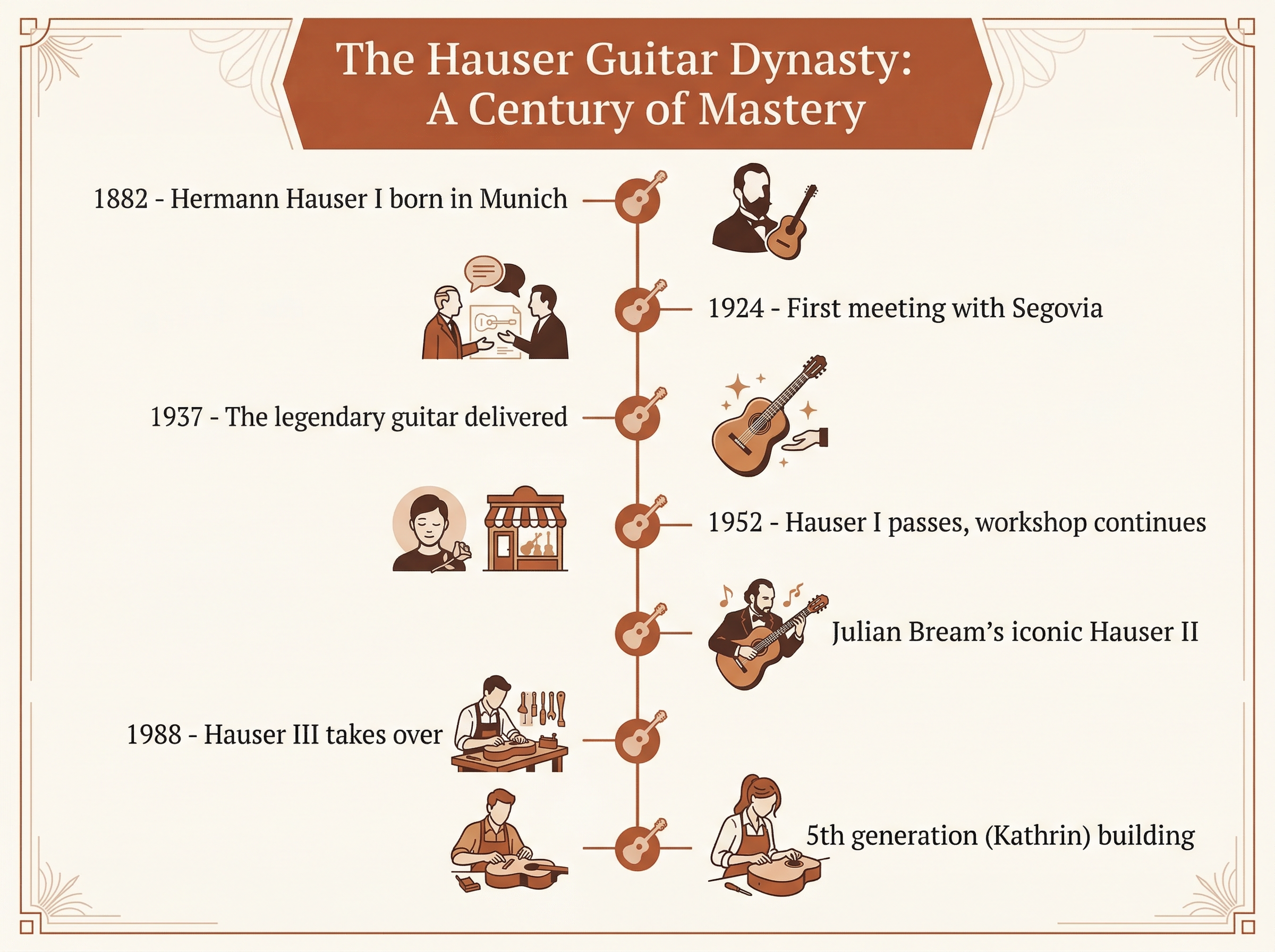
Timeline infographic showing the Hauser guitar dynasty from 1882 to present, with key milestones including the 1937 Segovia guitar
The Hauser Dynasty: A Century of Mastery — Generated with Nano Banana 2.0

Nearly every modern luthier building in the "traditional" style uses the 1937 Segovia Hauser as their primary blueprint. Walk into any serious classical guitar workshop from Tokyo to Toronto, and you'll find copies of Hauser's bracing patterns pinned to the wall. The influence isn't just historical—it's structural. Hauser I didn't just build great guitars; he codified a methodology that turned Spanish intuition into something repeatable, teachable, and endlessly refineable.

And yet the family refuses to scale. Seventeen guitars per year. A five-year wait. No factory line, no apprentice program expanding output. In a world obsessed with growth, the Hausers have decided that the right number is small enough to ensure every instrument leaves the workshop worthy of the name on the label.

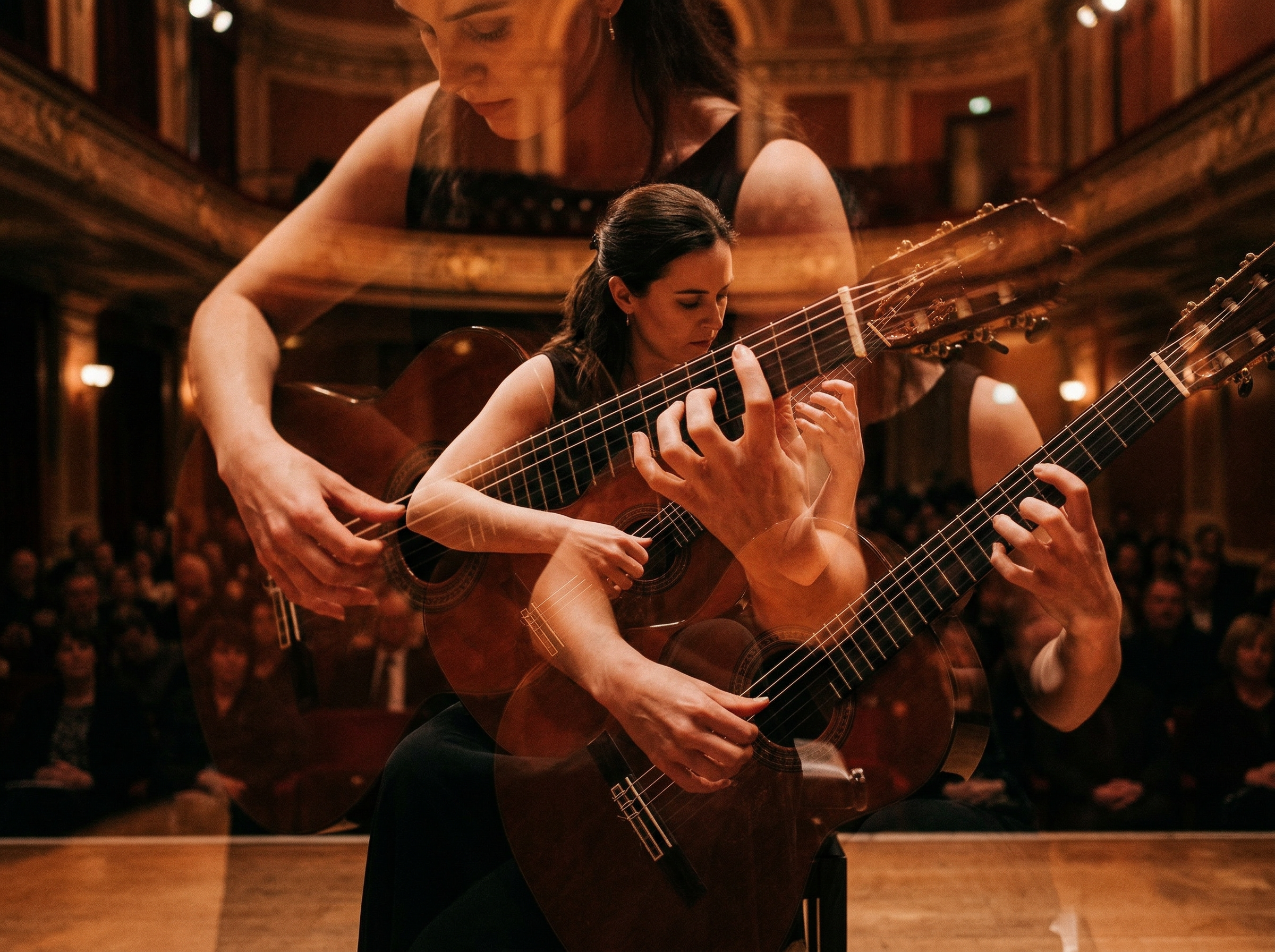
Concert stage atmosphere with classical guitarist performing, warm stage lighting
06

The Hands That Made the Legend

A guitar's reputation is built by the music that comes out of it. Segovia's endorsement created the legend, but a constellation of virtuosos sustained it. Julian Bream's 1957 Hauser II became the instrument behind "The Art of Julian Bream" and a library of iconic RCA recordings that defined the classical guitar's voice for a generation. Bream once described the guitar as having a "directness" that no other instrument could match—it was honest, it was immediate, and it didn't flatter a bad performance.

Pepe and Angel Romero of the legendary Romero family became lifelong advocates of Hauser III instruments, praising what they called the "purest sound" available. Miguel Llobet—the Catalan virtuoso who introduced Hauser I to Segovia in the first place—was himself a Hauser devotee. Even Django Reinhardt owned a Hauser, though his gypsy jazz playing represented a wholly different universe from Segovia's classical repertoire.

What unites these players across genres and generations is a shared conviction: a Hauser doesn't impose a sound. It reveals one. The guitar becomes a mirror for the artist's intention—brutally honest, endlessly responsive, and utterly unforgiving of laziness. That's why the greatest players choose them. Not because they sound beautiful by default, but because they make you sound exactly like yourself.

The Sound of Patience

In a world that optimizes for volume, speed, and scale, the Hauser workshop in Reisbach is a quiet rebuke. Seventeen guitars a year. Five generations of hands shaping Alpine spruce. The same bracing pattern that made Segovia set down his Ramírez in 1937. Some things aren't valuable because they're rare. They're rare because the people who make them decided that excellence has a number, and it's always smaller than demand.