Neuroscience + Film

Your Brain's Backup Battery

You can quote every line from The Princess Bride but couldn't tell someone how Inception ends. That's not a bug. It's your hippocampus making editorial decisions about what's worth keeping.

Listen
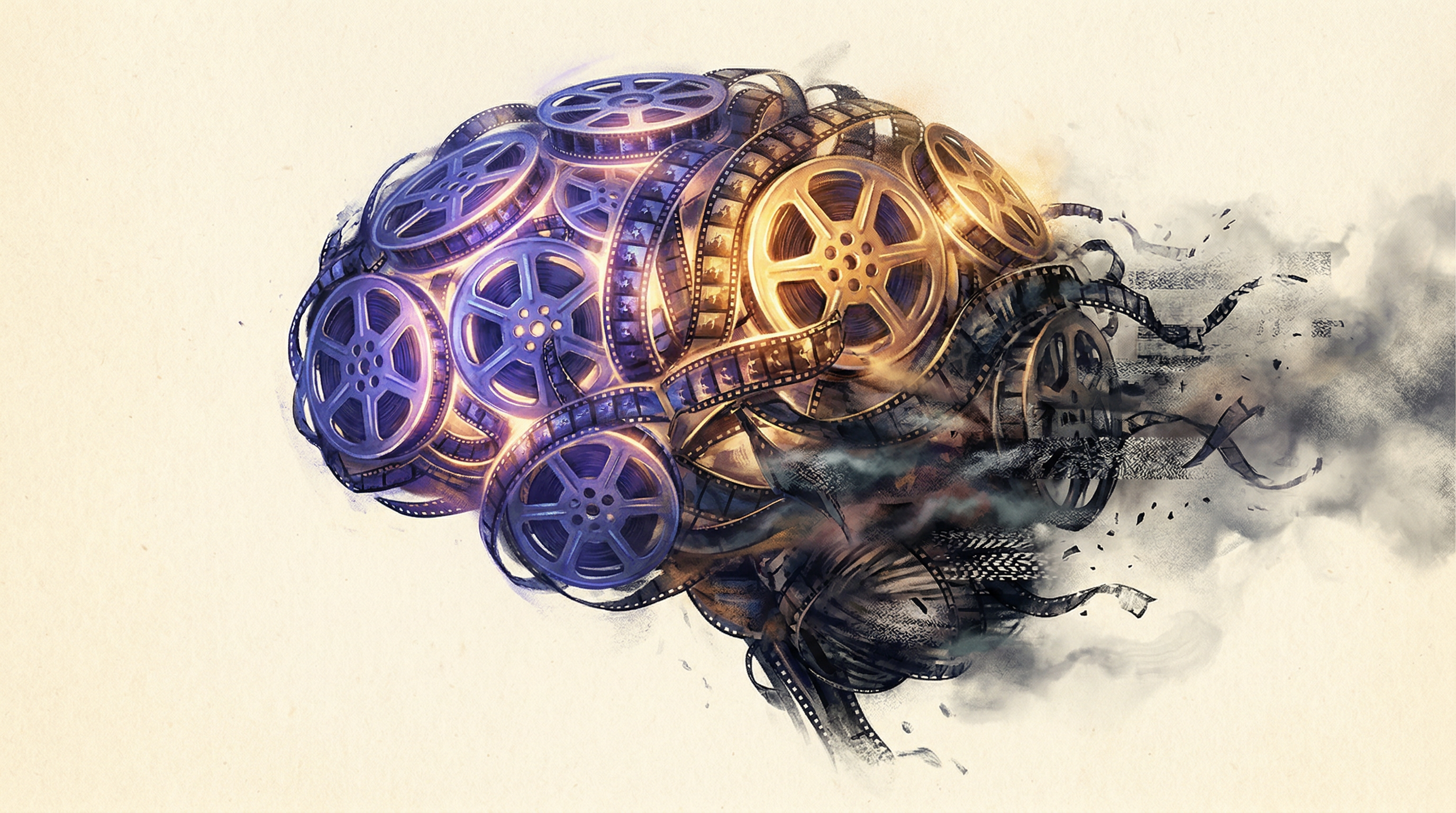
Surreal illustration of a brain made of film reels, some glowing vivid indigo and gold, others unraveling into fog
01

Your Brain Deletes Movie Endings on Purpose
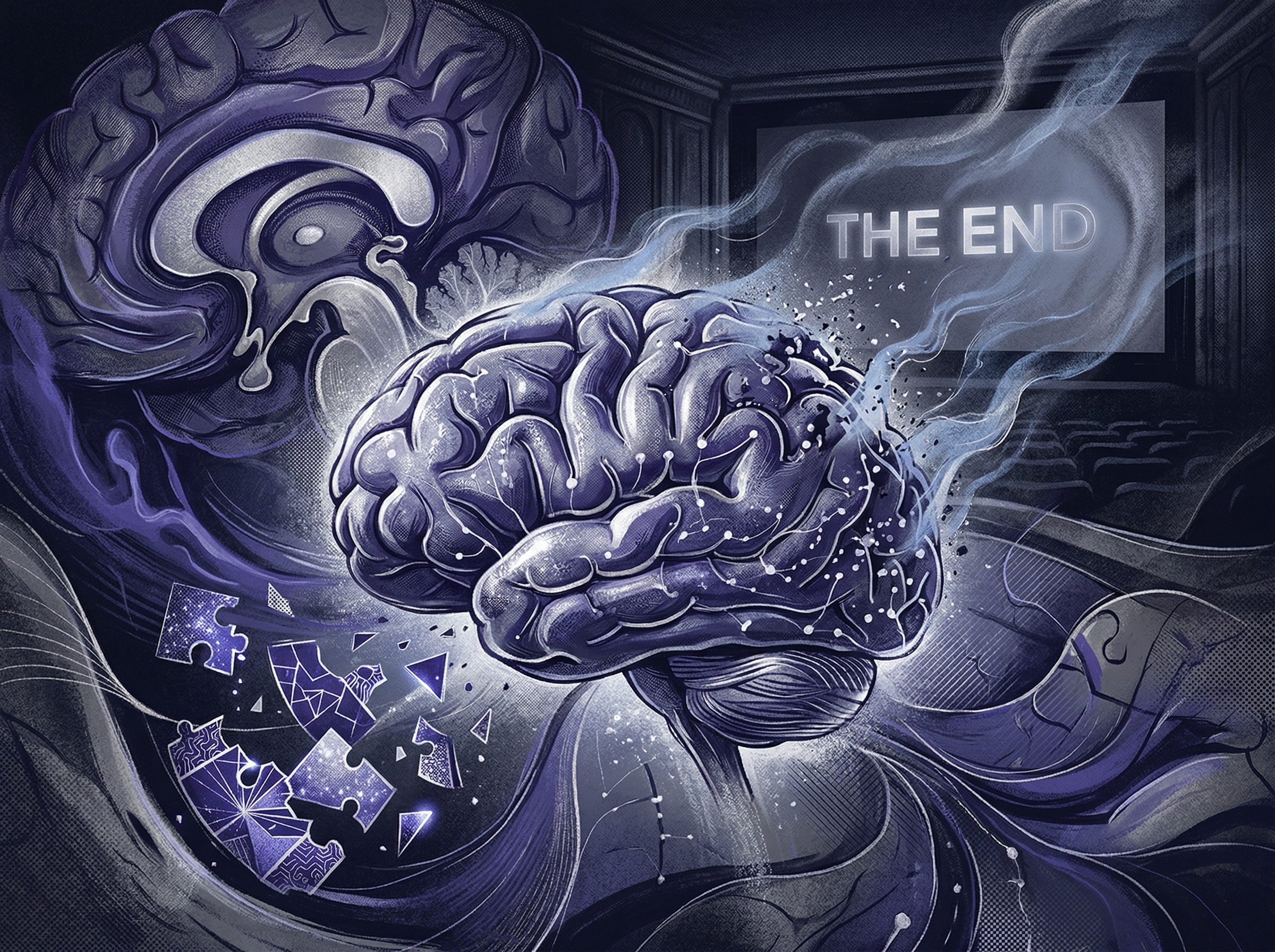
Abstract illustration of neural pathways dissolving like mist after a puzzle is solved, a fading movie screen showing THE END

Here's a test: describe the ending of a mystery you've watched three times. Not the general outcome — the specific sequence. The reveal, the confrontation, the final shot. If you're drawing a blank, congratulations: your brain is working exactly as intended.

New commentary on the Zeigarnik Effect from Psychology Today introduces what researchers are calling the "Closure Flush" — the cognitive equivalent of clearing your browser cache. While a story's central mystery remains unresolved, your brain maintains it in an active, high-priority buffer. Characters' motivations, clues, red herrings — all held in sharp focus because the "task" isn't complete. But the moment the killer is revealed or the couple finally gets together, your brain files a completion receipt and releases the specific mechanics to free up working memory.

This is why you can rewatch The Usual Suspects and still feel genuine surprise at the Keyser Söze reveal. Your brain kept the emotional weight — the sense of being fooled — but dumped the specific plot machinery that made the trick work. Resolution is your brain's signal to delete the cache.
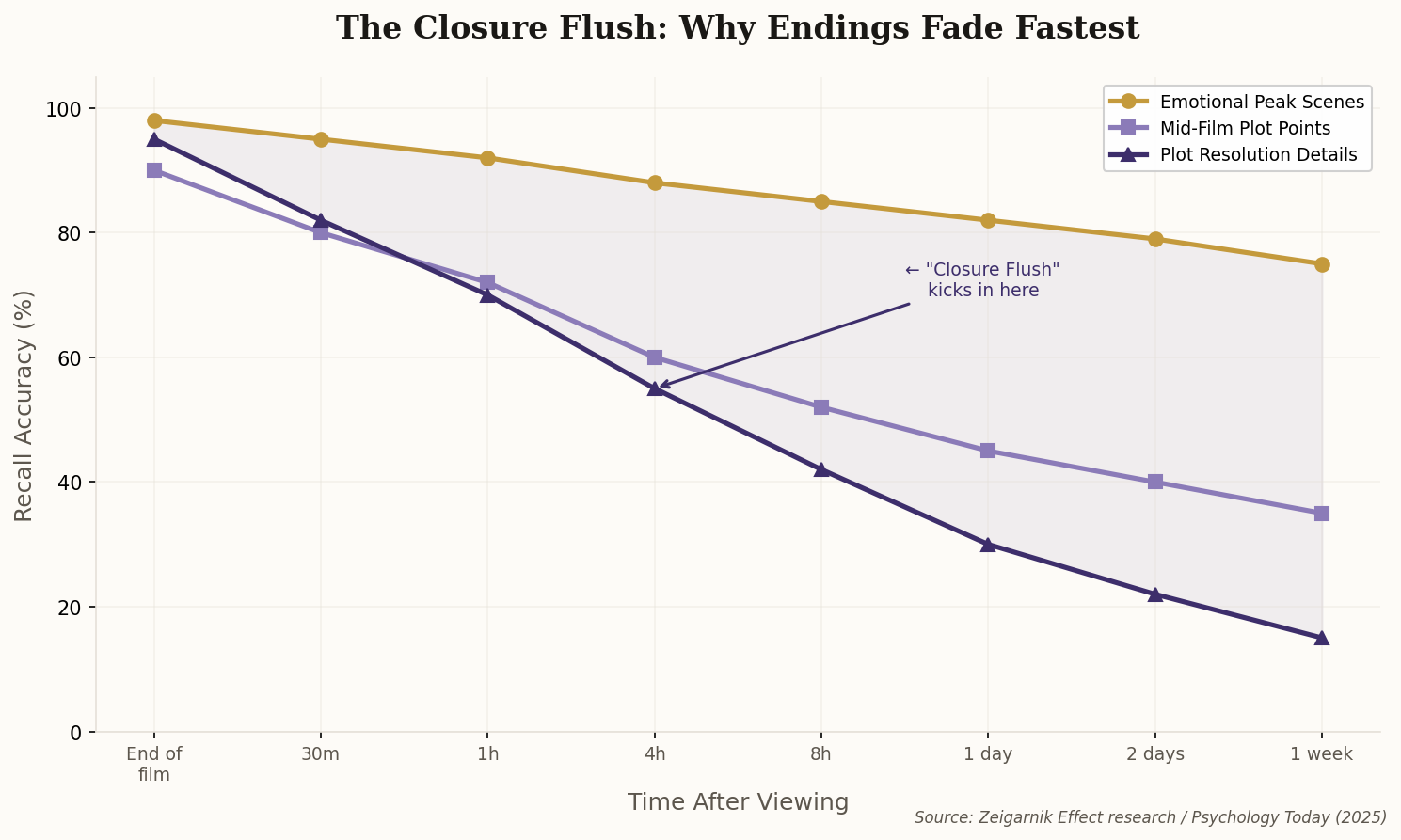
Line chart showing how emotional peak scenes retain 75% recall after one week while plot resolution details drop to just 15%
The "Closure Flush" in action: emotional peaks retain 5x better than plot resolutions over one week. The divergence begins within hours of viewing.

The implication cuts both ways. Movies with ambiguous endings — Mulholland Drive, No Country for Old Men, The Sopranos finale — dodge the flush entirely because the "task" is never marked complete. Your brain keeps chewing. That nagging feeling you have about a film years later? That's not frustration. That's your hippocampus refusing to let go of an open ticket.
02

The Dark Room Is Doing Half the Work

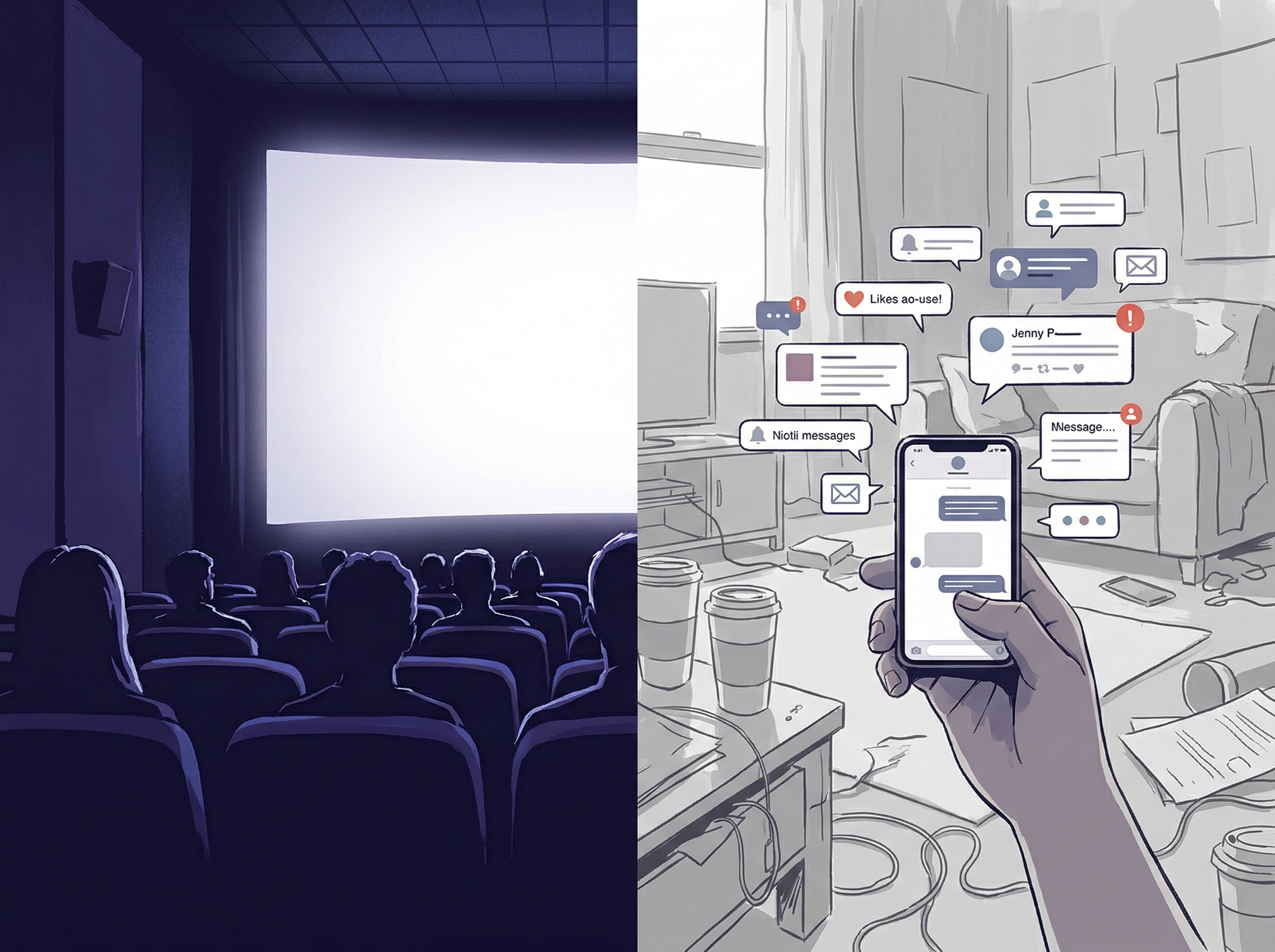
Split composition showing a dark movie theater with a glowing screen on the left, and a small phone screen in a bright room with notifications on the right

If you saw Jurassic Park in theaters in 1993, you can probably still feel the water glass trembling on the dashboard. If you watched it on your phone last month, you'd struggle to name three scenes. A neuroscience study from Publicis Groupe Denmark used functional near-infrared spectroscopy (fNIRS) to finally prove what cinephiles have argued for decades: the screen matters as much as the script.

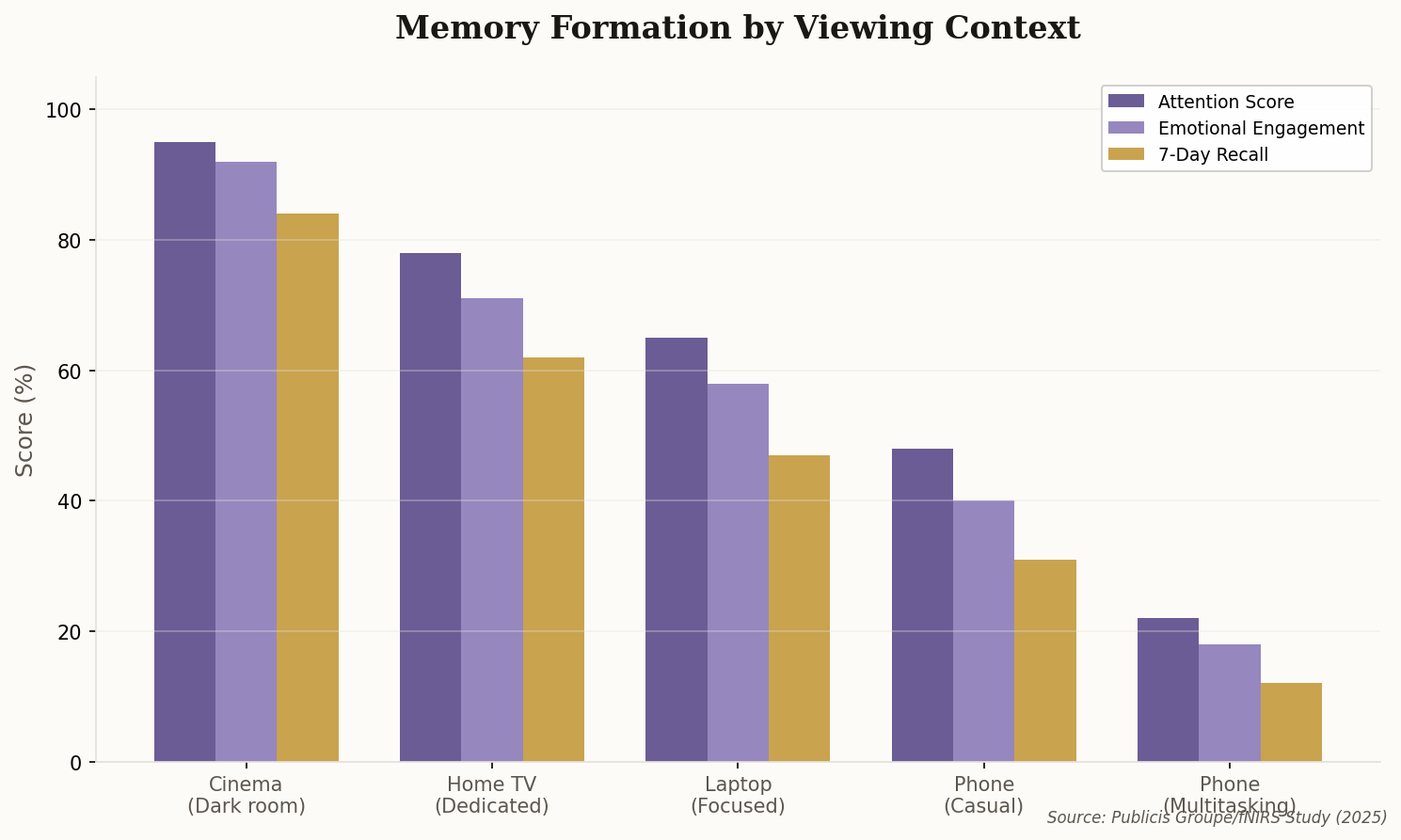
The study measured four "memory filters" — Attention, Attraction, Emotion, and Cognitive Load. Cinema was the only viewing medium to clear all four. Not TV. Not laptop. Certainly not mobile. When you're in a dark theater, your phone is off (or it should be), your peripheral vision is consumed by the screen, and a hundred strangers are sharing the same emotional wavelength. Your brain categorizes the experience as a personal episodic event — something that happened to you — rather than semantic information you passively absorbed.

Bar chart comparing attention, emotional engagement, and 7-day recall across cinema, home TV, laptop, and phone viewing contexts
Cinema clears all four memory filters. Phone multitasking retains just 12% at 7 days — barely better than not watching at all.

The researchers call this "Active Mental Relevance." It's the difference between remembering a concert and remembering a playlist. The theatrical experience creates a memory anchor that streaming — with its pauses, its notifications, its "Are you still watching?" interruptions — physically cannot replicate. Every filmmaker who insists their work "is meant to be seen in theaters" isn't being precious. They're being neurologically accurate.

03

Your Hippocampus Has a Save Button (And It's Picky)

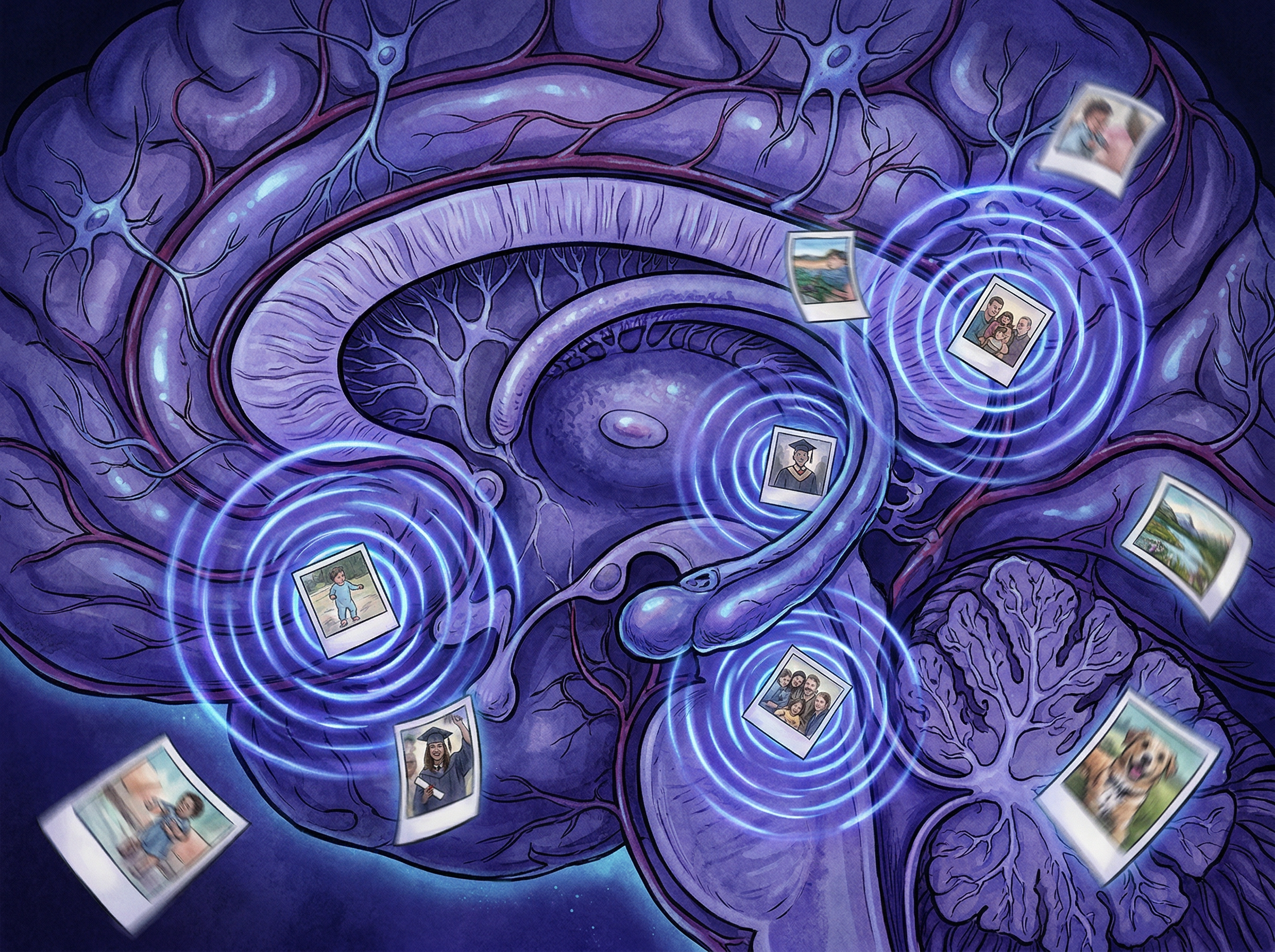
Macro cross-section of a brain with glowing indigo ripples emanating from the hippocampus, capturing tiny film frames like polaroid snapshots

Your brain doesn't record movies like a camcorder. It records them like an editor with a deadline and limited storage — capturing the scene transitions, discarding the filler, and making split-second decisions about what's worth the metabolic cost of long-term filing.

Groundbreaking intracranial research published in Nature Neuroscience found that high-frequency brain oscillations called "hippocampal ripples" spike at "event boundaries" — the moments when a scene changes, a character enters, or a narrative beat concludes. These ripples function as a neural save button, and their strength at any given boundary predicts whether that scene will be remembered months later. Not whether you paid attention. Not whether you liked it. Whether the ripple fired hard enough.

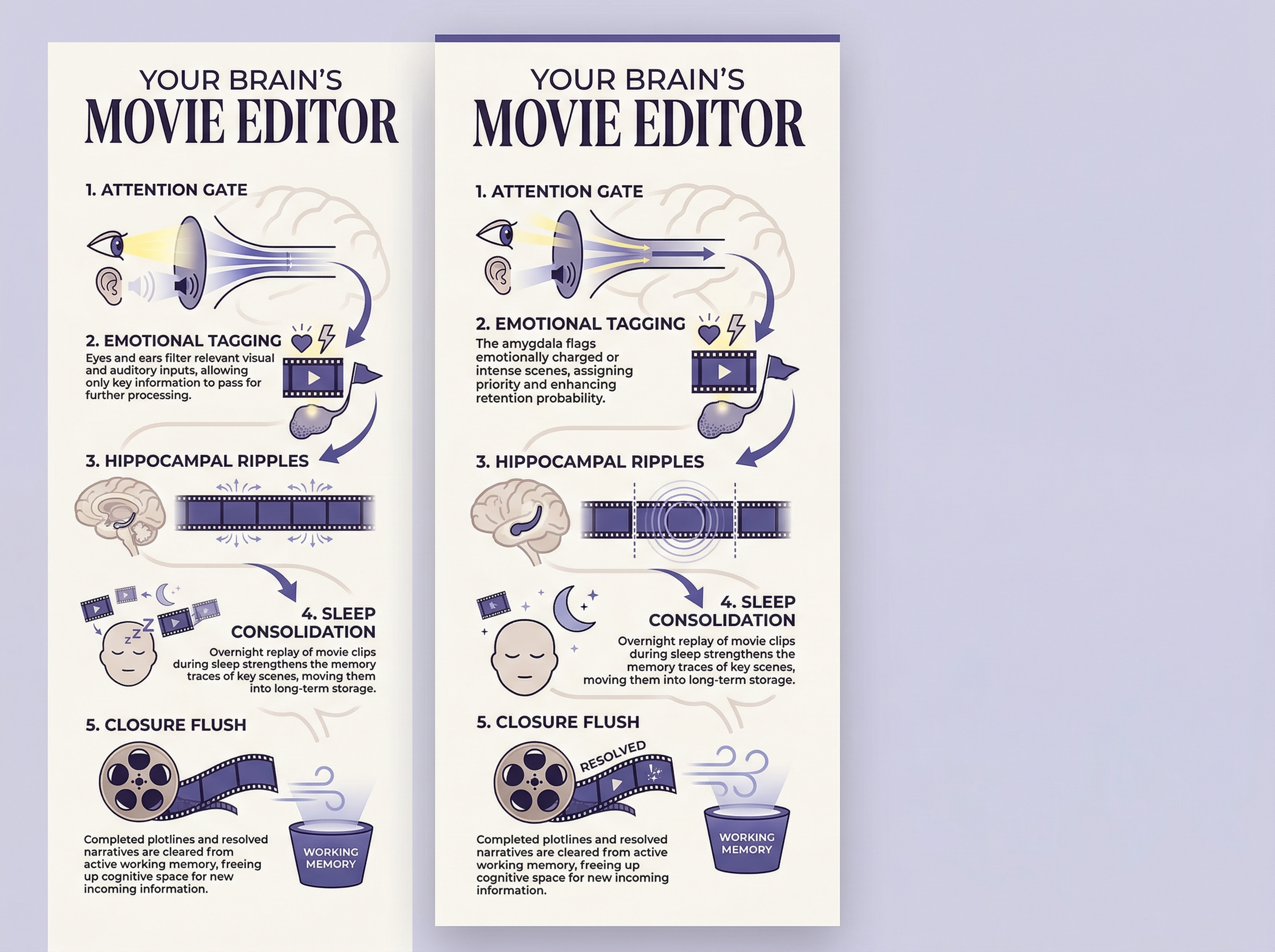
Infographic showing 5 stages of how the brain processes and stores film memories: Attention Gate, Emotional Tagging, Hippocampal Ripples, Sleep Consolidation, and Closure Flush
Your Brain's Movie Editor: the 5-stage pipeline from screen to long-term memory

This explains why you remember movies as a highlight reel rather than a continuous experience. Your brain is segmenting the narrative into discrete "chapters," and the strength of the neural reset between chapters determines what survives. A well-edited film with clear scene transitions and strong emotional beats gives the hippocampus clean boundaries to work with. A muddled, tonally flat film? The ripples barely register. The movie washes over you and leaves nothing behind — not because you weren't watching, but because your brain's editor found nothing worth clipping.

04

Binge-Watching Is Memory's Worst Enemy

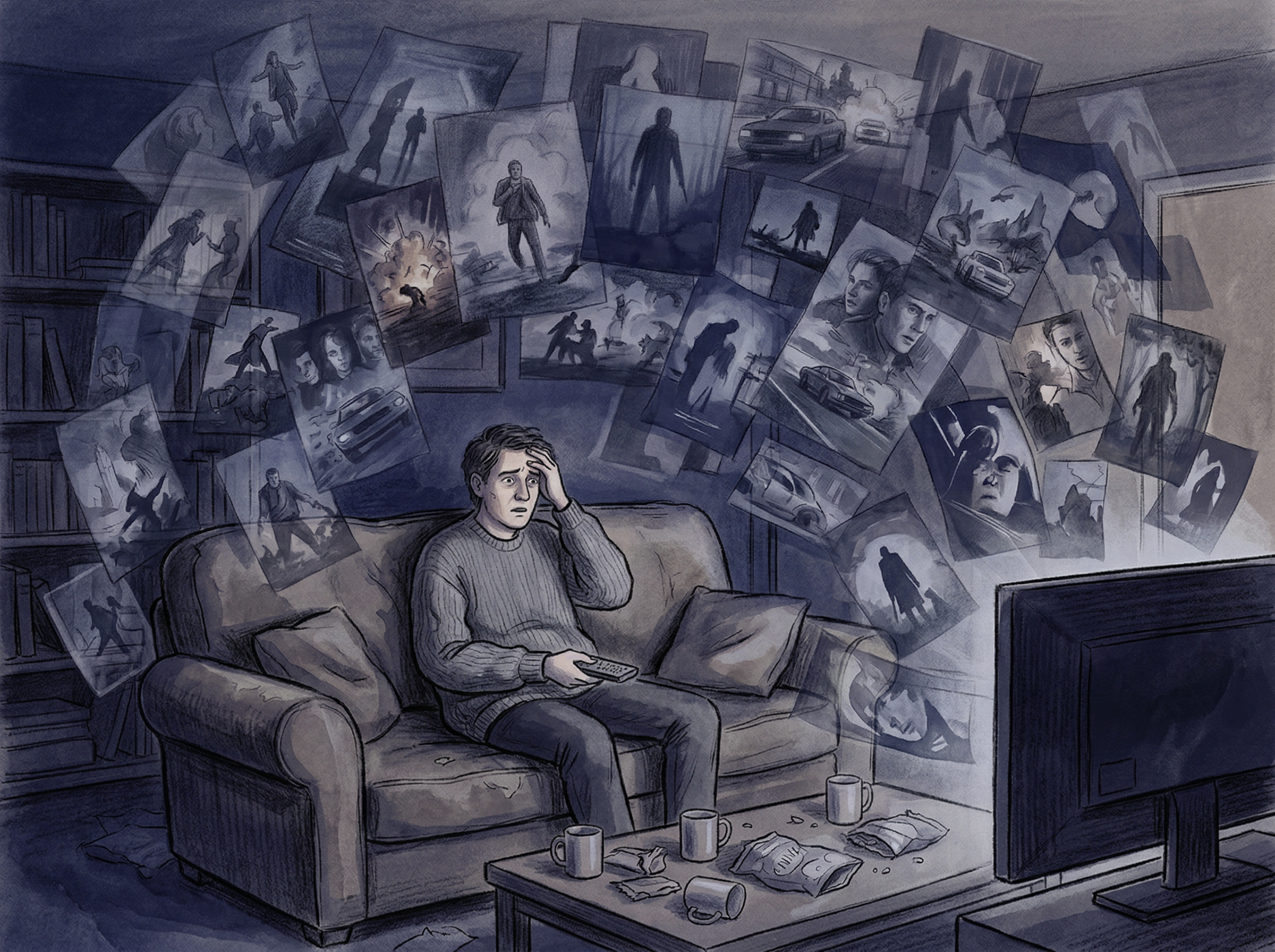
A person on a couch surrounded by dozens of ghostly transparent fading movie posters overlapping, representing plot interference from binge-watching

Here's a thought experiment: name every movie you watched in December. Not just the ones you loved — all of them. If you're a typical streamer, you watched 8-12 films that month and can recall maybe three with any specificity. The rest have blurred into a comfortable fog of "yeah, I think I saw that."

A new paper in Cognitive Science calls this "interference" — the technical term for what happens when you stack narrative experiences without giving your brain time to consolidate them. When you watch a film in a theater on Saturday and spend Sunday thinking about it, your brain runs "sleep-based consolidation," replaying key scenes during REM sleep and weaving them into your existing mental models. When you watch four films in a row on Netflix, each subsequent story actively degrades the encoding of the one before it. The plots don't just blur together — they compete for the same neural real estate.

The paper goes further, arguing that the ease of "just Googling the ending" creates what they call "digital amnesia for art." When you know you can look something up, your brain simply doesn't bother encoding it. It's the same mechanism that makes us terrible at remembering phone numbers now that our contacts app handles it. We're outsourcing our relationship with art to an algorithm, and the result is a generation that watches more movies than any in human history while remembering fewer of them.

The fix is almost embarrassingly simple: space your viewing. Watch one film. Sleep on it. Talk about it with someone. Then watch the next one. Your great-grandparents didn't have a choice — a movie came to the local theater for one week and then it was gone. Turns out that scarcity was doing more cognitive work than anyone realized.

05

The Last Five Minutes Run the Whole Show

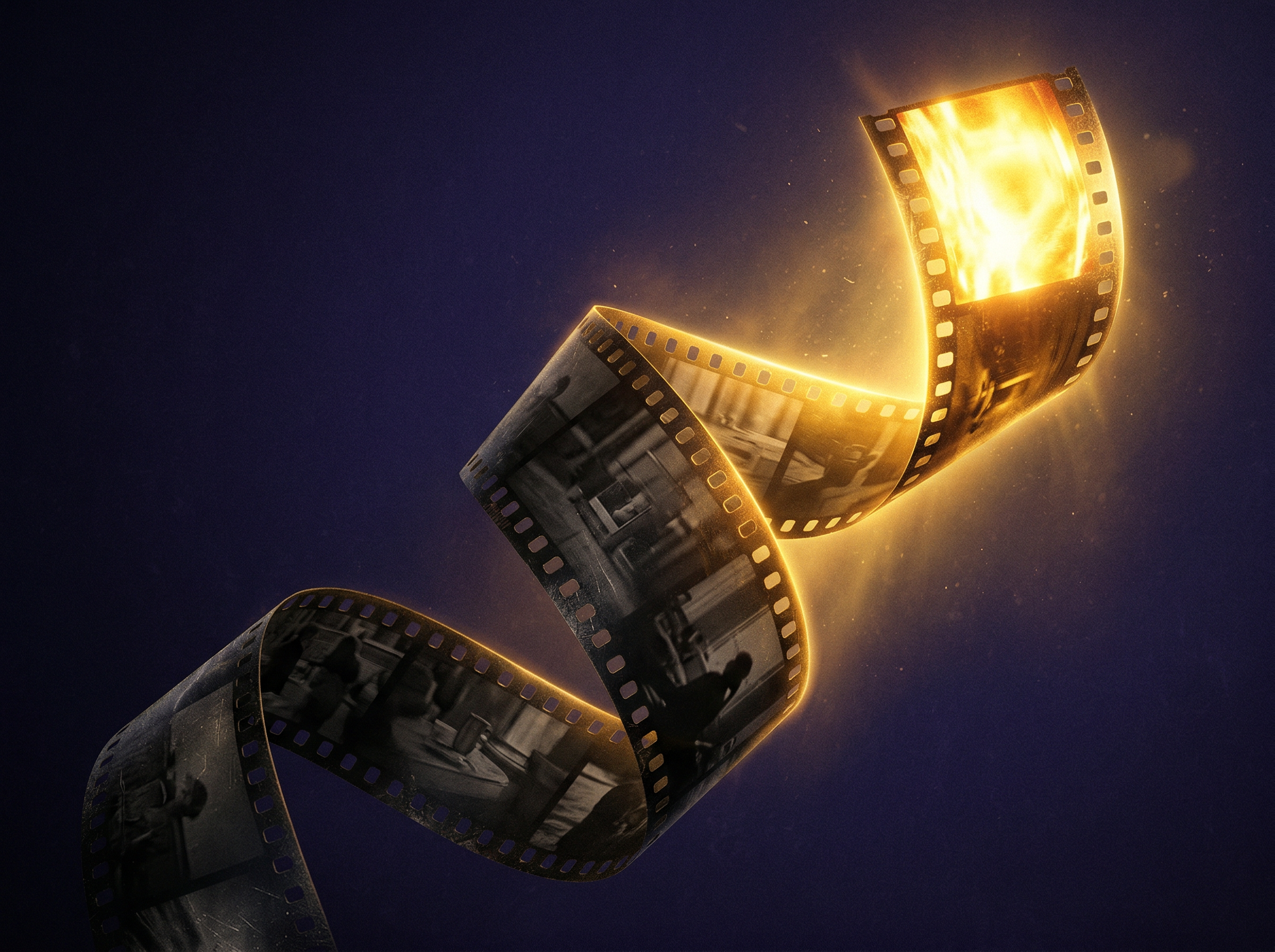
A dramatic film strip curling upward, the final frame blazing with intense golden light while middle frames are dim

Daniel Kahneman's Peak-End Rule was originally about colonoscopies and ice-cold water, but it explains more about movie culture than any film theory textbook. The rule is brutally simple: your brain judges an experience based on two data points — the most intense emotional moment (the Peak) and the final moment (the End). Everything in between is essentially averaged out.

This has enormous consequences for how we remember films. A mediocre two-hour movie with one spectacular chase scene and a satisfying final shot will be remembered as "great." A genuinely excellent film with a botched ending will be remembered as "disappointing" — no matter how brilliant the preceding 110 minutes were. Game of Thrones fans know this rule intimately. Six seasons of the best television ever made, retroactively flattened by two seasons of declining quality and a finale that left millions feeling betrayed. The Peak was there. The End destroyed the archive.

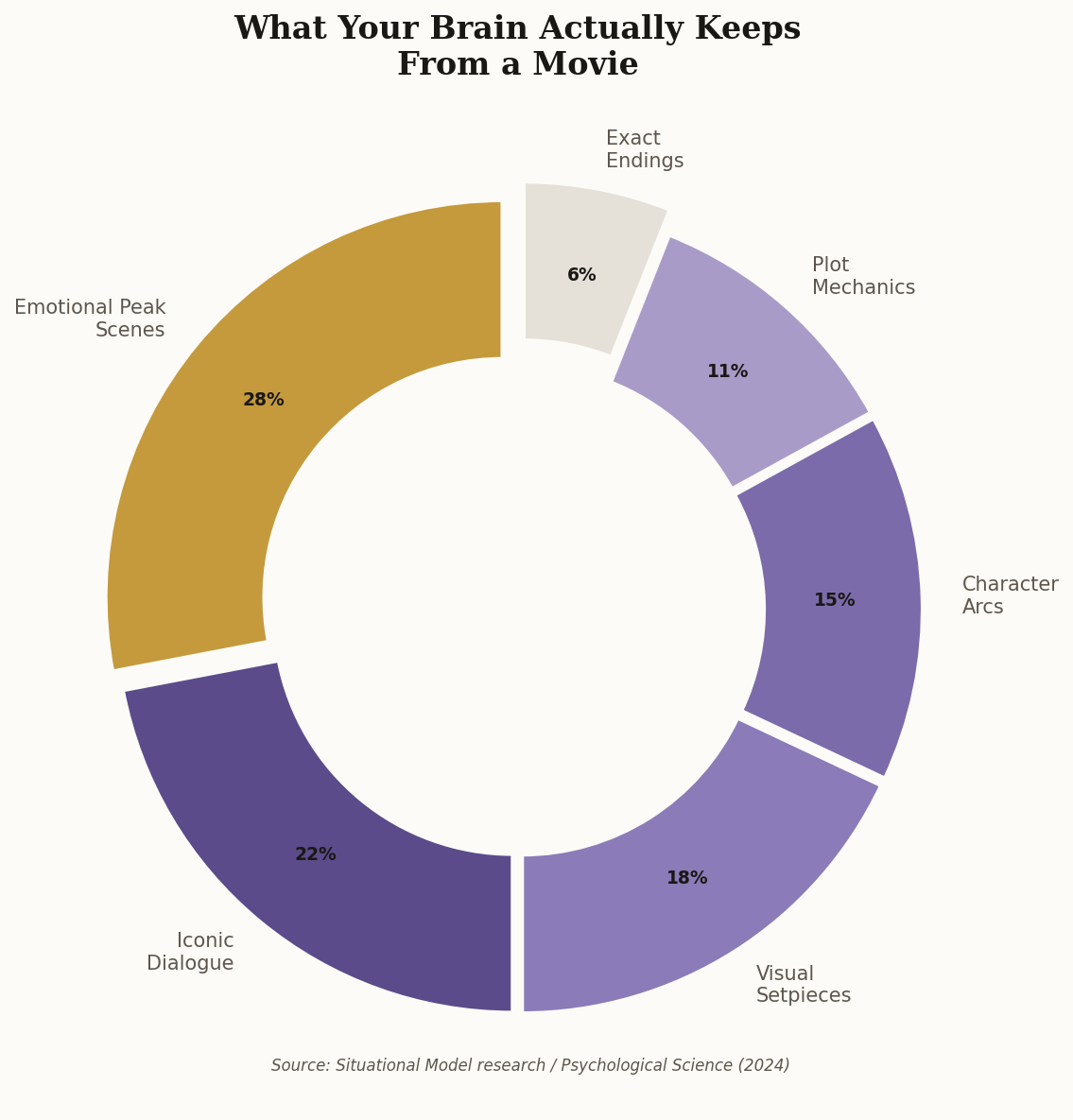
Donut chart showing what the brain actually keeps from a movie: 28% emotional peak scenes, 22% iconic dialogue, 18% visual setpieces, 15% character arcs, 11% plot mechanics, 6% exact endings
What your brain actually files from a 2-hour movie. Emotional peaks dominate; exact endings barely register at 6%.

The flip side is equally revealing. This is why franchise loyalty works: if the ending of a Marvel film sticks the landing — even if the middle sagged — audiences return for the sequel. The remembering self writes a favorable review. It also explains the "word-for-word" phenomenon. The lines we memorize are almost always from Peak moments: "Here's looking at you, kid." "I am your father." "You can't handle the truth." These are emotional summits, and our brain treats them as the entire mountain.

06

The Molecular Glue That Makes Childhood Movies Immortal

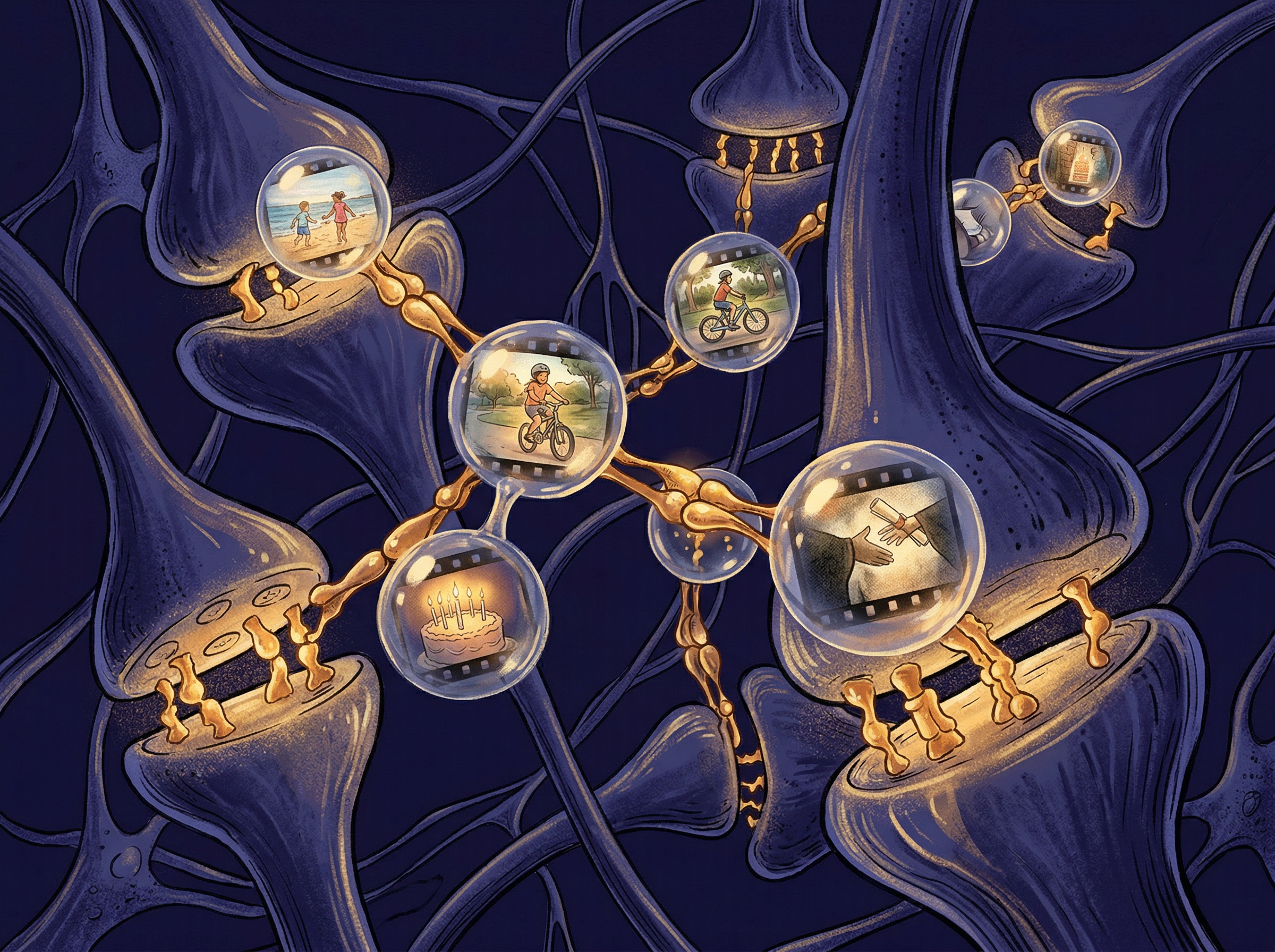
Microscopic view of synaptic connections with glowing amber molecular bridges holding together vivid memory fragments of film scenes

Every cell in your body replaces itself over a span of roughly seven years. Every protein in your brain turns over even faster. So how can you still recite the entire "Inconceivable!" exchange from The Princess Bride twenty years after you last watched it? The answer, published in Science Advances, is a molecule called KIBRA.

KIBRA functions as a "synaptic tag" — molecular glue that sticks to the neural connections encoding your strongest memories and protects them from the brain's natural protein recycling. When you watch a scene with high emotional engagement — terror, joy, awe, heartbreak — KIBRA gets deployed to the synapses that fired during that experience. It marks them as "keep," and those connections persist even as the surrounding cellular architecture is rebuilt from scratch. The memory survives because the tag survives.

This is the biological answer to why childhood movie memories feel qualitatively different from adult ones. Children experience films with an intensity of emotion that most adults rarely access. That first viewing of The Lion King, E.T., or Toy Story triggered KIBRA deployment at a scale that a jaded thirty-something watching yet another Netflix original simply can't match. The memories from those childhood viewings aren't just psychologically special — they're molecularly fortified. Your brain literally built a stronger cage around them.

The practical implication? If you want a movie to stick, you need to feel something while watching it. Not "appreciate" it intellectually. Not "admire" the cinematography. Actually feel transported. KIBRA doesn't care about your Letterboxd rating. It responds to awe, to grief, to the full-body shiver when a soundtrack hits at exactly the right moment. The movies you remember word-for-word are the ones where you forgot you were watching a movie at all.

The Reel You Keep

Your memory isn't broken — it's curated. Every forgotten ending is your brain making room for what actually mattered: the moments that made you gasp, laugh, or cry. The next time you can't remember how a movie ended, consider that you might be remembering exactly the right parts. The question isn't why you forget. It's what you chose to keep — and what that says about the stories that shaped you.