

Your Nose Could Fix Your Knee
Here's a sentence you didn't expect to read today: the cartilage slowly drooping your nose into your chin might be the key to curing osteoarthritis. The ENCANTO project, an EU-funded clinical trial, has discovered that nasal septum chondrocytes — the cells in your nose cartilage — are vastly more resilient than the cartilage in your joints. They're taking small biopsies from patients' nasal septums, growing them in a lab, and successfully transplanting them into destroyed knee joints.
The technique is called N-TEC (Nasal chondrocyte-based Tissue-Engineered Cartilage), and the results are striking. Unlike joint cartilage, nasal chondrocytes retain their ability to proliferate and form new tissue well into old age. The very property that makes your nose keep "growing" — cartilage cells that refuse to fully quit — turns out to be therapeutic gold when redirected to a joint that desperately needs fresh tissue.
For decades, the slow expansion of nasal cartilage was considered nothing more than a cosmetic nuisance of aging. Now it's being harvested as a regenerative resource. The tissue you'd pay a surgeon to reduce might be the tissue another surgeon needs to rebuild your mobility. That's not just clever science — it's a fundamental reframe of what "aging tissue" means.

The Zombie Cells Behind Your Drooping Face
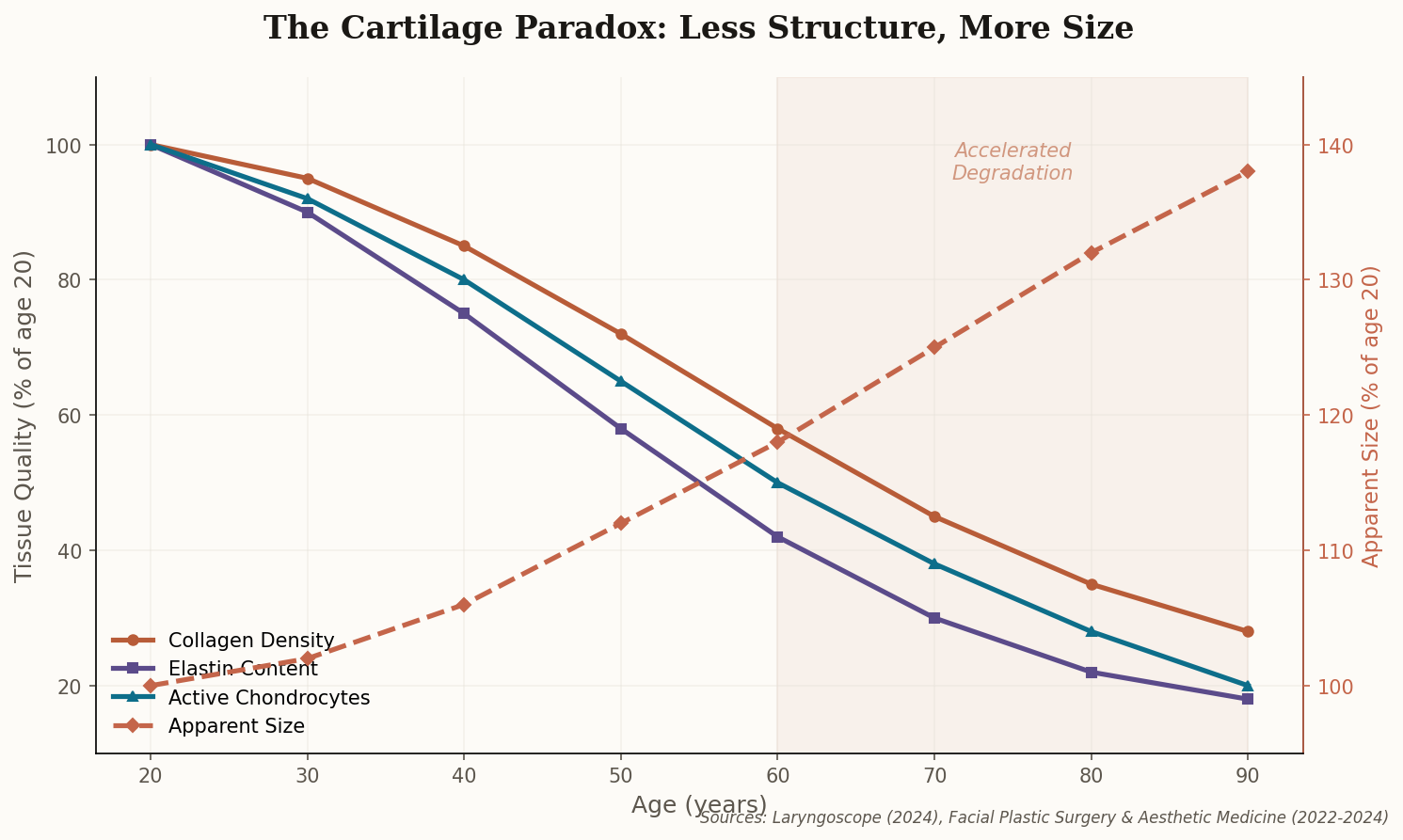
The reason your nose droops and your ears elongate isn't because cartilage cells are multiplying uncontrollably. It's something more unsettling: they're becoming zombies. Research published in 2025 identified that aging cartilage cells accumulate high levels of p16 and p21 proteins, which effectively transform them into senescent cells — alive but no longer dividing, and actively hostile to their neighbors.
These "zombie" chondrocytes secrete a cocktail of inflammatory enzymes called SASP (Senescence-Associated Secretory Phenotype) that degrades the surrounding healthy cartilage matrix. The collagen scaffold weakens. The elastin loses its snap. Gravity does the rest. The result isn't growth — it's structural collapse disguised as growth. Your nose isn't getting bigger because cells are proliferating. It's getting bigger because the scaffolding is giving way.

The promising angle? Experimental senolytic drugs are being tested to selectively clear these zombie cells. If they work, we might not just slow the drooping — we might fundamentally change how cartilage ages. The first trials are targeting joint cartilage (where the functional stakes are highest), but the implications for facial cartilage are obvious.

Your Face Is a Biological Clock
If your nose and ears are growing at a predictable rate, could you use them as a clock? Researchers in 2025 and 2026 are doing exactly that — using AI-driven 3D facial scans to measure the millimeter-precise expansion of the nasal base and earlobe length, then correlating those measurements with a person's overall "biological age." The idea is elegantly simple: your face is a living readout of your cellular health.
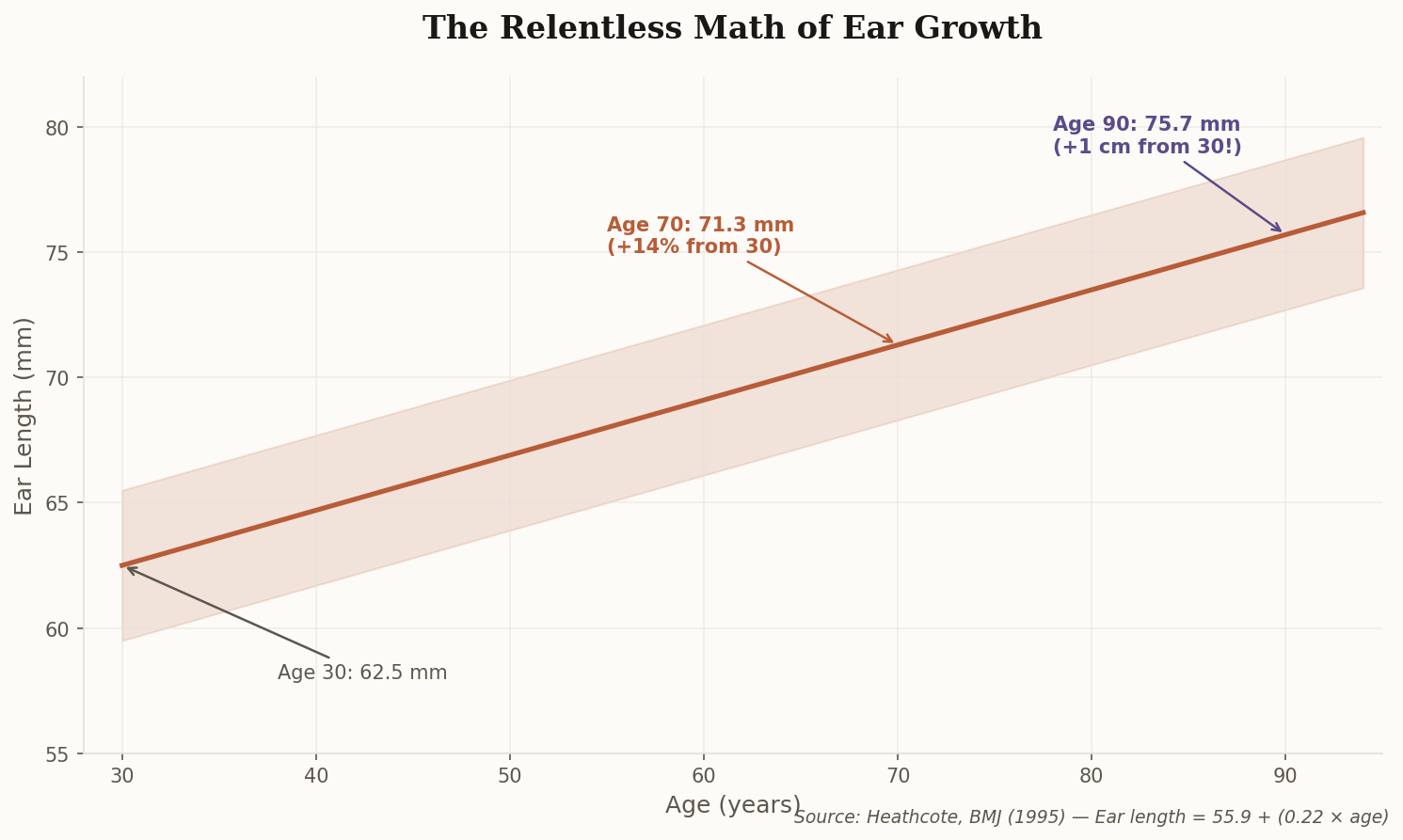
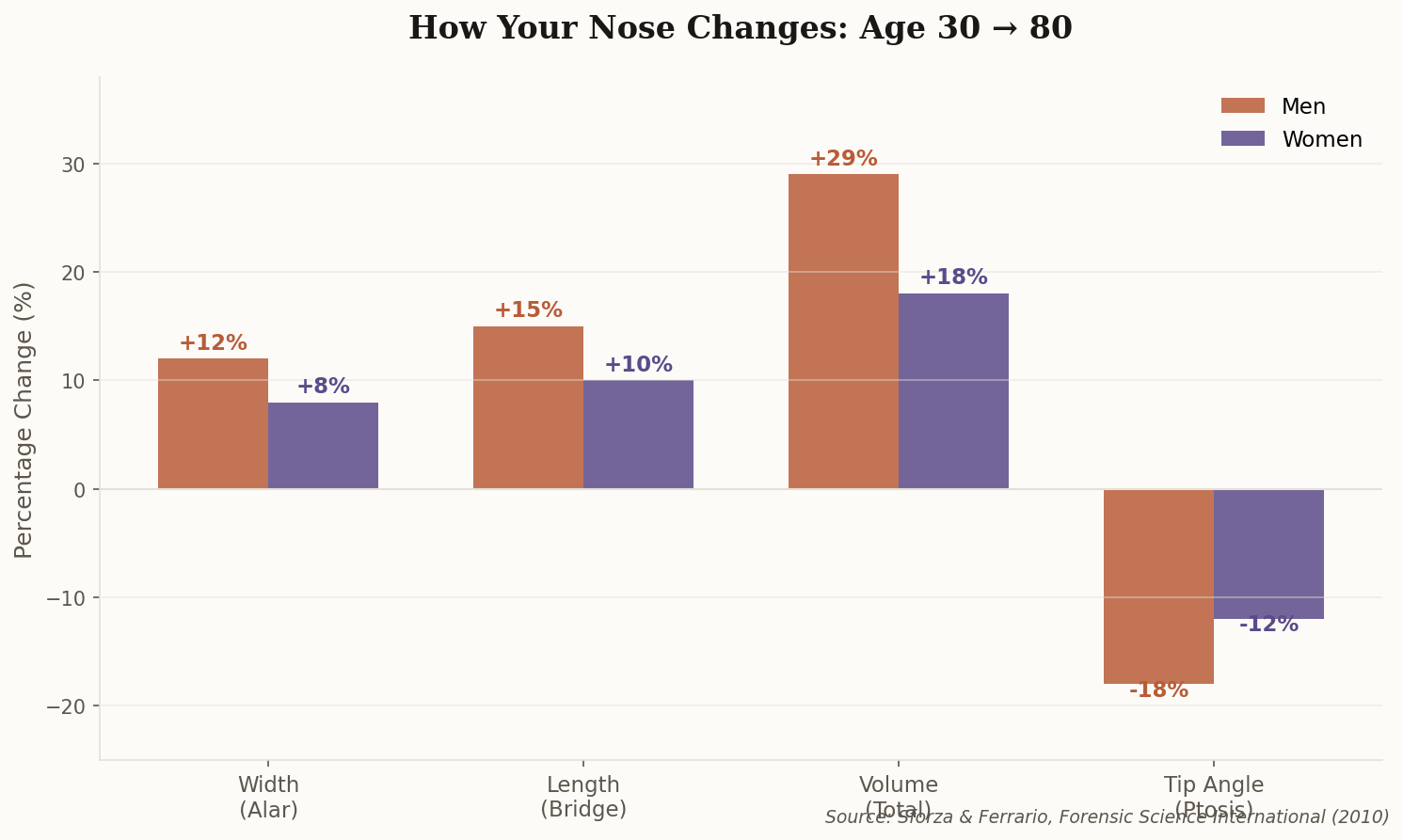
This builds on decades of forensic measurement. The landmark 1995 BMJ study by Dr. James Heathcote — charmingly titled "Why do old men have big ears?" — established that ears elongate at an eerily consistent 0.22 mm per year. The math is almost absurdly clean: Ear length (mm) = 55.9 + (0.22 × age). A 2010 University of Milan study added the nose data, mapping 1,000 Italian faces and finding nasal volume increases by 29% in men and 18% in women between ages 30 and 80.
The new AI approach goes further. Instead of measuring one dimension, it captures the entire 3D topology of facial change — the widening of the alar base, the drooping of the nasal tip, the elongation and thinning of earlobes. The thesis is provocative: someone whose facial cartilage is aging faster than their chronological age might have accelerated systemic aging. Your face might predict your health trajectory better than a blood panel.

Eartox and the Rise of Cartilage Cosmetics
The cosmetic industry has noticed your drooping cartilage, and it has opinions. "Eartox" — dermal fillers injected into aging earlobes to restore volume — has become one of the fastest-growing procedures in aesthetic medicine. Meanwhile, Botox is being injected into the depressor septi nasi muscle to prevent it from pulling the nasal tip downward. Welcome to the age of cartilage cosmetics.
But this isn't purely vanity medicine. The functional consequences of aging cartilage are significant and underappreciated. As ear cartilage weakens, the cartilaginous portion of the ear canal can physically collapse, narrowing the opening and trapping earwax. Cerumen impaction affects 25% to 65% of nursing home residents, causing conductive hearing loss that often gets misdiagnosed as cognitive decline. Similarly, nasal valve collapse from weakened alar cartilage contributes to obstructive sleep apnea.
Rhinoplasty for older adults (50+) is rising, but healing takes 25–40% longer due to decreased blood flow and thickened nasal skin. The more interesting development is the non-surgical space: injectable collagen stimulators, hyaluronic acid fillers for nasal tip support, and even thread lifts for ear reshaping. The line between "cosmetic" and "functional" has never been blurrier — a filler that restores earlobe volume might also prevent the canal collapse that leads to hearing loss.

0.22 Millimeters Per Year
The science of ear growth has a founding father, and his name is James Heathcote. In 1995, this British GP measured the ears of 206 patients between ages 30 and 93 and published his findings in the BMJ under the title that launched a thousand dinner-party conversations: "Why do old men have big ears?" His answer was precise: ears elongate by 0.22 mm per year, every year, without exception.
The Japanese followed up in 1996, confirming the results. Then the Italians went further — Sforza and Ferrario at the University of Milan mapped 1,000 faces using 3D morphometry and added the nose to the equation. Between ages 30 and 80, nasal volume increases by roughly 29% in men and 18% in women. The nasal tip angle decreases progressively, producing the characteristic "hooked" appearance of extreme old age. Men's noses are larger at every age, but the rate of change is gender-neutral. Biology is an equal-opportunity drooper.
What makes these numbers haunting is their inevitability. Unlike gray hair (genetics) or wrinkles (sun damage, smoking), ear and nose growth follows a biological program that has no known modifiable risk factors. You can't exercise your way out of it. You can't eat antioxidants to slow it. It's the purest expression of aging: cartilage degrading under the patient, relentless force of gravity, one-fifth of a millimeter at a time.

Laozi's Long Ears
Every culture on earth has noticed that old people have big noses and long ears. What they've done with that observation tells you everything about their values.
Leonardo da Vinci studied the phenomenon in his visi monstruosi (monstrous faces), using elongated noses and jutting chins as a mathematical system for mapping "ideal ugliness." Quinten Massys painted The Ugly Duchess in 1513 — an elderly woman with exaggerated, sagging facial cartilage, satirizing aged vanity. In Rembrandt's late self-portraits, he meticulously recorded the sagging of his own nose and the thickening of his ears, transforming biological inevitability into dignified self-witness.
But travel east and the same biology means something completely different. Laozi — whose birth name, Li Er (李耳), literally means "Plum Ear" — is depicted with dramatically elongated earlobes as a symbol of spiritual capacity and accumulated wisdom. In Buddhist iconography, the Buddha's long earlobes represent his renunciation of princely jewels and his openness to hearing the suffering of all beings. The same drooping cartilage that Western art treated as grotesque, Eastern traditions interpreted as divine.
From an evolutionary perspective, this cartilage was never meant to last a lifetime. The protruding human nose first appeared in Homo erectus roughly 1.8 million years ago — a thermoregulation device for persistence hunting in arid environments, warming and humidifying air to protect the lungs. Elastic ear cartilage acts as a mechanical buffer, deforming and springing back to protect the delicate inner ear while its complex folds amplify frequencies between 1,000–4,000 Hz for sound localization. The "droop" of old age is simply the long-term cost of having organs optimized for a hunter who rarely lived past 40.