
Astrobiology & SETI

The Silence Is Deafening

Two hundred billion stars in this galaxy alone, and not a single phone call. New research is finally explaining why — and the answers are more unsettling than the question.

Listen
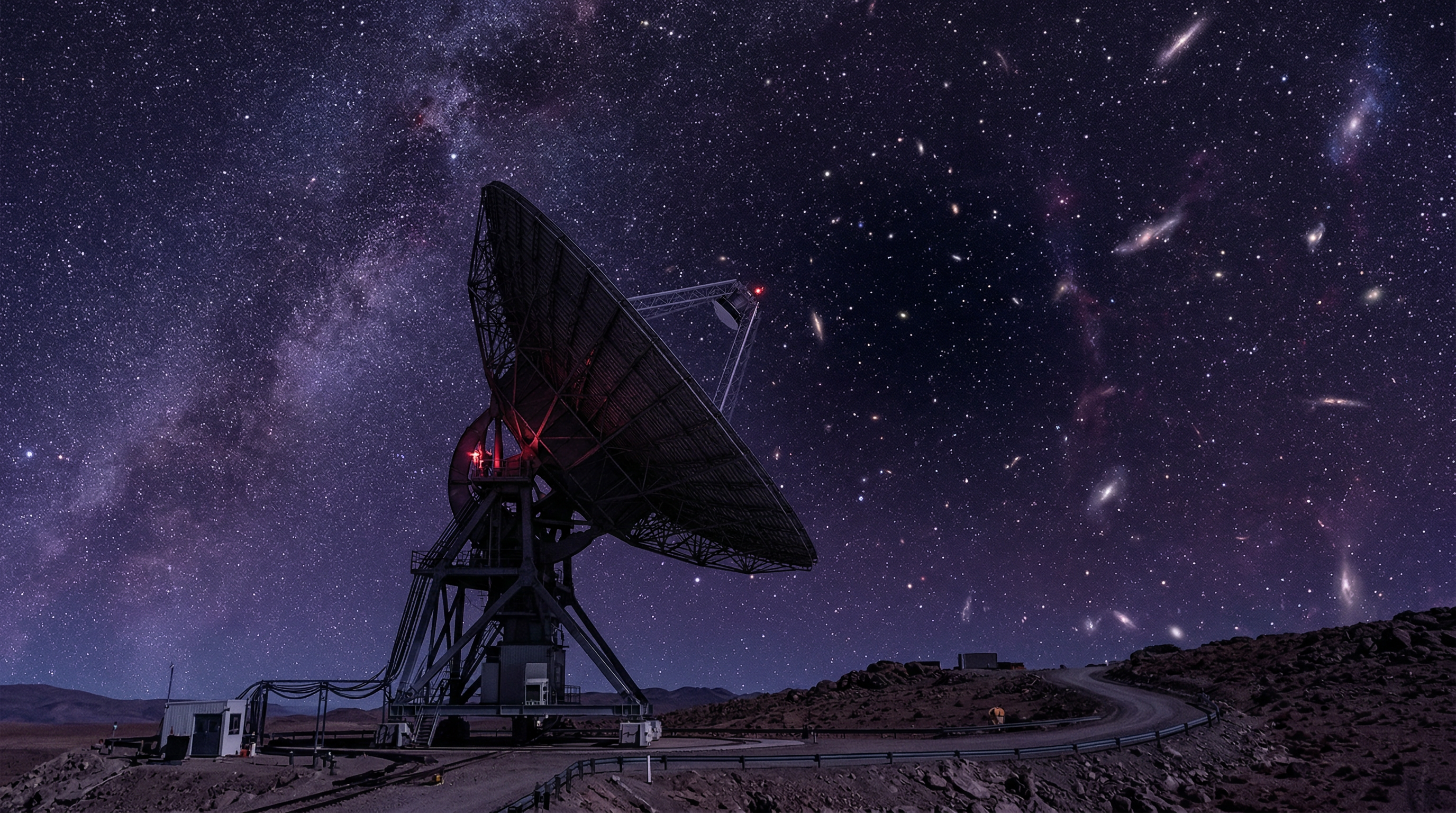
A vast cosmic void with billions of stars and a lone radio telescope, representing the profound silence of the universe
Radio waves scattered by stellar plasma turbulence, sharp signals dissolving into cosmic noise
01

We've Been Looking for the Wrong Thing

Here's a humbling thought: what if we've spent sixty years listening for alien signals and heard nothing — not because nobody's transmitting, but because we've been tuning in to the wrong channel?

A landmark study from the SETI Institute has demonstrated that plasma turbulence in the interplanetary medium around a transmitting star would "smear" any narrow-band radio signal before it even leaves the alien solar system. Traditional SETI algorithms hunt for ultra-sharp frequency spikes — laser-thin needles in a cosmic haystack. But this research proves those needles get turned into hay by the star's own atmosphere.

"We've been looking for laser-thin needles in a haystack, only to realize that the atmosphere of the star itself turns those needles into hay."

The implications are staggering. Decades of null results from projects like Breakthrough Listen and the Allen Telescope Array might reflect a fundamental observational bias, not a fundamental cosmic emptiness. The universe might be chattering away while we sit with our fingers in our ears, insisting the conversation must sound a particular way. The next generation of SETI surveys will need to search for broadened, diffuse signals — a far harder problem, but at least now we know we're asking the right question.

Ancient monuments crumbling into cosmic dust, an hourglass of stars with sand nearly run out
02

Five Thousand Years, Then Lights Out

If intelligent life is common in the galaxy — and every year the exoplanet data makes it look more plausible — then why haven't we heard from anyone? Physicists Sohrab Rahvar and Shahin Rouhani at Sharif University of Technology have a chilling mathematical answer: civilizations don't last long enough.

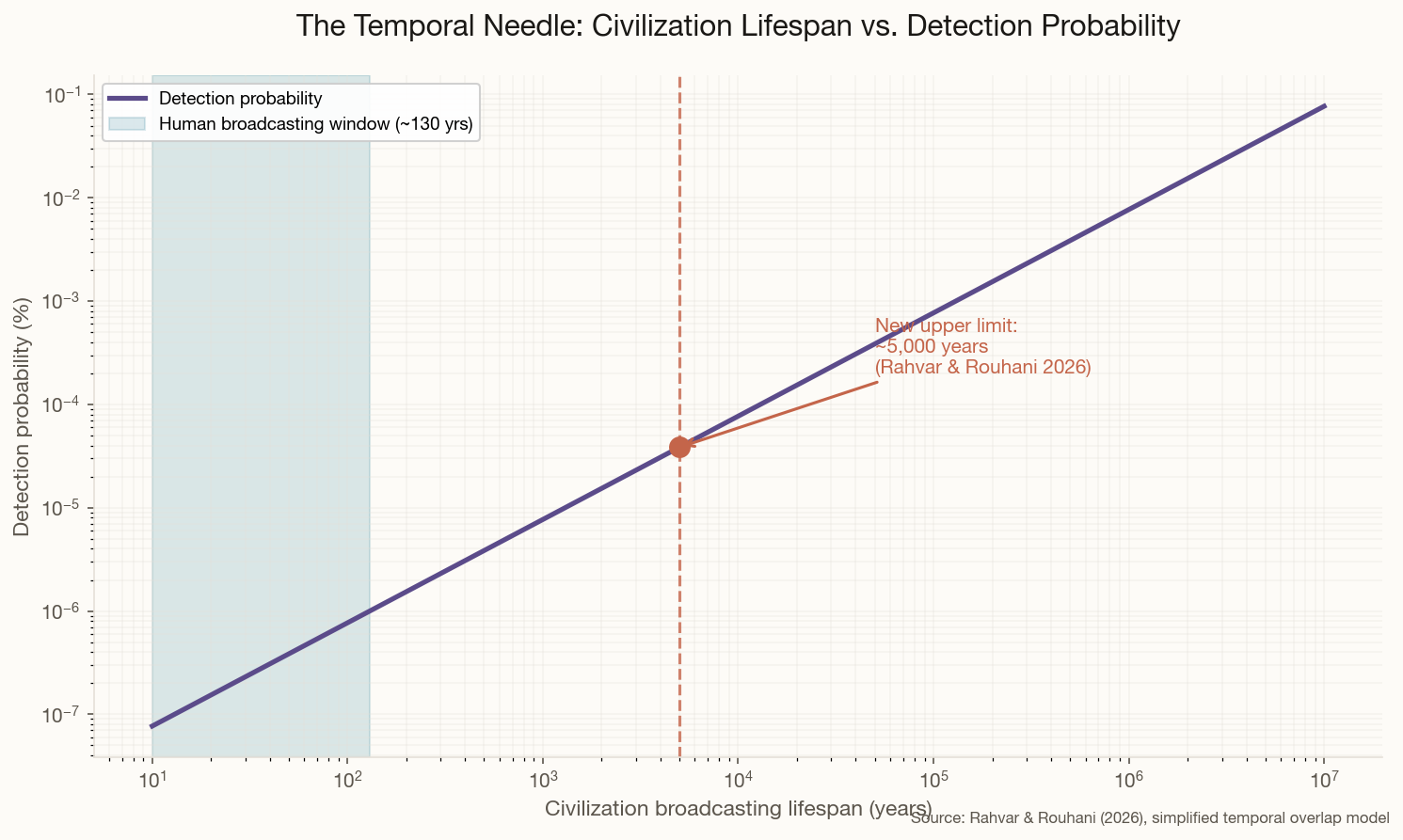
Using updated exoplanet frequency data, the team applied new constraints to the Drake Equation's L parameter — the average lifespan of a broadcasting civilization. Their conclusion? If intelligent life is even moderately common, the average civilization broadcasts for fewer than 5,000 years before going silent. For context, human civilization has existed for roughly 10,000 years, and we've been broadcasting radio signals for barely 130.

Log-log chart showing civilization broadcasting lifespan vs detection probability, with the 5,000 year threshold marked
The temporal needle: even a 5,000-year broadcasting window represents a vanishingly small probability of temporal overlap with another civilization scanning the same patch of sky.

The math is brutal. A 5,000-year window in a 13-billion-year-old galaxy means any two civilizations have a 0.0000004% chance of existing simultaneously and being close enough to detect each other. We aren't alone because nobody's out there — we're alone because everybody's already come and gone. The cosmic stage is enormous, and the actors only get a few minutes each.

An exoplanet with Doppler shift visualization showing zones of radio emission
03

Mapping Alien Cities from Light-Years Away

SETI has always been a yes-or-no question: is anyone there? Researcher Keitaro Takahashi just turned it into a where-on-their-planet-are-they question.

Takahashi's new technique — Rotational Doppler Cartography — exploits the fact that a rotating planet's surface creates tiny Doppler shifts (on the order of 10-6) in any radio emissions. By analyzing these fractional frequency variations, astronomers could map the latitudinal distribution of transmitters on an unresolved exoplanet. In other words, we could tell whether a signal comes from a single beacon at one location or a globally distributed industrial civilization — without ever taking a photograph.

"We are no longer just asking 'Is anyone there?' but 'Where on their world are they living?'"

This is SETI graduating from detection to archaeology. If we ever do intercept a technosignature, Takahashi's method would let us understand the scale and distribution of the civilization producing it. It's the difference between knowing a house has lights on and knowing which rooms are occupied. The IAU Symposium 404 this week specifically highlighted this work as a paradigm shift in how we think about technosignature science.

DNA helix dissolving where phosphorus atoms are missing, molecular structures floating in deep space
04

The Universe Has a Phosphorus Problem

We've been congratulating ourselves for decades about how many "habitable" planets are out there. Rocky world in the liquid-water zone? Check. But researchers at the University of Cambridge just threw cold water on the party by pointing out we've been ignoring the grocery list.

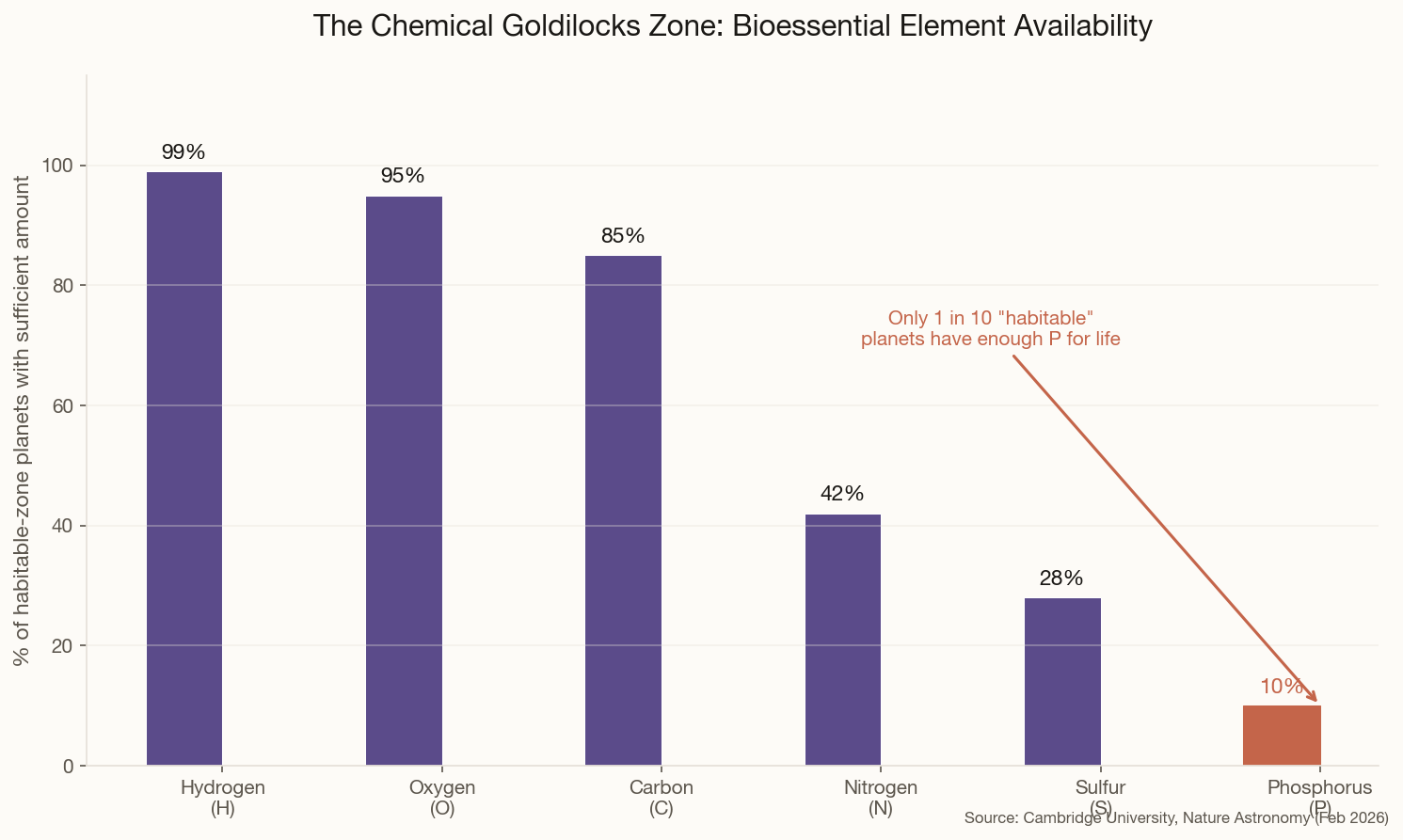
Their simulation of 50,000 exoplanetary systems found that phosphorus and nitrogen — two elements absolutely essential for DNA and cellular metabolism — are far rarer on rocky planets than anyone assumed. Only about 1 in 10 planets sitting in the traditional "habitable zone" actually have enough of these elements to support the chemistry of life. Water is common. The building blocks of biology are not.

Bar chart showing percentage of habitable-zone planets with sufficient bioessential elements, with phosphorus at only 10%
The chemical Goldilocks zone: while hydrogen and oxygen are abundant, phosphorus — essential for DNA — is vanishingly rare on otherwise "habitable" worlds.

This introduces what the researchers call a "Chemical Filter" to the Fermi Paradox. Even if the galaxy is brimming with temperate, watery worlds, the vast majority may be biochemical deserts — planets with oceans and sunsets but no chemistry capable of producing so much as a bacterium. The search for life needs to become a search for chemistry, not just comfort.

Spectral analysis overlaid on an ocean world exoplanet, absorption lines with question marks
05

The Biosignature That Wasn't (Yet)

Remember the excitement over K2-18b? The sub-Neptune exoplanet where JWST tentatively detected dimethyl sulfide (DMS) — a molecule produced almost exclusively by living organisms on Earth? A January meta-analysis has sobered the celebration. The detection sits at roughly 3-sigma confidence. In particle physics, that's interesting. In astrobiology, where the claim is "we found alien life," it's nowhere near sufficient.

The study, led by NASA-affiliated teams, found that other molecules — particularly methyl acrylonitrile — could produce similar spectral overlaps in K2-18b's thick hydrogen-rich atmosphere. The scientific community has now formally established a 5-sigma threshold for any future biosignature claims, mirroring the standard used to confirm the Higgs boson.

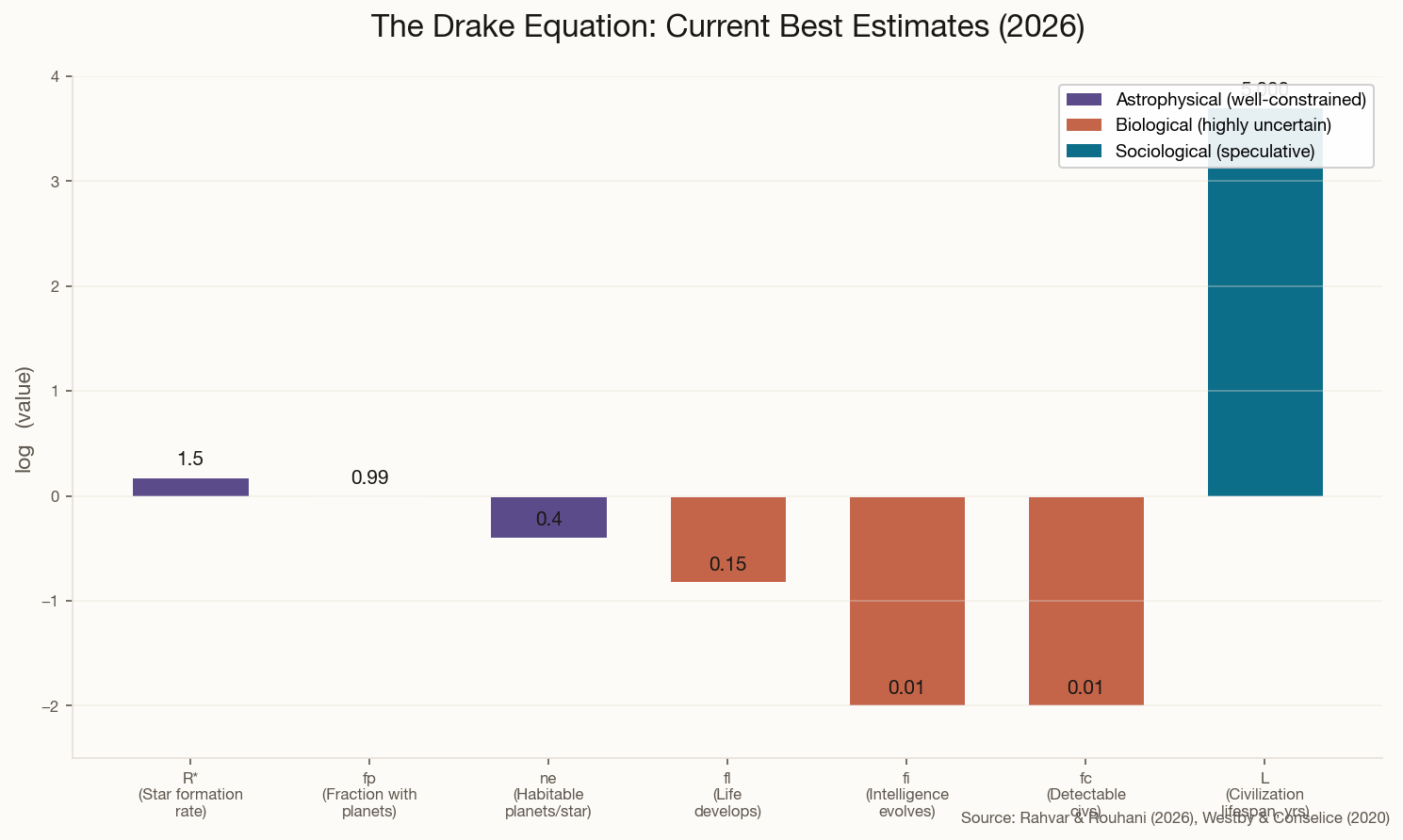
Drake Equation parameters shown as bar chart with uncertainty categories color-coded
The Drake Equation's parameters span orders of magnitude in certainty. Astrophysical values (left) are well-constrained; biological and sociological values (right) remain largely speculative — which is exactly why rigorous detection thresholds matter.

This is actually good news disguised as disappointment. Astrobiology is growing up. Rather than rushing to announce discoveries that collapse under scrutiny (see: ALH84001, the Mars meteorite that "proved" life in 1996), the field is building the evidentiary infrastructure to make a detection that sticks. When the first genuine biosignature is confirmed, the 5-sigma standard will ensure it's beyond reasonable doubt.

Cross-section of a rocky planet showing active plate tectonics vs a dead stagnant planet
06

You Won the Geological Lottery (and You Don't Even Know It)

Of all the proposed answers to the Fermi Paradox, the plate tectonics hypothesis might be the most humbling. Research by Alan Stern and Taras Gerya argues that long-term plate tectonics isn't just helpful for life — it's an absolute prerequisite for complex, land-dwelling intelligence.

Plate tectonics regulate Earth's carbon cycle, create continents, drive volcanism that replenishes the atmosphere, and generate the magnetic field that shields life from solar radiation. Without this geological engine running continuously for billions of years, you don't get complex ecosystems. You get Venus, or Mars, or a frozen rock. The updated 2025 analysis estimates that only 0.003% of rocky planets maintain the specific conditions for sustained tectonic activity.

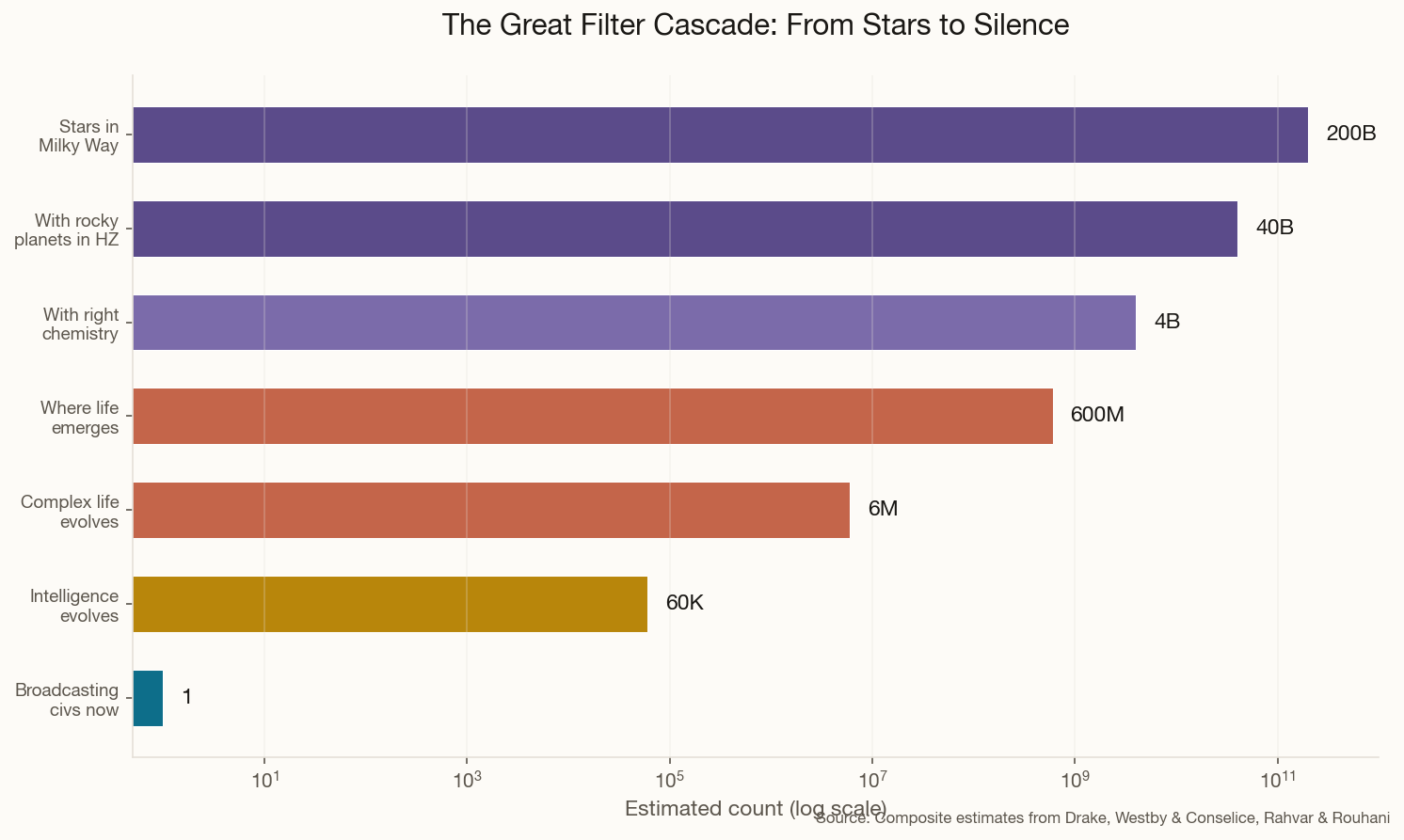
Horizontal bar chart showing the Great Filter cascade from 200 billion stars down to 1 broadcasting civilization
The Great Filter cascade: starting from 200 billion stars in the Milky Way, each successive filter dramatically narrows the funnel. By the time you account for chemistry, geology, and civilization lifespan, the numbers explain the silence.

This reframes the Great Filter not as some future catastrophe humanity must survive, but as a rare geological lottery that Earth won 4 billion years ago. Most rocky planets are geologically dead or dying. They had their shot at plate tectonics and lost it. The silence isn't because civilizations self-destruct — it's because the planetary conditions for complex life are extraordinarily rare from the very beginning.

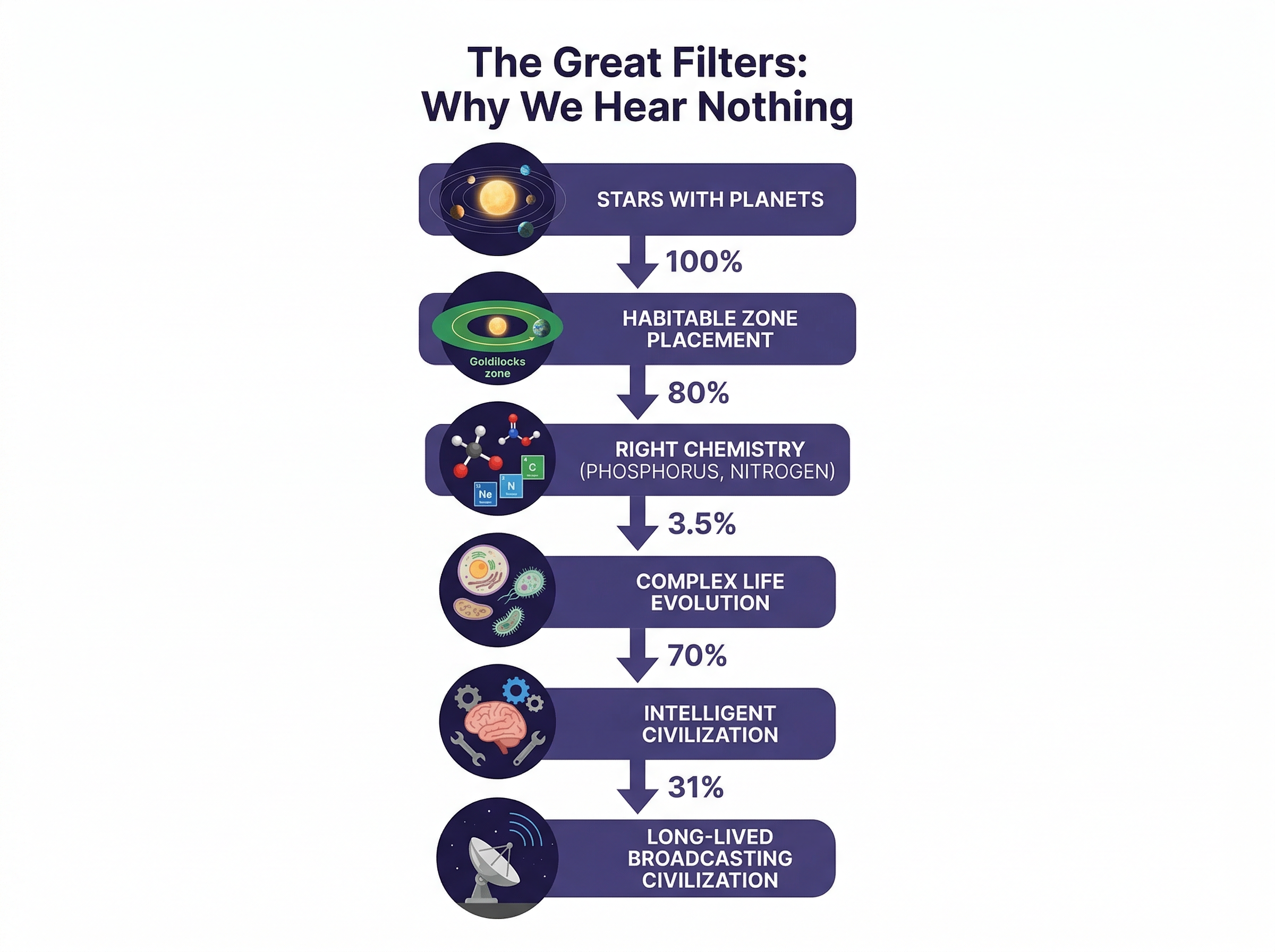
Infographic showing the Great Filters - a vertical flowchart of barriers from stars to broadcasting civilizations, with probabilities narrowing at each step
The Great Filters: a visual summary of the cascading barriers between star formation and interstellar contact. Each filter independently reduces the probability of detectable civilization by orders of magnitude.

The Answer Is Us

The Fermi Paradox isn't really about aliens. It's about the staggering improbability of our own existence. Every piece of research in this newsletter — the chemical scarcity, the geological lottery, the temporal needle, the detection bias — doesn't just explain why we haven't heard from anyone else. It explains why we are here at all. The silence isn't empty. It's the sound of how rare this moment is.