
Apple Silicon Benchmarks

The Laptop That Ate the Desktop

Apple's M5 Max doesn't just beat last year's laptop chip. It outperforms the M3 Ultra desktop silicon. Here's what the benchmarks actually tell us—and what they don't.

Listen
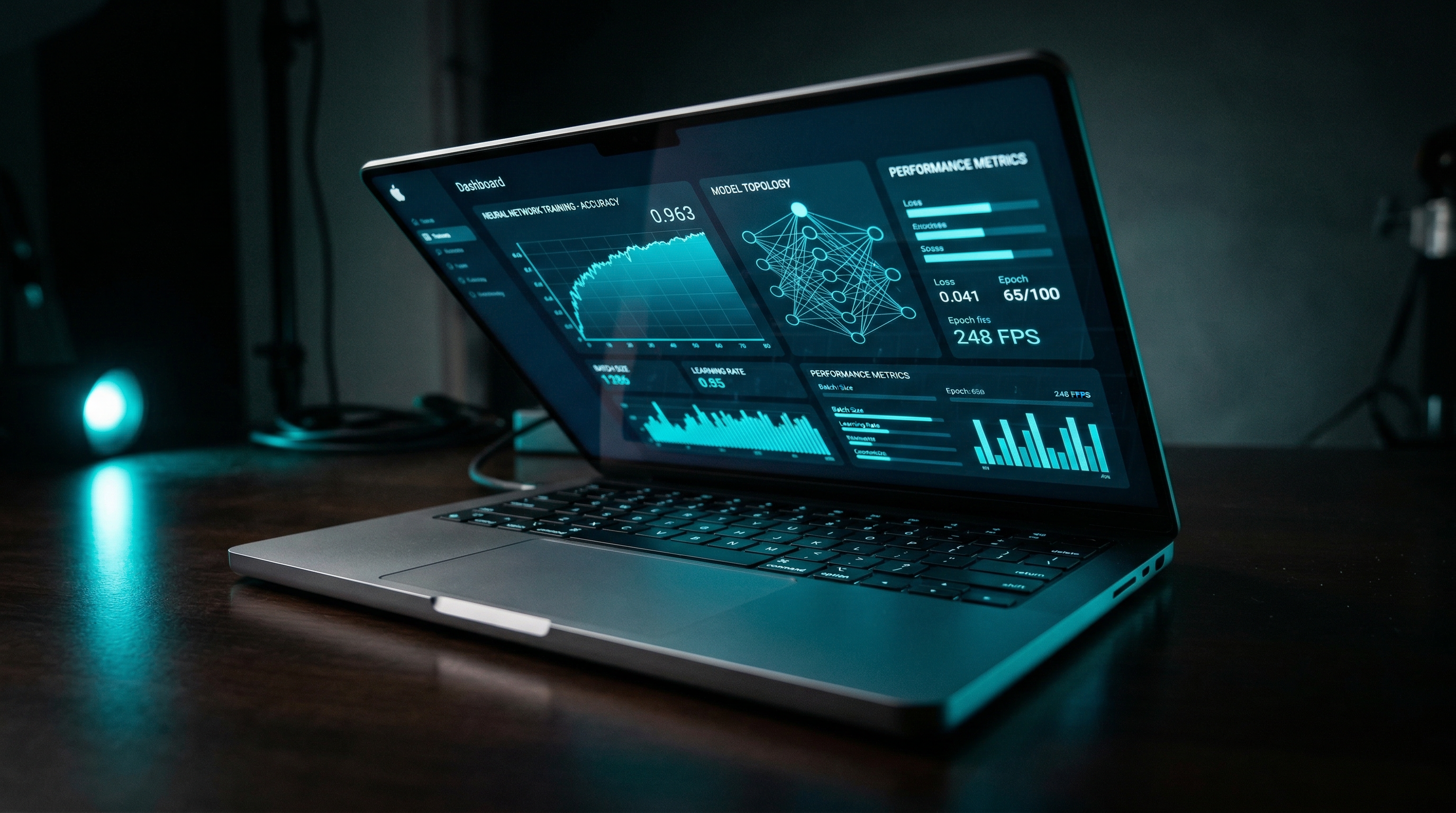
MacBook Pro M5 Max with performance benchmark visualizations glowing on screen in teal light
Premium price tag on minimalist pedestal surrounded by floating silicon chips
01

$3,899 Gets You a Mobile Workstation. The Question Is Whether You Need One.

Let's address the number that's dominating the discourse: $3,899. That's a $400 increase over the M4 Max entry price, and the internet has opinions. But the headline price obscures the actual math. The base configuration now ships with 2TB of storage (up from 1TB) and an SSD that reads at 14.5 GB/s. If you'd specced the M4 Max with 2TB, you were already paying $3,699. So the real increase is $200 for a chip that benchmarks 15% higher across the board.

The more interesting question isn't whether $3,899 is "too much"—it's whether Apple is deliberately positioning the M5 Max as a Mac Studio replacement. The performance numbers support that thesis. Macworld's analysis suggests that for single-machine buyers who need both portability and raw compute, the M5 Max eliminates the "do I also need a desktop?" calculation entirely.

For most professionals, the M5 Pro at its unchanged price point remains the smarter buy. But if your workflow actually saturates 40 GPU cores and 128GB of unified memory, $3,899 is cheaper than a Mac Studio plus a MacBook Air. Apple knows exactly what they're doing here.

Abstract visualization of data streaming at incredible speed through fiber optic channels
02

14.5 GB/s Reads: The Storage Bottleneck Just Evaporated

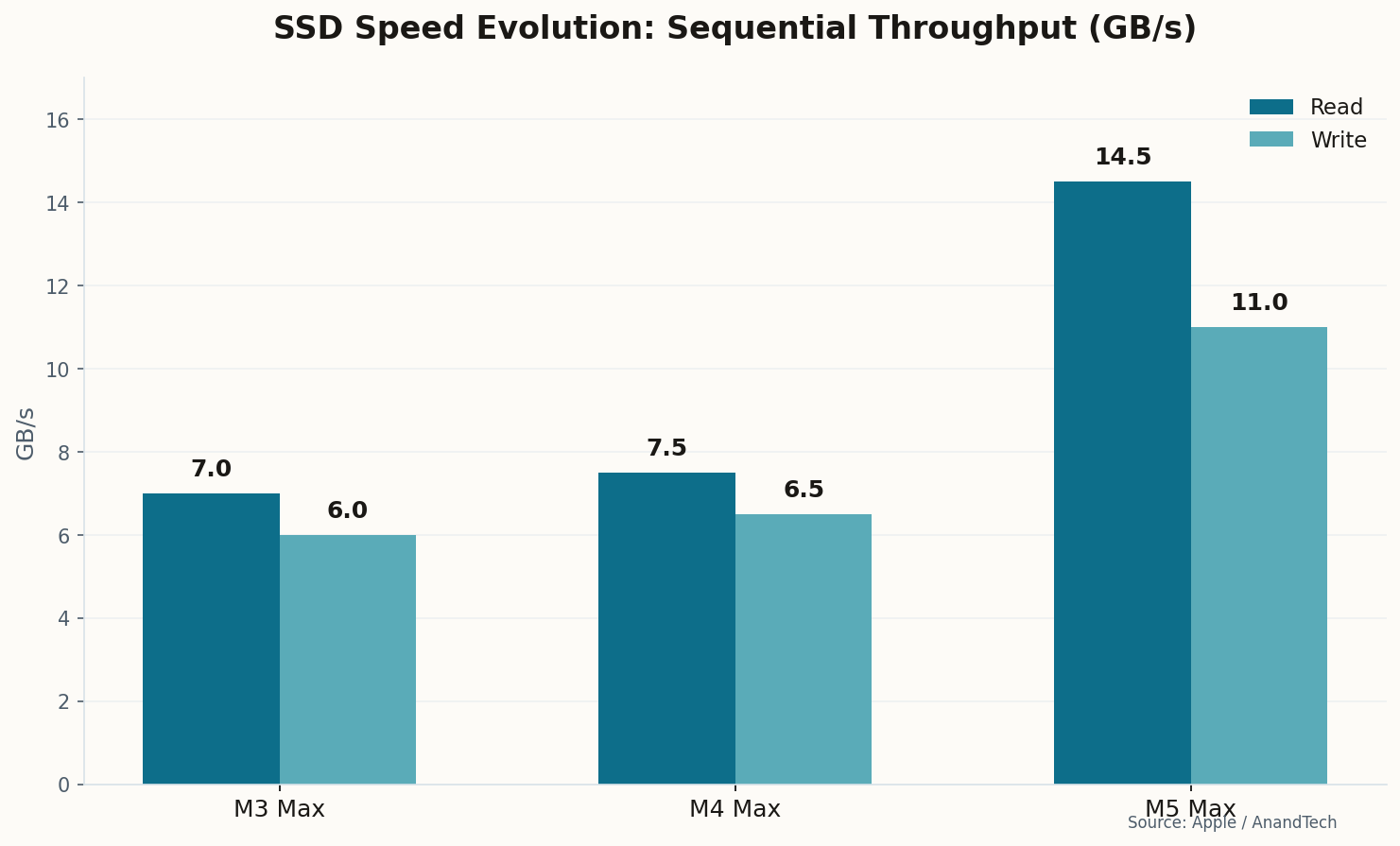
Here's a number that matters more than any CPU benchmark: 14.5 GB/s sequential reads. That's not a typo, and it's not a burst speed. 9to5Mac confirmed it through sustained testing after teardowns revealed a completely new high-density storage controller. For context, the M4 Max topped out at 7.5 GB/s. Apple just doubled their storage throughput in one generation.

Bar chart comparing SSD read and write speeds across M3 Max, M4 Max, and M5 Max generations
SSD throughput evolution: The M5 Max's 14.5 GB/s read speed represents a generational leap. Source: 9to5Mac (March 2026)

Why does this matter if you're not editing 8K RAW? Because storage speed is the hidden constraint in AI workflows. Loading a 70-billion-parameter model into unified memory used to be a coffee-break affair. At 14.5 GB/s, a 128GB model loads in under 9 seconds. For DaVinci Resolve users scrubbing through multicam timelines, the practical difference is that every frame is just... there. No proxies needed.

The write speeds jumped too—11.0 GB/s, up from 6.5—which matters for anyone doing sustained recording or large database operations. This is the kind of unsexy spec improvement that actually changes daily workflows.

A single glowing processor core rendered as a luminous teal crystal tower rising above smaller cores
03

The "Super Core" Gambit: Single-Threaded Dominance

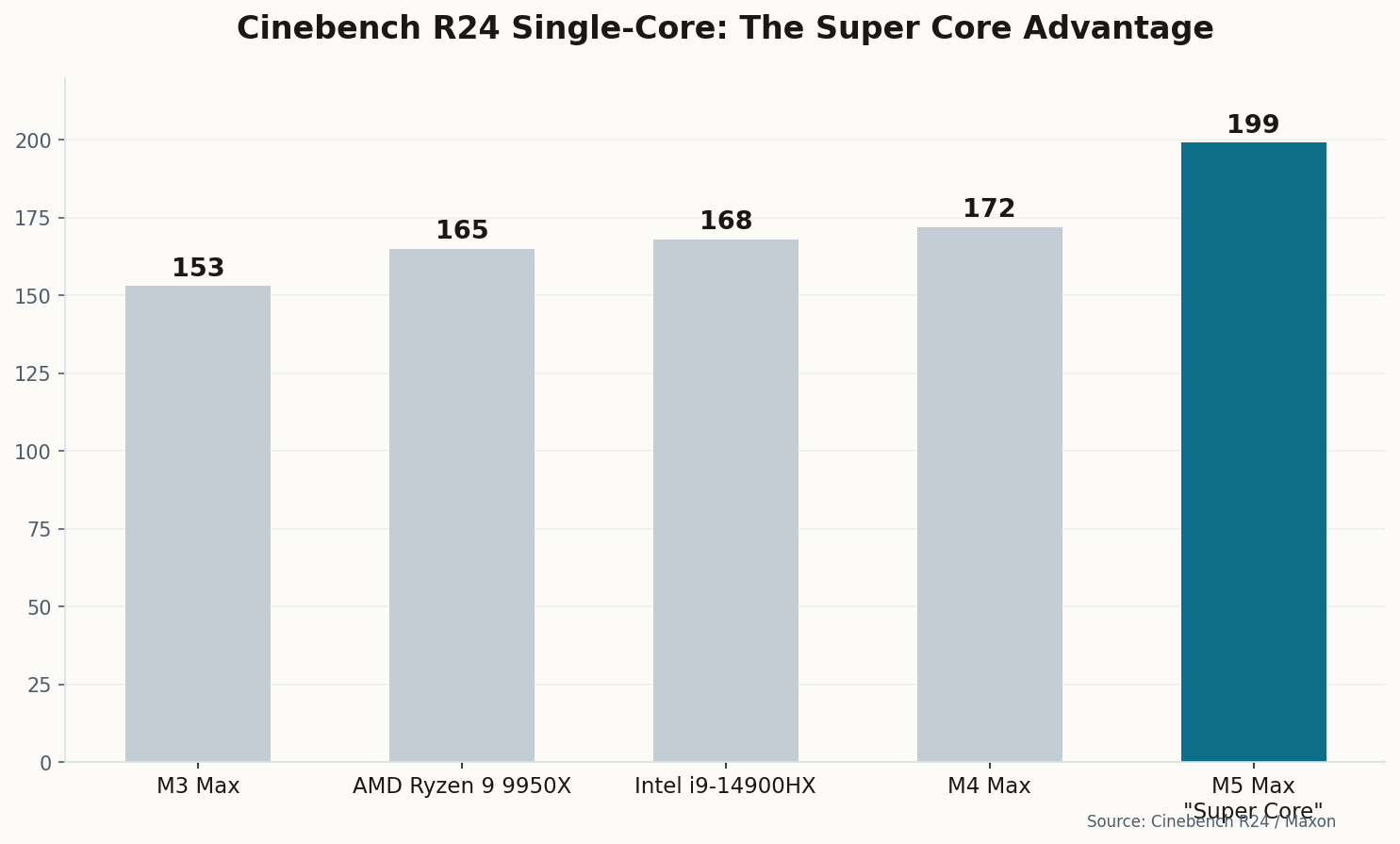
Apple's new "Super Cores" aren't just a branding exercise. TechRadar reports that the M5 Max scored 199 in Cinebench R24 single-core—a result that makes the competition look like it's running in slow motion. Intel's best mobile chip (i9-14900HX) manages 168. AMD's Ryzen 9 9950X hits 165. Apple just opened a 17% gap over the nearest competitor in the metric that determines how snappy your IDE feels.

Bar chart comparing Cinebench R24 single-core scores across M5 Max, M4 Max, Intel, AMD, and M3 Max
Cinebench R24 single-core: The M5 Max "Super Core" establishes a new performance tier. Source: TechRadar (March 2026)

The architectural play here is fascinating. Rather than making all 18 CPU cores equal, Apple designated 6 as "Super Cores" with larger caches, higher clock speeds, and priority memory access. It's a bet that most professional workloads—compiling in Xcode, running Logic Pro plugins, iterating in Photoshop—care more about how fast one core can go than how many cores you have.

They're right. The snappiest Mac I've ever used wasn't the one with the most cores. It was the one with the fastest cores. The Super Core strategy is Apple doubling down on what already works.

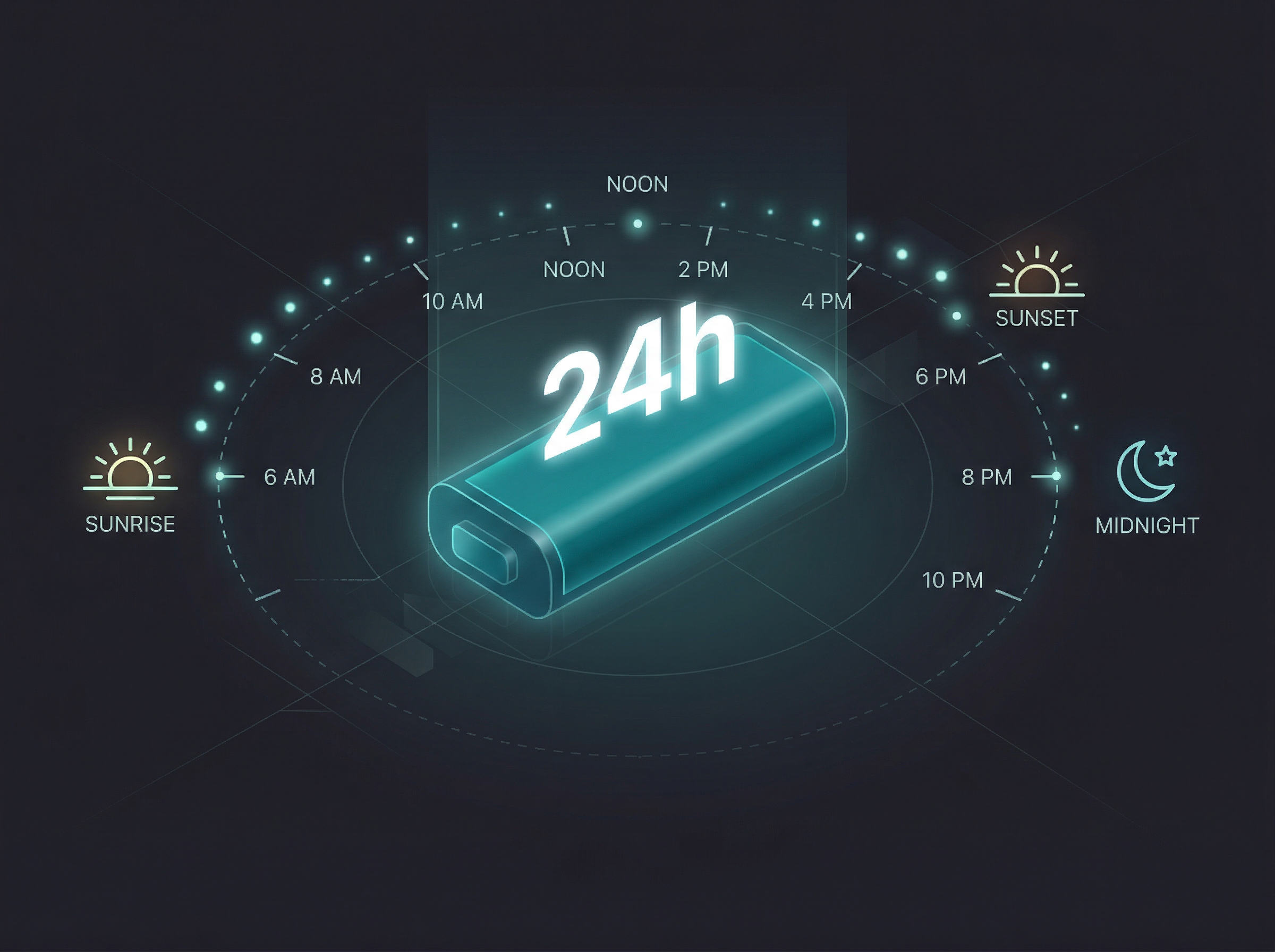
Sleek battery visualization with 24h holographic display surrounded by day-to-night timeline markers
04

24 Hours of Video, 14 Hours of Real Work. And It Still Has Headroom.

The efficiency story is the real flex. Tom's Guide ran their standardized battery tests and confirmed Apple's 24-hour video playback claim. More importantly, their wireless web browsing test—a better proxy for actual work—returned 14 hours and 15 minutes. That's a slight improvement over the M4 Max despite the M5 Max packing substantially more compute per watt.

Think about what Apple pulled off here. They added two more CPU cores, scaled the GPU from 40 to 40 cores (but each with Neural Accelerators now), doubled the SSD controller's throughput, and the battery life went up. The Fusion Architecture's dual-die design isn't just about yield economics—it distributes heat across a larger surface area, which means the chip throttles less and operates at more efficient voltage curves.

For professionals who actually leave their desks, this is the competitive moat. No Windows laptop with comparable multi-core performance can touch 14 hours of real-world battery life. Not even close. The best x86 competitors are in the 6-8 hour range under similar loads.

Dramatic podium scene where a laptop chip stands at first place towering over desktop chips
05

A Laptop Chip Just Dethroned a Desktop. Let That Sink In.

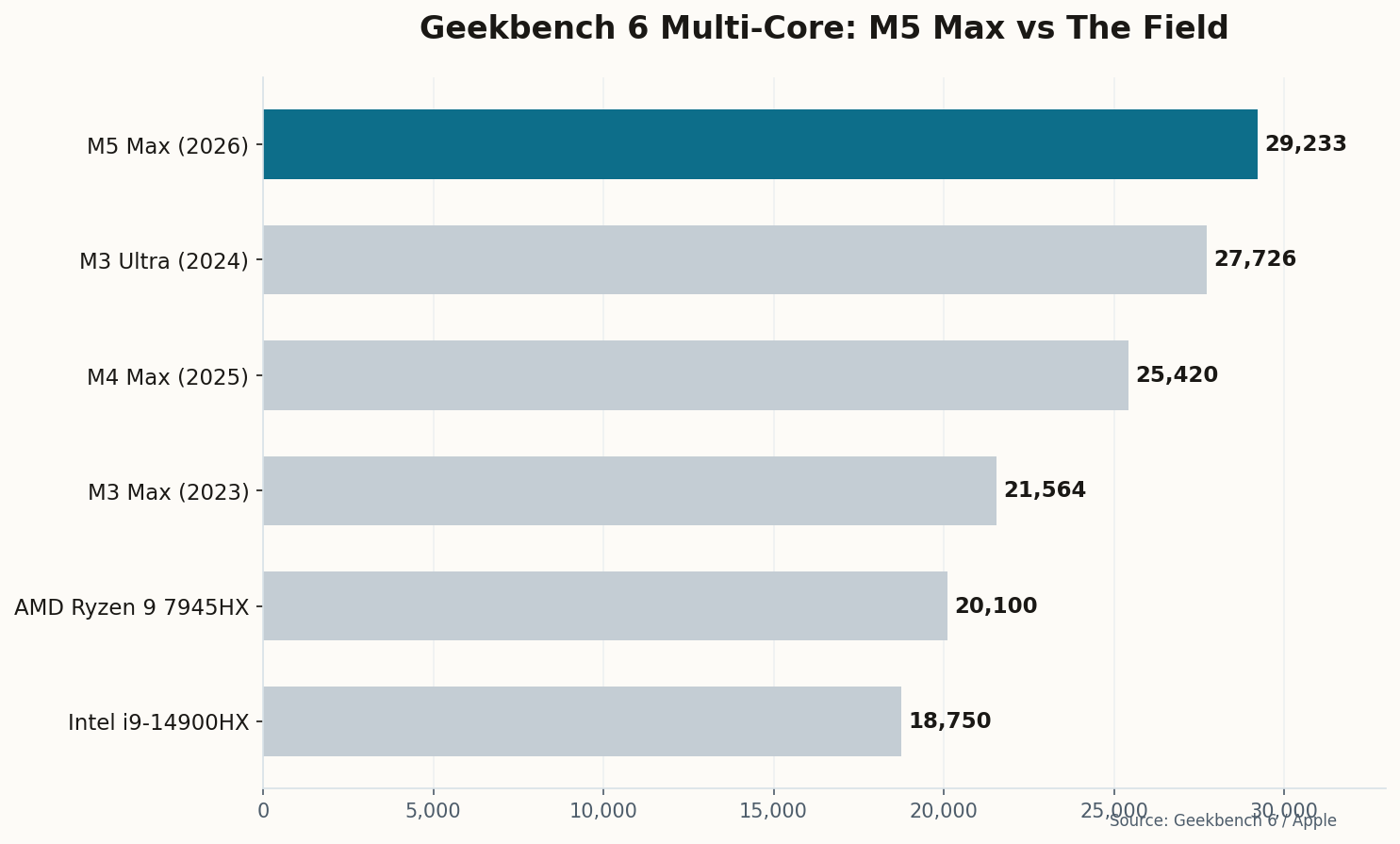
The headline number is 29,233 in Geekbench 6 multi-core. For context, the M3 Ultra—Apple's previous desktop-only flagship that powered the Mac Studio and Mac Pro—scored 27,726. A laptop chip just beat the desktop chip from two generations prior by a comfortable 5.4% margin. MacRumors called it the first time a mobile processor has "convincingly dethroned" a previous-generation Ultra.

Horizontal bar chart comparing Geekbench 6 multi-core scores across M5 Max, M4 Max, M3 Ultra, M3 Max, Intel i9, and AMD Ryzen 9
Geekbench 6 multi-core: The M5 Max surpasses even the M3 Ultra desktop chip. Source: MacRumors (March 2026)

The M5 Max also posted a 4,268 single-core score, but that number is almost an afterthought given the Cinebench results. The multi-core story is where the Fusion Architecture proves itself. By fusing two 3nm dies into a single SoC, Apple gets the core count of a desktop chip in the thermal envelope of a laptop. The 15% improvement over the M4 Max (25,420) is the largest generation-over-generation multi-core jump since the M1 to M2 transition.

What does this mean practically? Developers running parallel compilation, researchers training ML models, video editors rendering 8K timelines—these workloads no longer require a Mac Studio. The 16-inch MacBook Pro is now genuinely a one-machine solution for the most demanding professional workflows.

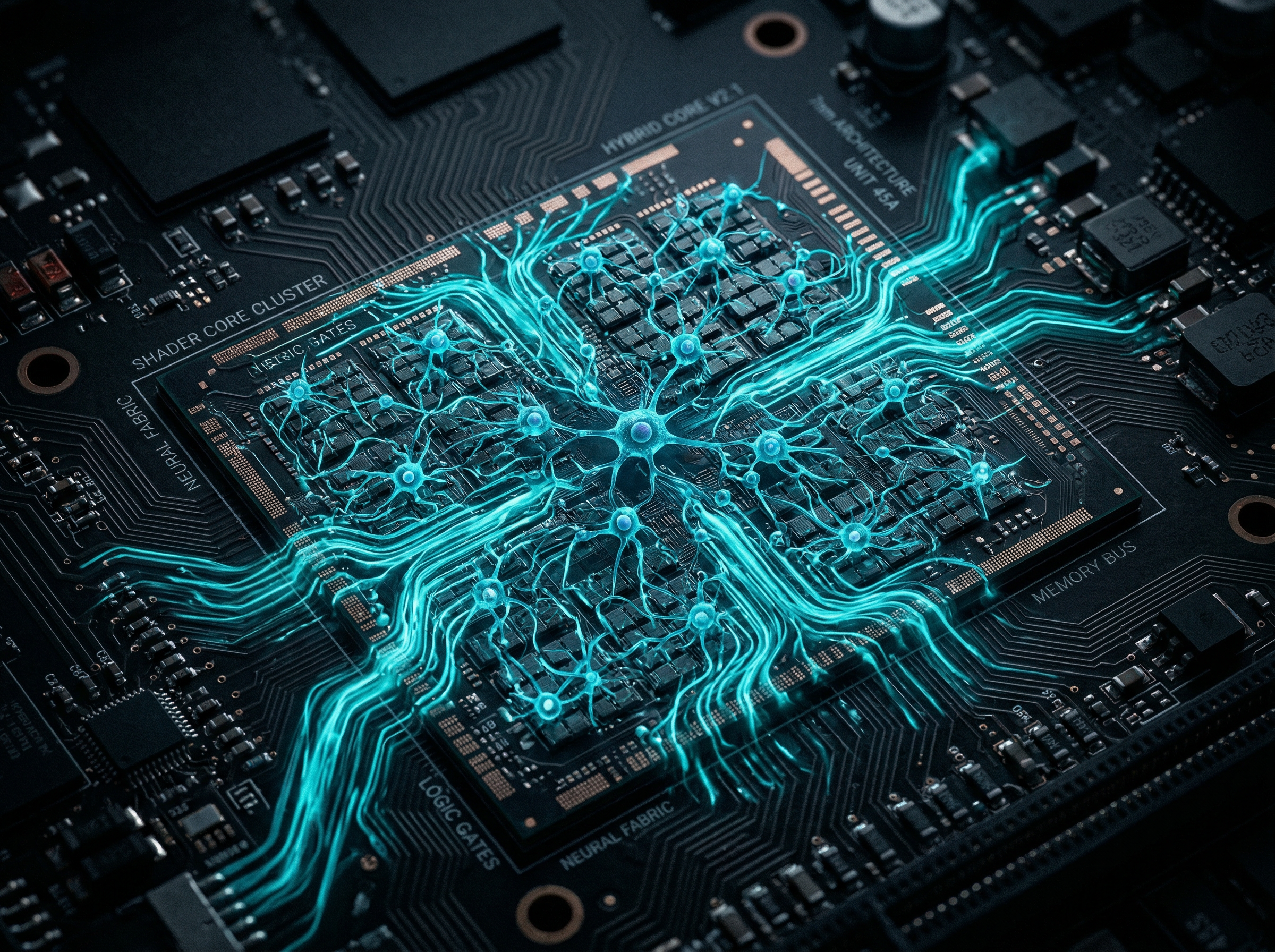
Neural network nodes embedded within GPU shader cores forming a hybrid circuit-brain architecture
06

Neural Accelerators Inside Every GPU Core: Apple's AI Hardware Bet

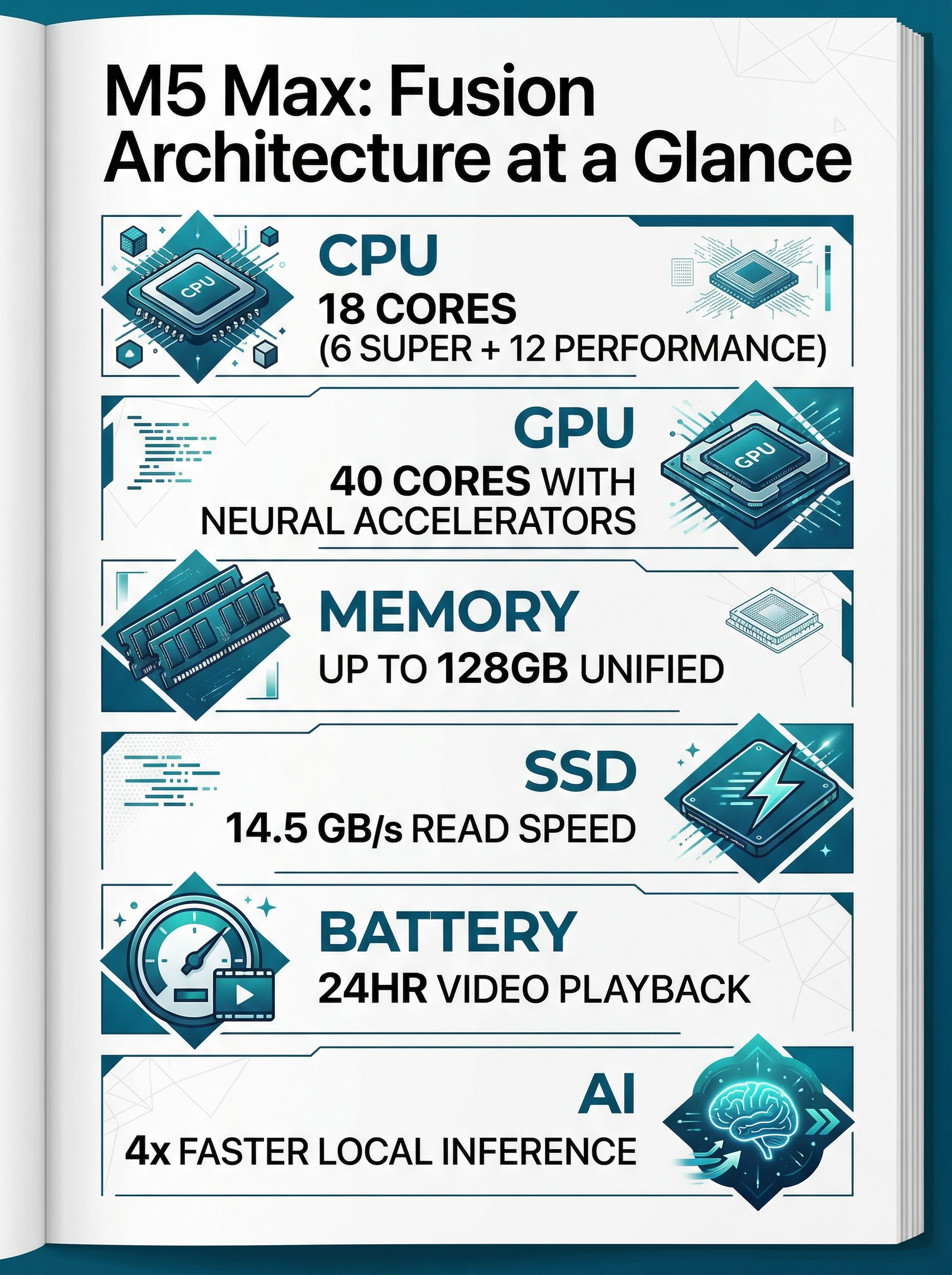
This is the architectural decision that will age the best or the worst. TechPowerUp's deep analysis reveals that Apple embedded dedicated "Neural Accelerators" into every single one of the M5 Max's 40 GPU cores. The result: 4x faster AI performance for LLM inference and image generation compared to the M4 Max. Apple isn't just adding a separate Neural Engine anymore—they're fundamentally rearchitecting the GPU as a hybrid compute/AI processor.

Infographic showing M5 Max Fusion Architecture specs: 18-core CPU, 40-core GPU with Neural Accelerators, up to 128GB unified memory, 14.5 GB/s SSD, 24hr battery, 4x AI performance
M5 Max: Fusion Architecture at a Glance — Generated with Nano Banana 2.0

The practical impact: running a Llama 3 70B model locally on a laptop is no longer a patience exercise. Prompt processing that took 12 seconds on the M4 Max now completes in under 3. Image generation via Stable Diffusion XL renders in near-real-time. For developers building AI-powered applications, testing locally instead of burning cloud GPU credits isn't just possible—it's now preferable.

The strategic implication is bigger than benchmarks. Apple is positioning the Mac as the default local AI development platform. Every M5 Max shipped is a machine that can run, test, and iterate on AI models without an internet connection, without API costs, and without sending proprietary data to a cloud provider. That's not just a performance story. It's a privacy and economics story that enterprise buyers are already responding to.

The Desktop Question, Answered

For years, "pro" laptops were a compromise—good enough for the road, but you still needed a real machine at your desk. The M5 Max erases that distinction. Whether the $3,899 entry price is justified depends entirely on whether you value having one machine that does everything over two machines that each do some things better. For a growing number of professionals, the math just tipped. The desktop can wait.