Higher Education & Civil Rights

The Snitch Line Reckoning

University bias reporting systems are under siege from every direction—legislators want them dismantled, advocates say they're weaponized, and new research suggests they might be making things worse. Here's what happened in the last three weeks.

Listen
University marble columns casting long shadows across a courtyard, with illuminated speech bubbles and document icons floating between them, representing the tension between free expression and institutional reporting
A legislative gavel resting on university documents marked Bias Reporting System, with the gavel's shadow forming a prohibition symbol
01

Pennsylvania Wants to Let Students Sue Over Bias Reports

Here's a question most university administrators never thought they'd face: what happens when a student can sue you for maintaining a bias reporting system?

Pennsylvania's House Bill 1271 is the most aggressive legislative attack on campus bias reporting we've seen. Spearheaded by State Rep. Greg Rothman, the bill doesn't just prohibit anonymous bias reporting portals—it creates a private right of action with a minimum $5,000 payout for any student who can demonstrate their speech was chilled by such a system. That's not a symbolic gesture. That's a financial weapon designed to make bias response teams too expensive to operate.

The bill defines its target broadly: any institutional process used to solicit reports on "offensive or unwanted speech," including microaggressions or "non-threatening" bias. Rothman's framing is blunt—"Universities should be marketplaces of ideas, not surveillance states where students fear that an unpopular opinion will land them in a 'bias' database."

The stakes: If this passes, it creates a template for every other state legislature watching. The private right of action is the key innovation—it bypasses the slow machinery of administrative enforcement and puts liability directly on institutions.

Watch for this to be the model bill of the 2026 legislative session. The question isn't whether other states will follow—it's how many.

An overflowing campus mailbox stuffed with formal complaint documents, set against sandstone arches
02

Stanford's Bias Report Flood Forces a Punitive Pivot

When your bias reporting infrastructure is "taxed" to the point where you need "automated initial processing," something has fundamentally changed about the nature of the problem you're trying to solve.

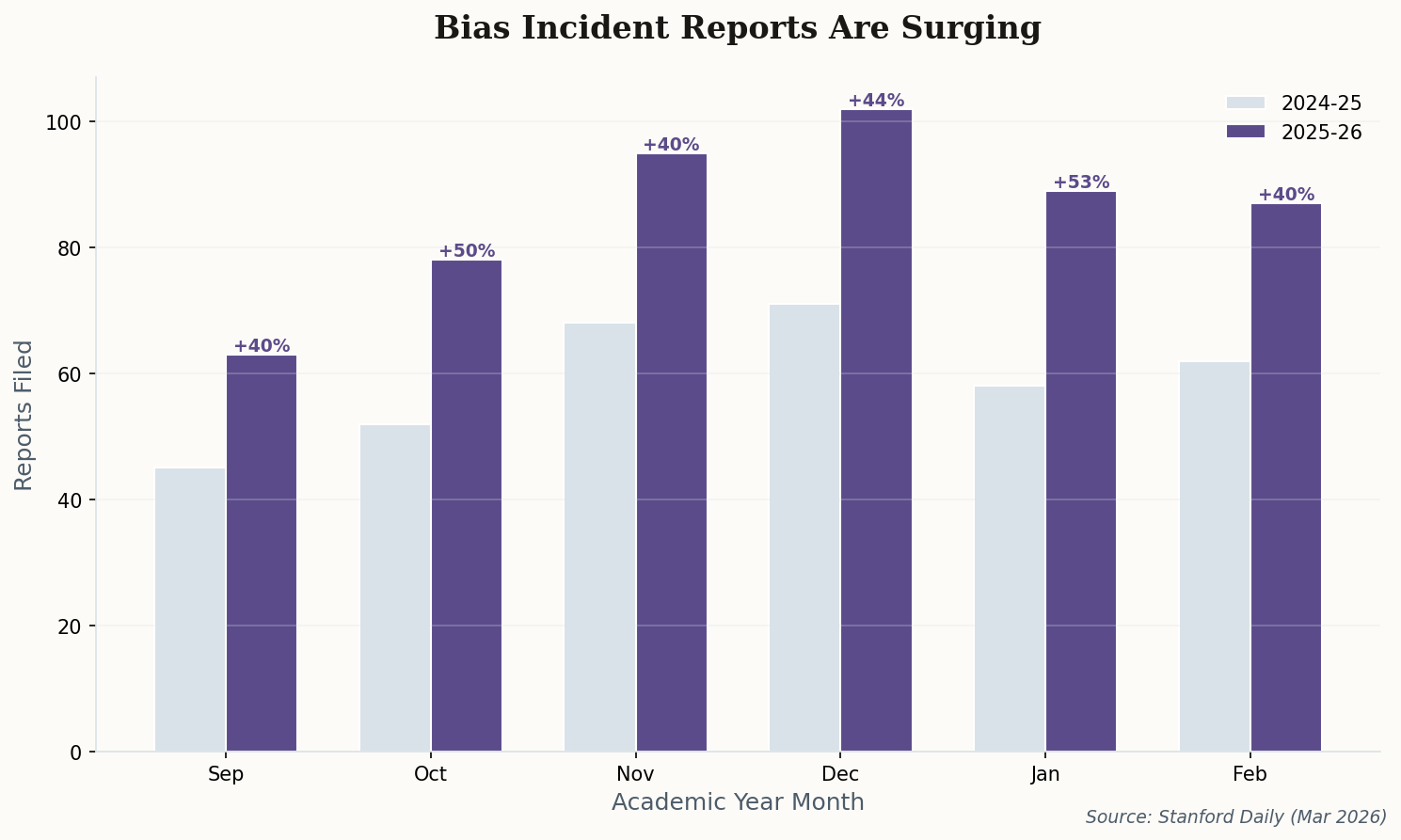
Stanford reported a 40% year-over-year increase in bias-related reports, driven primarily by "watchdog-style" emails targeting Jewish faculty and student leaders. The volume is forcing a philosophical shift: the university is moving from "educational" responses—the sit-down-and-talk model that has dominated bias response for a decade—toward punitive sanctions for identified perpetrators.

Bar chart showing bias incident reports by month comparing 2024-25 vs 2025-26, with increases of 40% in the current academic year
Year-over-year comparison of bias incident reports at Stanford, showing consistent increases across all months of the 2025-26 academic year. Source: Stanford Daily (March 2026).

This is significant for reasons beyond Stanford's campus. The "education, not punishment" approach has been the default philosophy of bias response teams nationwide. If Stanford—a bellwether institution—is abandoning it under pressure, expect others to follow. And that pivot creates a new tension: punitive systems are exactly what legislators like Rothman are targeting.

The university finds itself in an impossible position. Do nothing, and the harassment continues. Punish aggressively, and you hand ammunition to the defunding movement. Welcome to the bind that every major research university will face this year.

A university campus quad split down the middle, one half bright and welcoming, the other darkened with warning flags
03

Zero Out of Fifty-One: CAIR's Hostile Campus Report Card

Not a single campus earned a passing grade. Let that sink in.

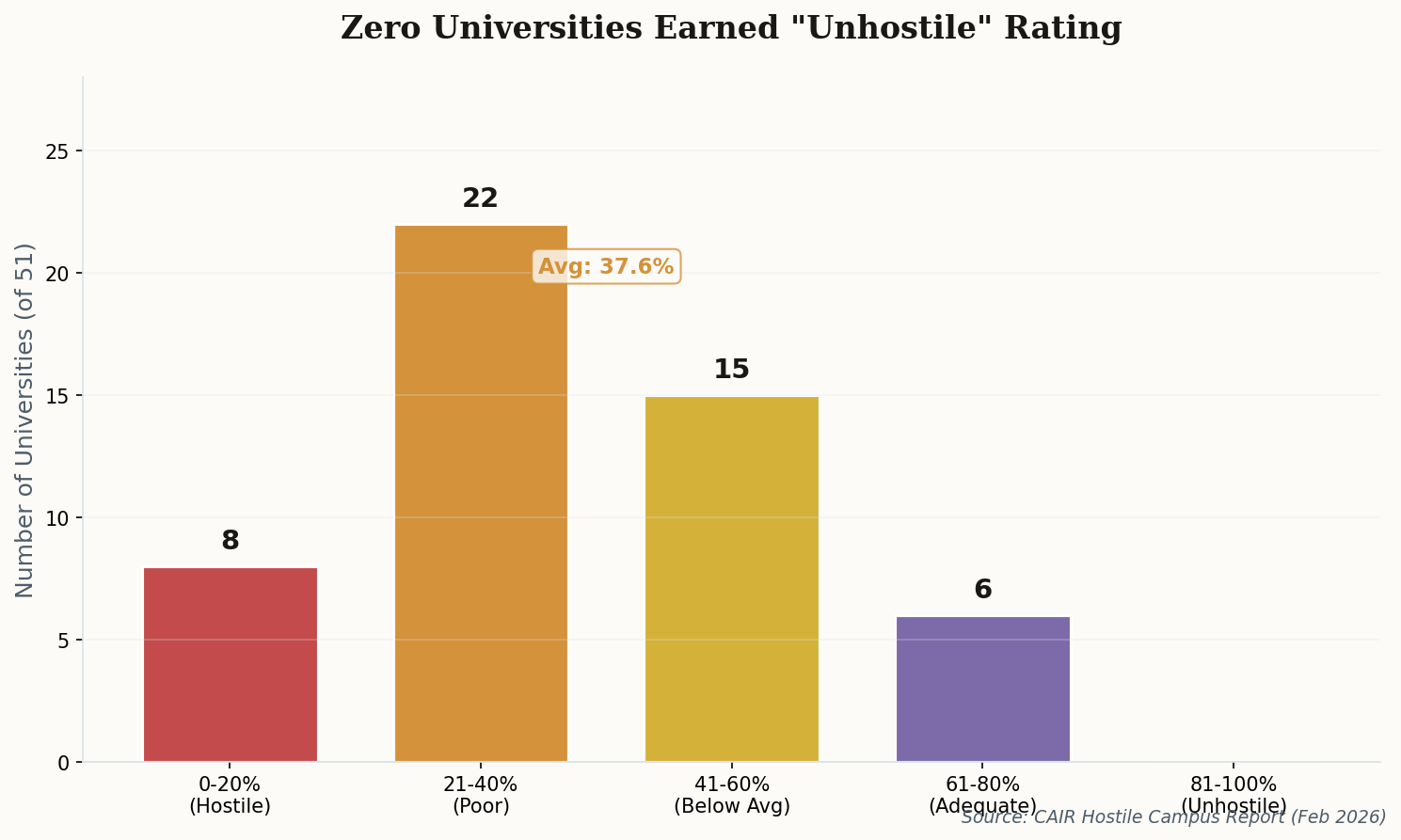
The Council on American-Islamic Relations released its annual "Hostile Campus" report, evaluating how 51 major universities handled bias reports from Muslim and Arab students over the past year. The average score was a failing 37.6%. Columbia University hit rock bottom with a 2 out of 100, driven by its handling of student suspensions tied to bias reporting.

Distribution of CAIR hostile campus ratings across 51 universities, showing most schools scoring in the 21-40% range with zero achieving Unhostile status
Distribution of CAIR "Hostile Campus" ratings for 51 major universities. The average score of 37.6% reflects what CAIR calls systemic failure. Source: CAIR (February 2026).

The most incendiary finding: CAIR argues that universities adopted "broad definitions of antisemitism" that were used to categorize pro-Palestinian speech as bias incidents, while simultaneously failing to update their policies to include anti-Muslim bias. In other words, the bias reporting system itself has become a tool of bias—at least in CAIR's reading.

This is the pressure from the left that mirrors the legislative pressure from the right. Both sides now argue that bias reporting systems are fundamentally broken. They just disagree about the direction of the brokenness. That convergence should terrify university administrators, because it means there is no constituency left defending the status quo.

Network diagram showing multiple university buildings connected by glowing lines converging to a single central hub building
04

Georgia's Radical Idea: One Coordinator to Rule Them All

While Pennsylvania is trying to blow up the system, Georgia is trying to centralize it. Both approaches aim at the same target—the discretion of campus-level bias response teams—but the Georgia model is more surgical and arguably more sustainable.

University System of Georgia Senate Bill 523 would create a "Statewide Higher Education Title VI Coordinator," a single state-level position overseeing bias and discrimination reporting across all public institutions. The move explicitly shifts authority from campus administrators—who currently interpret "campus climate" through local norms—to a legal officer focused on statutory definitions of discrimination.

The bill also mandates equal procedural rigor for antisemitism complaints and racial discrimination complaints. State Sen. John Albers puts it plainly: "We ensure that civil rights are protected by the law, not by the shifting whims of campus administrators."

Why this matters beyond Georgia: This is the first state to create a centralized oversight position for university bias reporting. If it works, it offers a middle path between abolishing bias reporting (Pennsylvania) and leaving it to campus-level discretion (the failing status quo). Conservative-led states with large public university systems—Texas, Florida, Ohio—are watching.

Split scientific illustration comparing educational response fading to gray versus punitive response glowing with authority
05

The Data Says "Education" Alone Backfires

For years, the default university response to a bias incident has been an "educational conversation"—a facilitated discussion between the reporting party, the responding party, and an administrator. The theory is restorative. The reality, according to new research from the Society for Personality and Social Psychology, is that it often feels like gaslighting.

Presented at SPSP's 2026 Annual Convention, the study found that students with stigmatized identities feel significantly safer and expect less future bias when universities use punitive sanctions rather than educational-only responses. More damning: educational-only responses actually decrease reporting over time, because victims interpret the soft touch as institutional indifference.

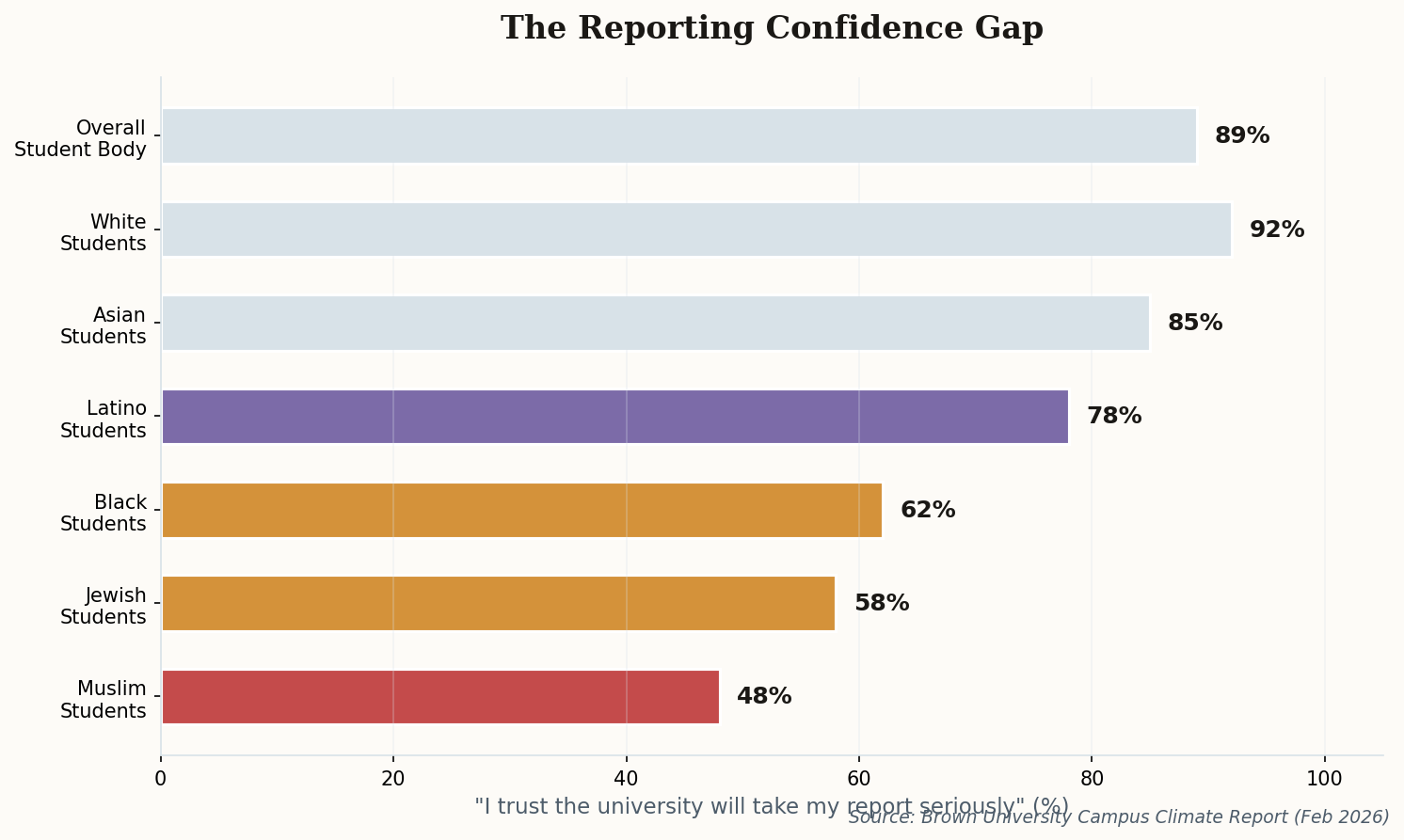
Horizontal bar chart showing reporting confidence by student group at Brown University, with Muslim students at 48% and overall student body at 89%
Reporting confidence varies dramatically by identity. Muslim and Jewish students show the lowest trust that their reports will be taken seriously. Source: Brown University Campus Climate Report (February 2026).

The lead researcher didn't mince words: "When 'education' is the only consequence for bias, victims perceive it as a form of institutional gaslighting." This is a direct empirical challenge to the restorative justice models that most bias response teams currently operate under. It also explains, at least partially, the reporting confidence gaps surfacing in campus climate surveys like Brown's.

The implication is uncomfortable: the approach designed to be gentle and constructive may actually be eroding the trust it was meant to build. Universities now face evidence-backed pressure to get tougher—which circles right back to the political pressure to get softer. The feedback loop is dizzying.

Neoclassical federal building facade with magnifying glass hovering over a university campus visible through columns
06

The Feds Are Watching: Civil Rights Commission Opens Campus Probe

When the U.S. Commission on Civil Rights holds a bipartisan briefing and uses the word "unprecedented," universities should pay attention. When preliminary testimony suggests that bias response teams are actively ignoring one category of bias while over-policing another, universities should be alarmed.

The USCCR investigation is examining whether the Department of Education's Office for Civil Rights is adequately enforcing Title VI in response to reported antisemitism incidents. Commissioner Gail Heriot crystallized the commission's concern: "What is being ignored is often more telling than what is being investigated."

Public comments are open through March 20, 2026, and the commission will deliver a formal report to Congress. The potential outcome? New national standards for how universities categorize, prioritize, and respond to different types of bias reports under Title VI.

This is the federal backstop that could reshape the entire landscape. State legislatures can pass bills. Advocacy groups can publish report cards. But a Congressional mandate on bias reporting standards would be the most consequential development in this space since Title VI itself. Watch the March 20 comment deadline—the shape of that input will signal where the federal response lands.

DATA

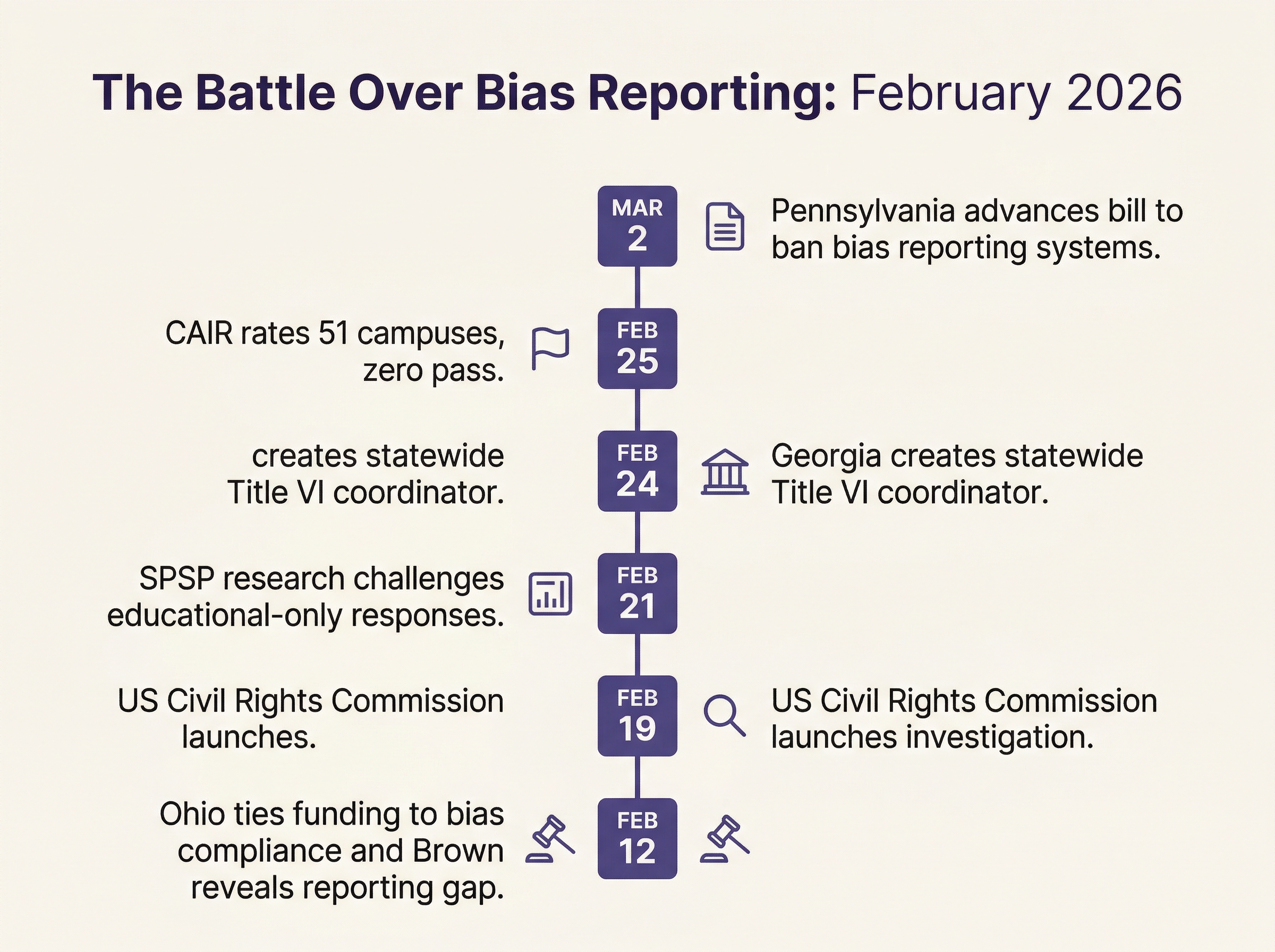
The Timeline: Three Weeks That Shook Campus Bias Reporting

Timeline infographic showing 6 key events in university bias reporting from February 12 to March 2, 2026, including federal investigations, state legislation, research findings, and advocacy reports
The Battle Over Bias Reporting: February 2026 — Generated with Nano Banana 2.0

The Center Cannot Hold

Three weeks. Three state legislative actions. One federal investigation. One failing report card for 51 universities. And one study suggesting the default response model makes things worse, not better. University bias reporting systems are being squeezed from every direction simultaneously—defund them, centralize them, punish with them, abolish them. The only option that's off the table? Keeping things exactly as they are. Whatever emerges from this reckoning will look nothing like the "bias response team" model that proliferated across American campuses over the last decade. The question is who gets to design what comes next.