
American History

The Great American Schism

How 230 years of political combat, coalition-building, and realignment created the two-party system we love to hate.

Listen
A sweeping panoramic illustration of American democracy through time, showing the Capitol building with overlaid images of founding fathers, civil war soldiers, suffragettes, and modern protesters
Hamilton and Jefferson facing each other in dramatic profile with the Constitution between them
01

The Argument That Built a Nation

Here's the thing nobody tells you about the Founders: they hated political parties. George Washington warned against "the baneful effects of the spirit of party" in his Farewell Address. Then his own cabinet invented them anyway.

The split was inevitable from the start. Alexander Hamilton, Washington's Treasury Secretary, wanted a muscular central government, a national bank, and close ties with Britain. Thomas Jefferson and James Madison saw Hamilton's program as a betrayal of revolutionary principles—too monarchical, too concentrated, too friendly to moneyed elites. They organized the Democratic-Republicans as a counterweight to Hamilton's Federalists.

The 1800 election—the so-called "Revolution of 1800"—was the proof of concept. Jefferson defeated John Adams 73–65 in electoral votes, and power transferred peacefully between hostile factions for the first time. Jefferson struck the conciliatory note: "We are all Republicans, we are all Federalists." A beautiful sentiment. He didn't mean it, of course—he spent the next eight years dismantling the Federalist program. But the precedent held.

The Alien and Sedition Acts of 1798 — The Federalists tried to criminalize criticism of the government. It backfired spectacularly, rallying opposition and accelerating their own demise. A lesson about overreach that American political parties would forget and relearn approximately every thirty years.


Andrew Jackson on horseback arriving at the White House with a crowd of common people behind him
02

When the Common Man Stormed the White House

Andrew Jackson won the popular vote in 1824 and lost the presidency anyway. John Quincy Adams cut a deal with Henry Clay—the "Corrupt Bargain"—and Jackson spent the next four years seething. When he finally won in 1828 with 178 electoral votes to Adams's 83, he didn't just enter Washington. He invaded it.

Jackson's inauguration party famously trashed the White House. But the real revolution was structural: the expansion of suffrage to all white males (property requirements dropped across most states), the invention of the spoils system ("To the victors belong the spoils," as his ally William Marcy put it), and the creation of the modern Democratic Party as a populist machine.

The opposition coalesced into the Whig Party, led by Clay and Daniel Webster. They stood for the "American System"—internal improvements, protective tariffs, the Bank. The Whigs won exactly two presidential elections. Both winners died in office. The party itself would soon follow, torn apart by the one issue neither party could survive: slavery.

Jackson's Bank War deserves its own mention. He vetoed the re-charter of the Second Bank of the United States with a message that reads like a populist manifesto: the bank served the rich at the expense of "the humble members of society." Sound familiar? The argument between concentrated financial power and democratic accountability hasn't changed in 190 years. Only the players rotate.

Abraham Lincoln in silhouette against a divided American landscape
03

A House Divided Builds a New Party

The Republican Party is the most successful third party in American history. Born in 1854 in a schoolhouse in Ripon, Wisconsin, it took the presidency six years later. No third party has come close since.

The catalyst was the Kansas-Nebraska Act, which allowed popular sovereignty on slavery in the territories. The Whigs shattered. The Know-Nothings flared and faded. And the Republicans organized around a single galvanizing principle: "Free Soil, Free Speech, Free Men." Their 1856 candidate, John C. Frémont, lost. Their 1860 candidate did not.

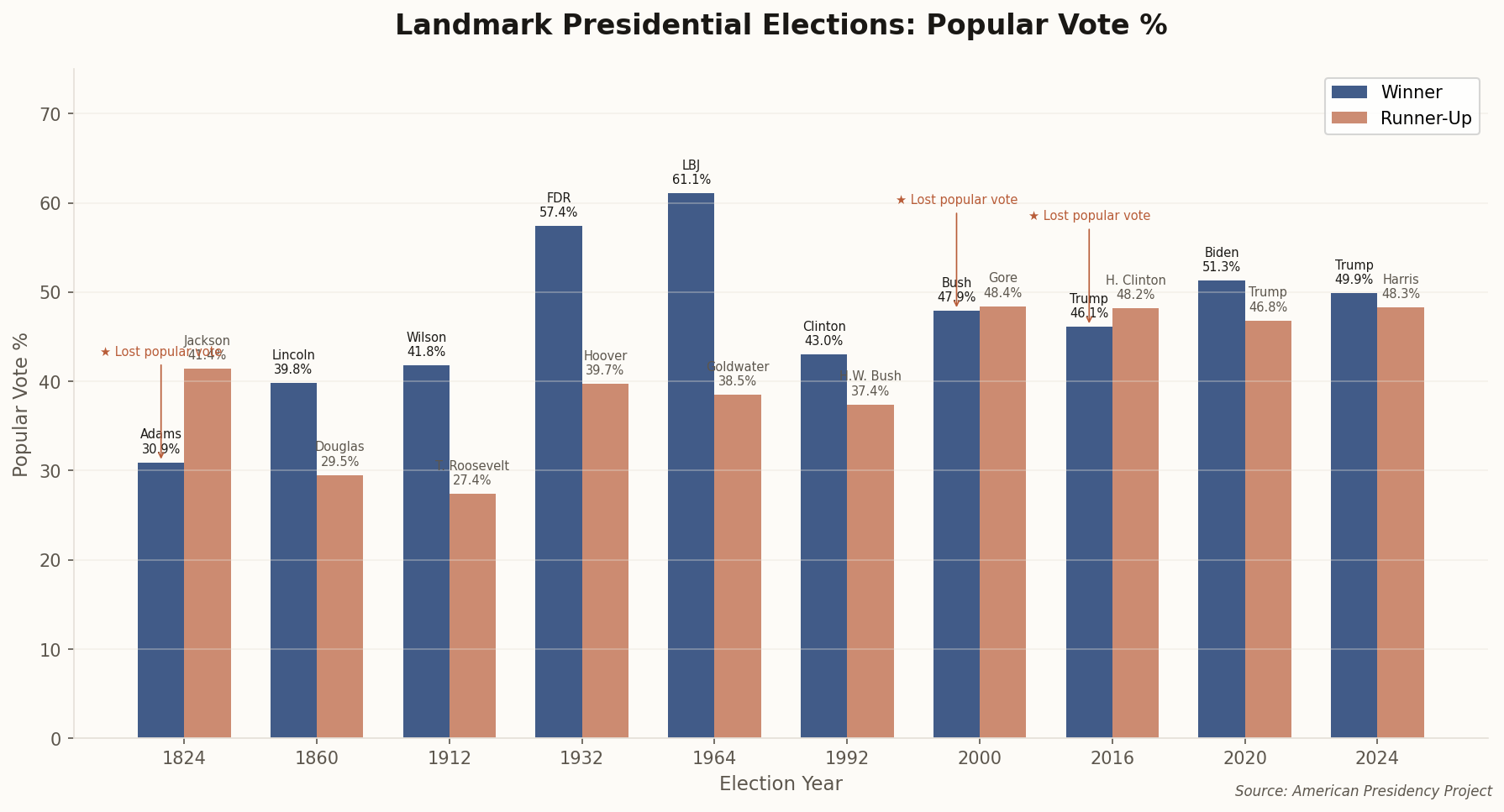
Abraham Lincoln won the presidency with 39.8% of the popular vote in a four-way split. He didn't appear on a single Southern ballot. Within weeks, South Carolina seceded. The partisan argument about slavery had become a shooting war.

Bar chart showing presidential popular vote percentages for landmark elections from 1824 to 2024
Presidential popular vote margins in landmark elections. Note the three instances where the winner lost the popular vote (marked with stars).

The Civil War forged the Republican Party's identity for the next seventy years: the party of the Union, of emancipation, of victory. Democrats became the party of the Lost Cause in the South and immigrant urban machines in the North. This alignment—Republicans as the party of moral reform and national power, Democrats as the party of local control and diverse coalitions—would persist, with mutations, until the Great Depression blew it apart.

"A house divided against itself cannot stand." — Lincoln's words from his 1858 Senate race weren't just rhetoric. They were prophecy. The question of slavery could not be compromised further. Sometimes the partisan system doesn't resolve tensions. Sometimes it crystallizes them into conflict.

Split composition showing a gilded age political boss on one side and Teddy Roosevelt charging forward on the other
04

Bosses, Bimetallism, and the Bull Moose

The Gilded Age was the golden era of the party machine. Tammany Hall in New York. The Pendergast machine in Kansas City. Republican stalwarts who handed out post office jobs like candy. Politics wasn't about ideology—it was about patronage, and both parties operated like competing franchise systems.

Then William Jennings Bryan set the 1896 Democratic convention on fire. "You shall not press down upon the brow of labor this crown of thorns; you shall not crucify mankind upon a cross of gold." The speech electrified the populist wing—farmers, debtors, the agrarian South and West who wanted free silver coinage to inflate the currency. He lost to William McKinley 271–176, but he remade the Democratic Party into something more ideological, more combative, more recognizably modern.

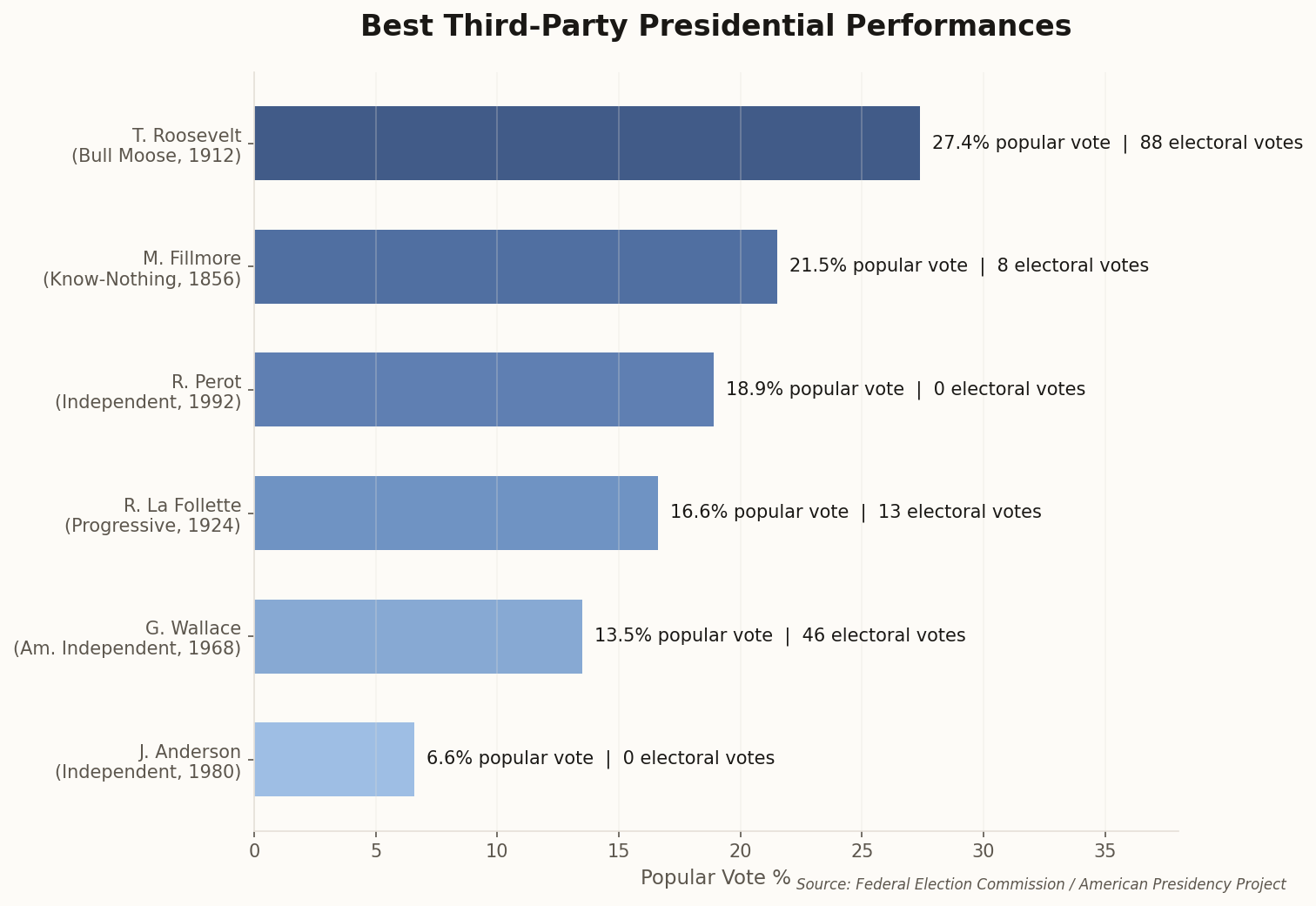
Horizontal bar chart showing the best third-party presidential performances in US history
The best third-party performances in presidential elections. Theodore Roosevelt's 1912 Bull Moose run remains the high-water mark, beating the sitting Republican president.

The real wildcard was Theodore Roosevelt. After his handpicked successor Taft proved too conservative, TR launched the Progressive "Bull Moose" Party in 1912 and pulled 27.4% of the vote—the best third-party showing in American history. He finished second, ahead of the sitting president. The split handed Woodrow Wilson the presidency with just 41.8% of the popular vote and a staggering 435 electoral votes.

Wilson's presidency delivered the income tax, the Federal Reserve, and women's suffrage. But the deeper lesson was about third parties in a winner-take-all system: they don't win. They spoil. Roosevelt's crusade didn't create a Progressive era—it created a Democratic one.

FDR delivering a fireside chat with WPA workers building infrastructure in the background
05

FDR Rewrites the Rules

The Great Depression didn't just wreck the economy. It demolished the Republican majority that had dominated American politics since the Civil War. Herbert Hoover lost to Franklin Roosevelt 472–59 in the Electoral College—one of the most lopsided defeats in presidential history.

FDR's genius was coalition architecture. He assembled an alliance that shouldn't have worked: Northern liberals and Southern segregationists. Union workers and African Americans. Catholic ethnics and Jewish intellectuals. Rural populists and urban progressives. The New Deal coalition held together for thirty years because FDR offered each group something tangible: Social Security, labor rights, agricultural subsidies, infrastructure jobs. "I pledge you, I pledge myself, to a new deal for the American people."

The crack appeared in 1948. When Harry Truman pushed a civil rights plank at the Democratic convention, Strom Thurmond led Southern Democrats out the door. The Dixiecrats carried four Deep South states. Truman won anyway—barely—but the fault line was visible.

By 1964, Lyndon Johnson signed the Civil Rights Act and reportedly told an aide, "We have lost the South for a generation." He was optimistic. It's been three generations and counting. LBJ crushed Barry Goldwater 486–52 in the Electoral College, winning 61.1% of the popular vote. But Goldwater carried the Deep South. The realignment had begun.

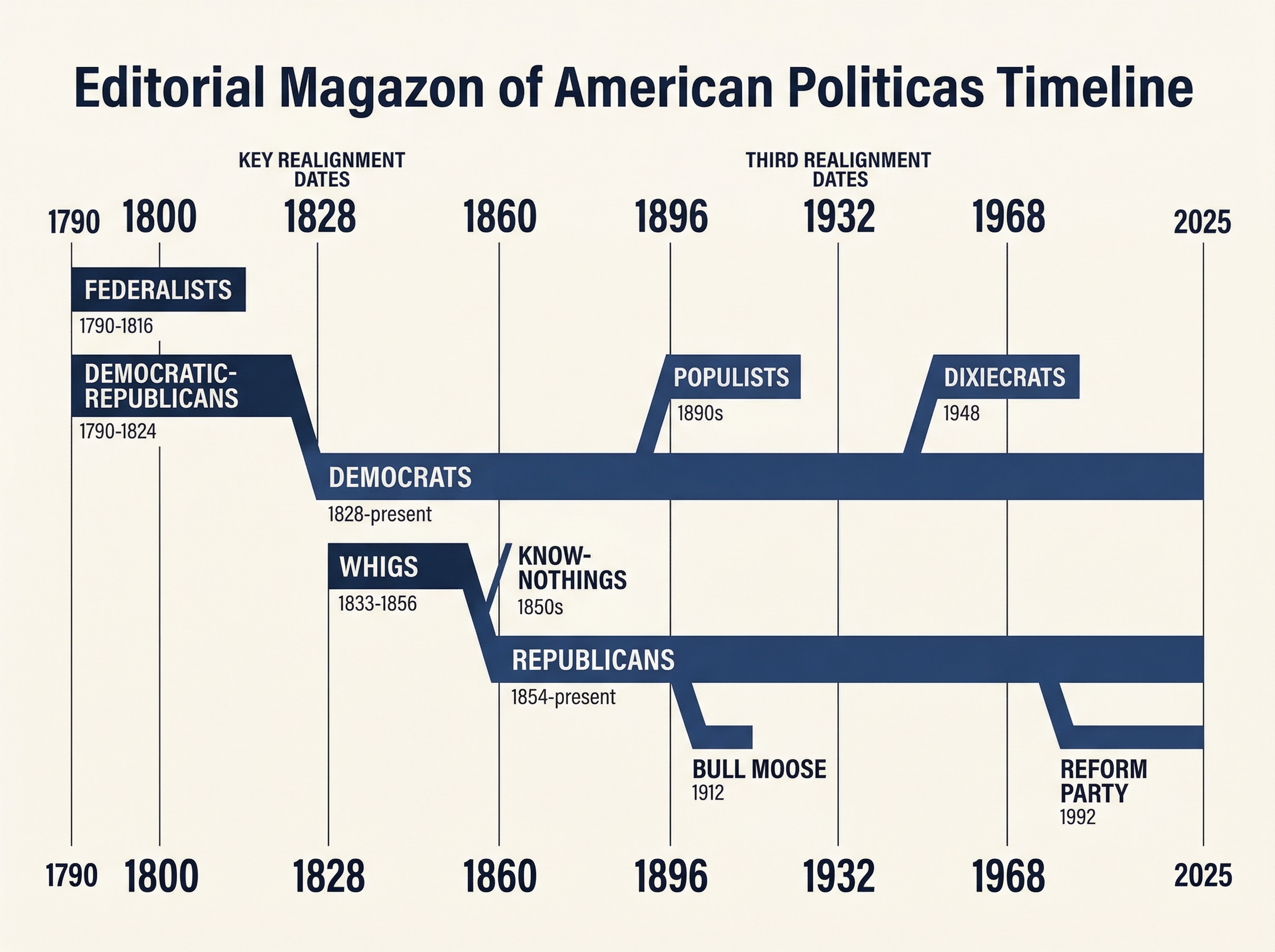
Timeline infographic showing the evolution of American political parties from 1790 to 2025, with party systems, third parties, and key realignment dates
Infographic: The evolution of American political parties, 1790–2025 — Generated with Nano Banana 2.0
An abstract map of the United States where the South shifts from blue to red, with Nixon and Reagan silhouettes
06

The Map Flips Color

Richard Nixon understood something that would reshape American politics for fifty years: the Democratic coalition's contradictions could be exploited. His Southern Strategy targeted white voters disaffected by civil rights, using coded appeals to "law and order" and "states' rights." George Wallace carried the Deep South as an independent in 1968 with 13.5% nationally and 46 electoral votes. Nixon took the rest of the South—and the presidency.

Ronald Reagan completed the realignment. His 1980 landslide (489–49 electoral votes) assembled a new Republican majority: Southern whites, suburban professionals, evangelical Christians, and anti-government libertarians. "Government is not the solution to our problem; government is the problem." That single sentence became the Republican Party's operating system for four decades.

The 1990s added another layer of intensity. Newt Gingrich and his Contract with America nationalized the 1994 midterms and flipped both chambers of Congress for the first time in forty years. He introduced a new style: politics as total warfare, compromise as betrayal, the opposing party as enemy rather than opponent.

Line chart showing U.S. voter turnout from 1840 to 2024, with key events annotated
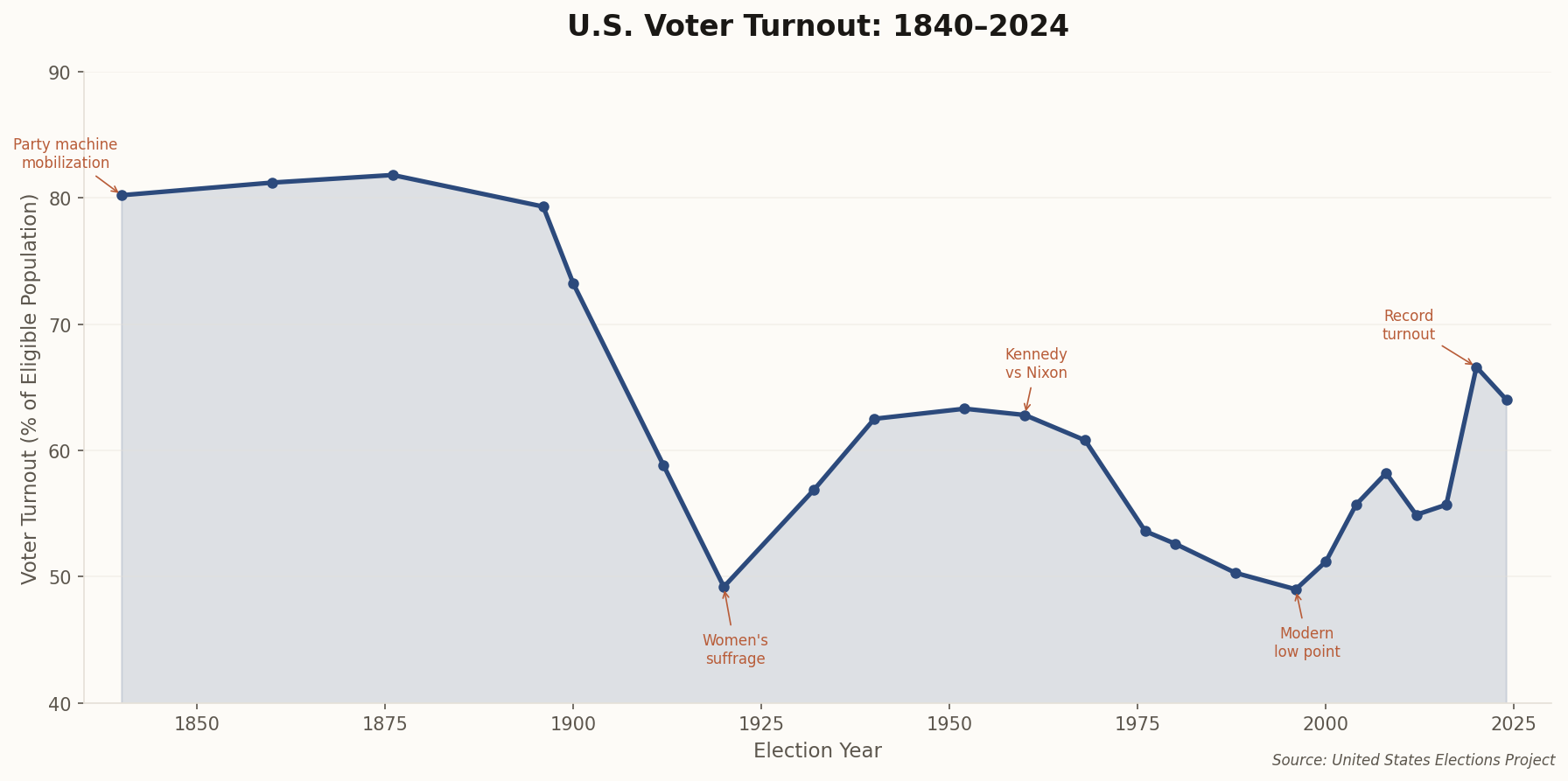
Voter turnout as a percentage of eligible population, 1840–2024. The 19th century's near-80% turnout rates have never returned, though 2020 came closest in over a century.

Bill Clinton responded with triangulation—his "Third Way" stole Republican positions on welfare reform and crime. He won twice but never cracked 50% (thanks to Ross Perot's 18.9% independent run in 1992). The 2000 election—decided by 537 votes in Florida and a 5–4 Supreme Court ruling—proved that America had become two nations sharing one government. The era of genuine swing had ended.

A fractured American flag with social media icons floating through the cracks and smartphones replacing ballot boxes
07

The Parties Eat Themselves

We live in the age of negative partisanship. Most Americans don't vote for their party. They vote against the other one. The defining feature of 21st-century politics isn't ideology—it's identity. Party affiliation has become a cultural marker as deep as religion or race.

Barack Obama's 2008 victory (365–173) assembled a coalition of young voters, minorities, and college-educated whites that seemed to presage a new Democratic majority. The Tea Party answered almost immediately, fueled by opposition to the Affordable Care Act and a visceral rejection of Obama's presidency. By 2010, Republicans recaptured the House in a wave.

Donald Trump's 2016 victory shattered assumptions on both sides. He won 304–227 while losing the popular vote by nearly 3 million. His coalition reshuffled the Republican base: working-class whites without college degrees replaced suburban professionals as the party's center of gravity. The GOP became a populist-nationalist party overnight—or rather, it became what it had been trending toward for decades.

The Democrats have their own civil war. The progressive wing (Bernie Sanders, Alexandria Ocasio-Cortez) pushes for democratic socialism and structural reform. The establishment wing insists on incremental pragmatism. Joe Biden won in 2020 with 81 million votes—the highest raw total in history—and a 66.6% turnout that hasn't been seen in over a century. Then Trump came back in 2024, winning both the Electoral College (312–226) and the popular vote—the first Republican to do so since George W. Bush in 2004.

January 6, 2021 — For the first time since the Civil War, the peaceful transfer of power was violently challenged. Whether you see it as an insurrection or a protest, it marked a crisis point: the parties no longer just disagree about policy. They disagree about whether elections themselves are legitimate.

Where does this end? The two-party system has survived civil war, depressions, world wars, and social revolutions. It has proven extraordinarily resilient—not because the parties are stable, but because they're adaptable. Every generation thinks its political moment is uniquely toxic. Every generation is partly right. The parties don't resolve America's contradictions. They metabolize them, slowly, imperfectly, and usually just in time.

The Argument Continues

The American two-party system is the world's oldest continuous democratic competition. It has reinvented itself at least six times. The only certainty is that it will reinvent itself again—the only question is whether the reinvention will happen at the ballot box or in the streets. History suggests the former. But history has been wrong before.