
NVIDIA DGX Spark

Four Sparks and a Prayer

What happens when you stack four desktop-class Blackwell supercomputers under your desk? 4 petaflops, 512GB of unified memory, and the death of your cloud GPU bill.

Listen
Four NVIDIA DGX Spark boxes connected by glowing fiber optic cables in a diamond formation
Holographic neural network projection above a desktop compute cluster
01

Running Llama 4 Maverick on Your Desk Is No Longer a Fever Dream

Here's the number that should keep cloud providers up at night: 5–8 tokens per second on a 400-billion-parameter model, running entirely on hardware you own. The r/LocalLLaMA community has been putting four-node DGX Spark clusters through their paces, and the results are quietly stunning.

Llama 4 Maverick, Meta's 400B flagship, runs with full context on the 512GB memory pool. No quantization hacks, no offloading gymnastics—the model just fits. DeepSeek-V3, with its mixture-of-experts architecture, hits ~12 tokens/sec by keeping hot experts in GPU memory and cold ones in CPU territory. That's faster than most people type.

But the real flex is context length. Users report running 128k context windows on 70B models without noticeable degradation. For researchers doing long-document analysis, RAG pipelines, or multi-turn reasoning chains, that's the difference between "proof of concept" and "production-grade." One commenter nailed it: "Running a 400B model locally without a server rack is a religious experience for an AI researcher."

The math is straightforward. A comparable cloud H100 instance runs $3/hour. At 720 hours/month, that's $2,160. The Spark cluster pays for itself in under 9 months—and then it's free forever. That changes the calculus for every university lab and startup team with a tight GPU budget.
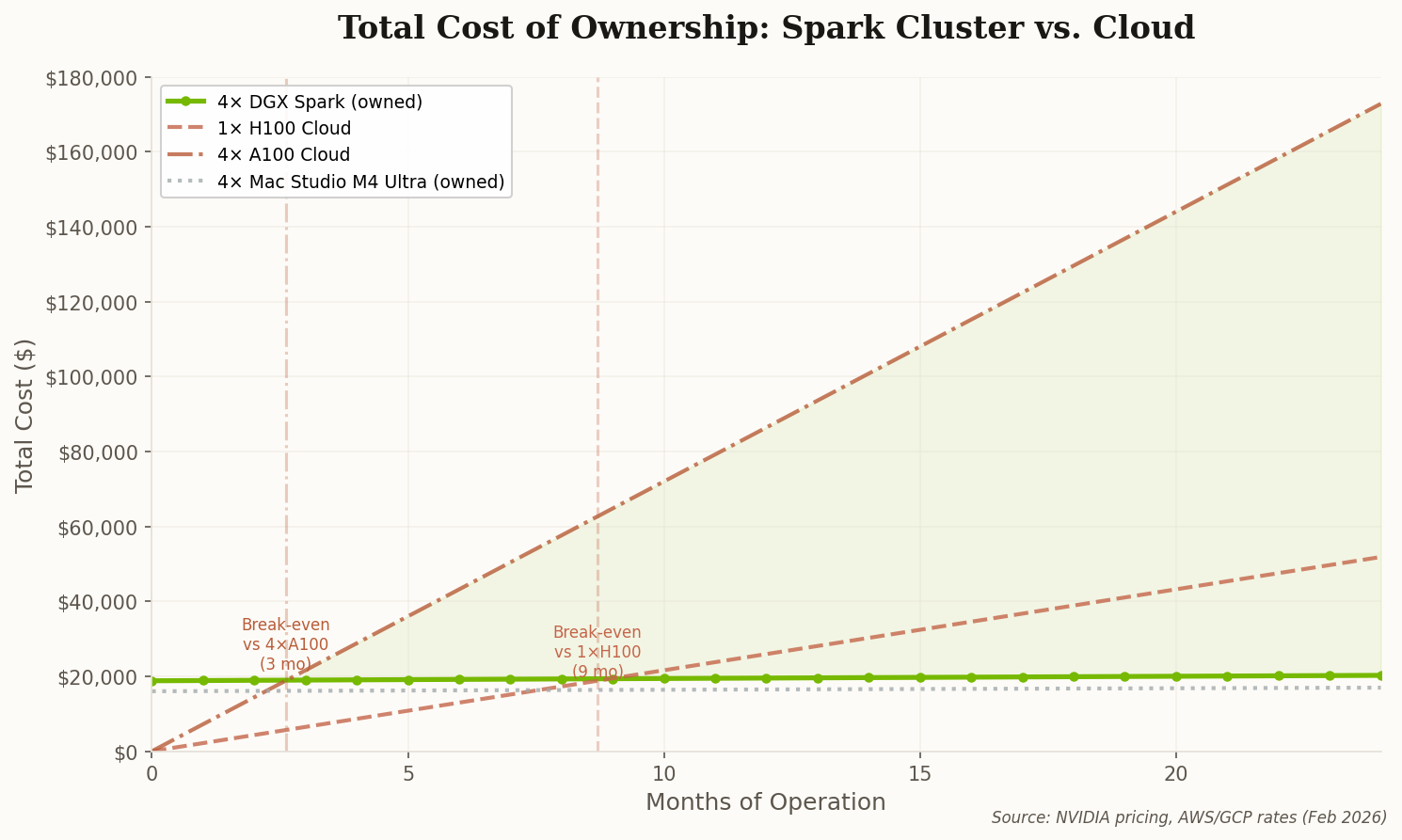
Line chart showing total cost of ownership over 24 months: DGX Spark cluster flatlines at $18,800 while cloud costs climb linearly to $172,800
Total cost of ownership: The Spark cluster breaks even against a 4-GPU cloud instance in under 3 months, and against a single H100 in about 9 months. After that, every hour of compute is effectively free.
Row of branded desktop AI workstations on a retail display shelf
02

The $3,266 Question: OEMs Crack Open the GB10 Market

NVIDIA's Founders Edition is gorgeous, but at $4,699 post-hike, it's not the only way in. ASUS fired the first shot: the Ascent GX10 ships at $3,266 with a 1TB NVMe (versus NVIDIA's 4TB). That's a 30% discount for the same GB10 silicon, and for a four-node cluster, the savings add up to $5,732—nearly enough for a fifth node.

Dell went a different direction with the Pro Max GB10, a ruggedized chassis designed for edge AI deployments—think factory floors, field research stations, and autonomous vehicle labs. Lenovo's ThinkStation PGX is the most ambitious: a dual-slot desktop that houses two GB10 modules in a single chassis, giving you 256GB of unified memory in one box.

The subtext is clear: NVIDIA's GB10 is becoming the ARM of AI hardware—a reference architecture that OEMs differentiate on price, form factor, and storage. That's exactly how prices fall. NVIDIA raised the Founders Edition from $3,999 to $4,699 in February, blaming LPDDR5X shortages, but OEM competition suggests the "shortage" has a shelf life.

Cluster builder's tip: For a budget 4-node cluster, 4x ASUS Ascent GX10 ($13,064) gives you identical compute to 4x NVIDIA Founders Edition ($18,796). Both hit 4 PFLOPS and 512GB. The only sacrifice is storage, which you can supplement with a shared NAS for model weights.

Abstract visualization of four interconnected compute nodes with luminous green bridges
03

The Architecture That Makes It a DGX, Not Just a Desktop

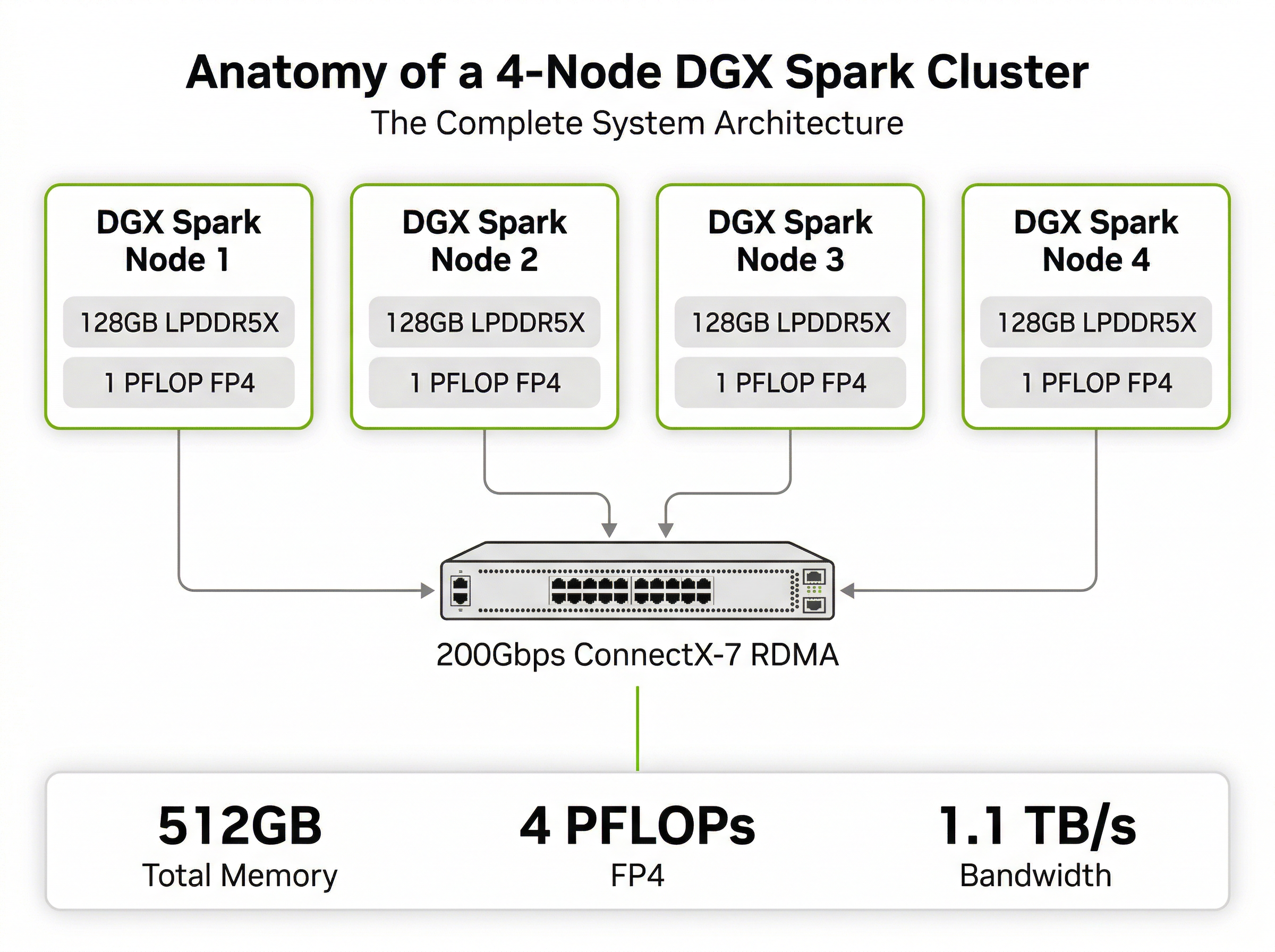
Every AI box can run a model. What makes the DGX Spark interesting is what happens when you connect four of them. Each node ships with dual ConnectX-7 200Gbps SmartNICs using RoCE—RDMA over Converged Ethernet. That means GPU-to-GPU communication across nodes with microsecond latency, the same interconnect fabric that powers NVIDIA's data center DGX systems.

The numbers at four-way scale: 4 PFLOPS of FP4 compute (1,920 TFLOPS dense), 512GB of pooled unified memory, and ~1.1 TB/s of aggregate memory bandwidth. Two nodes can connect directly; four require a 200GbE switch (about $1,500 for a Mellanox SN2700). It's not free, but it's an order of magnitude cheaper than comparable data center infrastructure.

Infographic showing the anatomy of a 4-node DGX Spark cluster with specs for each node and aggregate performance
Anatomy of a 4-Node DGX Spark Cluster — Each node contributes 128GB memory and 1 PFLOP; the ConnectX-7 RDMA fabric stitches them into a coherent 512GB, 4 PFLOP supercomputer.

Why RDMA matters: it enables Fully Sharded Data Parallel (FSDP) training and Tensor Parallelism for inference. You can shard a 400B model across all four GPUs and run it as if it were a single machine. Try that with four Mac Studios connected over Thunderbolt—you'll spend more time debugging networking than running experiments.

As one reviewer put it: "With four Sparks, you effectively have a 512GB 'Virtual Blackwell' instance running under your desk for less than the cost of a single H100."

Split-screen comparison of Mac Studio and DGX Spark with performance visualizations
04

The Decode Speed Surprise: Mac Studio Fights Back

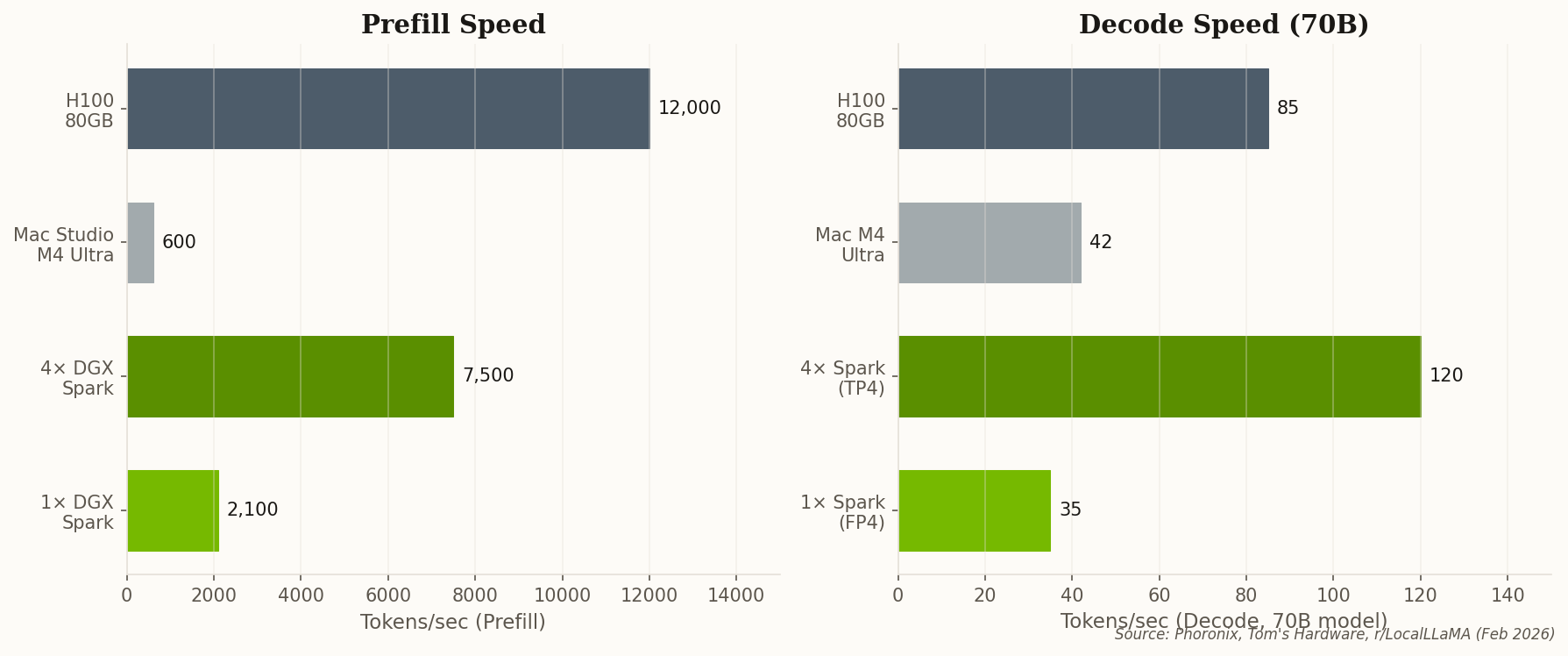
Here's where the narrative gets interesting. Phoronix benchmarks show the DGX Spark absolutely destroying Apple's Mac Studio M4 Ultra on prefill—2,100 tokens/sec vs 600. That's a 3.5x advantage, and it makes the Spark the obvious choice for prompt engineering, batch processing, and any workload that's heavy on input.

But on decode speed—the part where the model generates text token by token—the Mac Studio is 15% faster per node. The M4 Ultra's 800 GB/s memory bandwidth beats the Spark's 273 GB/s. For pure chatbot-style interaction on a single node, Apple still wins.

Side-by-side bar charts comparing prefill and decode speeds across DGX Spark, Mac Studio, and H100
The DGX Spark dominates prefill (prompt processing) while the Mac Studio M4 Ultra edges ahead on single-node decode. At 4-node scale, the Spark's RDMA advantage makes it untouchable.

The critical difference: the Mac can't cluster. Apple offers no RDMA equivalent, no Tensor Parallelism support, no multi-node FSDP. Four Mac Studios are four independent machines. Four DGX Sparks are one supercomputer. Phoronix said it best: "The Mac is a better chatbot; the Spark is a better developer's tool for training and prompt engineering."

For the "vibe coding" crowd running a local assistant, the Mac Studio might be the right call. For anyone doing serious research, fine-tuning, or multi-model inference serving, the cluster changes the game.

Exploded view of the GB10 Superchip showing Grace CPU and Blackwell GPU dies
05

Inside the GB10: The Superchip That Fits in a Backpack

The GB10 Grace Blackwell Superchip is an engineering statement. A Blackwell GPU with 6,144 CUDA cores and 192 Tensor cores bonded to a 20-core Grace ARM CPU (Cortex-X925/A725) via NVLink-C2C—all sharing 128GB of LPDDR5x unified memory. No PCIe bottleneck. No discrete VRAM limitation. The entire memory pool is coherent and accessible from both compute engines.

Peak performance: 1 petaflop of FP4 (sparse) or 480 TFLOPS dense. The form factor is absurd—5.9" x 5.9" x 2"—roughly the size of a hardcover book. The cooling is passive-assisted, quiet enough for an office desk. Ian Buck, NVIDIA's VP of Hyperscale, wasn't exaggerating: "DGX Spark puts the power of a data center Blackwell node into a form factor that fits in a backpack."

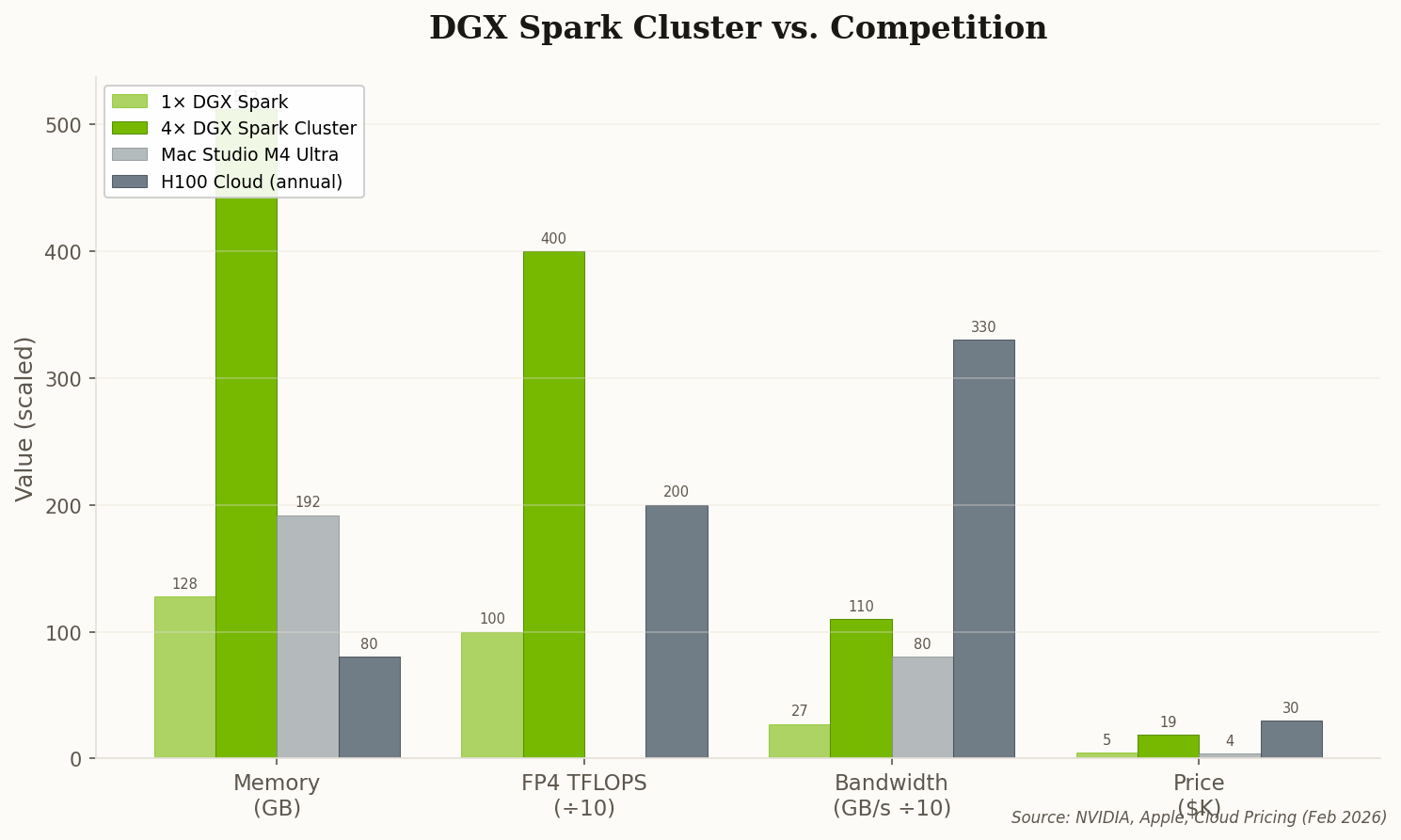
Grouped bar chart comparing DGX Spark, 4-node cluster, Mac Studio M4 Ultra, and H100 Cloud across memory, TFLOPS, bandwidth, and price
Scaled comparison across four dimensions. The 4-node DGX Spark cluster leads in memory and FP4 compute while remaining the most cost-effective option for always-on AI research.

The unified memory architecture is the killer feature. A single H100 has 80GB of HBM3. To run a 70B model unquantized, you need careful memory management. The Spark's 128GB lets you load the model and still have headroom for KV cache, activations, and experimentation. At four nodes, 512GB means even the largest open-weight models fit without compromise.

Abstract visualization of a software update transforming a machine with streams of code
06

The Update That Changed Everything: 2.5x Overnight

When the DGX Spark launched, critics had one legitimate complaint: the 273 GB/s memory bandwidth was a bottleneck compared to HBM3e-equipped data center GPUs. They weren't wrong. But they also weren't accounting for software.

NVIDIA's January 2026 driver update delivered three optimizations that collectively boosted throughput by 2.5x:

NVFP4 (Blackwell FP4) support: The GB10's Blackwell GPU was designed for 4-bit inference from the start, but launch drivers ran in FP8 mode. Unlocking native FP4 effectively doubled the arithmetic throughput per memory bandwidth dollar.

Eagle3 Speculative Decoding: A lightweight "draft" model runs ahead of the main model, predicting likely next tokens. When the draft is correct (which happens ~70% of the time), the main model can verify multiple tokens in a single pass instead of generating them one at a time. This is the software equivalent of adding memory bandwidth.

FlashAttention-3: A Blackwell-specific implementation of the attention mechanism that reduces memory I/O during the most bandwidth-intensive phase of inference. StorageReview called the result exactly right: "The January update transformed the Spark from a capacity-focused novelty into a high-throughput workhorse."

The lesson is classic NVIDIA: ship the hardware first, then unlock its potential through software. The DGX Spark you buy today will keep getting faster without changing a single wire. For a cluster of four, that 2.5x improvement applies to every node—meaning aggregate performance has effectively gone from "impressive" to "absurd" with a single apt update.

The Desk Is the New Data Center

Four DGX Sparks for under $19K gives you more unified memory than most cloud instances, RDMA networking that enables real distributed training, and a total cost of ownership that makes cloud GPUs look like a subscription you forgot to cancel. Carmack was right—the "1 petaflop" marketing is generous. But the RDMA interconnect is the real engineering win. It's what makes this a DGX, not a gaming PC with ambitions. The question for 2026 isn't whether desktop AI clusters work. It's whether you can afford to keep renting what you could own.