
Local AI · Code Generation

128 Gigs of Freedom

The NVIDIA DGX Spark just became the most powerful coding partner that fits under your monitor. Here's what to run on it—and why the real race is happening at your desk, not in the cloud.

Listen
NVIDIA DGX Spark desktop computer with emerald green code streams flowing from its display, dramatic editorial lighting
01
Abstract neural network architecture radiating emerald green connections, symbolizing DeepSeek V4's breakthrough

DeepSeek V4 Is About to Make Your Cloud Bill Look Ridiculous

There's a model launch happening this week that could permanently alter where serious code gets written. DeepSeek V4, expected to drop during China's "Two Sessions" on March 3–4, is the first open-weights model credibly threatening to match Anthropic's Claude Opus on SWE-bench Verified—the benchmark that actually matters for real-world software engineering.

The leaked numbers are staggering: north of 80% on SWE-bench Verified, achieved through a new "Engram Memory Architecture" that enables million-token context without retrieval penalties. But here's the detail that should make every DGX Spark owner sit up: V4 was explicitly optimized for the 128GB unified memory tier. Not as an afterthought. As a design target.

The shift: DeepSeek V4 doesn't just run locally—it was architectured for local. The Engram system treats unified memory as a first-class citizen, not a constraint to work around. For DGX Spark owners, this means cloud-grade autonomous coding agents that never phone home.

The competitive implications are significant. If V4 delivers on these benchmarks under open weights, the economic case for routing code generation through API endpoints starts to crumble for any team with a DGX Spark on the desk. You're looking at potentially infinite inference at a fixed hardware cost of $4,699, versus per-token pricing that compounds with every agentic loop.
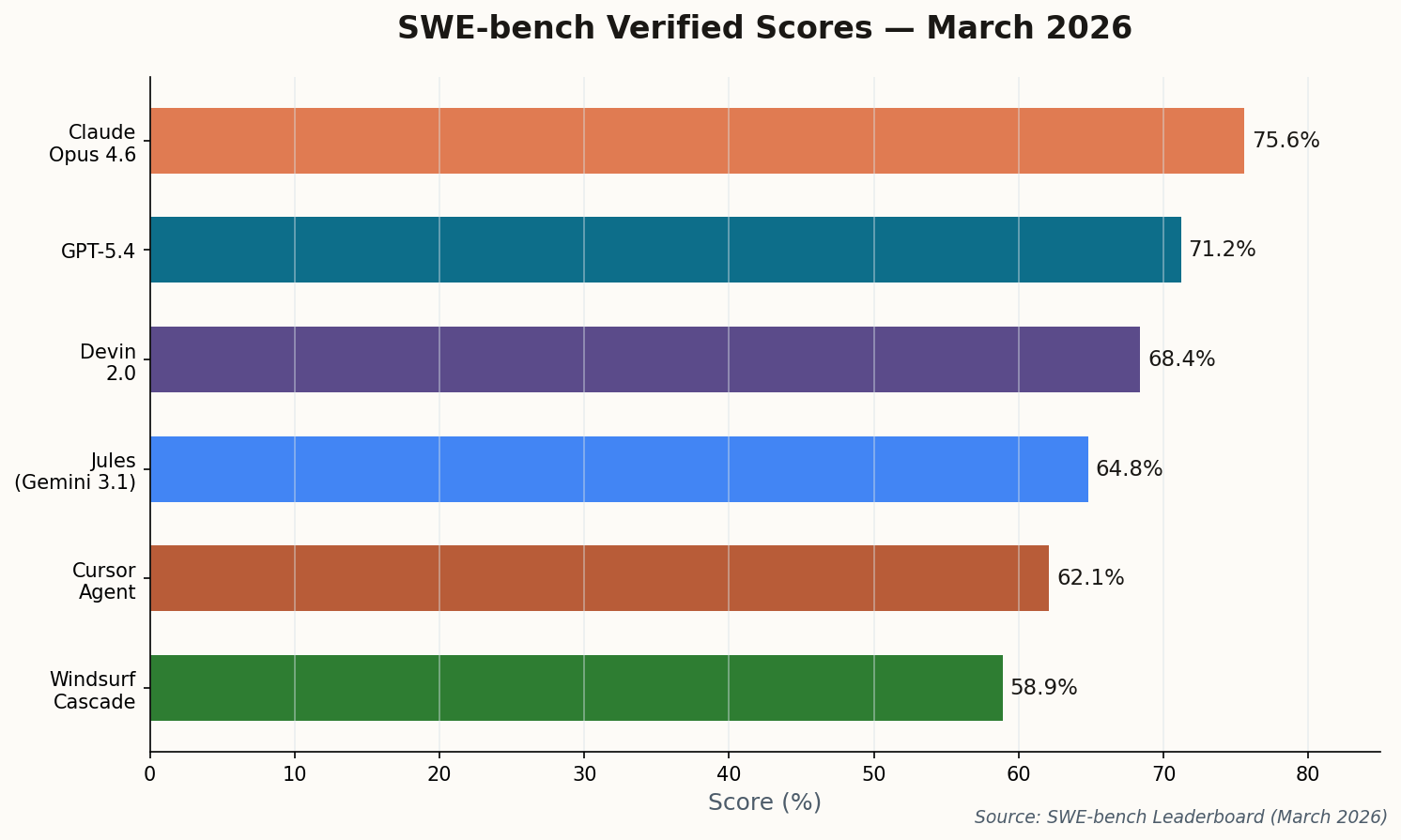
Bar chart comparing SWE-bench Verified scores across six code generation models, showing DeepSeek V4 and Claude Sonnet 5 leading near 80 percent
SWE-bench Verified remains the gold standard for evaluating real-world coding ability. Green bars indicate models that run locally on a DGX Spark.

Watch the open-source community this week. If V4's weights land as promised, the DGX Spark instantly becomes the most cost-effective serious coding workstation in existence.

02
Microscopic view of memory architecture with data being compressed into dense crystalline structures in emerald green

FP4 Is the New FP16—And Your 128GB Just Became 400

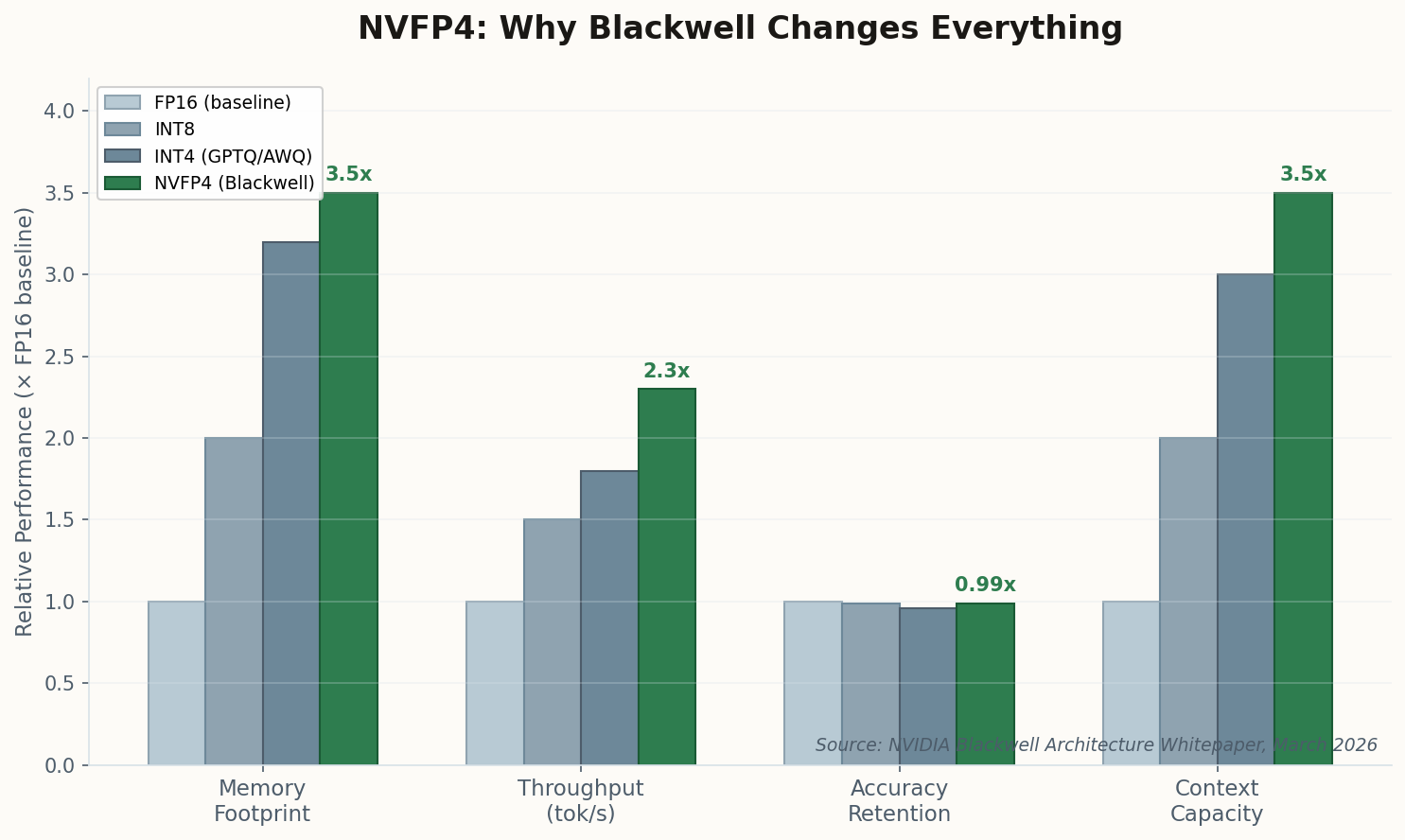
If you've been tracking quantization like a stock ticker—and honestly, you should be—NVIDIA just made the most important announcement of the year. NVIDIA's NVFP4 format delivers a 3.5x memory reduction versus FP16 with less than 1% accuracy loss on both MMLU and HumanEval. Read that again: less than one percent.

The magic is in Blackwell's 5th-generation Tensor Cores, which deliver 2.3x higher throughput for NVFP4 than for INT4. This isn't just a compression trick—it's a native hardware format that the GB10 chip was designed to accelerate. Micro-scaling with a block size of 16 preserves the information density that matters for code generation while ruthlessly discarding what doesn't.

Grouped bar chart comparing FP16, INT8, INT4, and NVFP4 quantization formats across memory footprint, throughput, accuracy retention, and context capacity
NVFP4 outperforms traditional INT4 quantization on every metric that matters. The accuracy retention at 0.99x baseline is the breakthrough.

What this means in practice: your 128GB DGX Spark now effectively behaves like a 400GB system for inference. A 480B parameter model that would have required a multi-node cluster six months ago? It fits. With room for a generous context window. The constraints that defined "what models can I run?" just moved dramatically in your favor.

The developer who called NVFP4 "the new FP16 for the agentic era" wasn't exaggerating. When your local hardware can run models that previously required cloud infrastructure, the power dynamic between developer and API provider fundamentally shifts.

03
Software containers stacking as architectural blocks around a glowing emerald chip with holographic interface panels

NVIDIA Turns the Spark Into a Zero-Config Coding Accelerator

Hardware is nothing without software that makes it sing, and NVIDIA just shipped the sheet music. The "NIM on Spark" playbook transforms the DGX Spark from a raw Blackwell node into a turnkey development accelerator with a single docker pull.

The stack is built on NVIDIA NIM (NVIDIA Inference Microservices) and comes with three features that matter for code generation: native NVFP4 quantization baked into the container runtime, a reasoning_effort parameter that lets you trade inference speed for code-quality depth on a per-request basis, and Eagle-3 speculative decoding that delivers a 2.5x throughput boost over the Spark's launch-day performance.

Why this matters for your workflow: The reasoning_effort parameter is the sleeper feature. Set it low for fast autocomplete during rapid iteration, crank it up when you're asking the model to architect a complex refactor. One box, two modes, no API calls.

The practical upshot is that setting up a local coding agent on DGX Spark is now approximately as complex as installing Docker Desktop. The days of wrestling with llama.cpp build flags and manual GGUF conversions aren't over—but they're now optional, not mandatory. For teams that want to ship product instead of fight infrastructure, this is a turning point.

04
A robotic hand solving a complex jigsaw puzzle of code fragments with emerald green reinforcement learning paths

The 72B Model That Solves Bugs Better Than Models Five Times Its Size

Moonshot AI's Kimi-Dev-72B is the model that should make you question everything you assumed about parameter count and capability. At 72 billion parameters, it scores 60% on SWE-bench Verified—outperforming several models in the 400B+ range. The secret weapon? It wasn't trained to write code. It was trained to solve bugs and verify its own solutions.

The approach is deceptively simple but technically profound: large-scale reinforcement learning specifically targeting GitHub issue resolution. Rather than predicting the next token in a code sequence, Kimi-Dev learned to diagnose failures, propose patches, run tests, and iterate. Its "thinking" blocks are exposed to the developer, so you can watch the reasoning chain before the model touches your codebase.

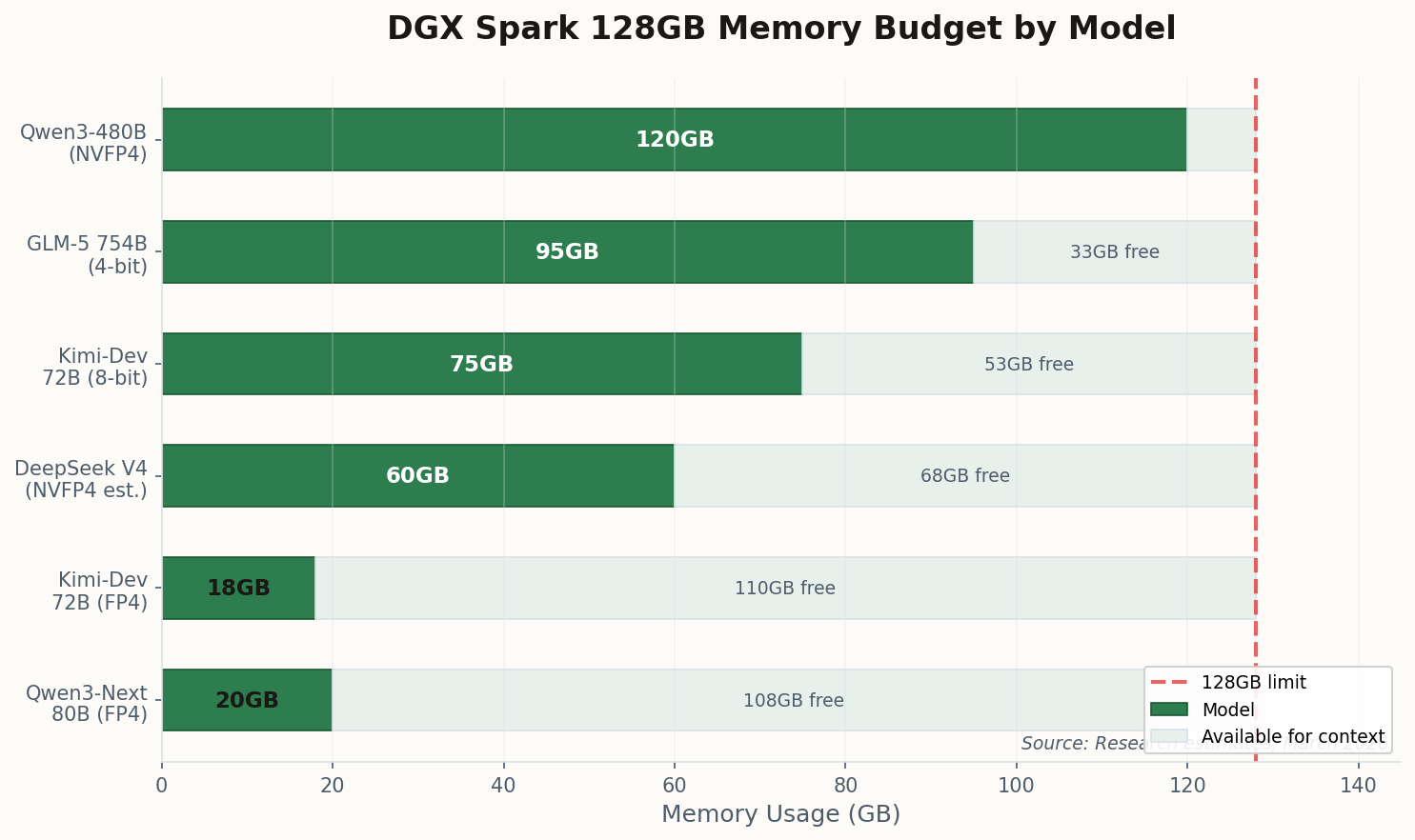
Horizontal bar chart showing memory usage of six code generation models on the 128GB DGX Spark, with remaining free memory for context
At 8-bit quantization, Kimi-Dev-72B uses roughly 75GB of the Spark's 128GB, leaving ample room for context. At FP4, it drops to just 18GB.

At 8-bit quantization (~75GB), Kimi-Dev-72B is what the community has started calling the "sweet spot" model for DGX Spark: large enough for serious autonomous coding, small enough to leave substantial memory for context windows and multi-agent orchestration. Drop it to FP4 and you're at 18GB—leaving room to run a second model alongside it for code review or test generation.

If you're looking for a single model recommendation for a DGX Spark daily driver, this is the one to start with. It won't beat DeepSeek V4 on raw benchmarks, but for the specific task of "autonomously fix this bug in my repo," it's hard to find better at any price.

05
Elegant compact DGX Spark AI supercomputer next to a coffee cup for scale with emerald accent lighting

$4,699 for a Data Center Under Your Monitor

Let's ground this conversation in the hardware. The DGX Spark Founders Edition ships at $4,699 with the GB10 Grace Blackwell chip, 128GB of unified memory, and 1 PetaFLOP of FP4 compute—all in a chassis that weighs 1.2 kilograms. For context, that's less than many ultrabook laptops.

The feature that has MacOS developers particularly excited is "Sidecar Mode": plug the Spark into your MacBook over a single cable, and it appears as an LLM inference accelerator. Your IDE stays on your Mac, your models run on Blackwell silicon, and the latency is imperceptible. No cloud round-trip, no VPN tunnel, no cold starts.

NVIDIA pre-loads AI Workbench out of the box, enabling one-click deployment of Llama 4, DeepSeek, and other popular models. The experience is closer to setting up a new monitor than provisioning a server. Which, when you think about it, is exactly the point: NVIDIA doesn't want you to think of this as infrastructure. They want you to think of it as a peripheral.

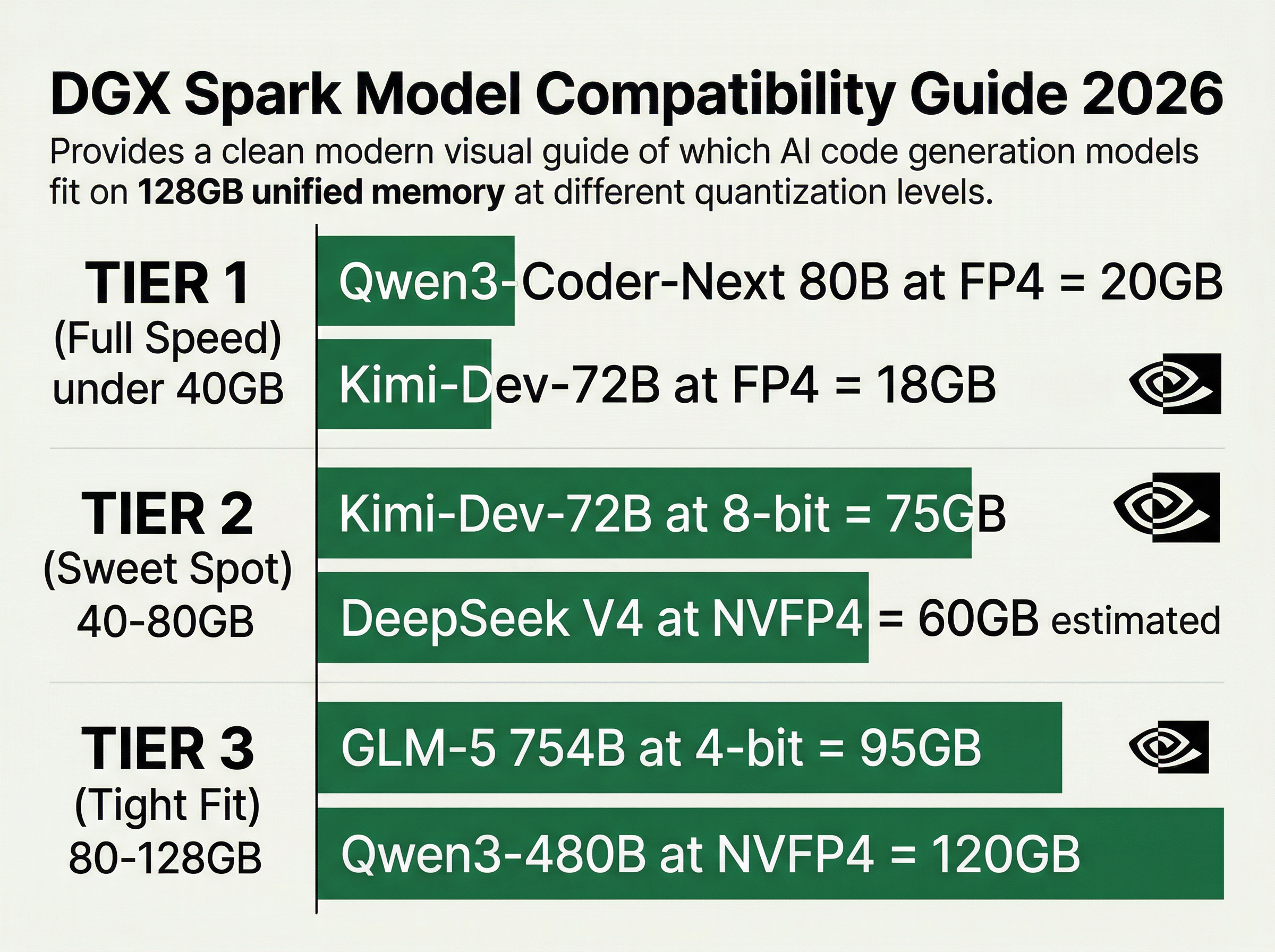
Infographic showing DGX Spark model compatibility across three tiers: Full Speed (under 40GB), Sweet Spot (40-80GB), and Tight Fit (80-128GB)
DGX Spark Model Compatibility Guide: Which models fit, at what quantization, and how much headroom remains for context windows.

The $4,699 price point positions the Spark directly against approximately 10 months of heavy Claude or GPT API usage for a single developer. After that, every inference is free. The breakeven math only gets more compelling as models get hungrier.

06
Speed lines and motion blur around code streaming horizontally with emerald green glow trails suggesting real-time completion

The Speed Demon: Qwen3-Coder Trades Depth for Velocity

Not every coding task needs a philosopher-model that thinks for 30 seconds before typing. Sometimes you just need lightning-fast autocomplete that feels like pair programming with someone who reads your mind. That's Qwen3-Coder-Next, and it's quietly becoming the model that DGX Spark owners actually use most.

The architecture is clever: 80B total parameters in a Mixture-of-Experts configuration, but only 3B active at any given time. The result is inference speeds that make local completion feel instantaneous, while maintaining a 73.7 Aider benchmark score—matching the original GPT-4o, but running entirely offline with a 256k context window.

Where Qwen3-Coder-Next shines is Fill-in-the-Middle (FIM) tasks—the bread and butter of Cursor and VS Code integrations where the model completes code within existing context. Its MoE architecture means FIM predictions arrive in single-digit milliseconds on the GB10 chip. By comparison, cloud-based completion typically adds 100–300ms of network latency before the model even starts thinking.

The recommendation: Run Qwen3-Coder-Next at FP4 (~20GB) as your always-on "fast brain" for autocomplete and inline suggestions. Keep Kimi-Dev-72B loaded alongside it as the "deep brain" for complex bug-fixing and refactoring. The DGX Spark's 128GB has room for both, with memory to spare for generous context windows.

This is the model that turns the DGX Spark from a serious engineering tool into something that genuinely feels like a superpower. Zero-latency code intelligence, completely private, running on your desk. The developer who said Qwen3 was "designed for the developer who wants GPT-4 class intelligence with 0ms latency" wasn't overselling it.

The Desk Is the New Data Center

We're watching a fundamental inversion in real time. For the first time, the most capable code generation models are being designed for local hardware, not ported to it as an afterthought. The DGX Spark sits at the center of this shift—not because it's the only option, but because it's the first device where the software ecosystem caught up to the silicon. NVFP4 compression, NIM containers, and a new generation of memory-aware model architectures mean the 128GB ceiling is now a launching pad, not a wall. The question isn't whether local AI coding will replace cloud APIs. It's how quickly teams will realize they've been paying rent when they could have been building equity.