AI & Sequential Art

The Same Face Twice

Character coherency was the last unsolved problem in AI-generated comics. In February 2026, three different solutions arrived in the same week. Here's what happened — and what it means for anyone trying to make a graphic novel with a machine.

Listen
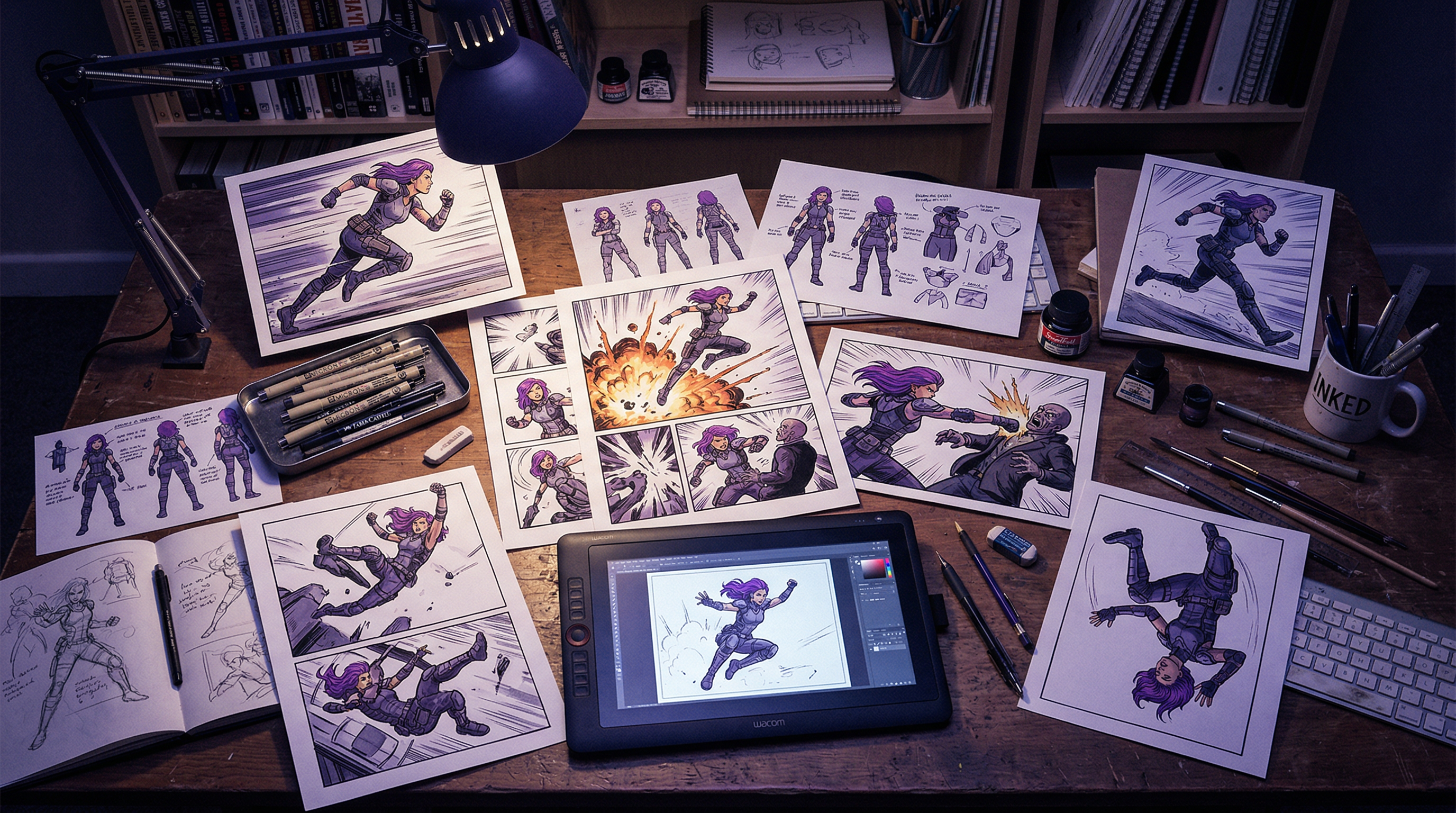
A comic artist's desk viewed from above, showing panels of the same character in different action poses with perfect visual consistency
01

Enterprise Money Just Entered the Chat
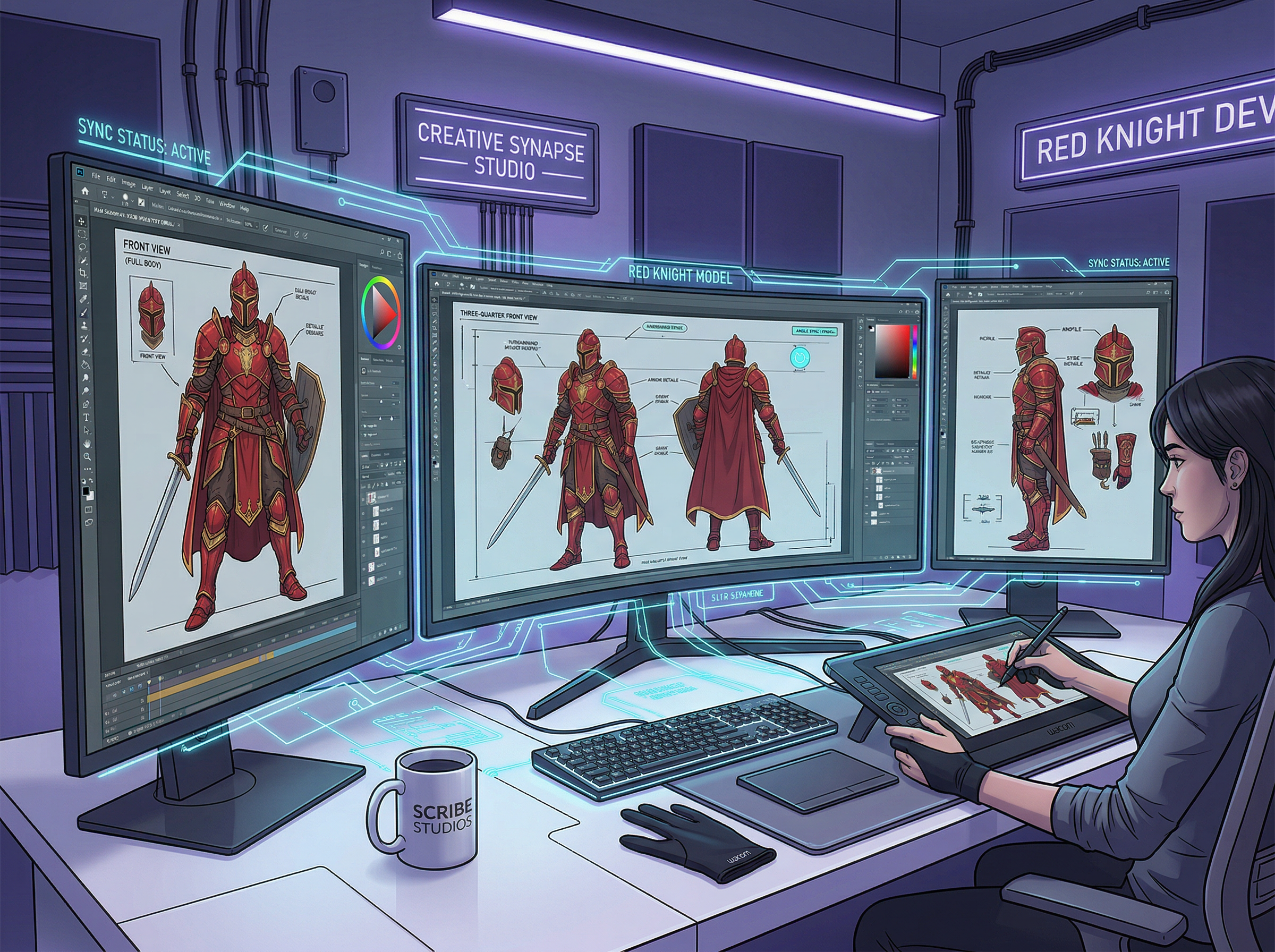
Professional storyboard workspace with synchronized character model sheets displayed across connected digital screens

Here's how you know a technology has crossed from "toy" to "tool": somebody builds a SaaS platform around it and charges enterprise pricing. Story-boards.ai launched its Continuity Suite last week, and it's not aimed at weekend hobbyists. It's aimed at animation studios that burn 40% of their production hours fixing character inconsistencies between frames.

The pitch is straightforward. Upload a character design once. The platform syncs it across every workspace, every artist, every AI generation agent touching the project. Their internal testing claims a 70% reduction in redraw time for character-related errors. That's not a marginal improvement — that's eliminating an entire role from the pipeline.

What makes this significant isn't the technology (which is essentially reference-image conditioning wrapped in a project management layer). It's the signal. When enterprise tools appear, it means the underlying capability is stable enough that businesses will bet their workflows on it. Two years ago, nobody would have shipped a continuity system for AI art because the models couldn't hold a face for three consecutive panels. Now it's a product category.

The real question isn't whether AI can maintain character consistency — it's whether traditional studios will adopt these tools fast enough to matter, or whether a new generation of solo creators will simply route around them entirely.
02

Five Characters, One Model, Zero LoRAs

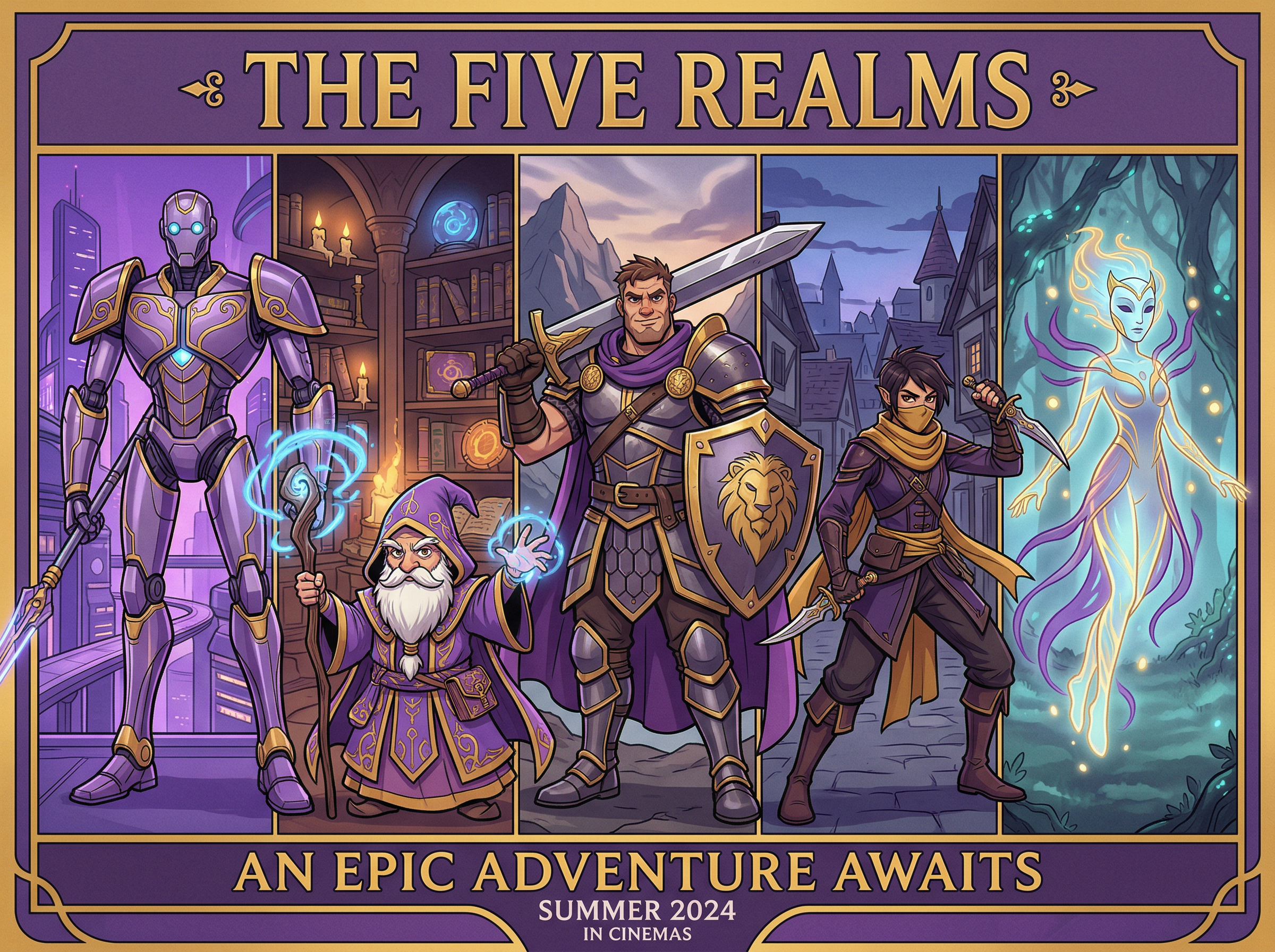
Five distinct cartoon characters rendered with perfect anatomical consistency in the same vibrant art style

Google DeepMind's Gemini 3.1 Flash image generation (internally called Nano Banana 2) shipped what might be the most consequential feature for AI comic creators: native multi-character tracking. Not one character. Not two. Five distinct characters and 14 specific objects, maintained simultaneously across generations without any external tooling.

The technical trick is their "Advanced Subject Consistency" system, which maintains high-dimensional identity embeddings for each character in what they call a "narrative cache." Think of it as a short-term visual memory — the model remembers that Character A has green eyes, Character B has a scar on their left cheek, and Character C always wears that stupid hat. Crucially, it remembers these things relative to each other, so characters don't slowly drift toward a visual average.

The modular "Banana-Peels" system is the cherry on top: snap-on character LoRAs that work without retraining the base model. For comic creators, this means you can define a character sheet once and apply it to any generation. No more ComfyUI node spaghetti, no more overnight training runs.

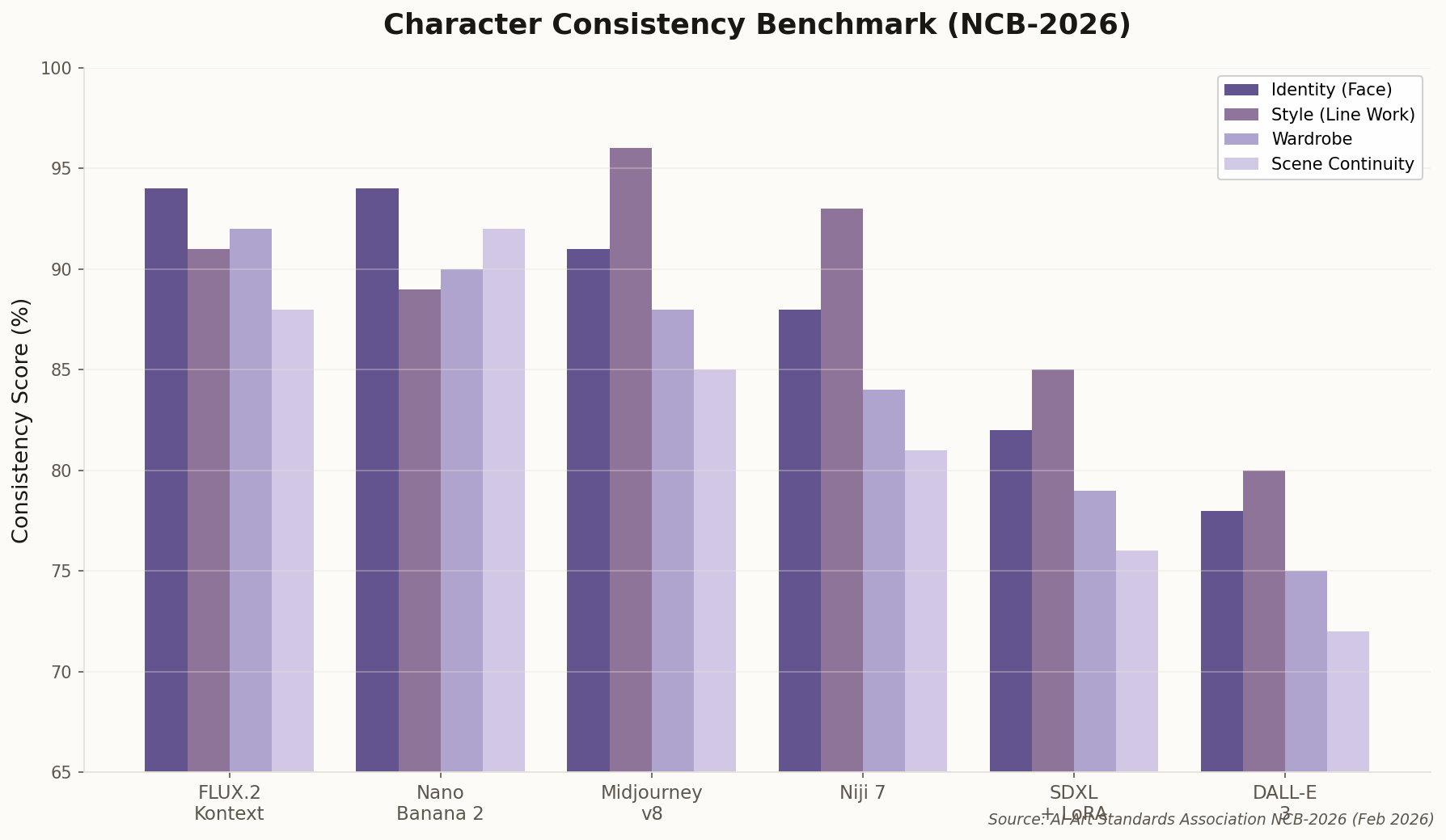
Bar chart comparing character consistency scores across models — FLUX.2 Kontext and Nano Banana 2 tied at 94% for Identity, with Midjourney v8 leading in Style at 96%
NCB-2026 benchmark results: identity, style, wardrobe, and scene continuity scores across major image generation models. FLUX.2 Kontext and Nano Banana 2 share the identity crown.

The benchmark numbers tell the story. In the NCB-2026 evaluation, Nano Banana 2 tied with FLUX.2 Kontext for first place in character fidelity — and scored the highest for multi-character scene continuity at 92%. For solo creators working on ensemble cast stories, this is the model to watch.

03

The Holy Grail Workflow That Reddit Built

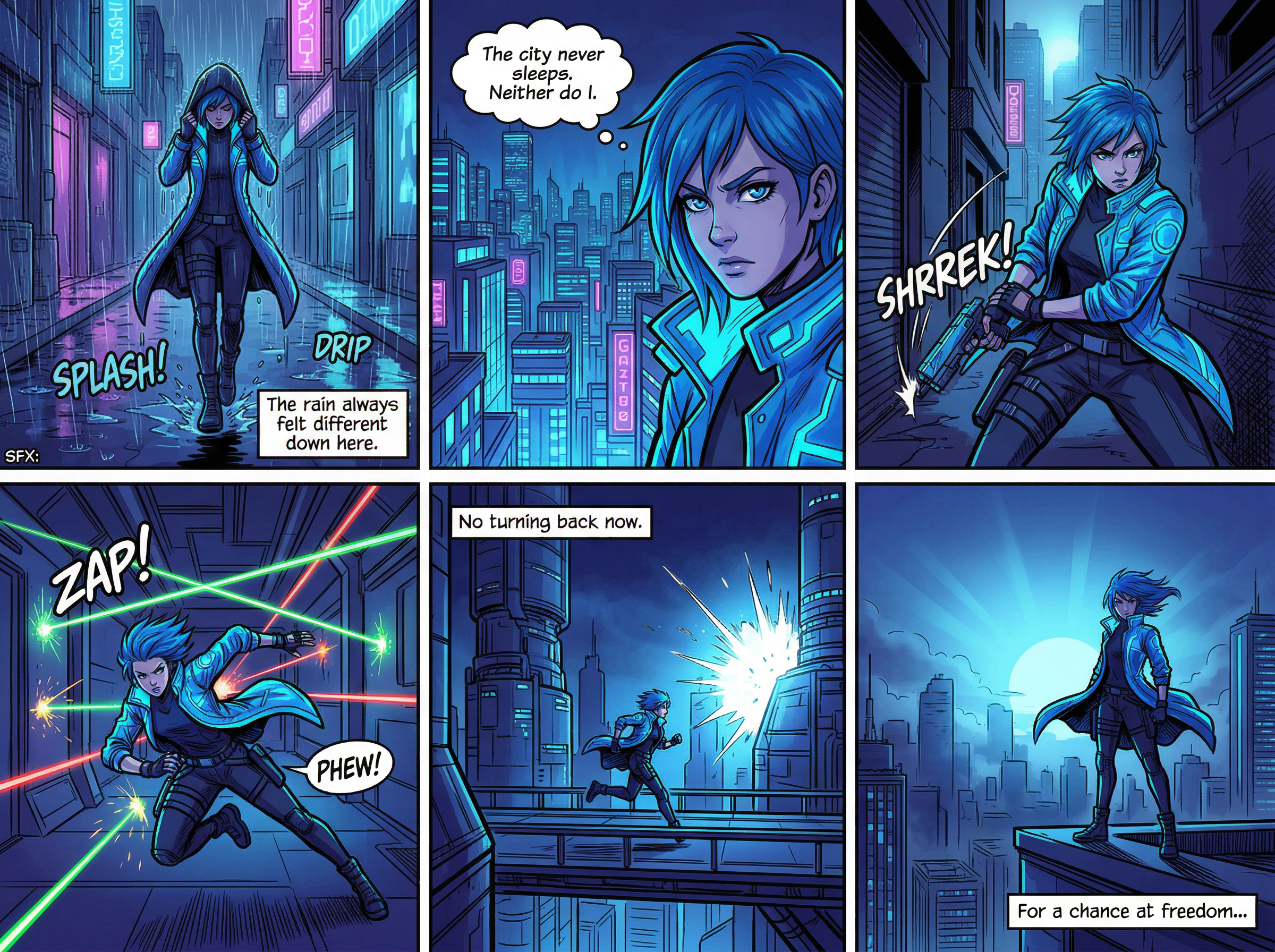
A six-panel comic page showing the same cyberpunk character in different dramatic poses, perfectly consistent across all panels

While the big labs shipped features, the open-source community did what it always does — built something better from spare parts. A Reddit workflow posted in late February demonstrates seed-fixed latent batching for Flux in ComfyUI, and the results are staggering: entire comic pages (4-6 panels) generated in a single latent batch with 100% character proportion and color consistency.

The technique is deceptively simple. Fix the seed. Use regional attention masking to define panel boundaries. Apply the new Flux-Attention-Control nodes to prevent character features from bleeding across panel borders. The result? One click, one page, zero drift.

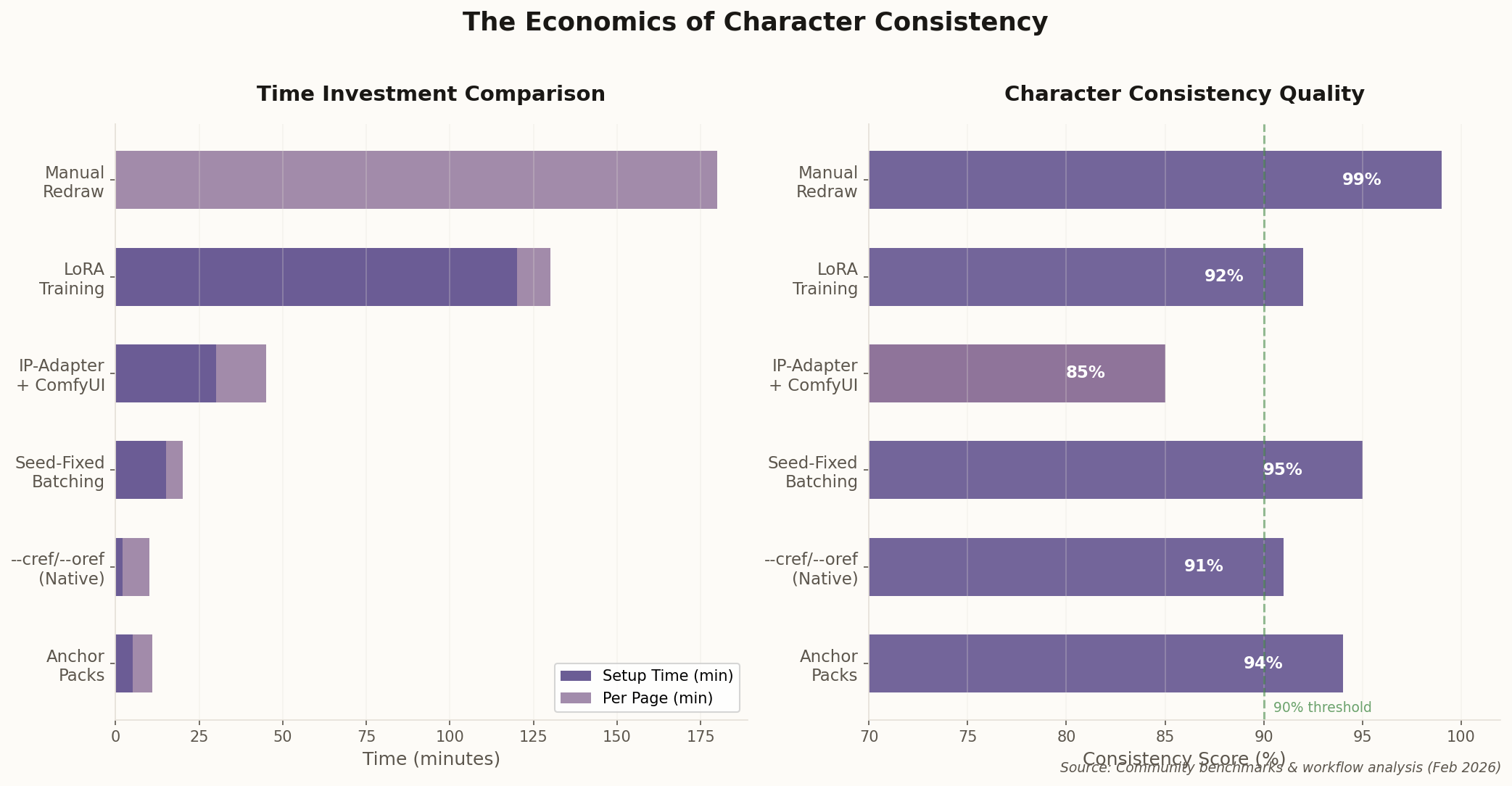
Dual chart showing time investment and consistency quality for different character consistency approaches. Seed-fixed batching achieves 95% consistency with just 5 minutes per page.
The economics of character consistency: setup time vs. per-page time (left) and quality scores (right). Seed-fixed batching offers the best time-to-quality ratio for indie creators.

What makes this transformative for indie creators isn't the quality — it's the economics. Traditional LoRA training takes 2+ hours of setup for 92% consistency. Seed-fixed batching takes 15 minutes of setup for 95% consistency. That's not an incremental improvement. That's the difference between "I'll work on my comic this weekend" and "I'll work on my comic during lunch."

The webtoon industry in South Korea — which already produces 6,000+ new episodes per week — is paying very close attention to this workflow. Expect to see it integrated into commercial webtoon platforms within months.

04

Midjourney Finally Learned What Clothes Look Like

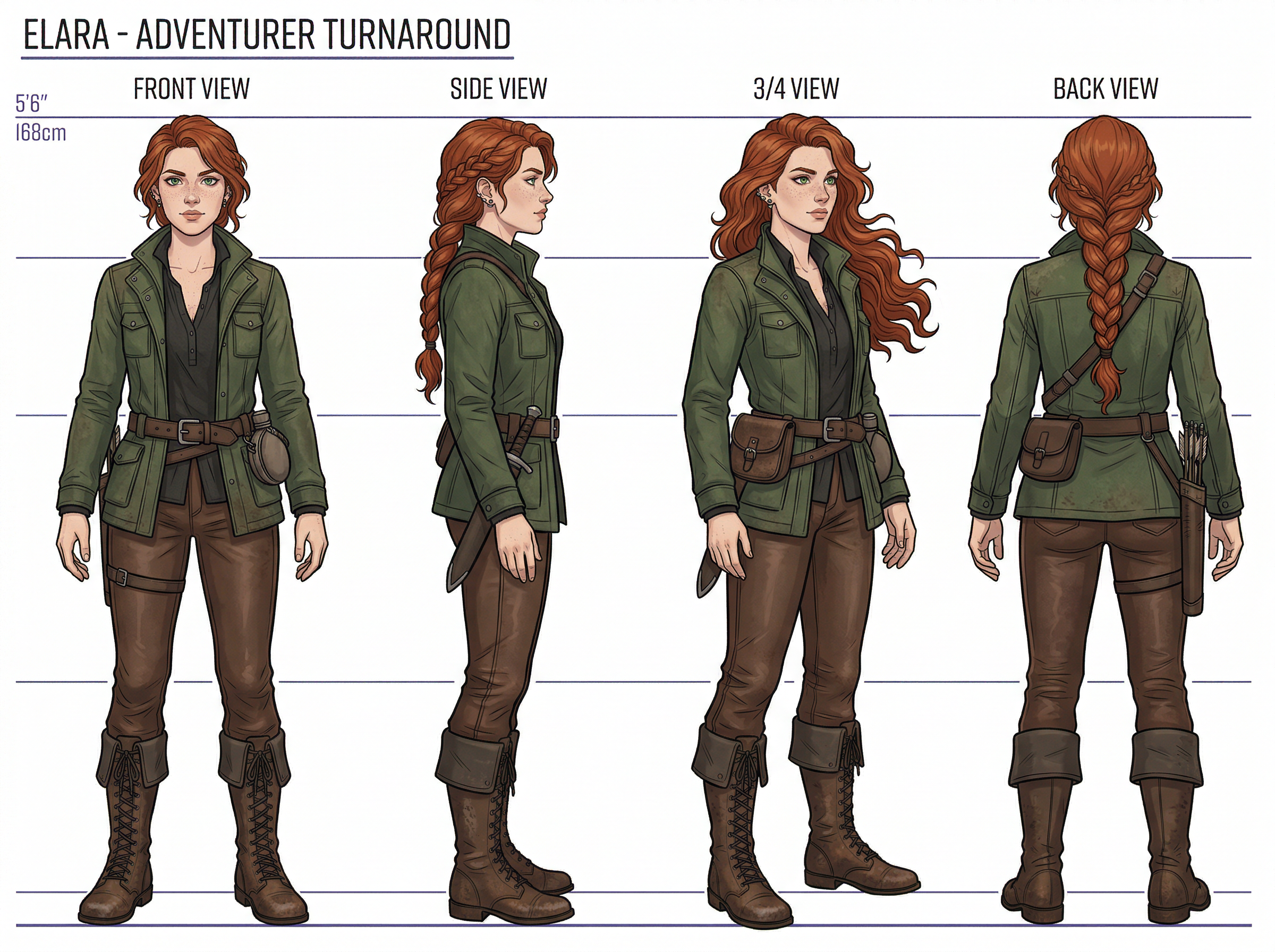
A character reference turnaround sheet showing the same adventurer from front, side, three-quarter, and back views with perfect proportional consistency

If you've ever used Midjourney's --cref parameter, you know the frustration. The face stays consistent. The clothing... does whatever it wants. Your armored knight becomes a casual-Friday knight. Your detective's trench coat grows lapels, loses buttons, changes color between panels. It's the "outfit drift" problem, and it's been Midjourney's Achilles heel for character-driven work.

Version 8's --oref (Omni Reference) fixes this by capturing what Midjourney calls a character's "Digital DNA" — not just facial geometry but the full ensemble: body proportions, clothing patterns, accessories, and their spatial relationships. The practical difference is enormous. You can now render a character doing a backflip and their belt buckle will still be the right shape.

The integration with Midjourney's new web-based Edit Model is the other half of the story. Instead of regenerating entire images to fix minor inconsistencies, you can now in-paint character features directly in the browser. This closes the feedback loop that made Midjourney impractical for sequential art: you no longer need five generations to get one usable panel.

The limitation? --oref still works with a single reference image, which means complex wardrobe changes (your character removes their jacket, then puts on a disguise) require manual intervention. It's a massive step forward, but it's not quite "draw me a 200-page graphic novel" territory. Yet.

05

Consistency Shouldn't Mean Being Frozen in Time

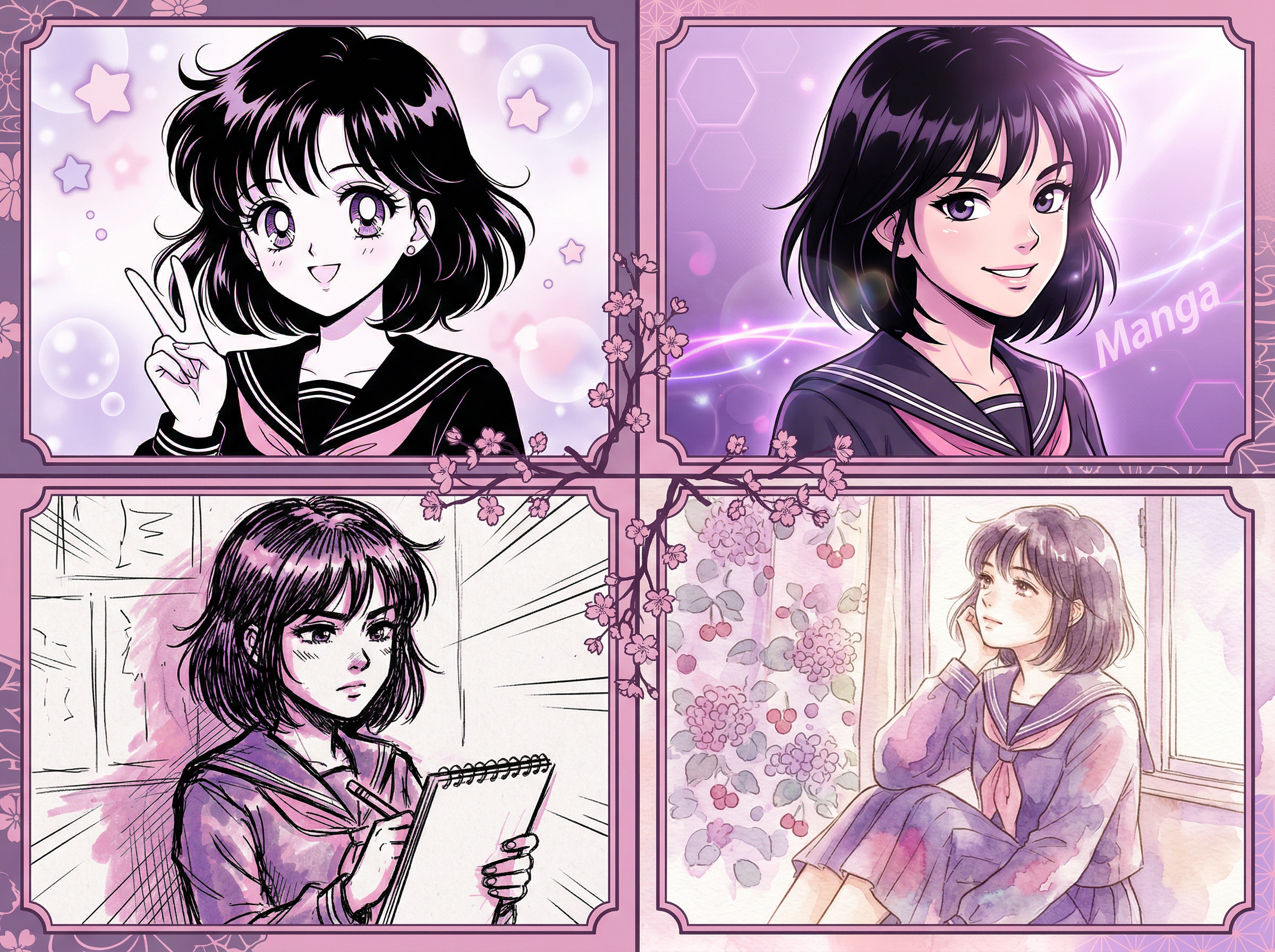
The same manga character rendered in four distinct art styles — 90s retro, modern digital, sketchy indie, and watercolor — while maintaining recognizable identity

Niji Journey's version 7 update tackles a problem that Western AI art tools haven't even acknowledged exists: style-adaptive character consistency. In manga, art style isn't static. A character rendered in a dramatic scene looks different from the same character in a comedic chibi moment. The proportions change. The line weights shift. The eyes might triple in size. And somehow, the reader still recognizes the character instantly.

Previous AI tools treated this as a bug. Niji 7 treats it as a feature. Their "Style-Adaptive Cref" allows a character's appearance to morph based on the target art style while preserving what they call "identity invariants" — the features that make a character recognizable regardless of artistic context. The nose shape. The hair silhouette. The distinctive way the eyes are drawn.

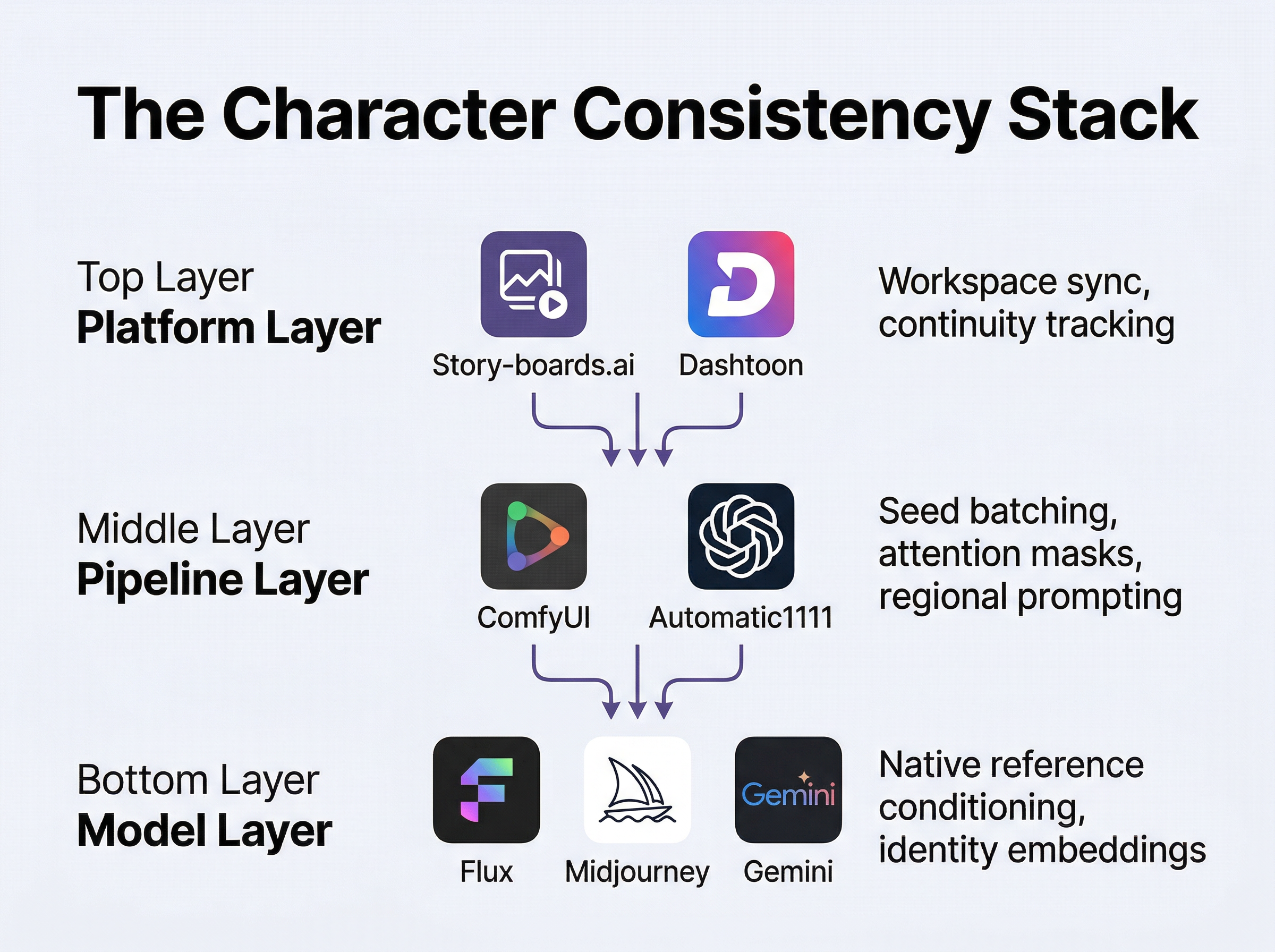
Infographic showing the three-layer character consistency stack: Platform Layer, Pipeline Layer, and Model Layer with their respective tools and capabilities
The Character Consistency Stack: three layers of technology working together to solve the identity persistence problem in AI-generated sequential art.

This matters because it solves the uncanny valley problem that plagued earlier manga generation tools — the jarring effect of a photorealistic face pasted onto a stylized anime body. Niji 7's approach is more sophisticated: it builds the character within each style rather than transferring features between them. The result is characters that feel native to whatever visual universe they inhabit.

06

Ten References, Zero Training, One Character

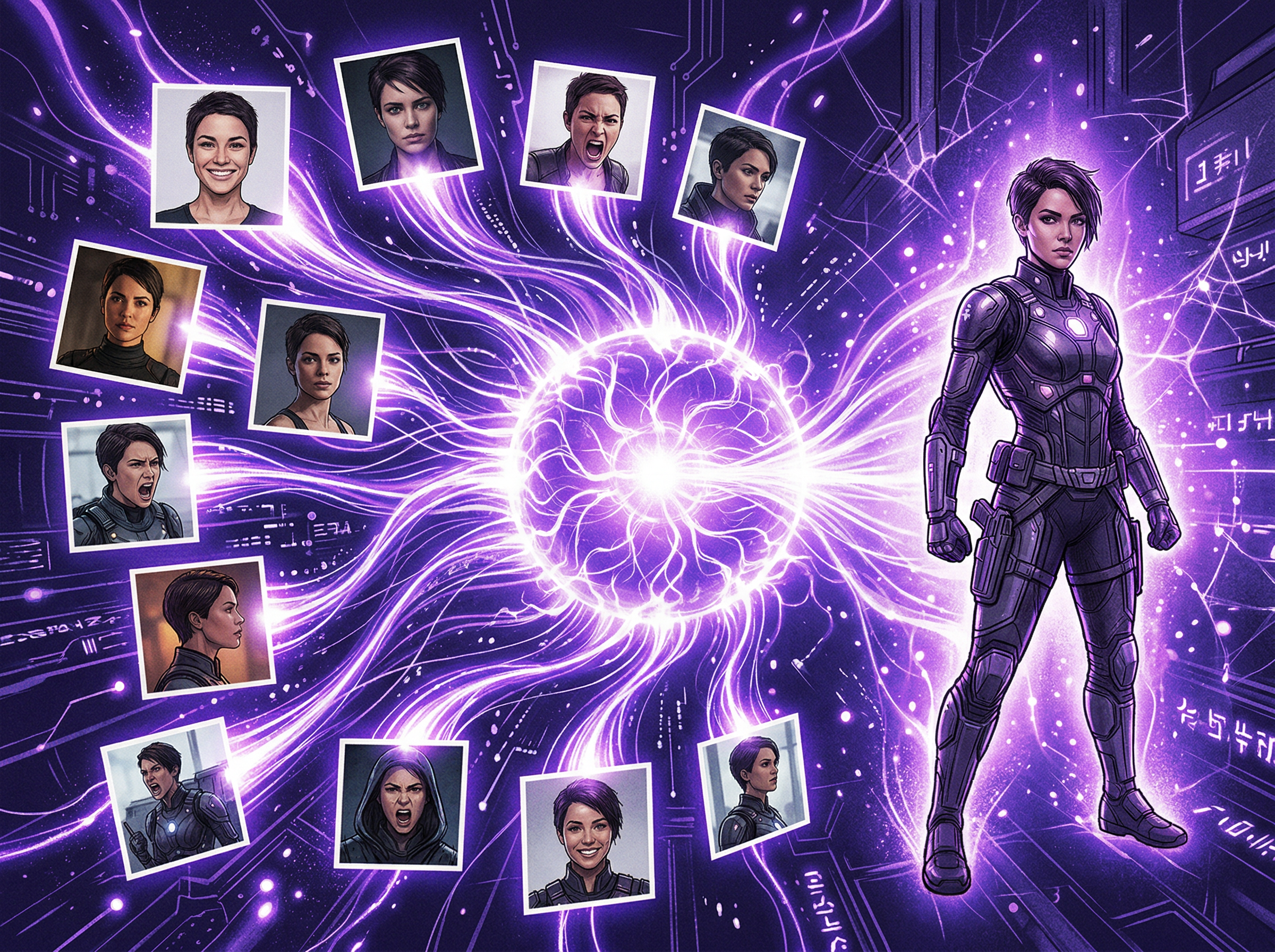
An artistic visualization of multiple reference photographs being synthesized into a glowing central orb that projects a consistent character design outward

Black Forest Labs' FLUX.2 Kontext update answers a question that's haunted every indie comic creator: what if you need perfect character consistency for a 20-page short story, but don't want to spend a day training a LoRA that you'll use exactly once?

Kontext's answer is "Anchor Packs" — upload up to 10 reference images of your character (front, side, 3/4, expressions, action poses) and the model synthesizes them into a coherent identity embedding in real-time. No training. No waiting. No GPU rental fees. Just drag, drop, and generate.

The "Style-Locked" capability is equally important for comic work. It ensures that line weights, hatching patterns, and shading techniques remain consistent across generations — the kind of visual grammar that distinguishes a professional comic from a sequence of unrelated images that happen to share a character.

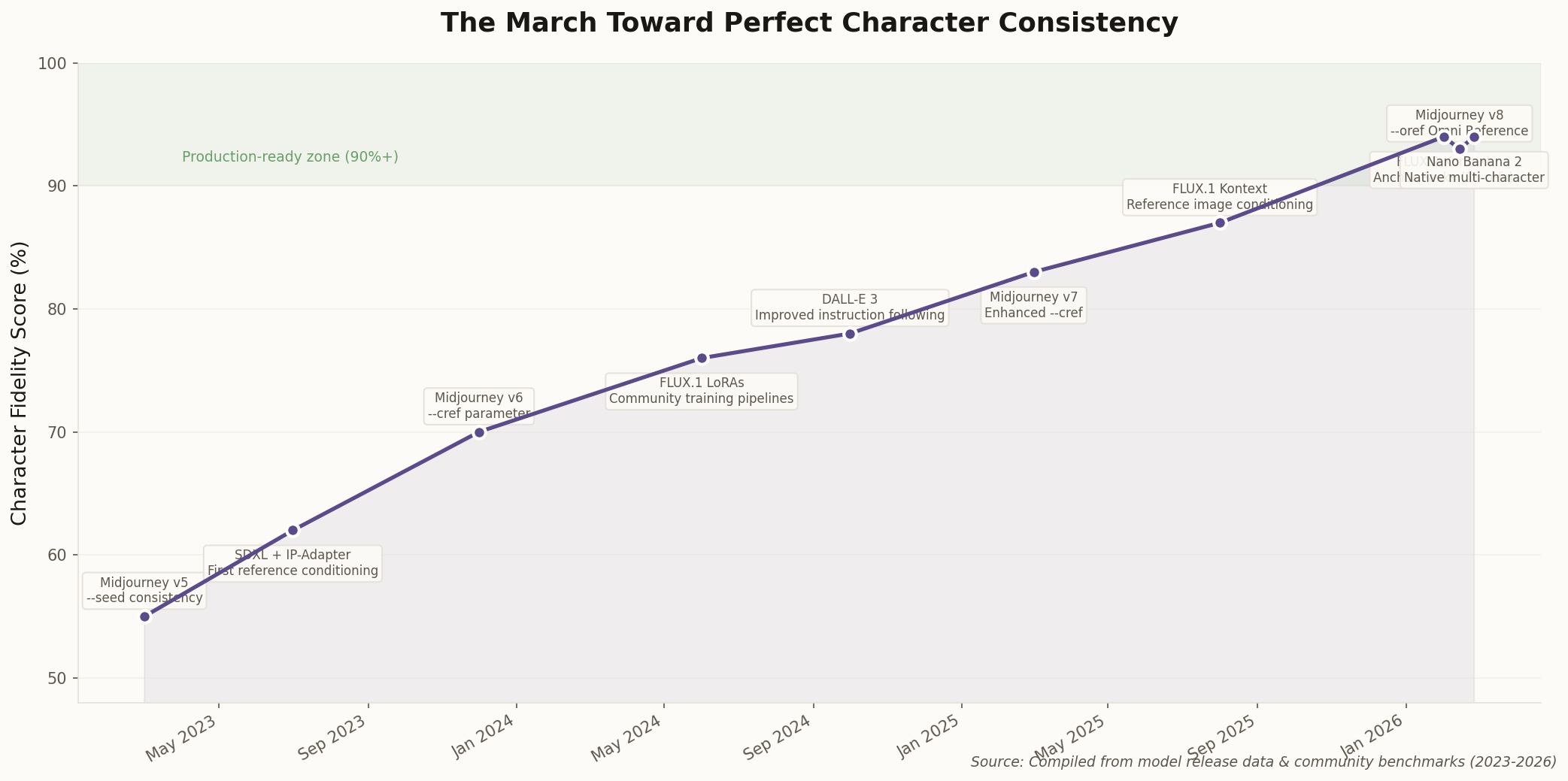
Line chart showing the evolution of character consistency scores from 55% in March 2023 to 94% in February 2026, with a marked 'production-ready zone' above 90%
Three years from 55% to 94%: the evolution of character fidelity in image generation. The "production-ready" threshold of 90% was crossed in February 2026 by three models simultaneously.

The timeline tells the whole story. In March 2023, the best character consistency score was 55% — barely better than a coin flip on whether your hero would look the same in two consecutive panels. By February 2026, three models independently crossed the 90% threshold in the same month. That's not a coincidence. That's a capability barrier shattering.

The convergence of FLUX.2 Kontext, Midjourney v8, and Nano Banana 2 all hitting 90%+ in the same month suggests we've reached a fundamental inflection point. The question is no longer "can AI maintain character consistency?" — it's "how will the comic industry reorganize around the assumption that it can?"

The Identity Problem Is Solved. Now What?

For three years, character consistency was the excuse. The reason AI couldn't make "real" comics. The technical barrier that kept generative art in the realm of one-off illustrations rather than sequential storytelling. That excuse just expired. Three independent approaches — native model conditioning, pipeline-level seed batching, and enterprise workspace tools — all crossed the production-ready threshold in the same month. The technology isn't perfect, but it's good enough. Good enough to ship a webcomic. Good enough to prototype a graphic novel. Good enough that the interesting questions are no longer technical but creative: What stories will we tell when the barrier to visual storytelling drops to near zero? Who gets to be a comic book artist when the definition of "artist" expands to include anyone with a vision and a prompt? The tools are here. The characters hold their faces. The panels flow. What happens next is up to you.