
Apple Event Preview

No Keynote Required

Apple's March 4 event kills the keynote, floods every price point with Apple Intelligence, and quietly declares war on Chromebooks. Here's everything we know nine days out.

Listen
Ethereal glass panels floating in darkness, revealing ghostly silhouettes of Apple devices through prismatic light
Abstract neural network visualization with luminous speech waveforms transforming into AI connections
01

Siri Finally Gets a Brain Transplant

Here's the real story buried beneath all the hardware chatter: iOS 19.4 has entered internal testing at Apple, and it's carrying the most significant Siri overhaul since the assistant launched in 2011. We're talking a full large language model backbone — the kind of conversational intelligence that makes ChatGPT and Gemini actually useful.

This isn't a coincidence. Every hardware product Apple is expected to announce on March 4 ships with enough neural engine headroom to run advanced on-device AI. The software is the connective tissue. An Apple Intelligence-powered Siri that can maintain context across conversations, execute multi-step tasks, and actually understand what you mean when you mumble a half-formed request — that's the pitch that makes a $599 iPhone or a $349 iPad suddenly feel like a steal.

The timing is surgical. Ship the hardware, drop the software update weeks later, and every review cycle becomes a two-act play: "it's nice" becomes "oh, now it's essential." Mark Gurman has been hinting at this cadence for months. Watch for iOS 19.4 to land in late March or early April, just as the first wave of new hardware reviews go live.

Modern smartphone with Dynamic Island glowing teal against a dark backdrop with circuit patterns
02

iPhone 17e: The Budget Phone That Doesn't Look Like One

Apple's budget iPhone strategy has always been about controlled compromise — give people enough to stay in the ecosystem, but never so much they skip the flagship. The iPhone 17e might be the first model that breaks that pattern in Apple's favor.

The specs leak reads like a flagship from two years ago: a 6.1-inch OLED display with Dynamic Island (finally killing the notch on the entire iPhone lineup), the A19 chip with 8GB of RAM for full Apple Intelligence support, and Apple's in-house C1X 5G modem replacing Qualcomm silicon. That last detail matters enormously — it means Apple controls the entire communication stack for the first time at this price tier.

At a rumored $599 with MagSafe wireless charging finally included, the 17e sits in an interesting position. It's not competing with the Pixel 9a or Galaxy A series — it's competing with refurbished iPhone 15 Pros. And that's exactly the point. Why buy someone else's hand-me-down when the "budget" option now looks and feels indistinguishable from current flagships?

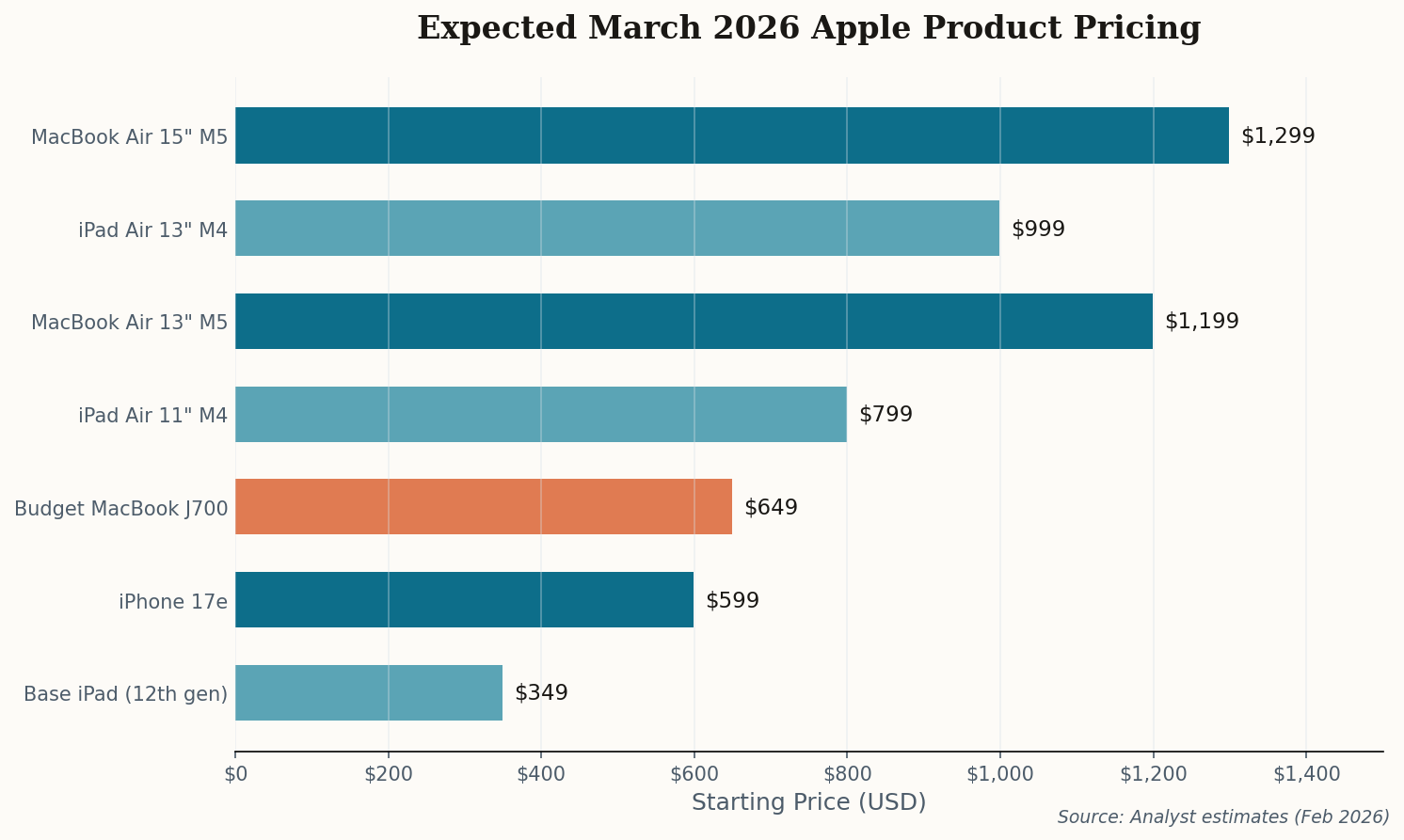
Horizontal bar chart showing expected pricing for all March 2026 Apple products, ranging from $349 for the base iPad to $1,299 for the 15-inch MacBook Air
Expected pricing across all products rumored for the March 4 event. Apple is filling every $200 gap in its lineup.
Multiple tablets floating in formation with glowing neural pathway visualizations on their screens
03

Every iPad Now Speaks Intelligence

The iPad story is actually two stories that add up to something bigger than either one alone.

First, the iPad Air is skipping the M3 chip entirely and jumping straight to M4. That's a 30% CPU boost and 20% stronger GPU over the current model, plus an N1 networking chip for Wi-Fi 7 support. The 11-inch and 13-inch configurations stick with LCD displays — no OLED — which keeps the Air firmly in the "high performance, reasonable price" lane that iPad Pro owners shouldn't feel threatened by.

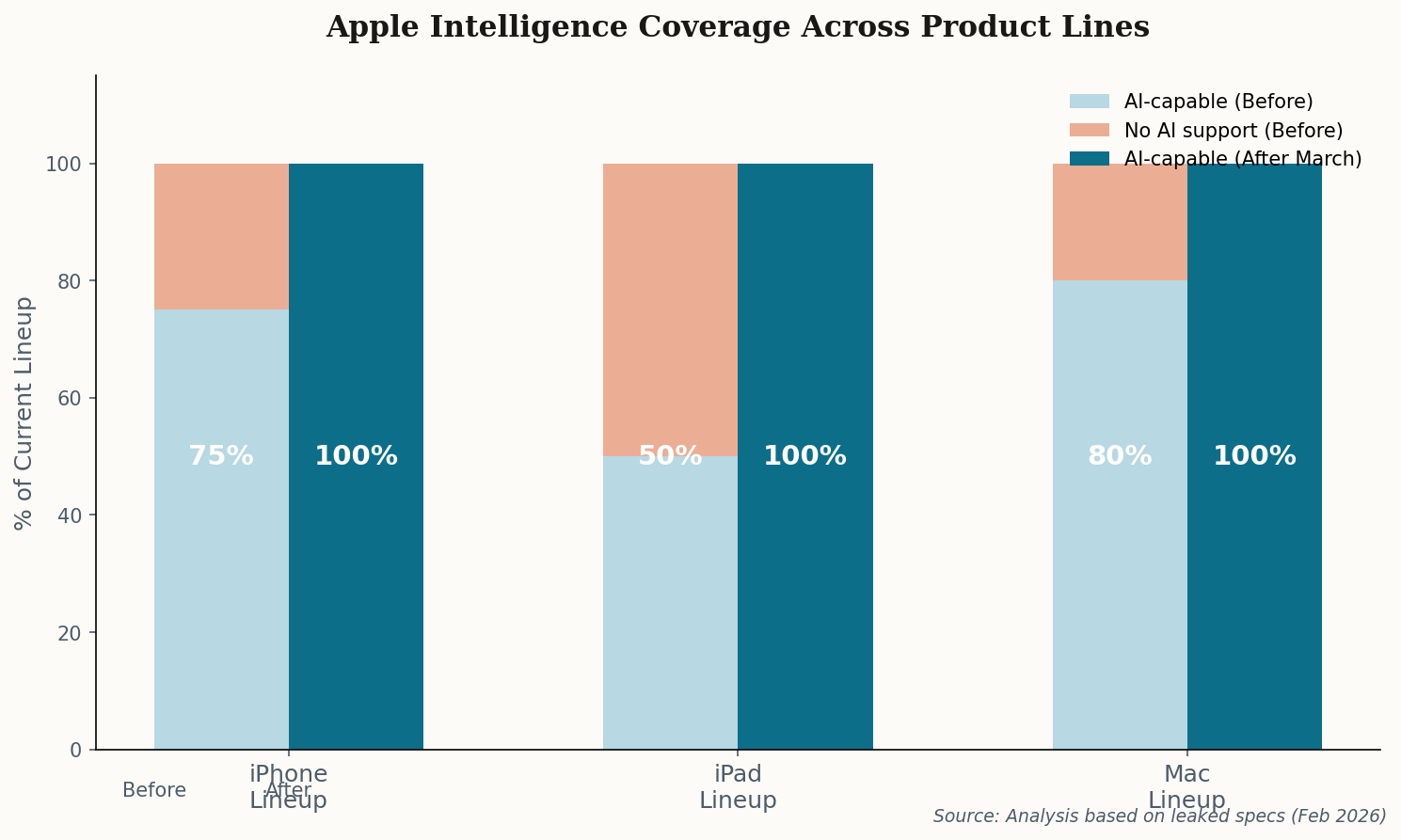
Second — and this is the move that matters strategically — the 12th-generation base iPad gets the A18 chip. That single upgrade means Apple's entire active iPad lineup, from the $349 entry model to the $1,599 M4 Pro, now supports Apple Intelligence. No asterisks, no "available on select models" fine print. When Apple says "iPad" in a marketing campaign, they can now mean every iPad they sell.

Before and after comparison showing Apple Intelligence coverage across product lines reaching 100% after March event
After March 4, Apple's entire active product lineup supports Apple Intelligence — a first since the feature launched in 2024.
Ultra-thin laptop profile radiating computational energy with M5 chip floating above
04

M5 MacBooks: The Clockwork Upgrade

Nobody will be surprised by M5 MacBooks. That's kind of the point.

Apple's custom silicon cadence has become so predictable that it's basically a metronome: new chip generation, refresh the Air, refresh the Pro, repeat. The 13-inch and 15-inch MacBook Air models get the standard M5, while the 14-inch and 16-inch MacBook Pro configurations step up to M5 Pro and M5 Max. Performance gains will be incremental but real — expect 15-20% CPU improvement and a meaningful jump in neural engine throughput.

The interesting question isn't what the M5 MacBooks will be — it's what they'll cost now that a $599 A18-powered MacBook is joining the lineup below them. The MacBook Air's starting price hasn't moved in years. Does the existence of a dramatically cheaper option give Apple cover to hold the line at $1,199? Or does the Air finally drop to $999 to create a cleaner pricing ladder? My bet: the prices hold. Apple doesn't discount; Apple adds options.

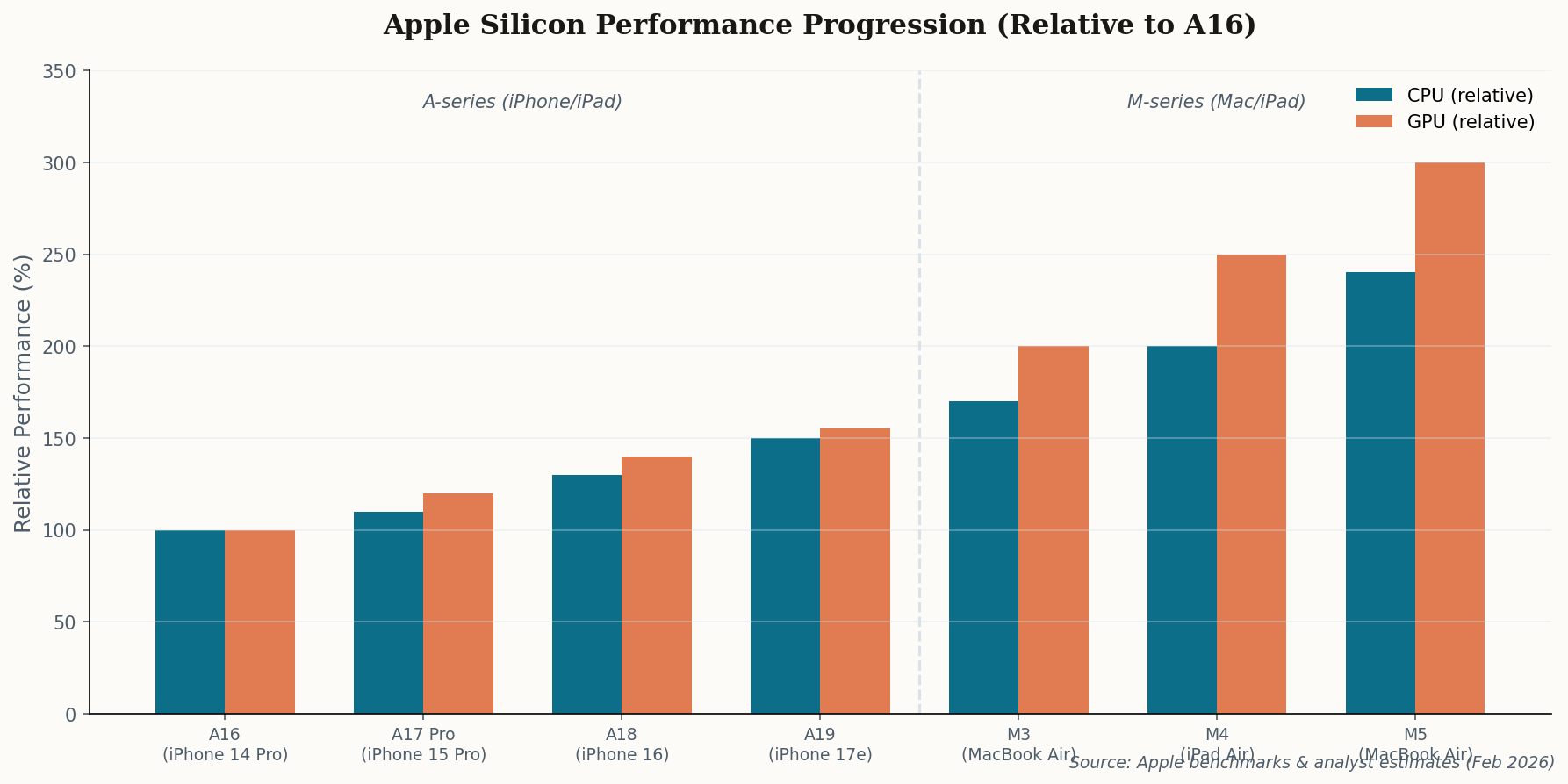
Grouped bar chart comparing CPU and GPU performance across Apple chip generations from A16 through M5
Apple's silicon trajectory shows no signs of plateau. The M5 is expected to deliver ~40% more GPU performance than the M3 that launched just two years ago.
Three luminous portal doorways with press credentials and cameras in the foreground
05

Death of the Keynote (Long Live the Experience)

Mark Gurman dropped what might be the most underappreciated detail of the entire March event cycle: Apple isn't doing a keynote. No slickly produced two-hour video. No "one more thing." Instead, announcements will roll out over three days — March 2 through March 4 — via staggered press releases, culminating in hands-on media sessions in New York, London, and Shanghai.

Apple is calling it a "Special Apple Experience," which is corporate-speak for "we have too many products to fit in one presentation and none of them are individually dramatic enough to justify the Steve Jobs Theater." That sounds dismissive, but it's actually bullish. When your product lineup is this broad and this mature, the spectacle becomes the portfolio itself. You don't need a stage when every price point tells the same story: Apple Intelligence, everywhere, for everyone.

There's a practical benefit too. Localized hands-on events mean journalists in three time zones get to touch the hardware simultaneously. No more waiting for the Cupertino press corps to publish before London gets a turn. The news cycle starts everywhere at once. It's less theater, more carpet bombing.

Colorful laptops in yellow, green, blue, and pink fanned out with school supplies nearby
06

The $599 Chromebook Killer Hiding in macOS 26.3

This is the one nobody expected. Codename "J700," found buried in the macOS 26.3 update, points to an entirely new product category for Apple: a budget MacBook powered by an A18 Pro chip instead of M-series silicon.

Let that sink in. Apple is putting a phone chip in a laptop. A 12.9-to-13-inch LCD display in an aluminum chassis, available in the kind of playful colors (yellow, green, blue, pink) that haven't graced a Mac since the original iMac G3. The expected price: somewhere between $599 and $699, with 8GB of RAM as the base configuration.

The target market is obvious: education. Chromebooks have owned classrooms for a decade because Apple refused to compete on price. The cheapest MacBook Air still starts at $1,099. A sub-$700 Mac with Apple Intelligence, a real operating system, and the build quality parents trust? That's not just competing with Chromebooks — that's attacking Google's most defensible market with the one thing Google can't match: a vertically integrated AI stack running natively on custom silicon.

The A18 Pro in a laptop form factor is fascinating. In the iPhone 16 Pro, it already delivers desktop-class single-core performance. With the thermal headroom and sustained power delivery of a laptop chassis, this chip could punch well above its weight class — potentially matching M1 MacBook Air performance at half the price.

The Takeaway

March 4 isn't about any single product — it's about Apple closing every gap in its lineup simultaneously. A $349 iPad with Apple Intelligence. A $599 iPhone that looks like a flagship. A $599 Mac that exists at all. When the dust settles, there will be no Apple product you can buy that doesn't run the full AI stack. That's not a product launch. That's a platform lock-in completion event. The keynote is dead because the strategy speaks for itself.