
On-Device AI

Your iPad Is Almost Smart Enough

The race to fit today's cloud intelligence into the device in your hands is closer than you think. Memory, not compute, is the final boss.

Listen
An iPad floating in space with luminous neural pathways radiating from its surface, cloud infrastructure dissolving into particles being drawn into the device
Two luminous paths converging at the horizon, representing the closing gap between cloud and on-device AI
01

The Industry Just Put a Date on It: GPT-4 Parity by Late 2026

Here's the number that should reshape how you think about your next hardware purchase: industry consensus now points to models in the 3B-to-30B parameter range achieving "GPT-4-class performance on specific tasks" sometime in 2026. Not in a lab. Not on a server rack. On hardware you already own or will buy this year.

The math behind this isn't wishful thinking. Quantized small language models already retain 70-90% of their full-precision accuracy while consuming 75% less memory. Edge models running at 50 to 500 tokens per second are actively replacing API calls for real-time applications — from live translation to code completion to document summarization. Gartner projects that by 2027, small language models will be used three times more frequently than general-purpose LLMs by organizations.

The critical insight isn't that on-device models will be "as good" as GPT-4 at everything. They won't. The insight is that 90% of the tasks you actually perform — drafting emails, summarizing documents, answering factual questions, writing code snippets — don't require a trillion-parameter model sitting in a data center 800 miles away. A well-tuned 14B model running locally can handle those tasks at the same quality level, with zero latency and complete privacy. The cloud's monopoly on useful intelligence is already cracking.
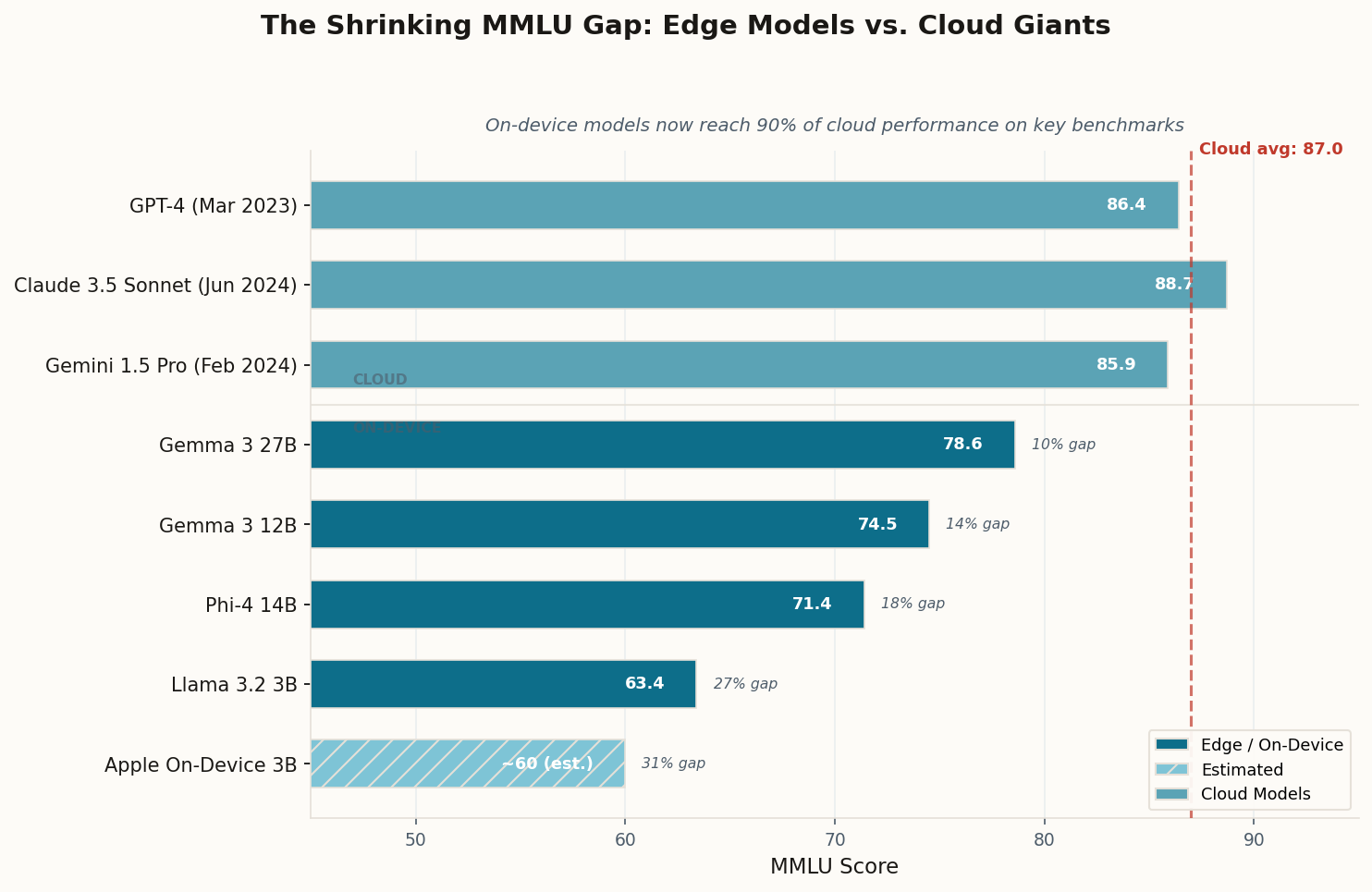
Bar chart comparing MMLU scores of cloud models (GPT-4, Claude, Gemini) versus edge models (Gemma 3, Phi-4, Llama), showing the narrowing gap
MMLU benchmark scores: cloud foundation models vs. edge models. The gap that was 25+ points in 2023 has narrowed to under 10 for the best edge models. Sources: OpenAI, Google DeepMind, Microsoft Research, Meta AI (2024-2026).
Crystalline gemstone emanating neural network patterns, representing Google's Gemma 3 edge-optimized model
02

Gemma 3 Scores 78.6 on MMLU — From a Model That Fits on Your Laptop

Google didn't just release another model with Gemma 3. They released a statement of intent. The 27B variant scores 78.6 on 5-shot MMLU — a benchmark that GPT-4 scored 86.4 on when it launched in March 2023. That's an 8-point gap. For context, the gap between GPT-3.5 and GPT-4 on the same benchmark was roughly 16 points. Edge models are closing in at twice the rate the cloud models improved.

The 12B variant is perhaps more interesting for the iPad conversation. At 74.5 MMLU, it's competitive with cloud models from just 18 months ago, and it fits comfortably in 8GB of RAM when quantized to INT4. That's the base config of every current iPad Pro.

But the real news is the Gemma 3N architecture — a purpose-built variant designed explicitly for battery-powered edge hardware. Google is following Meta's playbook: split the model family into server-scale and mobile-native branches. The days of "one model to rule them all" are over. The future is task-matched models deployed where they make the most sense — and increasingly, that's on the device in front of you.

A balance scale with a server rack and a tablet finding perfect equilibrium, representing the Goldilocks zone of model size
03

Phi-4 and the Goldilocks Zone: 14 Billion Parameters Is the Magic Number

Microsoft's Phi-4 isn't the largest model or the highest scorer, but it might be the most important one for answering the question this newsletter poses. At 14 billion parameters and 71.4% on MMLU, it sits in what researchers are calling the "Goldilocks zone" — large enough to reason well, small enough to run on consumer hardware.

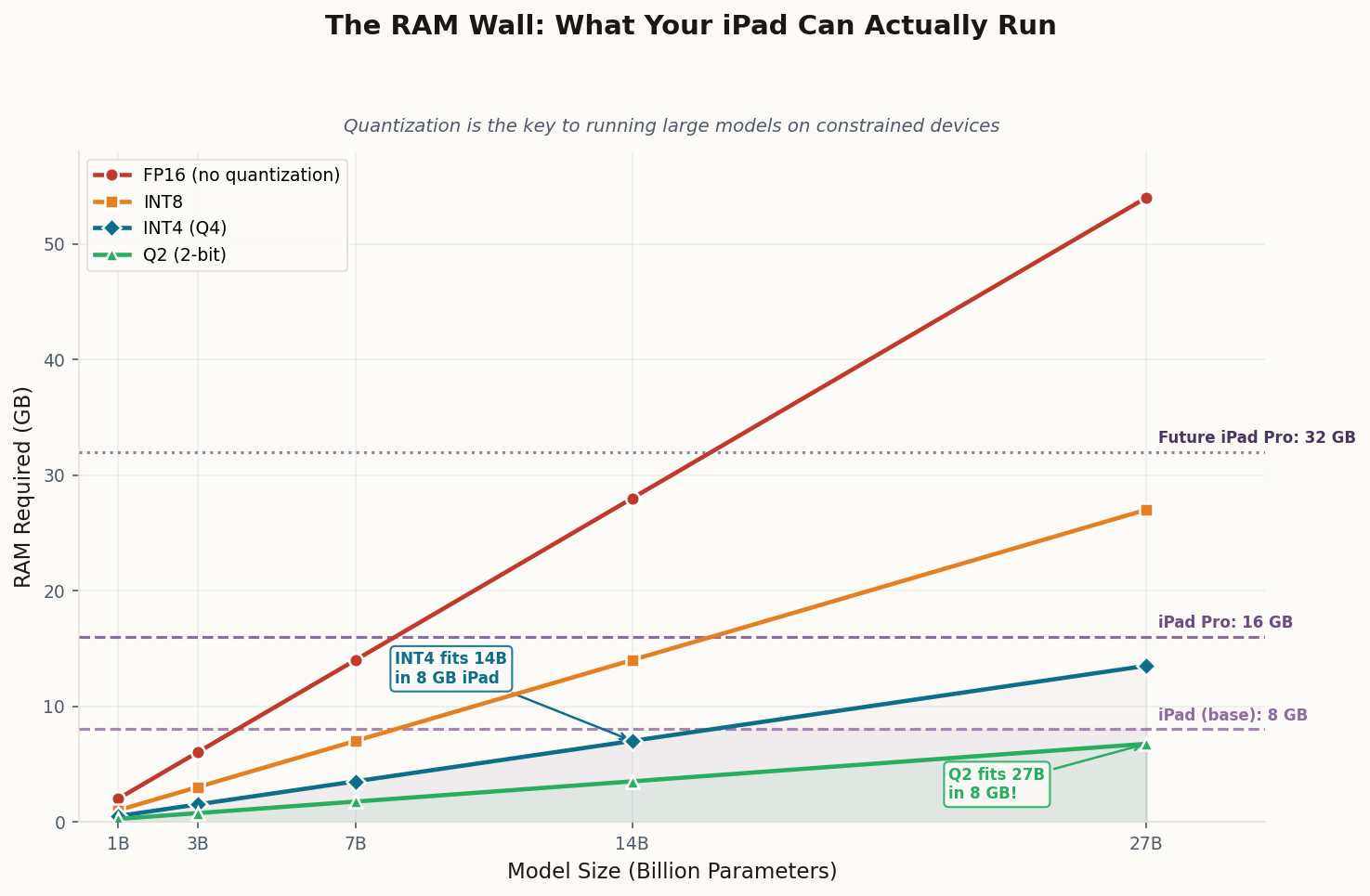
The arithmetic: a 14B model quantized to INT4 consumes roughly 7GB of RAM. That's within reach of an iPad Pro with 16GB unified memory, leaving headroom for the operating system and other apps. It's not a science project anymore — it's a shipping product waiting for the right software integration.

The Goldilocks math: 14B parameters at INT4 quantization = ~7GB RAM. iPad Pro (M4, 1TB) ships with 16GB unified memory. That leaves 9GB for iPadOS, apps, and system processes. The model fits. Today.

Phi-4 was designed from the ground up for resource-constrained, latency-sensitive environments. That's a polite way of saying Microsoft built it for Copilot+ PCs — but the same architecture runs beautifully on Apple Silicon. The 10-15B parameter range is emerging as the sweet spot where reasoning capability meets hardware reality, and it's the range where the next two years of progress will matter most.

Chart showing model parameter counts vs RAM requirements at different quantization levels, with iPad RAM tier lines overlaid
RAM requirements by model size and quantization level, with iPad hardware tiers overlaid. At INT4 quantization, a 14B model fits in today's iPad Pro. At Q2, even 27B models become feasible. Sources: GGUF benchmarks, Apple hardware specs (2024-2026).
Translucent arrows racing through a digital tunnel, the smallest leading the pack, representing speculative decoding
04

The Software Trick That Triples Your iPad's AI Speed

When people ask "when will my iPad match GPT-4?", they're usually thinking about hardware: faster chips, more RAM, better Neural Engines. But the most dramatic recent improvement didn't come from silicon. It came from a software technique called speculative decoding — and it delivers a 2-3x speedup on existing Apple Silicon without touching the hardware.

The concept is elegant: a tiny "draft" model (say, 1B parameters) rapidly proposes candidate tokens. A larger "verifier" model (say, 14B) checks them in parallel. Because verification is cheaper than generation, the net effect is dramatically faster output. Apple's MLX framework implements this natively in Swift, taking advantage of unified memory's zero-copy architecture — the draft and verifier models share the same memory space without expensive data transfers.

And then there's the breakthrough from Intel and the Weizmann Institute, presented at ICML 2025: universal speculative decoding that works with any draft model and any target model, regardless of vocabulary mismatch. Previous approaches required carefully paired model families. Now you can grab any small model off Hugging Face as your draft model and accelerate any larger model by up to 2.8x. This has already been merged into mainstream inference libraries.

Software is a multiplier, not an adder. Speculative decoding doesn't just make on-device inference faster — it effectively advances the hardware timeline by 2-3 years. Your M4 iPad Pro with speculative decoding performs like the M7 iPad Pro would without it.

Macro view of a neural processing chip with teal circuit pathways radiating outward in organic patterns
05

Apple's M5 Doesn't Just Improve the Neural Engine — It Reinvents the Playbook

Apple's M5 chip tells you everything about where the company thinks AI is headed. The 16-core Neural Engine got its expected 10% bump over M4 — incremental, not revolutionary. But the real story is the introduction of "Neural Accelerators" embedded directly in the GPU, delivering a 4x overall AI speedup compared to M4.

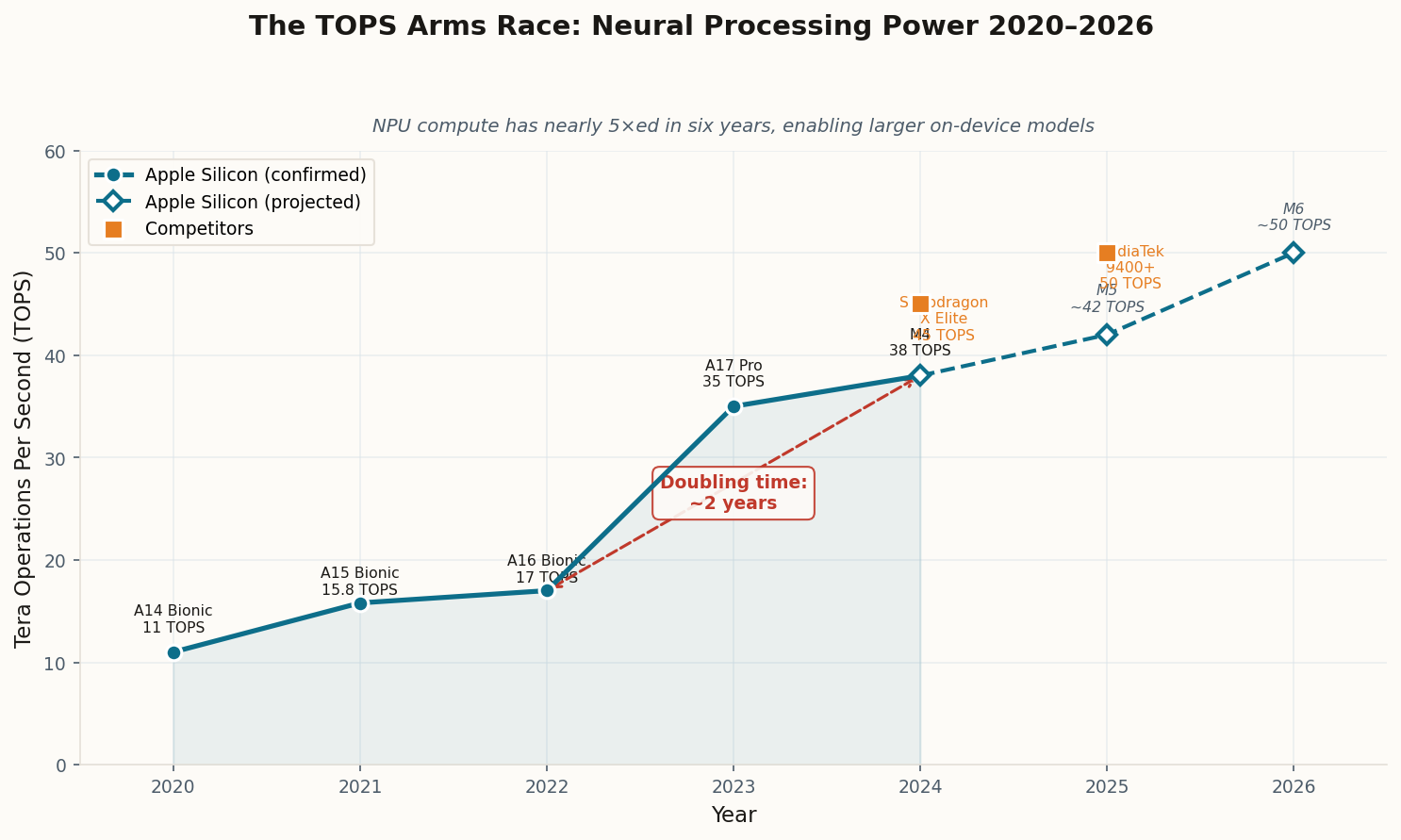
This is a strategic pivot. Instead of pouring all AI compute into the dedicated Neural Engine, Apple is distributing neural inference across the entire chip — NPU, GPU, and CPU working in concert. The M5's peak AI throughput is 6x that of the M1, which launched just five years ago. The A19 Pro (expected in iPhone 17 Pro) is projected to hit 35 TOPS, while the M6 architecture targets 50 TOPS with memory bandwidth exceeding 500 GB/s.

Line chart showing NPU TOPS ratings from 2020 to 2026, with Apple chips and competitor chips tracked, showing doubling roughly every 2 years
Neural processing power (TOPS) across Apple and competitor chips, 2020-2026. Apple's hybrid NPU+GPU approach with M5 breaks from the pure Neural Engine trajectory. Sources: Apple, Qualcomm, MediaTek hardware specs and projections.

But here's what matters for the "when will my iPad match GPT-4?" question: raw TOPS aren't the bottleneck anymore. A 38 TOPS Neural Engine (M4) can already process a 3B model at 30+ tokens per second. The limiting factor isn't how fast the chip can think — it's how much model you can fit in memory at once. Apple knows this, which is why the M5's real flex isn't the TOPS number but the memory architecture improvements that let those accelerators actually breathe.

An hourglass with glowing data streams instead of sand, bottleneck glowing intensely teal at the narrow point
06

The RAM Wall: Your iPad's Brain Is Starving

Community benchmarks have made the uncomfortable truth quantifiable: the M4 iPad Pro's Neural Engine is capable of 38 TOPS, but the base configuration ships with just 8GB of unified memory. Running Apple's own 3B on-device model consumes approximately 3GB of that. Add iPadOS, background processes, and whatever app you're actually trying to use, and you're in memory pressure territory before the model even warms up.

This is the core tension in the "when will on-device match cloud?" debate. We don't have a compute problem — we have a memory problem. A 14B model at INT4 needs 7GB. A 27B model at INT4 needs roughly 13.5GB. The math only works on the 1TB iPad Pro (which ships with 16GB RAM) or future hardware with 32GB+. For the vast majority of iPad users on 8GB, the ceiling is a 3B model. That's useful — but it's nowhere near GPT-4.

The timeline in RAM terms: 8GB (today's base iPad) = 3B models. 16GB (today's top iPad Pro) = 14B models. 32GB (likely 2027-2028 iPad Pro) = 27B+ models. That 32GB tier is where on-device approaches GPT-4 parity for everyday tasks.

The industry aphorism that "software is eating hardware" rings particularly true here. Aggressive quantization (2-bit via GGUF), speculative decoding, and MLX's zero-copy memory management are all strategies for making the most of limited RAM. But they're optimizations, not solutions. Until Apple ships an iPad with 32GB of unified memory — something the MacBook Pro already offers — the iPad will remain a "good enough" AI device rather than a genuine cloud replacement.

The honest answer to "how long?" is this: for task-specific parity, you're looking at late 2026 to early 2027 — models like Phi-4 and Gemma 3 running quantized on 16GB iPads, handling most daily workflows without cloud assistance. For broad general-intelligence parity with today's GPT-4? That's a 2028-2029 story, contingent on Apple shipping 32GB iPads and the model ecosystem continuing its current compression trajectory. Two to three years. Not five. Not ten. And the software tricks arriving now are accelerating that timeline faster than anyone predicted.

The Cloud's Monopoly Has an Expiration Date

The question was never if your iPad would match today's cloud AI — it was when. The convergence of aggressive model compression, hardware advances that double NPU power every two years, and software multipliers like speculative decoding has compressed the timeline from "someday" to "soon." The 14B Goldilocks models already rival cloud performance from 18 months ago. By the time Apple ships a 32GB iPad Pro, the software will be ready. Your device already wants to be smart enough. It just needs a little more room to think.