Technology & Futures

The Point of No Return

Everyone agrees the Singularity is coming. Nobody agrees what it is. Inside the competing visions of Kurzweil, the abundance crowd, the AGI labs, and the skeptics who say it's all a mirage.

Listen
Abstract visualization of a singularity point with converging light rays in teal and amber
Two silhouetted figures debating on a grand illuminated stage with neural network projections
01

Two Architects of the Future Walk Into Davos and Can't Agree on When It Arrives

If you want to understand why "the Singularity" means something different depending on who's saying it, you only needed to watch the World Economic Forum session titled, with characteristic understatement, "The Day After AGI."

On one side: Anthropic CEO Dario Amodei, who told the audience that AI models would replace the work of all software developers within a year and reach "Nobel-level" scientific research in multiple fields within two. On the other: Google DeepMind CEO Demis Hassabis, who offered a cooler 50% chance of AGI "within the decade" — and pointedly noted it wouldn't come from models built exactly like today's.

The real fireworks came when both discussed whether AI systems can "close the loop" — autonomously designing, improving, and deploying future generations of models. Amodei said they might be six to twelve months from that capability. That's not a prediction about artificial general intelligence. That's a prediction about an intelligence explosion — I.J. Good's original nightmare scenario from 1965, where smarter systems build smarter systems and the feedback loop runs away from human control.

Amodei avoids the word "Singularity" entirely. He calls AGI a "marketing term." But his predictions — all coding replaced in a year, Nobel-level science in two, recursive self-improvement in months — describe precisely what Singularity theorists have been predicting for decades. The label changed. The substance didn't.

Hassabis's caution matters too. He represents the camp that believes genuine AGI requires fundamental architectural breakthroughs beyond current transformer models. In his telling, the Singularity isn't twelve months out — it's a research program that could take a decade. Both men run companies building these systems. Their disagreement isn't about whether it happens, but about whether today's approach is sufficient or whether something new is needed.
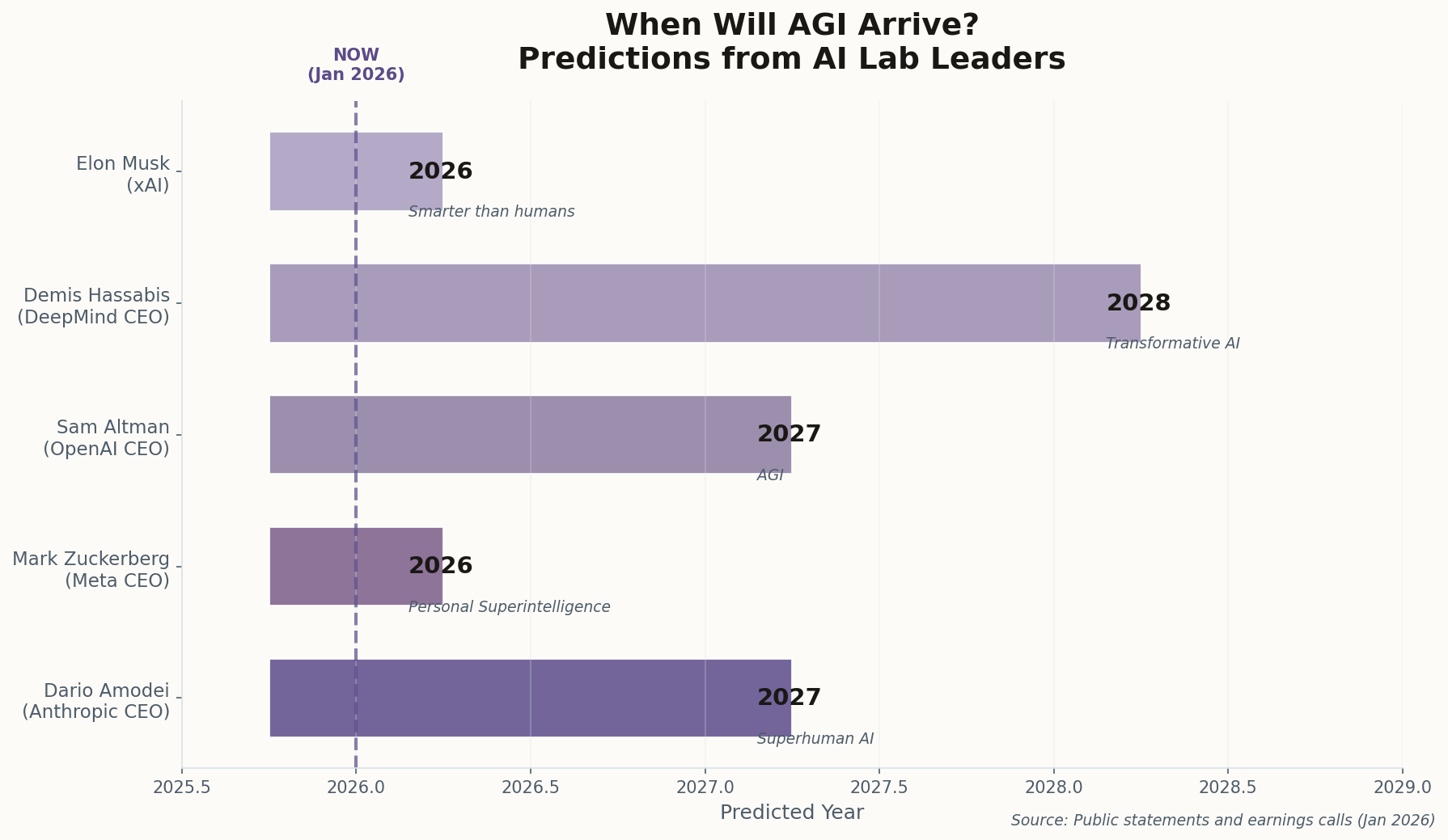
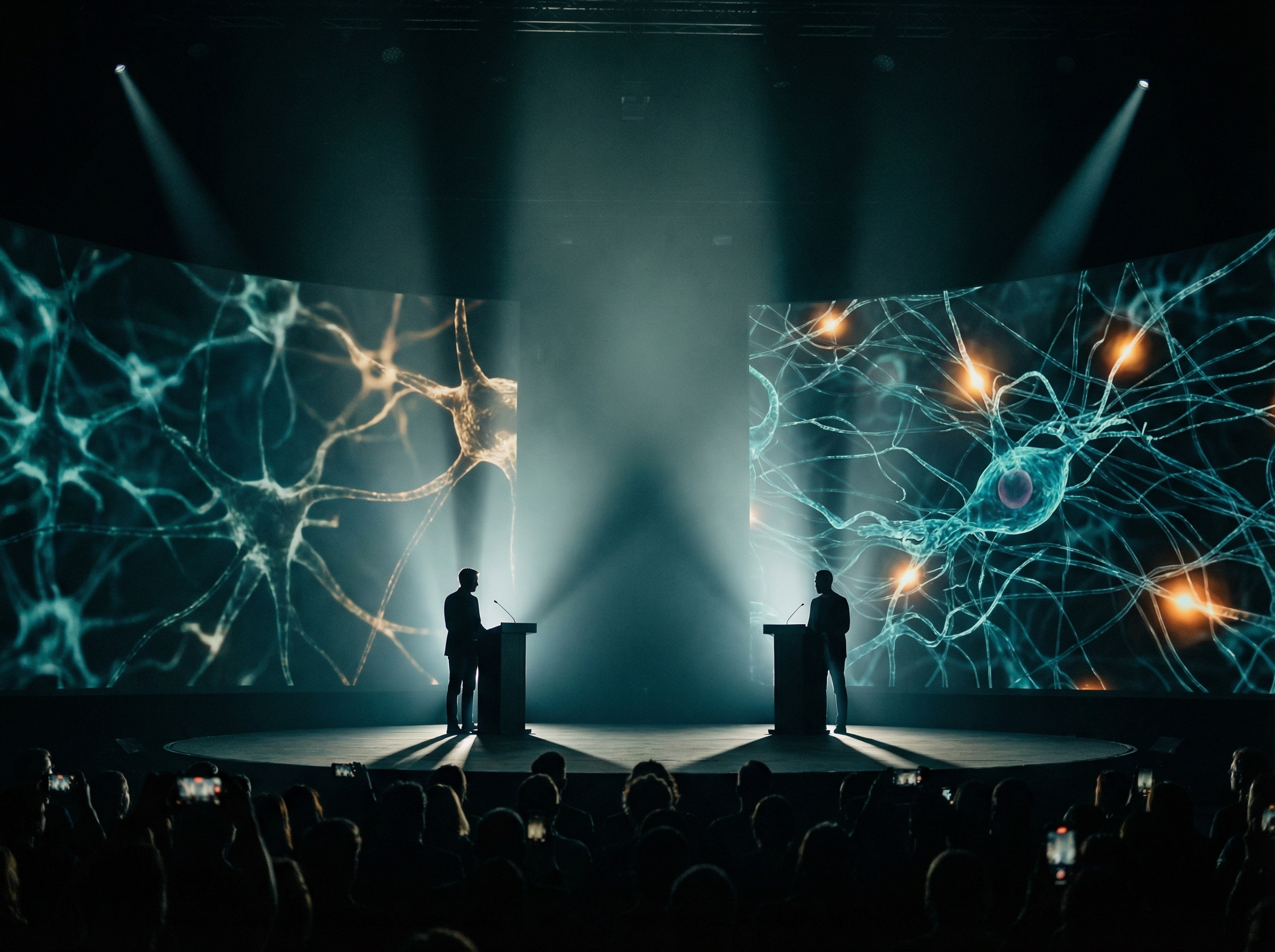
Chart showing AGI timeline predictions from different camps, ranging from 2026 (Musk) to 2060+ (Marcus)
AGI predictions span a 35-year range depending on who you ask. The only consensus is that nobody agrees. Sources: WEF Davos 2026, Metaculus, AI researcher surveys.
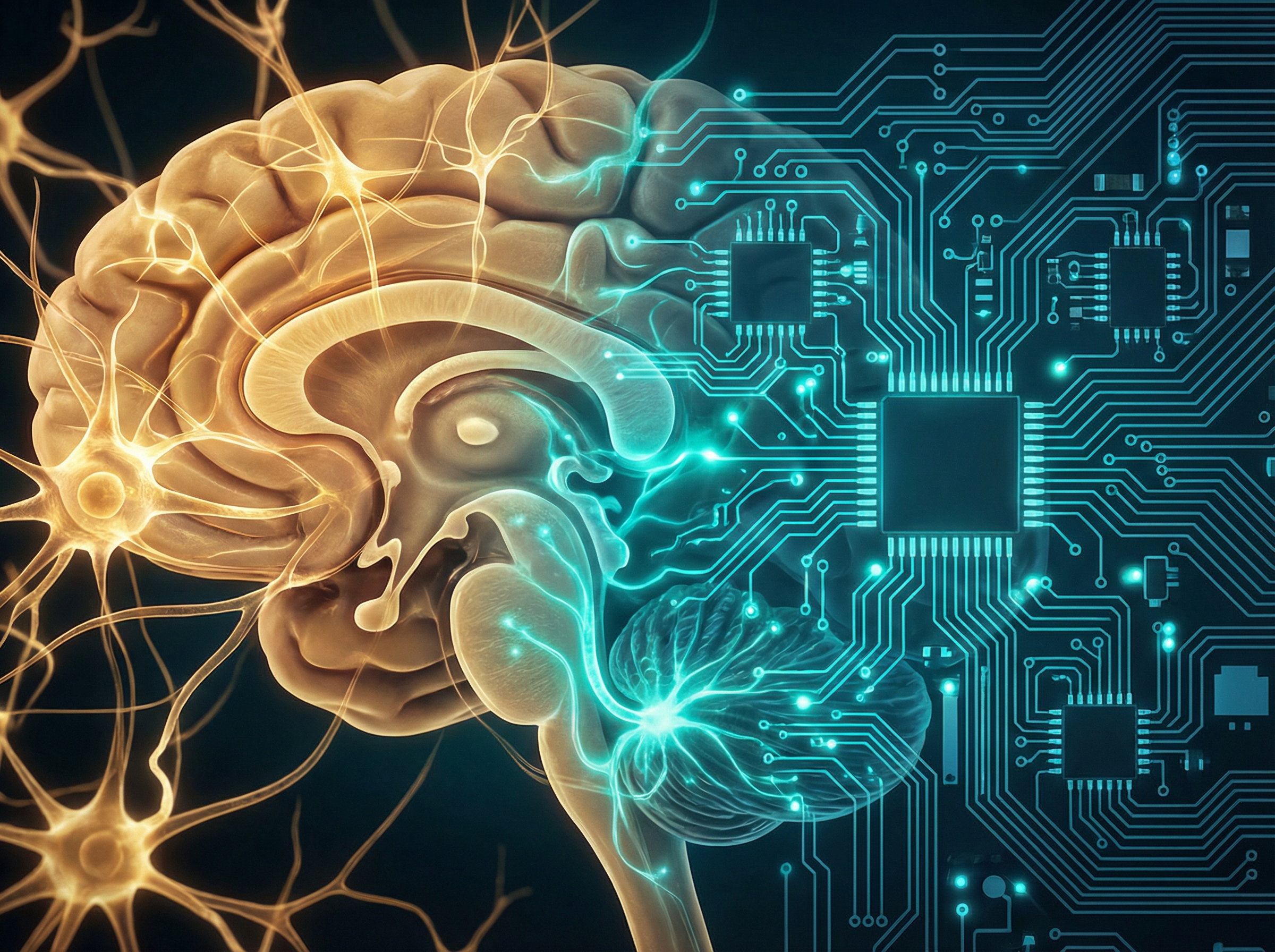
Human brain dissolving into circuit board pattern with bioluminescent teal glow at the transition
02

Kurzweil's Singularity Isn't What You Think It Is

Most people hear "the Singularity" and picture a sudden event — a moment when AI wakes up and everything changes overnight. That's not what Ray Kurzweil has ever meant.

In The Singularity Is Nearer, his 2024 update to the 2005 original, Kurzweil lays out a vision that's closer to a slow-motion merger than a lightning bolt. He predicts AGI — AI that matches the best human expert in every field — by 2029, but the Singularity itself doesn't arrive until 2045. The sixteen-year gap is the point. In Kurzweil's framework, AGI is just a waypoint. The Singularity is when human intelligence and machine intelligence become so deeply intertwined that you can't meaningfully separate them.

This is the part that separates Kurzweil from most AI researchers. He's not primarily worried about AI as an external force acting on humanity. He sees it as something we absorb — through brain-computer interfaces, nanotechnology operating inside our bodies, and augmented cognition that extends biological thinking into digital substrates. The Singularity, for Kurzweil, is not when machines surpass us. It's when the boundary between "us" and "machines" dissolves.

What makes this framework politically potent is its optimism. Kurzweil's Singularity isn't a catastrophe to be avoided — it's a destination to be reached. At the Abundance Summit, Elon Musk remarked that "Ray is prescient, and he's conservative," suggesting 2029 for AGI is too late. Kurzweil, notably, hasn't moved his timeline up. He insists AGI means the highest human level across all fields of knowledge — not just coding, not just math, but law, medicine, art, philosophy, engineering. By that standard, we're not there yet, and the breathless predictions from lab CEOs are measuring something narrower.

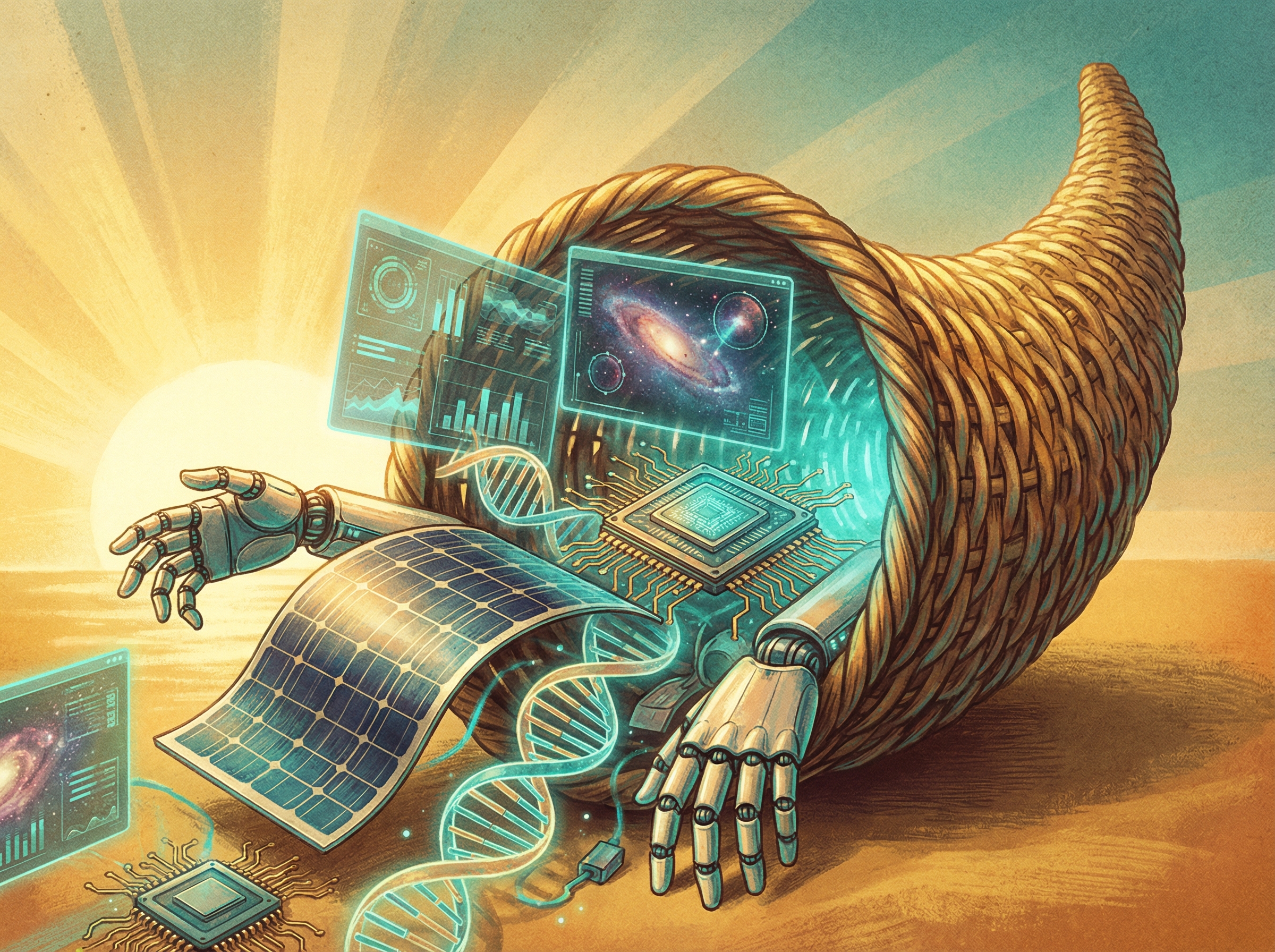
Cornucopia overflowing with exponential technologies bathed in optimistic golden sunrise light
03

The Moonshot Crowd Turned the Singularity Into a Business Plan

Peter Diamandis doesn't spend much time debating whether AI will achieve consciousness or when recursive self-improvement will trigger an intelligence explosion. He's too busy telling a room of 600 entrepreneurs in Los Angeles how to get rich from it.

Abundance360 — Diamandis's flagship community — bills itself as "a 25-year journey to the Singularity," running from 2013 to 2038. Members pay premium fees for early access to exponential technologies: AI, quantum computing, brain-computer interfaces, longevity science, next-generation food systems. The 2026 summit is scheduled for March 8-12 in LA, continuing the community's tradition of turning technological inevitability into actionable investment theses.

This is the abundance framing of the Singularity, and it's fundamentally different from either the intelligence explosion model or Kurzweil's merger vision. In Diamandis's world, the Singularity is a marketing concept — a narrative of exponential convergence that justifies big bets. When he released exclusive content from the 2025 summit publicly, calling it "too important to keep private," the message was clear: the technologies converging right now (AI, longevity, robotics) represent an investment opportunity on the scale of the industrial revolution.

The philosophical implications of superintelligent AI? Diamandis acknowledges them, but the community's energy runs on a different fuel: the belief that these technologies will solve climate change, cure disease, extend human lifespan, and create material abundance. The Singularity, in this telling, is the moment when scarcity becomes optional. It's an economic prediction dressed in techno-utopian clothing, and it resonates with people who have capital to deploy and a need for narratives that justify deploying it aggressively.

Exponential curves rendered as glowing teal light trails against a dark analytical background
04

The Numbers Don't Lie — But They Don't Tell the Whole Truth Either

Whatever definition of the Singularity you prefer, the raw capability numbers from 2025 are striking. OpenAI's GPT-5.2 scored 100% on the AIME 2025 math competition and 40.3% on FrontierMath — a ten-fold improvement over previous models. On the GDPval benchmark, which tests professional knowledge across 44 occupations, GPT-5.2 in thinking mode beat or tied human industry professionals 70.9% of the time.

Anthropic's Claude Opus 4.5 leads software engineering benchmarks at 80.9% on SWE-bench Verified. Google's Gemini 3 Pro is natively multimodal with a 1 million token context window. The frontier models released in late 2025 can handle tasks that take humans multiple hours — models from 2024 tapped out at under thirty minutes.

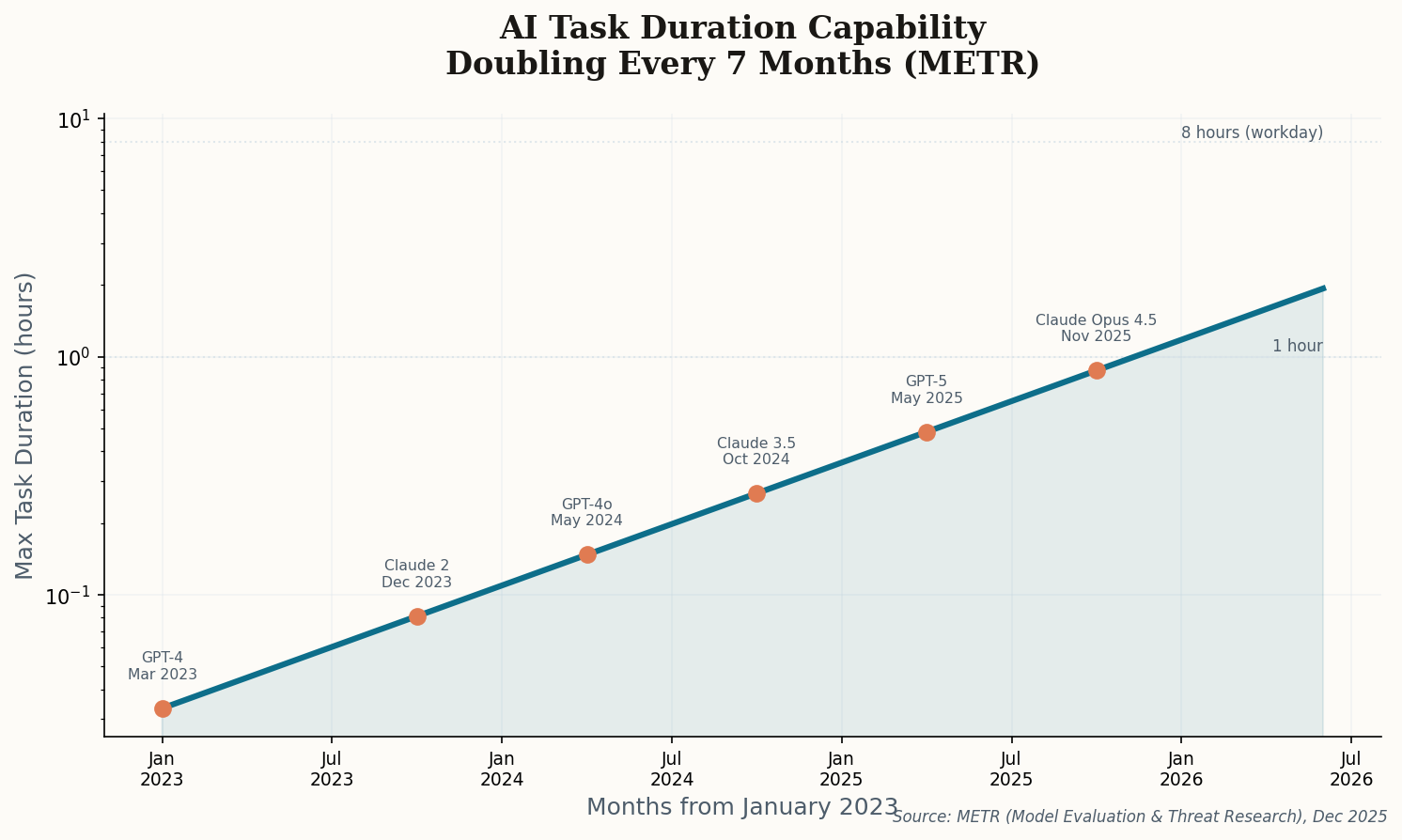
Chart showing AI task duration capability doubling every 7 months from 2023 to 2026
METR (Model Evaluation & Threat Research) finds AI task duration capability doubles every ~7 months, from minutes in early 2023 to hours by late 2025.

The most Singularity-relevant finding comes from METR (Model Evaluation & Threat Research): the length of tasks AI can handle is doubling every seven months. That's an exponential curve in capability, and it maps uncomfortably well onto the "accelerating returns" framework that Kurzweil has been promoting since 2005.

But here's the critical nuance: benchmark performance on structured tasks is not the same as general intelligence. GPT-5.2 can solve competition-level math problems, but it can't reliably plan a multi-step project without hallucinating constraints that don't exist. Claude Opus 4.5 writes excellent code but still struggles with the kind of common-sense reasoning that a six-year-old handles effortlessly. The exponential curves are real. The question is whether they're approaching a Singularity or an asymptote.

Translucent soap bubble floating against a dark background reflecting distorted images of AI circuits
05

The Skeptic's Case: What If the Singularity Is Just a Bubble?

Gary Marcus has a message for anyone pricing in the Singularity: check your assumptions. The NYU cognitive scientist and AI researcher has been the most persistent, most specific, and most data-driven critic of Singularity narratives, and his track record is worth examining: sixteen of his seventeen "high confidence" predictions about 2025 proved correct.

Marcus's 2026 predictions are blunt. He expects the generative AI bubble to burst before year-end, argues that LLM limitations are "inherent" rather than "transitory bugs," and predicts that domestic robots like Optimus and Figure will remain "mostly demos with little product." His core argument: current AI architectures traffic in the statistics of language without explicit representation of facts or explicit tools for reasoning over those facts. Hallucinations aren't a bug to be fixed — they're a feature of the design.

Marcus's critique of Singularity claims rests on a specific technical argument: "conflating increasingly sophisticated statistical approximations with intelligence itself." GPT-5 was underwhelming. Hallucinations remain unsolved. The exponential curves are real but they measure narrow capability, not general intelligence.

The strongest version of Marcus's argument isn't that AI won't become transformative — it's that the Singularity narrative creates a self-reinforcing hype cycle that distorts investment, misleads policymakers, and distracts from the AI capabilities that actually work. When Amodei says all coding will be replaced in a year, Marcus sees a prediction that serves Anthropic's fundraising narrative. When Diamandis sells a "25-year journey to the Singularity," Marcus sees a sales pitch with a deadline conveniently far enough away to never be testable.

Is he right? His 2025 scorecard is impressive. But even Marcus acknowledges that AI progress is real and consequential — he just argues it's following an S-curve, not an exponential path to infinity. The difference between those shapes matters enormously: one leads to a Singularity, the other to a plateau.

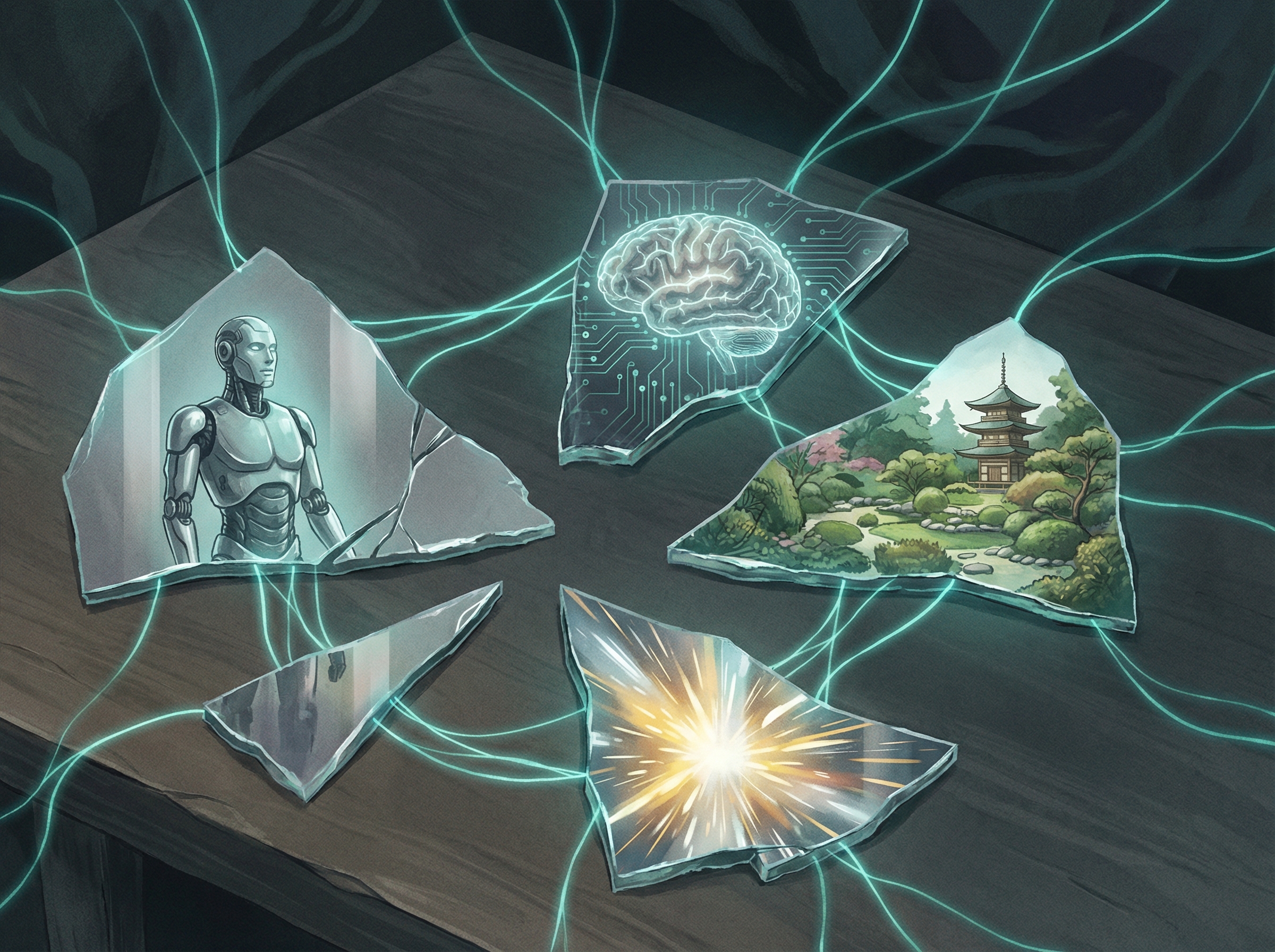
Shattered mirror with each shard reflecting a different interpretation of the future connected by thin teal threads of light
06

The Word Means Whatever You Need It to Mean

Here is the uncomfortable truth at the bottom of every Singularity debate: the participants aren't arguing about the same thing.

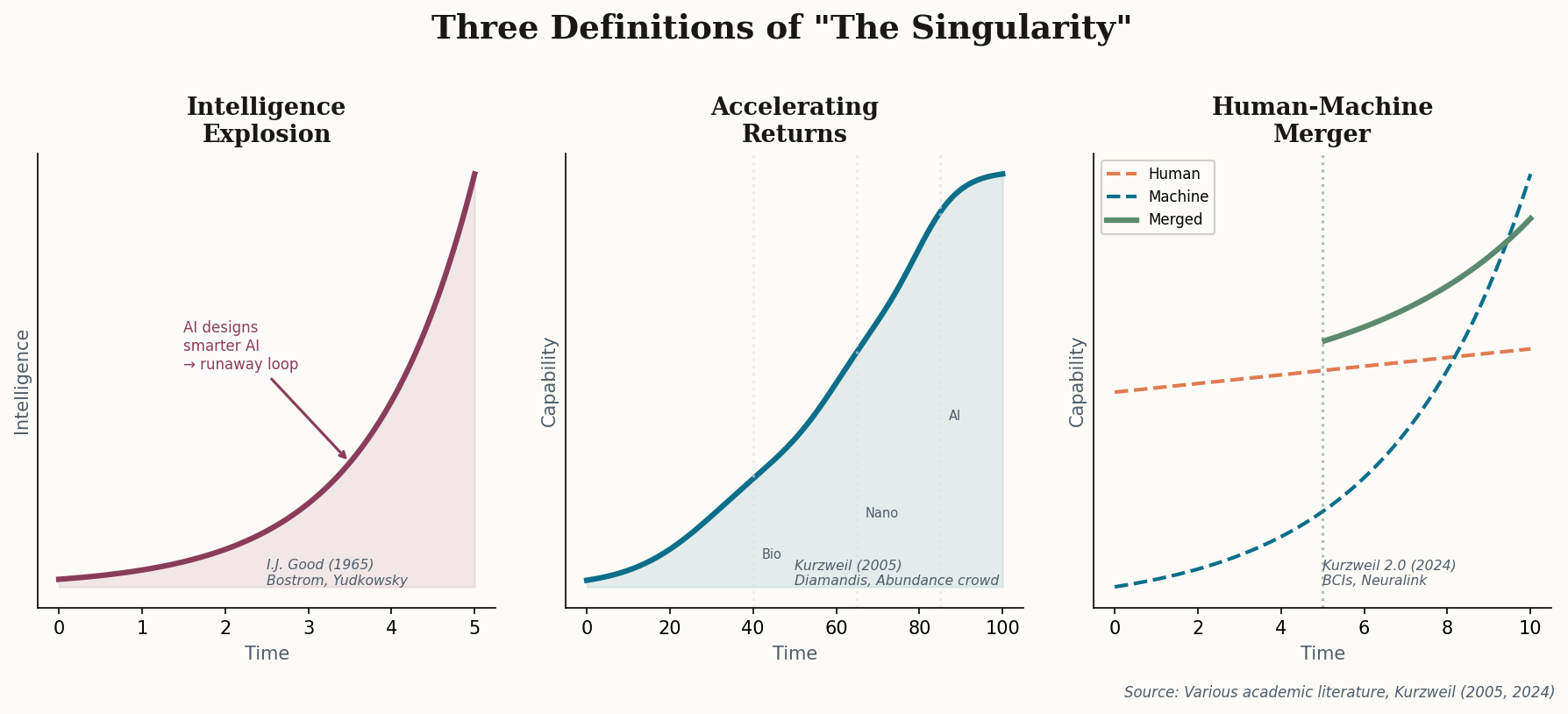
I.J. Good's 1965 formulation was precise: an "intelligence explosion" where an ultraintelligent machine designs even better machines, creating a recursive loop that rapidly outstrips human comprehension. Vernor Vinge borrowed the mathematics term "singularity" — a point where existing models break down and prediction becomes impossible. This is the hard version: a discontinuity in the trajectory of civilization.

Kurzweil softened it. His Singularity is not a discontinuity but an acceleration — the "law of accelerating returns" applied across computing, biology, and nanotechnology simultaneously. It's predictable, gradual (in his telling), and fundamentally about human augmentation rather than replacement. The date (2045) isn't a rupture point — it's when the curves converge.

Three conceptual charts showing different Singularity models: Intelligence Explosion, Accelerating Returns, and Human-Machine Merger
Three competing models of "the Singularity" — each implies radically different timelines, mechanisms, and outcomes for humanity.

Diamandis and the abundance crowd stripped it further: the Singularity becomes a narrative of technological convergence that creates material abundance. No particular theory of intelligence required — just the empirical observation that multiple exponential technologies are converging simultaneously. The Singularity, in this version, is just "the future" with better branding.

The AGI labs use none of this language. Amodei calls AGI a "marketing term" even while predicting capabilities that match Good's intelligence explosion almost exactly. Hassabis talks about "human-level AI" while carefully noting it may require architectural innovations beyond current systems. They've replaced "Singularity" with euphemisms — "transformative AI," "powerful AI," "the day after AGI" — but the underlying phenomenon they're describing is recognizably the same.

And Marcus, the skeptic, argues they're all wrong: not because the technologies won't be important, but because the Singularity concept itself — in any formulation — mischaracterizes how technological progress actually works. S-curves, not exponentials. Plateaus, not takeoffs.

This definitional chaos isn't an accident. "Timeline fights are the Singularity's favorite sport," as one recent analysis put it, "because they let everyone argue about the future without agreeing on definitions." The word has become a Rorschach test: investors see opportunity, researchers see a research program, philosophers see an existential question, and marketers see a brand. They're all describing the same accelerating reality. They just can't agree on what it means.

The Map Is Not the Territory

Maybe the most honest thing anyone said at Davos was Hassabis admitting a "50% chance." Not of the Singularity — of AGI within the decade. The rest is interpretation, extrapolation, and storytelling. AI capabilities are advancing on an extraordinary trajectory. What that trajectory means — whether it bends toward merger, explosion, abundance, or plateau — depends less on the technology than on which story you choose to tell. The Singularity isn't a prediction. It's a narrative frame. Choose wisely.