Fitness & Culture

The Weight You Carry on Purpose

Rucking went from military punishment to America's fastest-growing fitness trend. Here's what's driving the movement — and the science that says the gym bros might be right this time.

Listen
Person rucking along a mountain trail at golden hour with a weighted backpack
01

The Man Who Mainstreamed Rucking Just Wrote the Book on It
Book resting on a trail map beside ruck plates in warm morning light

If you've heard the word "rucking" in the last three years, you probably have Michael Easter to thank. The author of The Comfort Crisis — a book that basically told a generation of desk workers they were too comfortable — drops his most focused work yet on February 24: Walk With Weight: The Definitive Guide to Rucking.

At 208 pages, it's not trying to be an encyclopedia. It's trying to be the single book you hand someone who asks "why are you walking around with a backpack full of bricks?" The timing is deliberate — Easter knows rucking is at an inflection point between "weird fitness thing" and "thing your mom does on Saturday mornings." This book is designed to push it firmly into the latter category.

The real significance isn't the content — it's the signal. When a best-selling fitness author stakes his next book entirely on one exercise modality, that's a market thesis. Easter is betting rucking is not a fad. He's betting it's a permanent addition to how humans stay fit. Given that his last book sold over a million copies, a lot of people are about to find out he might be right.

02

75 Miles, a Marathon, and the Super Bowl of Rucking

Aerial view of ruckers marching in formation along a desert road at dawn

February 2026 might be the densest month in rucking event history. Three races tell the story of a sport that's outgrown its organizer.

The Immortal 32 Ruck (Feb 27-28) is a 75-mile endurance march from Gonzales to San Antonio, Texas, retracing the route of the 32 reinforcements who marched to defend the Alamo. It's brutal, historical, and increasingly populated by civilians who've never worn a uniform. Then there's Ruck Tampa 26.2 — a full marathon-distance ruck event that sold out in Florida on February 7 — and the GWOT 100, a national virtual challenge asking participants to log 100 miles during the month.

But the big one is still ahead: the Bataan Memorial Death March at White Sands, New Mexico. It's the "Super Bowl of rucking," and 2026's registration data tells an important story — civilian Heavy division entrants now outnumber military participants for the first time. That's not just a statistic. That's a cultural tipping point.

03

Your Metabolism Doesn't Slow Down When You Ruck

Abstract scientific visualization of metabolism as glowing energy pathways through a silhouette carrying weight

Anyone who's dieted knows the frustrating truth: your body fights back. Cut calories, and your metabolism slows to compensate — a phenomenon called "metabolic adaptation" that makes sustained weight loss feel like pushing a boulder uphill. New research highlighted in early 2026 suggests rucking might be the best way to cheat the system.

Studies on participants with obesity and arthritis found that daily weighted vest use — functionally identical to rucking — resulted in significantly less metabolic slowdown during weight loss phases compared to unweighted controls. The participants also experienced less weight regain afterward.

"Incorporating load into daily movement provides a stimulus that preserves lean mass and metabolic health." — Journal of Exercise Science

This is the finding that should make every weight-loss program designer sit up. Rucking doesn't just burn more calories than walking (roughly double with a 30-lb pack). It may actually protect the metabolic machinery that keeps burning calories long after you've taken the pack off. For the millions of people who've tried and failed to keep weight off through diet and cardio alone, that's not incremental news — it's a fundamentally different proposition.

04

The Trend That Refuses to Peak

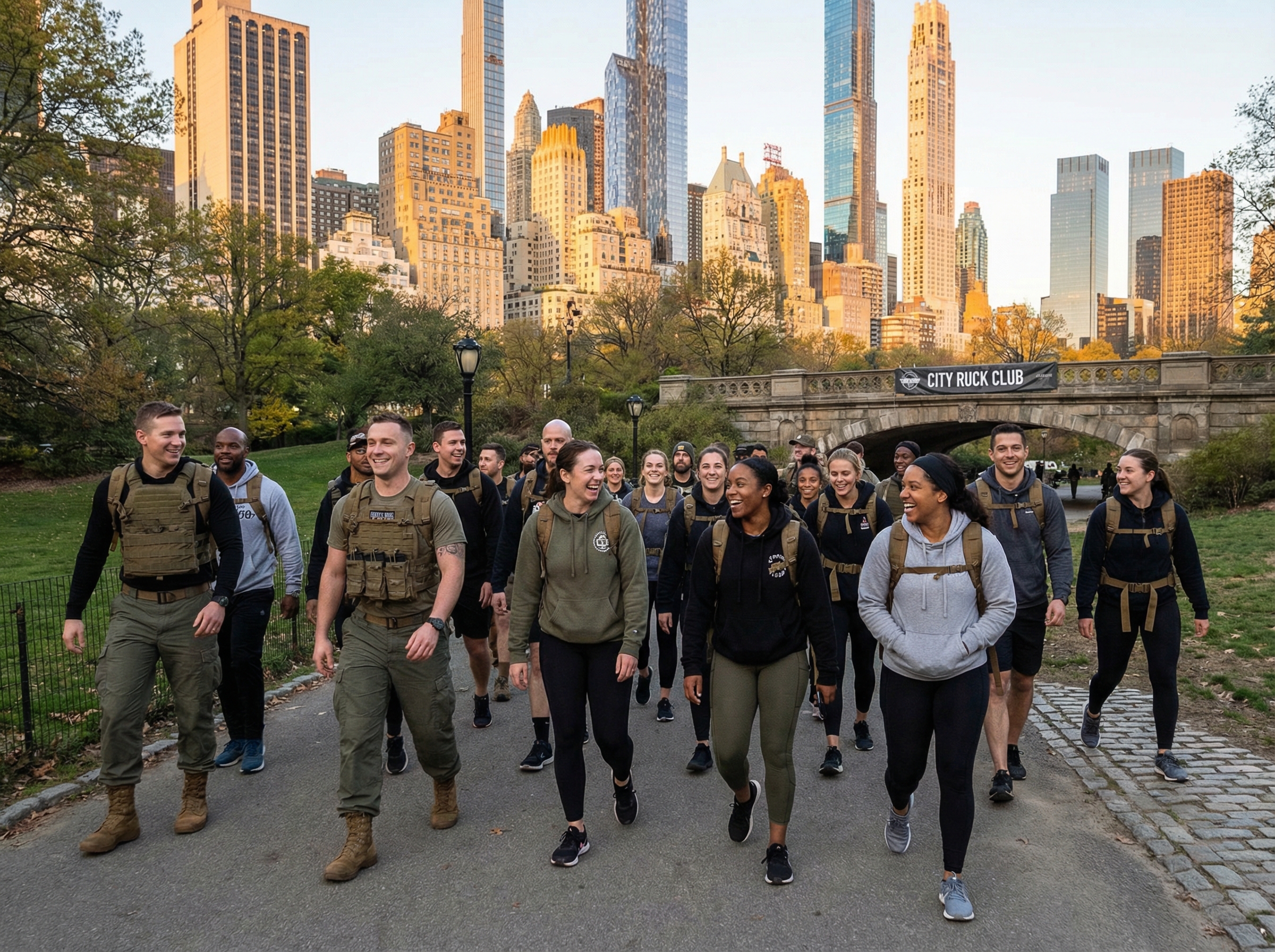
Diverse group of people rucking through an urban park at golden hour

Every January, fitness publications declare the "trends to watch." Most of them are gone by March. Rucking has now appeared on these lists for three consecutive years — and unlike cold plunges or mouth taping, the participation numbers keep climbing.

The drivers are straightforward and that's exactly why this isn't a fad: low barrier to entry (you need a backpack and some weight), alignment with the zone 2 cardio obsession popularized by Peter Attia and Andrew Huberman, and the growing allergy to gym memberships among people who'd rather exercise outdoors. The 2026 evolution is "smart rucking" — GPS-based route planning, wearable integration for load-adjusted calorie tracking, and community apps that turn neighborhoods into courses.

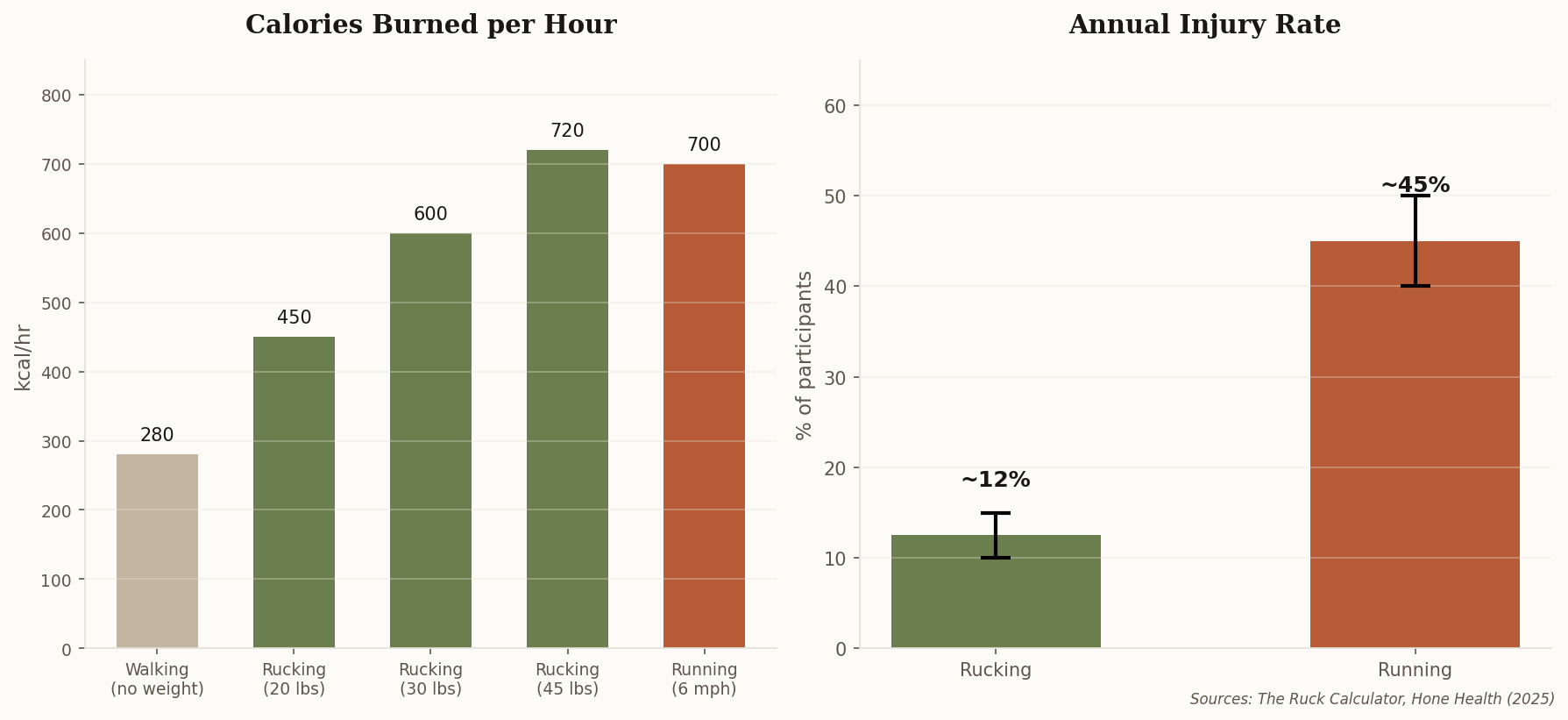
Bar chart comparing calorie burn and injury rates between rucking and running
Rucking with a 30-lb pack burns nearly as many calories as running at 6 mph — with roughly one-third the injury rate. Data from The Ruck Calculator and Hone Health.

The numbers explain the conversion: rucking with 30 pounds burns roughly 600 calories per hour — comparable to running at a 10-minute mile pace — but with an annual injury rate of 10-15% versus running's 40-50%. For the growing population of 30- and 40-somethings whose knees have filed a formal complaint against jogging, that math is irresistible.

05

The Gear Race Is On — and It's a $37 Billion Prize

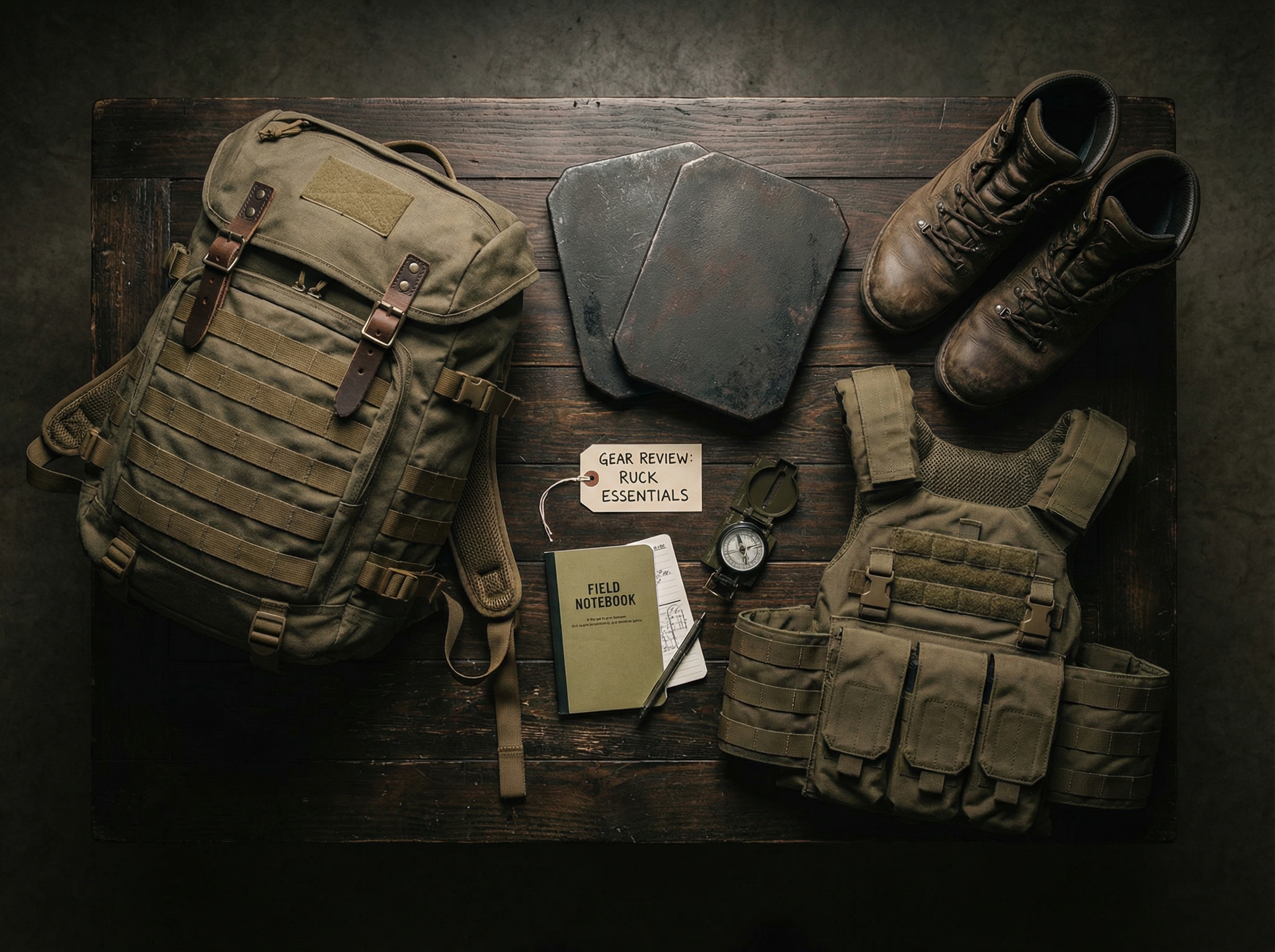
Flat lay product photography of premium rucking gear on a weathered wooden surface

GORUCK built the rucking gear market almost single-handedly. Now everybody wants in.

The company's 2026 "Essentials" lineup confirms the Rucker 5.0 — a fifth-generation ruck-specific pack — alongside the return of the heritage GR1 in full 1000D Cordura construction. It's a tell: GORUCK is simultaneously serving the fitness mainstream (Rucker) and the tactical purists (GR1) who made the brand. New Mackall footwear and USA-made apparel runs round out a product roadmap that reads more like Nike than a niche tactical brand.

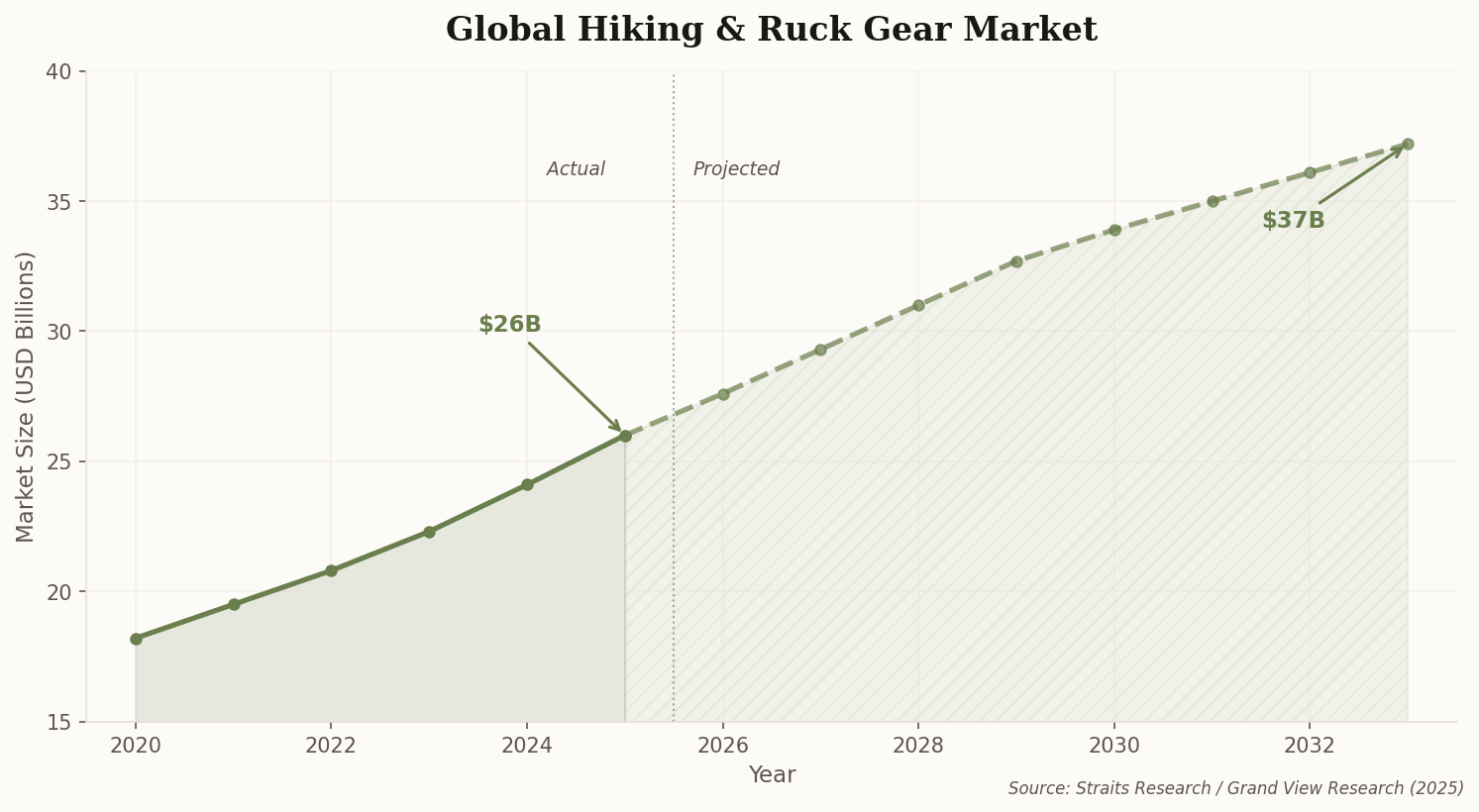
Line chart showing hiking and ruck gear market growth from $26B in 2025 to projected $37B by 2033
The global hiking and ruck gear market is projected to grow 42% from $26B to $37B by 2033, driven by adventure tourism and the athleisure crossover. Source: Straits Research / Grand View Research.

Meanwhile, 5.11 Tactical has aggressively retooled its RUSH and Skyweight pack lines — legacy military bags being re-engineered with fitness rucking in mind. The load-bearing improvements aren't cosmetic; they're a structural acknowledgment that their fastest-growing customer segment isn't deploying to a combat zone. They're deploying to a local trail.

The market context makes the competition inevitable: the global hiking and ruck gear market is projected to grow from $26 billion in 2025 to over $37 billion by 2033. When there's that much money on the table, expect every outdoor brand from Osprey to The North Face to launch a "ruck-ready" line within the year.

06

Want to Get Faster Under Load? Stop Rucking So Much.

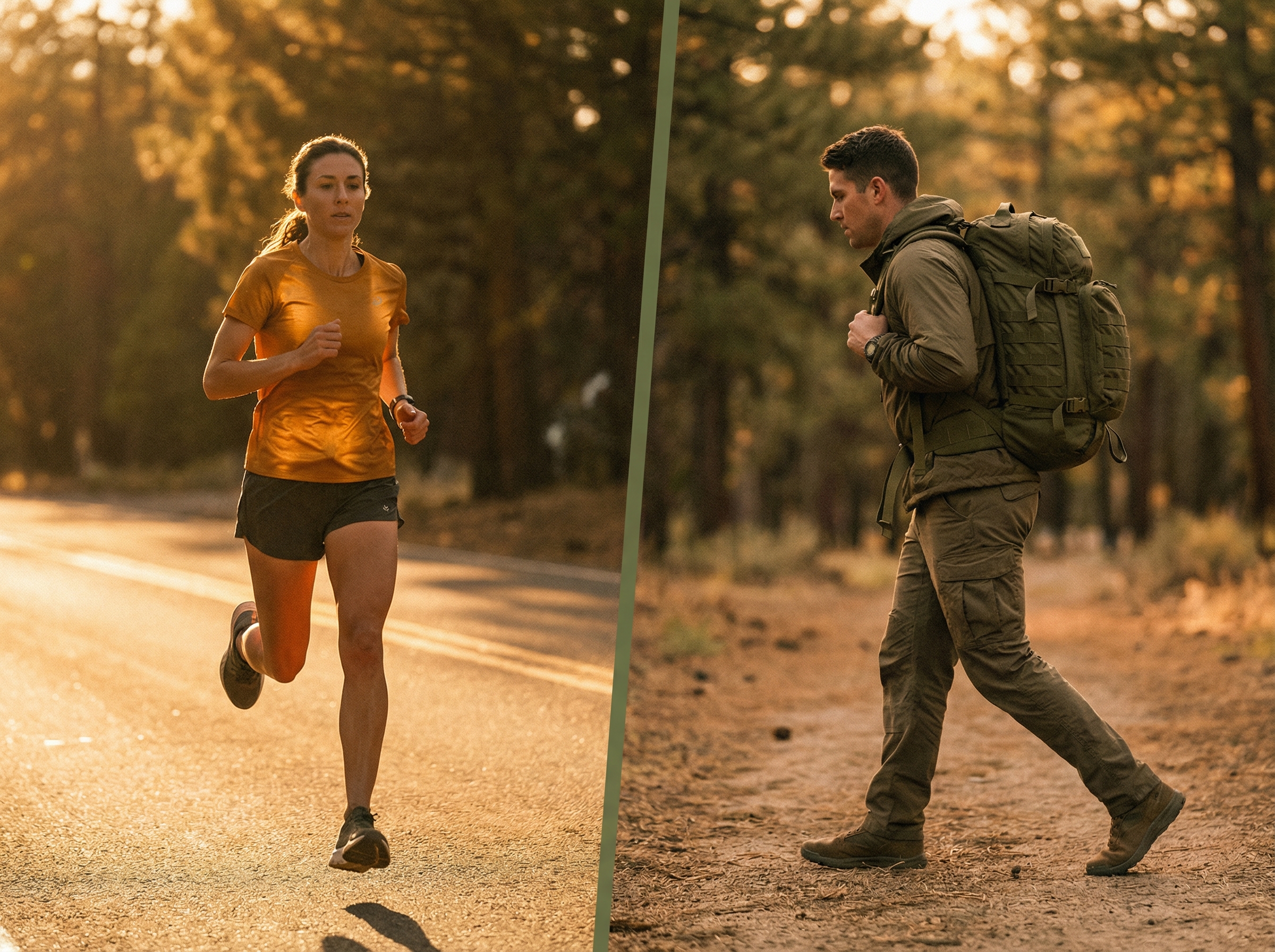
Split composition showing a runner on asphalt and a rucker on a trail at golden hour

Here's the counterintuitive finding that should change how every rucker trains: the best way to get faster under a pack isn't to ruck more. It's to get stronger in the gym.

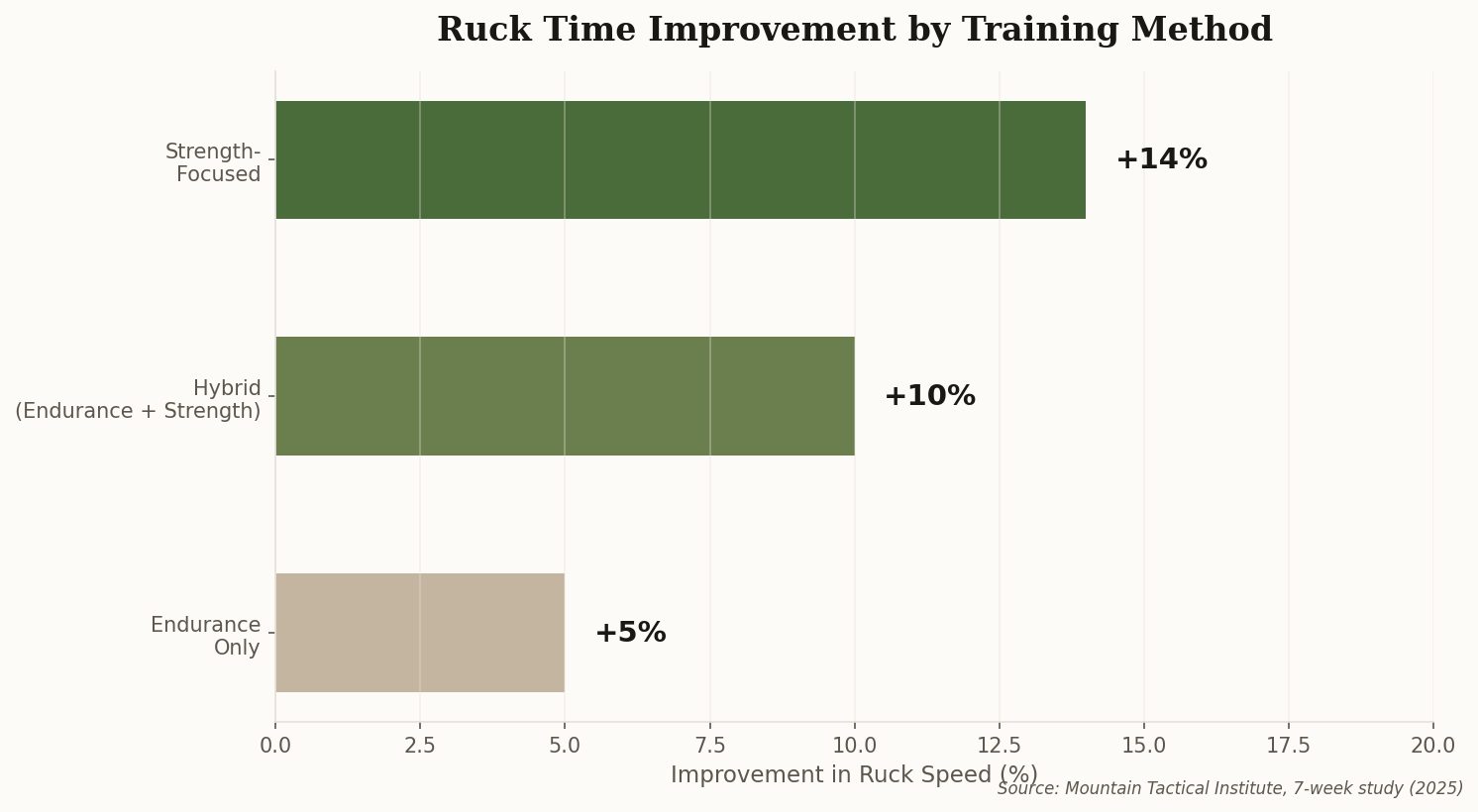
The Mountain Tactical Institute — the research arm used by special operations units — published mini-studies showing that "strength-heavy" and hybrid training programs significantly outperformed pure endurance approaches for improving ruck speed. One case study tracked a 46-year-old subject through a 7-week strength-focused cycle: his ruck times improved 14%. Not by adding miles. By adding squats, deadlifts, and loaded carries.

Horizontal bar chart showing ruck time improvement by training method: endurance only +5%, hybrid +10%, strength-focused +14%
Strength-focused training produced nearly 3x the ruck speed improvement of endurance-only programs. Source: Mountain Tactical Institute, 7-week study (2025).

The logic, once you hear it, is obvious: rucking is limited by your ability to carry weight efficiently, not your cardiovascular ceiling. Leg and core strength determine how much energy you waste per step. Build a stronger chassis, and every mile under load becomes metabolically cheaper. It's the same principle that transformed marathon training decades ago — the best distance runners spend significant time in the weight room.

For the growing population of recreational ruckers wondering why their times have plateaued despite logging more miles, the prescription is clear: trade one ruck session per week for a strength session. The data says your pack will feel lighter within two months.

The Load Ahead

Rucking is in that rare sweet spot where the science, the market, and the culture are all pointing in the same direction. When a military training method becomes a book deal, a $37B market opportunity, and your neighbor's Saturday morning routine — all in the same month — you're not watching a trend. You're watching a permanent change in how people move. The only question left is whether you're carrying weight yet.