
NVIDIA DGX Spark · Business Applications

The $3,999 Data Center

Six ways to turn NVIDIA's personal AI supercomputer into a revenue engine—from privacy-obsessed law firms to garage-scale startups pulling down venture funding.

Listen
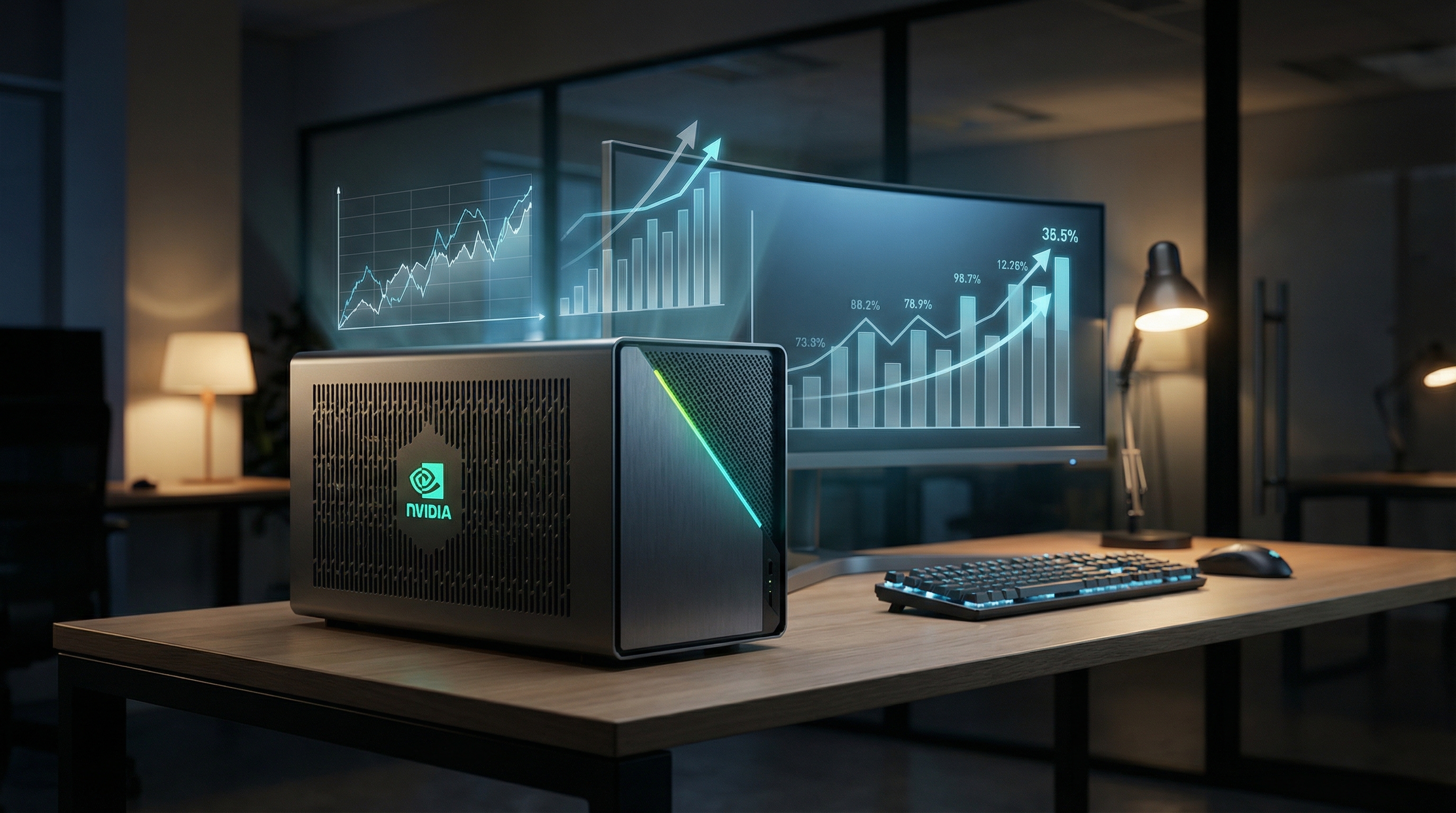
NVIDIA DGX Spark workstation glowing with teal light on a modern desk, holographic revenue charts floating above it
Vault door ajar revealing neural network patterns, symbolizing enterprise data privacy
01

The Paranoid Enterprise Is Your Best Customer

Here's a business model that practically sells itself: walk into a law firm or medical clinic and ask one question. "Where does your data go when you use ChatGPT?" Watch the color drain from their face. Then hand them a box the size of a Mac Mini that runs Llama 3 70B entirely on-premise, with 128GB of unified memory that can swallow a full case file without a single byte leaving the building.

DreamFactory is already doing exactly this, bundling DGX Spark units with their API-as-a-Service platform to convert legacy enterprise databases into secure RAG pipelines. Their target? Healthcare and finance—sectors where a HIPAA violation or SEC audit makes cloud AI a non-starter. Enterprise contracts are ranging from $25,000 to $100,000 per year per deployment.

The real revenue isn't in selling the hardware. It's in the consultancy layer on top: configuring retrieval-augmented generation for specific document types, fine-tuning models on proprietary legal precedent or medical literature, and charging $200–$500 per hour for what amounts to "AI paralegal" work. The 128GB memory advantage matters here because legal briefs and medical imaging datasets are enormous—consumer GPUs with 24GB choke on them.

The play: Build a consultancy that deploys DGX Spark units as "private AI infrastructure" for regulated industries. Charge setup fees ($10k+), monthly maintenance, and per-project fine-tuning. Your cost basis is one $3,999 box per client.

Balance scale with a small glowing cube versus clouds, coins flowing between them
02

The Cloud Breakup Math That Changes Everything

AWS raised H200 instance prices by roughly 15% in January 2026. That sound you hear is a thousand indie developers doing the math on a napkin—and realizing the answer is "buy the box."

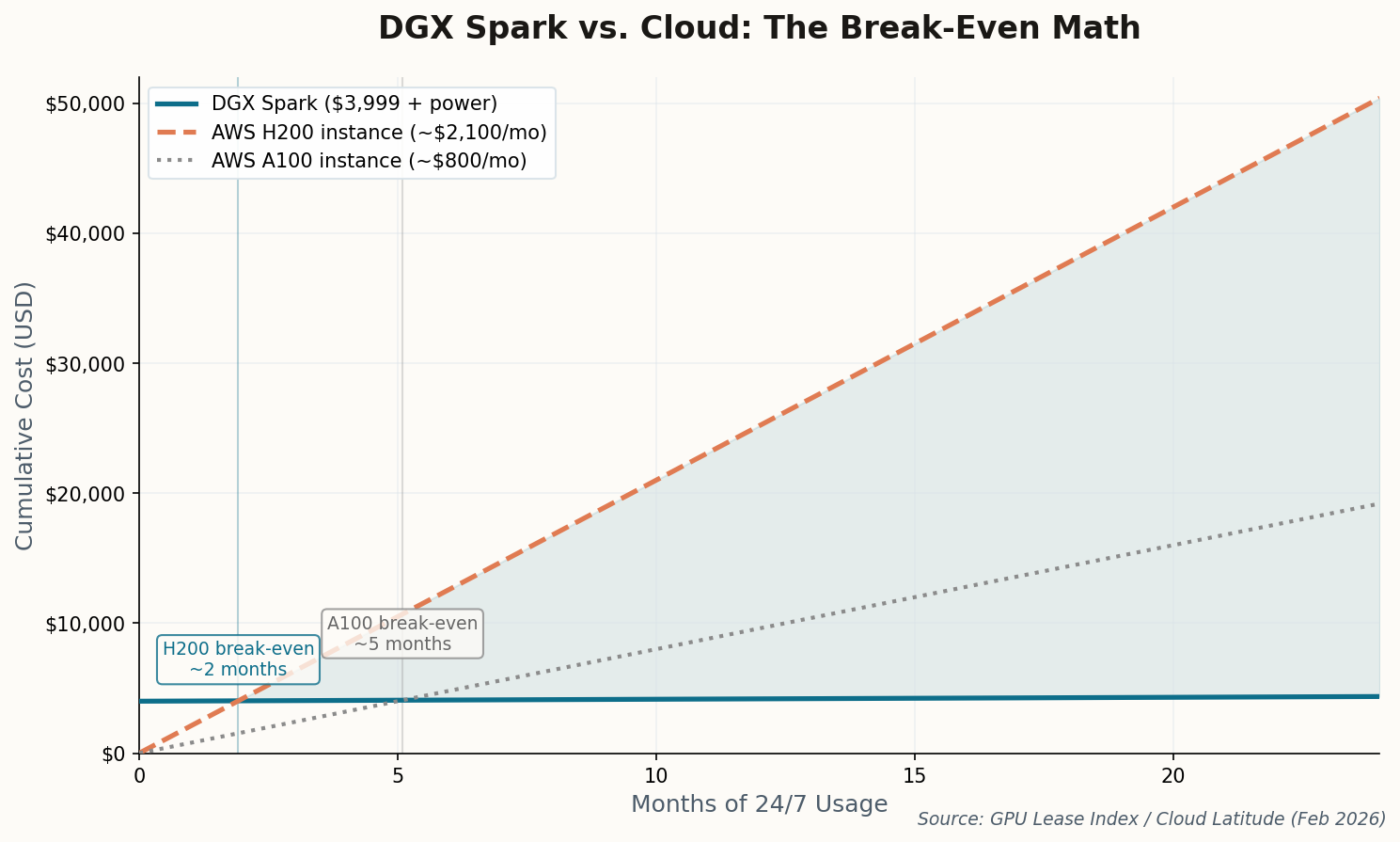
The numbers are stark. A comparable GPU capacity block on AWS runs north of $2,100 per month for on-demand H200 access. The DGX Spark costs $3,999 plus about $15 per month in electricity at average U.S. rates. That's a break-even at roughly two months for heavy 24/7 workloads against H200 pricing, or about five months against the more modest A100 tier at $800/month.

Line chart showing DGX Spark cumulative cost versus AWS H200 and A100 instances over 24 months
Cumulative cost comparison over 24 months of continuous usage. The DGX Spark breaks even against H200-class cloud instances in under 2 months, and against A100 instances in about 5 months. Source: GPU Lease Index / Cloud Latitude (Feb 2026).

After month two, every hour of inference is essentially free compute. Run the numbers over a year and you're looking at $20,000+ in savings versus cloud—from a single purchase. For anyone running sustained workloads like dev/test cycles, batch processing, or always-on inference endpoints, buying has become dramatically cheaper than renting. And unlike a cloud subscription, the hardware doesn't evaporate when you stop paying.

The play: Offer "cloud exit" consulting for startups burning $2k+/month on GPU cloud. Migrate their inference workloads to DGX Spark, charge a one-time migration fee, and keep them on a maintenance retainer. You're the hero who cut their GPU bill by 85%.

Creative studio workspace with ultrawide monitors showing AI-generated video frames
03

Video Gen Without the Cloud Tax

Black Forest Labs just validated their FLUX.1 and FLUX.2 models for the DGX Spark's FP4 tensor cores, and the implications for creative studios are enormous. An eight-minute video generation task that previously required a cloud GPU farm? One minute on a Spark. That's not an incremental improvement. That's a workflow transformation.

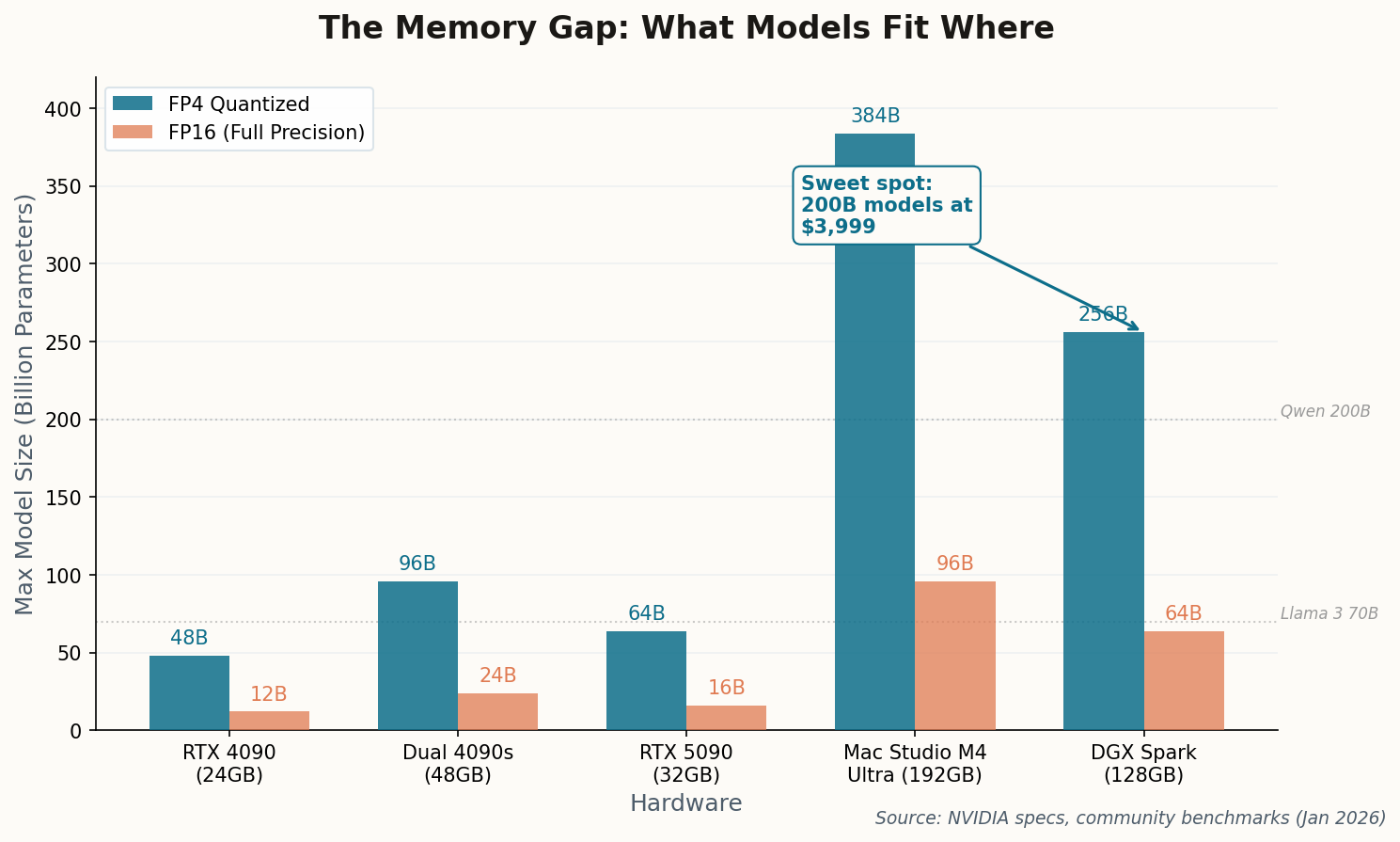
The NVFP4 driver update (announced at CES 2026) is the key enabler. By running inference at 4-bit floating point precision, the Spark squeezes 2.5x more performance from its Blackwell GPU while dramatically reducing memory footprint. Models like Qwen-235B now run comfortably in the 128GB envelope—something that would require multiple RTX 5090s lashed together to even attempt.

Bar chart comparing maximum model sizes across different GPU hardware from RTX 4090 to DGX Spark
The "memory gap" between consumer GPUs and the DGX Spark. At FP4 quantization, the Spark can host 200B+ parameter models that simply don't fit on consumer hardware. Source: NVIDIA specs, community benchmarks (Jan 2026).

Creative agencies are already licensing FLUX models at $500–$2,000 per seat per month. But here's the real play: instead of paying someone else for per-seat licenses, run the open-source models yourself on a Spark and sell the output. A single DGX Spark can serve a boutique motion graphics studio, churning out commercial-grade AI video for clients who don't know (or care) that your "render farm" fits on a desk.

The play: Launch an AI-powered creative studio with a DGX Spark as your sole production infrastructure. Offer video generation, image creation, and 3D asset production at rates that undercut cloud-dependent competitors by 40–60%.

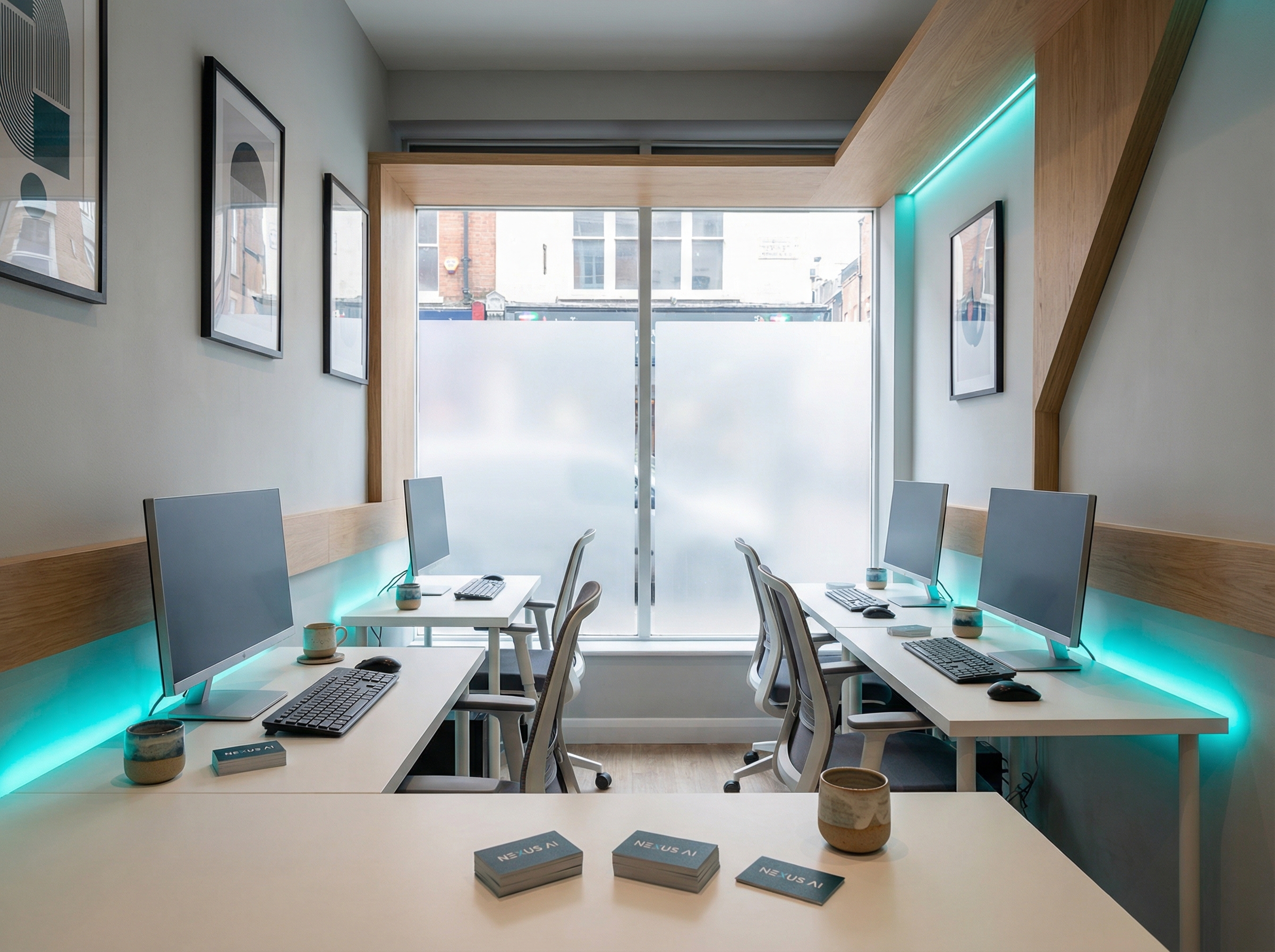
Small modern office with multiple compact AI workstations, warm teal accent lighting
04

The Zero-Overhead AI Agency

There's a new breed of AI agency emerging, and their secret weapon isn't a bigger team or fancier models. It's fixed infrastructure costs. Buy two or three DGX Sparks for $12,000 total, and your marginal cost per inference drops to essentially zero. Compare that to cloud-native agencies passing through API costs at $0.01–$0.03 per thousand tokens to clients—and suddenly your pricing advantage is structural, not just tactical.

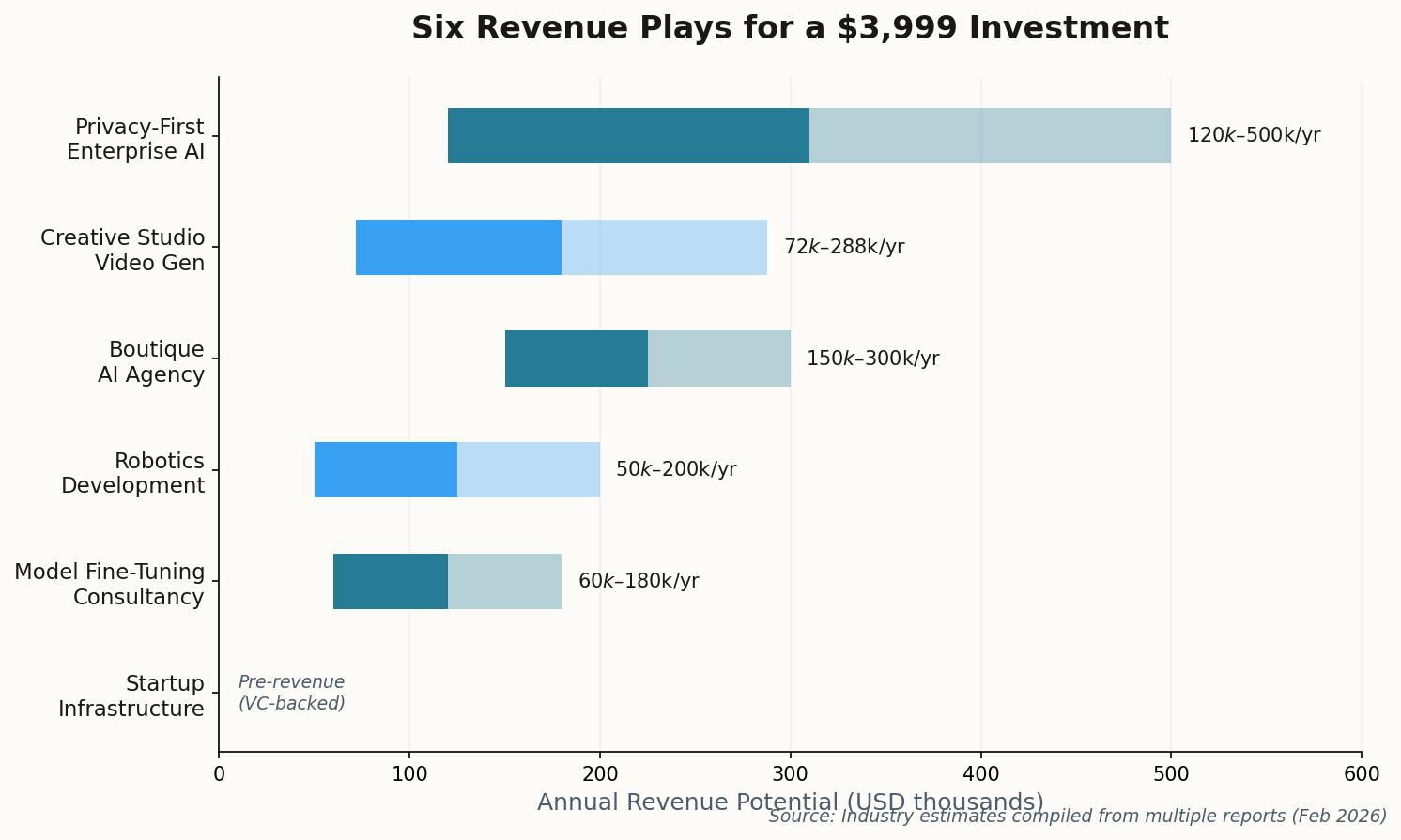
Horizontal bar chart showing annual revenue potential for six different DGX Spark business models
Annual revenue potential across six DGX Spark business models. Privacy-first enterprise AI and boutique agencies show the strongest risk-adjusted returns relative to the $3,999 hardware investment. Source: Industry estimates compiled from multiple reports (Feb 2026).

The model works like this: offer "Fixed Price" model training and inference services. Because your infrastructure is a sunk cost, you can quote flat monthly fees while cloud-dependent competitors must hedge against usage spikes. Reports suggest these boutique agencies are pulling $150,000–$300,000 in annual revenue with less than 5% infrastructure overhead. That's the kind of margin that makes SaaS founders jealous.

The real moat, though, is data gravity. Once a client's proprietary data lives on your Spark and their fine-tuned models run on your hardware, switching costs are enormous. You're not just an agency at that point—you're their AI infrastructure provider.

The play: Stand up a 2–3 Spark cluster ($12k investment). Offer flat-rate AI services to 5–10 SMB clients. Your pitch: "No per-token fees, no surprise bills, no data leaving your network." Aim for $2,500–$5,000/month per client.

Robotic arm connected to compact AI compute unit with neural processing visualization
05

Robots That Can't Wait for a Server

Cloud latency kills robots. That's not a metaphor—when a Vision-Language-Action model needs 200ms to decide whether a robotic arm should grip or release, the result is broken objects and dangerous environments. The DGX Spark solves this by running the entire perception-decision-action loop locally, on hardware that shares its DNA with NVIDIA's data center architecture.

Developers are already using DGX Sparks to train and deploy "agentic" workflows for robots like Hugging Face's Reachy Mini. The 128GB unified memory is critical here: Vision-Language-Action models are memory hogs that need to hold visual context, language instructions, and motor control policies simultaneously. Consumer GPUs can't do this without painful offloading to system RAM.

Mercedes-Benz confirmed at CES 2026 that they're using similar Blackwell-based hardware architecture for autonomous vehicle R&D, running their Alpamayo reasoning model on Spark-class hardware to prototype edge scenarios. This means skills learned developing on a Spark translate directly to the booming autonomous systems industry.

The play: Build custom robotics software stacks on DGX Spark, then license them to manufacturing and logistics companies. The R&D hardware doubles as your demo unit. Custom robotics contracts are running $50k+ in this space.

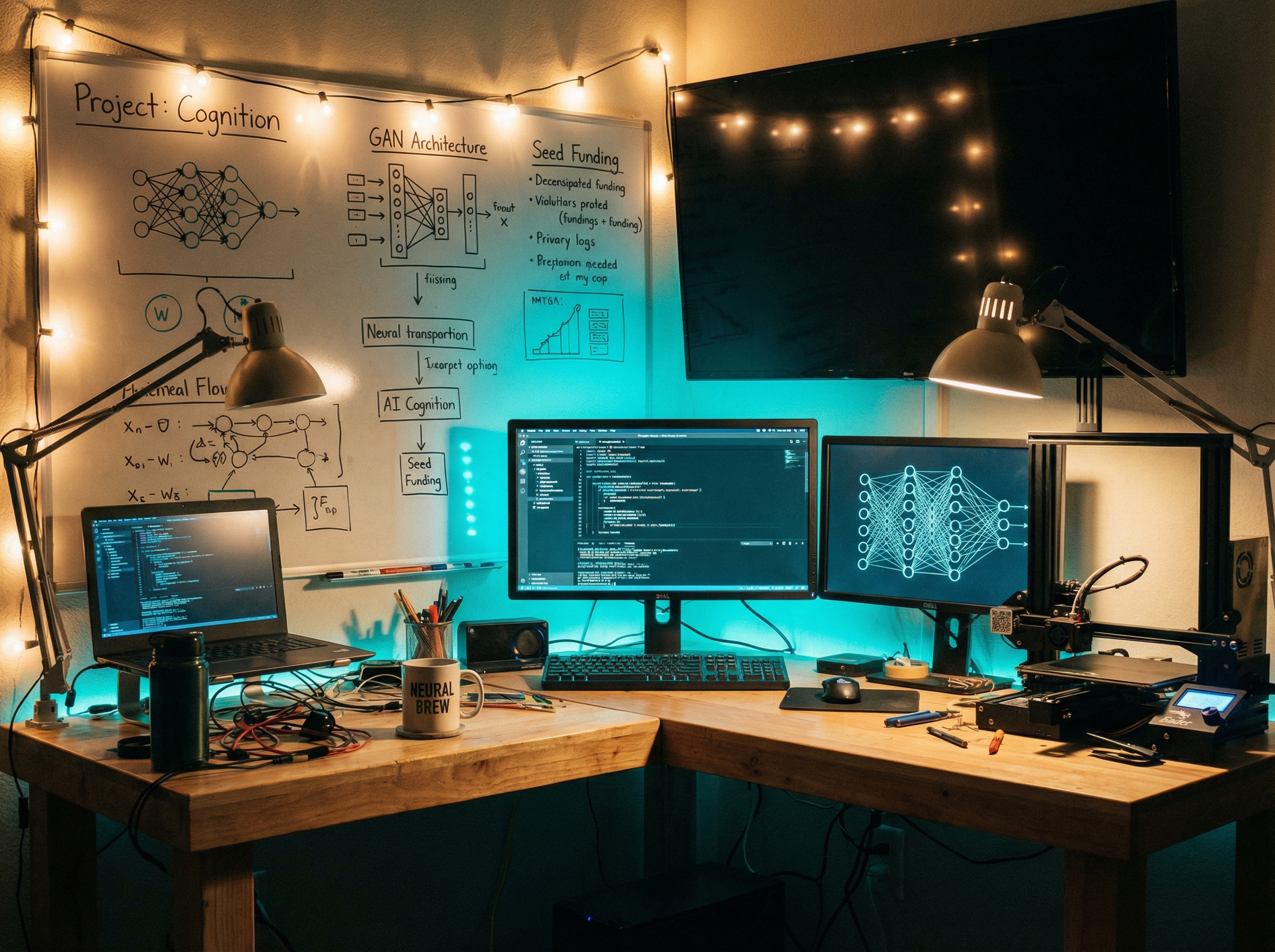
Home garage converted into mini AI lab with compact workstation glowing teal on workbench
06

Your Garage, Your Data Center, Your Series A

The most subversive thing about the DGX Spark might be what it does to startup economics. Andrej Karpathy demonstrated training a functional "ChatGPT-style" LLM on a single Spark for about $100 in electricity. Let that sink in: the barrier to training your own specialized model has collapsed from "raise a seed round for cloud compute" to "plug in a box."

On Reddit's r/LocalLLaMA, a startup founder going by "u/NeuralArchitect" is building "Brain World Models" for precision therapeutics on a single DGX Spark—a deep-tech application that would have required $50,000+ in cloud spend just two years ago. The system runs coding agents that automatically improve their own codebases overnight. Pre-seed valuations for startups in this space are ranging from $2M to $5M.

VCs are paying attention. The community consensus on r/LocalLLaMA is telling: the Spark is "overpriced" for simple chatbot inference compared to used mining GPUs, but its real value is software parity with DGX Cloud. Code developed on a Spark runs identically in NVIDIA's data center stack. Investors view startups using DGX Spark as "serious" about infrastructure scalability—compared to those hacking on consumer gaming cards.

The play: Use DGX Spark as your entire development and demo infrastructure. Build your MVP, train your models, and serve your beta users from a single box. When VCs ask about your infrastructure story, the answer is "it scales 1:1 to DGX Cloud." That's not a pitch—it's a moat.

The Real Question Isn't What It Costs. It's What You Build.

The DGX Spark isn't a consumer GPU with aspirations. It's a $3,999 bet that the most profitable AI businesses of the next decade won't be built in the cloud—they'll be built on desks, in garages, and inside the walls of companies that refuse to let their data leave the building. The hardware is here. The economics make sense. The only missing variable is you.