
Edge Computing · AI Strategy

The Edge of Intelligence

Apple is betting its AI future on silicon rather than servers. As consumer sentiment shifts against cloud AI and the M5 chip promises a 4x inference leap, the question isn't whether edge computing matters—it's whether Apple moved fast enough.

Listen
Apple silicon chip floating in deep space with neural network pathways emanating outward like a constellation, rendered in teal and silver tones
01
Digital shield protecting a human silhouette with binary data streams bouncing off its surface

The Privacy Pivot Is Real—and Apple Didn't Even Have to Ask

Here's the thing about privacy as a competitive moat: it only works when people actually care. And according to a new industry report published this week, they suddenly, decisively do. Consumer sentiment toward cloud-only AI has flipped negative for the first time, with 61% of respondents now preferring on-device processing over cloud-based alternatives. That's up from just 18% four years ago.

The catalyst isn't some abstract concern about surveillance. It's specific, visceral incidents—training data scrapes that surfaced private medical records, AI-generated deepfakes powered by cloud-stored photos, and a growing "who has my data?" anxiety that no amount of corporate reassurance can soothe. The report calls this the "Privacy Pivot," and it identifies Apple as the primary beneficiary, citing the company's marketing of "Local Data Processing" as a premium feature rather than a limitation.
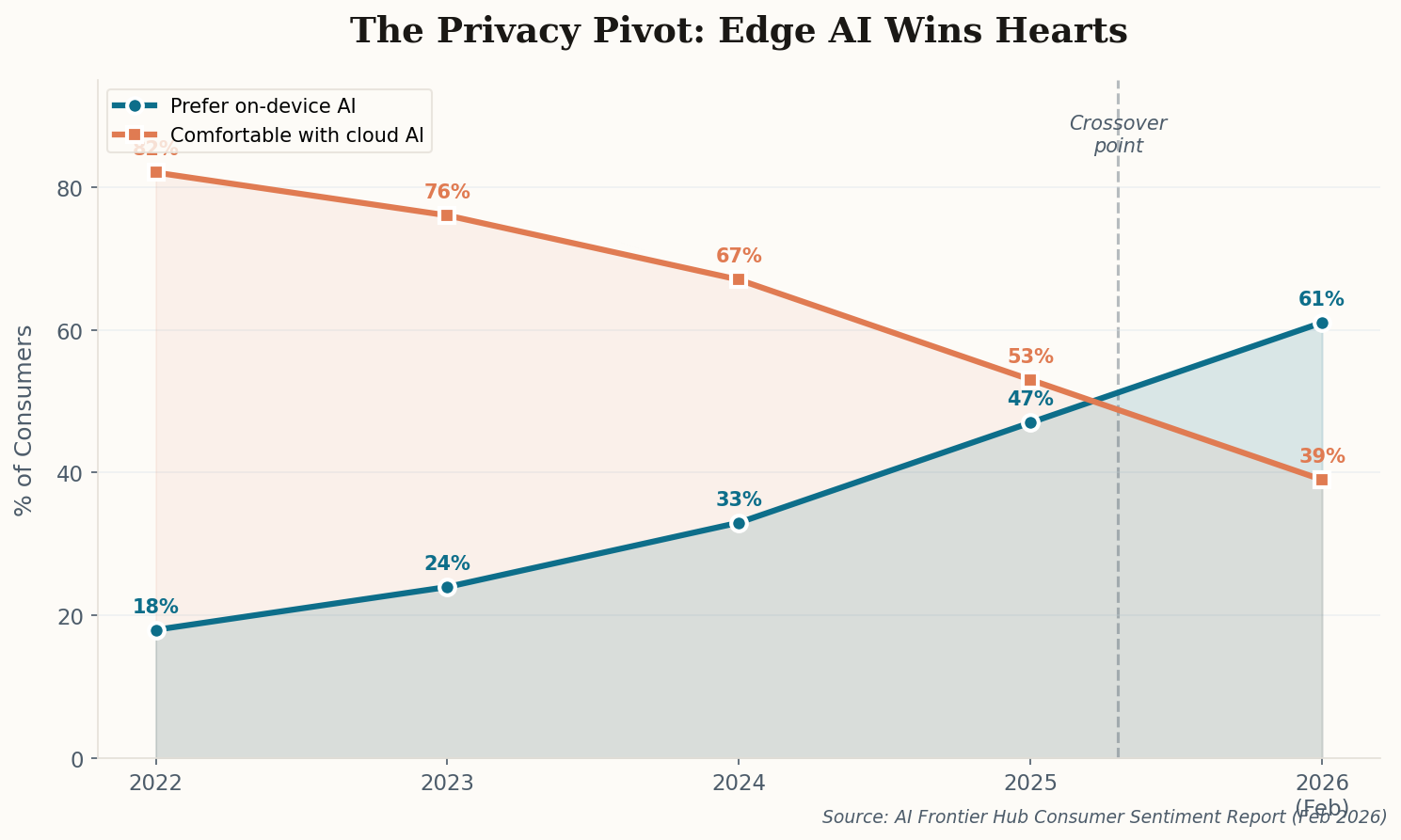
Line chart showing consumer preference for on-device AI rising from 18% in 2022 to 61% in February 2026, crossing over cloud AI preference around mid-2025
Consumer preference for on-device AI has crossed the 50% threshold for the first time, accelerating through 2025-2026. Source: AI Frontier Hub Consumer Sentiment Report.

What's brilliant—and let's be honest, a little cynical—is that Apple is rebranding a technical constraint as a virtue. Running smaller models on-device isn't just a "choice," it's a consequence of mobile hardware limitations. But when your competitor's 400-billion-parameter cloud model keeps making headlines for data breaches, your 3-billion-parameter local model starts looking less like a compromise and more like a feature. Watch for this narrative to dominate WWDC 2026.

02
Cross-section of a next-generation processor chip revealing stacked neural accelerator layers with glowing teal circuit pathways

M5 Leaks Reveal Apple's Real AI Weapon: 83-Millisecond Time to First Token

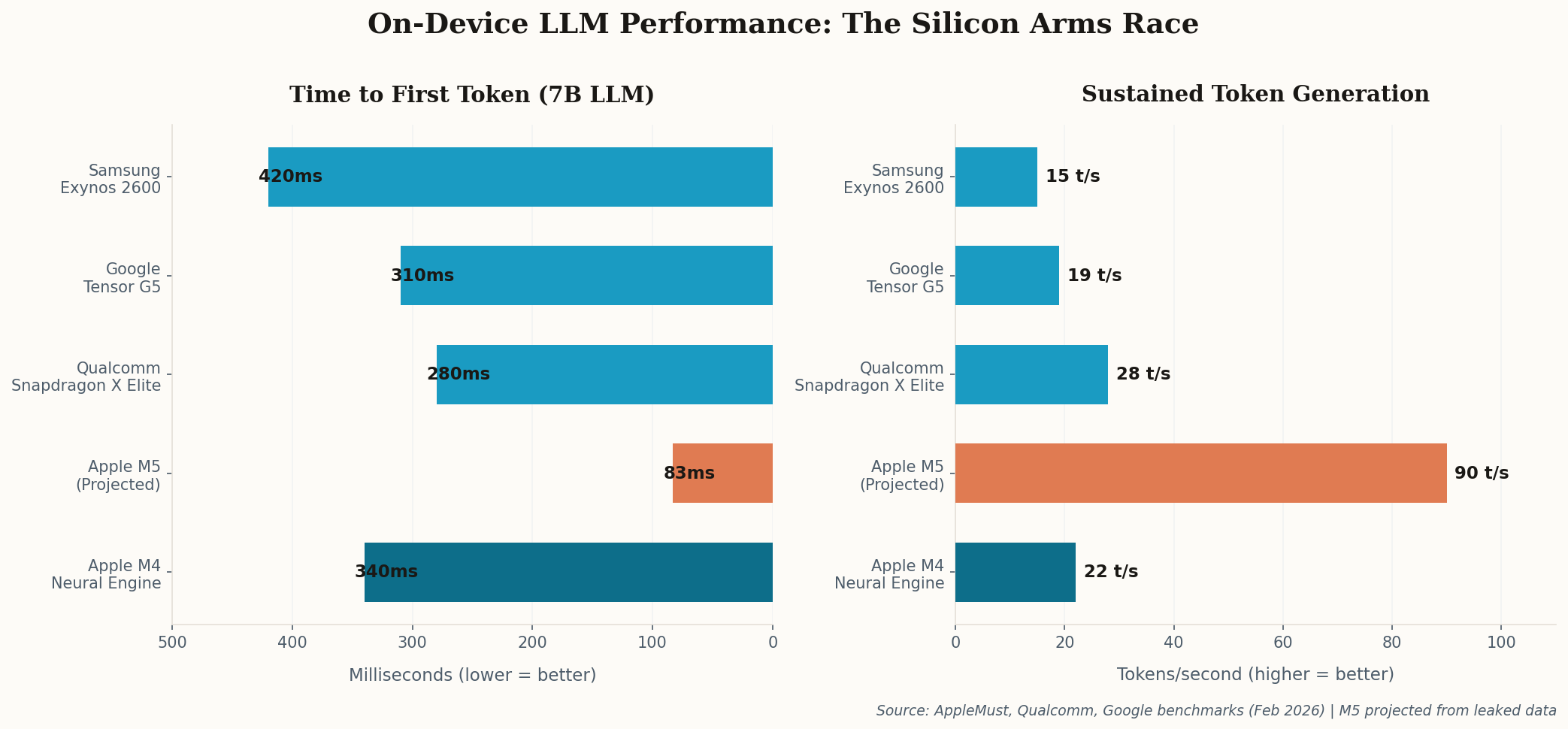
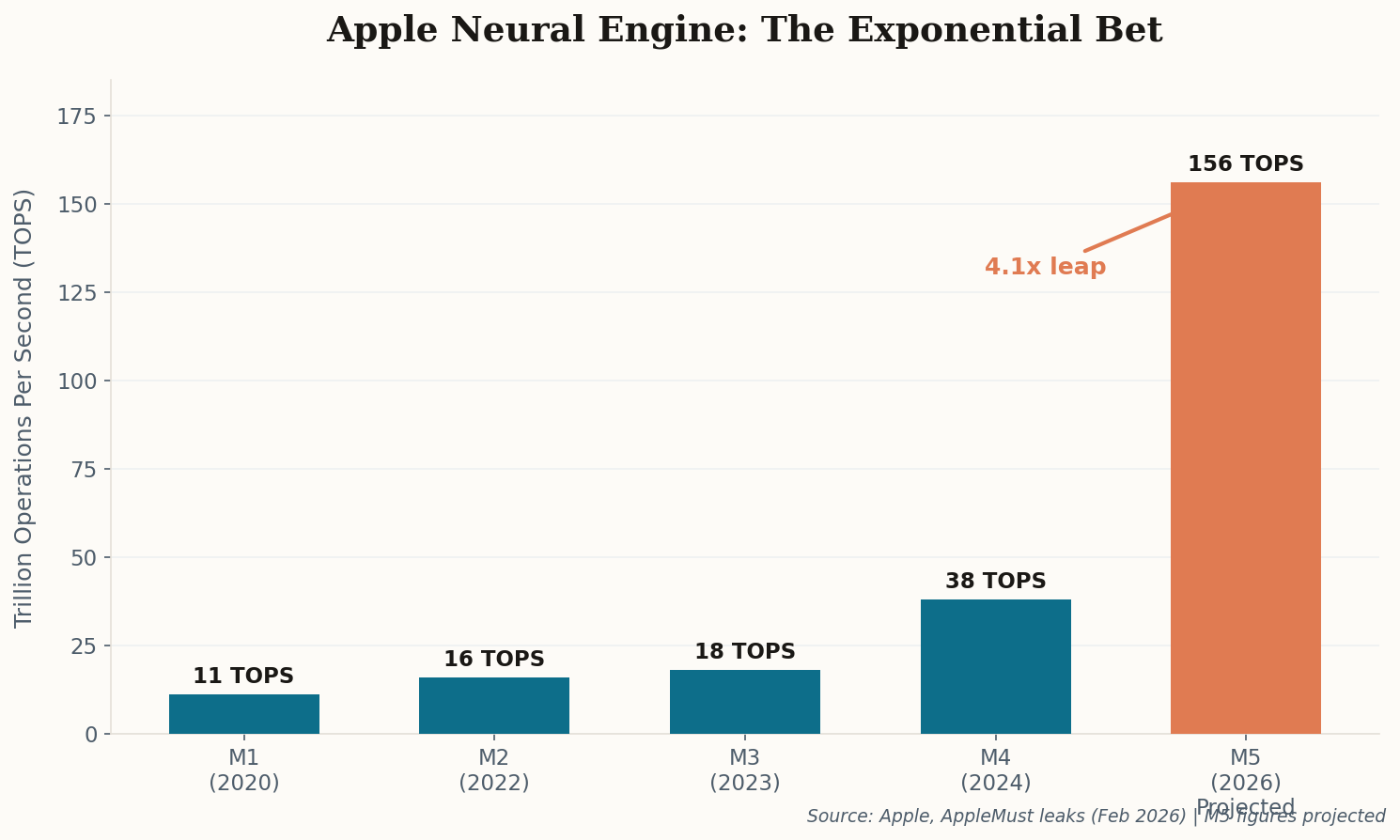
Forget the marketing pitch—the M5 leak tells the real story. Hidden deep in macOS 26.3 beta code, references to a radically redesigned Neural Engine surfaced this week, and the numbers are staggering. The upcoming M5 chip reportedly delivers a 4.1x improvement in "time to first token" for large language model inference compared to the M4. In practical terms: 83 milliseconds from prompt to first response.

Why does time-to-first-token matter so much? It's the single metric that determines whether on-device AI feels "instant" or "laggy." Right now, the M4's Neural Engine takes about 340ms to start generating text from a 7B-parameter model. Usable, but noticeably slower than cloud-based OpenAI responses. At 83ms, the M5 would make local inference feel indistinguishable from cloud. That's the holy grail.

Bar chart showing Apple Neural Engine TOPS progression from M1 at 11 TOPS to M5 projected at 156 TOPS, with a dramatic 4.1x leap annotation
The M5's projected 156 TOPS represents a discontinuous leap in Apple's Neural Engine trajectory, suggesting a fundamental architectural redesign rather than incremental improvement.

The leaked architecture points to dedicated "Neural Accelerators"—purpose-built silicon for transformer-style attention operations, not just generic matrix math. Apple is essentially designing chips that are optimized specifically for text generation. This is the same strategic bet that made the original M1 revolutionary: don't compete on general-purpose benchmarks, compete on the workloads that actually matter to your users. The question is whether they can ship it before Qualcomm's next Snapdragon revision closes the gap.

Dual horizontal bar chart comparing on-device LLM inference across five chipmakers, showing Apple M5 projected to lead dramatically in both time-to-first-token and sustained token generation
If the M5 benchmarks hold, Apple will lead on-device LLM inference by a factor of 3-4x over the nearest competitor. Data compiled from AppleMust leaks, Qualcomm, and Google benchmarks.
03
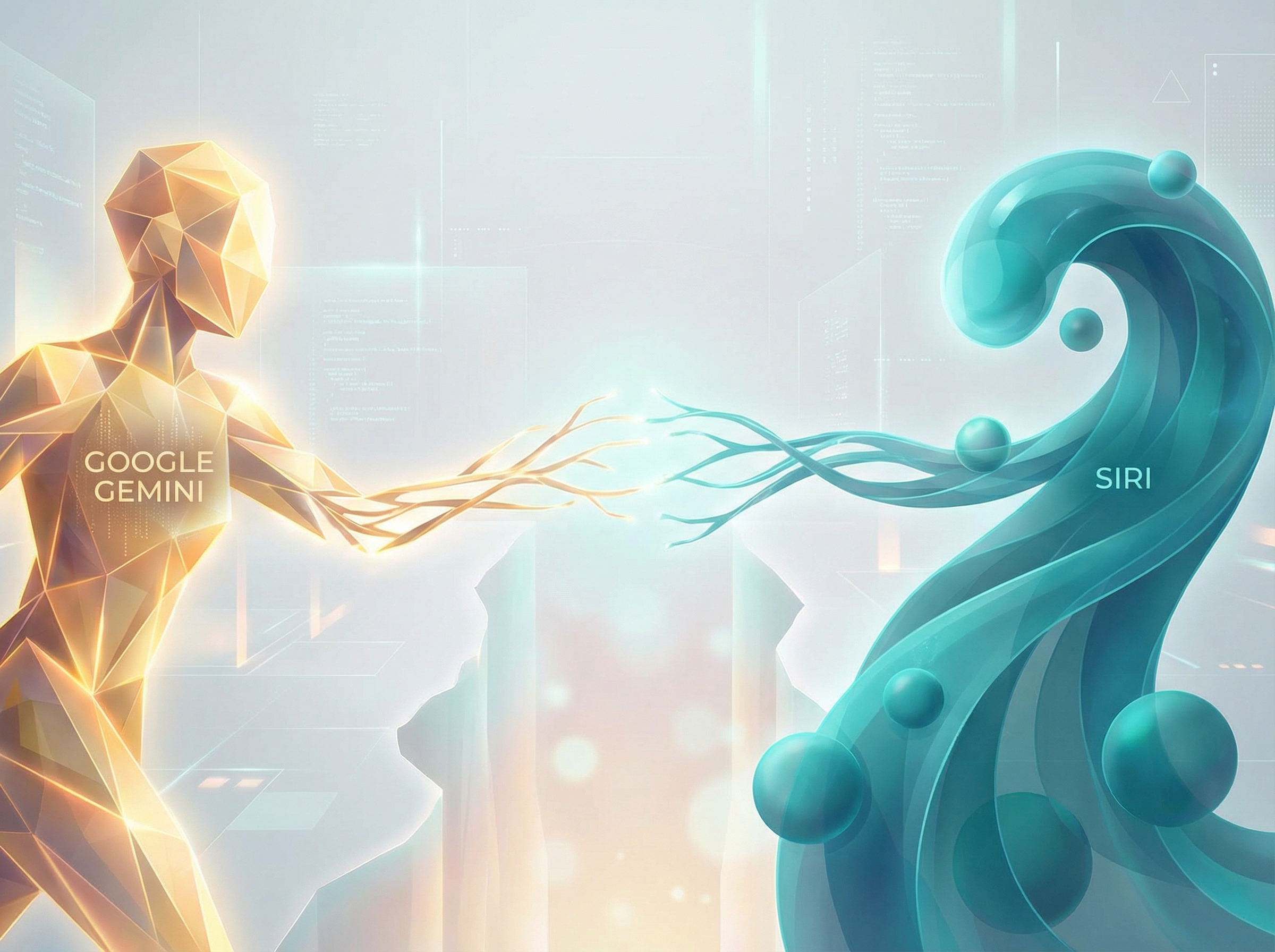
Two abstract AI entities, one warm gold representing Gemini and one cool teal representing Siri, reaching toward each other across a luminous divide

The Siri-Gemini Marriage Counseling Continues

Apple's "Hybrid AI" strategy—process what you can locally, hand off the hard stuff to a partner's cloud—sounds elegant on a keynote slide. In practice, it's proving messy. New reports this week confirm that the "Gemini-powered Siri" beta, originally expected in early February, has slipped again. The integration is now pegged for the iOS 26.5 cycle, roughly six months behind the original timeline.

The architecture itself is interesting: personal context (your contacts, calendar, messages, photos) stays encrypted on-device. Only the "query intent" gets sent to Google's Gemini cloud for complex reasoning, which then returns a response that Siri synthesizes locally. It's a privacy sandwich with a cloud filling. But each delay raises the same uncomfortable question: if edge computing is Apple's strength, why does it still need Google to make Siri smart?

The tension in one sentence: Apple wants to own the user's trust through local processing, but it can't yet match the reasoning capability of cloud-scale models. The Gemini partnership is a bridge—but bridges have a way of becoming permanent.

Meanwhile, Google separately updated Gemini Nano—its smallest model designed for on-device use—with music generation capabilities this month. That's Google essentially saying: "We can do edge computing too, and we'll make it do things Apple hasn't even attempted." The pressure to ship a fully autonomous on-device Siri that doesn't need Google as a crutch is intensifying.

04
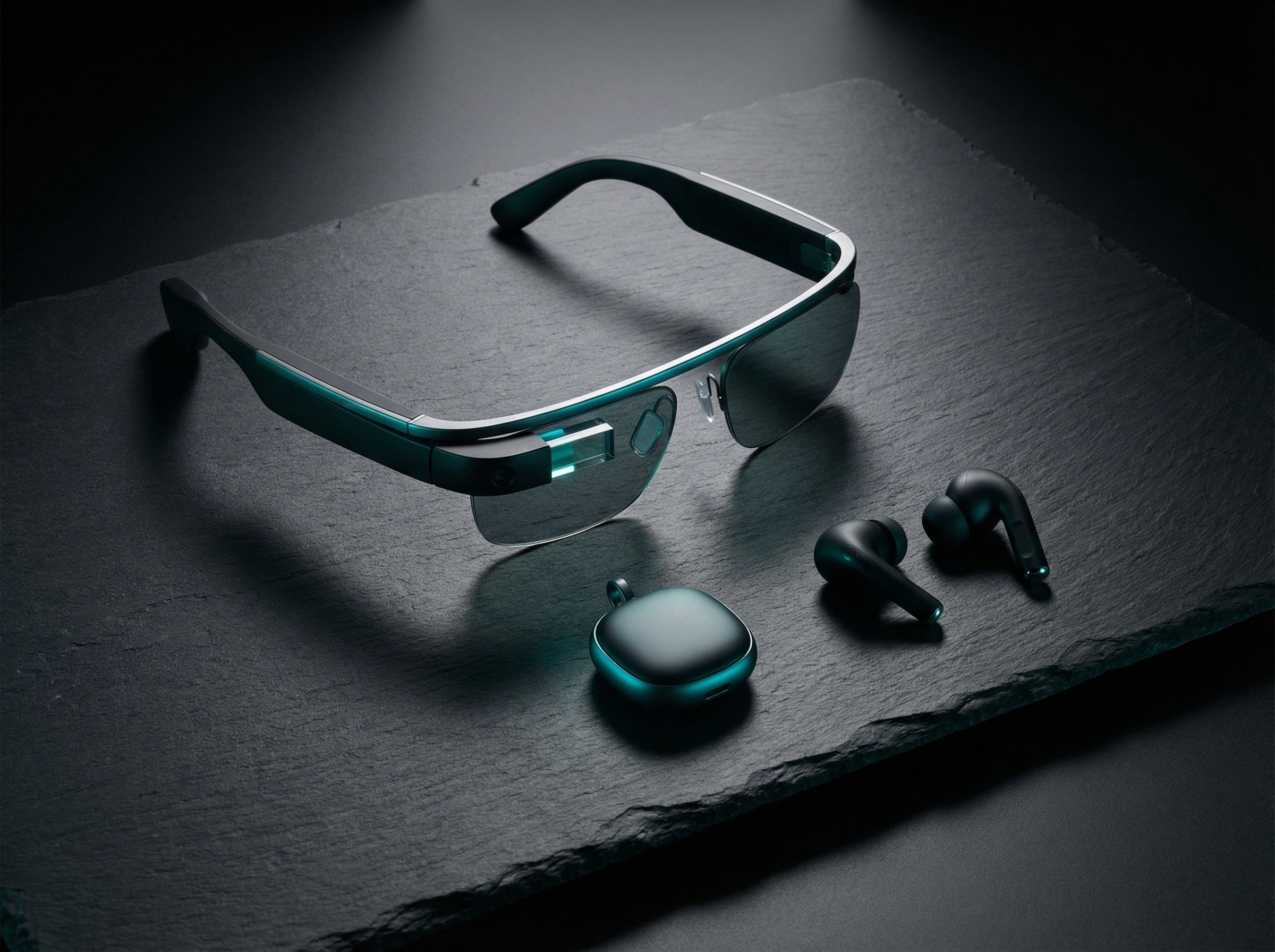
Smart glasses, a pendant device, and wireless earbuds arranged on dark slate, each with subtle teal ambient lighting

Apple's AI Wearables Trio: The iPod Shuffle Had a Baby With Siri

Valentine's Day brought a love letter to edge computing nerds. Reports surfaced detailing three new AI-centric hardware categories in active development at Apple: smart glasses, an "AI Pendant," and camera-equipped AirPods. All three are designed around a single principle—process visual and audio data locally before syncing with the iPhone. No cloud required for the core experience.

The AI Pendant is the wild card. Described as an iPod Shuffle-sized device, it's designed solely for voice interaction and ambient context gathering. Think of it as Siri decoupled from the screen—you talk to it, it talks back, and it remembers your conversation context locally. It's Apple's answer to the Humane AI Pin and Rabbit r1, but integrated into an ecosystem rather than standing alone as a curiosity.

The glasses and camera AirPods follow the same playbook: put AI sensors on the body, process the data at the edge, and keep the cloud out of it unless the user explicitly opts in. This is where Apple's silicon investment becomes a hardware strategy—every one of these devices needs a tiny, power-efficient neural engine that can run real-time inference on battery power. If the M5's neural accelerators are as good as the leaks suggest, these wearables become the proof that edge AI isn't just for laptops. Expected launch window: late 2026 to 2027.

05
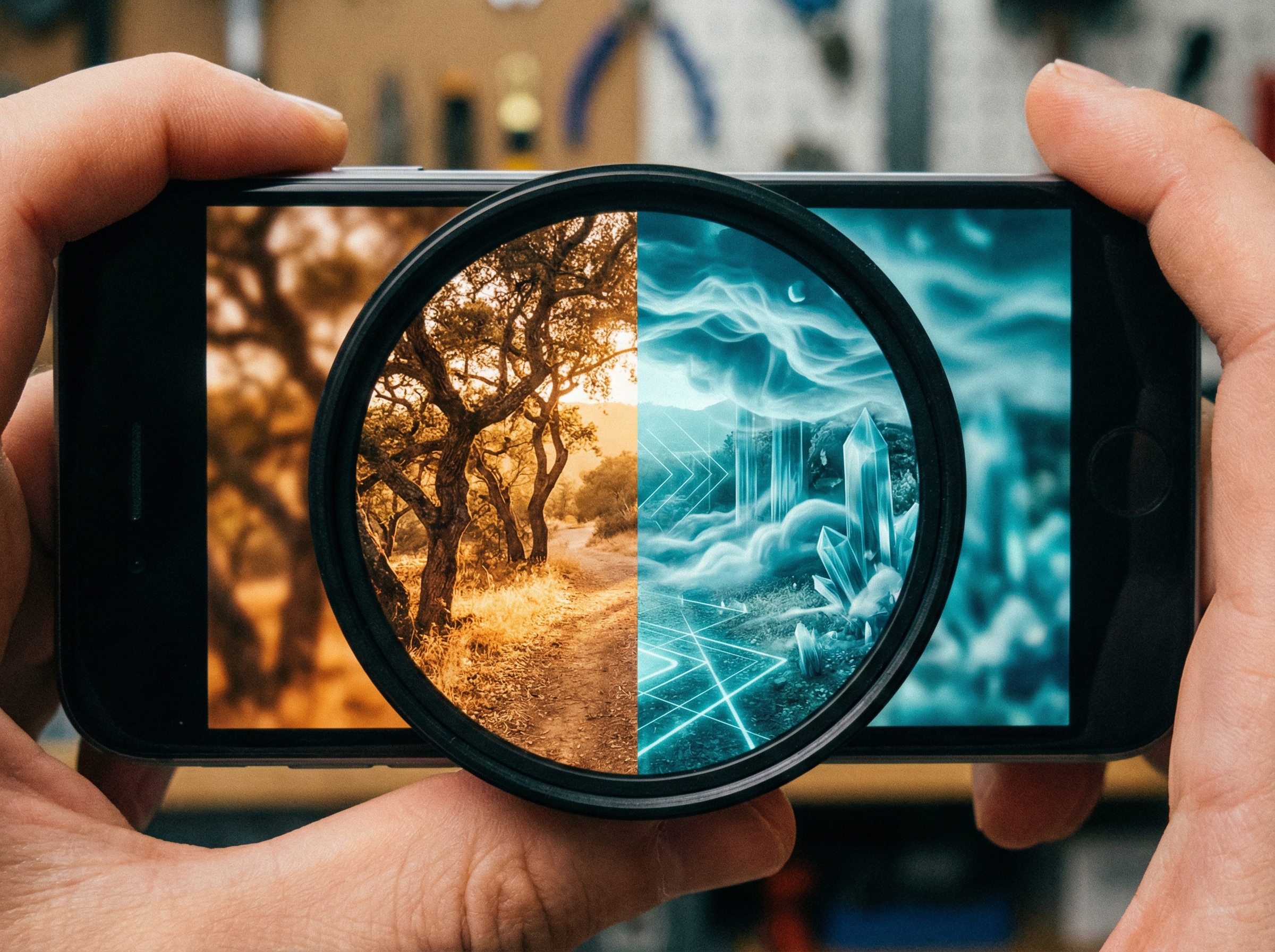
Smartphone camera with split view showing reality transforming into AI-generated imagery, warm and cool tones divided

Samsung's Galaxy S26 Throws Down the AI Camera Gauntlet

While Apple refines its privacy narrative, Samsung is going full throttle in the other direction—aggressive, generative, unabashedly creative. Ahead of the February 25 Unpacked event, Samsung teased two headline features for the Galaxy S26's AI camera: "Generative Restoration" (reconstructing missing details in photos from scratch) and "Environmental Transformation" (changing weather, lighting, or time of day in any scene). All processed on-device.

The philosophical split is now impossible to ignore. Apple's approach to AI photography is corrective: Clean Up removes distractions, Smart HDR enhances reality. Samsung's approach is generative: the AI doesn't just fix your photo, it reimagines it. You can photograph a cloudy afternoon and transform it into a golden sunset—and Samsung considers that a feature, not a fabrication.

The divergence matters because it defines what "AI camera" means. Apple says: "We help you capture truth, better." Samsung says: "We help you create the image you wanted." Two valid philosophies, one massive UX battle for 2026.

Both approaches run entirely on-device, which makes this an edge-computing-versus-edge-computing fight rather than an edge-versus-cloud one. The question isn't computational power—it's philosophy. And it'll be fascinating to see which resonates more with consumers who are simultaneously demanding privacy and wanting AI to do increasingly magical things to their photos.

06
Holographic code editor displaying Swift syntax surrounded by neural network visualization with flowing data streams in teal

MLX and macOS 26.3: Laying the Track Before the Train Arrives

The least sexy but most consequential developments this fortnight happened in code commits and maintenance updates. Apple released mlx-swift v0.10.0 alongside MLX core v0.30.6 on February 10, introducing breaking changes to quantization APIs to align Swift bindings with the Python core. Translation: Apple is making it easier for developers to build AI models that run natively on Apple Silicon, regardless of which language they prefer.

The key optimization targets what Apple calls the "Unified Memory" architecture—the M-series design where CPU and GPU share the same memory pool. Traditional frameworks like PyTorch were designed for systems where data must be explicitly transferred between CPU and GPU memory. MLX eliminates that overhead entirely. The v0.30.6 update specifically improves "vector fused grouped-query attention," the transformer operation that determines how fast LLMs can process long context windows.

A day later, macOS 26.3 shipped with under-the-hood preparations for "next-generation Neural Engine requests" and stability fixes for Core ML background processes that were draining battery on M3 and M4 MacBooks. Neither update made headlines, but together they represent Apple doing what it does best: quietly building infrastructure that'll become obvious when the M5 arrives and developers suddenly need their MLX models to run at 156 TOPS. The framework is ready. The silicon is coming. The developer ecosystem just needs to catch up.

The Verdict: Not Yet—But the Pieces Are on the Board

Will Apple "win" the AI war with edge computing? Not in 2026. The honest answer is that Apple is building the infrastructure for a fight that plays out over the next 3-5 years. The M5 leak, the privacy pivot, the wearables roadmap, the MLX framework—these are chess pieces, not checkmate. What Apple has that nobody else does is a vertically integrated stack from silicon to software to services, all optimized for a single bet: that the future of AI is personal, private, and on your person. Cloud-first competitors have the stronger models today. Apple is betting they won't need cloud-strong models tomorrow—because the edge will be strong enough. It's the most Apple bet imaginable: control the hardware, define the narrative, and wait for the world to come to you.