
Product Management + AI

Who Needs a Product Manager?

Salesforce lays off a thousand in an AI pivot, Notion ships a pocket PM, and Klarna's CEO says one bot does the work of 850 humans. The product management role isn't dying—it's being recompiled.

Listen
A product manager silhouetted against a dissolving holographic project board, symbolizing the transformation of the PM role in the age of AI
01
A smartphone emitting soft light with AI agents carrying project management artifacts

Your Phone Just Got a Product Manager

Notion shipped version 3.2 this week, and the headline feature is a "Pocket Notion Agent" that lives on your phone and does the thing PMs spend 40% of their week doing: chasing updates across tools. The agent doesn't just sit inside Notion anymore. It reaches into Slack, Asana, and Jira, synthesizes status, and builds you a briefing before your morning standup.

Here's what's genuinely new: you can point it at either GPT-5.2 or Claude Opus 4.5 depending on the task. Need structured extraction from a messy Confluence page? Pick one model. Need creative strategy brainstorming? Pick the other. The PM has become a model router.

I want to be precise about what this threatens and what it doesn't. The "status update PM"—the one whose primary value is knowing who's doing what—just lost their moat. A mobile agent that autonomously syncs project state across five tools eliminates the coordination tax that justified a full-time headcount. But the PM who knows why those five teams are building what they're building? That role just got more powerful, because now they have real-time cross-tool intelligence without spending half their day collecting it.
02
Empty corporate office floor with vacant chairs, symbolizing layoffs

Salesforce Cuts a Thousand—and Calls It Strategy

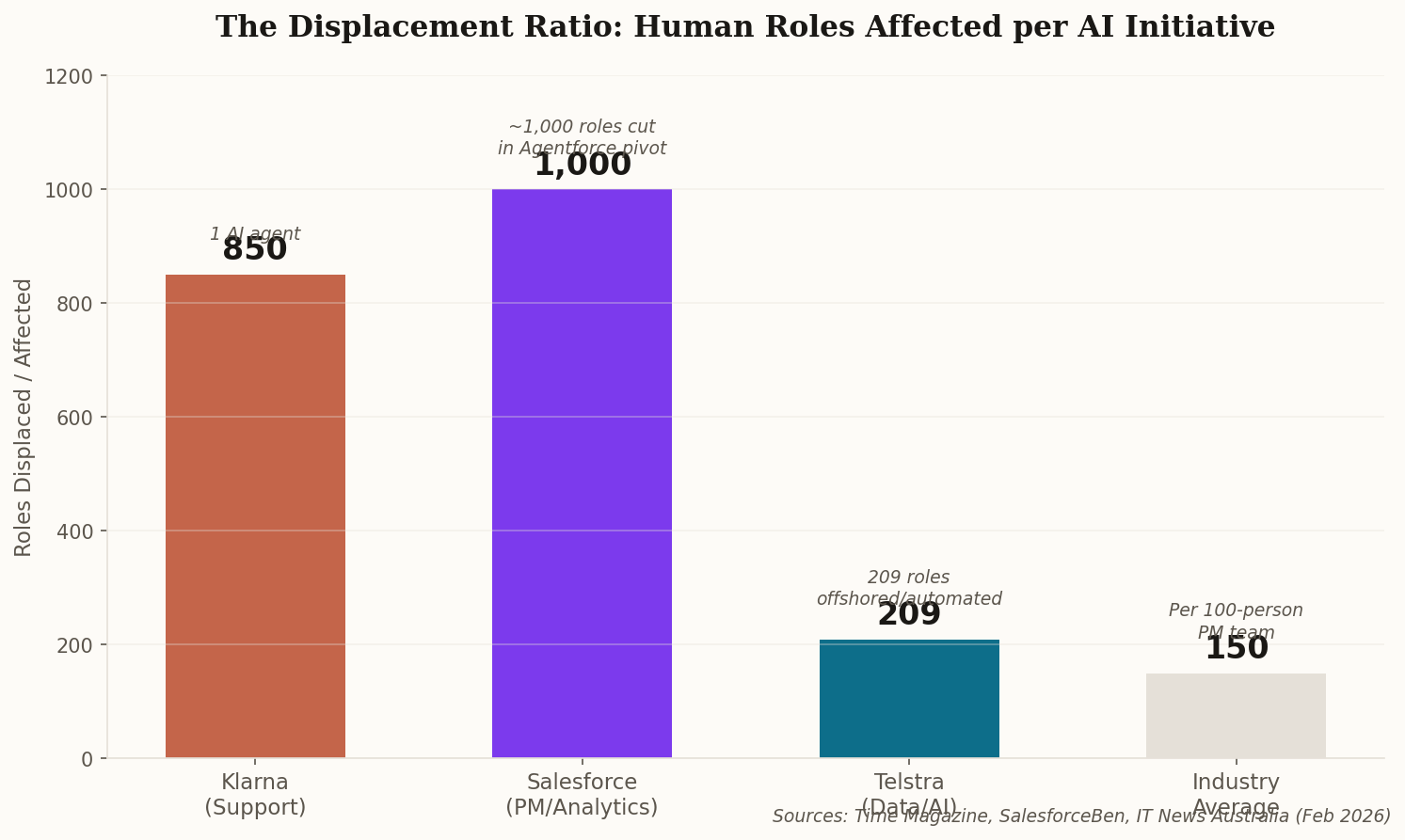
Salesforce laid off roughly 1,000 people across product management, marketing, and data analytics. The cuts landed squarely on the team behind Agentforce, the company's autonomous AI agent platform. Think about that irony for a second: the people building the AI agent platform got displaced by an "efficiency-first" mandate to rely more on AI agents.

The company's statement was boilerplate restructuring language: "We are sharpening our focus on our biggest priorities." But the subtext is sharp. Salesforce isn't cutting because Agentforce failed—they're cutting because it's working. When your own product automates the workflows your own employees manage, the headcount math changes fast.

Bar chart comparing human roles displaced per AI initiative across Klarna, Salesforce, and Telstra
The displacement ratio varies by context, but the direction is consistent: AI initiatives are measurably reducing headcount in operational roles. Sources: Time Magazine, SalesforceBen, IT News Australia (Feb 2026).

This is the template that other enterprise companies will follow in 2026. Not "we're replacing PMs with AI" but "we're restructuring for efficiency" while quietly absorbing PM-adjacent work into agent workflows. If your job is primarily operating a tool rather than deciding what to build, the writing is on the wall—and Salesforce just made it bold.

03
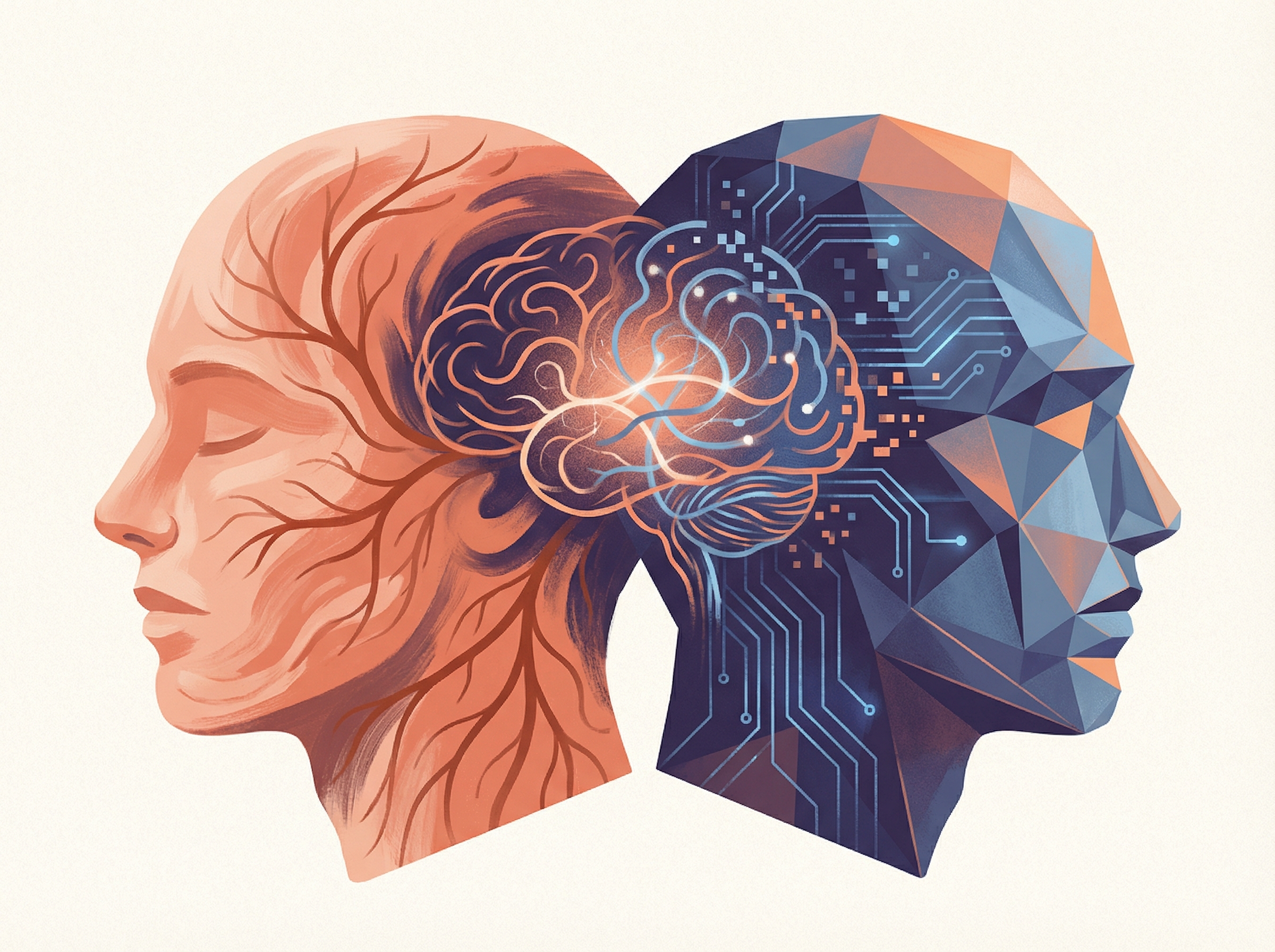
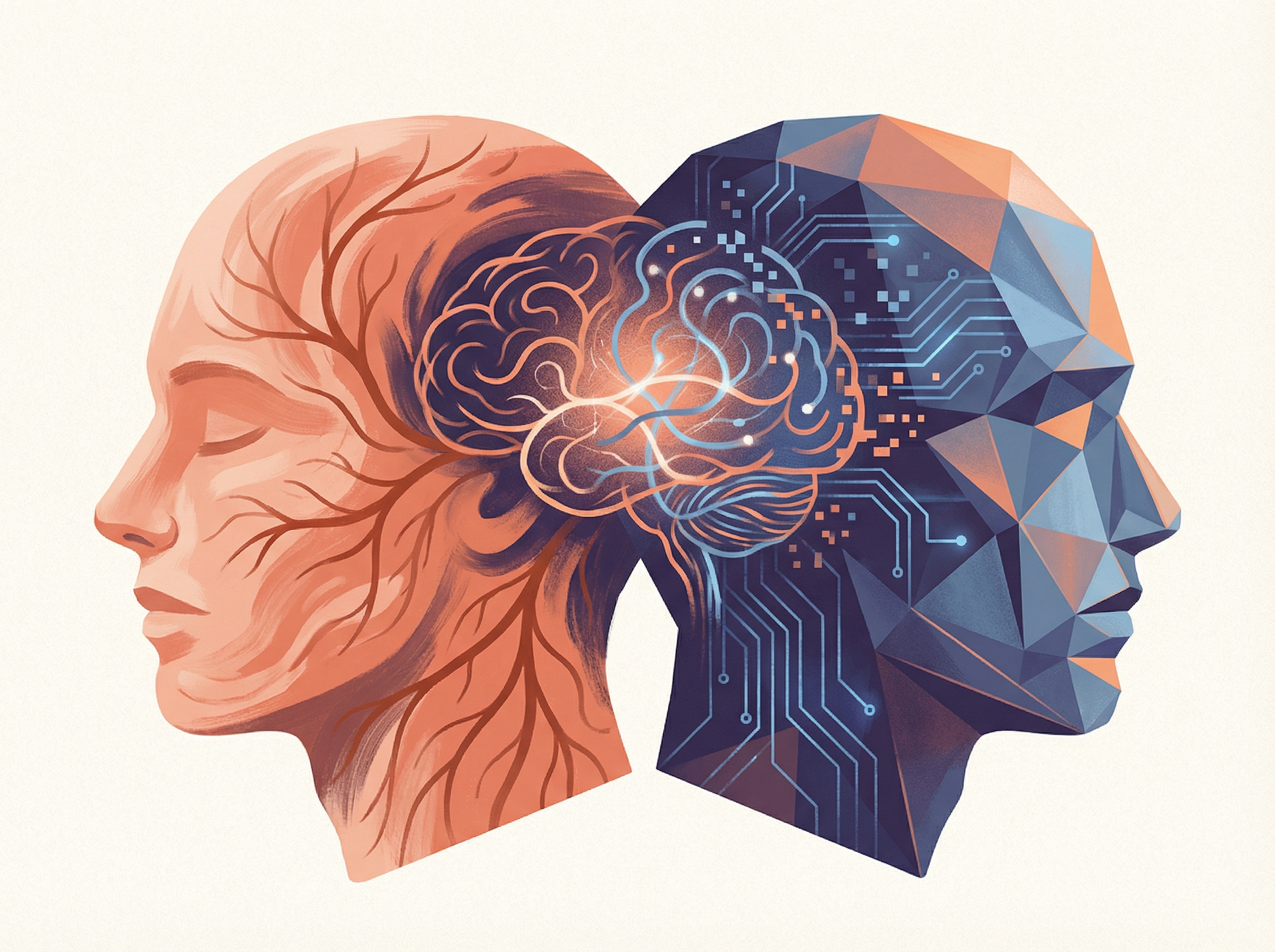
Two minds merging, one organic and one digital, representing the fusion of human intuition and AI literacy

Product Sense Now Requires a GPU

Marily Nika published the second part of her "Building AI Product Sense" series on Lenny's Newsletter, and it contains a detail that should make every PM interviewing at a FAANG company sit up: Meta has introduced a specific "Product Sense with AI" interview module. It's no longer a nice-to-have. It's a gate.

Her framework draws a line that matters: when should you use deterministic code versus probabilistic AI models? This is the new judgment call that separates senior PMs from the pack. A junior PM says "let's add AI." A senior PM says "this feature needs 99.9% accuracy, so we use rule-based logic here and ML only for the recommendation layer where 85% is acceptable." That's product sense in 2026—understanding that models are probabilistic systems with latency and cost trade-offs, not magic.

"In 2026, you cannot have product sense without understanding the probabilistic nature of the underlying models." — Marily Nika

What this means in practice: if you're a PM who hasn't spent real time working with model APIs, understanding token economics, or thinking about evaluation metrics beyond traditional product KPIs, you're interviewing with one hand tied behind your back. The bar moved, and it moved fast.

04
A single AI entity standing before hundreds of human silhouettes, representing the 1-to-850 ratio

One Bot, 850 Humans, Zero Sentimentality

Klarna CEO Sebastian Siemiatkowski stood on stage at the "Leading with AI Summit" and said the quiet part loud: Klarna's AI support agent now does the work of 850 human customer service representatives. His prediction? A significant portion of Klarna's workforce won't exist by 2030. Not because they'll be fired—they'll leave through attrition and simply won't be replaced.

"We are seeing attrition, and we are simply not replacing those roles because the AI is picking up the slack." That's the most honest description of how AI displacement actually works in 2026. It's not a dramatic mass layoff. It's the slow hollowing out of roles that used to require warm bodies.

For product managers specifically, the 850:1 ratio applies to support contexts, not product strategy. But here's the uncomfortable adjacent question: if an AI can handle 850 support conversations, how many PRDs, competitive analyses, and roadmap updates can it handle? The answer isn't 850, but it's a lot more than one. The operational leverage that AI gives individual PMs means companies need fewer of them, even if each remaining PM is more productive than ever.

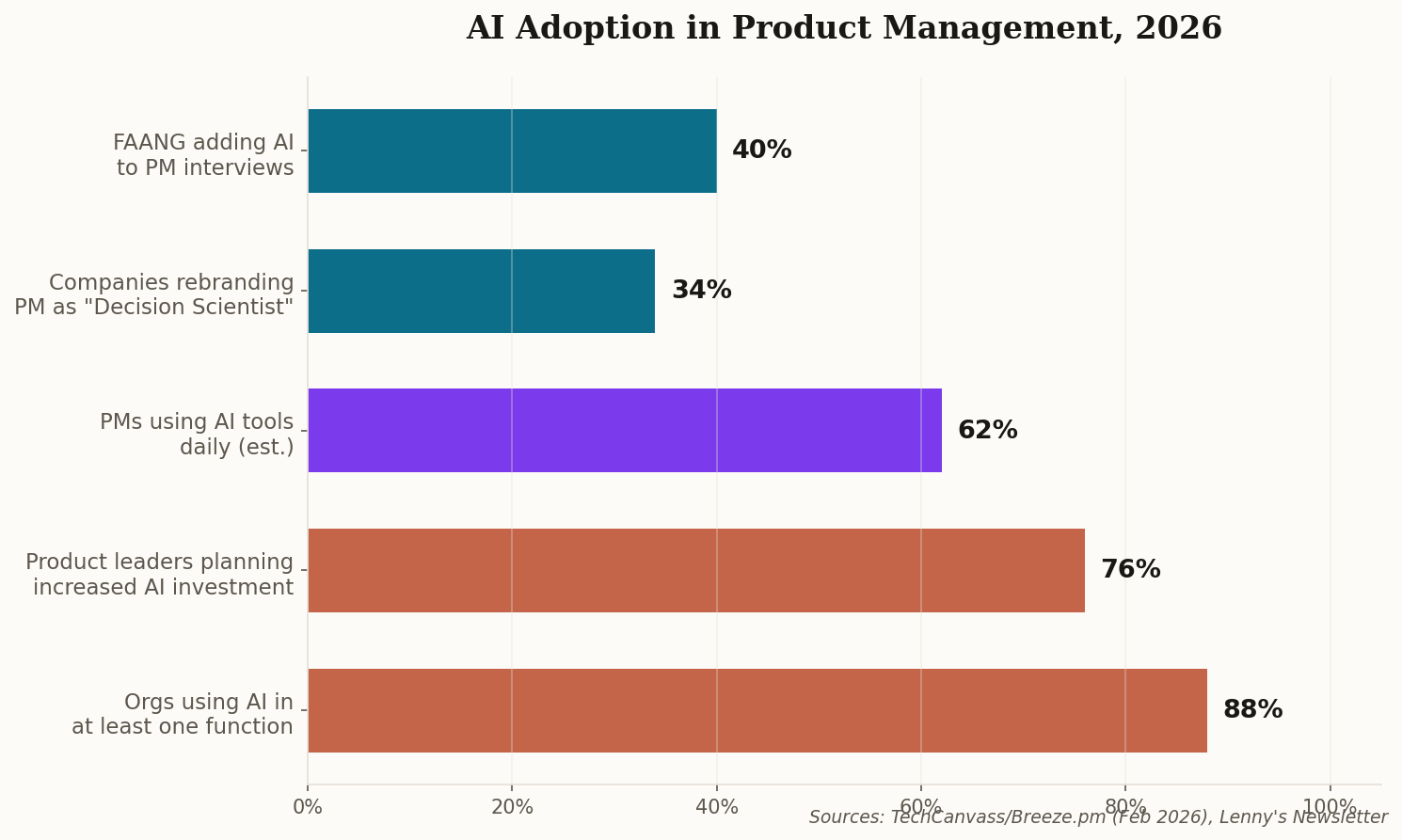
Horizontal bar chart showing AI adoption rates in product management functions
88% of organizations now use AI in at least one business function, with 76% of product leaders planning to increase AI investment specifically for product strategy. Sources: TechCanvass/Breeze.pm, Lenny's Newsletter (Feb 2026).
05
A microscope examining a product roadmap, symbolizing the PM-to-Decision-Scientist evolution

The Product Manager Is Dead. Meet the Decision Scientist.

A new industry report from TechCanvass and Breeze.pm makes a claim that would have been heresy two years ago: the "Generalist PM" who manages a backlog and writes user stories is fading. What's replacing them? The "Decision Scientist"—a PM who models outcomes, designs experiments, and makes high-stakes calls that AI can't.

The numbers support the thesis. According to the report, 88% of organizations now use AI in at least one business function, and 76% of product leaders expect to increase AI investment for product strategy in 2026. That's not a pilot program. That's an industry shift.

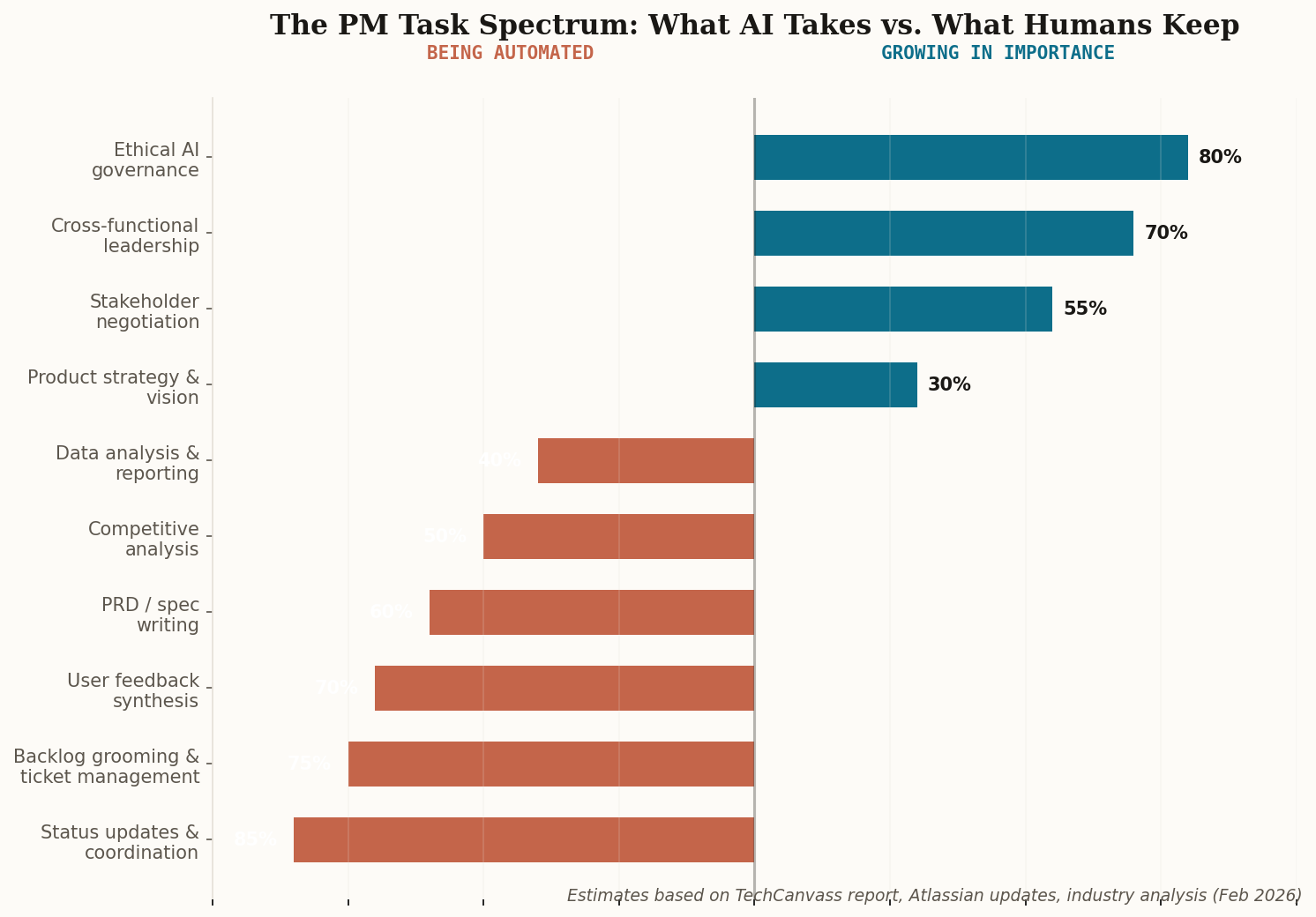
Diverging bar chart showing PM tasks being automated versus growing in importance
The PM task spectrum: mechanical work (status updates, backlog grooming, feedback synthesis) is being automated, while strategic work (stakeholder negotiation, ethical governance, cross-functional leadership) is growing. Estimates based on industry analysis, Feb 2026.

"The Product Manager of 2026 is less a 'clerk' of the backlog and more a 'decision scientist' for the business." — TechCanvass/Breeze.pm Report

I'll take a position here: the title change matters less than the skill change. Whether you call yourself a PM, a "Decision Scientist," or a "Strategic Product Lead," the question is the same. Can you do the work that AI can't? Can you sit in a room with a VP of Engineering, a CFO, and a customer advisory board and synthesize their competing needs into a decision? Can you tell a stakeholder no, with data, and hold the line? That's the job now. The rest is becoming someone else's algorithm.

06
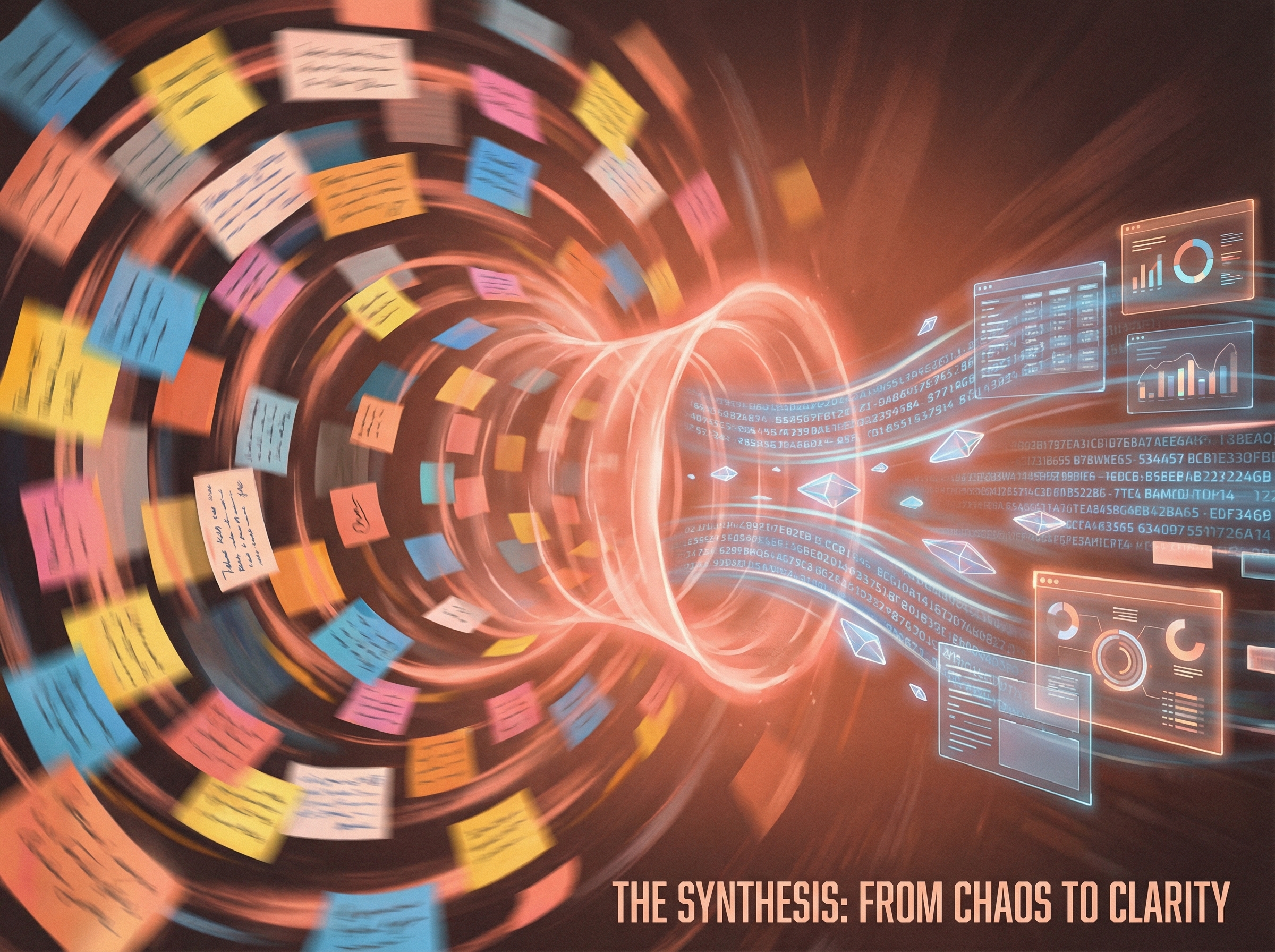
Sticky notes being swept into a vortex and transforming into structured data streams

Jira's AI Just Ate Your Feedback Synthesis Job

Atlassian updated Jira Product Discovery with their cross-product AI engine, Rovo. The update includes automated PRD generation from comment threads, and—here's the real weapon—automated feedback synthesis that turns thousands of customer comments into prioritized insights.

Let me be specific about what this automates. A mid-level PM at a B2B SaaS company might spend 8-10 hours per week reading support tickets, tagging feature requests, and building the case for roadmap priorities. Rovo does this in minutes. It synthesizes, it prioritizes, and with the integration of recently acquired Cycle, it pipes those insights directly into roadmap items.

The PMs I'd worry about here aren't the ones at startups who talk to five customers a week. It's the PMs at enterprises with 10,000+ users who relied on being the human funnel between customer feedback and engineering. That funnel just got replaced by a pipeline. The PMs who survive are the ones who add judgment on top of the synthesis—who can look at Rovo's output and say, "yes, but here's what the data doesn't show you."

07
A retail storefront viewed through an AI agent's augmented perspective with data overlays

Forget SEO. Now You Need Agent Optimization.

Klarna released an open standard called the "Agentic Product Protocol"—structured feeds for over 100 million products designed to make them discoverable not by humans, but by AI shopping agents. It integrates with Google's new "Universal Commerce Protocol." We're watching the birth of "Agent SEO."

This is a paradigm shift for product managers in e-commerce and beyond. For twenty years, PMs optimized for human eyeballs: conversion funnels, landing pages, A/B tested button colors. Now they need to optimize for AI agents that comparison-shop autonomously. The agent doesn't care about your hero image or your trust badges. It cares about structured metadata, competitive pricing accuracy, and fulfillment reliability scores.

Here's the "so what" for PMs outside of e-commerce: this pattern will expand. If you build a B2B SaaS product, your future "customer" might be an AI procurement agent evaluating your API documentation, pricing structure, and integration capabilities—without ever visiting your marketing site. Product discovery is being rewritten, and the PMs who understand this shift will build products that speak both languages: human and machine.

The Recompilation

The product manager isn't disappearing. The job description is. The coordination work, the status chasing, the feedback funneling, the PRD drafting—those are becoming features of the tools we already use. What remains is the hard, human, irreducible work: judgment under uncertainty, stakeholder negotiation, ethical governance of the AI systems we're deploying, and the ability to say "we're building the wrong thing" when everyone else is celebrating velocity. If that sounds like your job, you're fine. If it doesn't, the window to retool is measured in quarters, not years.