Drone Warfare

The $500 War

Expendable drones costing less than a used iPhone are destroying hundred-million-dollar weapons systems—and reshaping military strategy from Mariupol to the Pentagon.

Listen
Formation of military drones silhouetted against a dramatic twilight sky
01
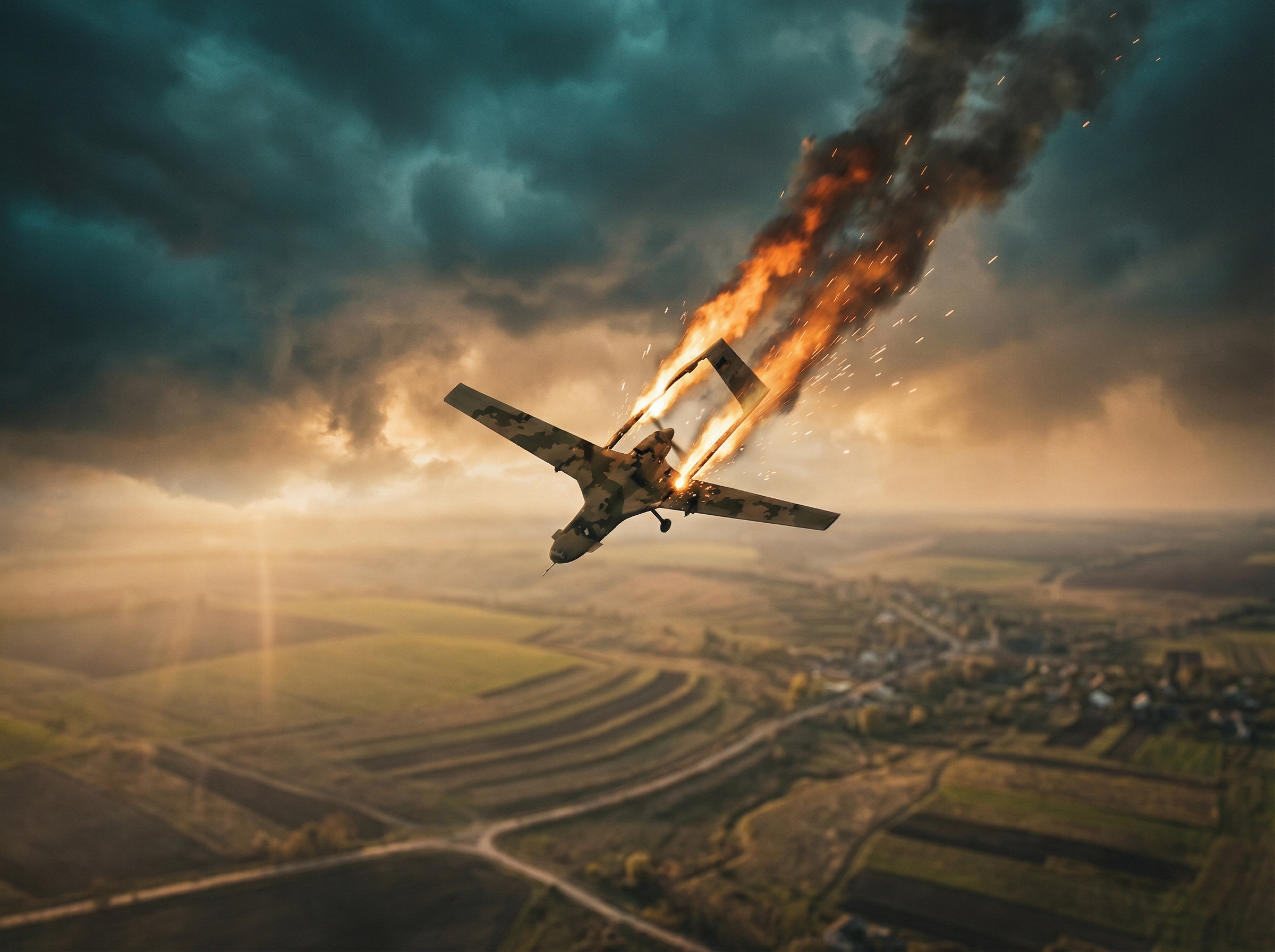
Surveillance drone falling through clouds trailing smoke over Ukrainian landscape

Ukraine Hunts Down Russia's Rarest Eye in the Sky

The war's asymmetric logic reached a new extreme this week when operators from Ukraine's Dnipro-1 Regiment tracked and destroyed a Russian "Knyaz Vishchyy Oleh" reconnaissance drone—one of the rarest and most valuable unmanned assets in Moscow's inventory. Confirmed with footage of the wreckage, this wasn't a lucky hit. It was a deliberate hunt.

Why this matters more than another combat clip: the Knyaz class provides the targeting data that directs Russian artillery and cruise missile strikes across hundreds of kilometers. Kill the eyes, and the fists swing blind. Ukraine's growing ability to find and eliminate high-altitude surveillance platforms represents a strategic capability that goes far beyond tactical drone-on-drone combat. It's forcing Russia to decide whether to risk increasingly scarce ISR assets or accept degraded situational awareness across entire front sectors.

The uncomfortable question for every military planner watching this war: if your adversary's most valuable reconnaissance platform can be hunted by a resourceful regiment with commercially available tools, what does that mean for the survivability doctrine you've built your entire force structure around?
02
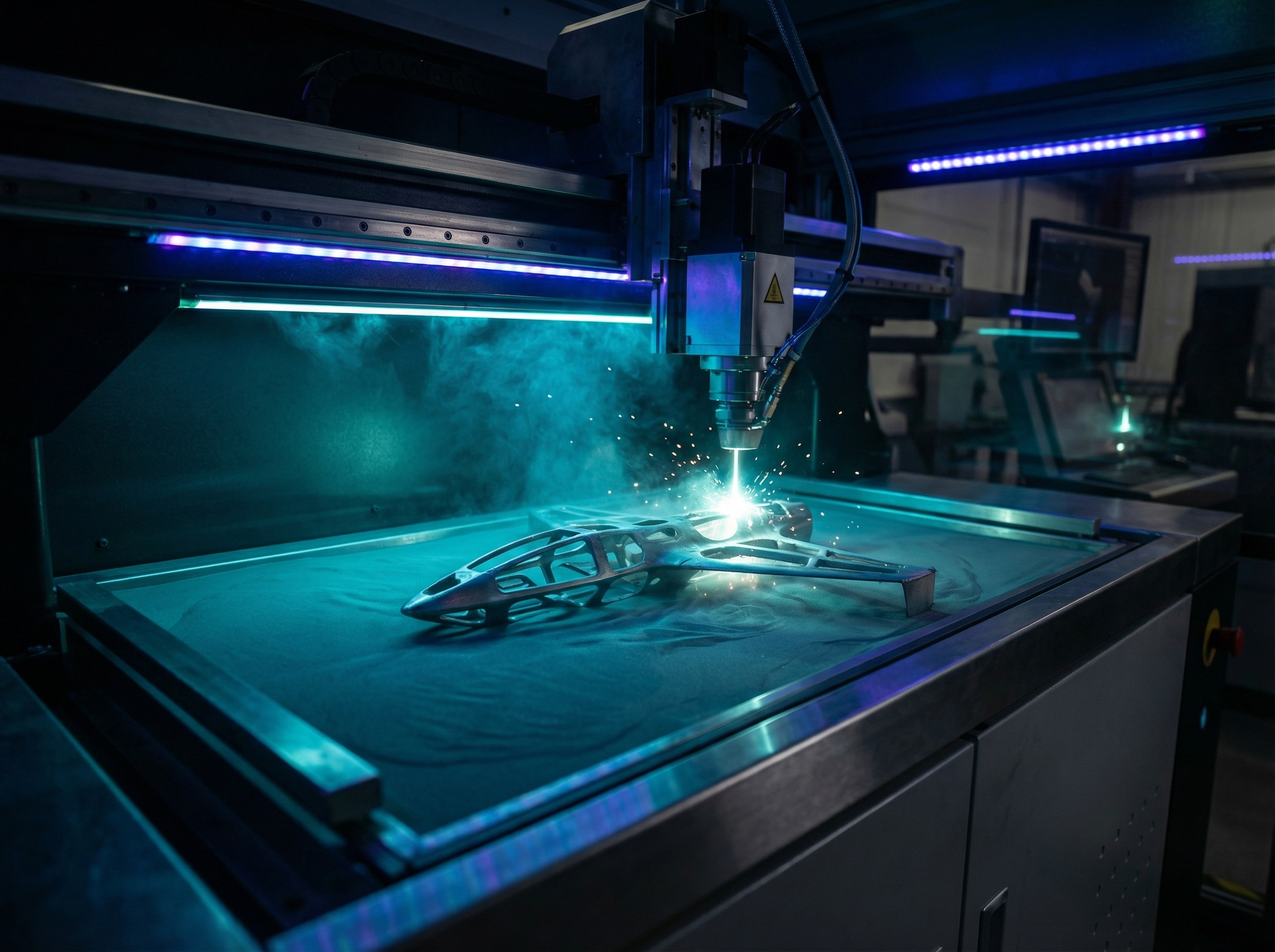
3D metal printer building a sleek military drone airframe

Seventy-One Days from Printer to Flight: Divergent Breaks the Production Barrier

Here's a number that should keep defense procurement officials up at night: 71 days. That's how long it took Divergent Technologies and Mach Industries to go from design file to a flying, military-grade strike drone they're calling "Venom." They didn't just build it fast—they 3D-printed the entire airframe using Divergent's proprietary digital production system.

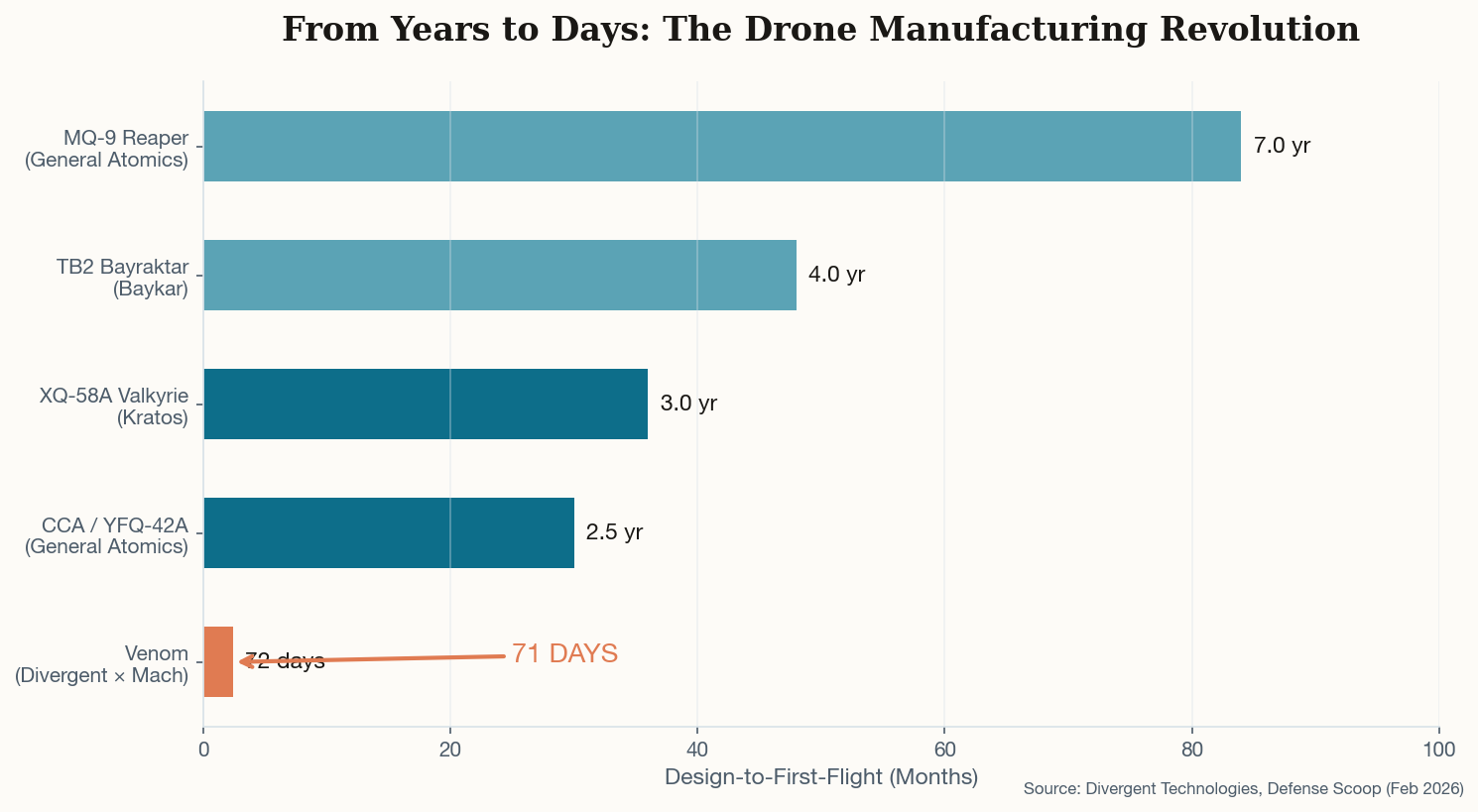
Chart comparing drone development timelines from 7 years for traditional programs down to 71 days for Divergent's Venom
Design-to-first-flight timelines across military drone programs. The Venom represents a 35x compression of the traditional development cycle.

To put this in context, the MQ-9 Reaper program took roughly seven years from concept to first flight. The CCA program, considered fast by Pentagon standards, is targeting 30 months. Divergent just compressed that cycle by a factor of 35. And because it's additive manufacturing, scaling production means adding printers, not building factories.

This directly addresses the central anxiety of American defense planners: that China can outproduce the US in an attritable drone war. If you can print airframes in weeks rather than build them in years, the production calculus changes fundamentally. The question isn't whether 3D-printed military drones will become standard—it's whether the Pentagon's acquisition bureaucracy can move fast enough to make it happen before it needs to.

03
Counter-drone interceptor deploying a capture net around a hostile quadcopter

The Pentagon's New Anti-Drone Weapon Is… a Net

Sometimes the most sophisticated solution is the simplest one. At a Hudson Institute event this week, Pentagon officials confirmed the first acquisition under "Replicator 2"—the counter-drone phase of the DoD's signature autonomous systems initiative. The purchase: AI-enabled Fortem Technologies "DroneHunter F700" interceptors that physically capture hostile drones in tethered nets.

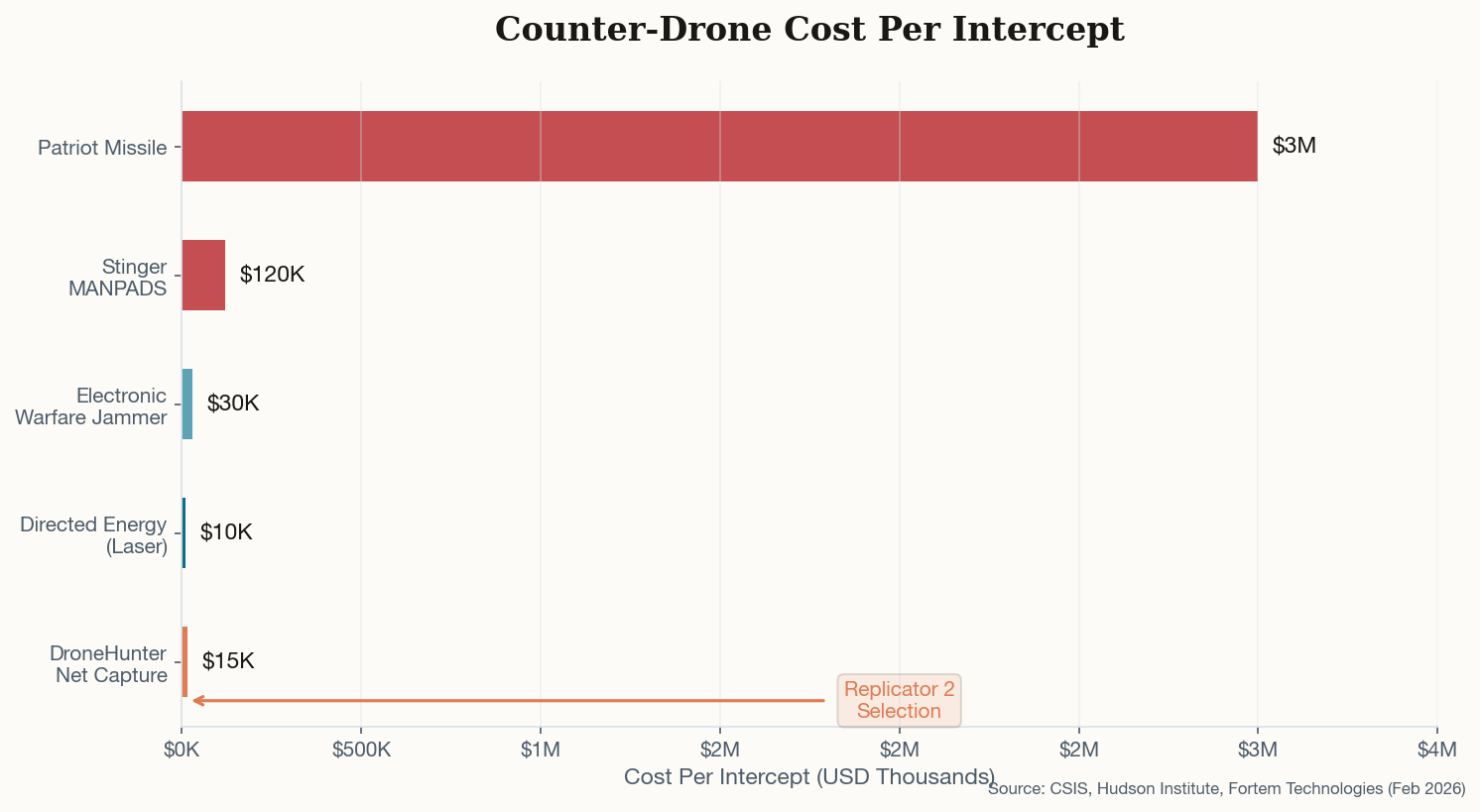
Chart comparing counter-drone intercept costs from $3M for Patriot missiles down to $15K for net capture systems
Cost per intercept across counter-drone methods. The Pentagon's Replicator 2 selection reflects a strategic shift toward affordable, reusable interception.

The math tells the story. Firing a $3 million Patriot missile at a $500 drone is the definition of losing a war of attrition. Even Stinger missiles, at $120,000 per shot, create an unsustainable cost exchange. Electronic warfare jammers are cheaper per engagement but don't work against autonomously navigating drones. The DroneHunter's net approach runs about $15,000 per intercept, the net and drone are reusable, and it works regardless of the target's guidance method.

This signals that the US military has internalized the lesson Ukraine is teaching in real time: you cannot defend against mass drone attacks with premium munitions. The counter-drone problem demands solutions that are as cheap and scalable as the threat itself. Nets aren't glamorous. They work.

04
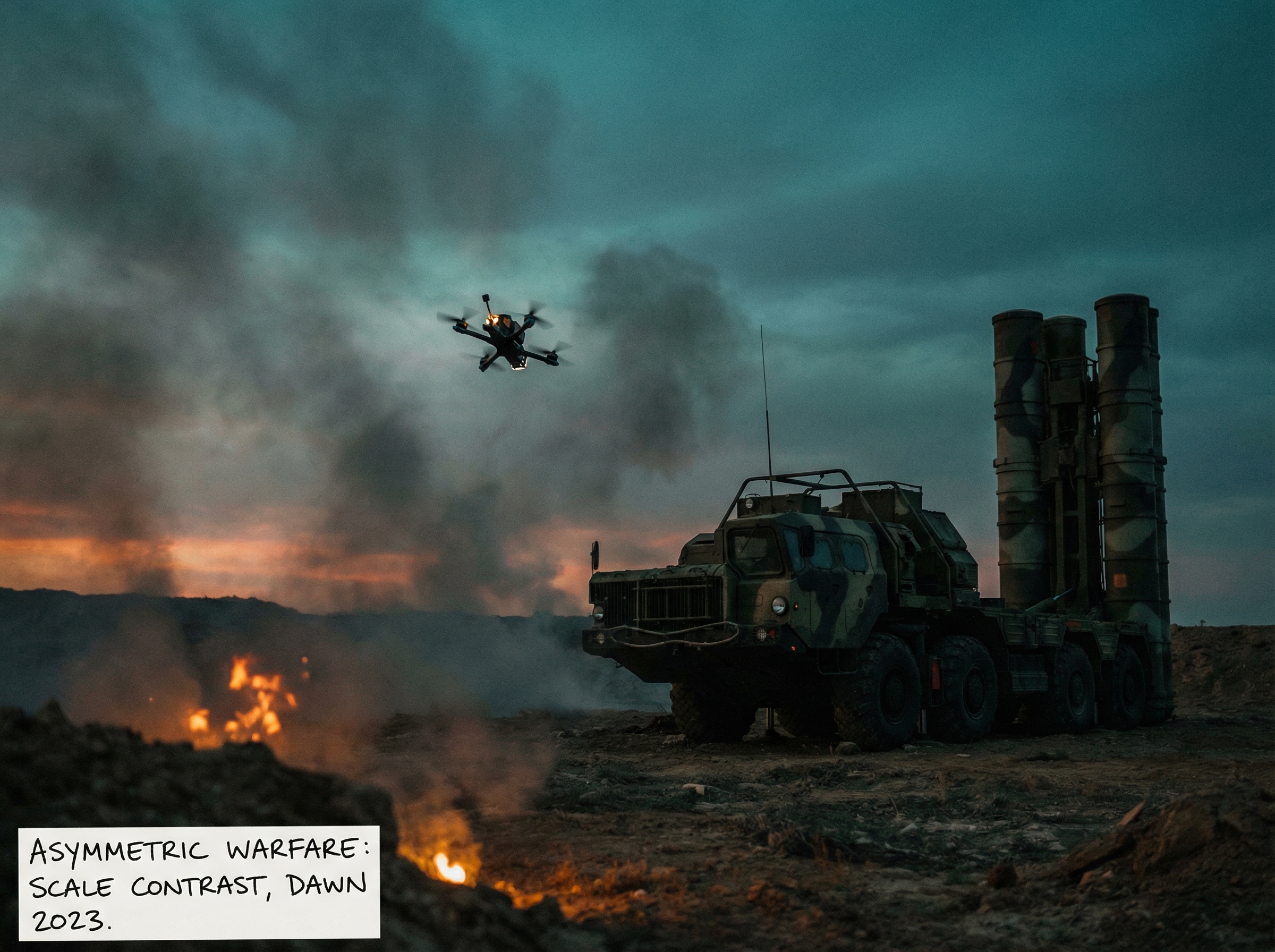
Dramatic scale contrast between a tiny FPV drone and a massive missile launcher

A Racing Drone Just Killed a $100 Million Missile System

Near occupied Mariupol, a Ukrainian drone strike destroyed a launcher for the S-300VM "Antey-2500"—a strategic anti-ballistic missile system designed to intercept cruise missiles and ATACMS. The weapon that killed it was almost certainly an FPV drone that costs somewhere between $500 and $2,000.

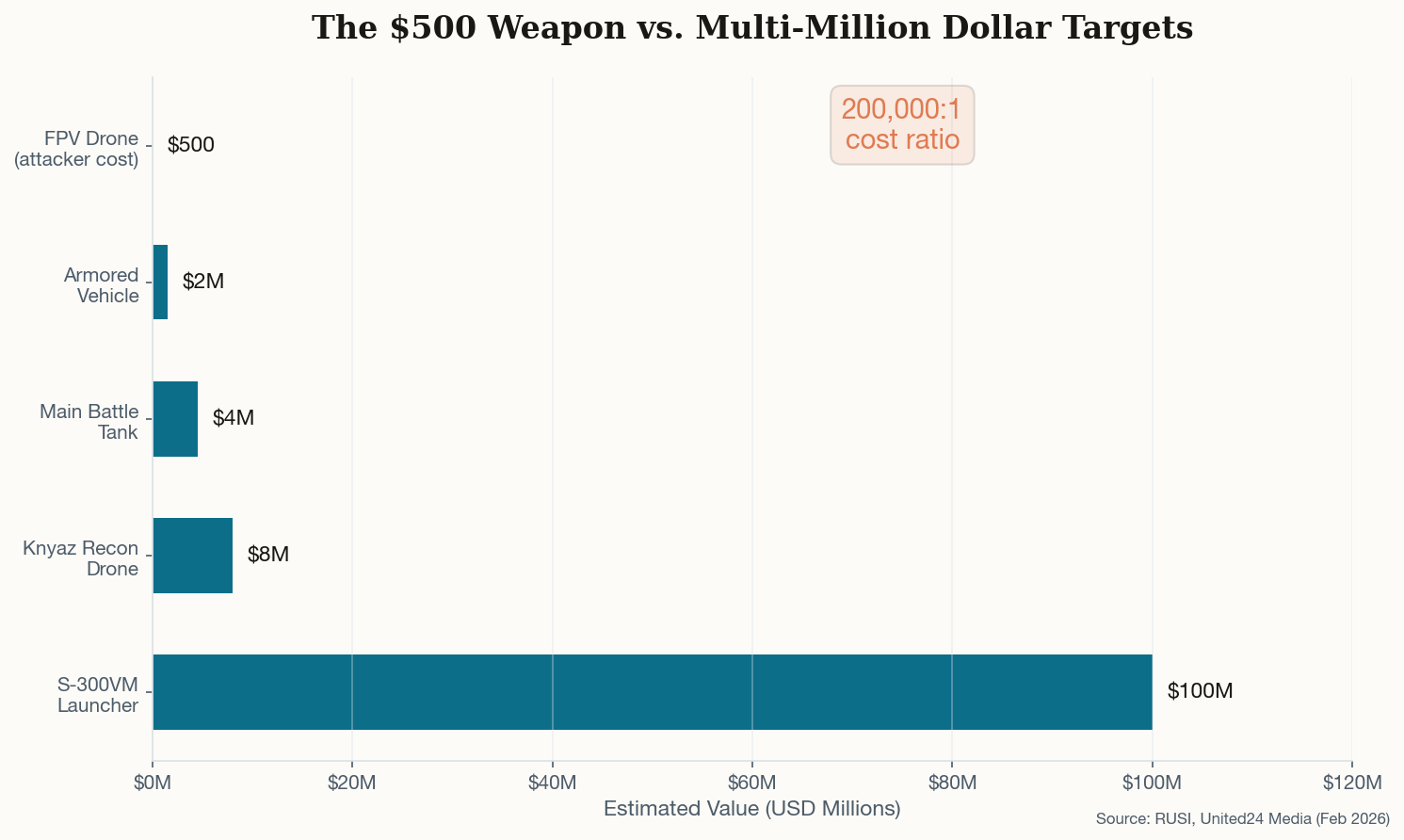
Chart showing 200,000:1 cost ratio between FPV drones and their targets
The economics of asymmetric drone warfare. A single FPV drone costing $500 can destroy targets worth 200,000 times its price.

The cost ratio here approaches 200,000:1. But the strategic impact goes beyond money. The S-300VM is one of Russia's most capable air defense systems—scarce, difficult to replace, and essential for protecting against Western-supplied long-range precision munitions. Every S-300VM launcher destroyed by a $500 drone opens the door wider for ATACMS, Storm Shadow, and SCALP strikes against deeper Russian targets.

This is the feedback loop that's reshaping the entire conflict: cheap drones destroy expensive air defenses, which enables precision strikes against high-value targets, which forces the defender to either spread remaining air defense assets thinner or accept gaps in coverage. It's a death spiral that no amount of industrial capacity can easily reverse once it starts.

05
Large carrier drone releasing a swarm of smaller FPV attack drones

Russia's Mothership Gambit: Carrier Drones Now Deploying FPV Swarms Deep Behind Lines

Russia just solved one of the FPV drone's biggest limitations: range. According to the Kyiv Independent, Moscow has begun deploying large "mothership" drones that carry smaller FPV strike drones deep behind Ukrainian lines before releasing them. It's a carrier-based aviation concept scaled down to expendable robotics—and it's working.

The twist that makes this particularly clever: the deployed FPVs are increasingly controlled via Ukrainian LTE mobile networks, using commercial SIM cards to navigate and receive targeting data. Russia is effectively hijacking Ukraine's own civilian telecommunications infrastructure as a weapons guidance system. Ukraine is now considering a ban on anonymous SIM card sales—a civilian policy change driven entirely by a military drone tactic.

This represents a genuine doctrinal evolution. The mothership approach extends the effective range of cheap FPV drones from a few kilometers to potentially dozens, while the LTE control method means they don't need dedicated radio links that can be jammed. The defender now faces a choice between disrupting their own communications network or accepting that drone strikes can reach areas previously considered safe rear echelons. Neither option is good.

06
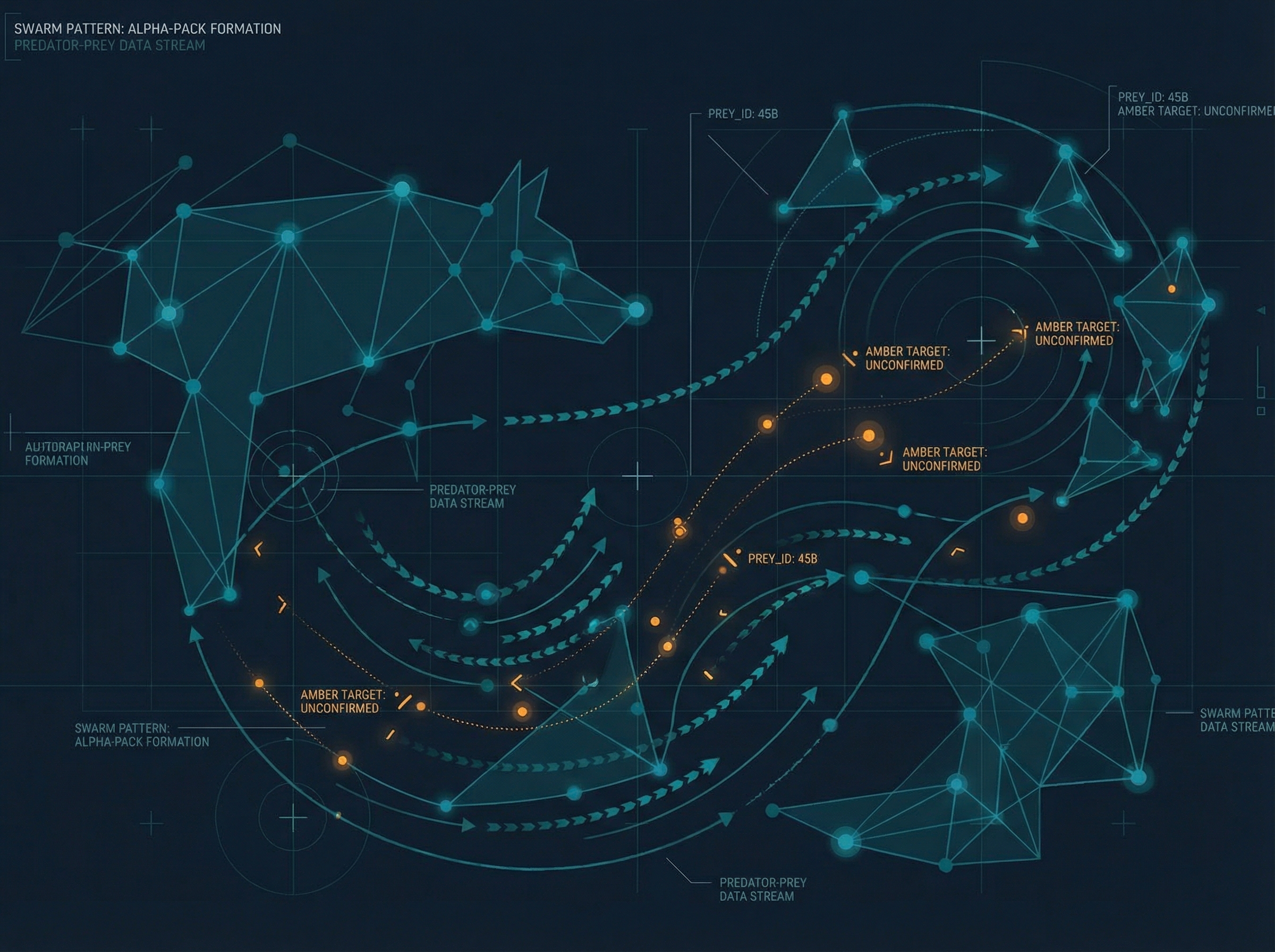
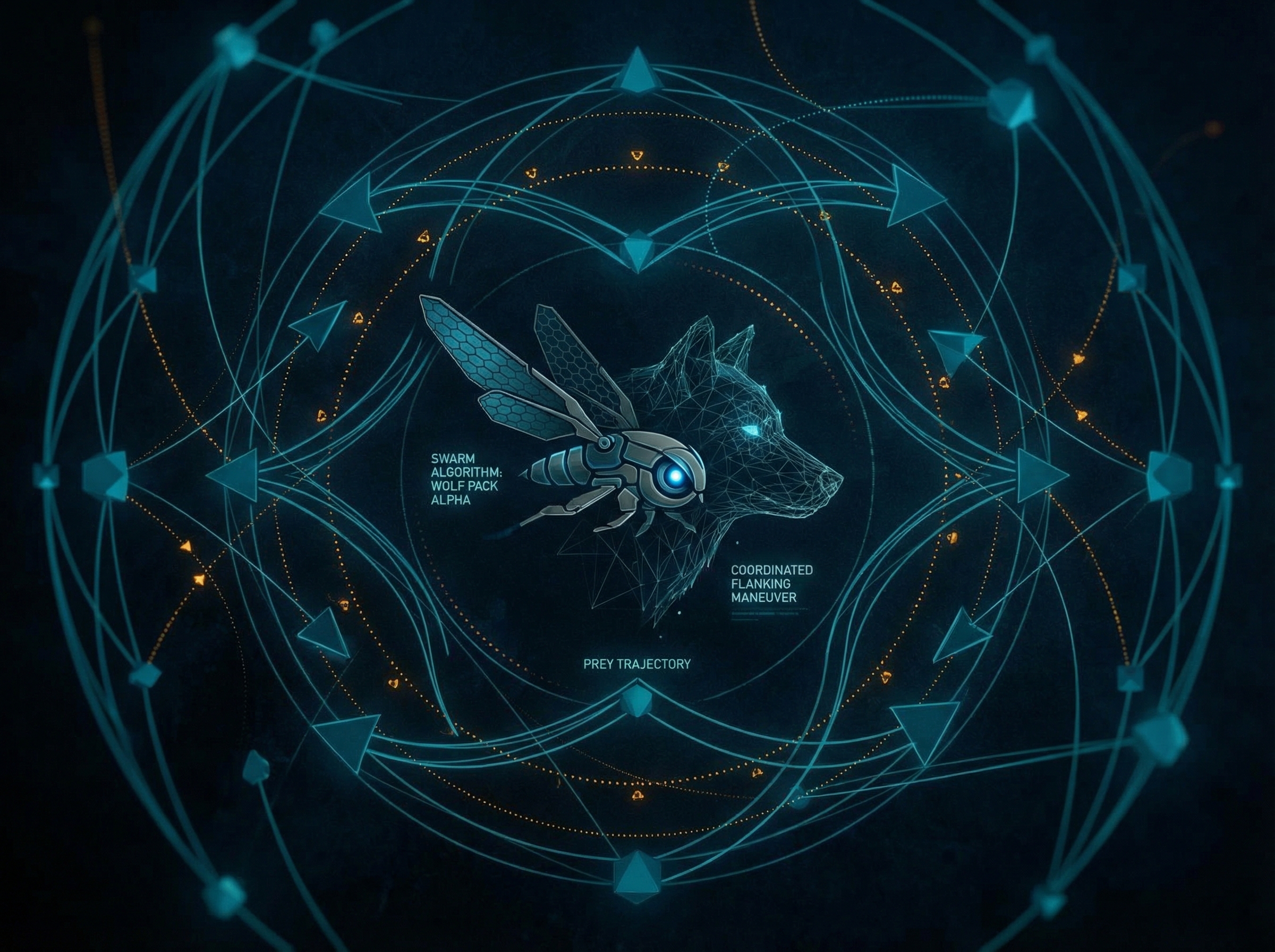
Abstract visualization of wolf pack formations translated into drone swarm patterns

Wolves in the Sky: China's Bio-Inspired Swarm AI Hunts in 6 Seconds

While the West debates procurement timelines, researchers at Beihang University—one of China's premier aerospace institutions with deep PLA ties—have been studying how wolves and hawks hunt. Not for zoological curiosity, but to teach autonomous drone swarms how to kill.

The results are sobering. In simulations, "hawk-trained" autonomous attack swarms neutralized "dove-modeled" defensive swarms in under 6 seconds. The AI learned predator-prey dynamics—flanking, encirclement, coordinated pursuit—and applied them to drone-on-drone combat without human intervention. No communication latency. No operator fatigue. No hesitation.

This research sits at the intersection of two trends that should concern Western defense planners. First, China's well-documented ability to produce vast quantities of cheap drones. Second, their accelerating work on the autonomous coordination software that turns a swarm from a collection of individual platforms into a single intelligent weapon system. The combination—mass quantity plus collective intelligence—is precisely the scenario that current Western counter-drone systems are least prepared for. Six seconds isn't a response time most human operators can match.

07
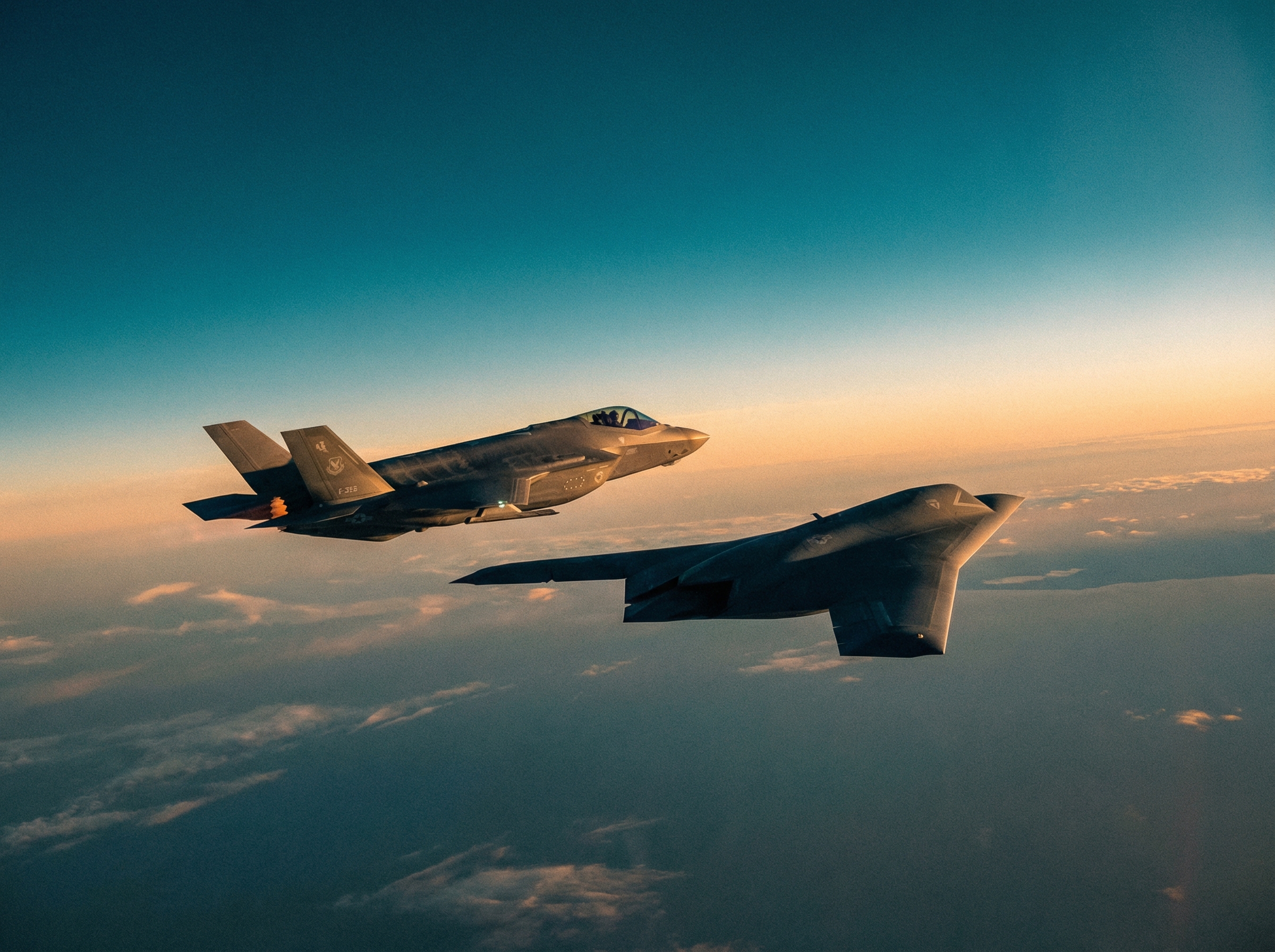
Stealth autonomous wingman drone flying alongside a manned fighter jet

The Loyal Wingman Learns to Think: General Atomics' CCA Passes Its Autonomy Test

General Atomics' YFQ-42A prototype for the Air Force's Collaborative Combat Aircraft program just completed a 4-hour semi-autonomous flight that successfully tested Collins Aerospace's "Sidekick" mission autonomy software. What makes this more than another test milestone: the flight validated the Air Force's "Autonomy Government Reference Architecture" (A-GRA), an open standard that decouples the AI brain from the airframe body.

In practical terms, this means the same autonomy software can run on different manufacturers' drones—or different software can run on the same drone—without expensive, time-consuming integration work. It's the USB standard applied to autonomous combat aircraft. The Air Force deliberately designed this to prevent vendor lock-in and enable rapid capability updates.

The CCA program envisions fleets of autonomous "wingmen" flying alongside manned fighters, absorbing risk and extending the reach of human pilots. At a target unit cost roughly one-quarter of an F-35, they're designed to be attritable—valuable enough to be useful, cheap enough to be expendable. This test moves the program from theoretical promise to demonstrated capability, and the open architecture means the platform gets smarter with every software update rather than every hardware generation.

The Arithmetic of Attrition

Every story this week circles the same gravitational center: the economics of expendability. A $500 drone kills a $100 million missile system. A 71-day printer replaces a 7-year program. A net replaces a missile. The side that builds faster, cheaper, and smarter doesn't just win engagements—it makes the other side's entire force structure obsolete. The drone revolution isn't coming. It's here, and it's being stress-tested in real time across Ukrainian fields and Pentagon procurement offices alike. The question isn't whether your military needs to adapt. It's whether it can adapt before the math becomes irreversible.