History of Technology

The Accidental Masterpiece

How one professor's rage at ugly proofs built a typesetting system that conquered science—and refused to die for nearly fifty years.

Listen
Ancient mathematical manuscripts transforming into digital code, with glowing indigo mathematical symbols bridging parchment and screen
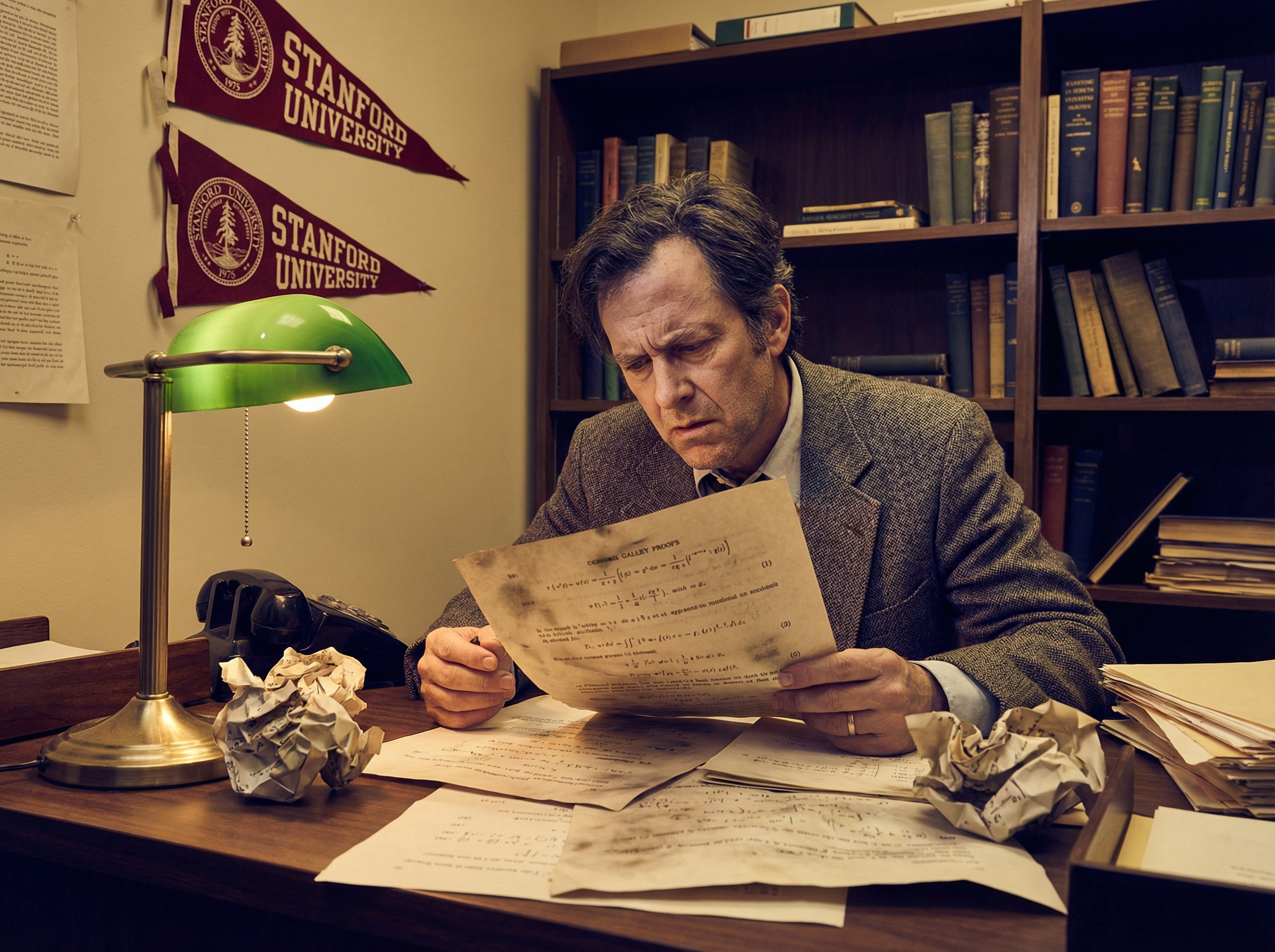
A professor examining typeset proofs under a desk lamp in a 1970s Stanford office
01

Knuth's Rage Against the Machine

In 1977, Donald Knuth received galley proofs for the second edition of The Art of Computer Programming and was, in his own word, "horrified." The publishing industry had just abandoned hot-metal Monotype machines for phototypesetting, and the results were ugly: distorted fonts, mangled subscripts, mathematical formulas that looked like they'd been set by someone who had never seen an equation. Knuth, a Stanford computer scientist with the aesthetic sensibilities of a Renaissance typographer, decided to fix the problem himself.

He thought it would take a few months. It took a decade.

What emerged was TeX—a system built on the "boxes and glue" model, where every character is a rectangular box and every space between them is stretchable glue. Where a normal word processor breaks lines one at a time (shoving the overflow to the next line like a careless bricklayer), TeX reads an entire paragraph and solves a global optimization problem to find the arrangement that minimizes ugliness across all lines simultaneously. The result is the eerily uniform "color" of a TeX page—that consistent grayness that typographers prize and most software can't achieve.

The first version, TeX78, was written in Stanford's SAIL language. But Knuth wasn't satisfied with portability, so he rewrote the entire system as TeX82 using his invention of literate programming—a methodology where the source code is the documentation, interleaved in the order a human would explain it. The resulting book, TeX: The Program, remains a masterclass in software engineering four decades later.

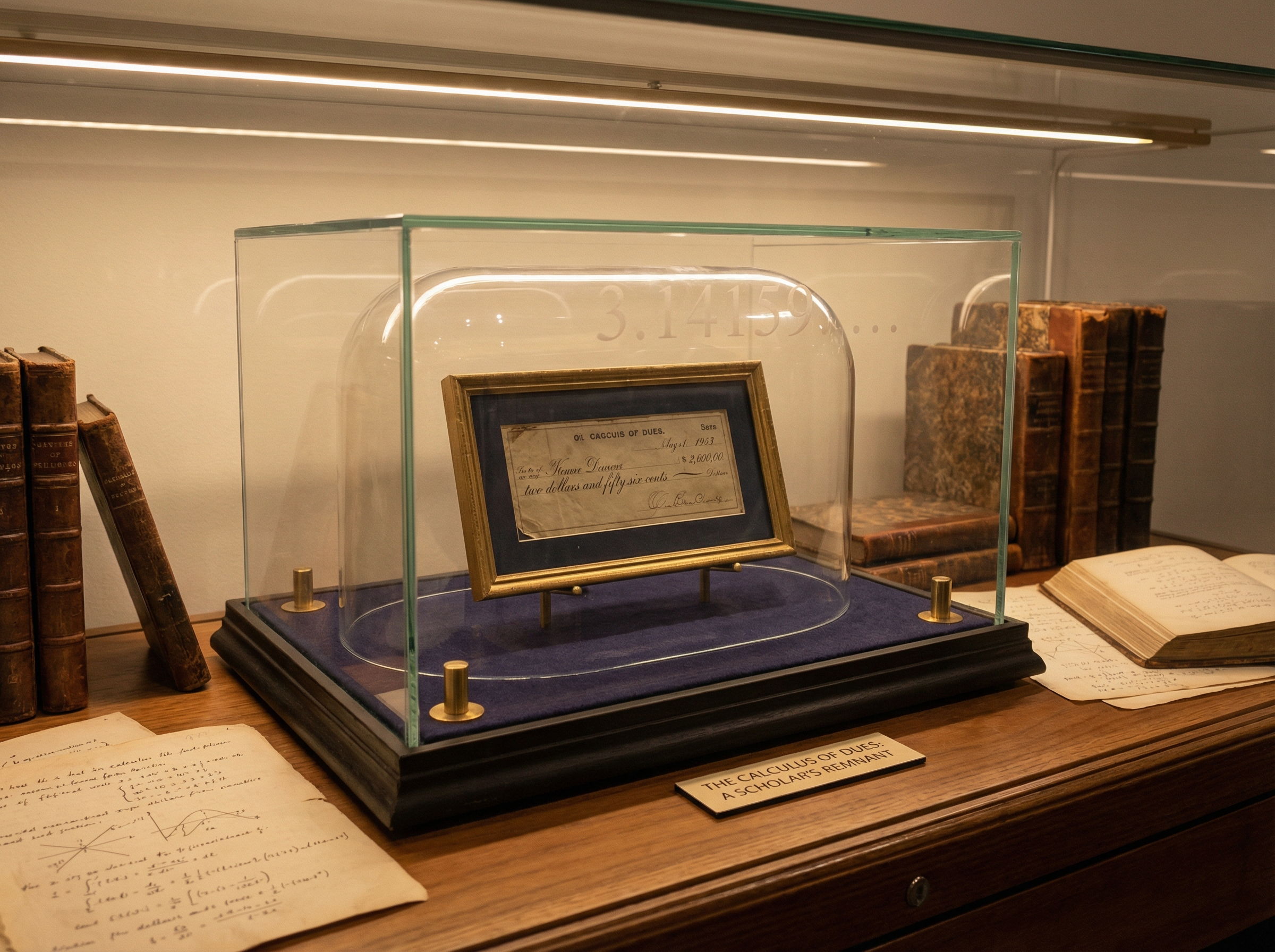
The $2.56 Check: Knuth offered a reward of $2.56 (one "hexadecimal dollar") for every bug found in TeX. The amount doubled each year. Almost no one cashed the checks—recipients framed them as trophies. In 2008, Knuth replaced physical checks with certificates from the fictional Bank of San Serriffe.

Layers of abstraction visualized as translucent architectural blueprints, from raw code to formatted documents
02

Lamport's Elegant Abstraction

TeX was a masterpiece of engineering, but using it felt like programming in assembly language. To start a chapter, you had to manually specify: skip down two inches, switch to 18-point bold, print the title, skip down one inch, switch back to 10-point roman. Leslie Lamport, a computer scientist at SRI International who would later win the Turing Award for his work on distributed systems, needed to write a book on concurrent programming. He liked TeX's output. He hated TeX's input.

Lamport's insight was the strict separation of logical structure from visual presentation. An author should never think about "18-point bold." They should say \chapter{Introduction} and let the software handle the rest. This philosophy—which anticipated CSS by over a decade—produced LaTeX (Lamport TeX), released around 1984.

LaTeX spread through academia like a benevolent virus. The initial version, LaTeX 2.09, defined the document classes millions of researchers still use: article, report, book. It provided automatic numbering for sections, equations, and figures. It handled cross-referencing with \label and \ref, saving authors from the nightmare of manually re-numbering citations every time a paragraph moved.

But success bred fragmentation. By the late 1980s, localized forks (GermanTeX, AASTeX, SLITeX) meant documents written in one version wouldn't compile in another. In 1989, the LaTeX3 Project—led by Frank Mittelbach alongside Chris Rowley and Rainer Schöpf—formed to reunify the ecosystem. Lamport handed them the keys. Their interim solution, LaTeX2e (1994), introduced the modular \usepackage system and was so robust it remains the standard version today, over 30 years later.

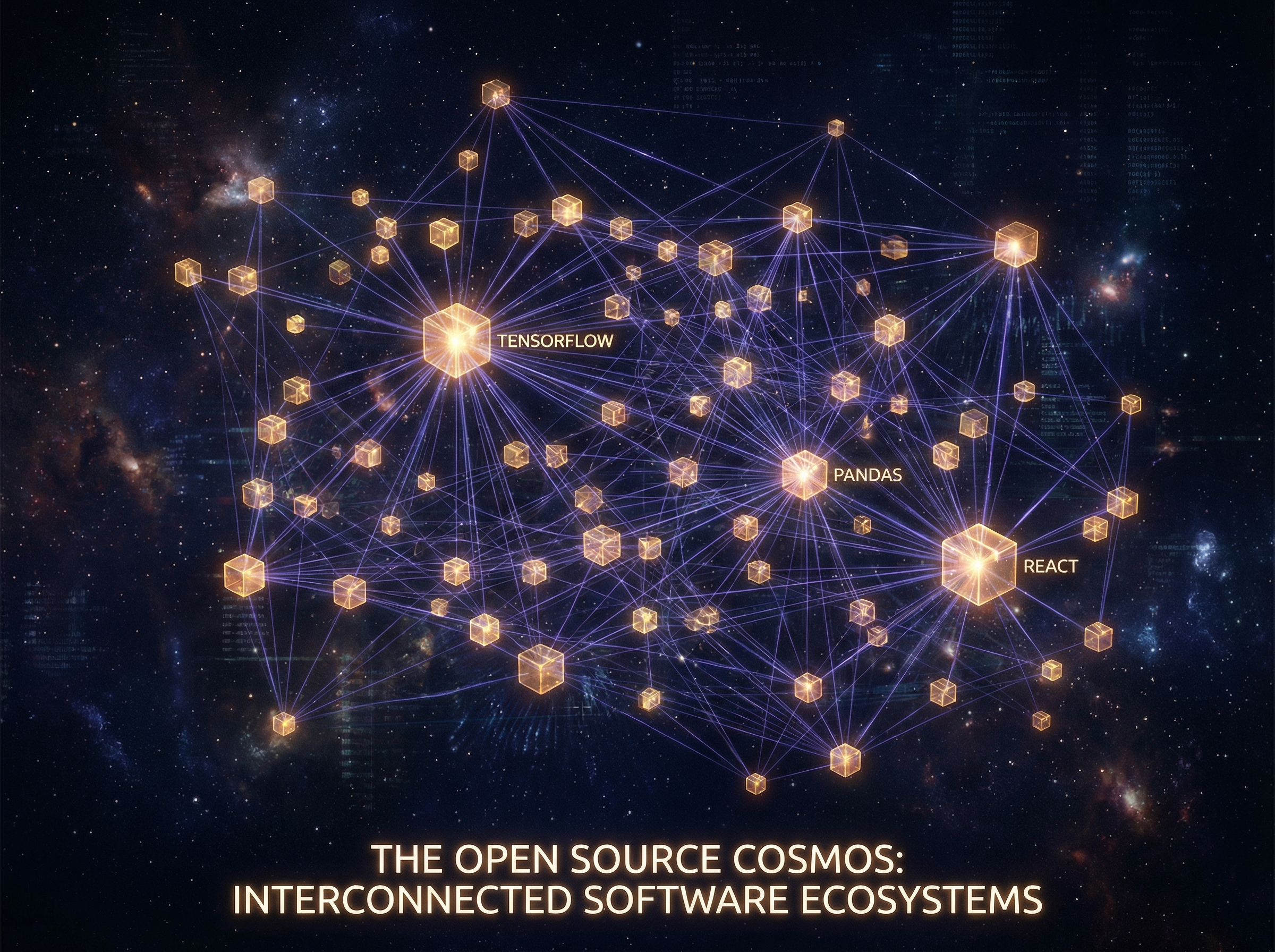
A constellation of glowing interconnected software packages floating in space
03

The Package Bazaar

The real power of LaTeX was never the kernel. It was the bazaar built around it.

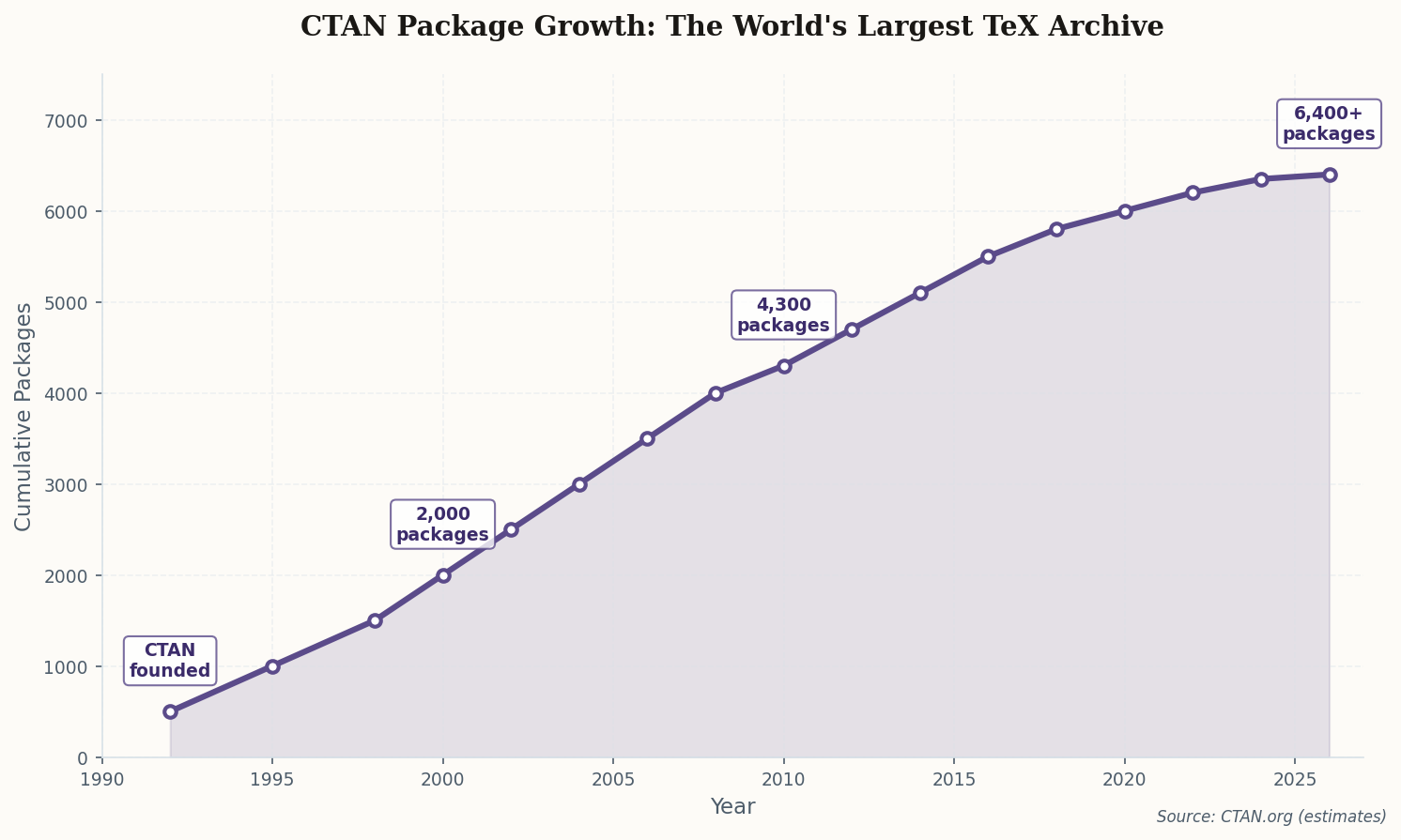
In 1992, at a meeting of the TeX Users Group in Portland, CTAN—the Comprehensive TeX Archive Network—was born. Think of it as npm for typesetting, a decade before npm existed. Before CTAN, finding a specific style file meant scouring FTP servers at random universities. After CTAN, the ecosystem had a spine. Today it hosts over 6,400 packages, from the essential to the gloriously niche.

Line chart showing CTAN package growth from 500 in 1992 to over 6,400 in 2026
CTAN's steady growth reflects a community that never stopped building. The curve flattened after 2015 as the ecosystem matured, but new packages still arrive weekly.

Five packages reshaped what LaTeX could do. amsmath (1994, from the American Mathematical Society) made professional mathematics possible. BibTeX (1985, by Oren Patashnik) separated bibliography data from presentation a decade before anyone called that pattern "separation of concerns." hyperref (1995, by Sebastian Rahtz) hacked deep into TeX internals to add clickable hyperlinks, dragging a print-era tool into the digital age. Beamer (2003, by Till Tantau) gave scientists presentations without PowerPoint. And TikZ (2005, also Tantau) let users draw publication-quality diagrams inside their documents, with fonts that perfectly match the surrounding text.

The result: an ecosystem where researchers could write, cite, diagram, present, and publish—all without leaving the LaTeX universe. Not because they were told to, but because each package genuinely solved a problem nothing else could.

Three glowing mechanical engine hearts representing pdfTeX, XeTeX, and LuaTeX
04

The Engine Wars

For its first two decades, TeX output a format called DVI (DeVice Independent)—a compact page description that needed conversion to PostScript before it could reach a printer. As PDF conquered the world, this two-step dance became increasingly awkward.

pdfTeX (1996) was the first revolution. Hàn Thế Thành, a Vietnamese computer scientist, built it as his PhD thesis at Masaryk University. It didn't just output PDF directly—it introduced micro-typographic features that made TeX output even more beautiful: margin kerning (nudging punctuation into the margins so text edges look straighter) and font expansion (imperceptibly widening or narrowing glyphs to improve line breaks). By the mid-2000s, pdfTeX was the default engine for most LaTeX users.

But pdfTeX inherited TeX's fatal limitation: it was an 8-bit system, handling only 256 characters. If you wrote in Chinese, Arabic, or even Greek, you needed painful workarounds. XeTeX (2004), created by Jonathan Kew, shattered that barrier. It was the first TeX engine with native Unicode support and direct access to OpenType fonts. Suddenly, \setmainfont{Times New Roman} just worked. The entire world's typographic heritage was accessible.

The third engine, LuaTeX (stable 1.0 in 2016), went further. Developed by Hans Hagen and Taco Hoekwater, it embedded the Lua scripting language directly into the TeX engine. Package developers could now intervene in the typesetting process while it was happening—manipulating boxes and glue programmatically, parsing JSON, or querying databases mid-render. It turned TeX from a fixed program into a programmable platform.

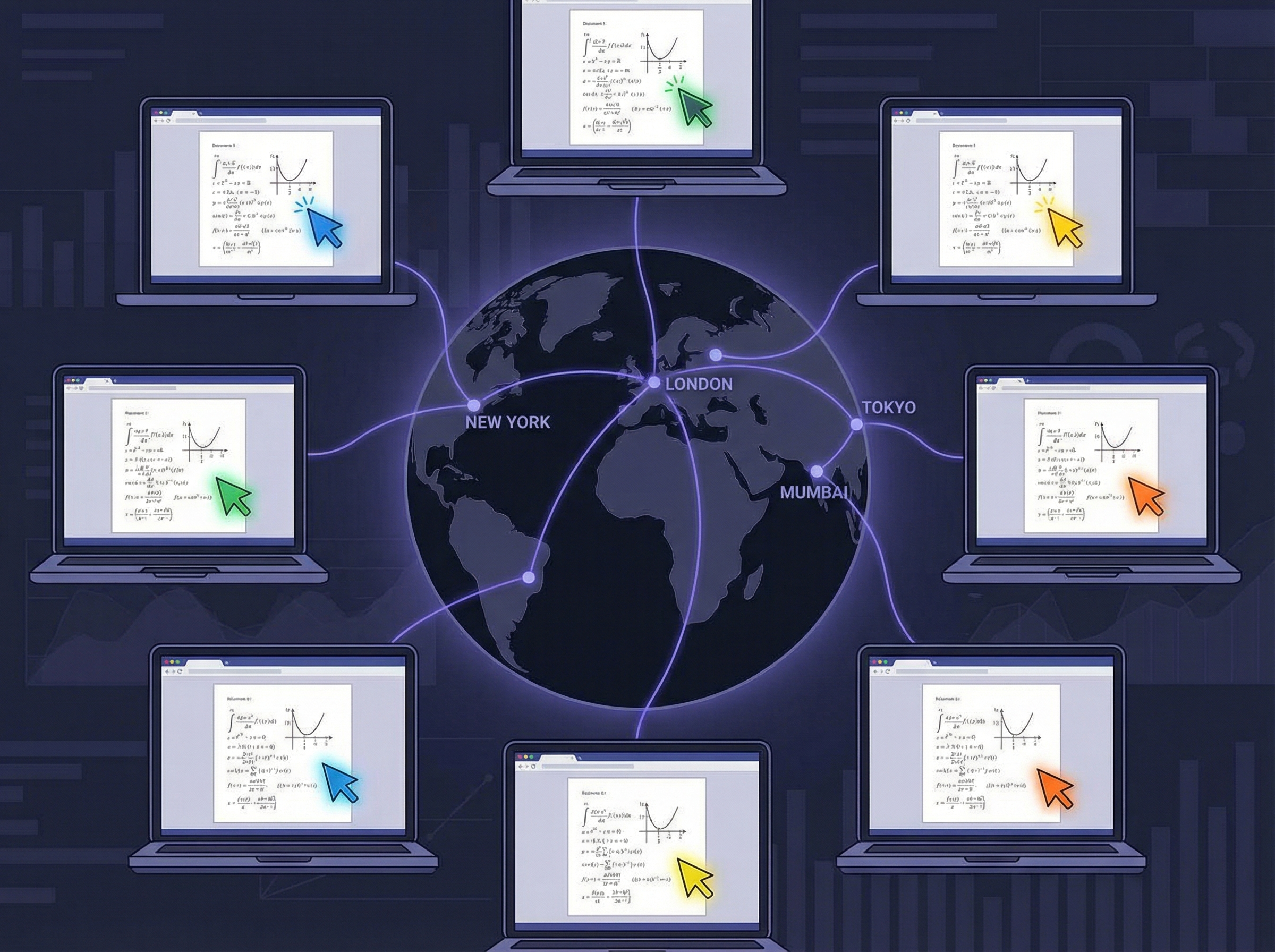
Multiple laptop screens showing collaborative document editing connected by luminous network lines across a globe
05

LaTeX Goes Online

For decades, the price of admission to LaTeX was a multi-gigabyte local installation, a tolerance for cryptic error messages, and the patience to compile and re-compile until the references sorted themselves out. It was a guild system: elders taught apprentices, and the uninitiated were left at the door.

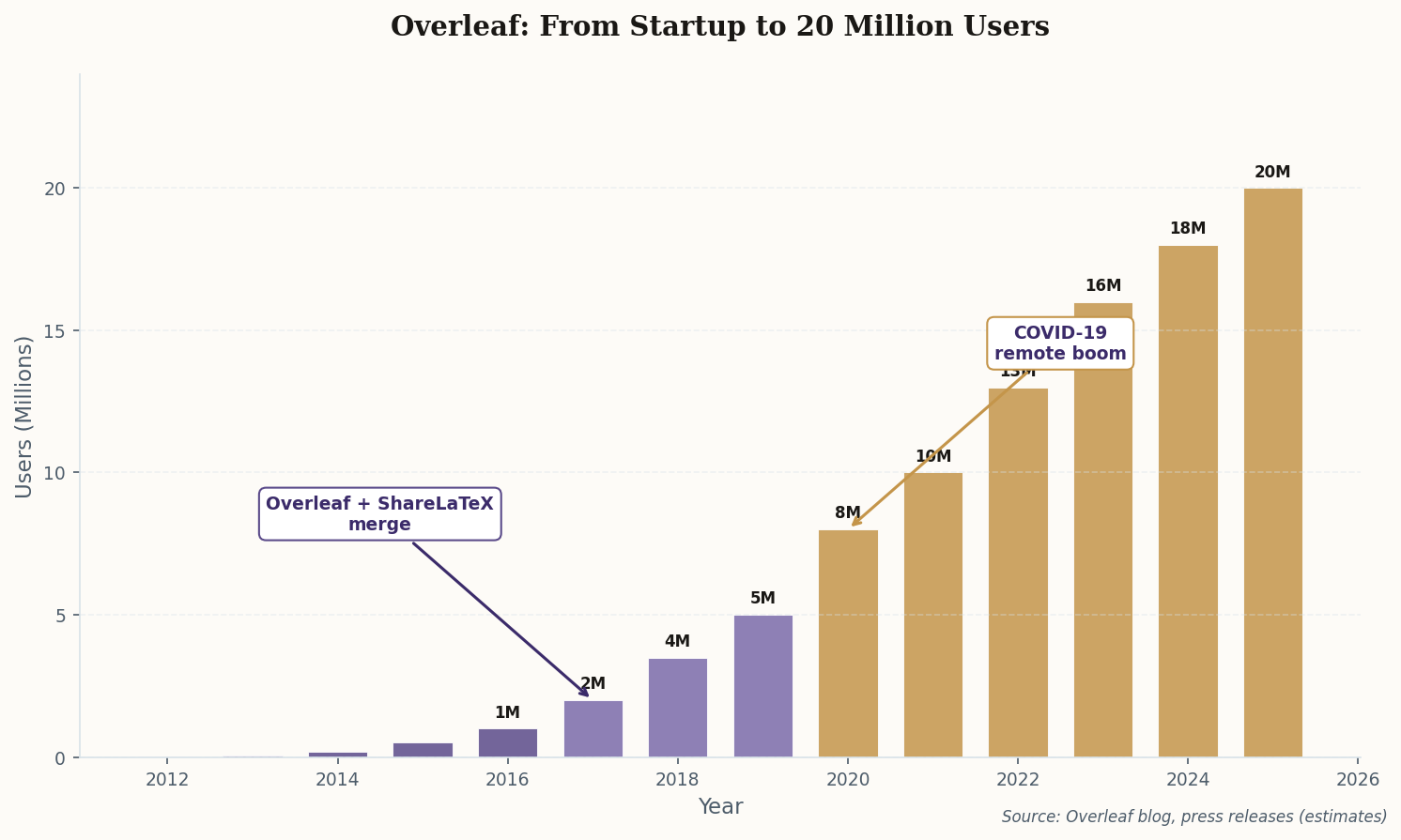
Overleaf blew the door off its hinges. Founded in 2012 as WriteLaTeX by mathematicians John Hammersley and John Lees-Miller, it offered what seemed impossible: LaTeX in a browser, with live preview, zero installation, and Google Docs-style real-time collaboration. A parallel effort, ShareLaTeX (founded by Henry Oswald), offered similar features. The two merged in 2017 under the Overleaf brand, and growth accelerated. By 2025, Overleaf reported over 20 million users.

Bar chart showing Overleaf's user growth from near zero in 2012 to 20 million in 2025
Overleaf's explosive growth, supercharged by the 2017 ShareLaTeX merger and the COVID-19 remote collaboration boom, brought LaTeX to millions who would never have installed TeX Live.

Meanwhile, arXiv—the preprint server founded at Los Alamos in 1991—locked LaTeX into the scientific infrastructure. Over 90% of mathematics and physics submissions to arXiv use LaTeX. To be read, you had to be on arXiv. To be on arXiv, you had to use LaTeX. It was a virtuous cycle that guaranteed LaTeX's dominance even as word processors improved.

The most significant recent challenge came from Typst, an open-source system written in Rust that entered public beta in March 2023. Typst compiles incrementally (changes render instantly), uses a modern scripting syntax, and produces error messages that humans can actually read. It's fast, elegant, and growing. But it faces the same problem every LaTeX competitor has faced for 40 years: LaTeX has 6,400 packages, 50 years of institutional inertia, and the entire arXiv ecosystem. Typst is a healthy competitor pushing LaTeX to innovate. It is not yet a replacement.

A framed check for $2.56 displayed like a museum artifact, surrounded by mathematical documents
06

The Immortal Typesetter

The culture of TeX is laced with delightful eccentricities. Start with the name: the "X" is actually the Greek capital letter Chi, so it's pronounced "tech," like the first syllable of "technology." LaTeX is "lah-tech" or "lay-tech." Pronouncing it "lay-tex" (like the rubber) is the mark of a novice—a shibboleth that has separated insiders from outsiders for four decades.

Then there's the version number. Knuth decreed that TeX's version would converge to π. The current version is 3.141592653. With every bug fix, another digit is added. When Knuth dies, the version will be set to π exactly, and any remaining bugs will be declared "features." It's software as finished art—a concept almost alien in the age of continuous deployment.

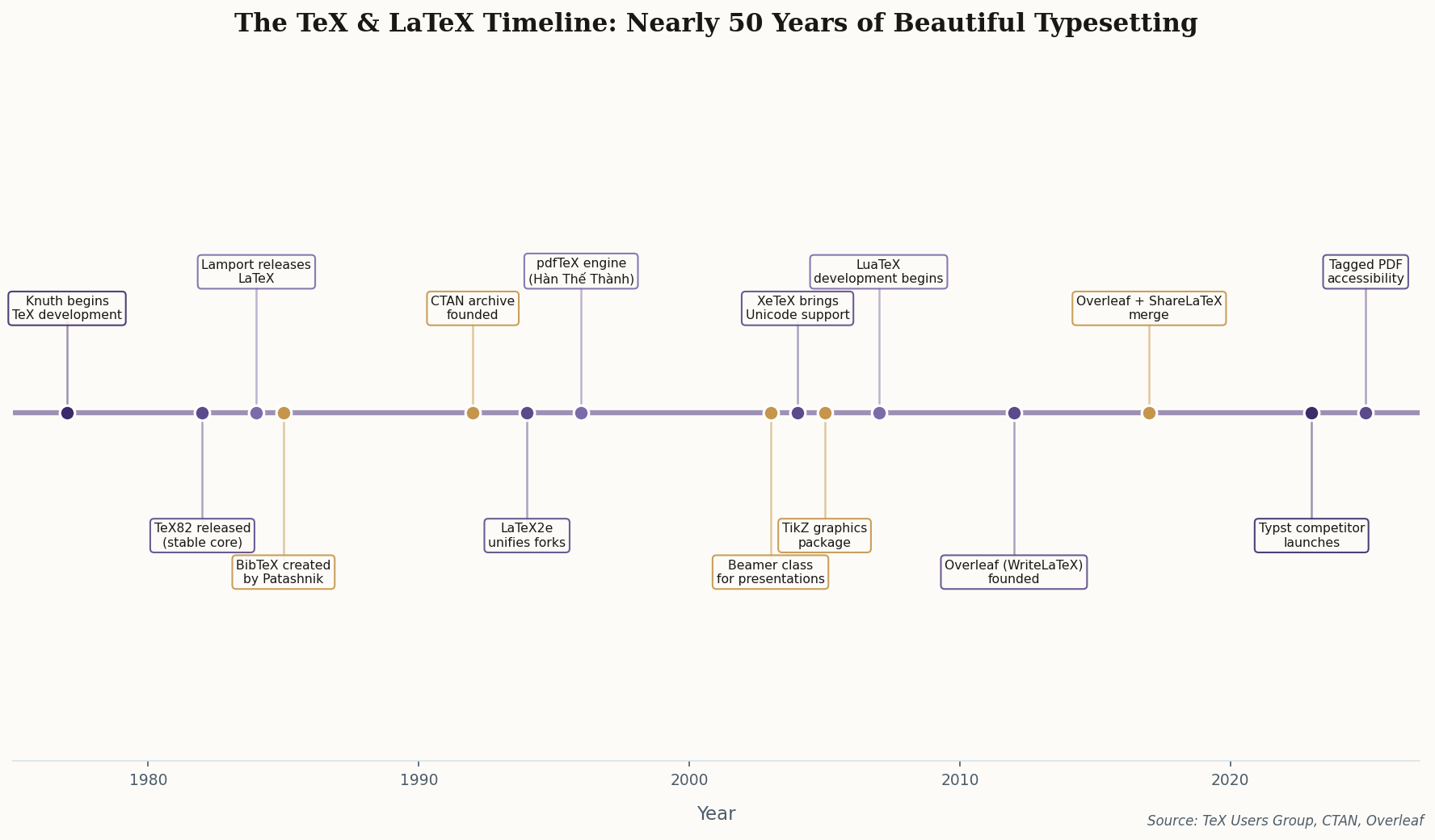
Timeline chart showing key milestones in TeX and LaTeX history from 1977 to 2025
Nearly five decades of continuous evolution: from Knuth's frustration in 1977 to tagged PDF accessibility mandates in 2025, the TeX ecosystem has never stopped adapting.

The "LaTeX tax" debate persists in every faculty lounge. Studies consistently show that for simple prose, Word is faster. But for anything with equations, cross-references, or long-term stability? LaTeX wins. And that stability argument is the killer. A LaTeX document from 1995 compiles identically today. A Word 95 file opens as a crime scene of broken formatting and missing fonts. For science—which builds on the permanent archival of knowledge—this stability is not a convenience. It's a requirement.

Looking forward, the most critical development is the Tagged PDF initiative led by Frank Mittelbach and Ulrike Fischer. With the European Accessibility Act taking force in 2025 and updated ADA regulations in 2026, universities and publishers are legally required to produce accessible documents. Standard LaTeX PDFs were "accessibility nightmares"—essentially pictures of text, invisible to screen readers. The LaTeX Project Team's multi-year effort to automatically generate PDF/UA tags, including MathML for equations, is saving LaTeX from institutional obsolescence. The 2025 kernel update shipped native support.

Nearly fifty years after a professor looked at ugly proofs and decided to build something better, his creation still typesets the equations that push physics forward, the proofs that settle mathematical conjectures, the papers that win Nobel Prizes. TeX wasn't supposed to be immortal. Knuth thought it would take a few months. That's the thing about accidental masterpieces—they have a way of outliving their creators' expectations.

Converging to π

The best software doesn't chase trends. It solves hard problems so well that the world builds around it. LaTeX is proof that quality compounds—and that a professor's frustration, given enough patience, can reshape how humanity communicates its most important ideas.