Higher Education

The Squeeze

A court greenlights the DEI purge. Another college announces its death. Foreign money becomes a loyalty test. And amid the wreckage, one essay dares to ask: what if the university just needs to become something else entirely?

Listen
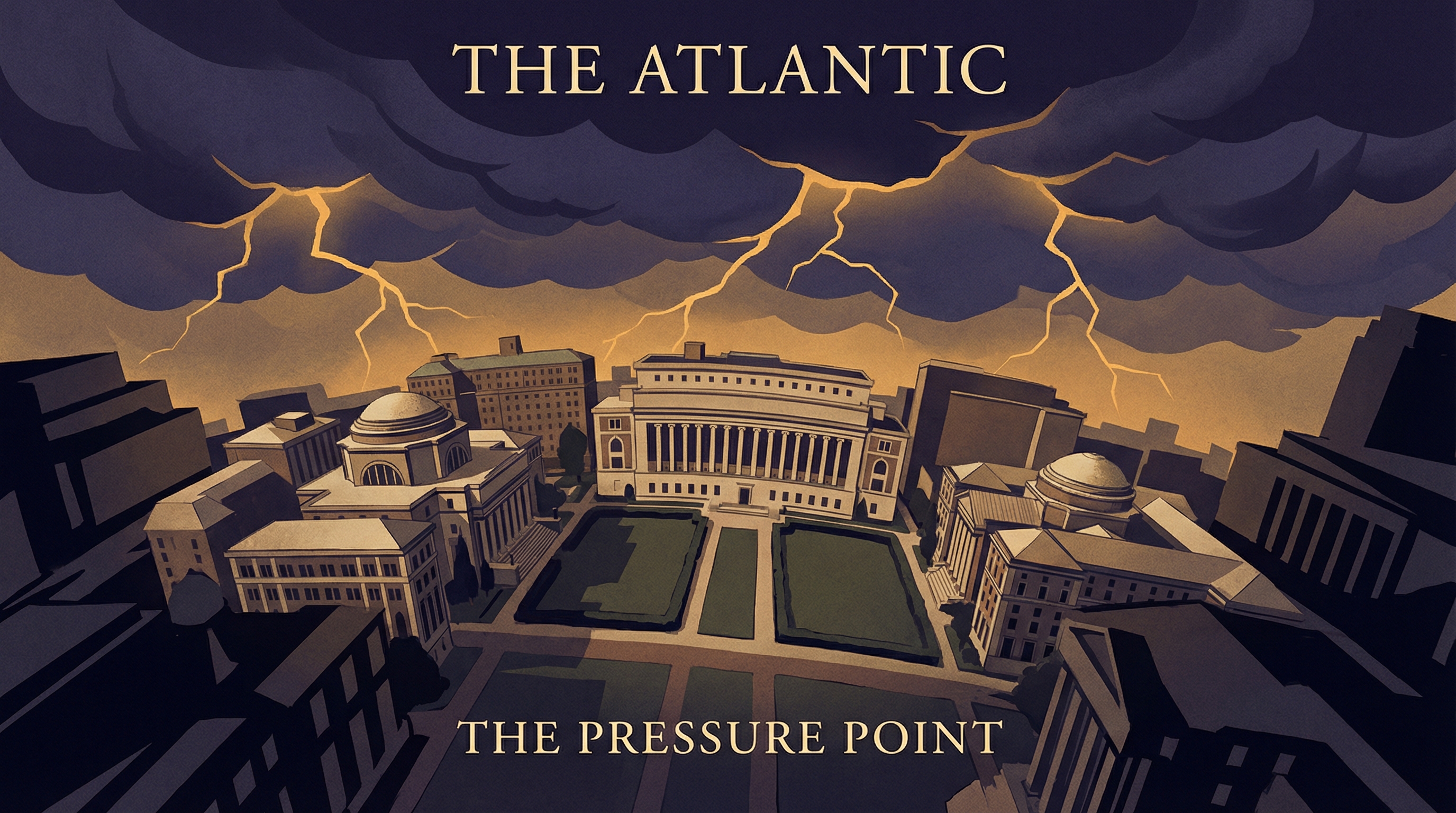
Aerial view of university campus compressed by invisible forces, indigo storm clouds with amber light breaking through, editorial illustration
01

$5.2 Billion Under the Microscope

The Department of Education dropped new Section 117 data this week revealing $5.2 billion in foreign gifts and contracts reported by U.S. universities for 2025. Alongside the data dump: a new "state-of-the-art" reporting portal that the administration frames as a national security imperative. Harvard, MIT, and Stanford are under renewed scrutiny.
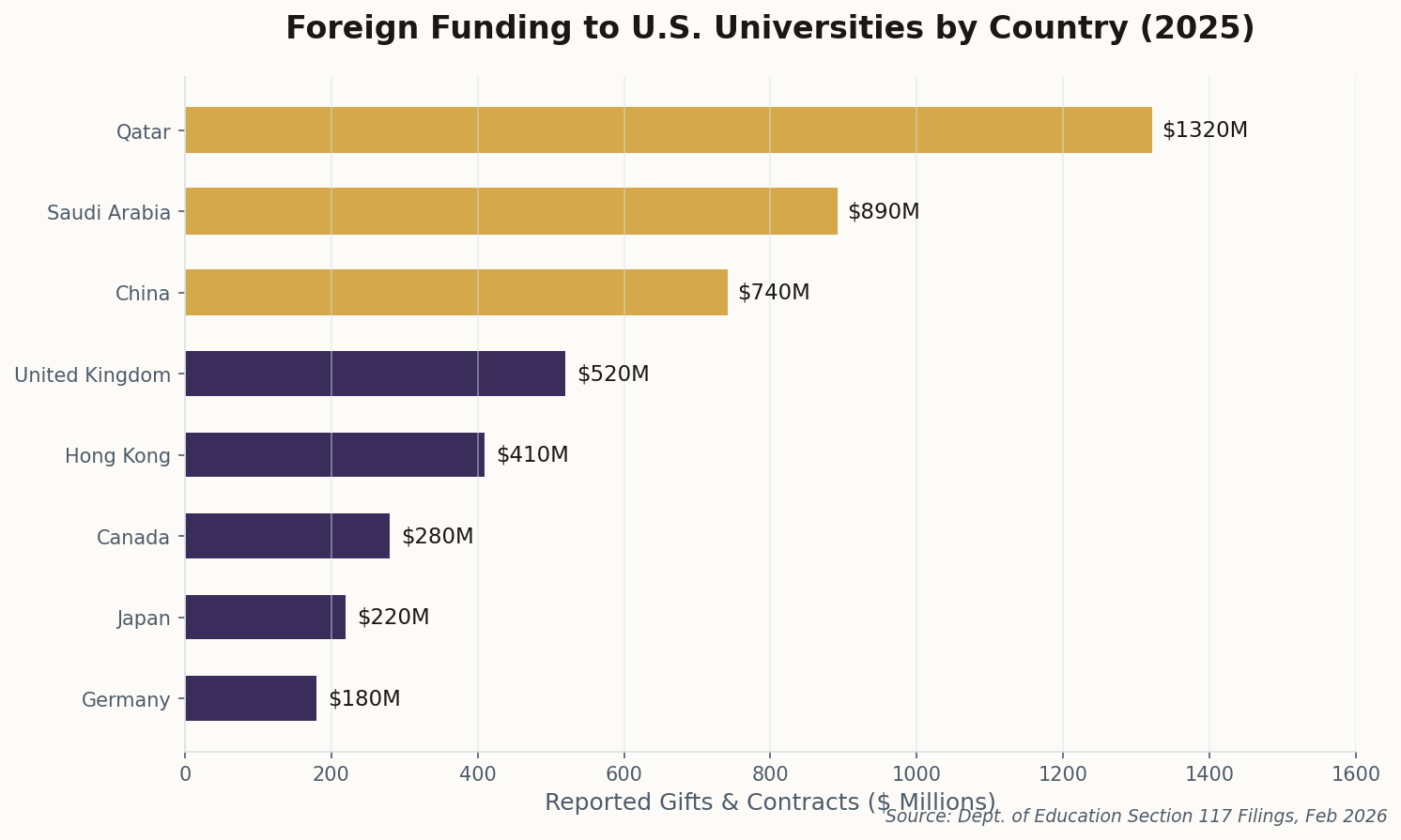
Horizontal bar chart showing foreign funding to US universities by country, Qatar leading at $1.32 billion
Source: Dept. of Education Section 117 filings (Feb 2026)

The numbers tell one story. Qatar leads at $1.3 billion, followed by Saudi Arabia and China. The administration tells another: that these figures represent a vector for foreign influence that universities have been too cozy about for too long. The new portal demands granular detail on every international partnership, every visiting scholar stipend, every research collaboration with a foreign institution.

The chilling effect is already measurable: Faculty report declining international collaborations rather than navigating the reporting maze. Some are avoiding conferences in countries the administration views unfavorably. The portal doesn't just monitor — it reshapes behavior.

The stated goal isn't unreasonable. Nobody wants a foreign government buying influence over American research. But the implementation treats every international dollar as suspect until proven innocent. The American research university's greatest competitive advantage — its openness to global talent and ideas — is being quietly reframed as its greatest vulnerability.
02

Another One Gone: Lourdes University Shuts Down

Lourdes University, a private Franciscan institution in Sylvania, Ohio, announced it will close at the end of the 2026 academic year. The reason is the same one killing small privates across the country: not enough students, not enough money, no way to square the two.

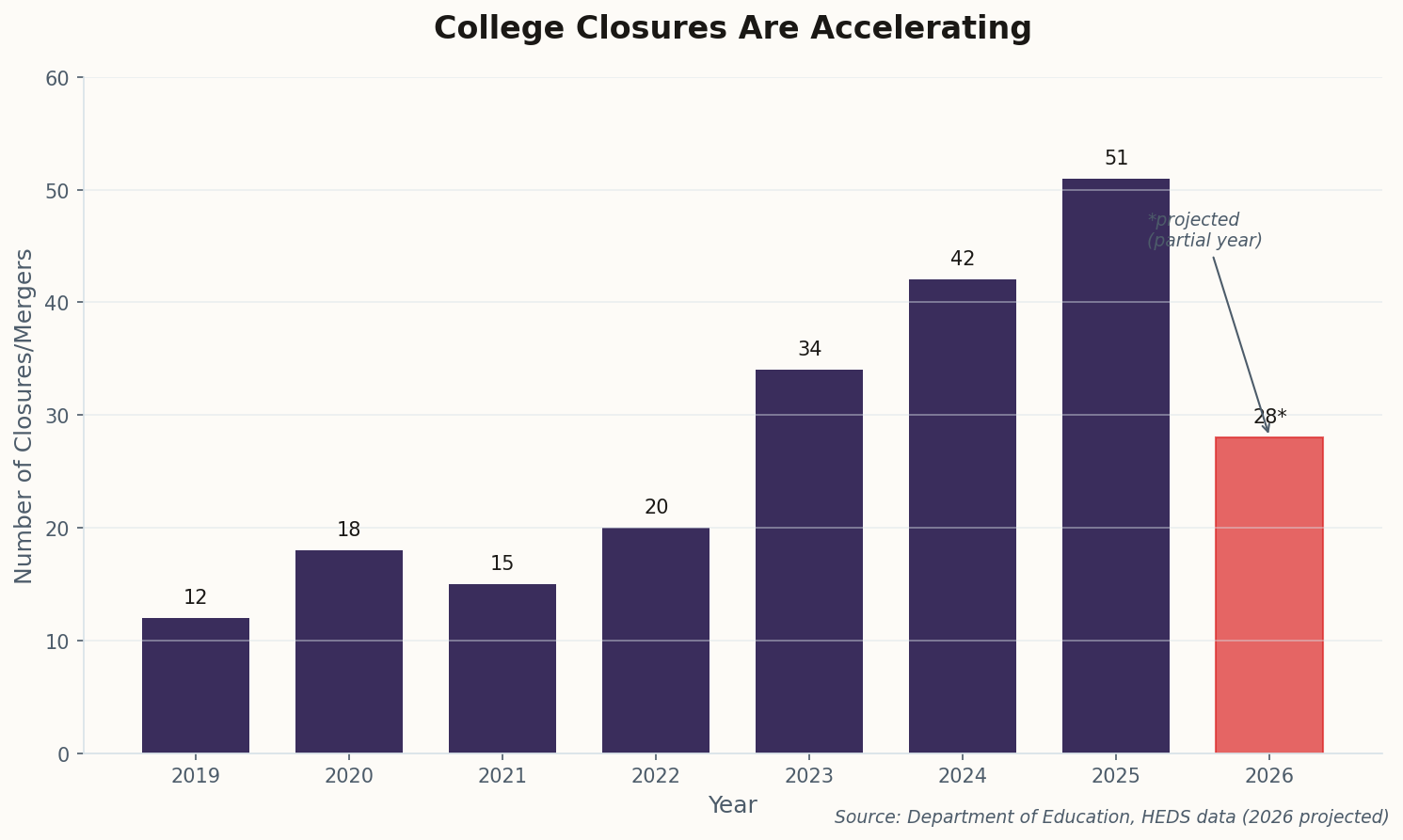
Bar chart showing rising US college closures from 15 in 2018 to 38 in 2025, with 12 already in 2026
Source: Chronicle of Higher Education, NAICU tracking (Feb 2026)

The trend line is brutal. We're not yet through February and a dozen institutions have already announced closures or mergers for 2026. Last year's total was 38 — itself a record. The year before that, 31. The demographic cliff that demographers warned about for a decade has arrived, and it's taking the small, tuition-dependent, minimally endowed colleges first.

What makes Lourdes worth noting isn't its size or prestige — it's its typicality. A mission-driven institution, faith-affiliated, regional in scope, serving students who often can't relocate to a bigger school. Every Lourdes closure means students who were barely hanging on to the idea of a degree now face longer commutes, transfer bureaucracy, or the temptation to quit entirely. The closure doesn't just end an institution — it frays the already thin educational safety net in communities that have few alternatives.

03

The FAFSA Actually Works This Year

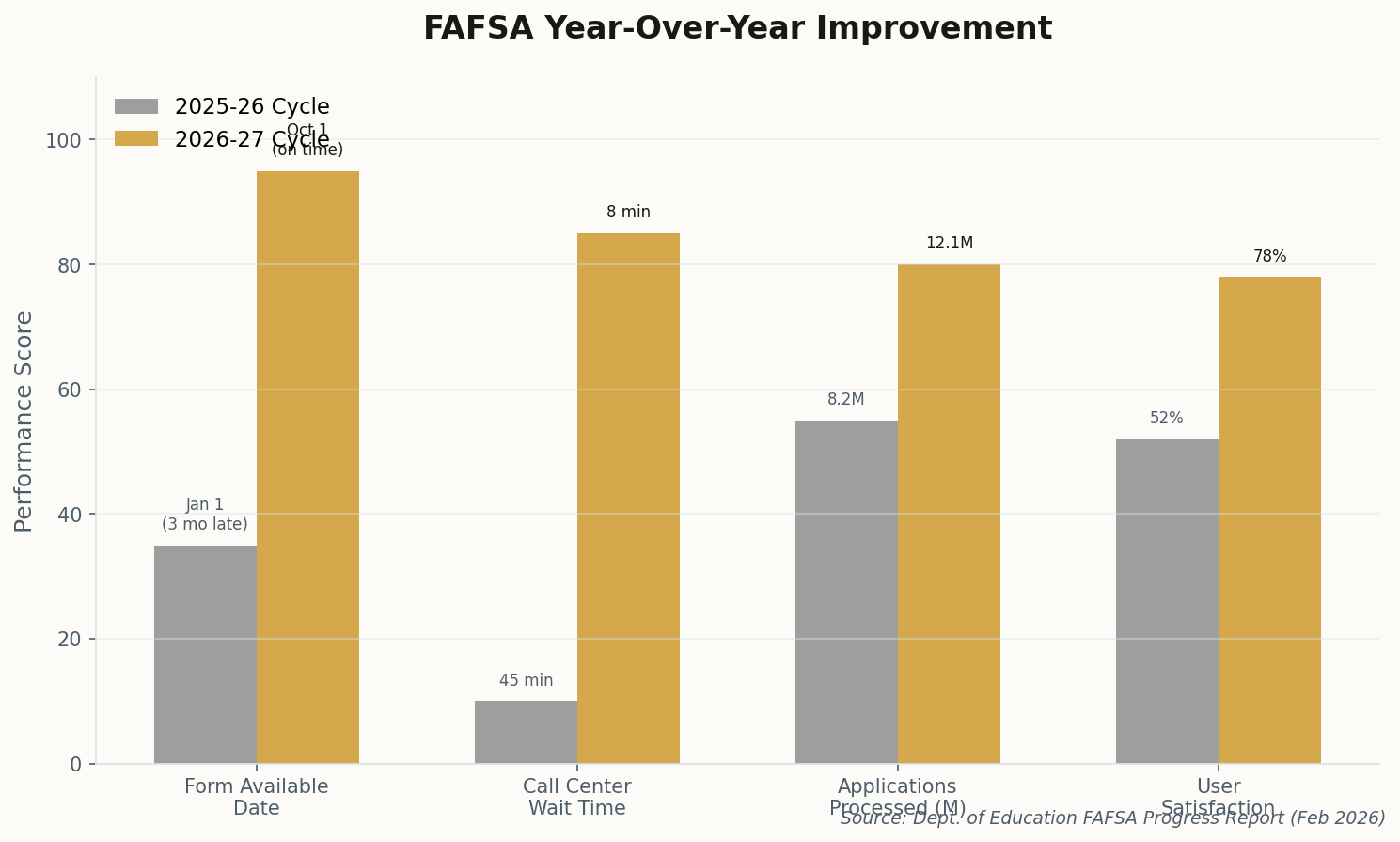
Here's something you don't hear often about the federal government: it fixed the thing. The Department of Education reported dramatically improved metrics for the 2026-27 FAFSA cycle — the earliest form launch in history, call-center wait times down from 45 minutes to 8, and user satisfaction scores jumping from 52% to 78%.

Grouped bar chart comparing FAFSA performance metrics between 2025-26 and 2026-27 cycles, showing major improvements
Source: Dept. of Education FAFSA Progress Report (Feb 2026)

If these numbers hold, the consequences are significant. Last cycle's catastrophic FAFSA rollout — delayed, glitchy, maddening — was directly linked to enrollment dips at institutions serving low-income students. When the form doesn't work, the students who need financial aid most are the ones who fall through the cracks. They don't wait around. They just don't enroll.

The turnaround matters less as a political win for the administration (which will claim it regardless) than as a practical lifeline for the enrollment numbers that keep vulnerable institutions alive. In a year when a dozen colleges are already closing, a functional FAFSA is the difference between "struggling" and "terminal" for hundreds of schools.

04

The Courts Blink: DEI Orders Get the Green Light

The Fourth Circuit Court of Appeals vacated a nationwide injunction that had blocked two of Trump's executive orders targeting DEI programs. The ruling — that plaintiffs hadn't met the "demanding standard" required to block the orders on their face — removes the last major legal barrier to the administration's campaign to dismantle diversity infrastructure across higher education.

This is the domino that institutional leaders were dreading. The injunction had given universities legal cover to slow-walk compliance. "We'd love to comply, but the courts say we can't" was a convenient shield. That shield is gone.

What happens now: Universities receiving federal grants and contracts must immediately assess whether their DEI offices, diversity requirements, and equity-focused programming expose them to enforcement action. The executive orders classify certain DEI programs as "illegal" — but the boundaries remain deliberately vague, maximizing the chilling effect.

The speed of the disassembly will vary. Elite privates with massive endowments can absorb the financial hit of losing some federal contracts. Public universities — which depend on federal funding for research, student aid, and operating budgets — have no such cushion. Expect a wave of "rebranding" in the coming weeks: offices of "diversity" becoming offices of "belonging" or "student success," their mandates quietly hollowed out while the nameplates change.

The deeper question is whether the substance survives the relabeling. Early evidence from the first wave of DEI closures in 2025 suggests it mostly doesn't. When you fire the staff, dissolve the budget, and eliminate the reporting lines, changing the name of what's left is cosmetic surgery on a corpse.

05

When Intelligence Is Cheap, What's a University For?

Mark Daley's essay in the Chronicle doesn't bother with the usual AI-in-education hand-wringing about cheating and academic integrity. He goes straight for the jugular: if intelligence is now abundant and cheap, the entire business model of selling access to expert knowledge is broken. Not threatened. Broken.

"What does a university become in a world where intelligence is abundant?"

His answer is provocative. Universities should pivot from "knowledge transmission" and "credentialing" — the twin pillars that have justified tuition for a century — toward "formation" (ethical and personal growth) and "convening" (bringing diverse groups together for the kind of friction that produces actual insight). In other words, stop selling what AI gives away free, and start selling what it can't replicate.

It's an elegant argument. It's also one that requires institutions to gut their own value proposition and rebuild it from scratch — while maintaining enrollment, satisfying accreditors, and paying the bills. The gap between the essay's vision and the typical university's capacity for transformation is roughly the size of the Grand Canyon.

Still, Daley names something that most institutional leaders won't say publicly: clinging to the old model isn't conservatism, it's suicide. The students already know this. They're the ones using AI to draft their papers, summarize their readings, and practice their Spanish. The question isn't whether the university changes — it's whether it changes on its own terms or has the change imposed upon it.

06

Congress Hears an Inconvenient Truth About College Costs

Julie Margetta Morgan, president of The Century Foundation, told the House Committee on Education and the Workforce what nobody in the room wanted to hear: federal deregulation and recent administration policies have "exacerbated" the cost crisis rather than alleviating it.

Her argument punctures the administration's preferred narrative — that reducing federal interference will somehow lower costs through market magic. Morgan's testimony focused on something simpler and harder to dispute: basic living expenses. When housing costs spike, when food prices rise, when transportation gets more expensive, the total cost of attending college goes up regardless of what tuition does. And federal policy, she argued, has driven up those costs.

The committee, predictably, split along party lines. Republicans pointed to institutional bloat and administrative overhead. Democrats cited cuts to student aid and regulatory rollbacks. Neither side engaged with the most uncomfortable implication of Morgan's testimony: that the affordability crisis isn't a bug that policy can fix but a structural feature of an economy where the costs of being alive keep outpacing the returns on education.

For students, the political theater is irrelevant. They're taking on debt in real time while Congress debates abstractions. The median student loan payment is now higher than the median car payment. At some point the question stops being "how do we make college affordable" and becomes "why would anyone rational still enroll?"

Pressure on Every Side

This week's stories describe an institution being compressed from every direction simultaneously. Courts greenlight the ideological purge. Another college dies quietly in Ohio. Foreign money becomes a loyalty test. The FAFSA works — a genuine bright spot, and the fact that "the form functions correctly" counts as good news tells you everything about the baseline. Meanwhile, the most interesting essay of the week dares to suggest that the real threat isn't any single crisis but the university's own refusal to reimagine what it's for. The squeeze isn't coming. It's here. The institutions that survive will be the ones that stop defending what they were and start building what they need to become.