
Economy • Policy • AI

The Severance Package

108,000 jobs cut in January. Three governments now discussing UBI. And a Forrester report that says most of these companies can't actually replace the people they're firing. Welcome to the economy's most expensive bluff.

Listen
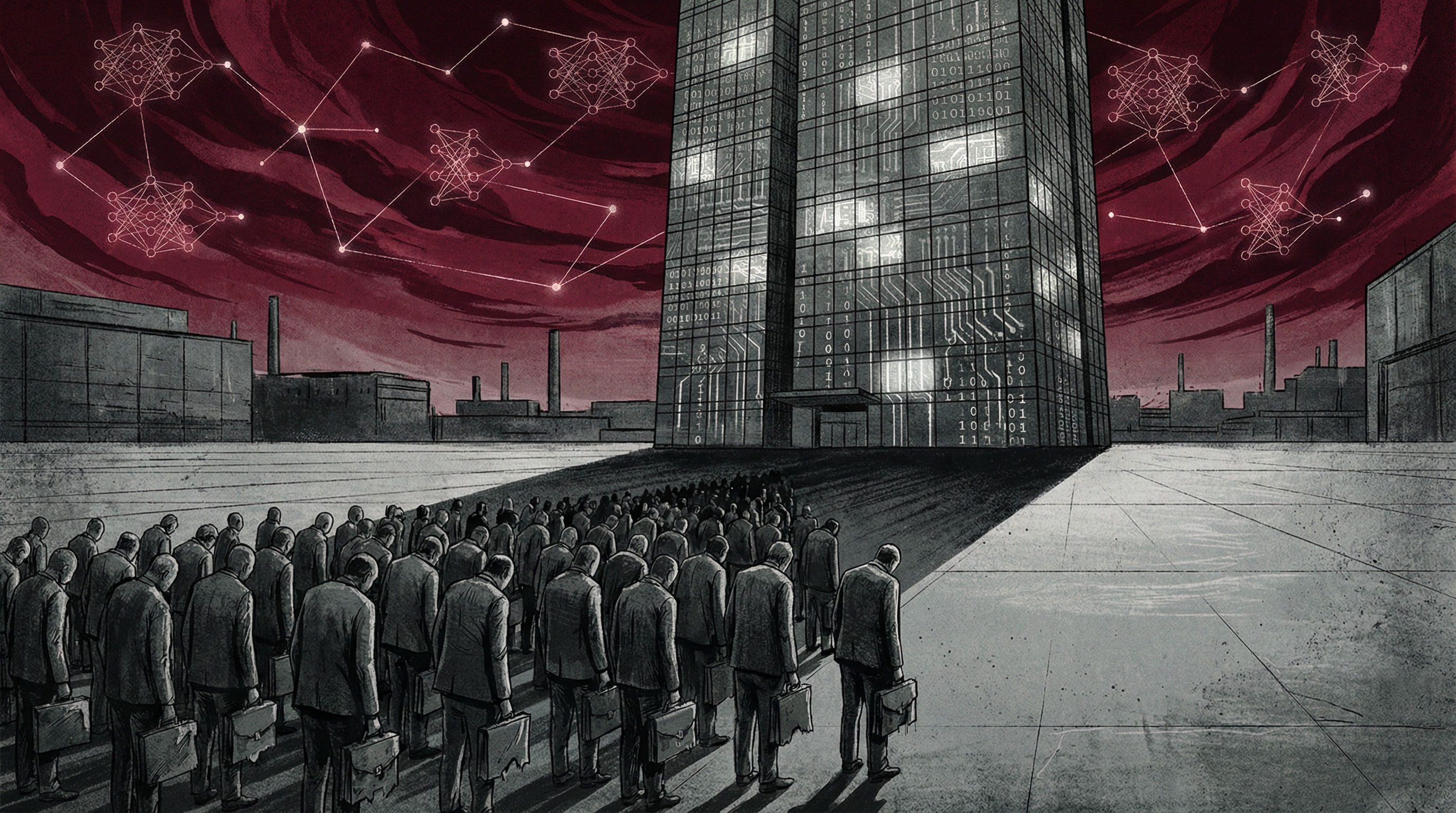
A corporate glass tower casting shadows over displaced workers under a crimson AI-networked sky
Empty office chairs in abandoned corporate atrium with binary code shadows
01

108,435 Chairs Just Went Empty

Here's a number that should make you uncomfortable: 108,435. That's how many job cuts U.S. employers announced in January 2026 alone—a 118% increase over the same month last year, according to Challenger, Gray & Christmas. Of those, 7,624 were explicitly attributed to "Artificial Intelligence." Not "restructuring." Not "market conditions." AI.

But the truly chilling figure isn't the cuts—it's the hiring. January saw just 5,306 new hiring announcements. That's the lowest January total on record since 2009, when the global financial system was busy being on fire. The math doesn't math: you can't shed a hundred thousand workers and hire five thousand and call that a "transition." That's a contraction wearing a Silicon Valley hoodie.
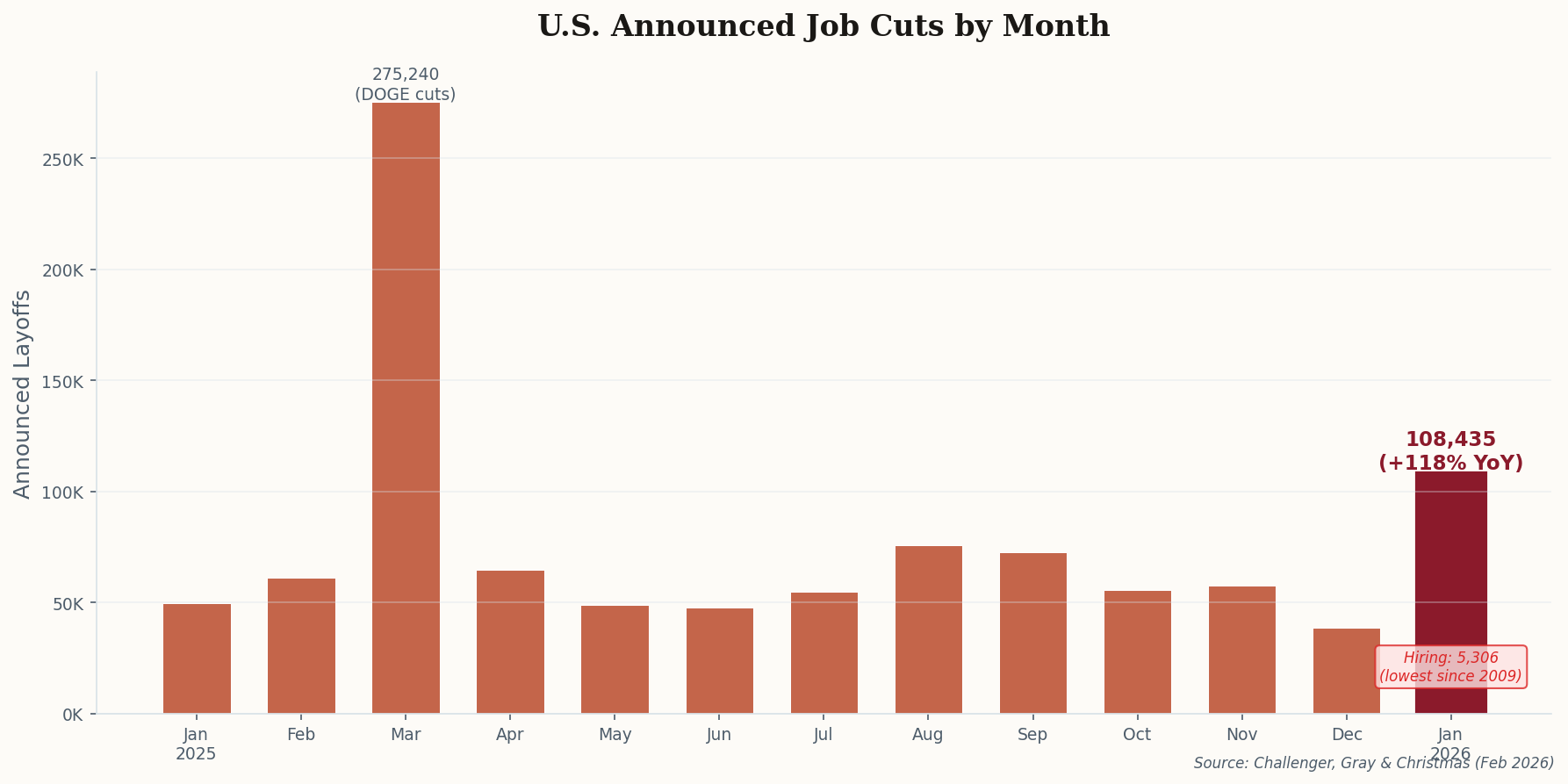
Bar chart showing U.S. monthly job cuts from January 2025 to January 2026, with January 2026 at 108,435
U.S. announced job cuts by month. January 2026's surge approaches the DOGE-driven March 2025 spike in federal workforce reductions. Source: Challenger, Gray & Christmas.

The corporate press releases all read the same: "efficiency," "agility," "AI-forward strategy." Translation: we're betting your mortgage payment that a large language model can do your job. Maybe it can. But Forrester's own analysis suggests most of these companies don't have the infrastructure to actually replace the roles they're eliminating. They're firing the pilot before the autopilot is installed.

"We are seeing a perfect storm of economic uncertainty and technological pivoting... companies are clearing out roles to make room for AI investments." — Andrew Challenger, Senior VP
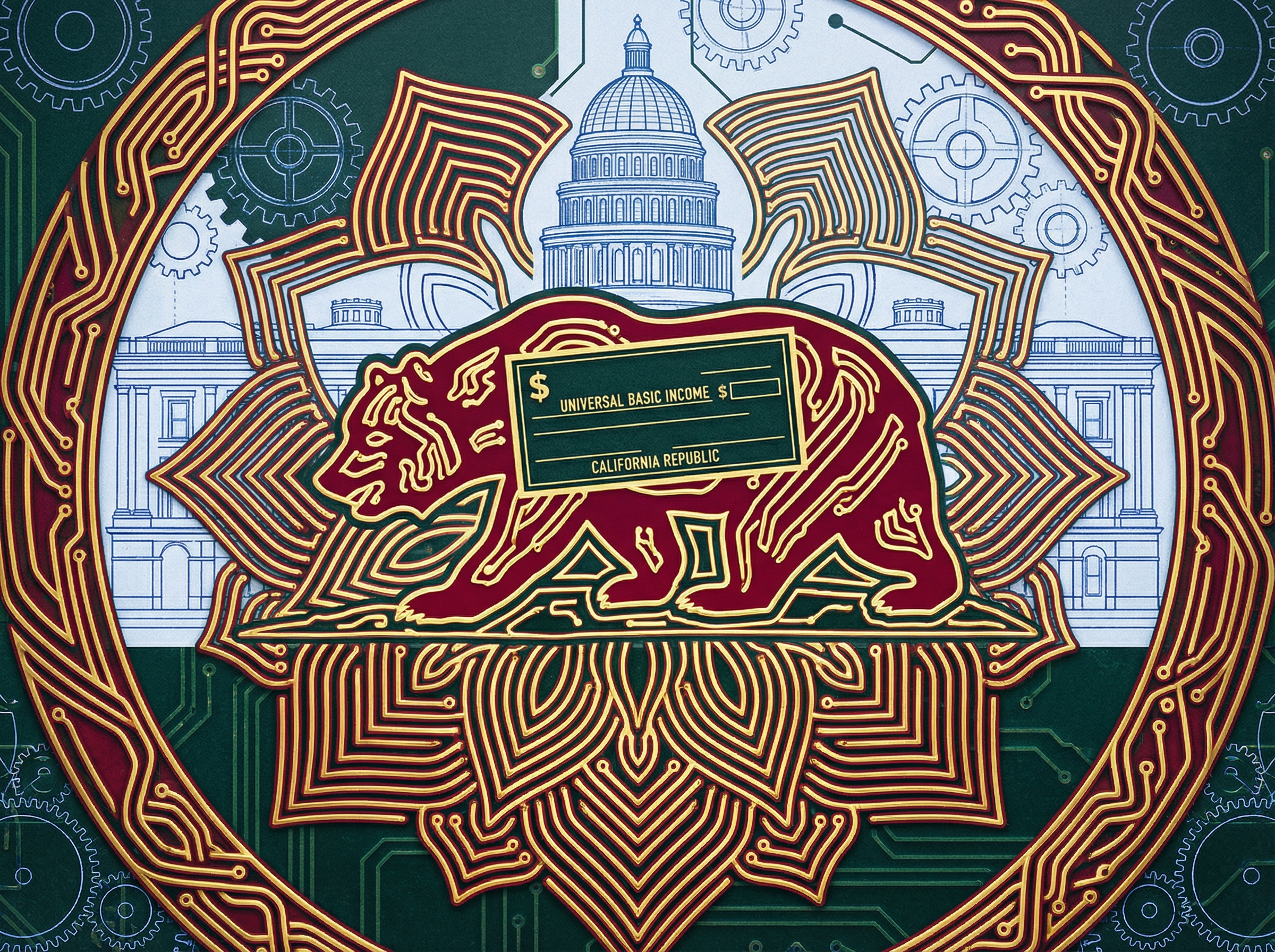
California state seal reimagined as a circuit board with UBI check
02

California Wants to Pay You $1,000 a Month (If a Robot Took Your Job)

Assembly Bill 3058—branded "CalUBI" by its supporters and "economic morphine" by its detractors—is now moving through the California legislative session. The premise is straightforward: if you lost your job to automation or AI, the state will pay you $1,000 per month for twelve months. No strings. No retraining mandates. Just cash.

This is the first state-level legislation in America that explicitly targets the cause of unemployment rather than the fact of it. Existing unemployment insurance doesn't care why you were fired. CalUBI does. And that distinction matters, because it forces a legal acknowledgment that some job losses aren't cyclical—they're permanent. Your position wasn't downsized. It was deleted.

The $1,000 figure, of course, is insulting if you live anywhere in California where rent exists. In San Francisco, it covers roughly three weeks of a studio apartment. In Bakersfield, maybe you stretch it to six. The program's real significance isn't the dollar amount—it's the precedent. Once you create a legal category for "technologically displaced workers," you've built the infrastructure for something much larger. And that's exactly what critics are afraid of.

"To investigate the efficacy of an unconditional benefit... for individuals displaced by technology." — AB 3058 legislative text

Here's the lie at the heart of it: $12,000 per year doesn't make anyone whole. It doesn't retrain a 52-year-old accounts payable specialist to become a machine learning engineer. It doesn't replace the health insurance, the 401(k) match, or the professional identity that came with a career. It's a severance package from society, and a cheap one at that.

Crystal piggy bank filled with AI company logos against Swiss Alps backdrop
03

Davos Has a Plan: Make AI Companies Fund Their Own Reparations

Leave it to the people who fly private to Davos to propose the most elegant solution to the problem they created. At the 2026 World Economic Forum, a Stanford-backed proposal introduced the "Universal Investment" model: new AI companies would deposit 10% of their founding shares into a sovereign wealth fund. As those companies grow, so does the fund. Eventually, citizens get dividends.

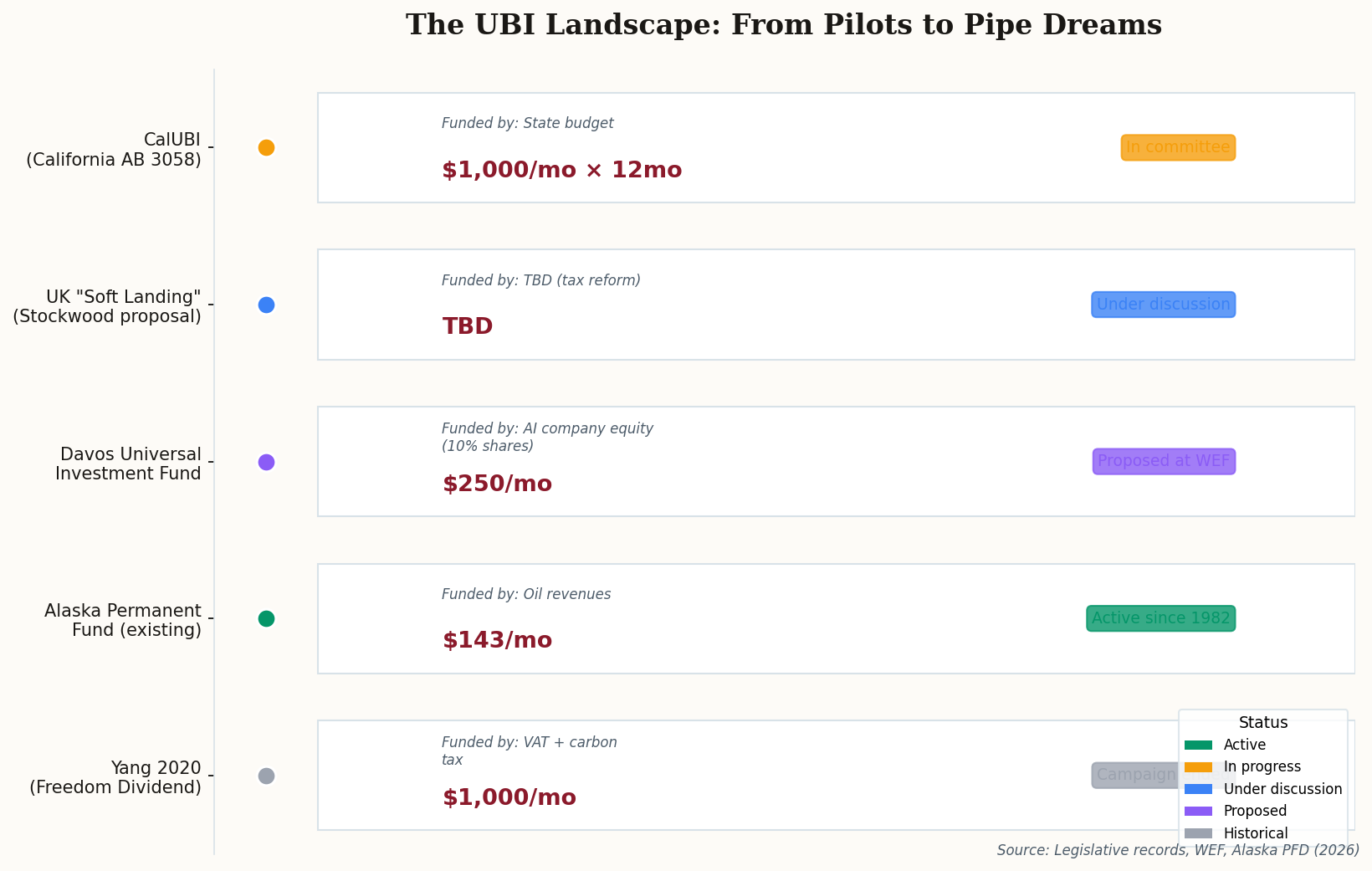
Sound familiar? It should. It's the Alaska Permanent Fund—the one program Americans consistently point to as "UBI that works"—except fueled by AI equity instead of oil revenue. The projected initial payout: $3,000 per year. Not life-changing. Not nothing.

Comparison chart of UBI proposals from CalUBI to Alaska Permanent Fund to Davos Universal Investment model
Current UBI proposals compared: funding sources, monthly amounts, and eligibility. Only the Alaska Permanent Fund is actually operational. Source: Legislative records, WEF, Alaska PFD.

The appeal is obvious: it doesn't raise taxes. Tech leaders can frame it as generosity rather than obligation. Politicians can support it without touching income tax rates. Everyone gets to feel good about a mechanism that, at $3,000 a year, pays out less than the monthly rent on a San Jose studio.

The deeper problem: this model assumes AI companies will generate the generational wealth everyone predicts. If the AI bubble deflates—and bubbles do deflate—the fund holds stock in companies worth a fraction of their IPO valuation. You've built a retirement fund on the premise that the hype cycle is actually a revolution. Maybe it is. But "maybe" is a lousy foundation for social policy.

Houses of Parliament through digital mesh with neural network clock face
04

Britain Quietly Admits It Has No Plan

Lord Jason Stockwood, the UK's Minister for Investment, did something unusual last week: he told the truth. In a remarkably candid interview, Stockwood confirmed that the British government is actively discussing Universal Basic Income as what he called a "concessionary arrangement" for industries about to be gutted by AI.

Read that phrase again. Concessionary arrangement. It's the language of labor negotiations, not social policy. The government isn't framing UBI as a right, or even as welfare—it's a concession. Something you grant to the losing side to prevent them from flipping the table.

"There will be bumpy societal changes," Stockwood said, in what may be 2026's most aggressive understatement. "We need to find a way to support those whose jobs go immediately." The proposal combines cash payments with "lifelong learning mandates"—because apparently the answer to "a machine replaced me" is "have you considered a certificate program?"

What's significant here isn't the policy details—there aren't any yet. It's the shift from if to how. A senior minister in a G7 government publicly acknowledged that AI displacement isn't speculative. It's happening. And the best they've got is "concessionary arrangements" and mandatory education. The UK hasn't had this little confidence in its economic model since the Suez Crisis.

Chemical plant at twilight with robotic arms replacing human workers
05

The Factory Floor Is Next

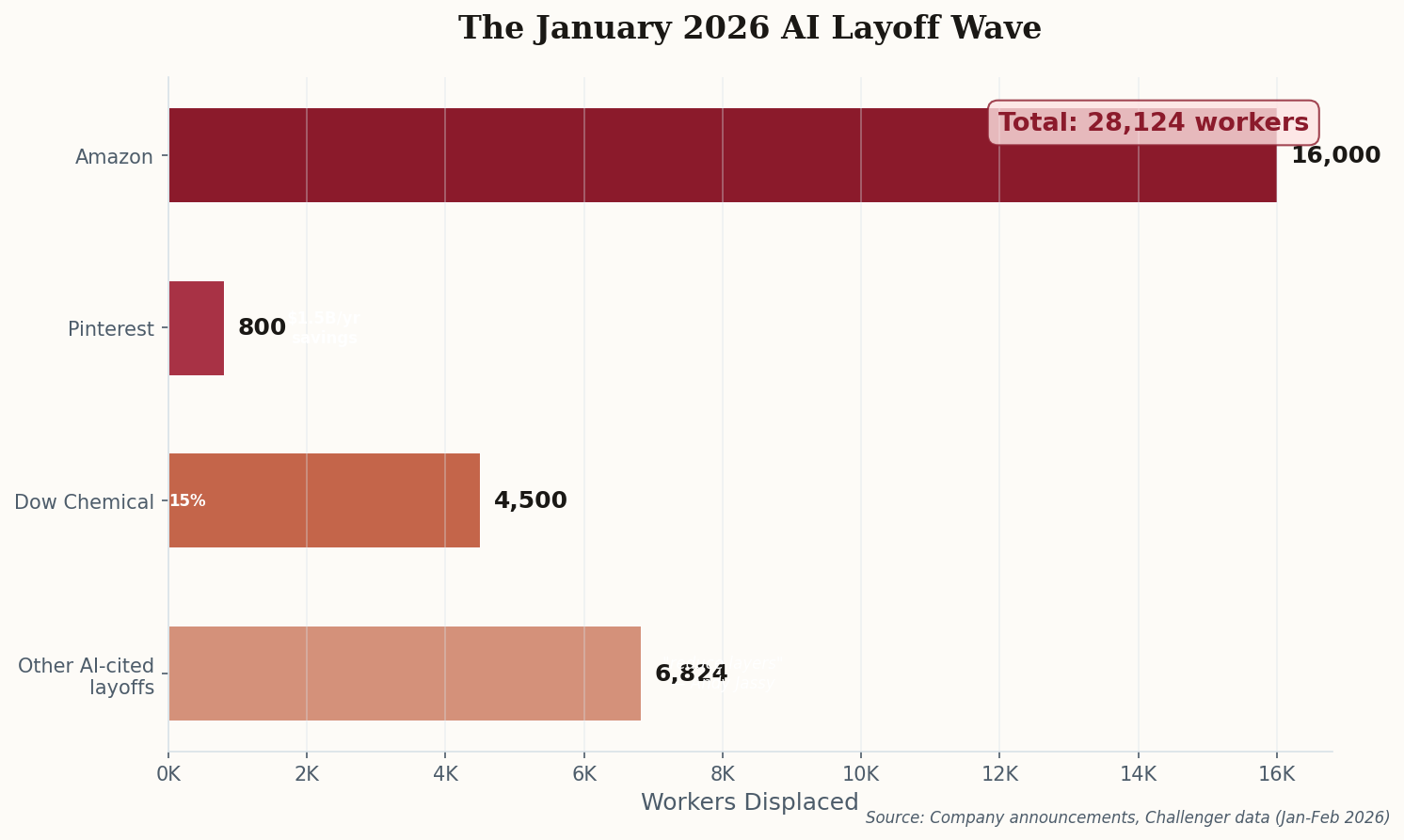
If you thought AI displacement was a white-collar problem, Dow Chemical just corrected that assumption. The company announced 4,500 layoffs—roughly 6% of its workforce—under a program called "Transform to Outperform." The initiative explicitly names AI and automation as the replacement strategy.

The economics are brutal and transparent: Dow expects to save $1.5 billion annually. The severance cost? Up to $800 million, paid once. The return on firing 4,500 people pays for itself in seven months.

Horizontal bar chart showing AI-attributed layoffs by company: Amazon 16,000, Dow 4,500, Pinterest 800
The January 2026 AI layoff wave by company. Total: nearly 28,000 workers displaced across tech, industrial, and social media sectors in a single month.

This matters because it demolishes the "learn to code" narrative. Dow's workers aren't social media managers or content writers. They're chemical engineers, plant operators, supply chain specialists. These are the jobs that were supposed to be AI-proof—complex, physical, requiring domain expertise. Turns out "domain expertise" is just another dataset to a sufficiently motivated optimization algorithm.

"We are modernizing our capabilities... leveraging digital and AI to work smarter." — Jim Fitterling, Dow CEO. Translation: the machines are cheaper than you.

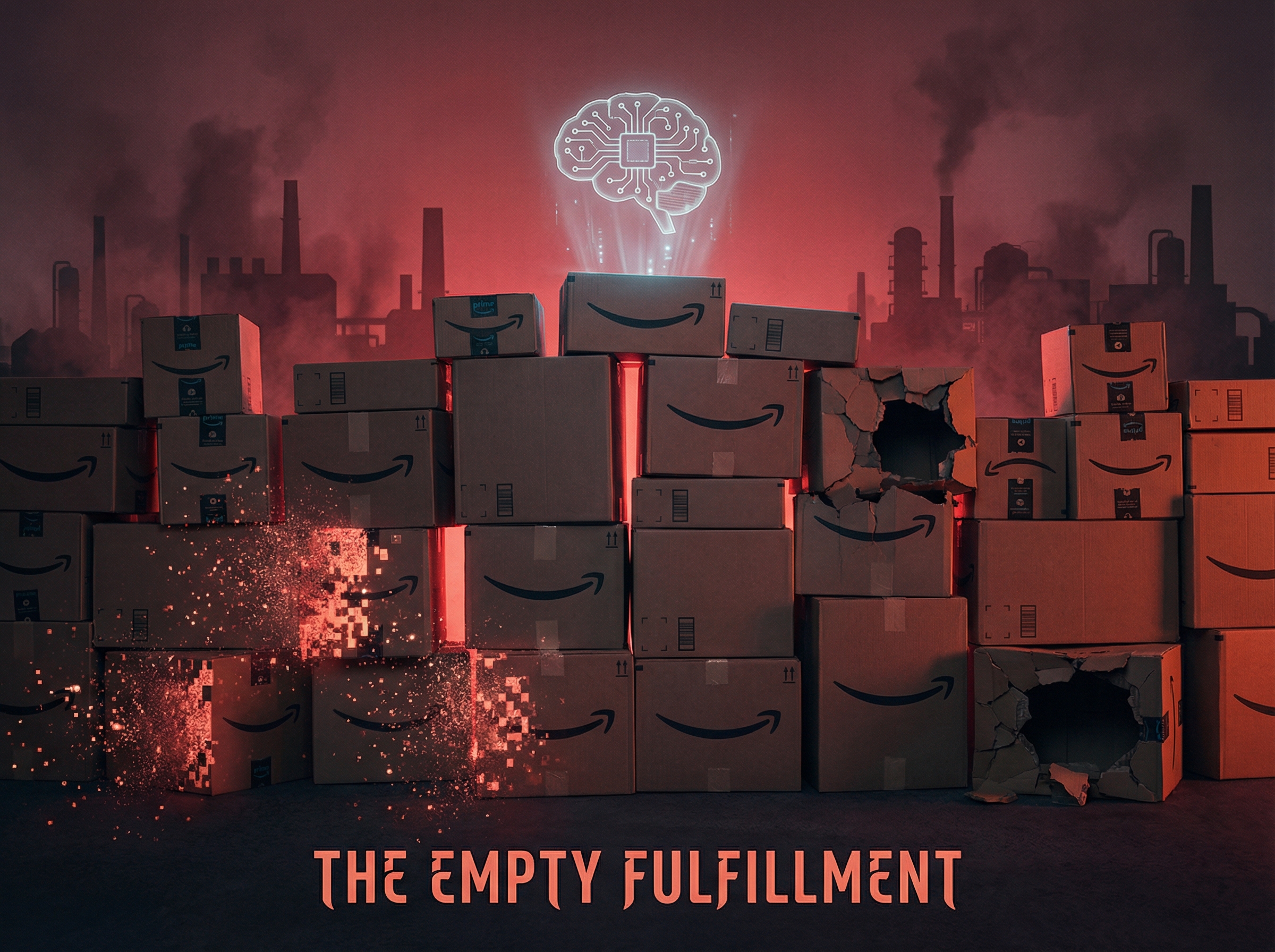
Amazon boxes stacked into a wall with AI brain hologram, some dissolving into digital particles
06

Amazon's 30,000-Person Experiment in Corporate Darwinism

Amazon eliminated 16,000 corporate roles in January, following 14,000 cuts in late 2025. That's 30,000 positions in roughly six months. CEO Andy Jassy framed it as removing "layers" and "bureaucracy" to accelerate AI integration. In corporate-speak, "removing layers" means removing the people in those layers.

But here's where it gets interesting. Forrester Research published a report the same week warning of what they call "AI Washing"—companies citing AI as the justification for layoffs that are actually driven by poor financial performance. Forrester found that many firms announcing AI-driven restructuring lack the mature infrastructure to actually replace the roles they're cutting.

In other words: some of these companies aren't replacing workers with AI. They're firing workers and hoping AI fills the gap later. Forrester predicts a "productivity gap"—a period where companies have fewer people AND no functioning AI replacement. The result? Operational failures, quality declines, and eventually... rehiring. At higher salaries, because the experienced people moved on.

"Fears of a job apocalypse are overstated, but the disruption is being exacerbated by executives firing ahead of the technology's readiness." — Forrester Research, January 2026

This is the real scandal hiding behind the UBI debate. The question isn't whether we need a safety net—it's whether the crisis that safety net is responding to is even real. If half these layoffs are "AI washing," then we're designing policy around a threat that's partly manufactured by executives goosing their stock price.

Pinterest-style pins as human silhouettes being replaced by glowing AI chips
07

Pinterest's Quiet Confession: We'd Rather Pay for GPUs Than People

Pinterest laid off 15% of its workforce—roughly 700 to 800 people—in what the company called a move to "rebalance" toward an "AI-forward strategy." Unlike the corporate doublespeak from larger companies, Pinterest's announcement was almost refreshingly honest about the calculus: these aren't redundancies. They're replacements. Legacy staff out, AI specialists in.

This is "skill-swapping" in its purest form. Pinterest isn't reducing headcount to cut costs—it's planning to increase spending on AI talent and compute infrastructure. The people being fired aren't too expensive. They're the wrong kind of expensive. A content moderation specialist costs $85K. A machine learning engineer costs $250K. Pinterest chose the ML engineer and told the content moderator to upskill.

There's something honest and something grotesque about this. Honest, because at least Pinterest isn't pretending these cuts are about "efficiency." Grotesque, because it confirms the darkest version of the AI transition narrative: your skills aren't declining in value because you're bad at your job. They're declining because someone built a cheaper version of you. Not a better version. Cheaper.

And that's the lie at the center of every UBI proposal, every "lifelong learning mandate," every "concessionary arrangement." They all assume the problem is that displaced workers need support while they acquire new skills. But what if the new skills have a shelf life of eighteen months before they, too, are automated? What if the treadmill doesn't have a destination—just an accelerating belt?

The Check That Bounces

The lie isn't that UBI is too expensive. It's that UBI is an answer. It's a painkiller prescribed for a patient who needs surgery. 108,000 jobs vanished in January and the best response from three different governments is some version of "here's a thousand dollars a month, go learn Python." Meanwhile, the companies doing the firing can't even prove they have working AI to replace the people they cut. We are watching an economy eat itself in real time—not because the machines are too smart, but because the executives are too impatient and the policymakers are too timid. The question isn't how much UBI should cost. The question is why we're letting companies externalize the cost of their AI bets onto the public. Until someone asks that question out loud, every UBI proposal is just a receipt for a bill someone else ran up.