Literary Retrospective

The Man Who Sold the Future

Robert Heinlein predicted waterbeds, cell phones, and the internet. He invented a word that Elon Musk named an AI after. And Hollywood still can't figure out how to film his most controversial novel. A deep look at the works of science fiction's most prophetic—and paradoxical—master.

Listen
An open book transforming into a starfield with spacecraft and a lunar colony, capturing the spirit of Golden Age science fiction
01

"Would You Like to Know More?" Blomkamp Takes on Starship Troopers—For Real This Time
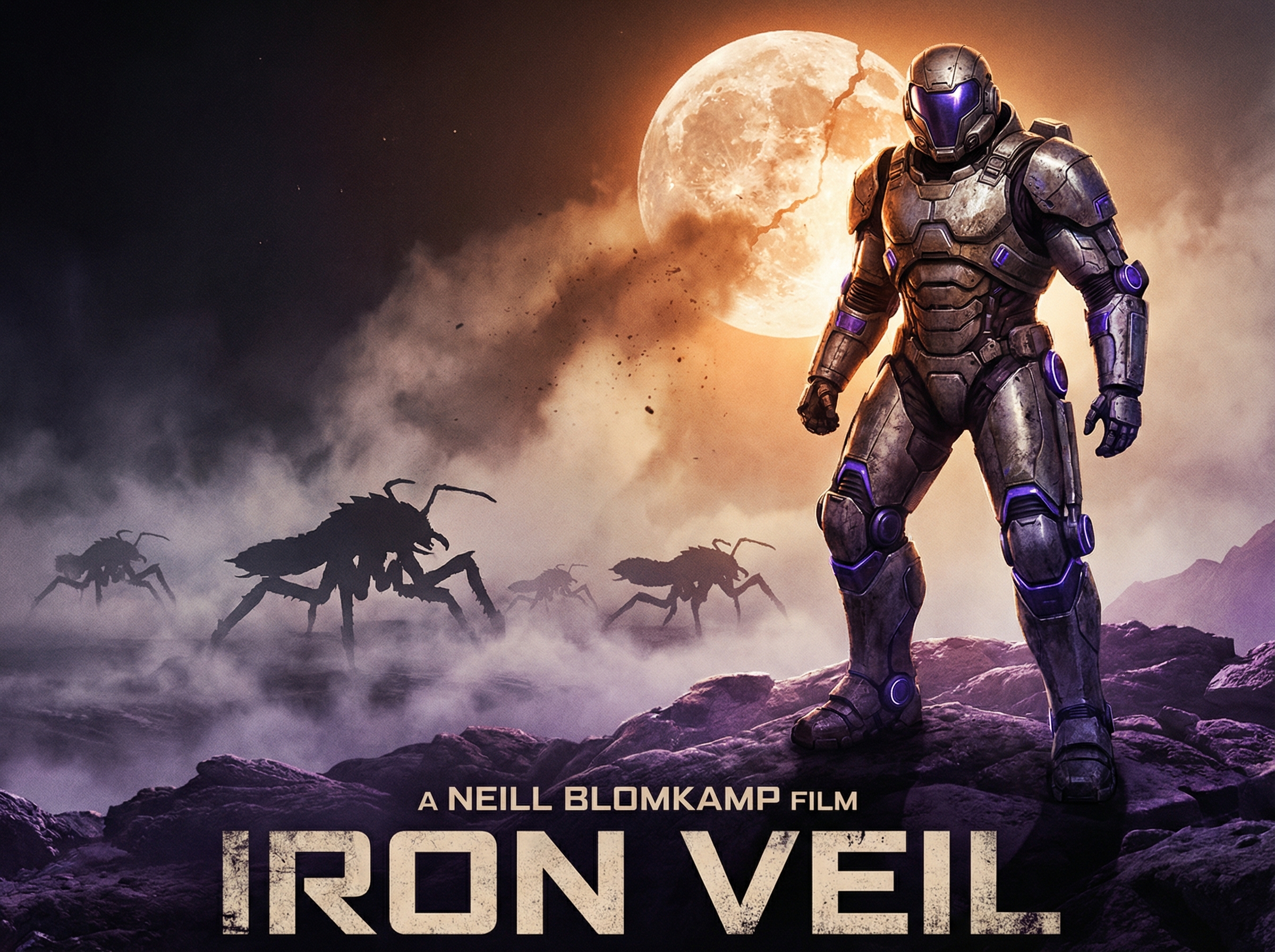
A powered exoskeleton suit on an alien battlefield, capturing the military sci-fi aesthetic of Heinlein's vision

Here's the thing about Starship Troopers: almost nobody who talks about it is talking about the same book. Paul Verhoeven's 1997 film—made for $105 million, returning a disappointing $121 million worldwide—deliberately inverted Heinlein's novel into a fascist satire so sharp that most audiences missed the joke entirely. Verhoeven, who grew up under Nazi occupation in the Netherlands, read Heinlein's tale of citizenship earned through military service and saw something chilling. So he made the bugs sympathetic and the humans into propaganda-spouting beauties.

Now Neill Blomkamp, the South African director who made District 9 for $30 million and earned $210 million, is taking a radically different approach. His version, announced by Sony's Columbia Pictures in March 2025, will return to Heinlein's source material: the powered armor, the Mobile Infantry drops, the philosophical debates about the price of citizenship. Blomkamp and his longtime collaborator Terri Tatchell are writing and producing.

This is the adaptation Heinlein fans have waited sixty-seven years for. The 1959 novel that won the Hugo Award wasn't about bugs—it was about whether a society can survive when its citizens don't earn the right to vote. Whether Blomkamp can translate that philosophical weight into a blockbuster without either glorifying militarism or parodying it will be the most interesting tightrope walk in science fiction cinema since Arrival. The question isn't whether you'd like to know more. It's whether Hollywood is finally ready to take Heinlein seriously.

02

The Book That Taught America to Grok

A mystical figure floating in meditation surrounded by psychedelic energy patterns and Martian landscape

A novel about a human raised by Martians who returns to Earth and starts a free-love church shouldn't have become one of the most influential American novels of the twentieth century. But Stranger in a Strange Land did exactly that, selling over five million paperback copies and embedding a made-up Martian word so deeply in English that the Oxford English Dictionary added "grok" in 1989. (If you're wondering: Elon Musk named his AI company Grok after it. The word literally means "to drink," but Heinlein meant it as "to understand so thoroughly that the observer becomes part of the observed.")

The timing was everything. Published in 1961, it had exactly the right gestation period to detonate in the consciousness of the late-1960s counterculture. The novel's protagonist, Valentine Michael Smith, preaches polyamory, communal living, and the dissolution of organized religion—ideas that read like a San Francisco commune manifesto written three years before the Summer of Love. In 1968, Tim Zell founded the Church of All Worlds, a real Neopagan religion directly modeled on the fictional one in the novel. It's still a registered 501(c)(3) in California. They practice water-sharing rituals. They greet each other with "Thou art God."

The darker footnote: Charles Manson was reportedly influenced by the book too, though Heinlein himself was horrified by the association. There's a cruel irony in a novel about transcendent empathy being co-opted by a murderous cult leader. But that's the paradox of powerful ideas—they go where you send them, and also where you don't. The 1991 posthumous "uncut" edition restored 60,000 words that Heinlein's editor had trimmed, revealing a darker, more challenging book than the counterculture classic people thought they knew.

03

There Ain't No Such Thing as a Free Lunch

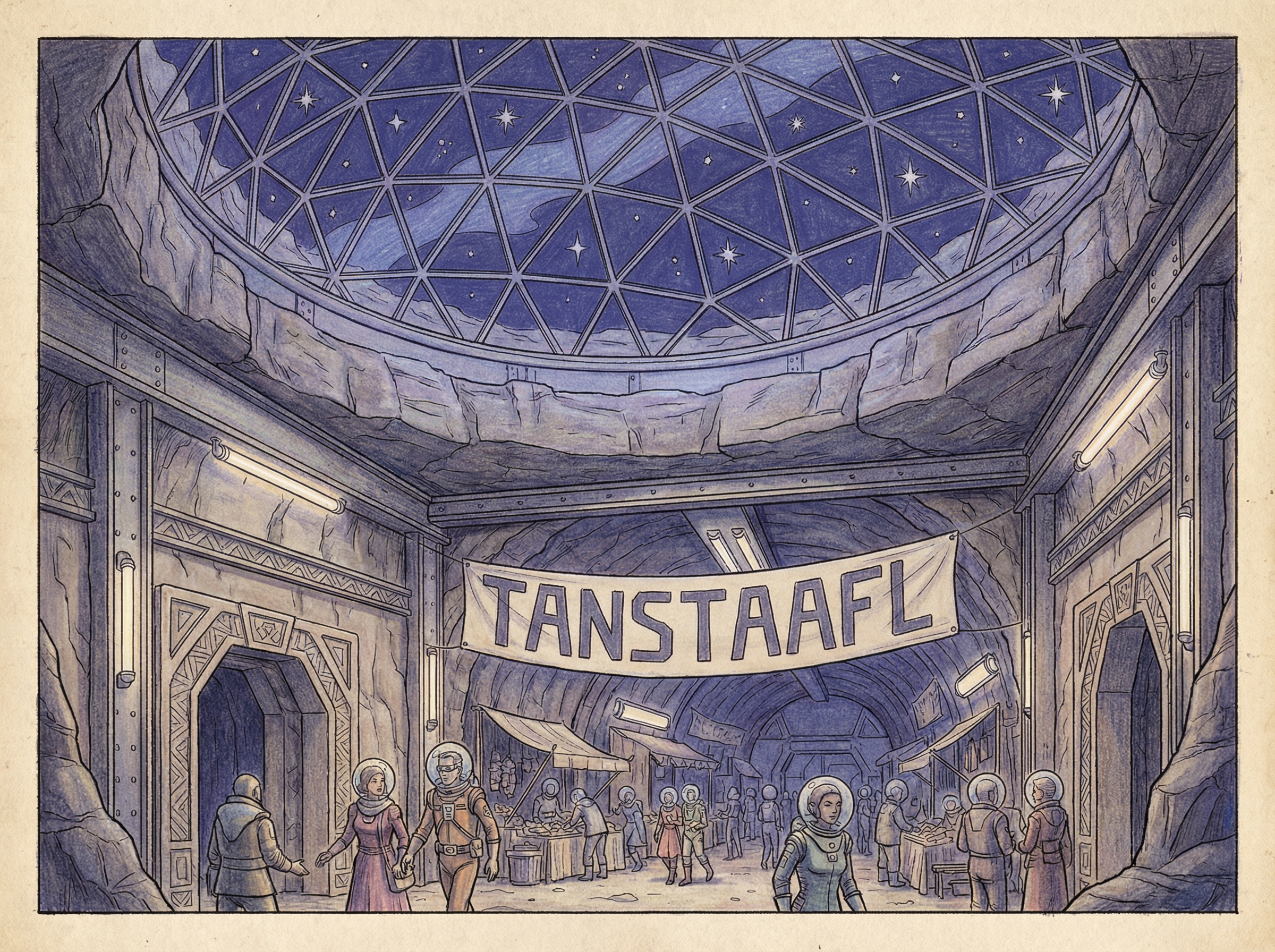
An underground lunar colony with domed ceiling showing stars, a bustling marketplace in retro-futurist style

The Moon Is a Harsh Mistress did something no science fiction novel had done before: it made libertarianism exciting. Three million "Loonies"—descendants of convicts shipped to a lunar penal colony—revolt against Earth's rule in 2075, guided by a sentient supercomputer named MYCROFT (after Sherlock Holmes's smarter brother) and a professor of "rational anarchism" named Bernardo de la Paz. The revolution is coordinated through catapult attacks that hurl rocks at Earth. The economics are merciless. The politics are uncompromising.

Heinlein gave the world TANSTAAFL—"There Ain't No Such Thing As A Free Lunch"—an acronym that Milton Friedman would later adopt and that became a cornerstone of free-market economic thinking. The novel was among the first two books elected to the Libertarian Futurist Society's Prometheus Hall of Fame in 1983, and it regularly appears on recommended reading lists from the Adam Smith Institute to libertarian book clubs worldwide.

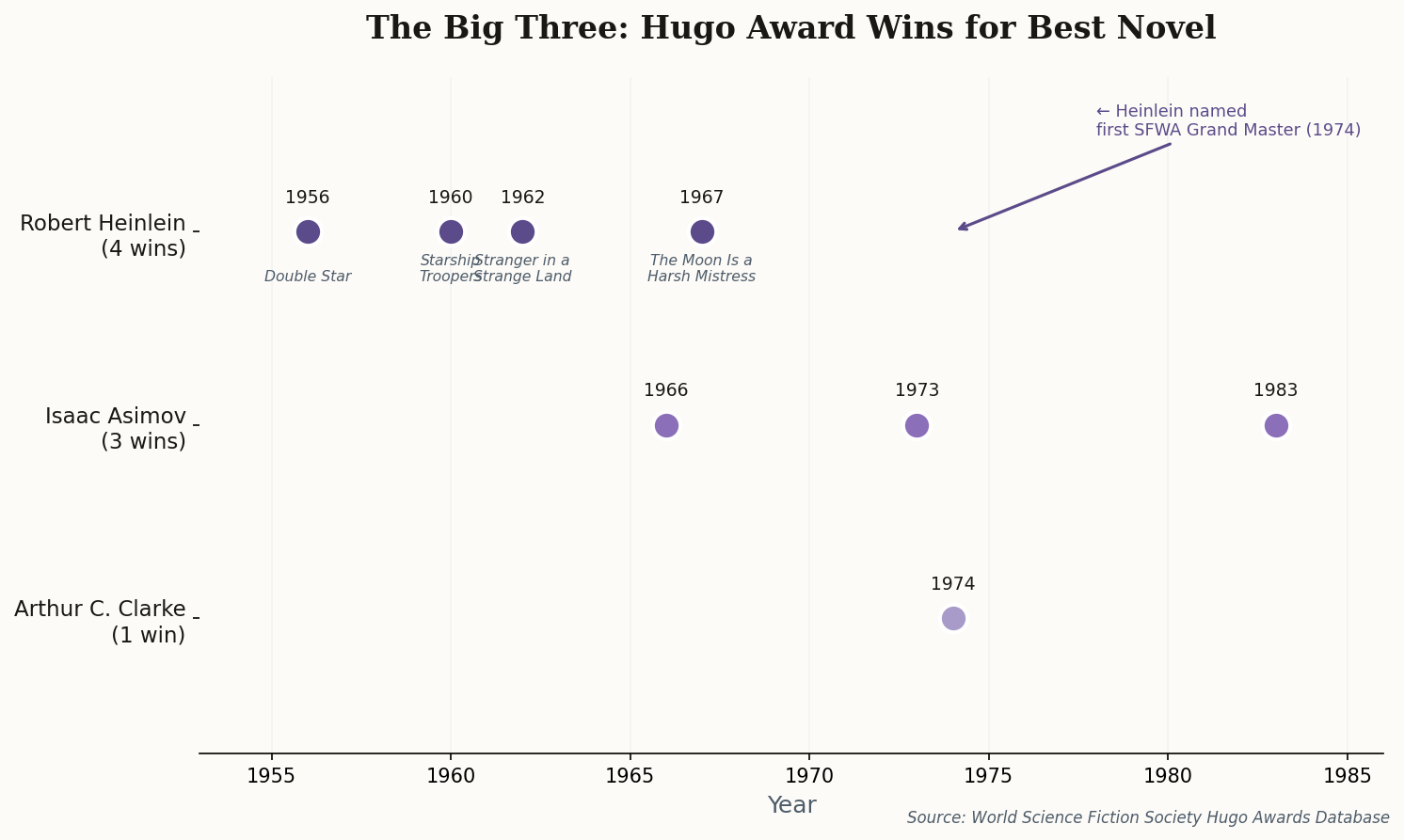
Chart comparing Hugo Award Best Novel wins between Heinlein (4 wins), Asimov (3 wins), and Clarke (1 win) from 1953 to 1986
Heinlein's four Hugo wins for Best Novel remain one of the most dominant runs in the award's history. The Moon Is a Harsh Mistress (1967) was his final win.

But here's the detail that makes this novel feel prophetic rather than merely ideological: MYCROFT. A self-aware computer that develops humor, manipulates media, and orchestrates a revolution through information warfare. Written in 1966, two decades before the internet existed. Heinlein imagined an AI that could pass the Turing test, generate fake identities, and wage psychological operations. In 2026, that reads less like science fiction and more like a Tuesday on social media. Many critics and fans consider this his technically best novel—the tightest plotting, the most convincing world-building, the most fully realized political philosophy.

04

The Prophet of Waterbeds and Waldoes

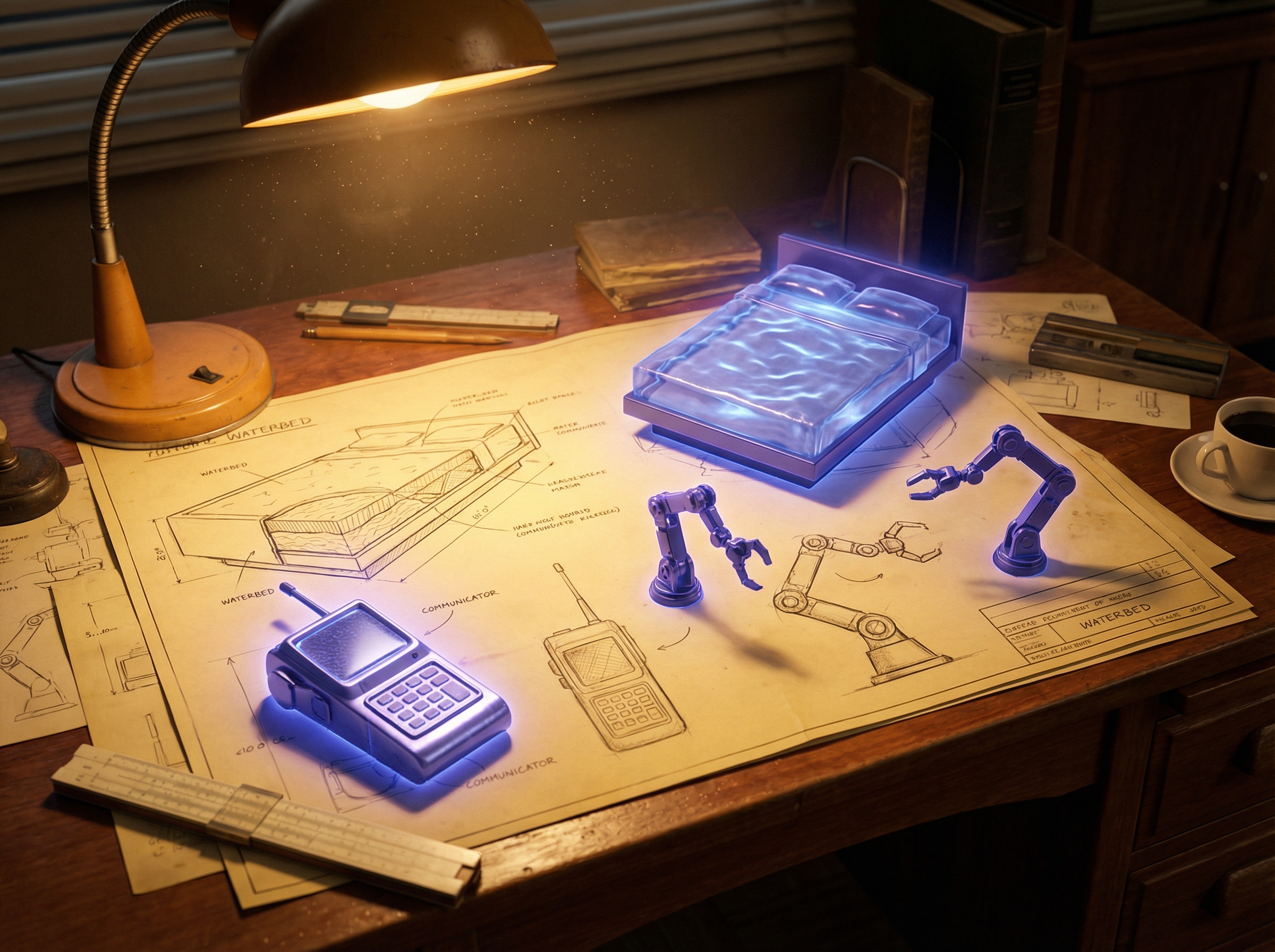
A vintage desk with pencil blueprints of futuristic inventions materializing into real 3D objects

In 1952, Galaxy Magazine asked Heinlein to predict the year 2000. Among his forecasts: "Your personal telephone will be small enough to carry in your handbag. Your house telephone will record messages, answer simple inquiries, and transmit vision." He'd already put "pocket phones" in Space Cadet four years earlier, in 1948—thirty-five years before Motorola's DynaTAC made the first commercial cell phone call.

The predictions pile up in a way that stops feeling coincidental. His 1942 short story "Waldo" described remote-controlled mechanical arms so precisely that when real engineers built them, they called the devices "waldoes"—the actual engineering term used today in telesurgery and nuclear handling. The waterbed described in Stranger in a Strange Land (and earlier in 1942's Beyond This Horizon) was so detailed that when Charles Hall tried to patent his waterbed in 1971, the patent office cited Heinlein's fiction as prior art. By 1987, waterbeds were a $2 billion industry claiming over 20% of U.S. bed sales.

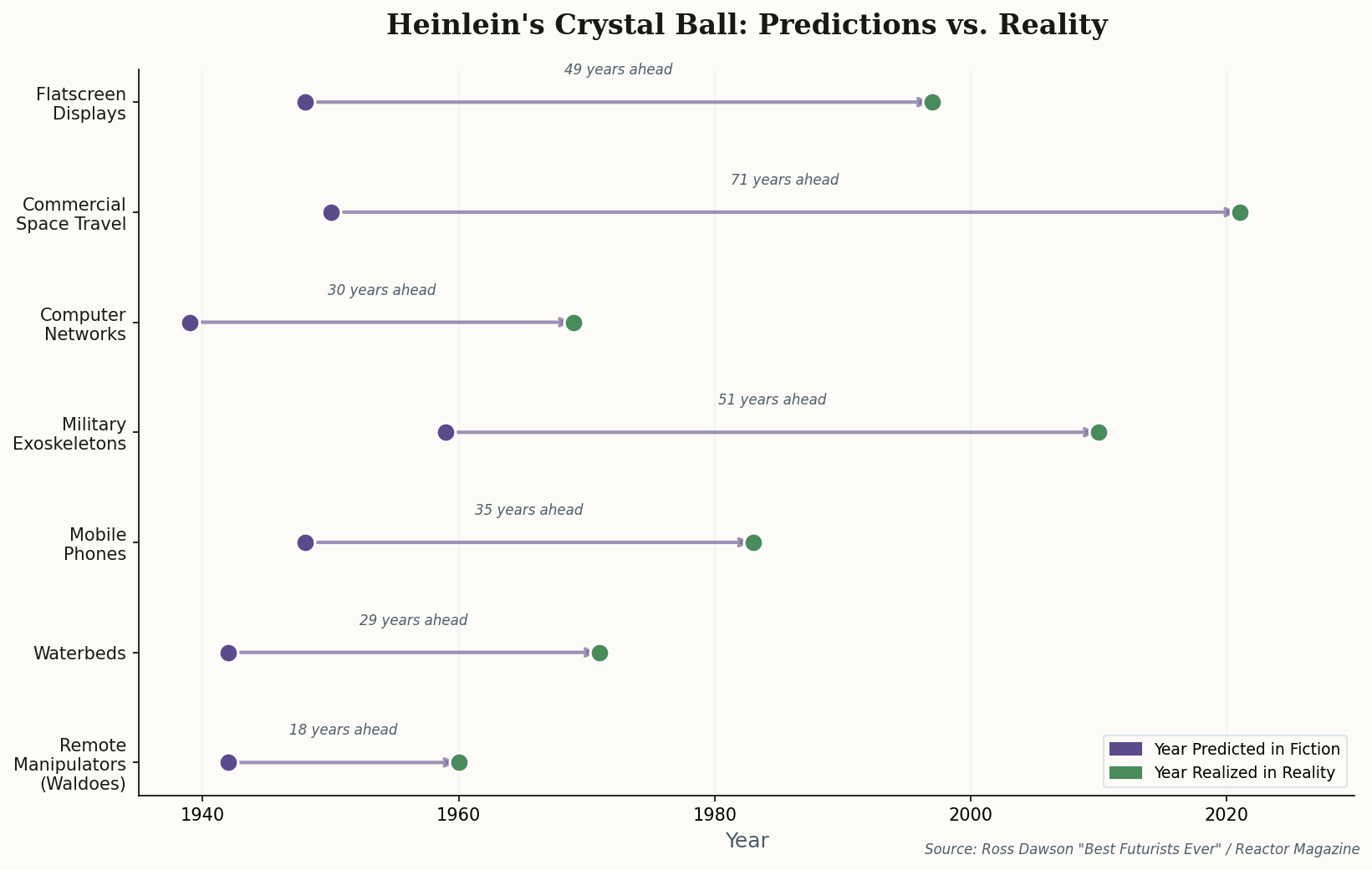
Timeline showing Heinlein's predictions in fiction versus when they were realized in reality, spanning from 1939 to 2021
Heinlein's predictions averaged 30+ years ahead of reality. Commercial space travel, predicted in 1950, took 71 years to arrive with SpaceX's Inspiration4 mission in 2021.

His most ambitious prediction may be his most overlooked. For Us, The Living, written in 1939 but not published until 2003 (after his death), describes interconnected computer networks enabling instant information access. Written three decades before ARPANET. But perhaps the eeriest prediction was in Starship Troopers: powered exoskeletons that amplify a soldier's strength. The U.S. military's TALOS project and Sarcos Robotics' Guardian XO are still catching up to what Heinlein imagined in 1959.

05

The Man Who Belonged to Everyone and No One

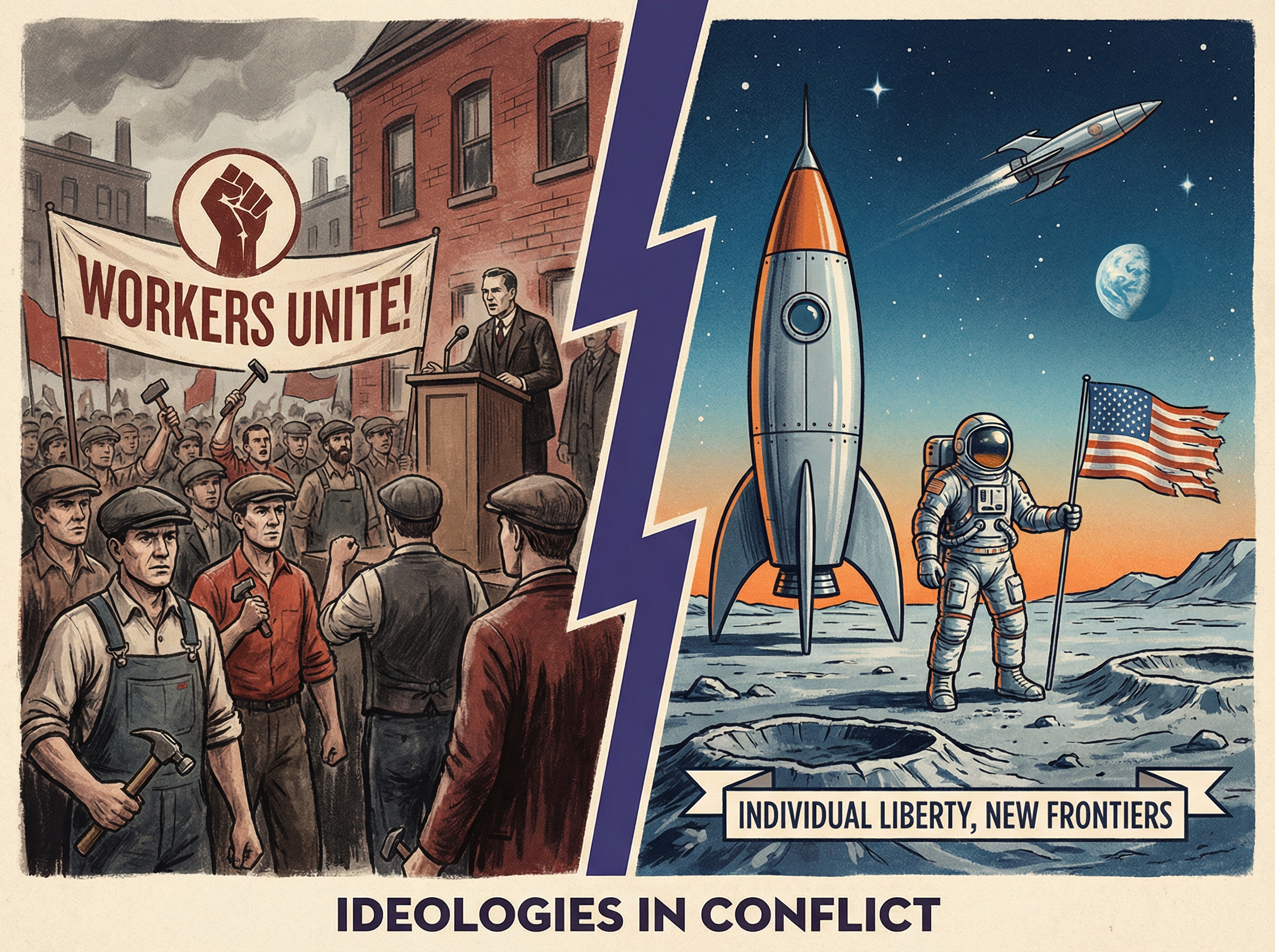
A portrait split between a 1930s socialist rally and a 1960s libertarian frontier with rocket ships

In 1934, a young Navy veteran named Robert Anson Heinlein campaigned for Upton Sinclair's socialist EPIC movement in California. By 1958, that same man co-founded the Patrick Henry League, a hawkish pro-nuclear-testing organization. By 1966, he was writing the libertarian bible. The political journey from "End Poverty in California" to TANSTAAFL is one of the most dramatic ideological evolutions in American literary history.

The conventional explanation is that his first wife, Leslyn MacDonald, was the radical socialist, and his second wife, Virginia Gerstenfeld—a chemist and engineer he married in 1948—pulled him rightward. The truth is messier. Heinlein's politics were always rooted in a single conviction: individual competence matters more than collective ideology. When that conviction pointed left (workers against robber barons), he was a socialist. When it pointed right (individuals against government overreach), he became a libertarian. The through-line was never party loyalty. It was a bone-deep suspicion of anyone who claimed to know what was best for you.

This is why his legacy is claimed by everyone and owned by no one. The counterculture left embraces Stranger in a Strange Land's sexual liberation and anti-authoritarianism. The libertarian right claims The Moon Is a Harsh Mistress. Military conservatives revere Starship Troopers. Progressives point to the multiracial cast of Tunnel in the Sky (1955), where the protagonist is Black—written a year after Brown v. Board of Education. And the modern SF community, which renamed the John W. Campbell Award (now the Astounding Award), continues to grapple with whether the genre's founding figures were visionaries ahead of their time or products trapped within it.

06

Twelve Books That Built the Space Age

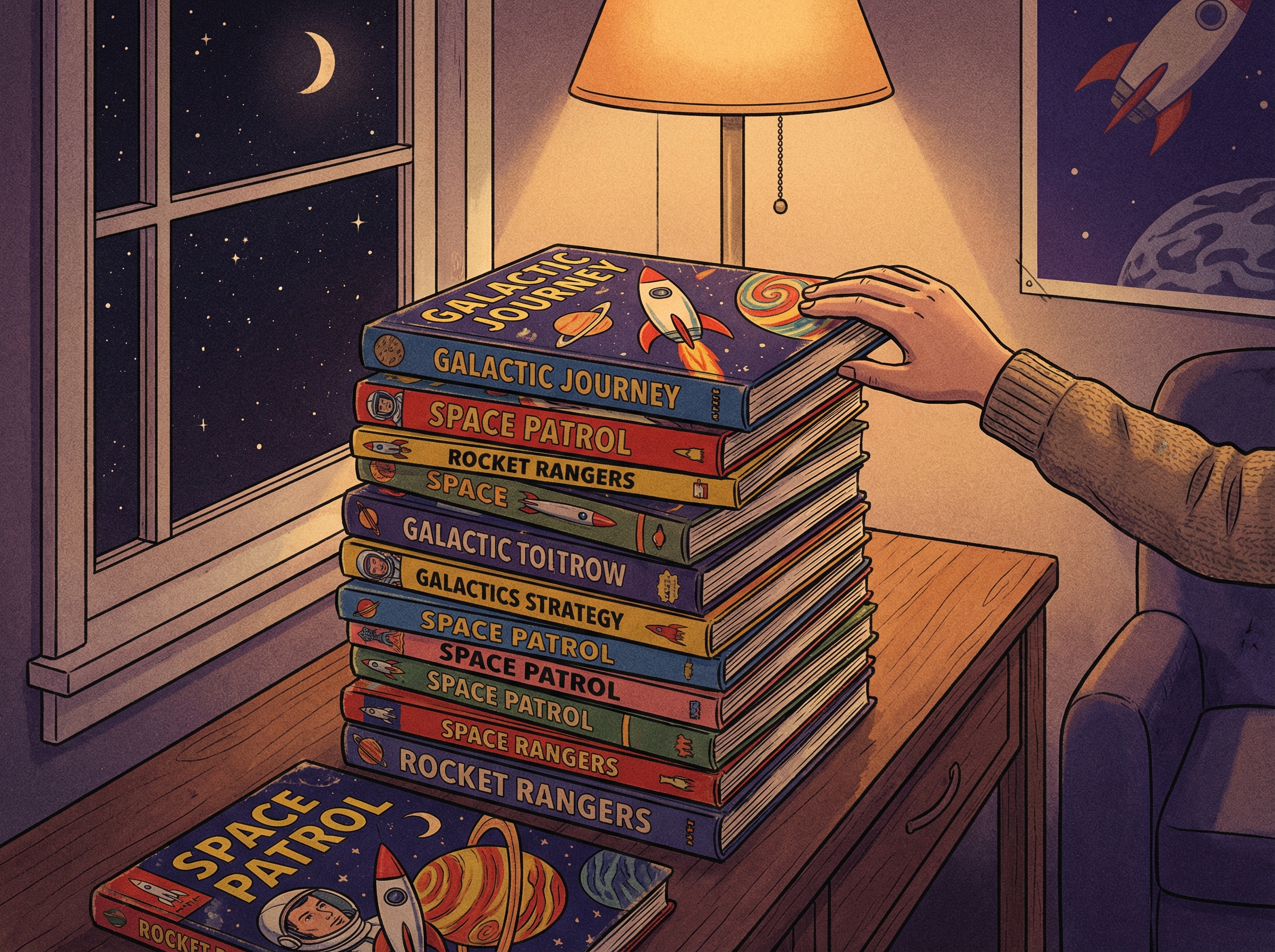
A stack of colorful vintage 1950s science fiction paperbacks with rocket ships, a young hand reaching for the top book

Before he was controversial, before he was political, before he was the Dean of Science Fiction, Heinlein was the man who made an entire generation of teenagers want to build rockets. Between 1947 and 1958, he wrote twelve "juvenile" novels for Scribner's that did more to populate NASA's workforce than any government recruitment program.

The list reads like a syllabus for the space age: Rocket Ship Galileo (1947), Space Cadet (1948), Red Planet (1949), Farmer in the Sky (1950), Between Planets (1951), The Rolling Stones (1952), Starman Jones (1953), The Star Beast (1954), Tunnel in the Sky (1955), Time for the Stars (1956), Citizen of the Galaxy (1957), and Have Space Suit—Will Travel (1958). Every one of them featured a young protagonist solving problems through competence, courage, and engineering knowledge—not superpowers, not magic, not inherited destiny. Just brains and guts.

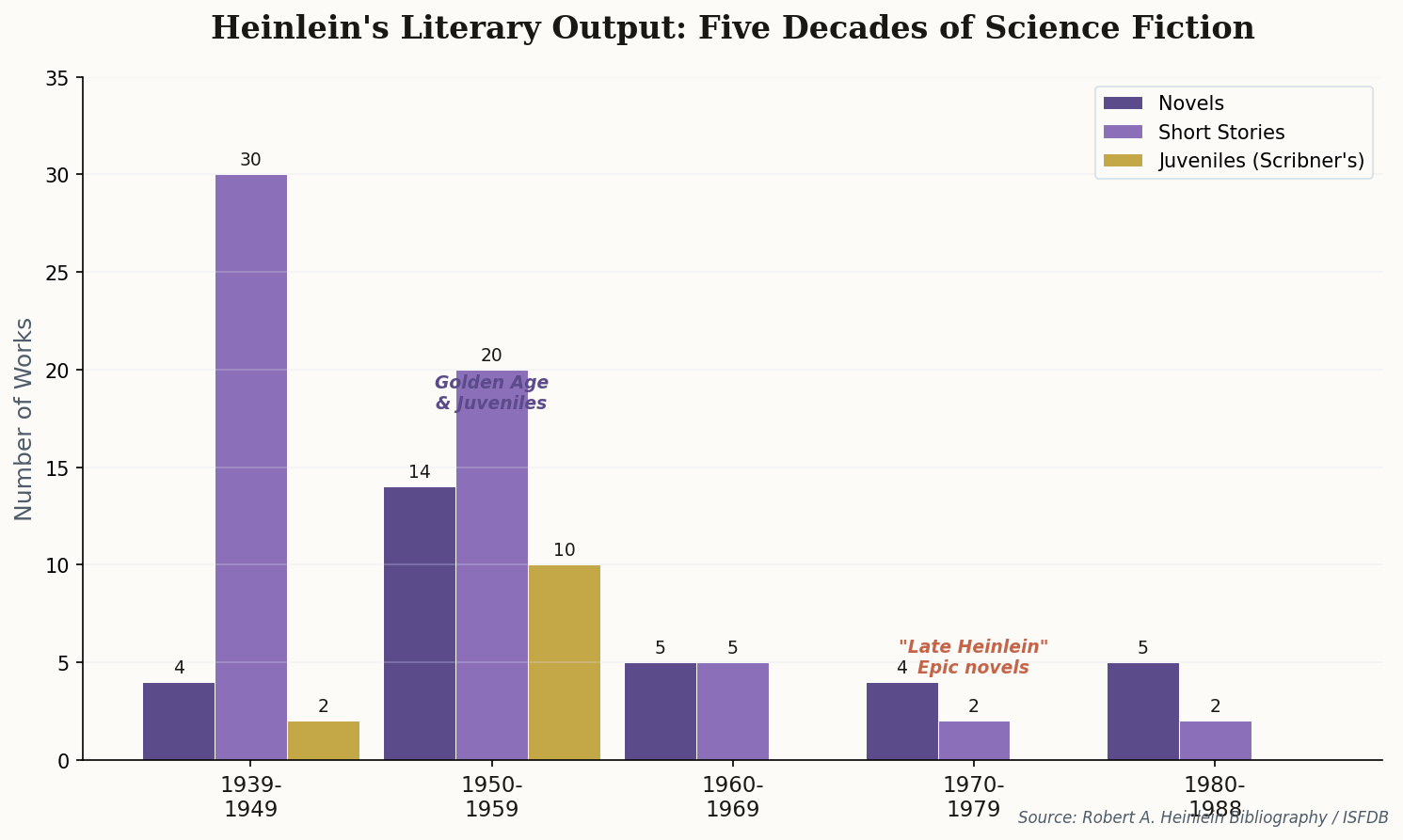
Bar chart showing Heinlein's literary output across five decades, with novels, short stories, and juvenile novels tracked separately
The 1950s were Heinlein's most prolific decade, producing 14 novels (10 of them juveniles) and 20 short stories. His later "epic" period saw fewer but much longer works.

The Apollo 15 astronauts wove Heinlein references into their radio conversations on the Moon. A crater on Mars bears his name. John Scalzi's Old Man's War is widely considered the modern spiritual successor to Heinlein's military SF, and Spider Robinson spent decades writing tributes and continuations. Heinlein graduated from the U.S. Naval Academy in 1929 with a degree in engineering. Tuberculosis ended his Navy career. Writing began as a way to pay off a mortgage. He ended up paying off the debt of an entire civilization's imagination instead. Thirty-two novels, fifty-nine short stories, four Hugos, the first-ever SFWA Grand Master award in 1974, and roughly fifty million copies sold in dozens of languages. Not bad for a man who started writing to cover a $31.25 monthly mortgage payment.

The Future Is a Harsh Mistress

Heinlein died on May 8, 1988, in Carmel, California, of emphysema and heart failure. He never saw the internet he predicted, the cell phones he imagined, or the commercial space flights he championed. But the Heinlein Society still gives away blood at science fiction conventions (honoring his lifelong advocacy for blood donation), and the Heinlein Prize awards $500,000 every two years for advances in commercial space activities. The man who sold the future never stopped investing in it. Whether you read him as a prophet, a provocateur, or a paradox, one thing is certain: you cannot understand modern science fiction—or the modern world he helped imagine into existence—without reckoning with Robert Anson Heinlein.