Military History

The Last Gamble in the Ardennes

In December 1944, Hitler threw 200,000 men and 600 tanks into the frozen Ardennes forest. What followed was the bloodiest battle in American history—and the moment the war's outcome became irreversible.

Listen
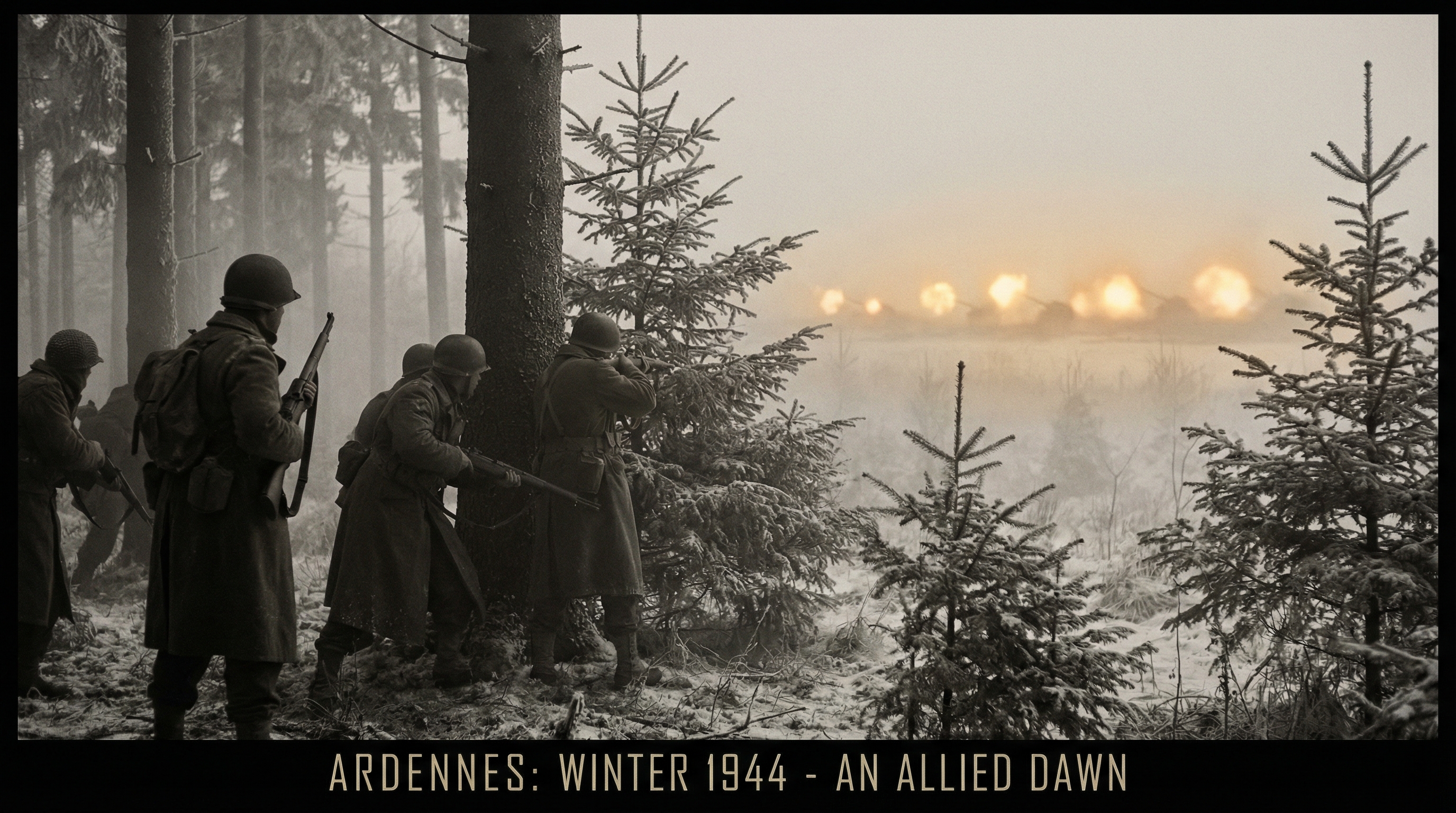
Dawn breaks over the frozen Ardennes forest in December 1944, artillery flashes illuminating fog-shrouded pine trees
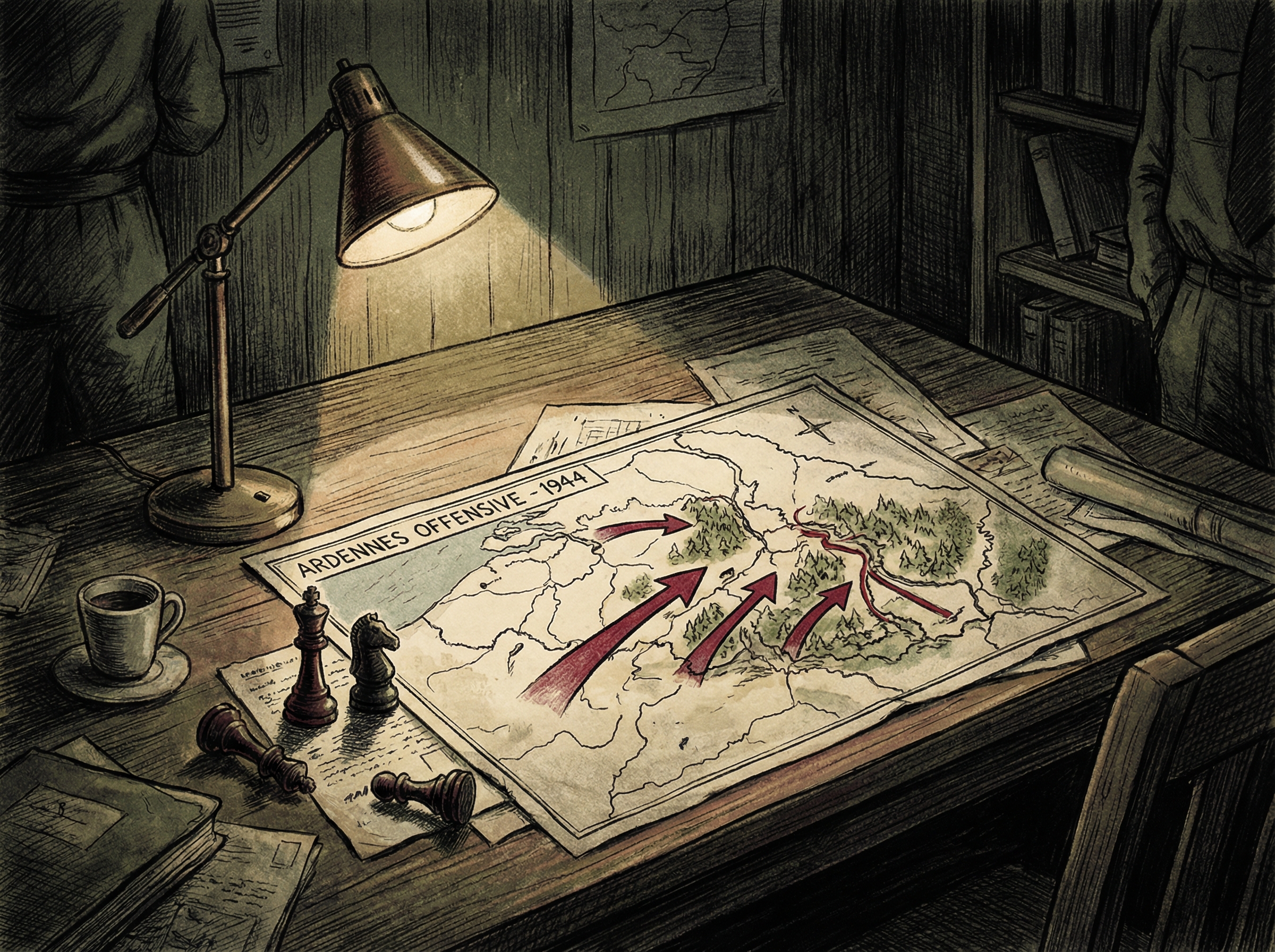
A war room map table illuminated by a single lamp, showing the Ardennes attack plan
01

Hitler's Last Gamble: The Plan That Made His Own Generals Flinch

By autumn 1944, the Third Reich was dying and everyone at the map table knew it. Allied armies had liberated France and Belgium. The Soviets were preparing their winter offensive toward Berlin. The rational move was to consolidate, defend, and negotiate. Adolf Hitler chose a different path entirely.

Operation Wacht am Rhein—Watch on the Rhine—was the kind of plan that only a man living inside his own mythology could concoct. The idea: hurl every remaining mobile reserve westward through the Ardennes forest, split the Allied armies in half, and seize the port of Antwerp. Cut off from supplies, the British and Americans would be forced to sue for peace, freeing Germany to turn east. It was, quite literally, a bet-the-country gamble on a single hand of cards.

His own commanders thought it was insane. Field Marshal von Rundstedt and Field Marshal Model argued for a more limited offensive. Hitler overruled them. As General Hasso von Manteuffel later said: "Hitler was gambling his last reserve... it was an all-or-nothing operation."

The force assembled in secret was staggering: over 200,000 troops, 600 tanks and assault guns (including the 70-ton Tiger II), and nearly 1,900 artillery pieces. The target was an 80-mile stretch of the American line the GIs called the "Ghost Front"—a quiet sector used for resting battle-worn units and breaking in green divisions. Allied intelligence, despite having cracked German codes via ULTRA, missed the buildup entirely. Strict radio silence and atrocious weather did what the Germans couldn't achieve on their own: perfect operational surprise.
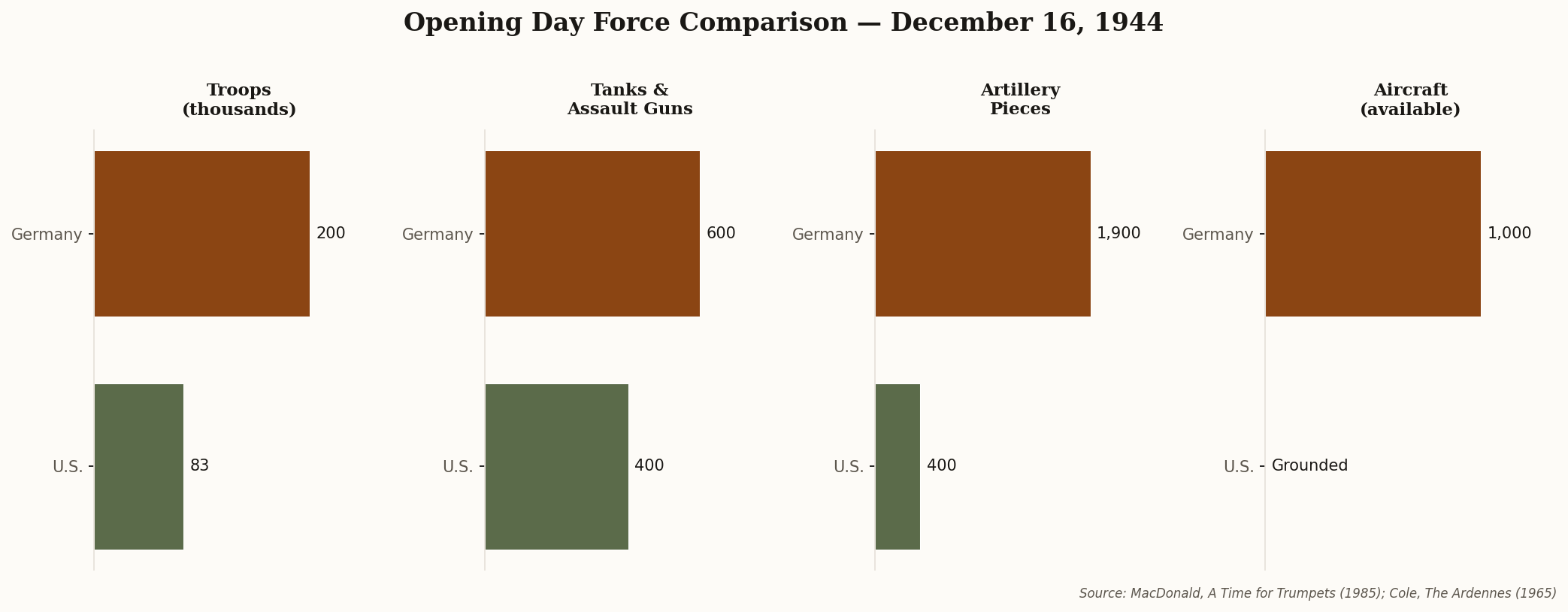
Bar chart comparing German and American forces on December 16, 1944: Germany had 200,000 troops, 600 tanks, 1,900 artillery, and 1,000 aircraft versus America's 83,000 troops, 400 tanks, 400 artillery, and 0 operational aircraft
Opening day force comparison. The American sector was outnumbered roughly 3:1 in troops and armor. Crucially, fog and cloud cover meant zero Allied air support for the first week.

The plan required three things to succeed: total surprise, bad weather to neutralize Allied air power, and captured fuel dumps to keep the panzers rolling. Hitler got two out of three. The third failure—fuel—would prove fatal.
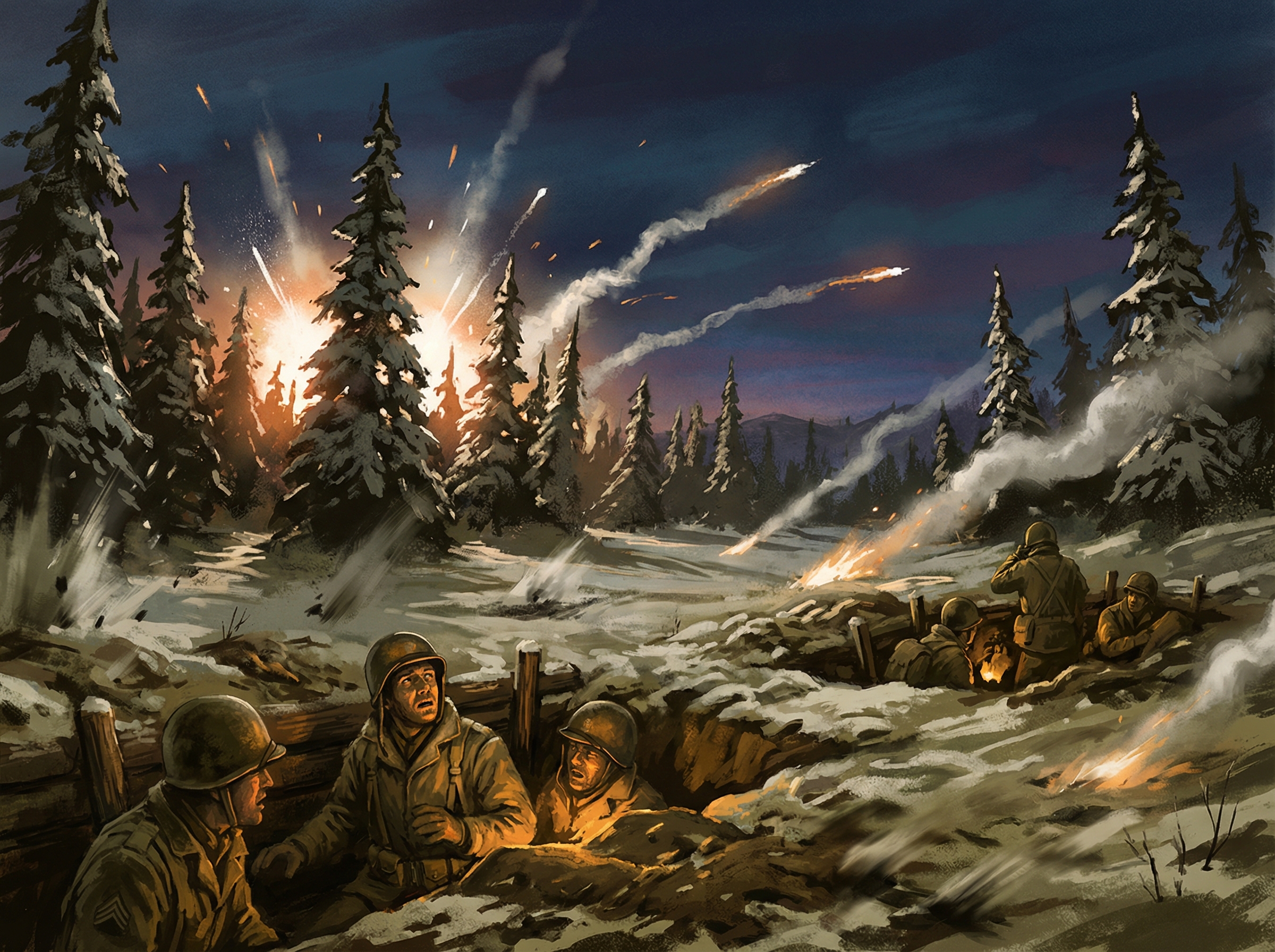
Predawn artillery barrage illuminating a frozen forest, explosions against the dark sky
02

05:30, December 16: The Ghost Front Shatters

The sound came before dawn. Two thousand German guns opened simultaneously along an 80-mile front, a thunderclap that obliterated communication lines and shook men awake in their frozen foxholes. Then came the white-clad infantry, wave after wave, materializing out of the fog like ghosts. The quiet sector was quiet no more.

What happened next was a study in contrasts. In the north, the U.S. 99th Infantry Division—derisively called "Battle Babies" because they'd never seen serious combat—did something no one expected. Outnumbered five to one at Elsenborn Ridge, they refused to break. Reinforced by the veteran 2nd Infantry Division, they held that critical high ground for days, inflicting devastating casualties on the I SS Panzer Corps. This one stubborn stand threw the entire German timetable in the northern sector into chaos. It doesn't show up in most Hollywood films. It should.

Further south, disaster. The green 106th Infantry Division, on the line barely five days, found itself surrounded at the Schnee Eifel. By December 19, roughly 8,000 to 9,000 men of the 422nd and 423rd Regiments surrendered—the largest mass capitulation of American troops since the Civil War. It was a staggering blow.

Leading the German spearhead was Kampfgruppe Peiper, an SS armored battle group of 4,800 men under Joachim Peiper. Their mission: race to the Meuse River crossings at any cost. But the narrow, twisting Ardennes roads conspired against them. At Stavelot and Trois-Ponts, tiny groups of American combat engineers blew bridges in their faces and set up roadblocks that bled hours from the timetable. Small units, making decisions under impossible pressure, altered the shape of the battle.

Timeline chart showing German penetration depth from December 16 to January 25, peaking at 50 miles around December 24-26 and never reaching the Meuse River objective at 60 miles
The "Bulge" at its deepest reached roughly 50 miles—tantalizingly close to the Meuse River, but never close enough. The dotted line marks the German objective they never reached.
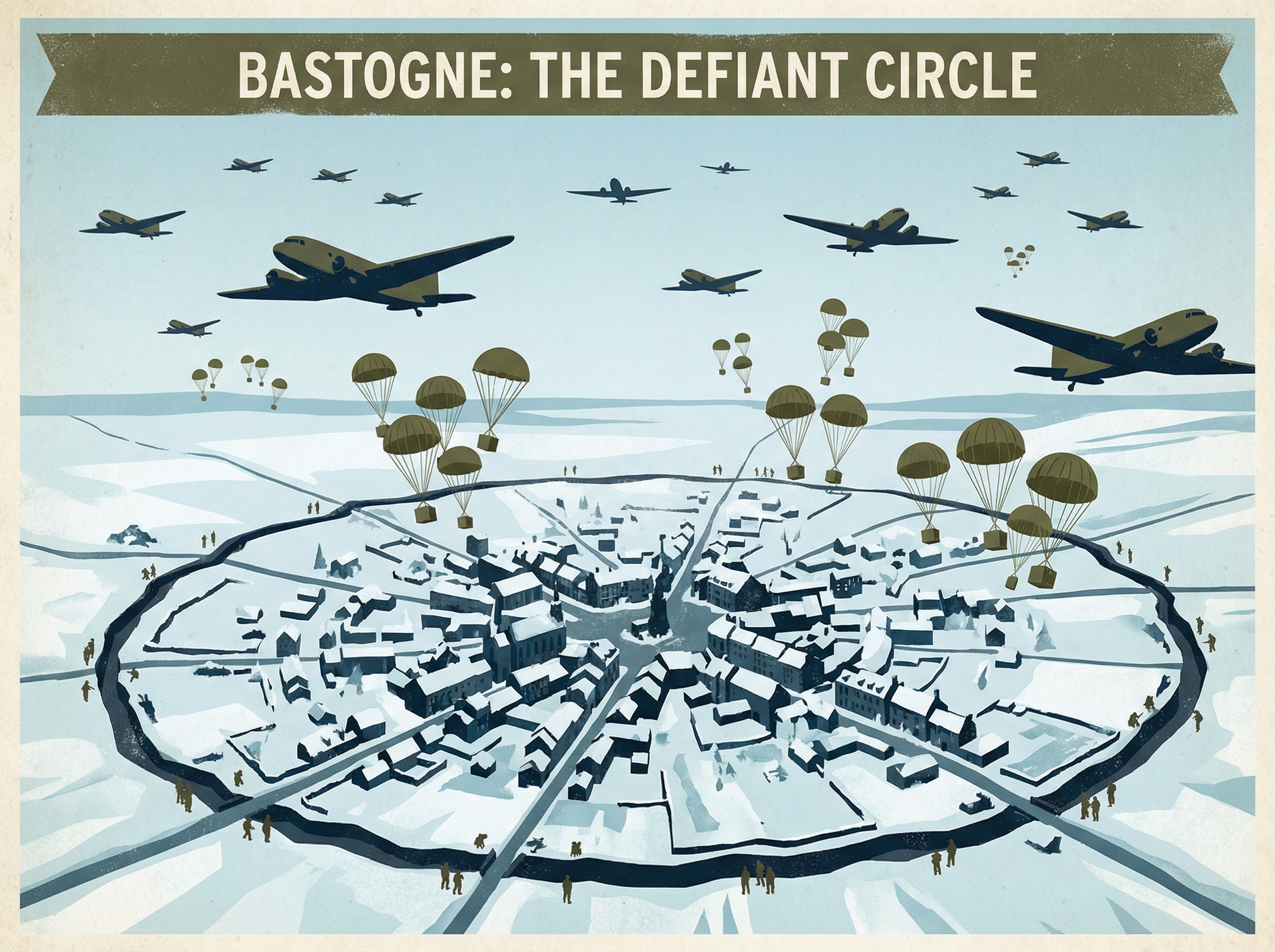
Aerial view of Bastogne under siege, supply parachutes dropping from C-47 aircraft against a winter sky
03

"NUTS!": The One-Word Reply That Defined American Defiance

Seven major roads converged on Bastogne. For the German 5th Panzer Army to reach the Meuse and Antwerp before their tanks ran dry, they needed every one of those roads. Eisenhower knew this too. He sent the 101st Airborne Division—the Screaming Eagles—into Bastogne by truck on December 19. Two days later, they were completely surrounded.

The conditions inside the perimeter were medieval. Temperatures near zero. Soldiers fighting in summer uniforms because winter gear hadn't arrived. Ammunition running low. Medical supplies essentially gone. Casualties lay in cold church basements because there was nowhere else to put them. And yet the morale held—a phenomenon that still confounds military psychologists.

On December 22, four German soldiers walked up under a white flag carrying a written ultimatum from General Heinrich von Lüttwitz: surrender within two hours or face "total annihilation." The message was brought to Brigadier General Anthony McAuliffe, who was napping. His response on reading it:

"Us surrender? Aw, nuts!"

His staff convinced him that his initial reaction was, in fact, the perfect formal reply. He had it typed, centered on a single sheet of paper: "To the German Commander: NUTS! — The American Commander." When the bewildered German officers asked Colonel Joseph Harper what it meant, Harper didn't mince words: "In plain English? Go to hell."

The reply entered the American military lexicon immediately. But what made it more than bravado was the follow-through. On December 23, the skies finally cleared. A fleet of C-47 transports, escorted by P-47 Thunderbolts, dropped 144 gliders and hundreds of supply parachutes over the besieged town. The "Battered Bastards of Bastogne"—their own nickname—had ammunition again. The hole in the doughnut held.

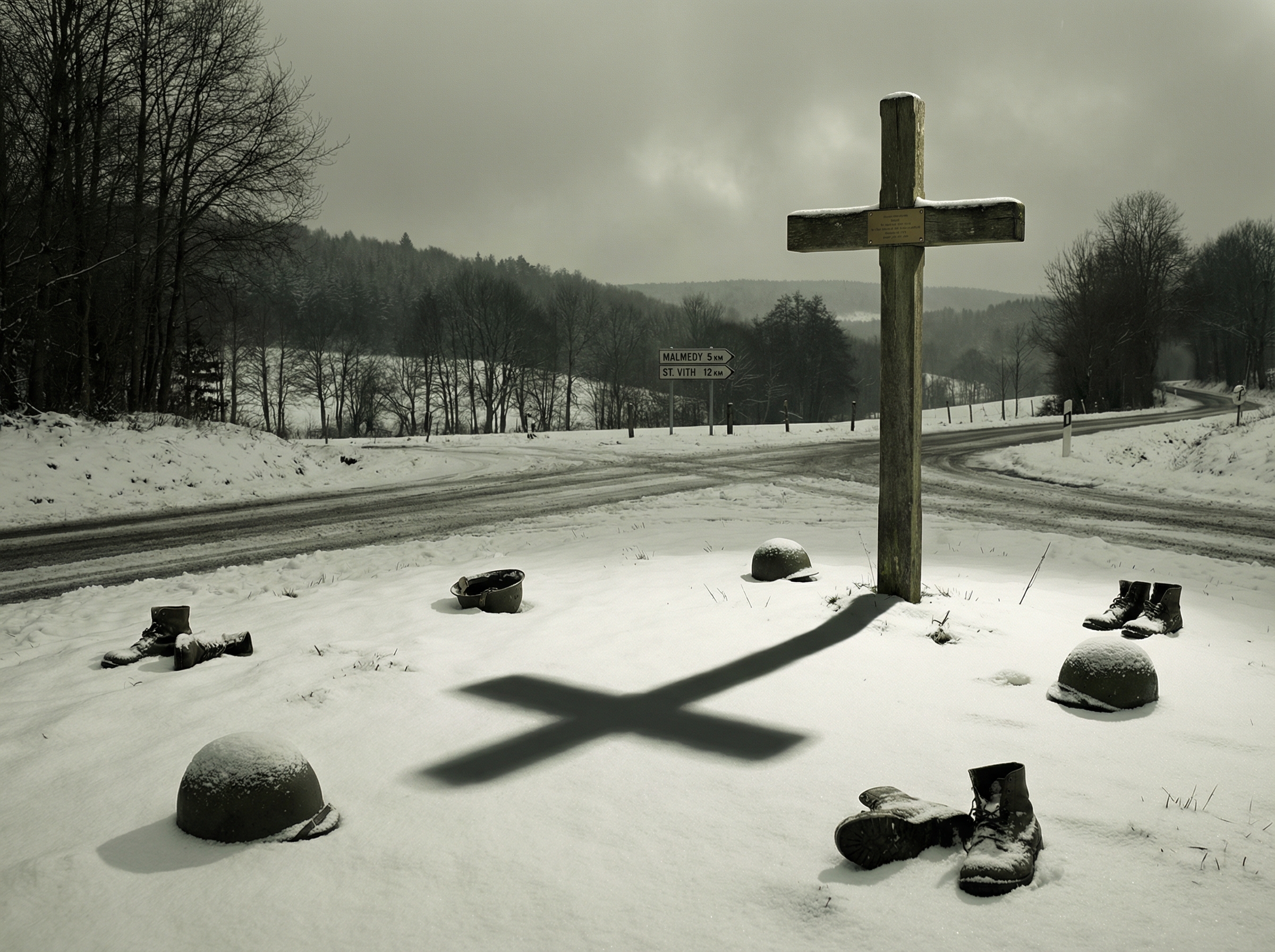
A solitary wooden cross casting a long shadow at a snowy crossroads, a memorial to the fallen
04

Blood in the Snow: Malmedy, the Wereth 11, and the SS

War has rules. The SS didn't care about them.

On December 17, Battery B of the 285th Field Artillery Observation Battalion blundered into Kampfgruppe Peiper's column near the Baugnez crossroads outside Malmedy. Outgunned and surrounded, about 120 Americans surrendered. They were herded into a snowy field. Then the machine guns opened up.

Eighty-four American POWs were murdered. SS troopers walked among the fallen, delivering coups de grâce to anyone still moving. More than 40 men survived only by lying motionless in the blood-soaked snow until the killers moved on. When word of the Malmedy Massacre spread through American lines, it fundamentally changed the character of the fighting. GIs who might have taken prisoners now thought twice.

Less known, and arguably more horrifying, is the story of the Wereth 11. That same day, eleven Black American soldiers from the 333rd Field Artillery Battalion, separated from their unit, sought refuge in a Belgian farmhouse. A local collaborator betrayed them to a patrol from the 1st SS Panzer Division. The soldiers were marched into a field, tortured, and murdered. Forensic examination later revealed broken legs, bayonet wounds to the eyes, and smashed skulls. It was one of the most brutal racially motivated war crimes against Black soldiers in WWII—and it remained largely forgotten for decades. A memorial at Wereth was finally erected in 2004.

Meanwhile, Otto Skorzeny's Operation Greif added psychological chaos. English-speaking German commandos in captured American uniforms and jeeps infiltrated Allied lines to cut communications and misdirect traffic. They largely failed at their military objectives, but they succeeded spectacularly at inducing paranoia. American GIs started quizzing each other on baseball stats and state capitals at every checkpoint. Even General Omar Bradley was detained for correctly identifying Springfield as the capital of Illinois—the MP was certain it was Chicago.

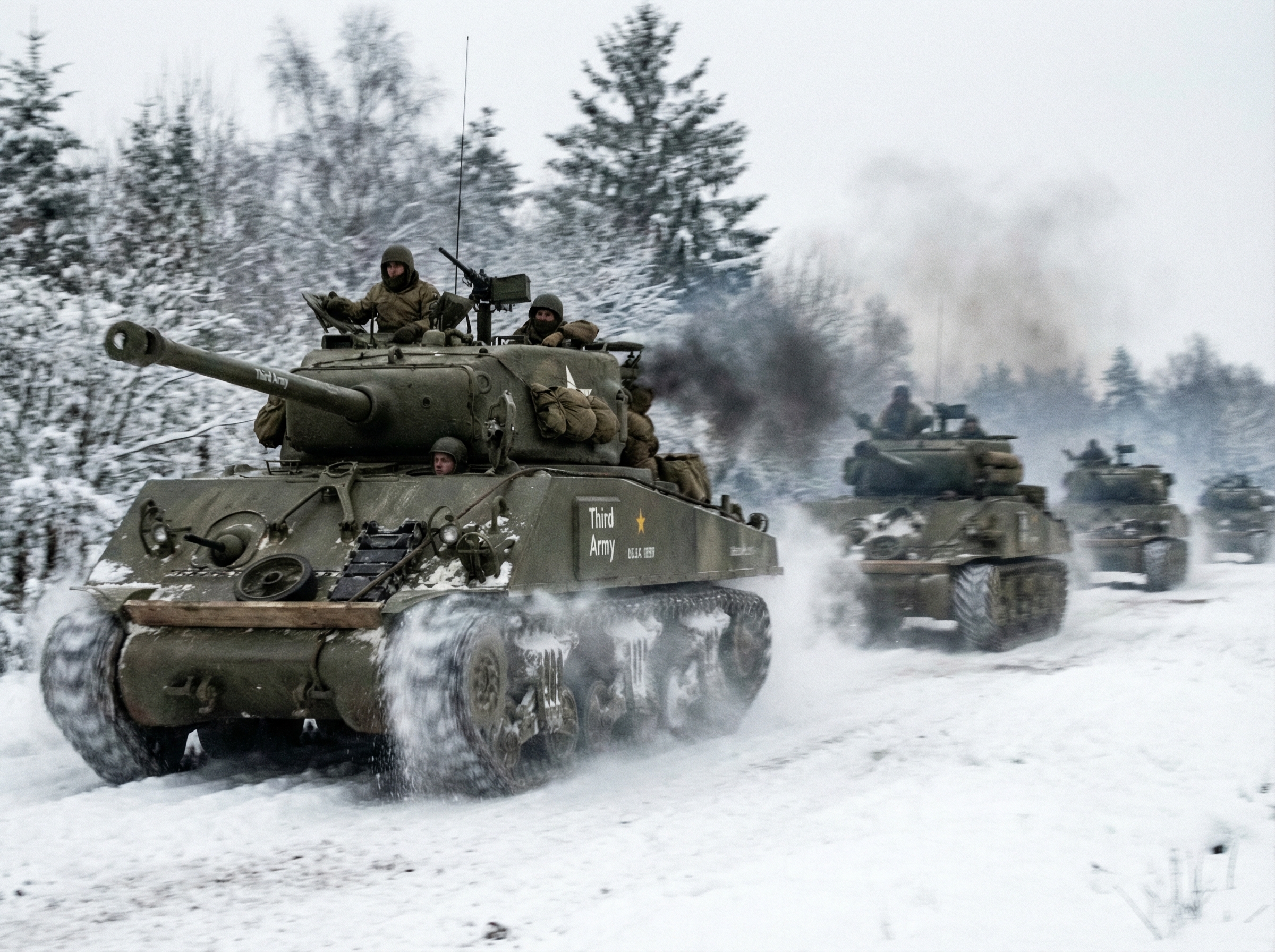
A column of Sherman tanks charging through deep snow, exhaust trailing behind
05

Patton Turns North: The 90-Degree Miracle

On December 19, Eisenhower convened a tense meeting at a damp barracks in Verdun. The mood was grim. Allied generals feared a catastrophe on the scale of Dunkirk. Eisenhower opened with a line that reframed everything: "The present situation is to be regarded as one of opportunity for us and not of disaster."

Then he turned to George S. Patton Jr. and asked how quickly the Third Army could disengage from the Saar front, pivot 90 degrees north, and hit the German flank. Patton's answer: "I can attack with three divisions in forty-eight hours."

The room went silent. Other generals thought it was impossible—a grandstanding boast from Patton's famously oversized ego. It wasn't. Patton had anticipated the German move and had already ordered his staff to prepare three contingency plans. In military logistics, what he proposed was roughly the equivalent of turning an aircraft carrier on a dime during a hurricane.

In less than three days, over 100,000 men and thousands of vehicles disengaged from combat, rotated 90 degrees, and marched nearly 100 miles over icy roads through blinding snowstorms. It remains one of the most remarkable logistical feats in military history. Patton himself attributed part of his success to divine intervention—he had his chaplain compose a prayer for clear weather, which he distributed to every soldier in the Third Army. The weather cleared.

Leading the final push was Lieutenant Colonel Creighton Abrams (the man the M1 Abrams tank is named for) and his 37th Tank Battalion of the 4th Armored Division. On December 26, smashing through the village of Assenois against fierce resistance, Abrams' tanks linked up with the 101st Airborne perimeter at 4:50 PM. The siege was broken. Patton later wrote in his diary: "The move of the Third Army from the Saar to the Ardennes... is the most brilliant execution of a complicated maneuver in the history of war." For once, the brag was arguably justified.

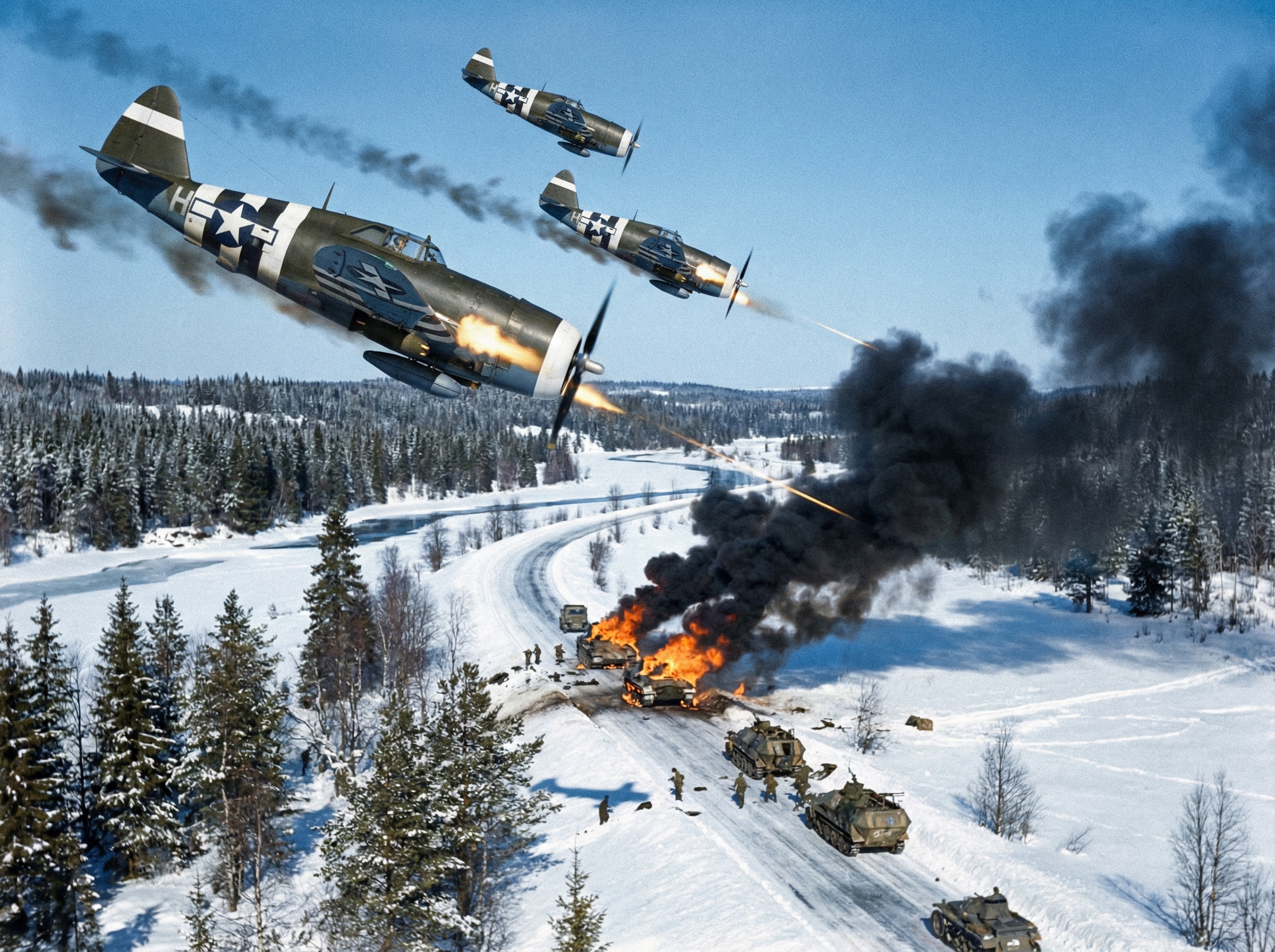
P-47 Thunderbolts diving through clear blue sky, strafing a burning German panzer column on a snowy road
06

Clear Skies, Burning Panzers: When the Weather Turned

For the first week of the battle, the German army's best ally wasn't a general—it was the weather. Dense fog, low clouds, and heavy snow grounded the mighty Allied air fleets. German panzer columns could move in daylight, safe from the dreaded Jabos (fighter-bombers). The calculus was simple: as long as the ceiling stayed low, German armor had a chance.

On December 23, a high-pressure system the meteorologists called the "Russian High" moved in. The fog lifted. The sun appeared. And thousands of Allied aircraft filled the sky.

P-47 Thunderbolts and Hawker Typhoons swooped on exposed German columns, unleashing rockets and bombs on tanks, trucks, and horse-drawn supply wagons. The roads of the Ardennes became open-air graveyards of burning wreckage. German fuel convoys—the lifeline of the entire offensive—were hunted down systematically.

The result was decisive. Near Celles, just four miles from the Meuse River—the doorstep of their objective—the 2nd Panzer Division literally ran out of gas. Immobile Tiger and Panther tanks became steel coffins, pounded from the air and then finished off by the U.S. 2nd Armored Division. The Meuse was never crossed.

In a final desperate throw, the Luftwaffe launched Operation Bodenplatte on New Year's Day 1945. Over 1,000 German fighters raided Allied airfields in Belgium and Holland, destroying nearly 500 aircraft on the ground. A tactical success—and a strategic catastrophe. The Luftwaffe lost nearly 300 pilots, many of them irreplaceable aces and squadron leaders. The Allies could replace 500 planes in weeks. Germany couldn't replace those pilots ever. Bodenplatte was the death certificate of the German air force.

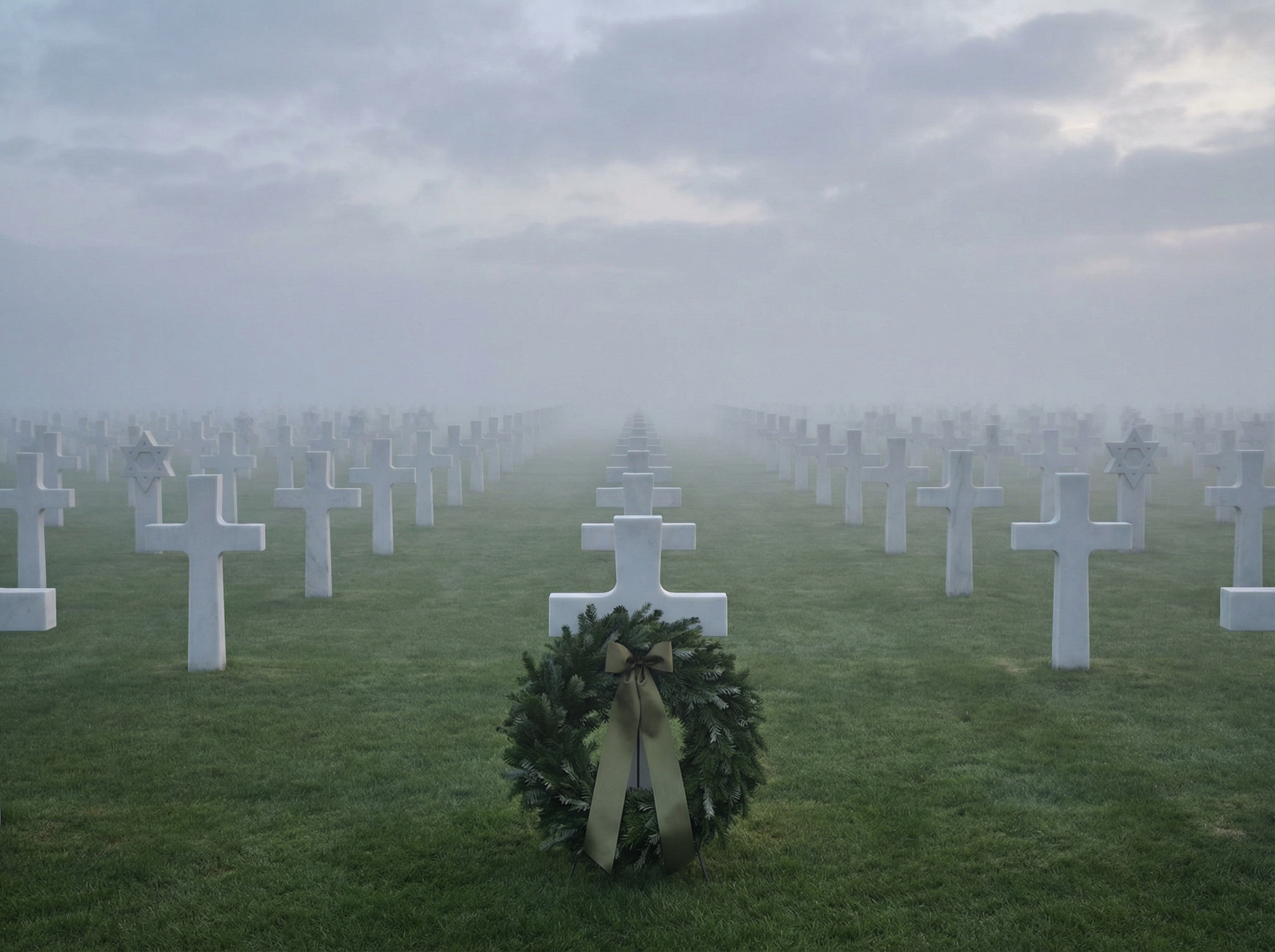
Rows of white crosses at an American military cemetery in Belgium, morning fog lifting over green grass
07

The Price of Victory: 89,500 American Casualties and the Lessons That Endure

By late January 1945, the Bulge was flattened and the original lines restored. Hitler's gamble had failed completely. But the cost of stopping it was staggering.

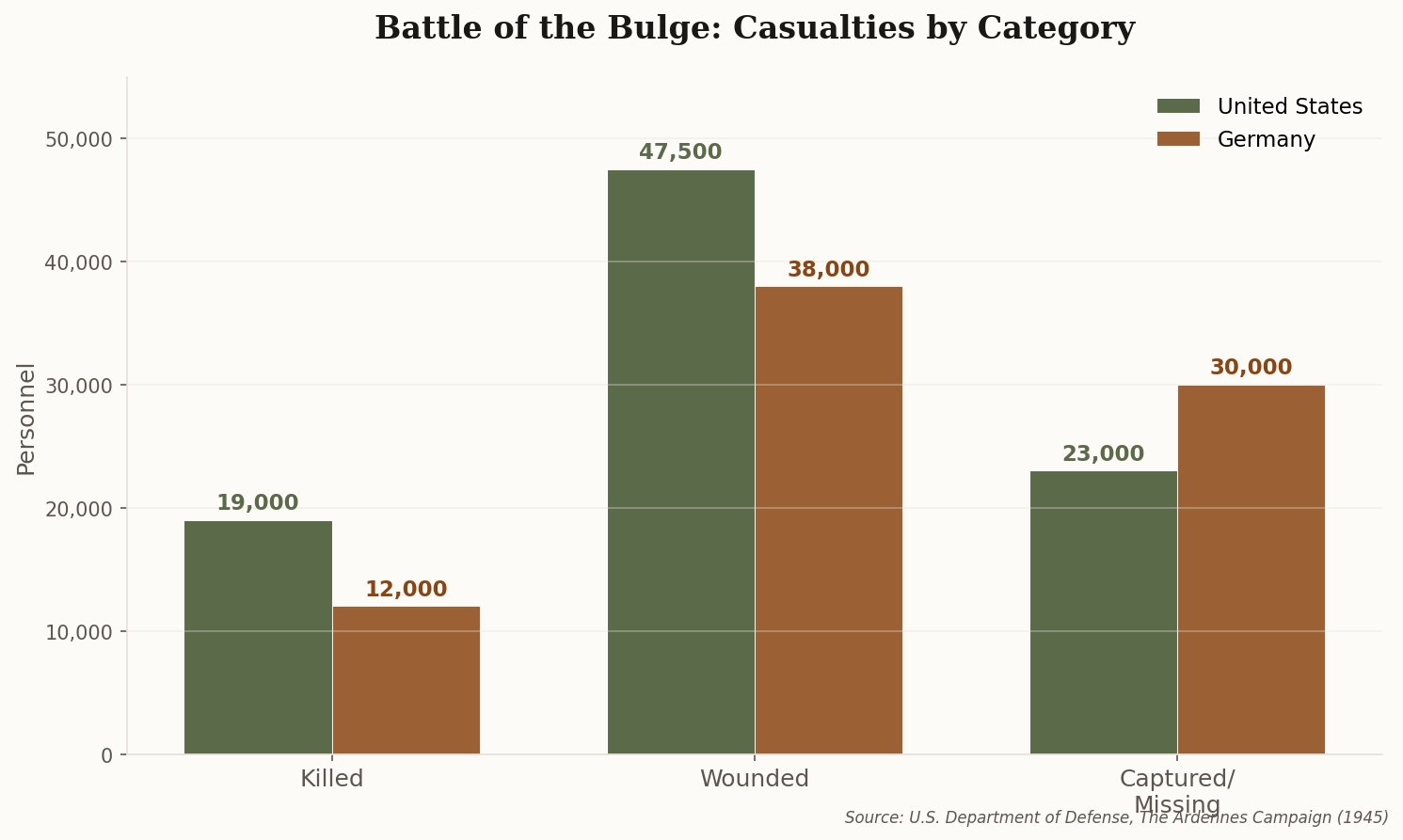
Bar chart comparing U.S. and German casualties: U.S. had 19,000 killed, 47,500 wounded, 23,000 captured versus German estimates of 12,000 killed, 38,000 wounded, 30,000 captured
Total American casualties reached approximately 89,500—making the Battle of the Bulge the bloodiest single battle in U.S. military history, exceeding Antietam, Gettysburg, and D-Day.

The American toll: approximately 89,500 casualties. Nineteen thousand killed. Forty-seven thousand five hundred wounded. Twenty-three thousand captured or missing. More Americans died in six weeks in the Ardennes than fell at Gettysburg, Antietam, or on the beaches of Normandy. For the United States, it remains the single bloodiest battle in its military history.

For Germany, the losses were existential. Estimates range from 67,000 to 125,000 casualties. But the numbers barely tell the story. The tanks, the fuel, the seasoned soldiers squandered in the Ardennes were the last mobile reserves the Wehrmacht had. They couldn't be replaced. Every Tiger lost at Celles was a Tiger that wouldn't defend the Rhine. Every gallon burned in the Ardennes was a gallon that wouldn't slow the Soviets. By launching Wacht am Rhein, Hitler didn't just fail to split the Allies—he accelerated his own defeat by months.

Some 3,000 Belgian civilians died in the crossfire, air raids, and reprisals. Towns like Bastogne, St. Vith, and Malmedy were reduced to rubble.

In December 2024, leaders and veterans gathered in the Ardennes for the 80th anniversary commemorations. The youngest veterans were 98. Soon there will be none left to tell it firsthand. What they'll leave behind is a lesson that still resonates in every military academy and every intelligence briefing room: surprise is always possible, logistics win wars, and ordinary people under extraordinary pressure can accomplish things that look miraculous in hindsight.

Winston Churchill put it best in the House of Commons: "This is undoubtedly the greatest American battle of the war and will, I believe, be regarded as an ever-famous American victory."

He was right.

Eighty Years On

The Ardennes forest has grown back. The foxholes have filled in. But the crossroads at Bastogne still converge on seven roads, and the names on the white crosses at Henri-Chapelle and Luxembourg American Cemetery still demand that someone remember what happened here—and why it mattered.