E-Ink & Display Technology

The Frame That Forgets to Glow

CES 2026 just proved that the future of photography on your wall is paper-thin, battery-powered, and increasingly painted by machines. Inside the e-ink display revolution.

Listen
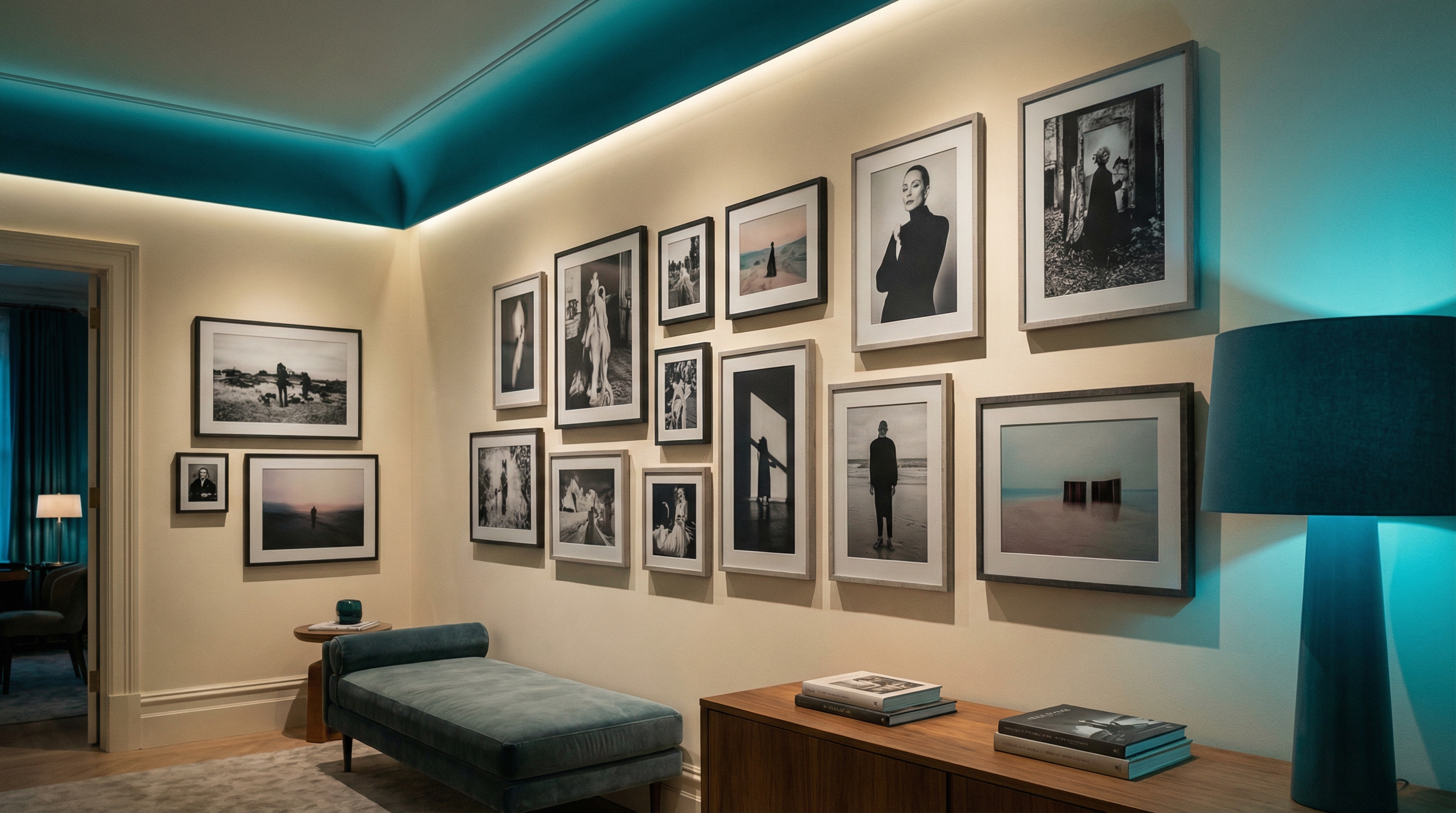
Elegant gallery wall featuring multiple e-ink digital frames displaying fine art photography with teal ambient lighting
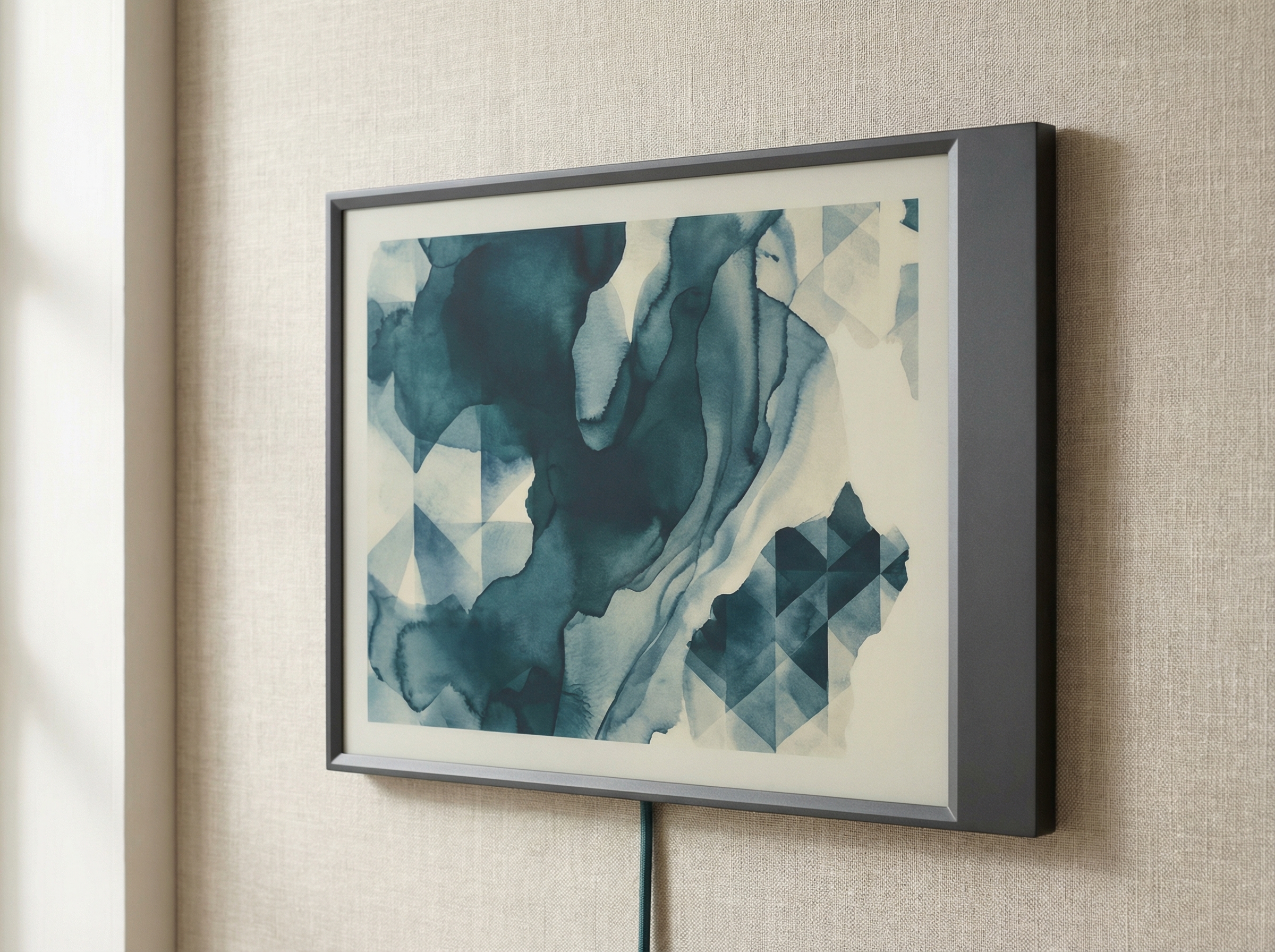
Smart home e-ink frame displaying AI-generated abstract art on a textured wall
01

Your Walls Now Take Prompts

Here's a sentence that would have sounded absurd three years ago: SwitchBot, the company best known for motorized curtain tracks and smart plugs, just launched an art frame that generates original paintings from your voice. Speak to it, and the E Ink Spectra 6 panel renders something that looks — genuinely looks — like pigment on canvas.

The lineup spans 7.3, 13.3, and 31.5 inches, and the AI generation runs on-device via a partnership with an undisclosed model provider. No subscription for basic uploads; the AI generation is the premium play. SwitchBot is betting that the same people who automated their blinds will want to automate their gallery wall too. It's glare-free, backlight-free, and consumes functionally zero power between image changes.

What's really happening here isn't about one product. It's about the collision of two previously separate trends — generative AI and calm technology — meeting on your living room wall. The frame that creates its own content is a fundamentally different product category than a frame that displays your vacation photos. SwitchBot just declared that the e-ink photo frame is actually an e-ink art machine.
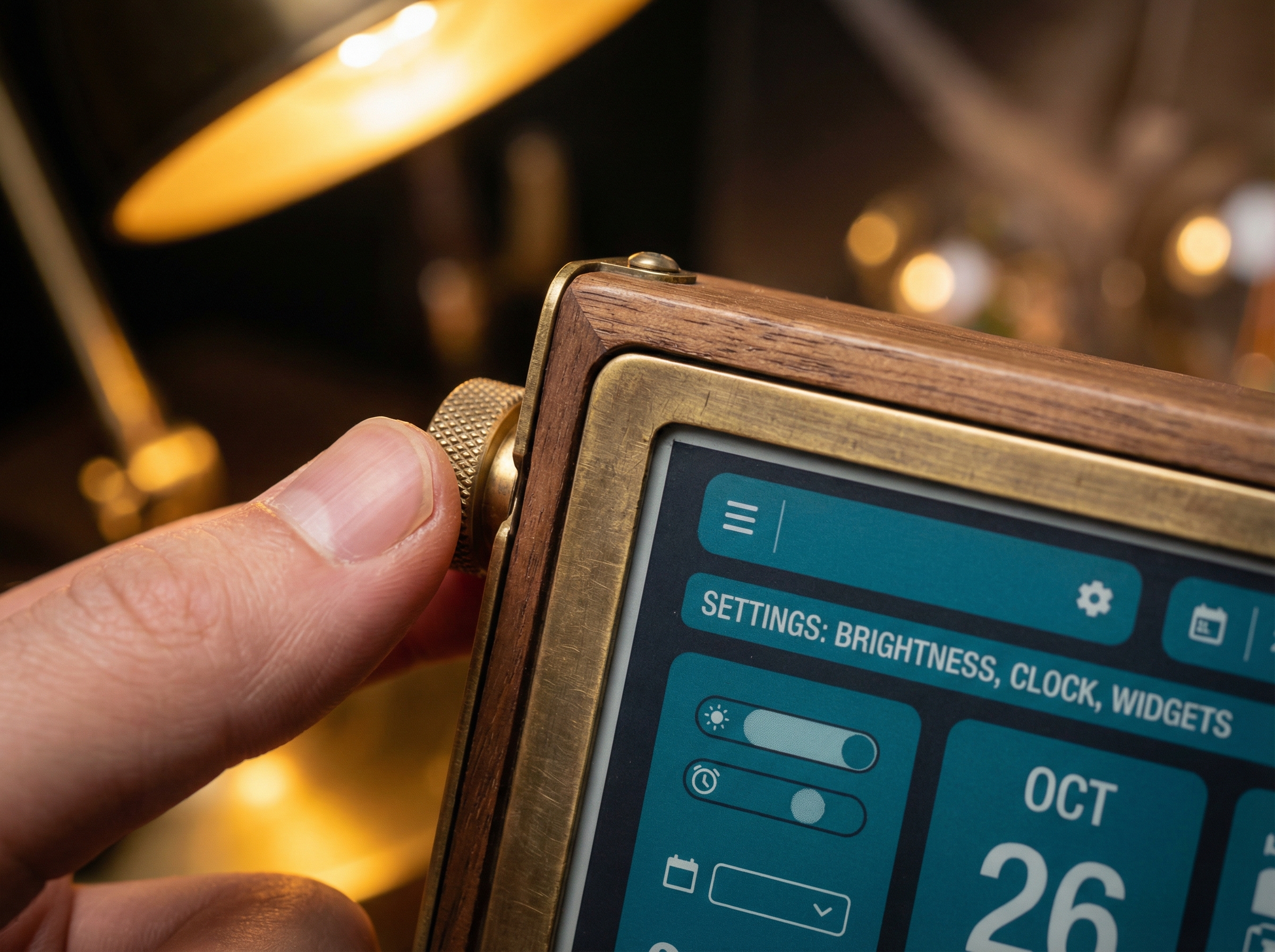
Close-up of a tactile brass dial control on a small e-ink desk frame with warm lighting
02

The Case for Turning a Knob

While everyone else at CES was adding AI to their e-ink frames, DuRoBo did something quietly radical: they added a physical dial. The Krono is a 6.1-inch desk frame with a satisfying brass knob that lets you scroll through photos like flipping through a Rolodex. No app. No voice command. Just your fingers and the click of a detent.

At $280, it's positioned not as wall art but as a "digital desk accessory" — a deliberate phrase that sidesteps the smart home category entirely. The design language is retro-futurist: think Dieter Rams meets an e-reader. DuRoBo's bet is that the best interface for something deeply personal, like your photos, isn't AI or touch or voice. It's the physicality of intention.

There's a real insight buried in this small product. The entire consumer electronics industry is racing to remove friction, to make everything ambient and automatic. DuRoBo is arguing that some friction is the point — that deliberately choosing which photo to display is part of the emotional experience. It's the anti-slideshow. And the fact that this product exists alongside AI art generators at the same trade show tells you the e-ink frame market is genuinely bifurcating into "hands-off" and "hands-on" philosophies.

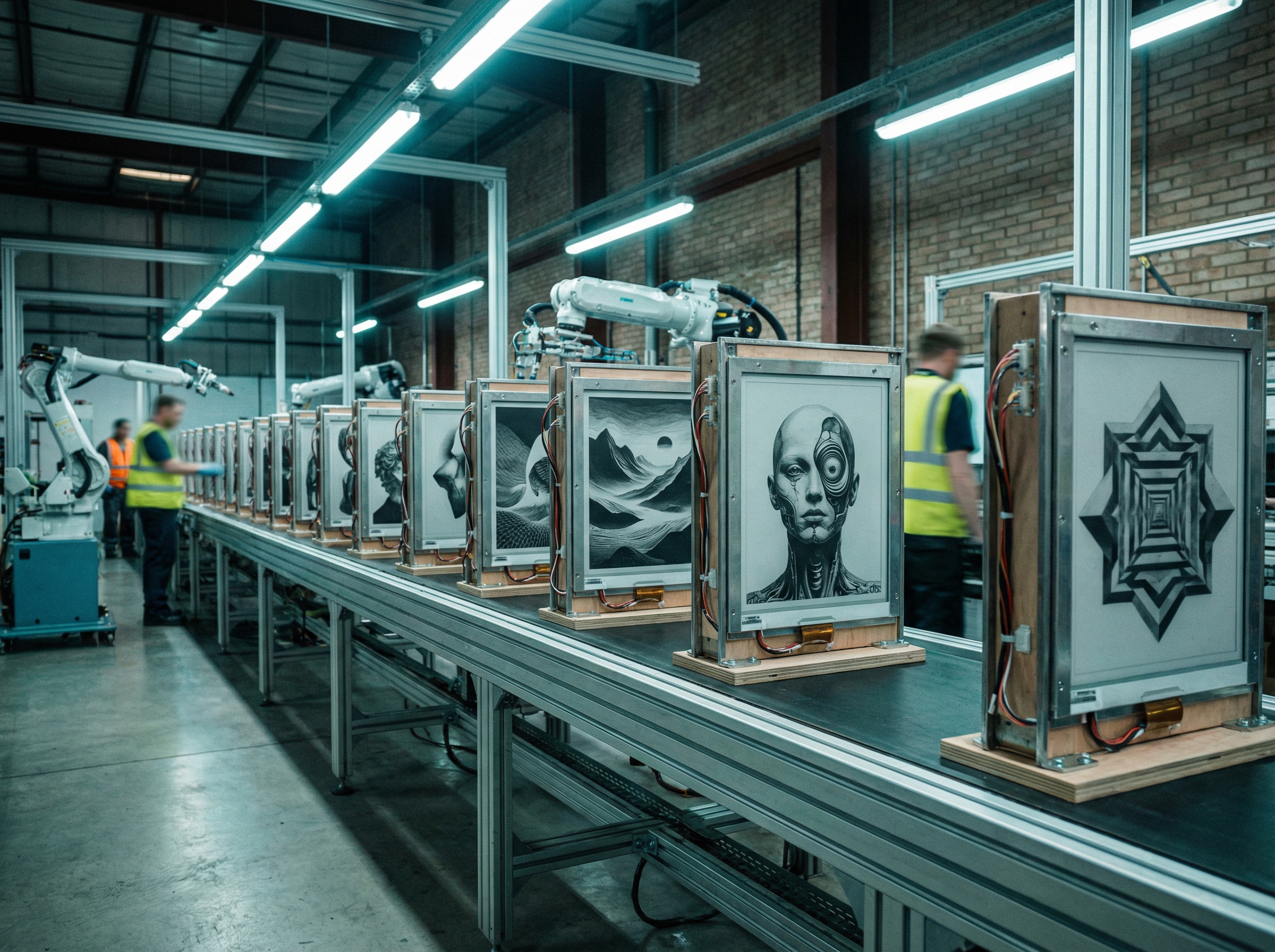
E-ink frames on a production line, each displaying different AI-generated artwork
03

When the Hardware Becomes the Afterthought

Fraimic debuted at CES 2026 with a pitch so similar to SwitchBot's that it could have been a coordinated launch. 13.3-inch and 31.5-inch e-ink canvases. On-device AI from text or spoken prompts. Subscription-free basic uploads. Multi-year battery life. The spec sheet is nearly identical — and that's the whole point.

What Fraimic's emergence signals is the beginning of commoditization. When two unrelated companies arrive at the same CES with essentially the same product, the underlying technology has matured to the point where differentiation shifts from hardware to software and services. The Spectra 6 panel is becoming a commodity component, like an LCD was by 2015.

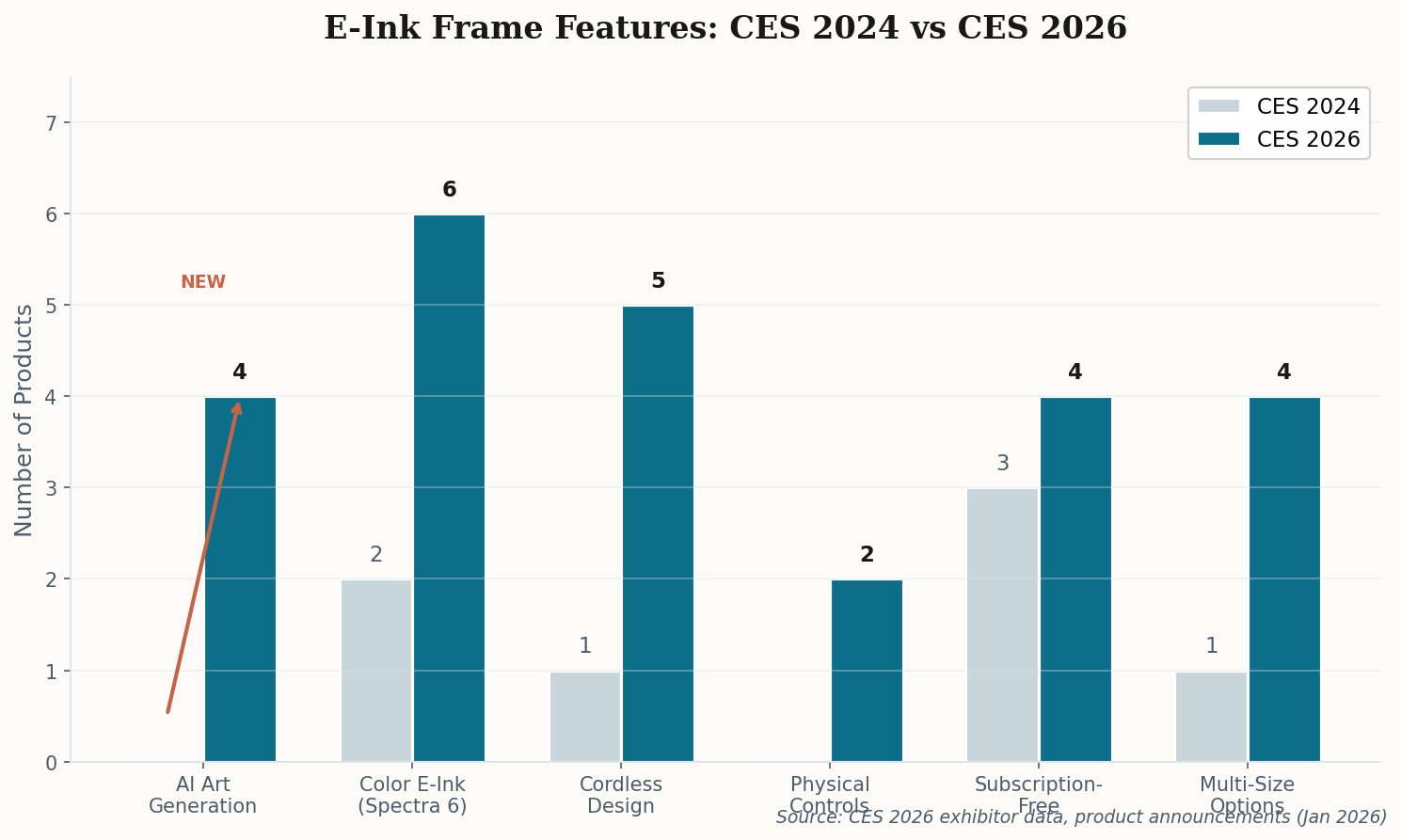
Bar chart comparing e-ink frame features at CES 2024 vs CES 2026, showing dramatic growth in AI art generation and cordless design
Feature proliferation at CES: AI art generation went from zero products in 2024 to four in 2026. Cordless design and color e-ink are now table stakes.

The winners in this next phase won't be the companies with the best display — they'll all have the same display. The winners will be the ones with the best taste engine, the most intuitive prompt interface, or the cleverest integration with your existing photo library. Fraimic claiming its canvas "mimics the look of paint on paper" is hardware marketing. The real battle is in the software that decides what goes on that paper.

Luxurious large-format e-ink poster frame with sculpted aluminum in an upscale penthouse interior
04

Six Thousand Dollars of Nothing

The InkPoster "Duna" costs $6,000 and consumes exactly zero watts when displaying an image. That contradiction — luxury priced, functionally free to operate — is the entire thesis of this product. Designed by Pininfarina (yes, the Ferrari Pininfarina), wrapped in sculpted aluminum and Alcantara, it's an A1-format e-ink poster that looks indistinguishable from a museum print.

This is a collaboration between PocketBook, E Ink Holdings, and Sharp — three companies that together control the supply chain from microcapsule to finished panel. The "Tela" model (31.5 inches, less exotic materials) comes in around $3,500. Both use Spectra 6 with over 60,000 colors and a battery that lasts up to a year.

Scatter plot showing e-ink frame products by price and display size, ranging from $199 to $6,000 across 6 to 32 inches
The e-ink frame market is rapidly stratifying. A $280 desk frame and a $6,000 Pininfarina wall piece coexist in the same product category — a sign of market maturation.

What InkPoster represents isn't just a product — it's a positioning statement for the entire industry. When a technology gets a Pininfarina collaboration, it's graduated from "gadget" to "design object." The $6,000 price tag will sell in small numbers, but its real function is aspirational: it makes the $500 Aura and the $1,300 SwitchBot seem like reasonable purchases. Every luxury market works this way. Someone has to be the ceiling.

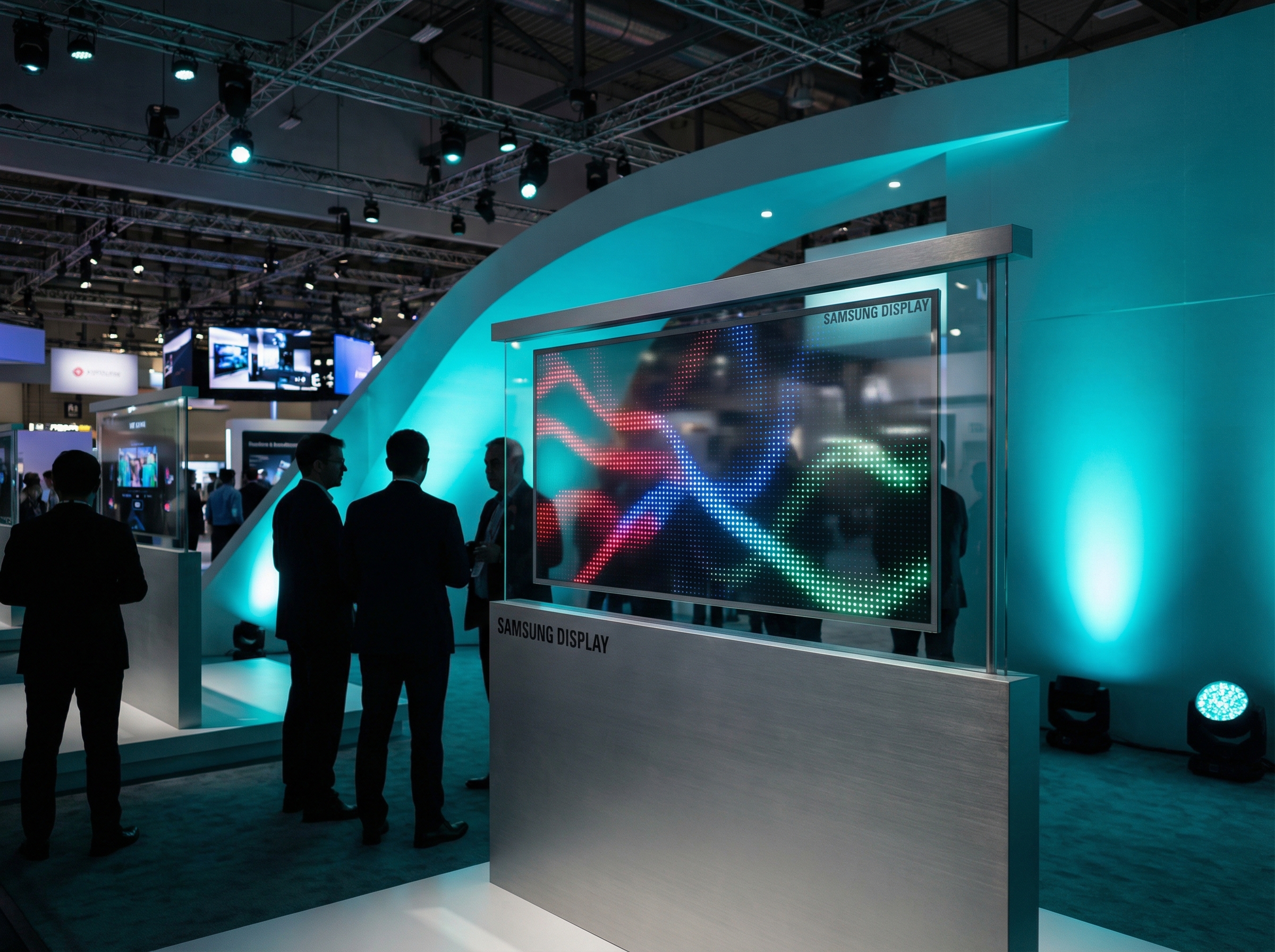
Ultra-thin Samsung e-paper display panel on a sleek exhibition stand with dramatic teal stage lighting
05

The Biggest Company in Displays Noticed

Samsung showed a 13.3-inch color e-paper display at CES 2026, the EM13DX, with proprietary "advanced color imaging algorithms" for improved saturation. The stated target is retail and signage, not consumer photo frames. But here's why it matters anyway: when Samsung commits R&D to a display technology, the supply chain follows.

Samsung's entry is less about the specific product and more about what it implies for economics. Their display manufacturing division produces panels at scales that PocketBook and Fraimic can only dream about. If Samsung decides the consumer market is worth pursuing — and a CES debut is often the first signal — e-ink frame prices could drop significantly within 18 months. The company's "zero watts for static images" messaging also validates a sustainability angle that smaller brands have been pushing for years.

Watch for Samsung's next move. If they announce a consumer variant at IFA 2026, the $500 price point becomes the new floor, not the ceiling. That changes the math for every startup in this space overnight.

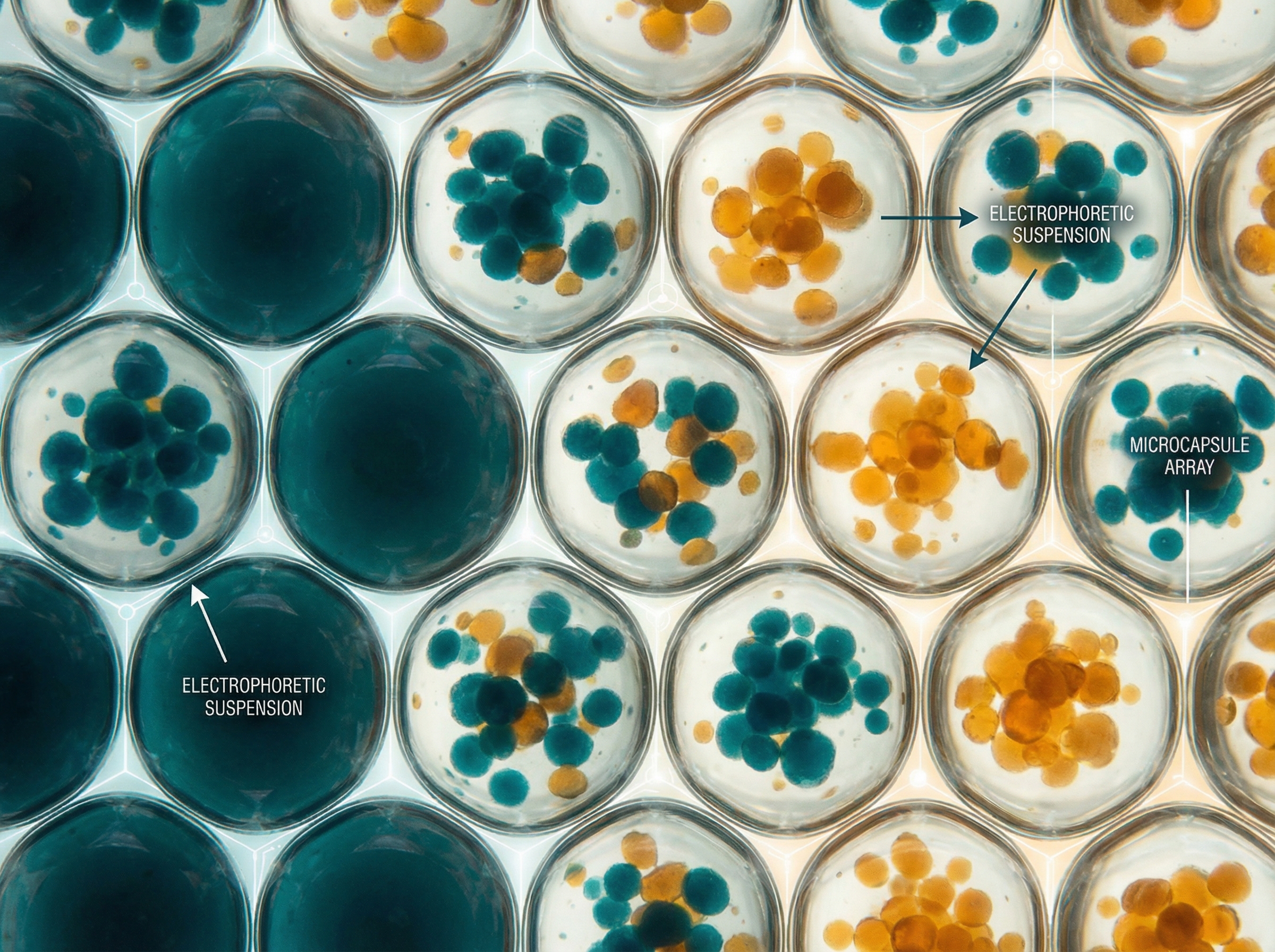
Extreme close-up of e-ink microcapsules in a hexagonal grid showing vivid colored pigment particles
06

The Sixty-Thousand-Color Engine Behind Everything

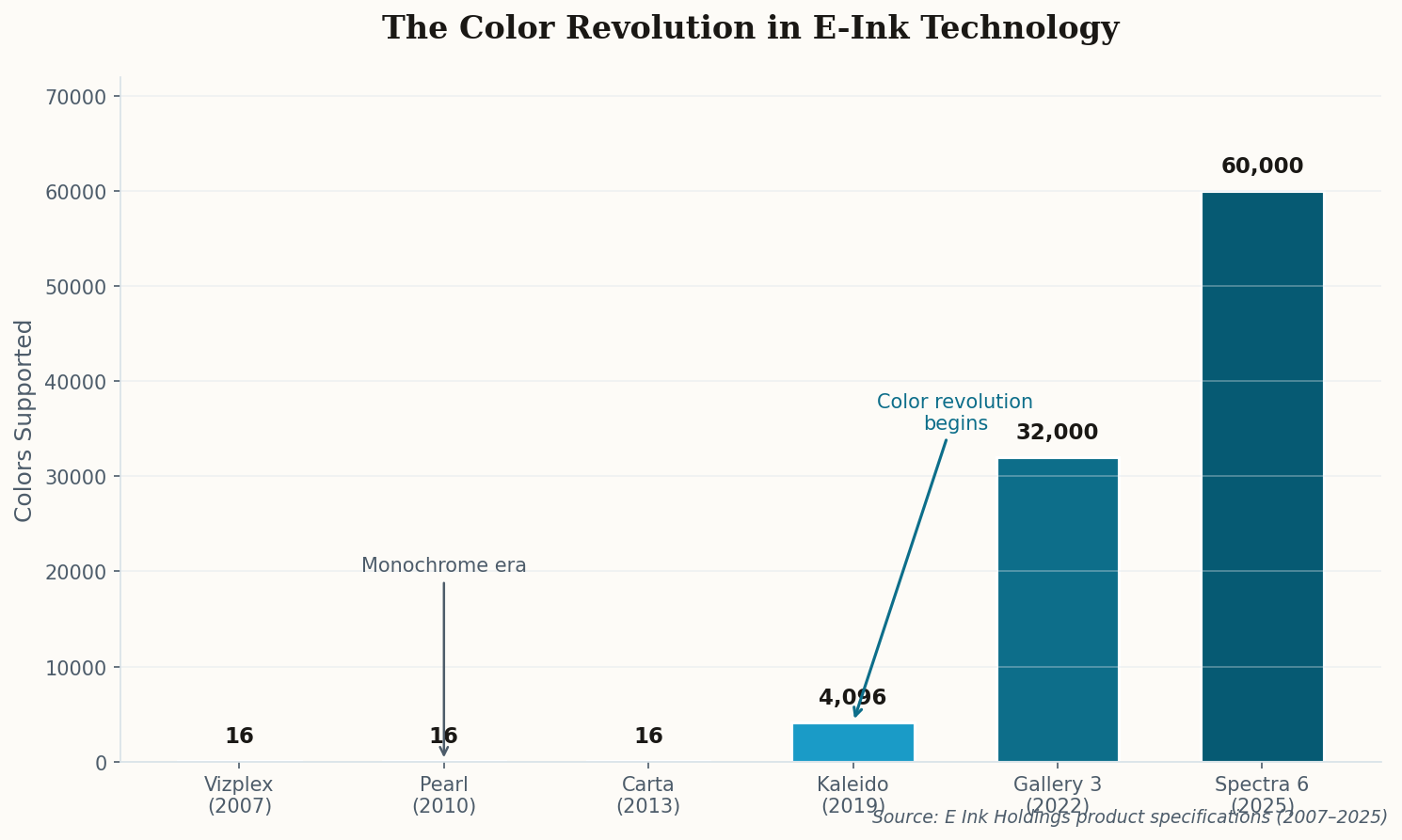
Every product in this newsletter — every single one — runs on the same underlying technology: E Ink's Spectra 6. This is the panel generation that finally crossed the photographic quality threshold. Where Gallery 3 produced roughly 32,000 colors with visible dithering artifacts, Spectra 6 pushes past 60,000 colors with optimized algorithms that make the ghosting problem essentially invisible at normal viewing distances.

Bar chart showing E-ink color technology evolution from 16 grayscale shades in 2007 to 60,000+ colors in 2025
Nearly two decades from 16 shades of gray to 60,000+ colors. The Spectra 6 generation represents the largest single leap in E Ink's color capability.

The key phrase from E Ink's own materials is "print-like quality" — and for once, the marketing isn't entirely aspirational. At the panel level, Spectra 6 achieves color saturation close enough to offset printing that the untrained eye genuinely cannot tell the difference. The remaining gap is in black depth and peak white, where e-ink still trails traditional paper slightly.

What makes Spectra 6 the real story of CES 2026 isn't the spec improvement — it's what it enabled. A single technology generation created the conditions for luxury collaborations, AI art generators, mainstream brand entry, and physical-dial desk accessories to all emerge simultaneously. That's not incremental improvement. That's a platform shift. The e-ink photo frame went from "interesting niche" to "legitimate product category" in one generation, and Spectra 6 is the reason.

The Wall Is the Next Screen

The story of e-ink photo frames is really the story of a technology finally becoming invisible. When a display consumes no power, produces no glare, and shows colors rich enough to fool your eye, the technology disappears and only the image remains. CES 2026 showed us six different visions for what that means — from AI art engines to brass dials to Pininfarina luxury. The common thread isn't the technology. It's the conviction that your wall deserves better than a glowing rectangle. Watch for Samsung's consumer play, the AI curation wars, and the first sub-$300 large-format color frame. The revolution is paper-thin and just getting started.