Design × Narrative

The Prettiness Trap

Every AI tool can now make beautiful slides. So what happens when beauty stops being a differentiator? The answer is older than PowerPoint itself: you need a story worth telling.

Listen
An editorial illustration contrasting mass-produced beautiful slides with a hand-crafted story arc
01

Tome and Gamma Abandon the Slide Entirely
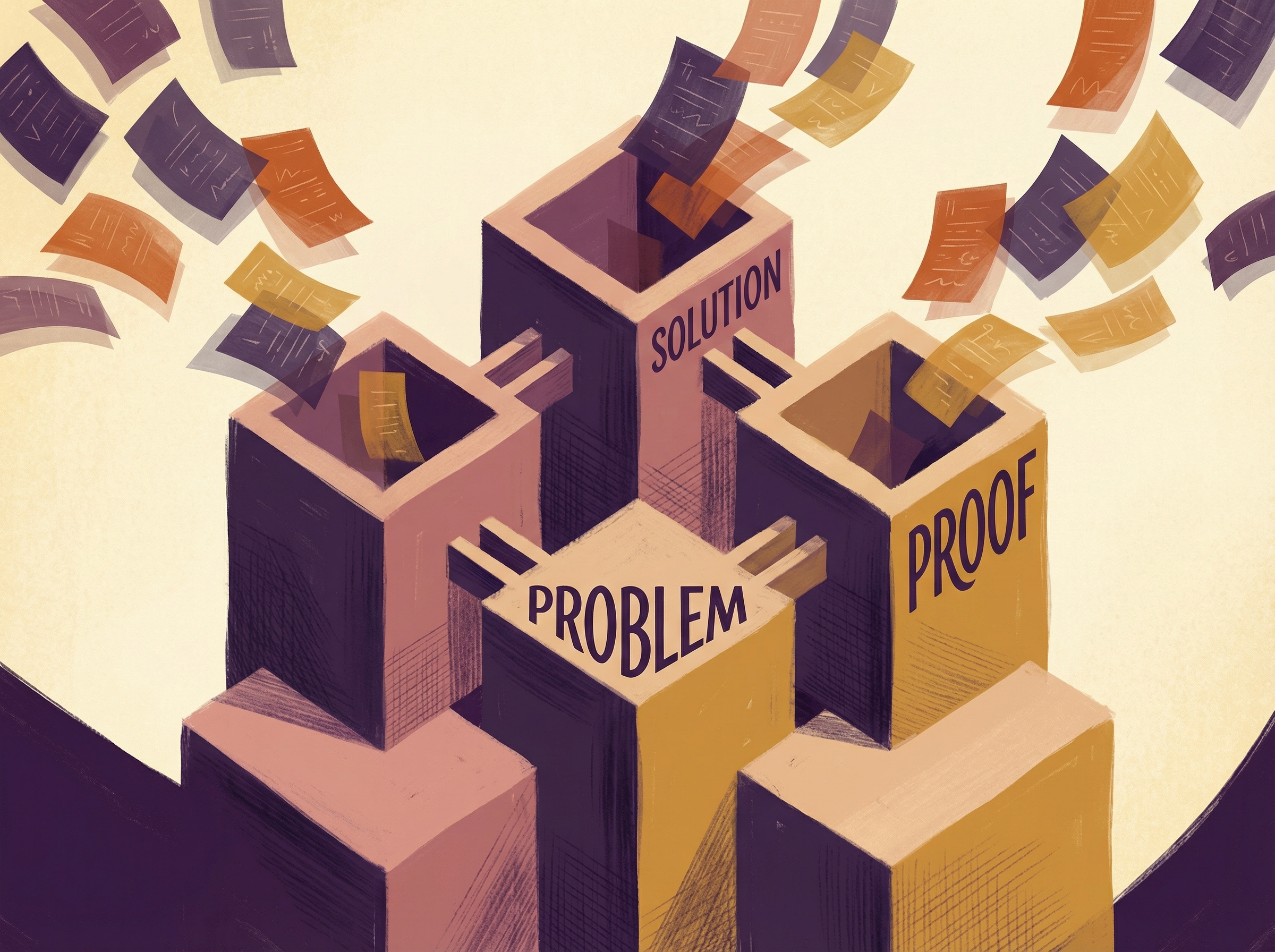
Architectural visualization of narrative blocks — Problem, Solution, Proof — replacing traditional slide structures

Here's a sentence that would have sounded insane five years ago: the two fastest-growing presentation startups have decided that slides are the wrong unit of thinking. Tome and Gamma are rolling out what they call "Narrative Blocks" — a system where the AI structures your content into logical argument components (Problem, Solution, Proof) before it even thinks about what font to use.

This is the clearest signal yet that the industry has internalized a truth that communication coaches have preached for decades: structure eats style for breakfast. Instead of generating slide-by-slide (pick a template, fill in bullets), the AI now asks a fundamentally different question: what are you trying to prove?

The shift from "Design First" to "Logic First" isn't just a UX tweak. It's a philosophical pivot. When your tool's first question is about argument structure rather than color palette, you're training an entire generation of users to think like editors, not decorators. The prettiness comes later — and it comes free.
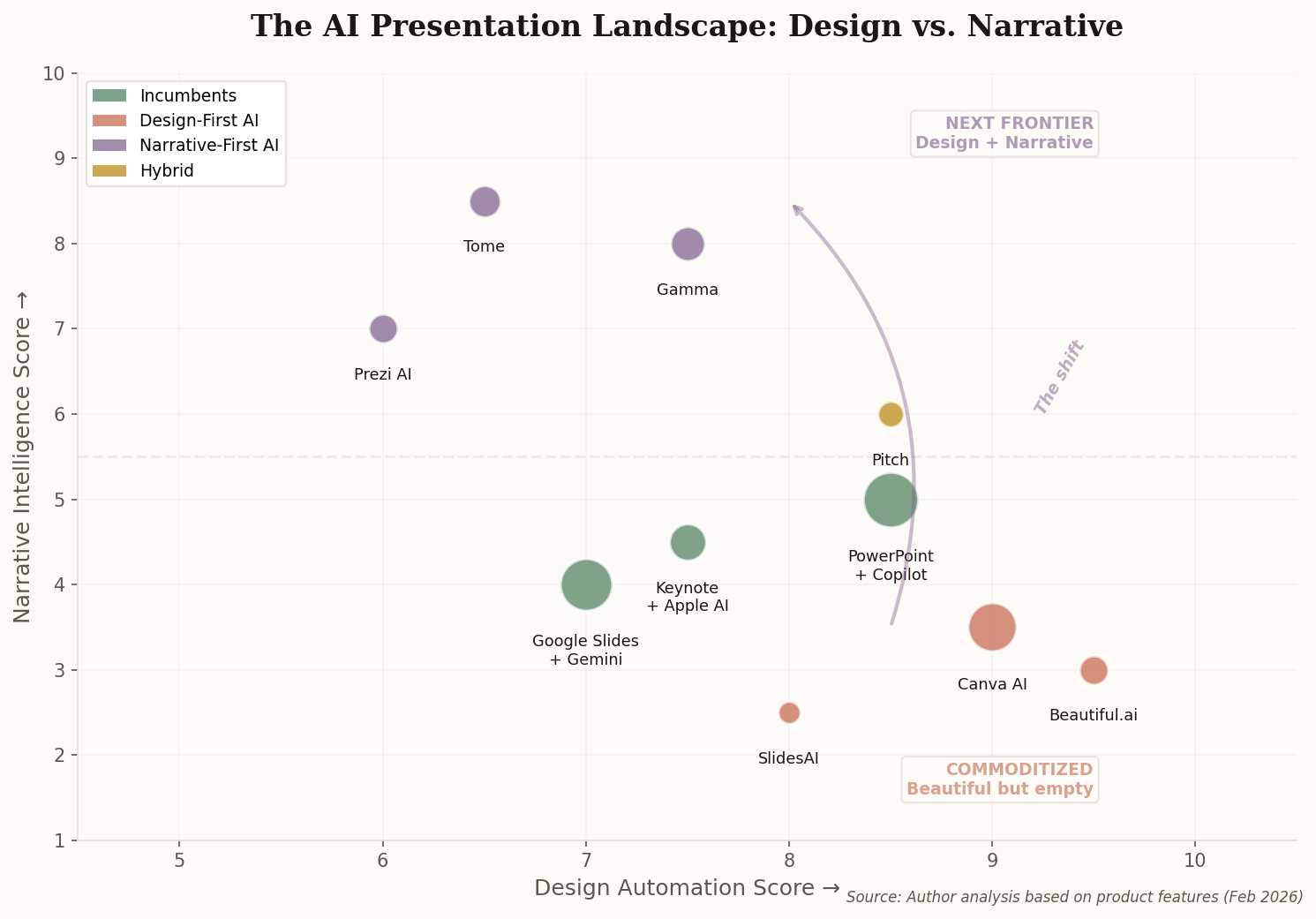
Scatter plot showing AI presentation tools mapped by Design Automation vs Narrative Intelligence scores
The AI presentation landscape is splitting into two camps: tools that automate beauty (lower right) and tools that automate thinking (upper left). The winners will do both.
02

Canva Makes On-Brand Design Invisible — And That's the Point

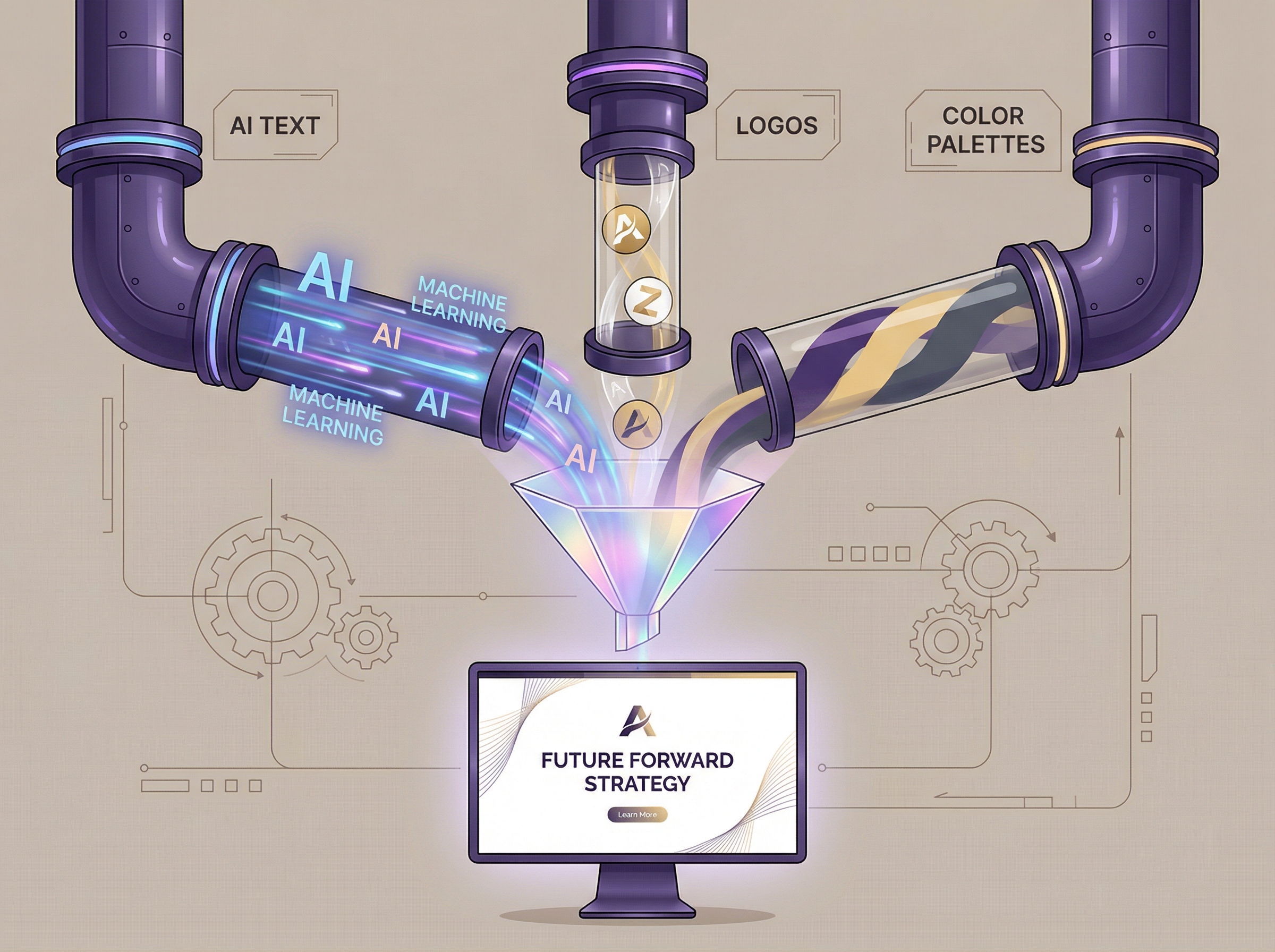
AI pipelines merging text, logos, and color palettes into a unified branded presentation

Canva just plugged its Brand Kit system directly into ChatGPT, Claude, and Microsoft Copilot. The result: you can now generate a fully brand-compliant presentation from any of these conversational AI tools without ever touching a design surface.

Think about what this means. The "hallucinated design" problem — where AI slides looked beautiful but used the wrong logo or someone else's brand palette — is essentially solved at the infrastructure level. Corporate identity guidelines are now enforced by API, not by a nervous brand manager reviewing decks at 11 PM on a Sunday.

But here's the uncomfortable implication: if everyone in your org can produce a perfectly on-brand, visually polished deck in 30 seconds, the deck itself becomes invisible. It's table stakes. The person who stands out in the Monday morning meeting isn't the one with the prettiest slides — it's the one who actually thought about what those slides need to say.

The real disruption isn't design automation — it's the death of "I spent all weekend on this deck" as a signal of effort. When beautiful is free, the only flex is thinking clearly.

03

$1.68 Billion and Counting: The Market That Ate Itself

Towering stack of identical beautiful slides forming a growth chart, symbolizing market commodification

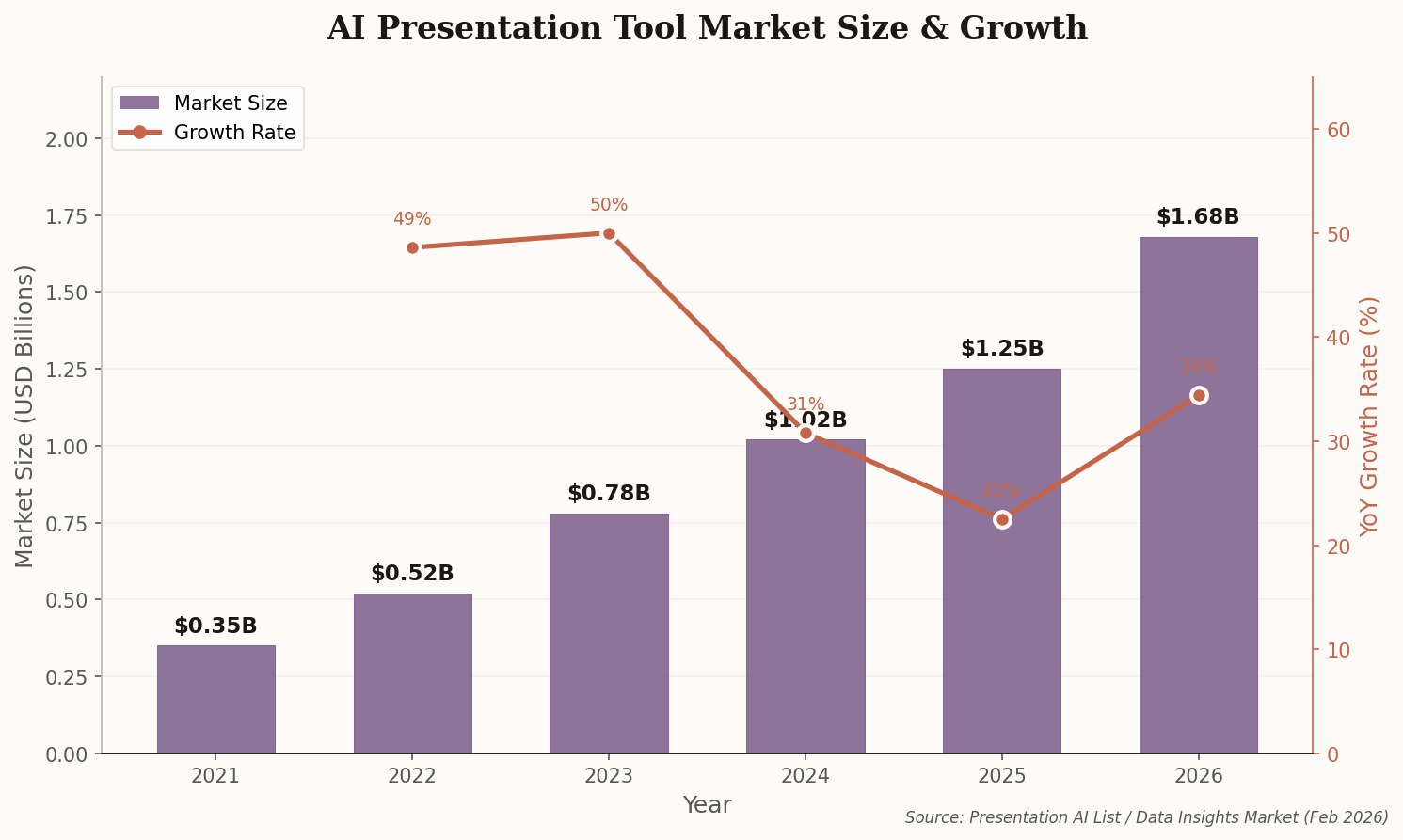
The AI presentation market is projected to hit $1.68 billion in 2026 — a 34% jump from $1.25 billion last year. Seventy percent of U.S. adults have now used AI for professional content creation. Design time has dropped 40% on average.

These numbers tell a story of staggering commodification. Generative AI adoption in presentations has outpaced personal computers at a comparable stage. Let that sink in: the tool that makes your ideas look good is diffusing faster than the tool that lets you compute them.

Bar and line chart showing AI presentation market growing from $0.35B in 2021 to $1.68B projected in 2026
The AI presentation market has grown nearly 5x since 2021. Growth rate spiked again in 2026 after a brief cooling, driven by enterprise adoption of integrated tools like Copilot and Canva AI.

But there's a paradox buried in the data. As more tools chase the same "beautiful slide" output, individual tools become less differentiated. It's the classic commodity trap: when everyone can do the same thing, nobody charges a premium for it. The market is growing, but the margins are thinning. The companies that survive this shakeout won't be the ones with the best gradient engine. They'll be the ones that help people think.

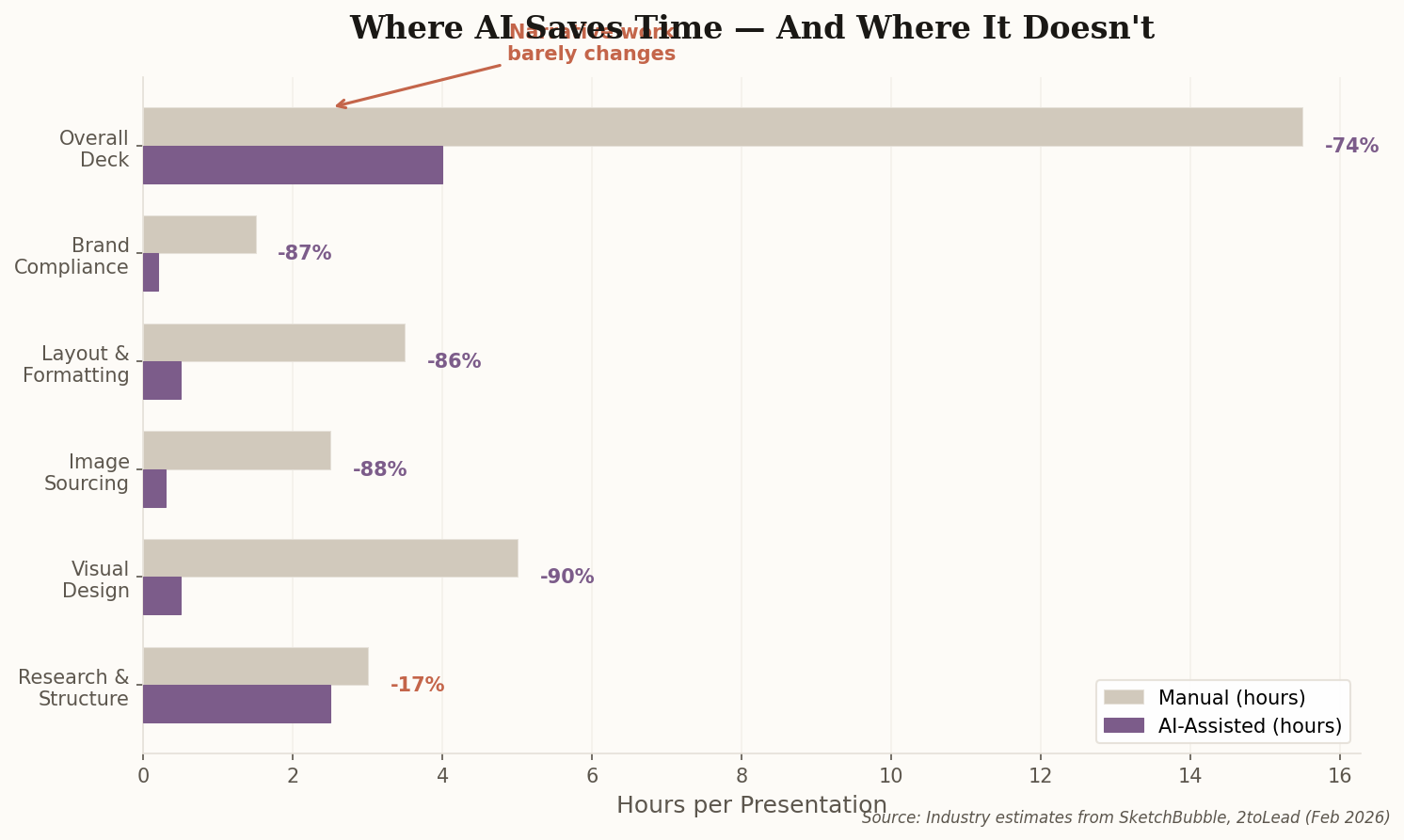
Horizontal bar chart showing AI dramatically reduces design-related tasks but barely touches narrative and research work
AI slashes visual design and formatting time by 85-90%, but research and narrative structure — the actual hard work of a presentation — barely budge. The bottleneck has shifted permanently.
04

The Hand-Drawn Backlash Is Real — and It's Not About Nostalgia

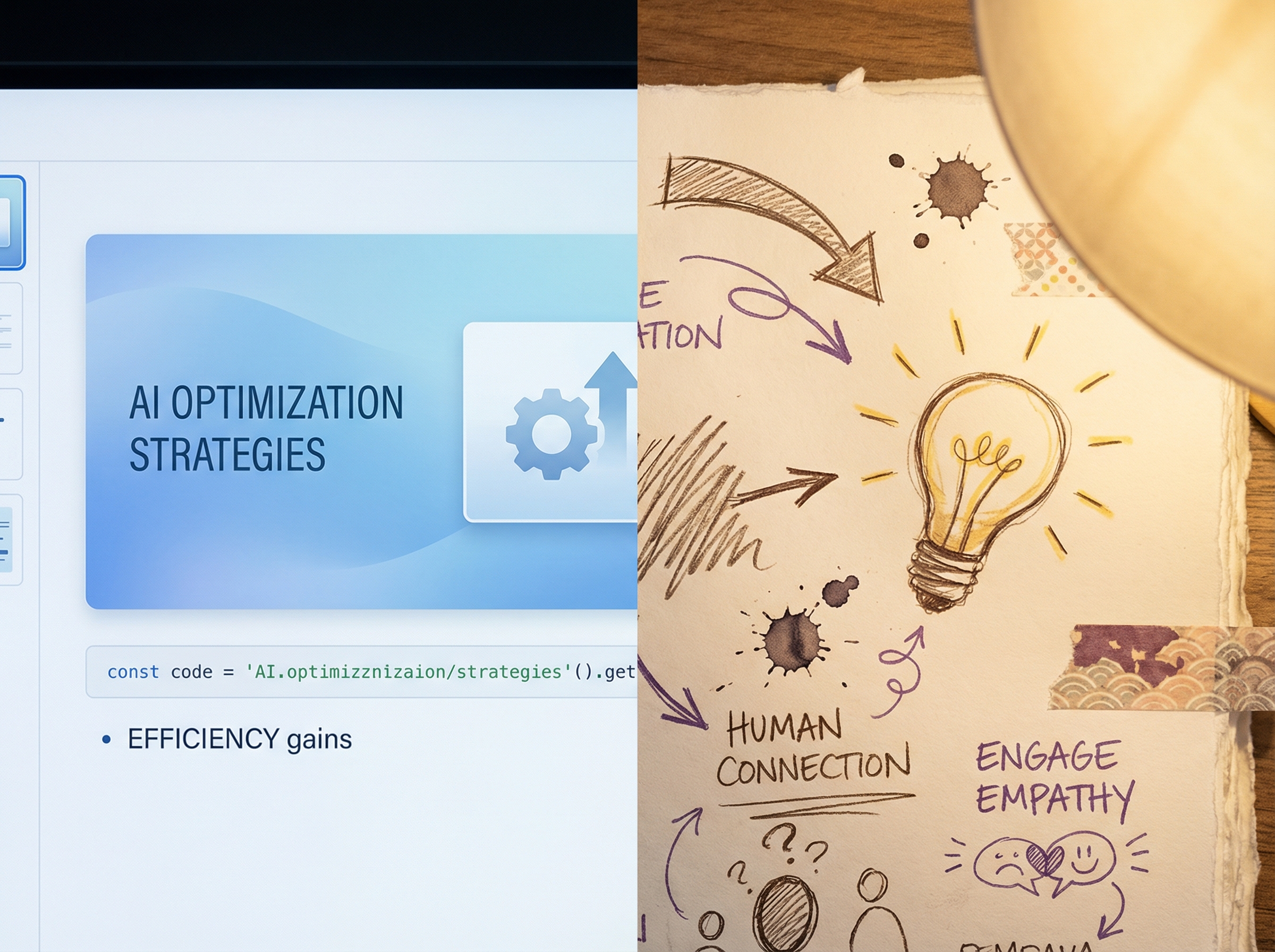
Split composition contrasting a sterile AI-generated slide with a warm, engaging hand-drawn sketch

A distinct counter-trend is emerging in early 2026: presentation designers are deliberately choosing "imperfect" aesthetics — hand-drawn elements, raw photography, analog textures — specifically because they signal human authorship. SketchBubble's annual trend report calls it the "anti-AI aesthetic," and the top-tier consulting firms are leading the charge.

This isn't Luddism. It's market signaling. When Beautiful.ai can produce a perfect gradient in 0.3 seconds, perfection becomes cheap. The premium shifts to authenticity — the visible evidence that a human made a deliberate creative choice. One ink blot on a whiteboard sketch communicates more confidence than 47 perfectly kerned slides.

The "Clarity-First" design movement is the rational extension of this: one metric per slide, data storytelling over decoration, narrative rhythm over visual spectacle. The best decks of 2026 don't look AI-generated. Not because they can't — but because looking human is now the flex.

05

Copilot Becomes the Designer You Never Have to Hire

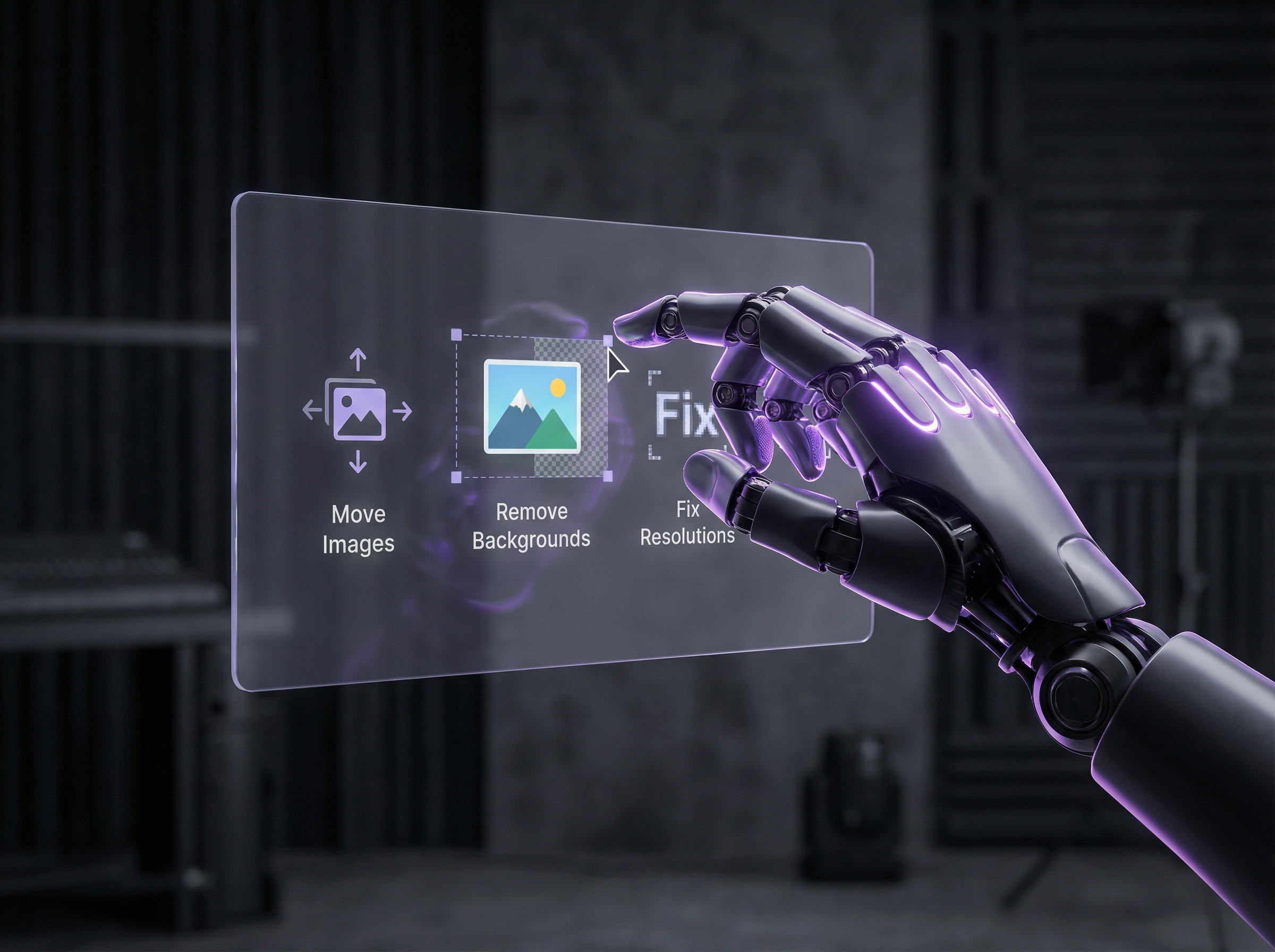
A robotic hand delicately adjusting presentation elements with precision, purple energy traces around fingertips

Microsoft Copilot's February update crosses a threshold: it's no longer a draft assistant. It's an autonomous agent inside PowerPoint. The new "In-App Image Editing" capability lets the AI fix resolution, remove backgrounds, and adjust compositions without the user switching tools. "Copilot Notebook Grounding" lets it reference your specific documents to build narrative logic.

Translation: every PowerPoint user on earth — and there are more than 500 million of them — just got a design team. Background removal used to be a Photoshop skill. Resolution fixing used to require knowing what DPI means. Now it's a button that says "make it look right."

This is the final nail in the "beautiful slides as differentiator" coffin. When the world's most ubiquitous presentation tool bundles autonomous visual polish, the skill of making things look good is literally built into the software. What isn't built in? Knowing which story to tell, which data to show, which argument to make. That still requires a brain.

06

Prezi Bets the Farm on Spatial Storytelling

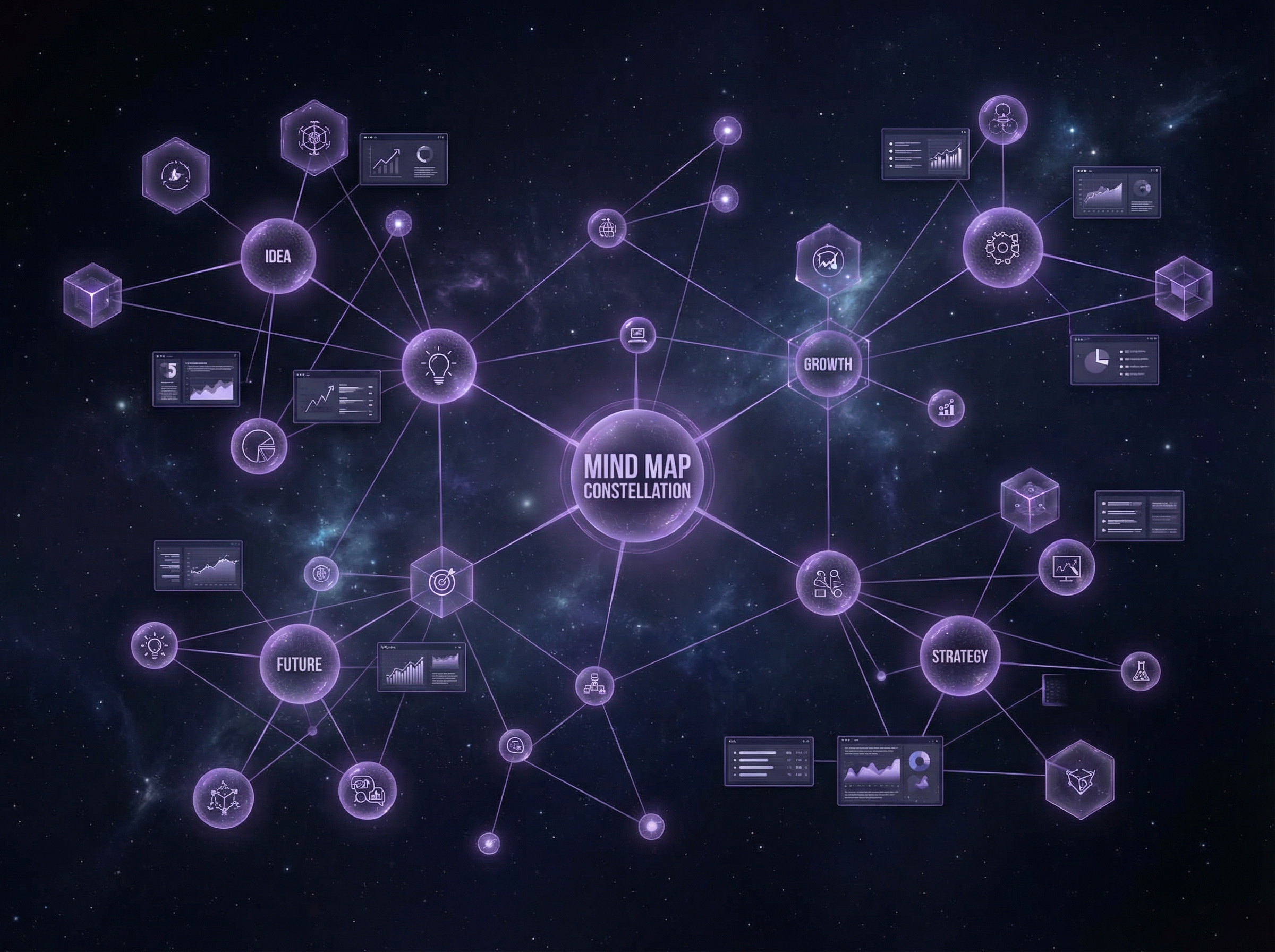
Three-dimensional mind map with presentation slides arranged as an interconnected constellation in space

Prezi has always been the presentation tool that makes people slightly motion-sick. But its latest AI update is genuinely interesting: "Smart Structure" analyzes imported documents and determines the optimal flow — linear versus spatial — based on content type. It's asking a question no other tool asks: should this even be a sequence of slides?

The "Instant AI Image Generation" and "Advanced Image Editing" features are table stakes at this point — every tool does this now. But the structure intelligence is different. Prezi is attempting to capture the message's "mood and intent" and translate it into information architecture, not just visual design.

It's a risky bet. Spatial presentations still make a lot of audiences uncomfortable — there's a reason linear storytelling has dominated for millennia. But Prezi is right about one thing: when everyone's slides look the same, the way you move through information becomes a differentiator. Whether audiences are ready for that is another question entirely.

The Story Is the Product Now

For two decades, "good at PowerPoint" was a genuine professional skill. You could build a career on making ugly data look presentable. That era is over — not gradually, but this month. The six stories above trace a single arc: beauty has been automated, commodified, and embedded into infrastructure. It's free, it's instant, and it's everywhere. What remains scarce — what will always remain scarce — is the ability to look at a messy, complicated situation and find the one story that makes people care. The slides are now the easy part. The thinking never was.