832 Cores, 13 Trillion Paths, and a Chess Piece
Every December, Donald Knuth does something most 87-year-olds do not: he stands before a packed Stanford auditorium and delivers a lecture dense enough to make graduate students take notes. This year's installment, "Adventures with Knight's Tours," might be his most delightfully obsessive yet.
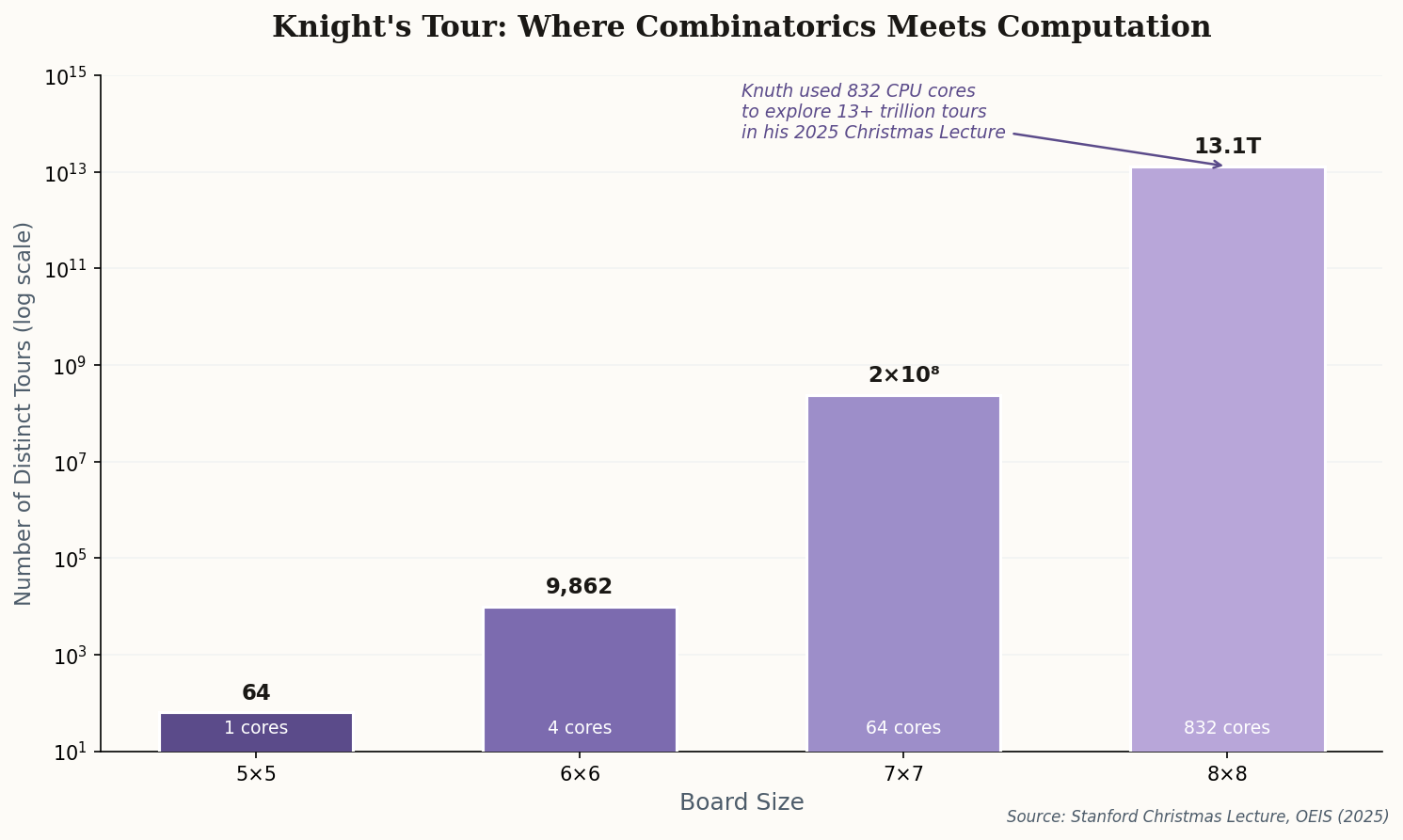
The knight's tour problem — moving a chess knight to visit every square on a board exactly once — sounds like a parlor trick. It's not. Knuth marshaled 832 CPU cores to explore the solution space of an 8×8 board, which contains more than 13 trillion distinct tours. He didn't just count them. He computed optimal solutions, discovered previously unknown symmetries, and presented the results with the aesthetic sensibility of a man who has spent sixty years believing mathematics should be beautiful.
What makes these Christmas lectures legendary isn't the raw computation — it's the insistence that even a "solved" problem has layers worth excavating. The knight's tour has been studied since Euler. Knuth found new things to say about it. That's the difference between knowing a result and understanding it.