The Dead Man Who Fooled Hitler
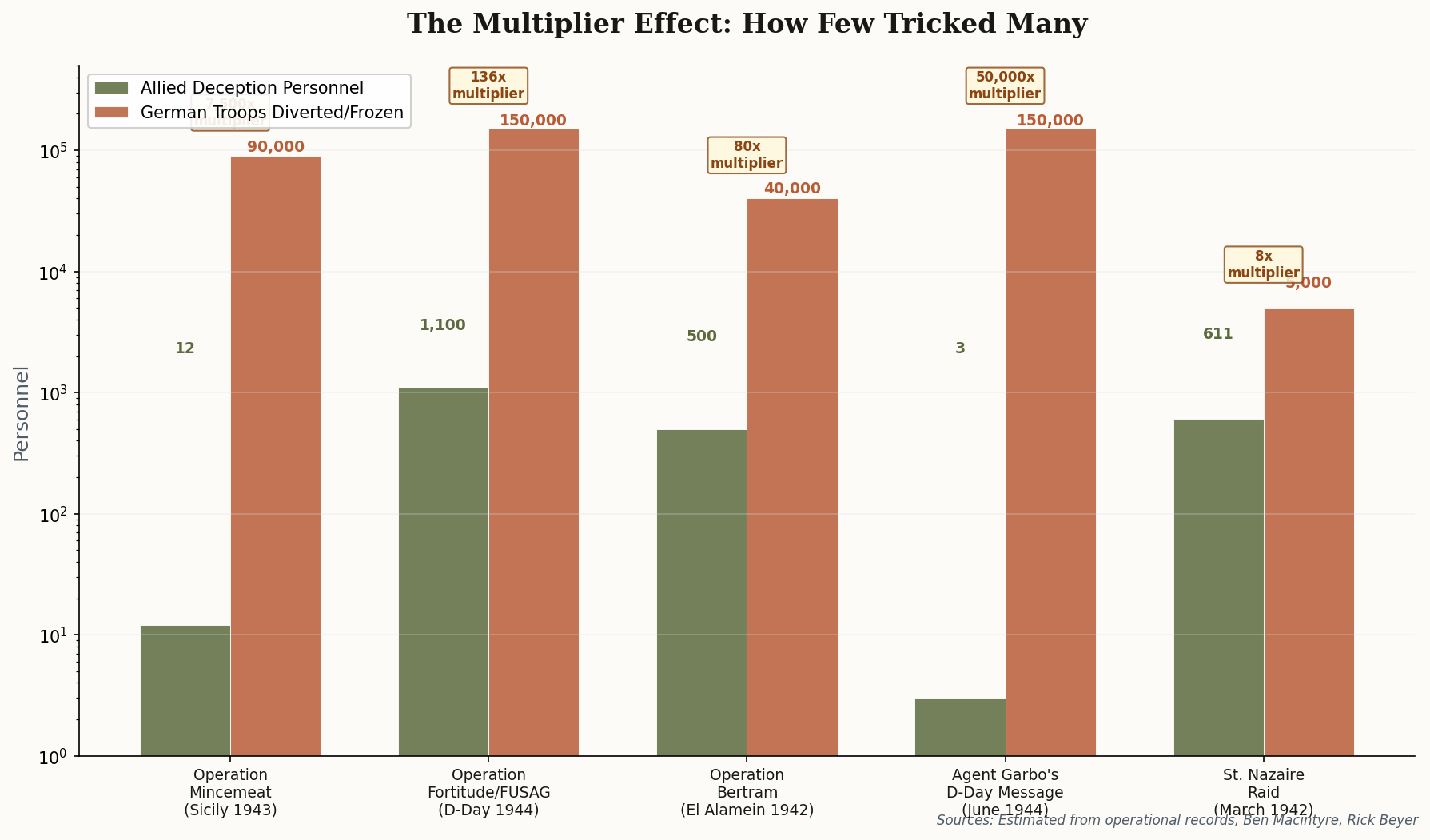
Here's how you invade a continent: you start with a corpse. In April 1943, British intelligence took the body of Glyndwr Michael, a Welsh homeless man who'd died of rat poison, dressed him in the uniform of a Royal Marines officer, and shoved him off a submarine near the Spanish coast. Chained to his wrist was a briefcase full of letters — forged, naturally — that "revealed" the Allies would invade Greece and Sardinia. Not Sicily. Definitely not Sicily.
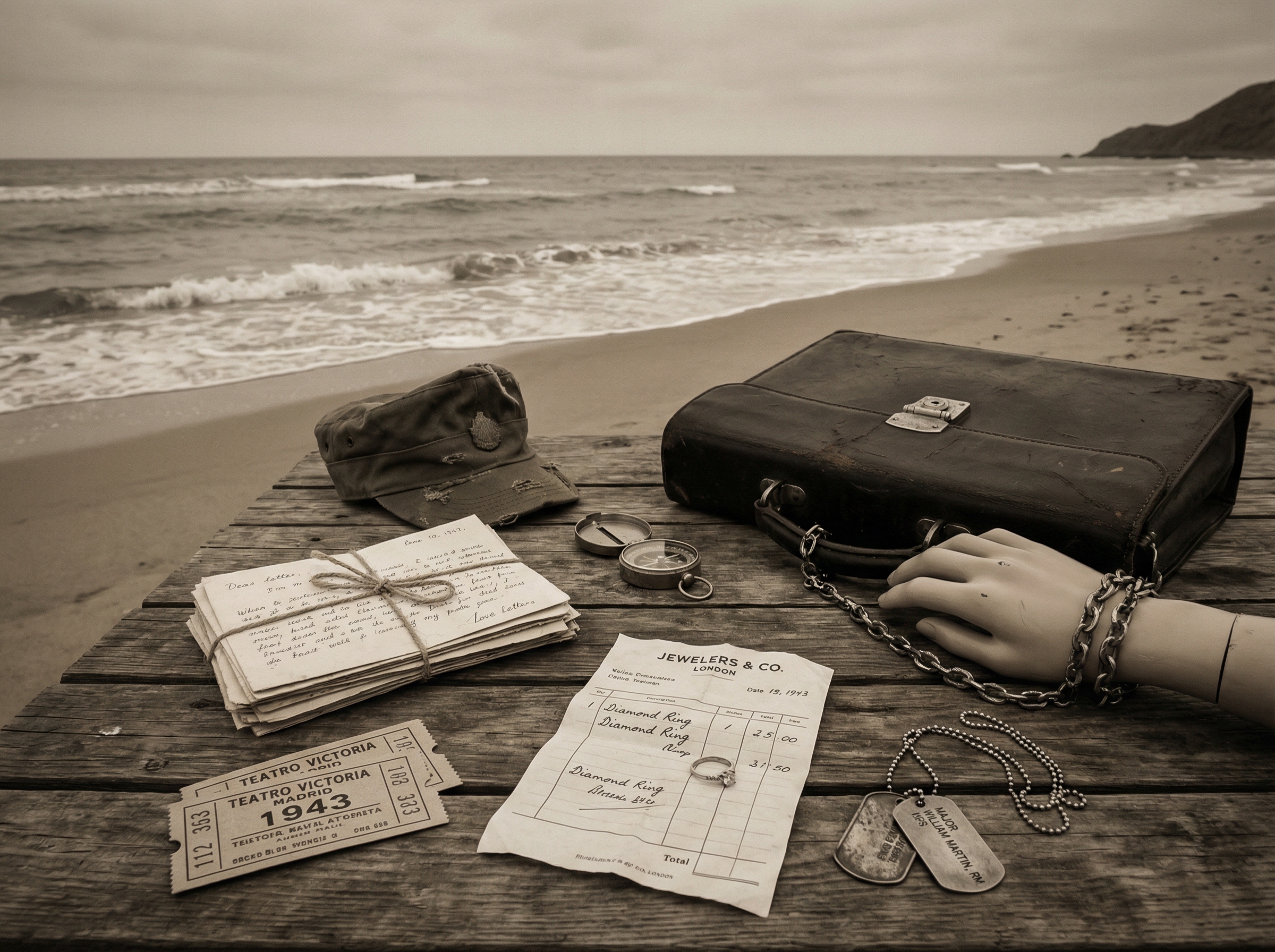
The genius was in the details. Ewen Montagu and Charles Cholmondeley didn't just plant military documents. They gave "Major William Martin" a life. A fiancée named Pam, whose love letters were tucked in his breast pocket. Theater ticket stubs. A receipt for a diamond ring. An irritable letter from his father about the engagement. Every detail designed so that when the Abwehr examined the body — and they absolutely would, because Franco's Spain was riddled with German agents — they'd find a real person, not a prop.
It worked beyond anyone's wildest projections. Hitler personally ordered entire Panzer divisions redeployed to Greece and Sardinia. When the Allies hit Sicily in July 1943, the beaches were lightly defended. Thousands of Allied soldiers survived the landing because a dead man nobody knew carried fake letters nobody questioned. The body was buried with full military honors in Huelva, Spain — the headstone reading the name of a man who never existed.
The telling detail: When MI5 tested the plan internally, the one concern was whether a pathologist might detect the rat poison. The answer: probably not, because the body would have been in seawater long enough to mask the toxicology. They were right. The Spanish performed an autopsy. They found nothing.
The Chicken Farmer Who Ran 27 Imaginary Spies
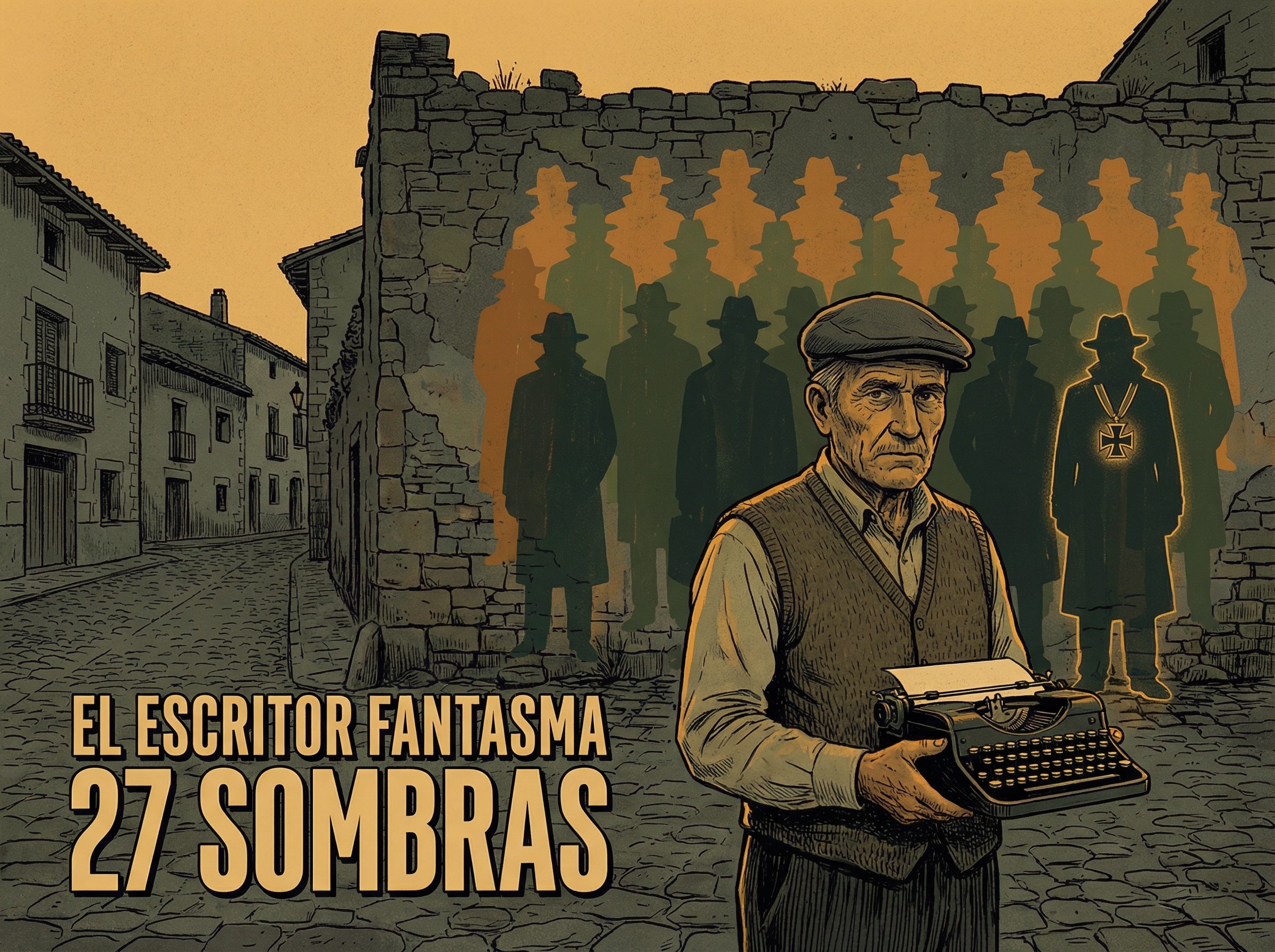
Juan Pujol Garcia was a Barcelona chicken farmer who hated both Fascism and Communism in roughly equal measure. He decided, with absolutely zero espionage training, that he would become a spy for the Allies. The British said no. So Garcia walked into the German embassy instead, offered his services, got recruited, and began sending Berlin intelligence reports about Britain — from Lisbon, where he was making everything up using a tourist guidebook, a map of England, and a train schedule.
The reports were spectacularly inventive. He invented 27 sub-agents across Britain — a Welsh nationalist, a disgruntled RAF officer, a Venezuelan student in Glasgow — each with distinct personalities and expense accounts. The Germans paid him roughly $340,000 (about $6 million today) to fund this fictional network. When one of his "agents" needed to be retired, Garcia killed him off and submitted a widow's pension request. The Germans paid it.
His masterpiece came on D-Day. Working with MI5 handler Tomás Harris, Garcia sent a message to Berlin just hours after the Normandy landings, arguing that this was merely a diversion — the real attack would hit Pas-de-Calais. The message was so convincing that Hitler overruled his generals and held two Panzer divisions in reserve. Those tanks never reached Normandy. Garcia is the only person in history to receive both the Iron Cross from Nazi Germany and the MBE from King George VI.
The absurd footnote: After the war, MI5 staged Garbo's "death" in Africa to protect him. He actually moved to Venezuela, ran a bookshop, and wasn't publicly identified until 1984 — four decades later.
1,100 Artists, Actors, and the Greatest Con in Military History
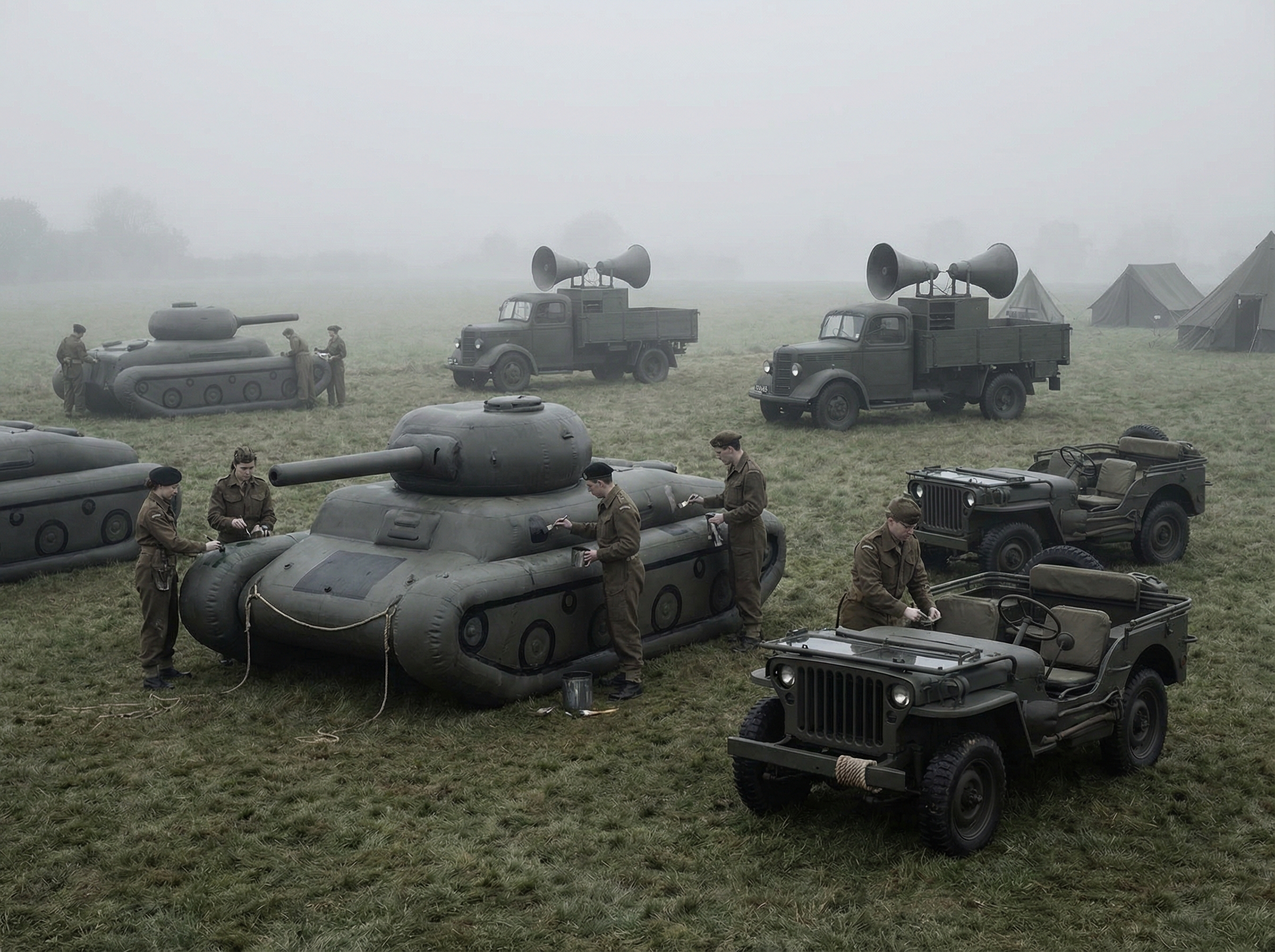
The 23rd Headquarters Special Troops was possibly the strangest military unit ever assembled. Its 1,100 men included artists from art schools, sound engineers from radio studios, actors, and designers. Their mission: pretend to be two entire Army divisions. Their commanding officer answered to a general who didn't exist, leading an army group — FUSAG — that also didn't exist, nominally commanded by George S. Patton, who was in on the joke.
The technology was a trickster's dream. They deployed over 1,000 inflatable rubber tanks that looked perfectly real from a reconnaissance plane but could be carried by four men. The sonic deception unit blasted recordings of tank columns and bridge construction from massive speakers audible 15 miles away. The radio operators created an entire fake electromagnetic signature for FUSAG — complete with enough chatter, call signs, and signal patterns to mimic 30,000 troops. They even sent fake soldiers to local pubs to talk loudly about their unit's "upcoming deployment to Calais."
It worked devastatingly. Even after June 6, 1944 — after D-Day had already happened at Normandy — the Germans kept two full Panzer divisions and 19 infantry divisions pinned at Pas-de-Calais, waiting for the "real" invasion. They waited for weeks. Among the Ghost Army's veterans: fashion designer Bill Blass, painter Ellsworth Kelly, and photographer Art Kane. The unit's existence was classified until 1996.
Exploding Rats, Coal Bombs, and Churchill's Ministry of Ungentlemanly Warfare
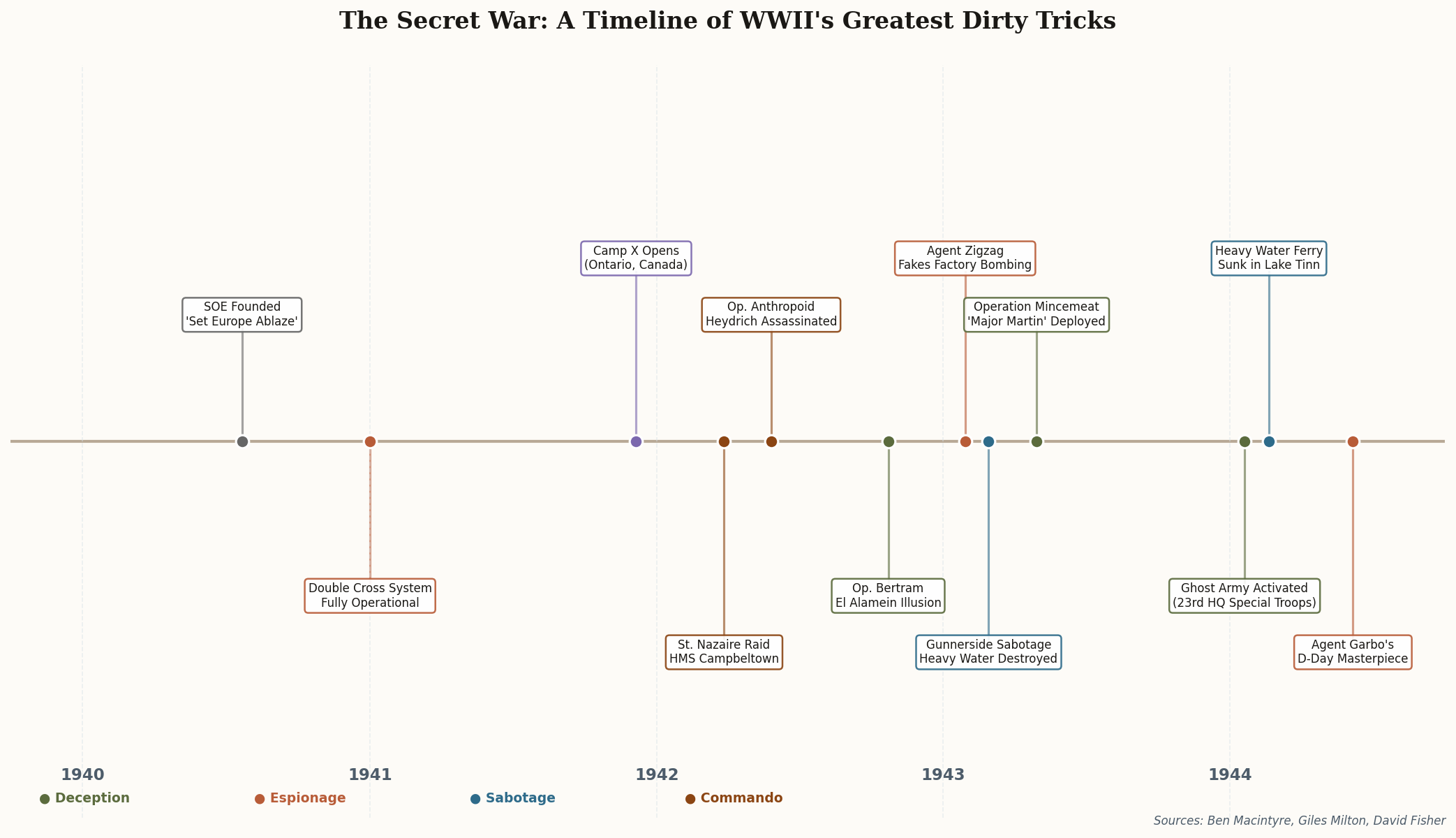
When Winston Churchill created the Special Operations Executive in July 1940, his directive was four words: "And now set Europe ablaze." SOE took him literally. At their research facility — Station IX, a requisitioned country house — some of the war's most devious minds spent five years inventing gadgets that would make Q Branch blush.
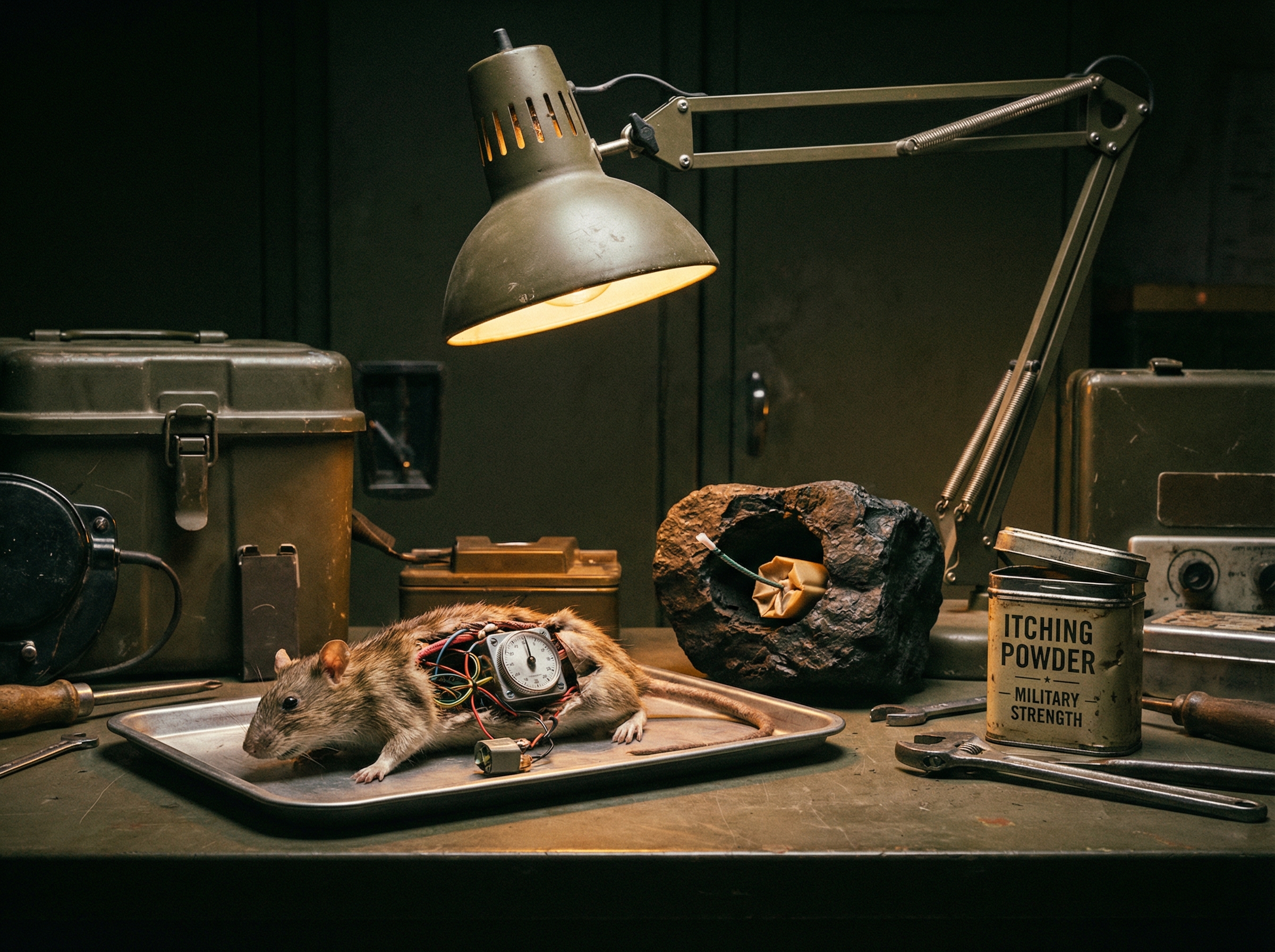
Their greatest hit was the exploding rat. They skinned dead rats, packed them with plastic explosive, and left them in German boiler rooms and factories. The idea: a stoker would shovel the "dead rat" into a furnace, detonating a blast powerful enough to rupture a boiler. But here's the real genius — the Germans intercepted the first shipment. Instead of simply disposing of them, German High Command distributed an all-units alert about exploding rats, triggering months of paranoid rat-hunting across occupied Europe. SOE never had to send another one. The idea of exploding rats caused more disruption than actual exploding rats.
The coal torpedo was arguably more effective: a hollow lump of coal, painted and textured to match the coal stocks on German railway lines. When a locomotive fireman shoveled it into the engine, it destroyed the entire boiler. Thousands were distributed by resistance networks. Then there was the industrial-scale itching powder, smuggled into laundries serving German garrisons, and the Welrod — a suppressed pistol so quiet it could be fired in a crowded room without anyone two tables away hearing it.
The legacy: SOE's gadget philosophy — low cost, high disruption, weaponized paranoia — directly influenced the CIA's Office of Technical Service. James Bond's Q was modeled in part on SOE inventor Charles Fraser-Smith.
The Magician Who Made an Army Disappear
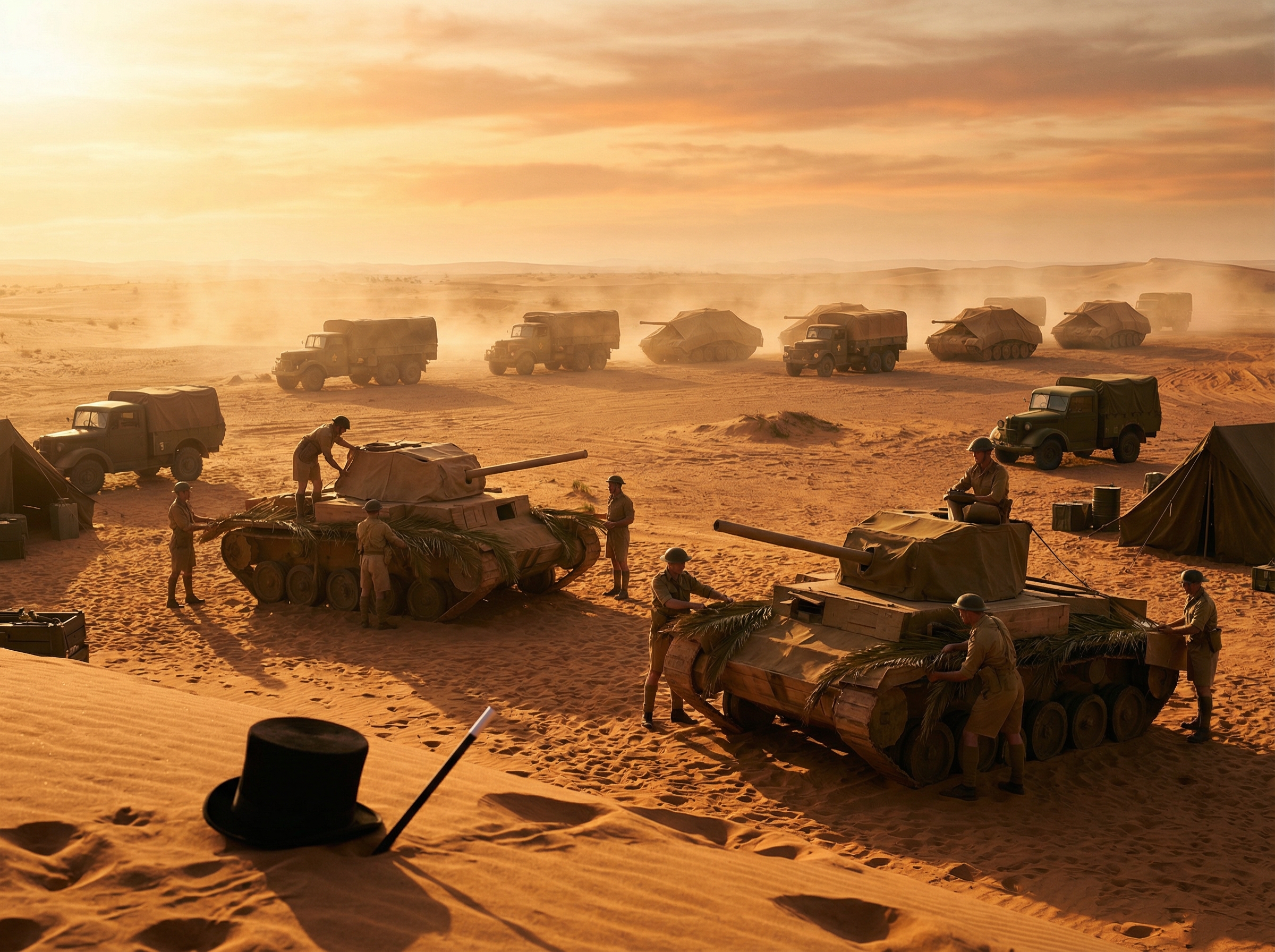
Operation Bertram was stage magic performed at the scale of a continent. Before the Battle of El Alamein, Montgomery needed Rommel to believe the main attack would come from the south. The real armor was massing in the north. The trick was making 1,000 tanks vanish in a flat desert with no cover, while simultaneously conjuring a fake army from thin air 40 miles away.
In the north, British engineers built "Sunshields" — canvas covers that transformed a Crusader tank into what looked, from 10,000 feet, like a harmless supply truck. In the south, 2,000 dummy tanks were assembled from palm fronds and old canvas, complete with fake tank tracks scored into the sand and artificial radio traffic. The coup de grâce was the fake water pipeline: a visible line of empty petrol cans stretching across the desert, progressing exactly five miles per day, complete with fake pumping stations. It told Rommel two things: the attack is coming from the south, and it won't happen until the pipeline reaches the front line.
When Montgomery struck from the north on October 23, 1942, Rommel's Panzers were out of position, guarding against an attack that was never coming. El Alamein became the first major Allied land victory of the war. Churchill would later call it "the end of the beginning." Rommel himself acknowledged it: "The war was decided by the scientists and the deceptive tactics."

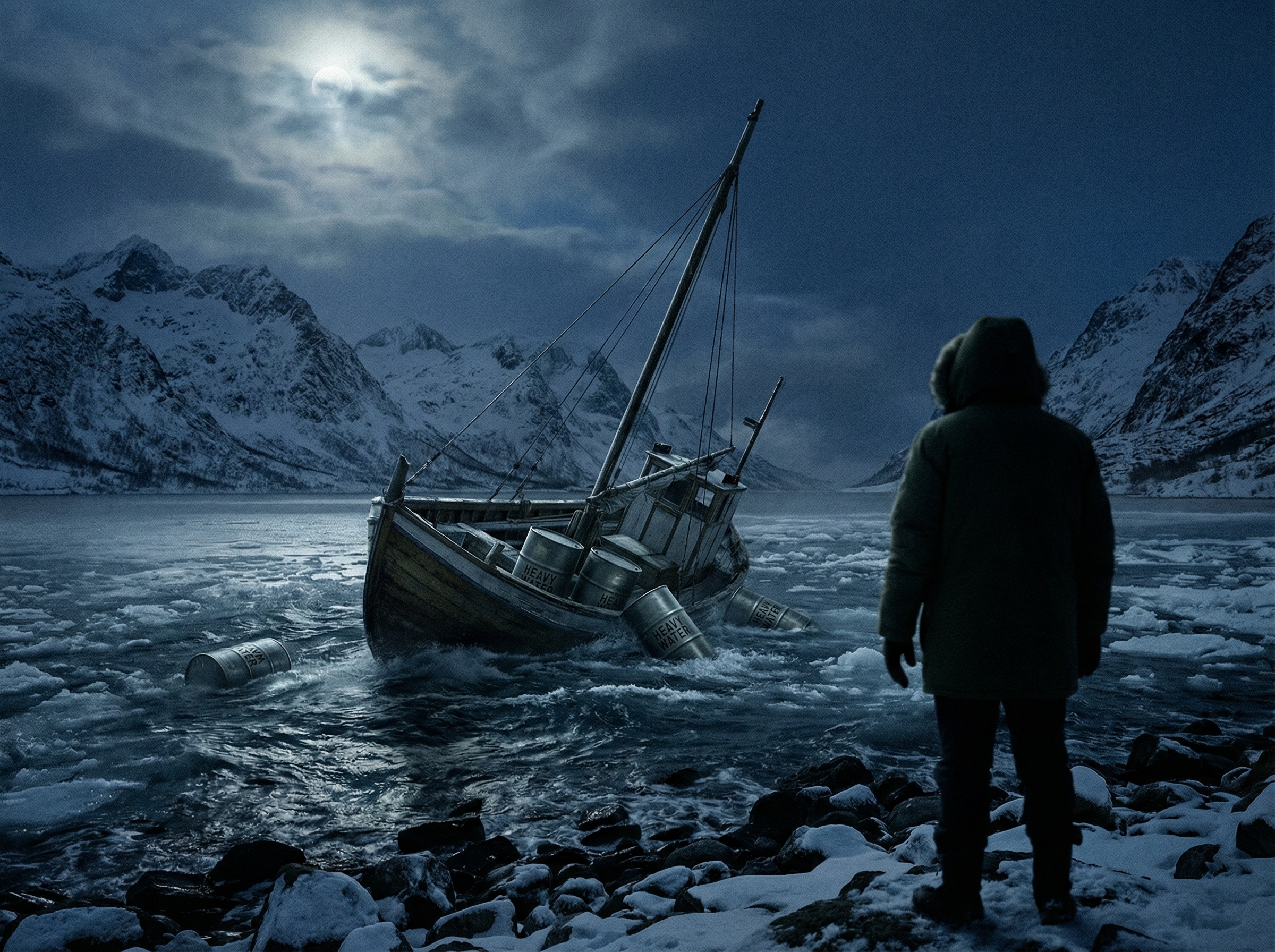
Sinking the Nazi Atom Bomb to the Bottom of a Norwegian Lake
The Norwegian heavy water sabotage is often called the most consequential act of sabotage in the entire war, and the claim is hard to dispute. Heavy water (deuterium oxide) was essential to the German nuclear weapons program. The Nazis' primary source was the Norsk Hydro plant at Vemork, perched on a cliff in occupied Norway.
In February 1943, Joachim Rønneberg and a team of Norwegian commandos trained by SOE pulled off a near-impossible raid: they skied across frozen mountains, climbed down a 500-foot gorge, broke into the plant through a cable duct, and detonated charges that destroyed the heavy water production cells. Not a single shot was fired. They escaped on skis, some of them crossing 250 miles to Sweden.
But the Nazis rebuilt the plant. When Allied bombing proved ineffective, SOE learned the Germans planned to ship remaining heavy water stocks to Berlin via a civilian ferry across Lake Tinn. Knut Haukelid made the hardest call of the war: he sneaked aboard the SF Hydro the night before departure and planted eight kilograms of plastic explosive in the bilge, timed to detonate over the deepest part of the lake. The ferry sank in minutes. Fourteen Norwegian civilians drowned alongside the heavy water barrels. "It was a question of the lesser of two evils," Haukelid said later. The Nazi nuclear program never recovered.
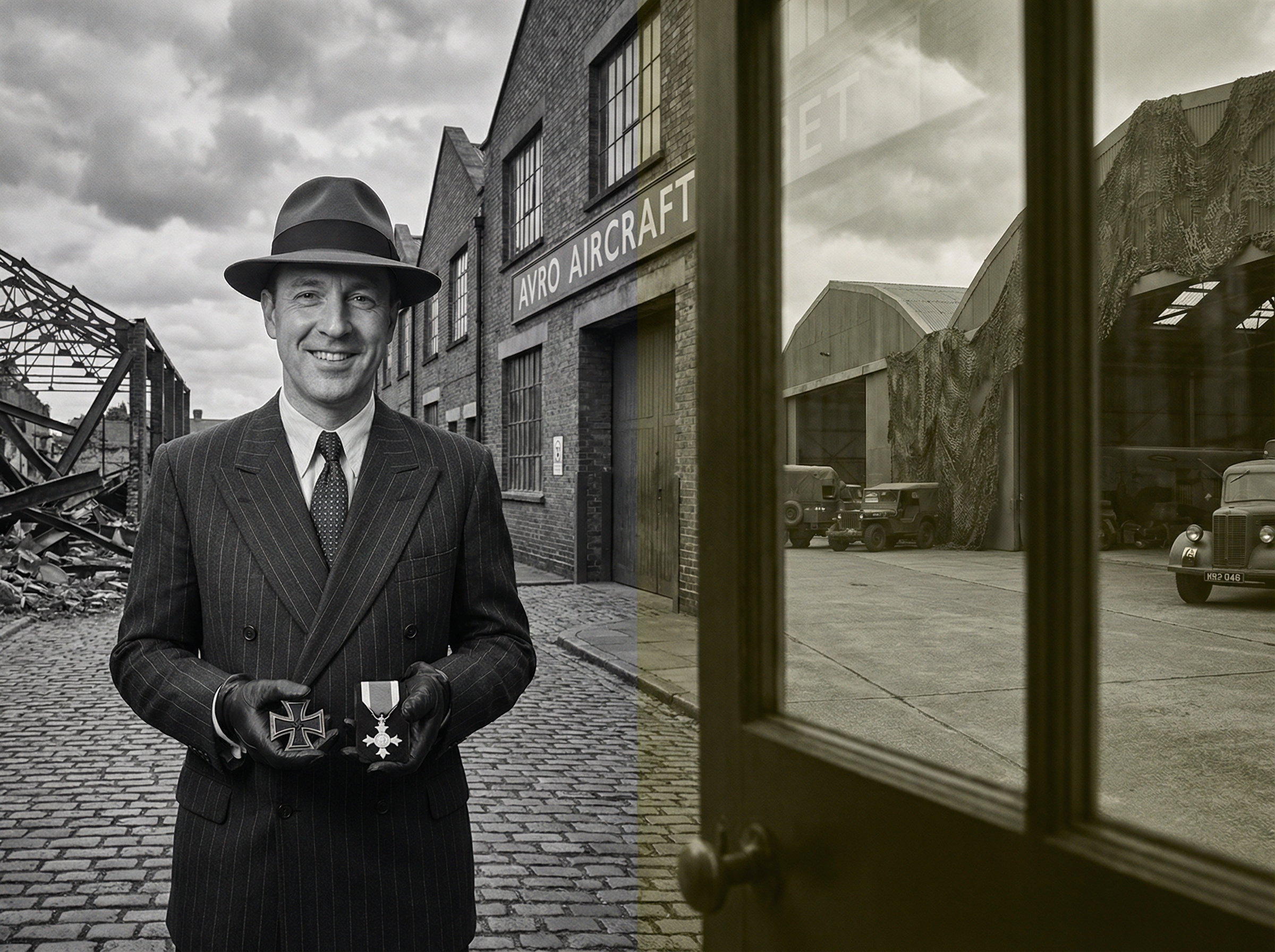
The Criminal Who Conned the Third Reich (and Got Medals from Both Sides)
Eddie Chapman was a professional safe-cracker doing time in a Jersey prison when the Nazis occupied the Channel Islands. Most men would have waited out the war. Chapman offered to spy for Germany instead — figuring it was his best ticket off the island. The Germans trained him in explosives, radio, and parachute operations, then dropped him into England with orders to destroy the de Havilland aircraft factory at Hatfield, where the deadly Mosquito bomber was being built.
Chapman walked straight to MI5 and turned himself in. What followed was one of the most audacious fakes of the entire war. MI5 helped Chapman stage the "destruction" of the de Havilland factory using camouflage netting, papier-mâché transformers, and carefully scattered rubble. A cooperative story was planted in the Daily Express reporting "an explosion at a factory in Hertfordshire." When German reconnaissance planes flew over, they photographed what appeared to be a bombed-out ruin. The factory — and Mosquito production — continued without interruption.
The Germans were so impressed they awarded Chapman the Iron Cross, making him the only British citizen known to have received one during the war. Meanwhile, MI5 was reading every report he filed, gaining invaluable insight into German sabotage training and Abwehr operations. "The Germans love me," Chapman told his handler, with the grin of a man playing the longest con of his criminal career. After the war, he returned to crime — briefly — then settled down and ran a health farm. He died in 1997, at 83, still dining out on the story.
The moral of the story: Never underestimate a man with nothing to lose and everything to prove. Chapman was a liar, a thief, and a bigamist. He was also, by any honest accounting, one of the bravest men of the war.