
Mathematics & Education

Truth and Clarity!

The mathematician who wrote 60 textbooks, threw chalk at students, toppled a National Academy nominee, and changed how the world learns algebra. Serge Lang taught like he was at war with confusion itself.

Listen
A dramatic chalkboard in a grand university lecture hall, covered in mathematical proofs, with a single piece of chalk at the base
An iconic yellow mathematics textbook standing upright on a polished oak desk, golden light streaming through a library window
01

The Yellow Book That Rewrote the Rules

If you've earned a PhD in mathematics since 1970, you almost certainly own a copy. Serge Lang's Algebra—known simply as "the yellow book" thanks to its Springer Graduate Texts spine—didn't just teach algebra. It redefined what algebra meant at the graduate level.

Before Lang, graduate algebra was a patchwork: groups over here, rings over there, fields somewhere else, and nobody talking to each other. Lang shattered that arrangement. The 1965 first edition was the first major text to integrate category theory and homological algebra into the standard curriculum, treating them not as exotic add-ons but as the natural language of the subject. It was an audacious bet. And it paid off.

The book went through three editions, each one more comprehensive. By the third edition, it had become less a textbook and more a mathematical encyclopedia—a reference that working mathematicians kept on their shelves long after qualifying exams were distant memories. The American Mathematical Society recognized this in 1999 when they awarded Lang the Leroy P. Steele Prize for Mathematical Exposition, noting that "perhaps no other author has done as much for mathematical exposition."

The Lang Standard: Before Algebra, you needed to be at a top-five department to learn category theory properly. After it, you just needed forty dollars and the discipline to work the proofs. That's not a minor thing—that's structural democratization of mathematical knowledge.
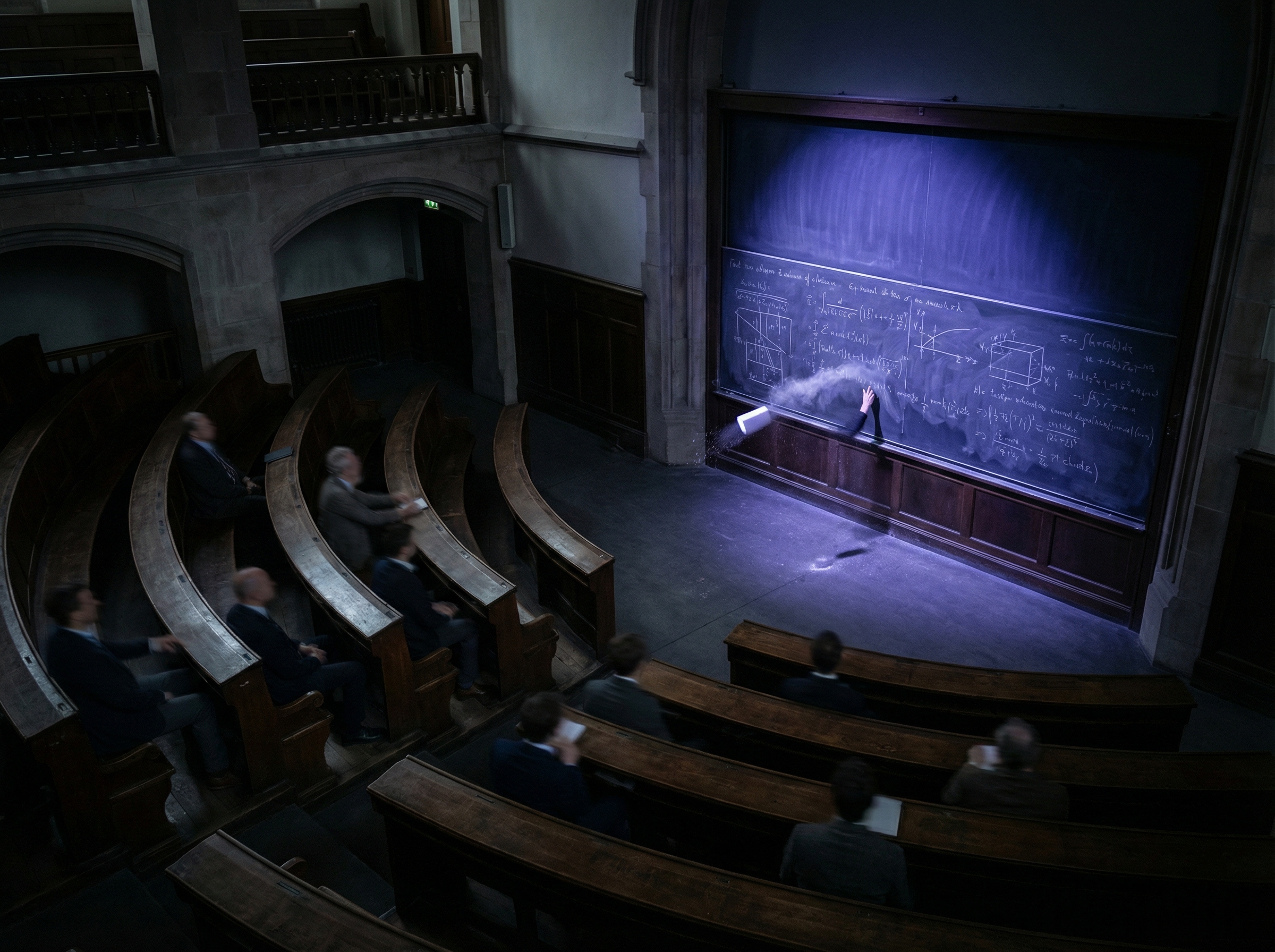
A dramatic lecture hall scene with rows of wooden seats curving around a central chalkboard covered in mathematical notation
02

"Truth and Clarity!"—Lang in the Classroom

Serge Lang did not teach mathematics. He performed it. Former students describe his lectures at Yale with the kind of breathless intensity usually reserved for recounting a particularly aggressive jazz performance.

His classroom war cry was "Truth and Clarity!"—shouted, not spoken, whenever anyone in the room committed the cardinal sin of being vague. This applied equally to undergraduates, graduate students, and visiting speakers. Lang treated imprecision like a moral failing, and precision like a form of respect for the subject and the audience.

The method was Socratic, but combat-Socratic. He would stop mid-proof, point at a student, and demand the next logical step. Hesitation was met with a piece of chalk hurled across the room—not at the student, as former colleagues were always quick to clarify, but near them. The distinction mattered to Lang, who saw the gesture as a kind of theatrical punctuation. The room needed to stay alert. Mathematics was happening, and you were either participating or you were furniture.

Timeline showing Serge Lang's career across four institutions: Princeton/IAS (1951-1953), University of Chicago (1953-1955), Columbia University (1955-1971), and Yale University (1972-2005)
Lang's half-century career spanned four elite institutions. His 1971 departure from Columbia was a political statement, not a career move.

His connection to the Bourbaki school ran deep. Like the Bourbaki group, Lang believed in teaching from the general to the specific—introducing abstract structures first, then showing how concrete examples instantiated them. This was the opposite of how most American textbooks worked at the time, and it drove some students to despair while electrifying others. There was no middle ground with Lang. You were either transformed by the experience or traumatized by it, and sometimes both.

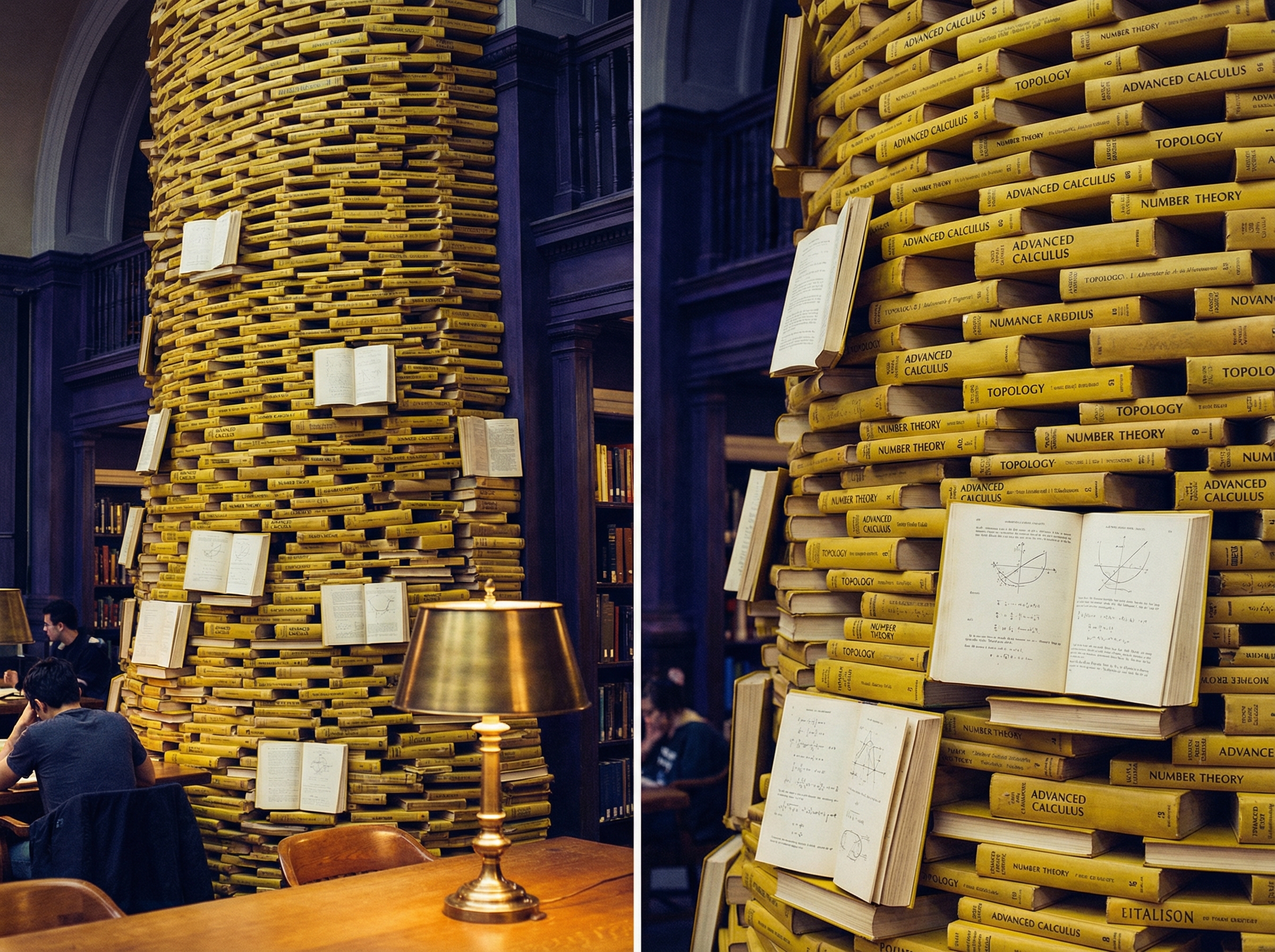
A towering wall of yellow-spined mathematics textbooks in a university library, stacked floor to ceiling
03

Sixty Books and Counting: The One-Man Publishing House

Most research mathematicians consider writing one textbook a significant accomplishment. A handful write three or four. Serge Lang wrote over sixty.

That number deserves to sit with you for a moment. Sixty-three books, spanning everything from high school geometry to research-level Arakelov theory. Not collections of lecture notes hastily bound—these were carefully structured, rigorously argued texts that became standard references in their fields. He wrote calculus textbooks for undergraduates. He wrote analysis textbooks for first-year graduate students. He wrote monographs on Diophantine geometry that only a few hundred people on Earth could follow. And he wrote them all in the same distinctive voice: terse, precise, and utterly uncompromising.

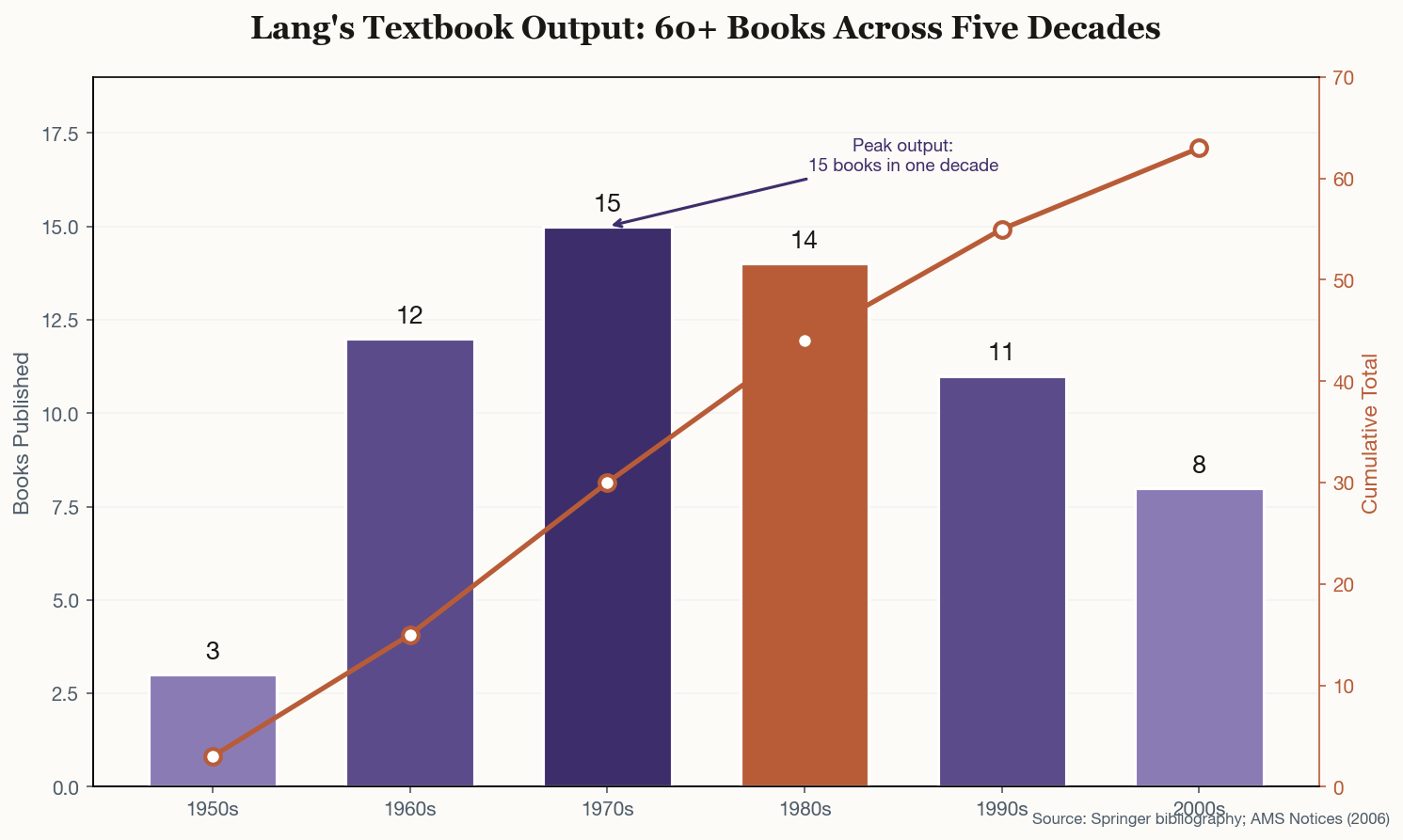
Bar chart showing Lang's textbook output by decade, peaking at 15 books in the 1970s, with a cumulative total line reaching 63
Lang's output peaked in the 1970s—his first decade at Yale—when he published roughly one book every eight months. The cumulative line shows a remarkably consistent pace across five decades.

The secret, if there was one, was that Lang wrote the way he thought: fast, in complete sentences, without much revision. He famously drafted entire textbooks during sabbaticals and visiting positions. Colleagues at Harvard and Berkeley recall him arriving with a manuscript half-finished and leaving six weeks later with a camera-ready text. The books weren't perfect—errata lists for some editions ran to several pages—but they were coherent in a way that few mathematical texts achieve, because they reflected a single clear vision of how the subject ought to be organized.

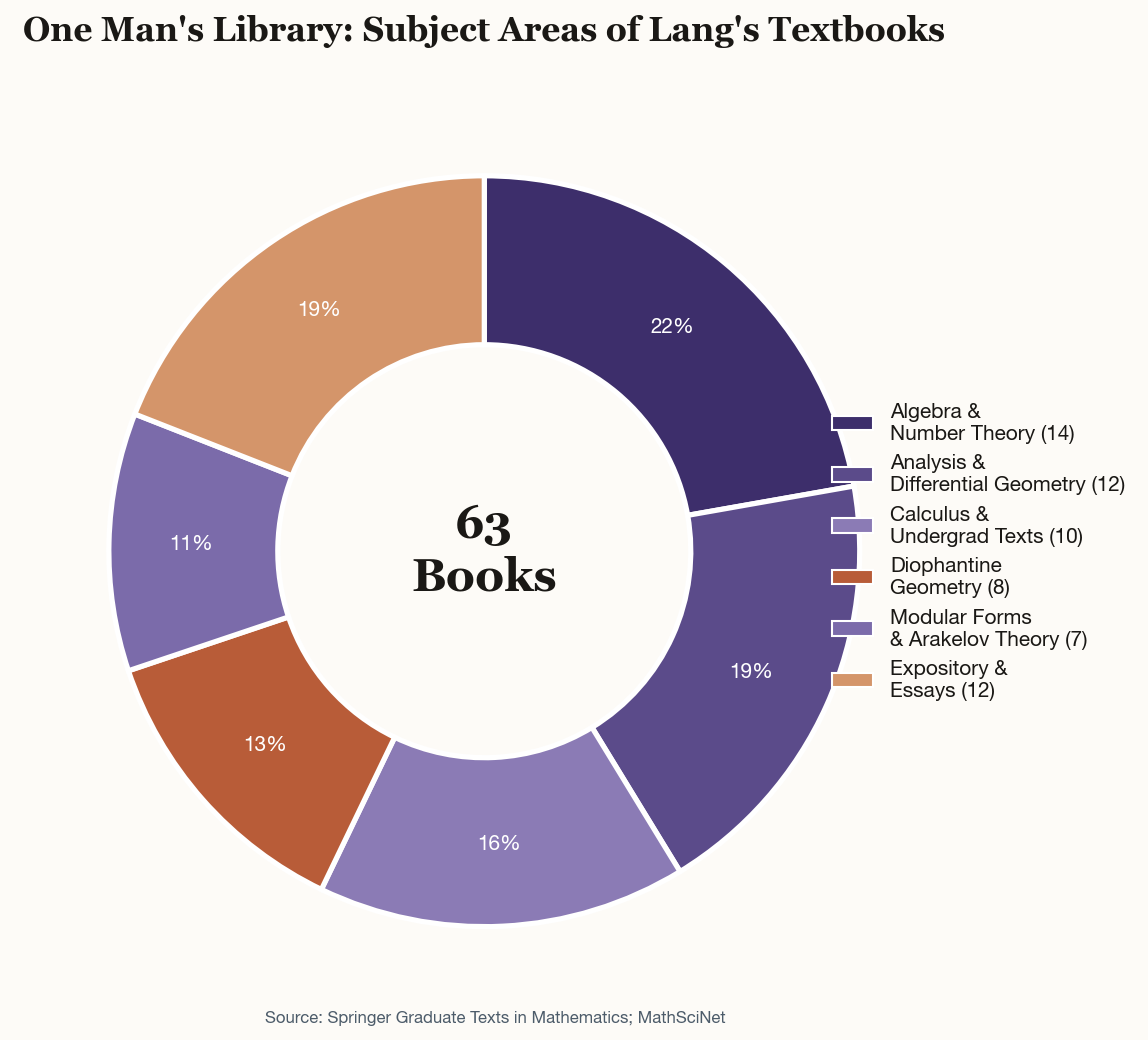
Donut chart showing the subject areas of Lang's 63 textbooks: Algebra and Number Theory (14), Analysis and Differential Geometry (12), Calculus and Undergraduate Texts (10), Diophantine Geometry (8), Modular Forms and Arakelov Theory (7), Expository and Essays (12)
The breadth is staggering. Lang wrote across the full spectrum of mathematics, from freshman calculus to the frontiers of arithmetic geometry.

The Lang Effect: Walk into any university mathematics library and count the yellow spines. Lang single-handedly shaped the Springer Graduate Texts in Mathematics series into the most important book collection in postwar mathematical education.

Close-up of a handwritten mathematics exam paper on a wooden desk with a stopwatch beside it
04

The Algebra Speed Test That Predicted Your Grade

On the first day of his calculus courses at Yale, Serge Lang would hand out a single sheet of paper. On it was a straightforward algebra problem—nothing that required calculus, nothing conceptually deep. Factor this expression. Simplify that fraction. The kind of thing a well-prepared high school junior should handle without breaking a sweat.

Then he would time the students.

Lang's claim was provocative and, by the standards of modern educational research, almost heretical: the speed at which a student solved this basic algebra problem was a near-perfect predictor of their final grade in the course. Not their SAT score. Not their high school GPA. Not their stated enthusiasm for mathematics. Just how quickly they could manipulate algebraic expressions under mild time pressure.

His theory was simple and, in the way of the best provocations, probably at least partially right. Students don't fail calculus because derivatives and integrals are intrinsically hard. They fail because their algebraic reflexes are too slow. If you have to stop and think about how to factor a quadratic while simultaneously trying to understand the chain rule, you're running two cognitive processes where you should be running one. The calculus concepts have no room to land because the algebra is taking up all the bandwidth.

This insight—that fluency in fundamentals, not raw intelligence, is the bottleneck—remains one of the most underappreciated observations in mathematics education. It's the kind of thing that sounds obvious once someone says it, and yet most calculus courses still begin with limits, not with a diagnostic algebra warm-up.

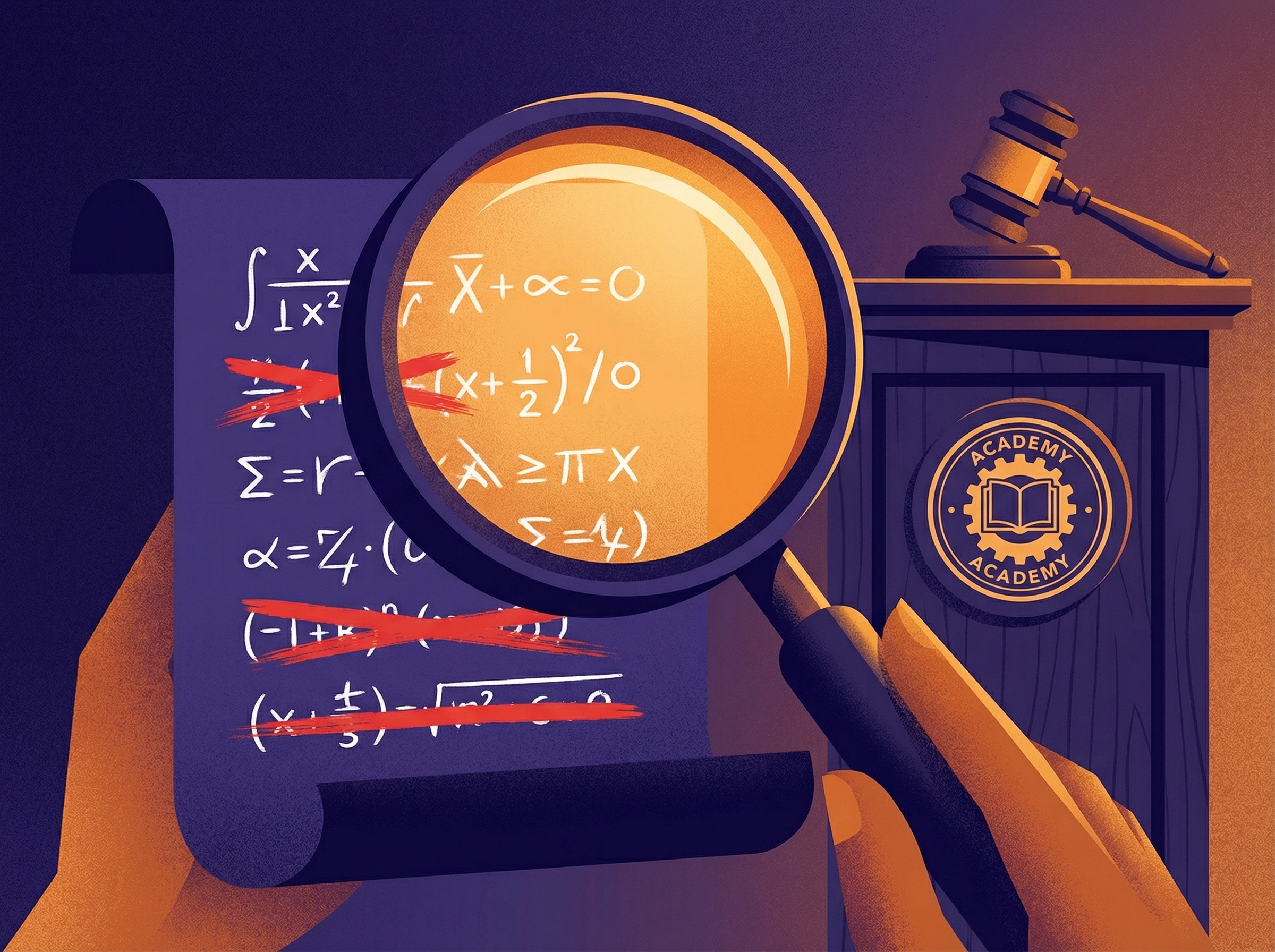
A magnifying glass examining a document with mathematical equations, some crossed out in red, with a gavel and academy seal in the background
05

The Huntington Affair: When a Mathematician Went to War

In 1986, Samuel P. Huntington—the Harvard political scientist who would later write The Clash of Civilizations—was nominated for membership in the National Academy of Sciences. It should have been a routine honor. It became a two-year war, and Serge Lang started it.

Lang's objection was precise and devastating. In Huntington's 1968 book Political Order in Changing Societies, there appeared a set of equations purporting to measure political stability. One of those equations classified apartheid-era South Africa as a "satisfied" society, based in part on data like telephone density. To Lang, this wasn't just bad social science. It was pseudo-mathematics—the cynical appropriation of mathematical notation to give political opinion the false veneer of scientific authority.

Lang compiled hundreds of pages of documentation, which he called his "Files"—a habit he maintained for every controversy he entered. He circulated them to every member of the Academy. He gave lectures. He wrote letters. He made himself, in the words of one colleague, "the most effective one-man wrecking crew in the history of American science politics."

Huntington was rejected for membership. Twice. It was an almost unprecedented rebuke, and it sparked a national debate about the boundaries between the "hard" and "soft" sciences. Lang didn't care about the debate. He cared about the math. If you're going to use equations, he argued, they have to mean something. Otherwise you're not doing science; you're doing decoration.

An open mathematics textbook radiating light outward like a beacon, connecting to silhouettes of students around the world
06

Democratizer, Contrarian, and the Shadow of Denialism

The question of whether Serge Lang democratized mathematics doesn't have a clean answer, and that's what makes it interesting.

The case for: Before Lang, learning topics like homological algebra or algebraic number theory required physical access to one of perhaps a dozen elite departments. You needed to be in the room. After Lang, you needed a book and the willingness to fight through it. His texts at Springer covered every level of the subject, from a high school geometry text to monographs on modular forms that pushed the frontier of the field. He built, essentially, a complete mathematical education between yellow covers. Students in Bogota, Bangalore, and Brisbane could now access the same material as students at Yale.

The case against: Lang was famously uncompromising about difficulty. He refused to "dumb down" anything. His books demanded mathematical maturity that many students didn't yet have, creating a paradox: the knowledge was accessible in principle but forbidding in practice. "Accessible," in Lang's dictionary, meant "clear." It emphatically did not mean "easy."

And then there is the shadow. In the 1990s, Lang became a vocal supporter of Peter Duesberg, the biologist who argued that HIV does not cause AIDS. Lang's involvement was characteristically methodological—he claimed to be questioning the logic of the consensus, not the biology—but the practical effect was to lend a distinguished mathematician's name to a dangerous fringe position. Yale publicly distanced itself. Former allies went quiet. The same relentless skepticism that had brought down Huntington's nomination was now being applied to epidemiological evidence, and the results were ugly.

It's tempting to draw a neat moral—that Lang's greatest strength was also his fatal flaw, that the contrarian who fought pseudo-mathematics became a purveyor of pseudo-epidemiology. But the truth is messier. The man who demanded "truth and clarity" from everyone he met was, in the end, most dangerous when he applied that standard to a domain where he lacked the expertise to know what clarity actually looked like.

What remains beyond dispute is the teaching. The books are still on the shelves. The Serge Lang Undergraduate Lecture at Berkeley still runs. And somewhere, right now, a first-year graduate student is opening Algebra for the first time, encountering category theory on page twelve, and wondering whether mathematics is the most beautiful or the most terrifying thing in the world. Lang would say: both. And he'd be right.

The Chalk Never Stopped

Serge Lang died in 2005, but his classroom never really emptied. Every yellow Springer spine on every library shelf is a lecture in progress—terse, uncompromising, and demanding that you meet the mathematics where it lives. That's not pedagogy. That's a dare. And the best students still take it.